
Our readers keep the lights on and my morning glass full of iced black tea. As an Amazon Associate, I earn from qualifying purchases.
Specs are compiled from manufacturer listings and verified buyer reviews and can change over time — please confirm the key details on the product page before buying.
Choosing a TV aerial depends on two things: how far you live from the broadcast towers and what sits between you and them. You do not need a giant roof-mounted unit to watch local news and sports — but a tiny indoor sticker antenna will not pull in channels from 70 miles away. Pick the wrong one, and you will get a black screen after every channel scan.
I’m Min — the founder and writer behind Gadgets Feed. This guide is built by comparing the manufacturers’ published specifications and the patterns across verified customer reviews, so you get each pick’s real strengths and trade-offs instead of marketing spin.
This roundup of the best tv aerial options helps you zero in on the model that actually pulls in the channels you want without frustration.
Our Picks at a Glance

How To Choose The Best TV Aerial
Range is measured in perfect open-air conditions, but your home sits between the antenna and the tower — walls, roofs, trees, and nearby buildings all eat into that number. You need to match the aerial type to your real environment, not a marketing claim.
Indoor vs. Outdoor: The Placement Trade-off
Indoor aerials are easy to set up — you plug them in, run a channel scan, and you are done. They work well if you live within 15-30 miles of the broadcast towers and have a window or wall facing them. Outdoor or attic-mounted aerials require more effort to install, but they give you a much clearer path to the signal and can pull in stations from 70+ miles away. The trade-off is straightforward: convenience versus range and reliability.
Amplified vs. Passive: When a Booster Actually Helps
An amplifier boosts the signal after the antenna captures it — it does not create signal where there is none. If you live close to towers, an amplifier can overload the tuner and make reception worse. If you are far from the towers, splitting the signal to multiple TVs, or using a long cable run, an amplifier helps overcome the loss. Start without one, then add it only if you see pixelation or weak channels.
VHF vs. UHF: Not All Channels Are the Same
Broadcast TV uses two frequency bands. VHF (Very High Frequency, channels 2-13) travels farther but is more easily blocked by hills and buildings. UHF (Ultra High Frequency, channels 14-51) handles obstacles better but has shorter range. Many cheap indoor aerials are UHF-only, so you might miss local VHF channels like PBS or some ABC affiliates. Look for an aerial that explicitly lists both VHF and UHF reception if you want all the free channels in your area.
Quick Comparison
| Model | Best For | Range | Mount Type | Amplified | Amazon |
|---|---|---|---|---|---|
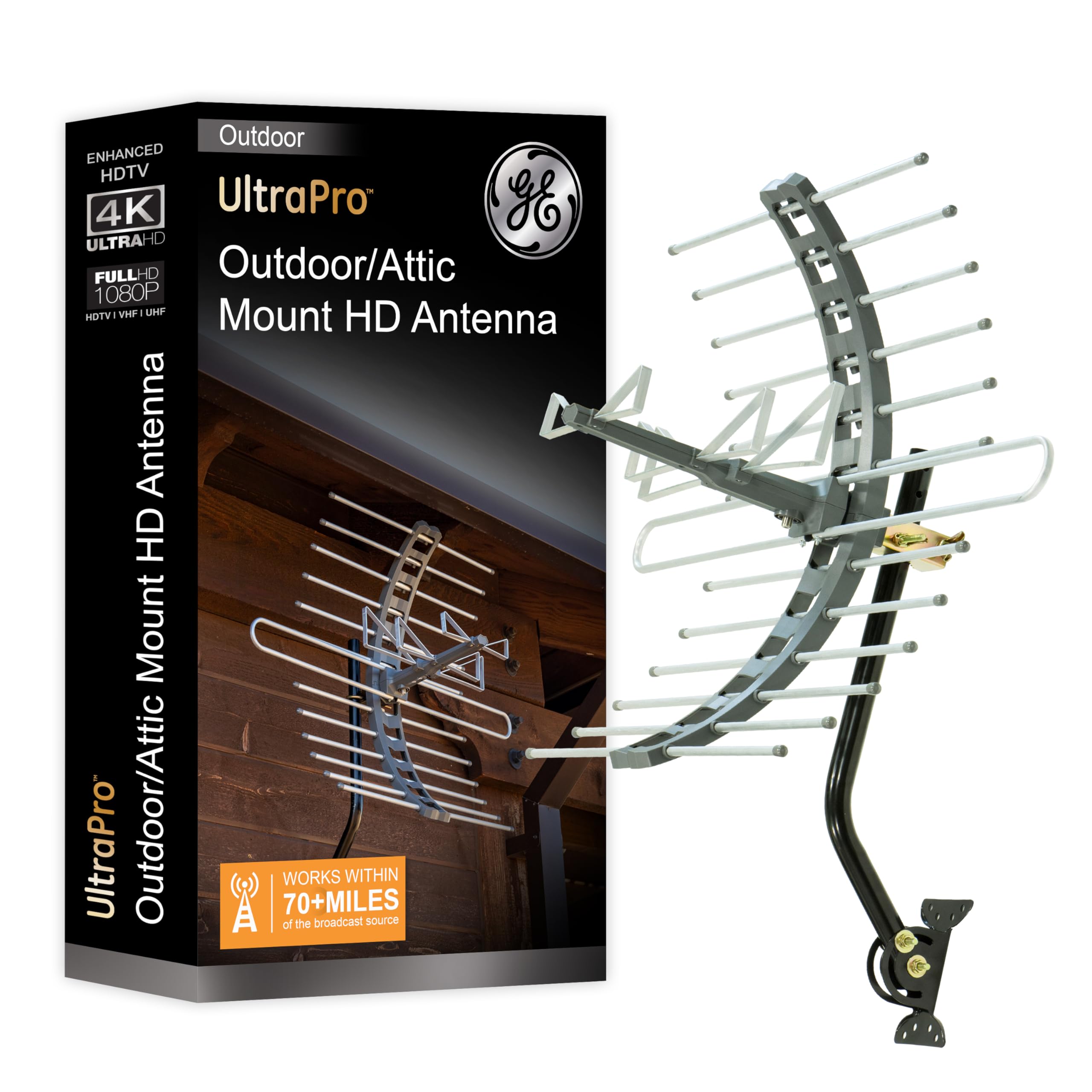
| GE Outdoor HD Digital TV Antenna 29884★ Best Overall | Roof or attic cord-cutters | 70 Miles | Outdoor / Attic | Passive | $38.98Amazon |
| Yeceny Motorized 150 MilesMotorized Pick | Rotating remote control | 150 Miles | Outdoor | Amplified | $38.88Amazon |
| 1byone Outdoor Omni-Directional | All-direction no-rotate outdoor | 100+ Miles | Outdoor / Attic / RV | Amplified | $59.99$79.99Amazon |
| Mohu Leaf Supreme Pro | Indoor with signal finder | 65 Miles | Indoor | Amplified | $69.99Amazon |
| August DTA240 | Magnetic mount for vehicles | 50 Miles | Indoor/Outdoor | Passive | $21.65$27.75Amazon |
| Fronguld 2025 Indoor Antenna | Budget indoor with amplifier | — | Indoor | Amplified | $26.34Amazon |
| Philips Rabbit Ears SDV7114A/27 | Close-range indoor simplicity | 30 Miles | Indoor | Passive | $15.59Amazon |
In‑Depth Reviews
1. GE Outdoor HD Digital TV Antenna 29884
Our pick — over 4★ from 10,500+ verified ratings; the strongest balance of quality and price.
The attic-mounted workhorse that pulls in more channels than most rooftop units.
If you want to replace your cable bill with free over-the-air TV, this GE model gives you the range and reliability to do it. It has a rated 70-mile range for VHF and UHF signals, and buyers report scanning 106 channels from 60 miles away without needing an amplifier. The antenna measures 29 inches long by 15 inches wide and 20.5 inches high — compared to the Philips rabbit ears at 7.5 x 2.1 x 4.7 inches — which is what lets it capture weak signals that smaller aerials miss. It also supports ATSC 3.0 (the NextGen TV standard that offers better picture and sound when broadcasts are available in your area).
Setup takes some patience. Buyers mention the assembly instructions are poor and recommend watching YouTube videos to get the antenna tubes aligned correctly. The plastic body is light at 3 pounds, but several owners mention it is not built for direct outdoor exposure long-term — one installer said to use attic mounting instead of roof mounting for durability. Still, with a 38-channel count from a single scan (one reviewer noted 97 channels unamplified after moving it 10 feet higher into an attic), this aerial consistently outperforms indoor flat panels.
Range-to-Reality Ratio: The 70-mile range is realistic for attic placement — one reviewer at 62 miles from towers got ~20 channels with a pre-amp. The true balance for maximum channels (106) is around 30-40 miles with a clear line of sight.
Reach for this if… you have attic access or a mast and want the best channel count per dollar — you will get more channels than any indoor aerial can deliver.
Look elsewhere if… you rent an apartment, cannot mount anything, or need a quick plug-and-play solution. This one rewards the time you put into installation.
2. Yeceny 150 Miles Motorized Antenna
The aerial that spins to find the signal, controlled from your couch.
This is the only model in this roundup with a motorized 360-degree rotation, so you can aim it at different broadcast towers without climbing a ladder. The included wireless remote lets you rotate the antenna to tweak reception as channels change. It claims a 150-mile range, and buyers in NE Alabama report picking up 80+ channels from 70+ miles away. The 40-foot RG6 coaxial cable gives you room to mount it far from the TV, and it supports two TVs directly (no splitter needed).
There are trade-offs. The rotation mechanism can be imprecise when you cannot see the antenna’s current direction — one buyer mentioned it is “iffy without visual line-of-sight.” The pole mount hole uses a non-US standard size, which might require an adapter. Durability is okay but not exceptional: a repeat buyer said it lasts about 2 years, and previous units broke from accidental falls, not the antenna itself. It is amplified, so if you are very close to towers (under 20 miles), the amplifier might overload your tuner rather than help.
What Rotates Right
- Remote-controlled rotation means you can chase signals without going outside
- Supports 2 TVs simultaneously without extra splitters
- Long 40ft RG6 cable for flexible outdoor placement
Where It Stumbles
- Rotation direction is hard to gauge without line-of-sight to the antenna
- Pole mount uses a non-standard hole size
- Amplifier can cause signal overload if you are close to towers
Best suited for: anyone whose local towers are spread in different directions — the motorized rotation lets you pull from multiple angles without a separate rotator.
skip it if: you want a low-maintenance installation. The motor adds complexity and a potential failure point over time.
3. 1byone Outdoor Antenna 100+ Miles

The set-and-forget outdoor aerial that grabs signals from every direction at once.
Unlike directional antennas that need precise aiming, the 1byone picks up VHF and UHF signals from all 360 degrees, so you do not have to know exactly where each tower sits. It claims a 100+-mile range and includes a built-in pre-amplifier and a 4G LTE filter that removes interference from nearby cell towers. The 39-foot RG6 cable gives you plenty of reach. A buyer in Manhattan using a window placement got 60 channels in 15 minutes, including CBS, NBC, FOX, and PBS. Another reviewer in a suburban area got 58 channels without an amplifier within 20 feet of the TV.
The catch is that you get only one TV output — adding a splitter will weaken the signal. Also, this aerial is not truly weatherproof despite the outdoor rating. One owner who mounted it outdoors in Reno found it filled with water after 2 years, corroding the pre-amp and RF connector. He fixed it by sealing seams and drilling drainage holes. If you mount it outdoors, consider an attic placement instead for longevity. The 2-year warranty is better than most, but it covers defects, not water damage.
The One-Output Reality: Running a single TV? You are set. Split to a second TV and you lose signal strength — the built-in amplifier helps but does not fully compensate for the loss.
Grab this if… you want the simplest outdoor install: mount it, plug it in, scan. No aiming, no rotator, no repeated ladder climbs.
Not for you if… you need to feed multiple TVs, or you plan to mount it directly outdoors in a rainy climate — attic installation is strongly recommended.
4. Mohu Leaf Supreme Pro
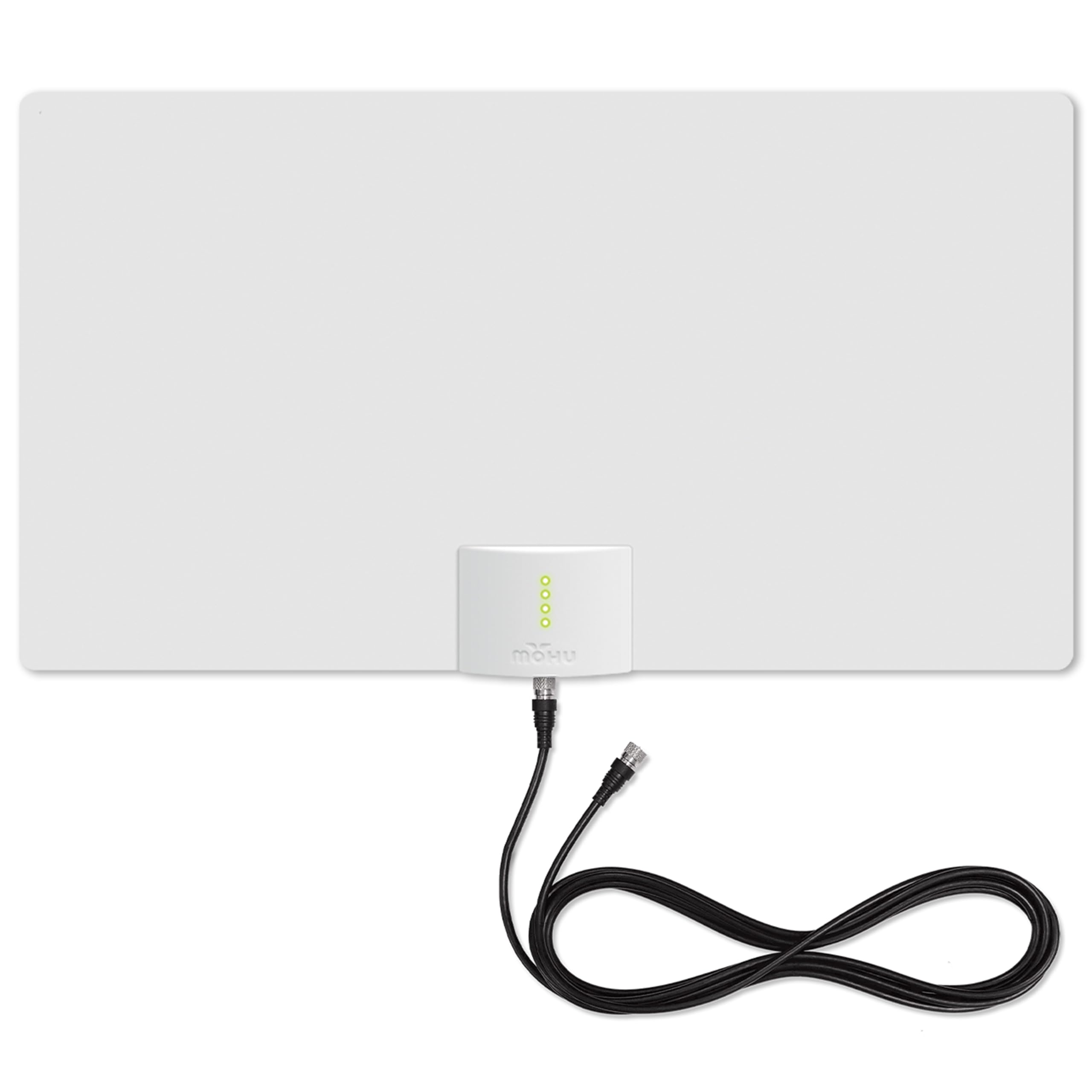
An ultra-thin indoor panel with a built-in LED that tells you where the signal is strongest.
The Mohu Leaf Supreme Pro solves the guessing game of indoor antenna placement. It has an integrated LED signal indicator that lights up when you move the antenna to a spot where reception is strongest — so you can walk around the room with it until the light glows. At just 0.04 inches thick, it is barely visible on a wall or window. It covers UHF and Hi-VHF bands and is reversible from white to black so you can blend it into your decor. It has a 65-mile range (343,200 feet) and supports 4K, 8K, and NEXTGEN TV.
Customers note location is everything with this one. One reviewer 35 miles from Detroit towers mounted it on an interior brick wall and got 48 perfect channels. Another in downtown Savannah had inconsistent reception with frequent signal drops, even for football games. The included mounting pins and velcro are weak — several reviewers replaced them with nails. The amplifier is located at the base of the antenna but is optional (the coax cable runs directly to the antenna, and the USB power injector can be left unplugged if you are close to towers). The 12-foot detachable cable is shorter than most outdoor models, so window placement is your best bet.
What the Light Shows
- LED signal indicator helps you find the optimal position without guesswork
- Ultra-thin profile (0.04 inches) is easy to hide or paint to match the wall
- Can be used without the amplifier to avoid signal overload if you are close to towers
Where It Falls Short
- Included mounting hardware is cheap; you will likely need your own nails or velcro
- Performance varies drastically by location — works great in some homes, not at all in others
- Signal strength lights can be inaccurate, according to some buyers
Best for: renters or homeowners who want the most discreet indoor option with a tool to find the balance — no drilling, no mast, no cable routing through walls.
Look elsewhere if: you are in a dense urban area with lots of interference, or more than 40 miles from towers. The flat panel design struggles compared to a rabbit ears or outdoor unit.
5. August DTA240

A tiny magnetic aerial that sticks to metal and pulls in channels that cable does not carry.
Weighing just 50 grams, the August DTA240 is the lightest aerial in this list — at 50 grams versus the Philips rabbit ears at 208.66 grams and built for portability. Its magnetic base lets you attach it to a metal surface like a fridge, a car roof, or an RV side, which actually improves reception by using the metal as a ground plane. The 2-meter coaxial cable is short but fine for tabletop or window use. Reviewers point out scanning 20+ stations including 8 that were not available on satellite or cable. One reviewer who replaced cable after 21 years found ~109 channels in his bedroom TV with this single unit.
The magnet is very strong. While that is great for staying put on a moving vehicle or a metal shelf, some reviewers warn it could affect nearby electronics like DVRs or hard drives. One owner wished the bottom was removable or replaceable. Signal pickup is not as strong as a larger indoor rabbit-ear setup — the same reviewer noted that “classic rabbit ears” worked better indoors. It runs on 50 miles of rated range, but you need that metal surface to get the best result. Without it, the antenna struggles to pick up anything.
Where It Shines: Inside an RV, on a boat, mounted to a satellite dish frame, or stuck to a metal window frame. The magnetic base makes it the most versatile mount in this roundup.
Perfect for: travelers, RV owners, or anyone who needs a tiny aerial that can double as an indoor unit on a metal shelf. The compact size (50 grams) means you can toss it in a glove box.
Not for you if: your home has no metal surfaces near the TV and you want max channel count. The magnet is a neat extra, but without metal, performance drops.
6. Fronguld 2025 Indoor Antenna

An entry-level amplified ampoule that works well for local channels at close range.
For under, the Fronguld gives you an amplifier and a 16.5-foot cable — the longest included cable among the indoor models here. The design is compact at 8.3 by 5.9 by 2.4 inches, and it supports 360-degree reception so direction matters less. It claims to handle 100 channels, but the product does not specify a maximum range in miles. Some buyers living within close range to towers report clean clear reception. The amplifier is built-in, so you do not need to buy a separate power injector. Setup is dead simple: plug the connector, run the scan.
The real-world performance is mixed. One buyer 45 miles from the towers said “it did not help me” and reported no VHF reception. Another got 18 channels no matter where he placed it. The amplifier boosts the captured signal but cannot create one if the antenna is too far from the broadcast source. This makes it a gamble if you are not within about 15-20 miles of the towers. The cable length (16.5 feet) is generous for routing to a better window or higher shelf, but the overall build feels budget-tier — reviews are only 3.8 stars out of 5 across about 600 ratings.
The Upside
- Long 16.5ft cable gives you flexibility to place it high on a wall or in a window
- Built-in amplifier may help in fringe areas (not a cure-all, but it helps)
- 360-degree design means you do not need precise aiming
The Downside
- No published maximum range — you are gambling on performance beyond close range
- Mixed buyer results; many report it fails beyond 20-30 miles
- Lacks VHF reception, which misses channels 2-13 (often PBS and some network affiliates)
Best for: a cheap first try at cord-cutting in a dense city or apartment within easy range of broadcast towers. The price is low enough that failure is not a big loss.
Look elsewhere if: you are more than 20 miles from the towers or need VHF channels. This is a UHF-only gamble.
7. Philips Rabbit Ears SDV7114A/27

The proven rabbit-ear design that still outperforms many flat panels at close range.
The Philips SDV7114A/27 is a no-nonsense indoor aerial that relies on extendable dipoles (the classic rabbit ears) and a loop element for UHF. It covers up to 30 miles and handles both VHF and UHF bands — important for getting PBS (usually on VHF) and local network affiliates. One buyer scanned 52+ channels instantly without any repositioning, including classic 60s and 70s shows from a local subchannel. It supports ATSC 3.0 (NextGen TV) for future-ready broadcasts. The 4-foot coaxial cable is short, but the whole unit sits on a tabletop, so the cable only needs to reach the TV. At 208.66 grams, it has some heft to stay put, unlike ultra-light flat panels that slide off surfaces.
The catch is range. One buyer in a suburban location reported failed scans and no HD-resolution channels. Weather can interrupt reception — rain and storms cause temporary signal loss, something outdoor aerials handle better. The dipoles need to be fully extended and pointed toward the towers, so you lose the stealth aesthetic of a flat panel. But within its range, buyers consistently report cleaner VHF reception than amplified flat antennas, which often struggle with channels 2-13.
Within Range, It Just Works: At under 15 miles from towers, shoppers say it works perfectly even in basements with no pixelation or VHF issues. Beyond that, performance drops fast.
Reach for this if… you are within 15 miles of the towers and want a simple, reliable indoor aerial that handles both VHF and UHF channels without fuss.
pass on it if… you are more than 20 miles from the towers or cannot place it near a window — the 30-mile range is optimistic for real-world homes with walls and roofs in the way.
Understanding the Specs
Range (Miles)
The distance an antenna can pick up broadcast signals in perfect open-air conditions. This number is useful for comparing aerials side by side, but your real-world range will be shorter due to walls, roofs, trees, and hills. A 70-mile range typically works well for users 30-40 miles from towers. For indoor aerials, cut the listed range in half for a realistic expectation. For outdoor units, subtract about 20% in suburban settings with trees and buildings.
VHF vs. UHF
TV broadcasts use two frequency bands. VHF (channels 2-13) covers longer distances but gets blocked more easily by obstacles — it is what the classic rabbit ears were designed for. UHF (channels 14-51) handles obstacles better but has shorter range. Many cheap flat panel aerials are UHF-only, which means you will miss PBS, some ABC affiliates, and other VHF stations. Always check that an antenna explicitly lists both VHF and UHF support if you want all available free channels in your area.
Amplified vs. Passive
An amplifier boosts the signal after the antenna captures it. It helps when you are far from towers, split the signal to multiple TVs, or use a long cable run. But if you are close to towers (under 20 miles), the amplifier can overload the tuner and make reception worse — pixelation or missing channels. Many amplified aerials let you run them without plugging in the power injector, which is a good first step. Start unamplified, then add power only if you need it.
Mount Type
Indoor aerials sit on a table, hang on a wall, or stick to a window. They are easy to install but limited by the building materials between you and the towers. Outdoor aerials mount on a roof, mast, or in an attic. They give you a clearer signal path and typically pull in channels from much farther away. Attic mounting is a popular middle ground — better than indoor, easier than roof mounting, and the antenna stays protected from weather. Outdoor mounting requires weatherproofing and grounding in many areas to meet electrical codes.
FAQ
Will a TV aerial work in a basement apartment?
Do I need to install a TV aerial outdoors or can I put it in the attic?
What is the difference between an amplified and a passive TV aerial?
How many channels can I expect from a 70-mile TV aerial?
Can I use a TV aerial with a smart TV that does not have a coaxial port?
Why do I get pixelation or freezing on some channels?
What does ATSC 3.0 (NextGen TV) mean for my antenna?
How do I know which direction my local broadcast towers are in?
Can I split a TV aerial signal to multiple TVs?
How long do outdoor TV aerials typically last?
Final Thoughts: The Verdict
If you want one dependable pick, the best tv aerial winner is the GE Outdoor HD Digital TV Antenna because it delivers the best channel count per dollar when mounted in an attic or on a roof, and it supports next-generation ATSC 3.0 broadcasts. If you want the convenience of remote-controlled rotation to aim at towers in different directions, grab the Yeceny 150 Miles Motorized Antenna. And for the simplest outdoor install that picks up signals from every direction without aiming, the standout is the 1byone Outdoor Omni-Directional Antenna.
How We Picked
We do not accept paid placement. Every pick is matched to a real buyer and a real use-case; we do not hands-on test units.
Sources & Methodology
Specifications: manufacturer listings and product documentation. Review insights: verified customer reviews, as of July 2026. Pricing: not shown on this page (it changes often); check the current price via the retailer link.
As an Amazon Associate, Gadgets Feed earns from qualifying purchases. This does not affect which products we feature.
Related Guides
Product prices and availability are accurate as of the date/time indicated and are subject to change. Any price and availability information displayed on Amazon at the time of purchase will apply to the purchase of this product. As an Amazon Associate I earn from qualifying purchases.
CERTAIN CONTENT THAT APPEARS ON THIS SITE COMES FROM AMAZON. THIS CONTENT IS PROVIDED "AS IS" AND IS SUBJECT TO CHANGE OR REMOVAL AT ANY TIME.
Amazon and the Amazon logo are trademarks of Amazon.com, Inc. or its affiliates.