
Our readers keep the lights on and my morning glass full of iced black tea. As an Amazon Associate, I earn from qualifying purchases.
Specs are compiled from manufacturer listings and verified buyer reviews and can change over time — please confirm the key details on the product page before buying.
Your car cranks slower every morning until one day it just clicks. Most people toss the battery and buy a new one. But often the lead plates inside are simply crusted with sulfate crystals — a kind of battery-scale. A desulfator charger (a device that sends high-frequency electrical pulses into the battery to break up those crystals) can scrub the plates clean and restore usable life. This guide covers seven chargers that can spark, maintain, and recover your batteries, so you can pick the right tool for your setup.
I’m Min — the founder and writer behind Gadgets Feed. This guide is built by comparing the manufacturers’ published specifications and the patterns across verified customer reviews, so you get each pick’s real strengths and trade-offs instead of marketing spin.
We looked at amperage, battery chemistry support, safety features, and desulfation ability to bring you this guide to the battery desulfator charger that actually delivers on the promise of waking up your sulfated batteries.
Our Picks at a Glance


How To Choose The Best Battery Desulfator Charger
Choosing a desulfator charger starts with knowing your battery type and how much recovery power you really need. Pick the wrong amperage or miss the right chemistry support, and your battery might stay sulfated or get damaged. Here is what to watch for.
Amperage vs. Charging Speed
Higher amperage (the measure of electrical current flowing into the battery) means faster bulk charging but can stress small batteries. A 20A unit like the VEVOR can refill a large deep-cycle battery quickly, while a 1.5A maintainer like the BatteryMINDer 1500 is gentle enough to leave connected for months without cooking the battery. For recovery, faster charging can help break loose sulfation — but slow, steady pulse conditioning often brings back more capacity over weeks.
Chemistry Compatibility: Lead-Acid vs. Lithium
Older desulfator chargers work only on lead-acid (flooded, AGM, gel) batteries. Newer models add lithium LiFePO4 (lithium iron phosphate, a common rechargeable lithium battery chemistry) support, which uses a different voltage profile and won’t accept desulfation pulses the same way. If you run a lithium battery, look for a model that explicitly says “LiFePO4” in its specs — the NOCO Genius series and the VEVOR 20A both handle it.
Desulfation Mode: Continuous vs. Selectable
Some chargers run desulfation pulses constantly in the background (like the BatteryMINDer models), while others let you toggle a separate desulfation mode. Constant desulfation is great for long-term maintenance — it prevents sulfate buildup before it starts. A selectable mode is better for recovering a heavily sulfated battery you know is weak, giving you higher pulse intensity on demand.
Safety and Protection Features
Reverse polarity protection (prevents damage if you swap the positive and negative clamps) saves you if you accidentally swap the clamps. Over-temperature protection stops the charger from overheating during a long desulfation cycle. Temperature compensation (adjusts charge voltage based on the air temperature around the charger) is critical if the charger lives in an unheated garage that sees freezing winters — it prevents overcharging in summer and undercharging in winter.
Quick Comparison
| Model | Best For | Amperage | Battery Types | Weight | Amazon |
|---|---|---|---|---|---|
| NOCO GENIUS5★ Best Overall | Everyday car and powersport use | 5A | 6V/12V Lead-Acid, LiFePO4 | 1.59 lb | $69.95Amazon |
| NOCO GENIUS10Also Great | Fast recovery with lithium support | 10A | 6V/12V Lead-Acid, LiFePO4 | 3.99 lb | $99.95Amazon |
| VEVOR 20A Smart Charger | High‑current deep‑cycle recovery | 20A | 6/12/24V Lead-Acid, LiFePO4 | 1.8 lb | $58.90Amazon |
| CRAFTSMAN CMXCESM258 | Value‑priced 4‑in‑1 with tester | 12A | 6V/12V Lead-Acid, AGM, LiFePO4 | 3.4 lb | $61.83$69.99Amazon |
| BatteryMINDer 1510 | Winter storage for multiple vehicles | 1.5A | 12V Lead-Acid | 15.2 oz | Amazon |
| BatteryMINDer 1500 | Long‑term gentle desulfation | 1.5A | 12V Lead-Acid | 16 oz | Amazon |
In‑Depth Reviews
1. NOCO GENIUS5: 5A 6V/12V Smart Battery Charger
Our pick — over 4.5★ from 20,500+ verified ratings; the strongest balance of quality and price.
The pocket‑sized 5A charger that fits in a glove box and revives weak batteries.
This is the most popular model in NOCO’s Genius line, and for good reason: at 1.59 pounds and measuring 3.43 x 4.61 x 7.95 inches, it weighs 1.59 pounds, while the VEVOR 20A charger weighs 1.8 pounds yet still delivers 5A of charge current. It handles 6V and 12V lead-acid (AGM, Gel, SLA, VRLA) and lithium LiFePO4 batteries, plus it uses precision pulse charging (short bursts of current) to automatically detect and reverse sulfation. One buyer mentioned a critical real-world hitch: on a Ford F-350 with AGM batteries (Absorbent Glass Mat, a type of lead-acid battery), the vehicle’s BMS (Battery Management System) blocked charging when the clamp went on the negative terminal — you must attach to bare metal instead. Once corrected, it worked fine.
The integrated thermal sensor adjusts charge voltage based on ambient temperature, so you get the right charge whether it is 90°F or 15°F. Force Mode lets you charge a battery as low as zero volts. The 5A rate is slower than the GENIUS10’s 10A — expect about 8 hours for a full charge on a standard car battery — but it is gentle enough for small powersport batteries like motorcycles and ATVs. Reviewers consistently mention the easy setup and automatic operation: you connect the clamps, plug it in, and walk away.
Unlike the CRAFTSMAN CMXCESM258 which includes a built-in battery tester, the GENIUS5 relies on simple indicator lights — no detailed display. That is fine for most users but note if you want to see exact voltage and percentage.
Smart all‑rounder: the GENIUS5’s combination of lithium support, thermal compensation, and compact size makes it the ideal choice for a daily-driver car, motorcycle, or boat that you want to keep topped up without dedicating a large workbench space.
Reach for this if: you want a reliable, automatic desulfator charger that fits in tight spaces and works on both lead-acid and lithium batteries.
Look elsewhere if: you need a faster charge rate or a detailed LCD display — the GENIUS10 or VEVOR 20A would serve you better.
2. NOCO GENIUS10: 10A 6V/12V Smart Battery Charger
The mid‑amp charger that brings dead truck batteries back from the afterlife.
You get a 10A charge rate — enough to refill a depleted car battery in hours, not days — and it still handles 6V and 12V lead-acid (AGM, Gel, SLA, VRLA) as well as lithium LiFePO4 (lithium iron phosphate) chemistries. The built-in thermal sensor adjusts charging voltage as the temperature changes, which prevents overcharging when the garage heats up and undercharging when it freezes. Buyers report this unit revived a dead 12V sealed lead-acid generator battery from 11.5V using the 12V repair mode for 4 hours; the battery held 12.6V overnight and started the generator perfectly.
It maintains automatically once the battery is full, so you can leave it connected indefinitely without worrying about damage. Force Mode (a special setting that lets you charge a battery with an extremely low voltage) lets you charge a battery that reads zero volts — a genuine recovery trick for deeply neglected cells. At 3.99 pounds it is noticeably heavier than the 1.59-pound NOCO GENIUS5, but the extra heft comes from the beefier transformer and larger enclosure that houses the 10A circuitry. One trade-off is the cables: owners mention the wires are aluminum rather than copper, and the power supply mode delivers low amps, not enough for running large car stereos.
Unlike the VEVOR 20A which pulls 20A compared to the BatteryMINDer 1500’s 1.5A, the GENIUS10 sits in a balanced spot — fast enough for daily use, gentle enough for lithium batteries. The included 72-inch AC cable and 80-inch DC cable with clamps and eyelet terminals (small rings that bolt directly to battery posts) make permanent installation in a boat or RV straightforward.
Why It Earns the Top Spot
- 10A charges lead-acid and lithium in hours, not days
- Force mode revives batteries from zero volts
- Temperature compensation prevents overcharge in any weather
Honest Trade-Offs
- Cables use aluminum wire, not copper
- Supply mode gives low amps, not enough for stereos
Best for most drivers: if you need one charger that handles cars, boats, lithium batteries, and emergency recovery while offering a balanced price.
Not the pick if: you want to maintain four or more batteries at once — look to a multi-bank unit instead.
3. VEVOR Smart Battery Charger, 20-Amp

The 20‑amp powerhouse with an LCD display that recovers deep‑cycle and LiFePO4 batteries.
This is the highest-amperage charger in the lineup — 20A means it refills a deeply discharged 100Ah battery in about 5 hours, compared to the BatteryMINDer 1500’s 1.5A which would take over 66 hours. It handles 6V, 12V, and 24V lead-acid (AGM, Gel, SLA) as well as 12V and 24V lithium LiFePO4 batteries. The LCD screen shows charging mode, voltage, current, and power percentage, so you always know exactly what is happening. One owner reported it works well with LiFePO4 marine batteries (24V 50Ah) and wakes the BMS via an AGM forced charge for 1-2 seconds before switching to lithium mode.
The desulfation mode uses pulse repair functionality targeted at lead-acid batteries. A separate Supply Mode charges batteries as low as 1V. The included accessories are generous: two copper wire terminals, a 9.8-foot figure-eight tail plug, and battery clamps. UL (Underwriters Laboratories), CE (Conformité Européenne), and FCC (Federal Communications Commission) certifications back the safety features, which include over-current, short-circuit, reverse polarity, overheat, and over-voltage protection.
The trade-off is battery count: this is a single-port charger, while the BatteryMINDer 128CEC2 can handle up to eight. Also, while the VEVOR supports LiFePO4, it does not offer cell balancing (a feature that equalizes voltage across individual lithium cells) — a feature found on some premium lithium chargers. One customer observed the charger runs a little warm during extended use but does not get hot to the touch.
Speed & Visibility
- 20A charges large batteries in hours, not days
- Large 3.6-inch LCD shows real-time stats
- Works with 6V/12V/24V lead-acid and LiFePO4
What It Lacks
- Single-bank only — cannot maintain multiple batteries
- No cell balancing for lithium packs
- Runs warm during heavy use
Built for big batteries: if you own marine deep-cycle, RV, or large lead-acid batteries and want visual feedback on the charging process, this is your pick.
pass on it if: you need to maintain a fleet of vehicles simultaneously — a multi-bank BatteryMINDer model is a better fit.
4. CRAFTSMAN 12A Car Battery Charger, CMXCESM258

A 4‑in‑1 solution that tests, charges, maintains, and reconditions batteries at a wallet‑friendly price.
The CRAFTSMAN is the only unit in this list that includes a built-in battery tester, letting you check battery health immediately without grabbing a separate multimeter (a handheld device that measures voltage, resistance, and current). It delivers 12A on 12V charging, plus 3A for 12V maintaining and 2A for 6V maintaining. The desulfation mode is called “Battery Reconditioning,” which uses advanced pulsing, according to the manufacturer, to extend battery life. It works with standard flooded, AGM, lithium LiFePO4, and deep-cycle batteries in gas and diesel vehicles. One user highlighted it kept a car battery charged in -20°F weather, which is a real stress test for temperature compensation.
At 3.4 pounds it is on the heavier side — similar to the BatteryMINDer 128CEC2’s 3.2 pounds — but the beefy transformer gives it the 12A output that can top off a dead battery in a couple of hours. The reverse polarity protection prevents costly mistakes if you mix up the clamps. The 4-in-1 design replaces multiple tools: tester, charger, maintainer, and desulfator all in one red box.
The main letdown is that the charger lacks a dedicated repair mode button — some reviewers wish it had a separate desulfation cycle like the NOCO units offer. It relies on automatic detection, which works but gives you less control. At a lower cost than the NOCO GENIUS5, it adds the tester feature, making it a strong value for someone who wants diagnostics built in.
Diagnostics built in: the integrated battery tester means you can check voltage and health before deciding whether to charge or replace — a feature missing from every other charger here.
Grab this if: you want a single device that tests, charges, maintains, and desulfates without needing separate tools.
Pass if: you prefer manual control over desulfation cycles — the NOCO or BatteryMINDer units give you more granular options.
5. BatteryMINDer 1510 12V 1.5A Smart Charger
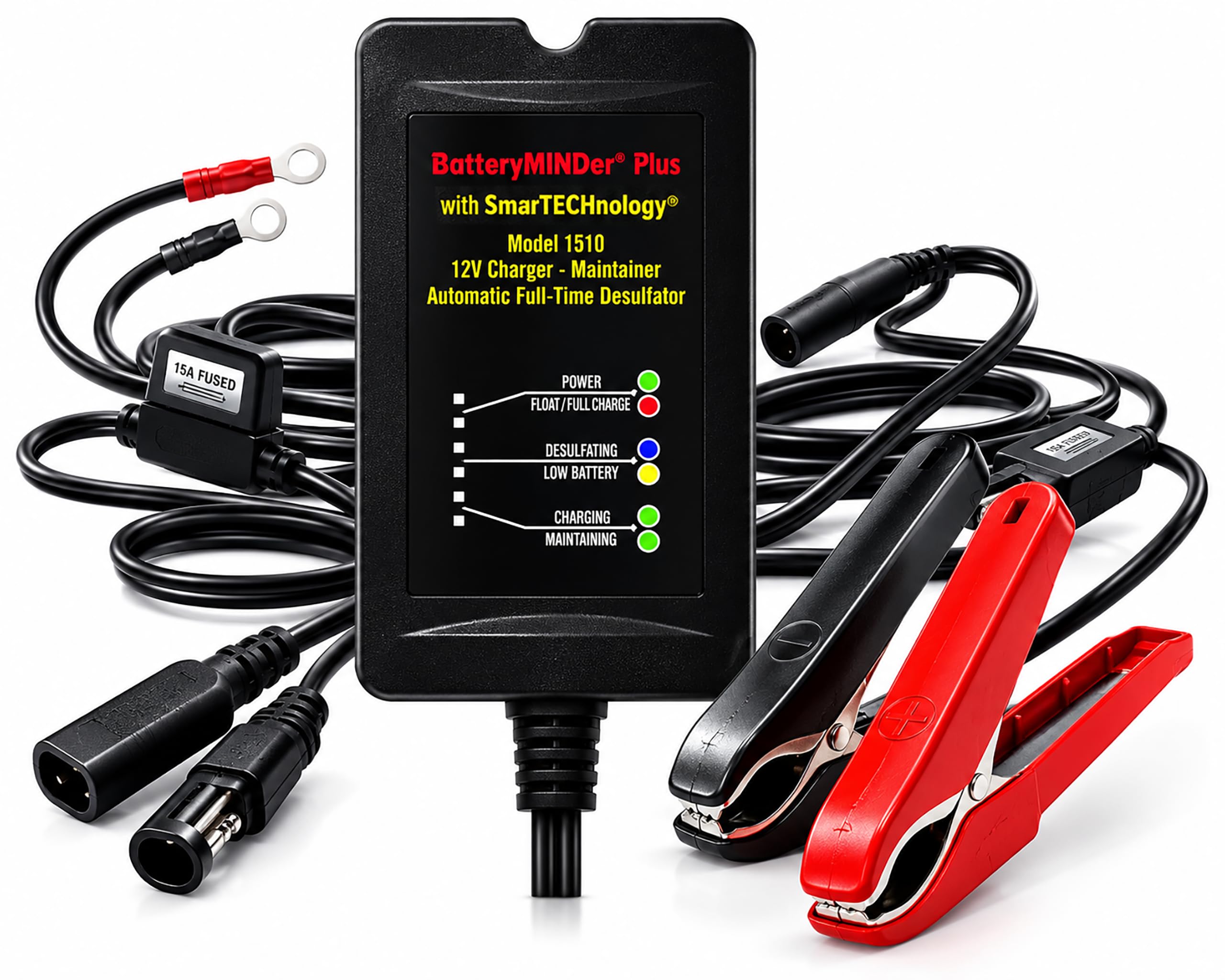
The 1.5‑amp whisperer that keeps a fleet of vehicles ready after months of storage.
The BatteryMINDer 1510 is nearly identical to the 1500 model but adds fused quick-connect terminals (a connector with a built-in fuse for safety) and a longer warranty — important differences if you plan to leave it connected to a motorcycle or classic car over winter. It delivers 1.5A with continuous high-frequency pulse desulfation running full-time, using a range of frequencies the brand claims to have patented to dissolve lead sulfate crystals. The manufacturer claims this can extend battery life up to four times compared to batteries not properly maintained. Customers note it successfully revives dead batteries if left connected for weeks — one shopper added they have owned six units since 1998 because the brand has been that reliable.
It can maintain up to four batteries in parallel with Y-connectors (sold separately), making it ideal for households with multiple seasonal vehicles. The 90-240V AC input lets you use it worldwide. At 15.2 ounces it is the lightest charger on this list — even lighter than the 16-ounce BatteryMINDer 1500 — and its dimensions of 3.4 x 8.4 x 6.7 inches are compact enough to stow in a saddlebag. The ambient temperature sensor adjusts voltage based on readings, ensuring proper charge in freezing or hot conditions.
The 1.5A rate is very slow — expect over 24 hours to charge a 50Ah (amp-hour, a measure of battery capacity) battery — so this is really a maintainer and desulfator, not a primary charger. Use a higher-amp charger like the NOCO GENIUS10 for bulk charging, then switch to the 1510 for long-term float maintenance.
Storage Specialist Strengths
- Continuous desulfation prevents sulfate buildup
- Maintains up to four batteries at once
- Fused quick-connect terminals for safe permanent install
The Slow Charging Reality
- 1.5A is too slow for bulk charging a large battery
- Y-connectors for multi-bank sold separately
Ideal for seasonal storage: if you winterize a car, motorcycle, ATV, or boat and want a charger that desulfates constantly while maintaining the battery indefinitely, this is your unit.
Not for quick recovery: if you need to refill a deeply discharged battery fast, pair this with a higher-amp charger or pick the VEVOR 20A instead.
6. BatteryMINDer 1500 12V 1.5A Smart Trickle Charger
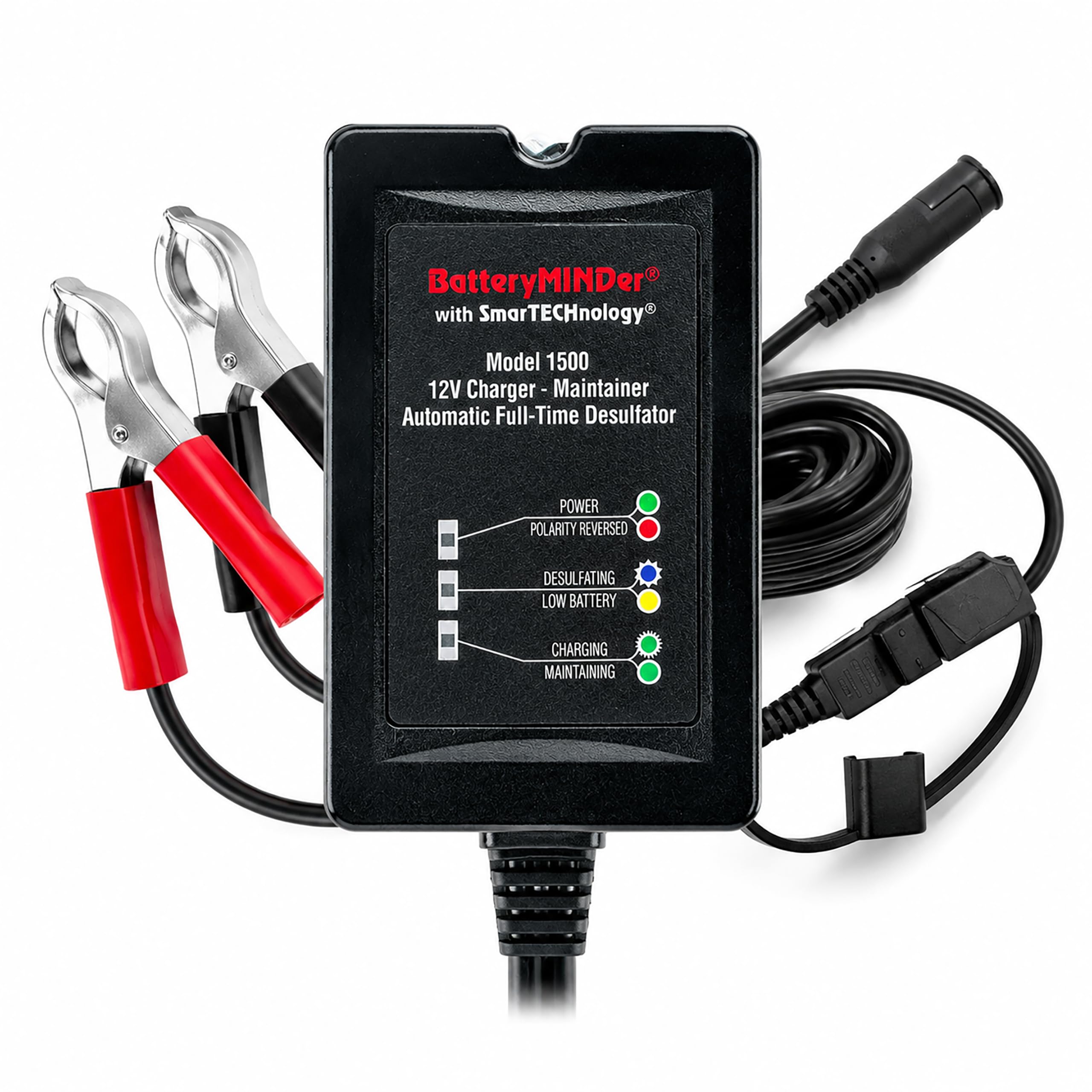
The low‑amp legend that pulled a 2004 Volvo battery back from 12.5V to 94% capacity over months.
This is the original BatteryMINDer that built the brand’s reputation. At 1.5A it is the polar opposite of the VEVOR 20A — a gap from 1.5A to 20A in charge current — but its strength is not speed. It runs a full-time automatic high-frequency pulse desulfator that uses a range of frequencies the brand claims to have patented to safely remove lead sulfate crystals. One buyer tracked the recovery of a heavily sulfated 2004 Volvo battery over months: resting voltage improved from 12.5V to 12.65V, which is 94% of original capacity. That is the kind of slow, persistent conditioning that brings back batteries other chargers would give up on.
The charger maintains up to four batteries in parallel when you add Y-connectors (sold separately). It includes reverse polarity, short-circuit, and over-temperature protection, plus a temperature sensor that adjusts voltage automatically. Its dimensions of 2.7 x 8.7 x 6.7 inches make it the second-most compact unit behind the 1510. FCC certification confirms it meets California Energy Commission efficiency standards.
The 1.5A charge rate means it takes 24+ hours to charge a 50Ah battery, so it is not suitable as a primary charger for regular driving use. One reviewer also noted that it has limited success reviving overcharged or worn-out batteries — only mild sulfation responds well to this gentle approach. At a lower price than the CRAFTSMAN, it is the cheapest dedicated desulfator charger in this lineup, but you lose the built-in tester and higher amperage options.
Patient recovery specialist: the BatteryMINDer 1500 excels at long-term desulfation where other chargers rush and fail — if you can leave it connected for weeks, it often works miracles on lightly sulfated batteries.
Pick this for: maintaining seasonal vehicle batteries and slowly recovering sulfated batteries that still hold some charge.
Avoid if: you need fast recharging or want to support lithium batteries — the NOCO GENIUS5 covers both for a higher cost.
Understanding the Specs
Amperage and Charging Speed
Amps (amperes) measure the current flow from the charger to your battery. Higher amperage means faster bulk charging — a 20A charger refills a 100Ah battery in about 5 hours, while a 1.5A maintainer takes over 66 hours. But fast charging risks overheating small batteries. For daily use, 5A to 10A is a balance that balances speed and safety. For long-term storage, 1.5A is gentle enough to leave connected for months without cooking the battery.
Desulfation vs. Maintenance
Desulfation uses high-frequency electrical pulses to physically break down lead sulfate crystals on battery plates — the main cause of capacity loss. A desulfator charger actively reverses this process. Battery maintenance, by contrast, simply keeps an already-healthy battery at full charge using a low float voltage (a steady, low voltage that keeps a battery topped up without overcharging). Many units combine both: they maintain the battery and run desulfation pulses in the background. Some chargers offer a separate “repair” or “desulfation” mode you activate manually for heavily sulfated batteries.
FAQ
Can a battery desulfator charger fix a completely dead battery?
How long does desulfation take to show results?
Will a desulfator charger work on lithium LiFePO4 batteries?
Can I leave a desulfator charger connected indefinitely?
What is the difference between a battery maintainer and a desulfator charger?
Can I charge multiple batteries with one desulfator charger?
How do I know if my battery is sulfated?
What size desulfator charger do I need for a motorcycle battery?
Will desulfation damage a healthy battery?
Final Thoughts: The Verdict
For most people, the best battery desulfator charger is the NOCO GENIUS10 because it balances a 10A charge rate with lithium compatibility, temperature compensation, and a dead-battery recovery mode that actually works. If you store multiple vehicles and want continuous desulfation for a whole fleet, grab the BatteryMIND
Related Guides
Product prices and availability are accurate as of the date/time indicated and are subject to change. Any price and availability information displayed on Amazon at the time of purchase will apply to the purchase of this product. As an Amazon Associate I earn from qualifying purchases.
CERTAIN CONTENT THAT APPEARS ON THIS SITE COMES FROM AMAZON. THIS CONTENT IS PROVIDED "AS IS" AND IS SUBJECT TO CHANGE OR REMOVAL AT ANY TIME.
Amazon and the Amazon logo are trademarks of Amazon.com, Inc. or its affiliates.