
Our readers keep the lights on and my morning glass full of iced black tea. As an Amazon Associate, I earn from qualifying purchases.
Specs are compiled from manufacturer listings and verified buyer reviews and can change over time — please confirm the key details on the product page before buying.
You’re trying to park in a tight spot, and you have no idea if that curb is three inches away or about to scrape your bumper. A 360° bird view camera solves that by stitching four camera feeds together so you can see a top-down view of your entire car on the screen, which makes squeezing into any space feel almost boring. The catch is that not every system actually delivers clear footage, and some require professional installation that can double the total cost.
I’m Min — the founder and writer behind Gadgets Feed. This guide is built by comparing the manufacturers’ published specifications and the patterns across verified customer reviews, so you get each pick’s real strengths and trade-offs instead of marketing spin.
If you want full-surround awareness without the guesswork, this is the only breakdown of the best 360° bird view camera for car you need, focused on real specs and honest buyer feedback.
Our Picks at a Glance
How To Choose The Best 360° Bird View Camera For Car
A 360° bird view camera for your car is more complex than a regular dash cam. You are buying four cameras and a processor that stitches the feeds into one overhead image, so a couple of key specs determine if the view is actually usable or just a confusing mess of distorted video.
Resolution — Are You Seeing Plates or Blobs?
The front camera resolution matters most because that is the lens you rely on for reading license plates ahead of you. A 4K front sensor gives you sharp enough detail to capture plates at a few car lengths, while a 1080P front lens is acceptable for general awareness but will blur plates that are farther away. The side and rear cameras can be 1080P and still work fine for lane awareness and backing up, because the critical detail at those angles is proximity, not plate clarity.
Night Vision — The Difference Between Safe and Sung
At night, your 360° system is useless if the image turns into grainy black soup. Look for an F1.6 or F1.8 aperture on the front camera — that number means the lens lets in more light, so you get a brighter picture in darkness. Infrared LEDs around the side and cabin cameras are even more important: without them, the side cameras see nothing when it is pitch black outside. Some systems use invisible IR LEDs, meaning you get a clear black-and-white image without a distracting red glow inside the car.
Parking Mode — Always On or Always Wired
Every 360° dash cam in this range offers parking mode, but here is the catch: almost none of them include the hardwire kit in the box. The camera runs on your car’s power when the engine is on, but to keep recording while parked, you need a separate hardwire kit that connects to your fuse box. If you want 24-hour surveillance, budget an extra – for that cable, and factor in the installation time or cost if you are not comfortable tapping into your car’s electrical system.
Quick Comparison
| Model | Best For | Front Resolution | Max SD Card | Field of View | Amazon |
|---|---|---|---|---|---|
| IIWEY N6★ Best Overall | Overall Value | 4K | 256 GB | 170° | Amazon |
| PAPAGO!Top Performer | Highest Resolution | 4K | — | 170° | Amazon |
| Driveye D7Smart Value | 4K Performance | 4K | 256 GB | 360° | Amazon |
| Zunfly W3 | Entry-Level 360° | 2K | 64 GB | 360° | Amazon |
| PRUVEEO | Adjustable Angles | 1080P | 256 GB | 360° | Amazon |
| VROAVIE Mirror Cam | Mirror Replacement | 1080P | — | 150° | Amazon |
| Weivision BDV09-HD | Large Vehicles | 1080P | 64 GB | 170° | Amazon |
| Weivision BDV09-09 | Large Vehicle 9″ | 1080P | 64 GB | 190° | Amazon |
| Weivision 360 Birdview | Aftermarket Builds | 1080P | 128 GB | 190° | Amazon |
In‑Depth Reviews
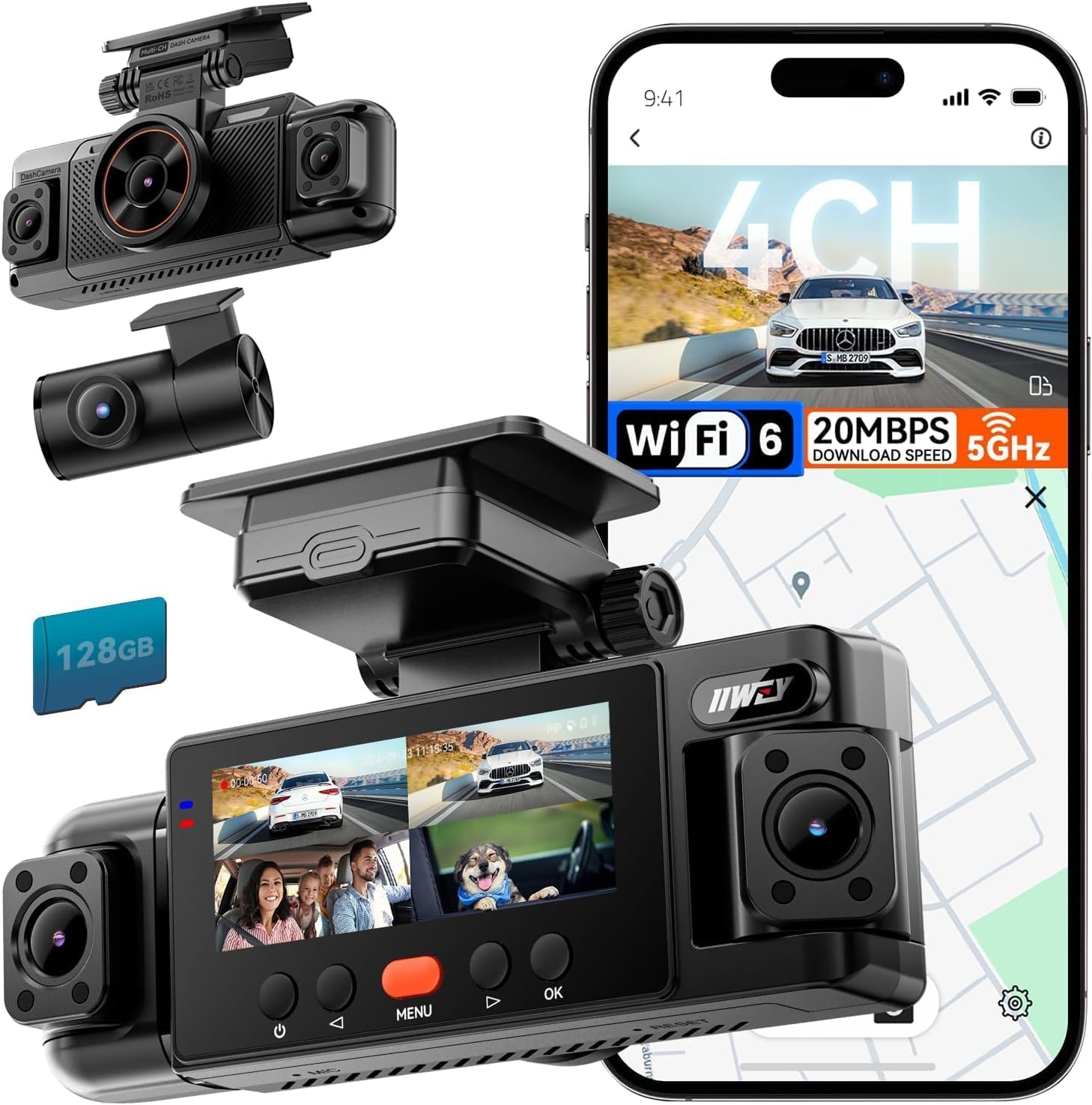
1. IIWEY N6 360° Dash Cam 4 Channel
Our pick — over 4★ from 8,500+ verified ratings; the strongest balance of quality and price.
Four crisp cameras, a supercapacitor, and WiFi-6 for downloads that do not test your patience.
The IIWEY N6 gives you a true 4-channel 360° view with an ultra-wide 170° field of view on the front and rear lenses, and 150° on the adjustable side cameras. The front records in proper 4K, so you get the clarity needed to read license plates at junctions, while the side cameras use infrared night vision to keep blind spots visible in darkness. Buyers report that the crisp 4K front video captures plates up to 4 car lengths and that the supercapacitor extends parking mode without the heat worries a battery would cause.
Unlike the Zunfly W3 which includes only a 64 GB card, the IIWEY N6 ships with a 128 GB card and supports up to 256 GB — a 4.0x gap in max storage capacity. The WiFi-6 (5.8 GHz) connection reaches about 20 MB/s for transfers, and the built-in GPS logs speed and route directly onto the footage. Just know that parking mode requires the separate hardwire kit, and the camera has no internal battery, so it must stay plugged into your car charger or fuse box to operate.
Reviewers also highlight the stable mount that resists 90°F+ heat and the user-friendly app that avoids pushing salesy upgrades. The auto-off for WiFi after about 5 minutes helps keep heat and power draw low when you are not using the app.
What Shines: Supercapacitor design for heat resistance, fast WiFi-6 transfers, and 4K front footage that gives you real plate-reading ability at night.
One Trade-off: The hardwire kit for 24/7 parking mode is sold separately, and the charger in the box only powers the unit while the engine runs.
Reach for this if: You care about front video clarity for reading plates and want WiFi-6 speeds for quick downloads.
Look elsewhere if: You want parking mode right from the start without buying an extra kit.
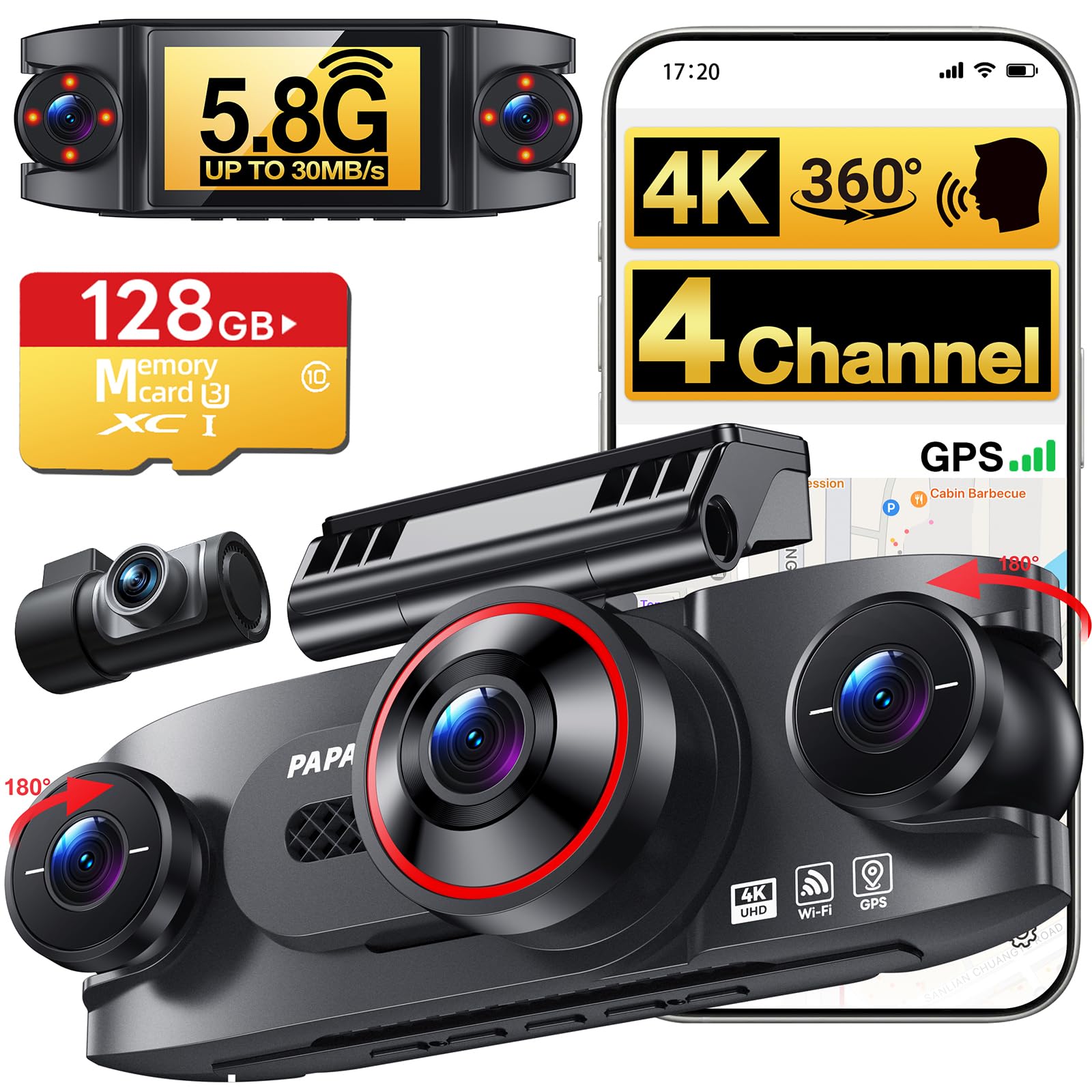
2. PAPAGO! 4 Channel 360° Dash Cam
Full 4K front, three 1080P cameras, and voice control for eyes-on-the-road operation.
The PAPAGO! delivers a 4K (3840x2160P) front camera and three 1080P cameras covering rear, left, and right, so you get the sharpest front view in this entire list. The left and right cameras each have eight invisible infrared LEDs, meaning they record clear black-and-white video even in a completely dark cabin. The F1.6 aperture on the front lens lets in more light than the F1.8 on most competitors, making night recording noticeably brighter.
Where this system stands apart is the 5.8 GHz WiFi that reaches up to 30 MB/s download speeds through the PAPAGO app — noticeably faster than the 20 MB/s on the IIWEY N6. You also get voice commands for saving videos or taking photos hands-free, plus physical one-click buttons to lock emergency footage across all four channels simultaneously. Owners mention that the left camera initially recorded black-and-white during the day, but PAPAGO support explained this is the low-light night vision mode, and the camera shifts to color in sufficient daylight.
Like every camera here, the hardwire kit for parking mode is sold separately (ASIN B0DBQD6WWQ), and the unit has no internal battery. The PAPAGO comes with a 24-month warranty, which is longer than the 12-month or 18-month coverage on most rivals.
Standout Specs: 4K front resolution, 30 MB/s WiFi downloads, and invisible IR LEDs for discreet cabin recording.
One Trade-off: The side cameras are sensitive to lighting — they shift to black-and-white in dim conditions, so daytime overhead sun may trigger night mode if the sensitivity is set high.
Grab it for: The highest front resolution and fastest WiFi transfers among these picks.
Skip it for: Side-camera color accuracy — you may see black-and-white footage indoors if the light is not bright enough.
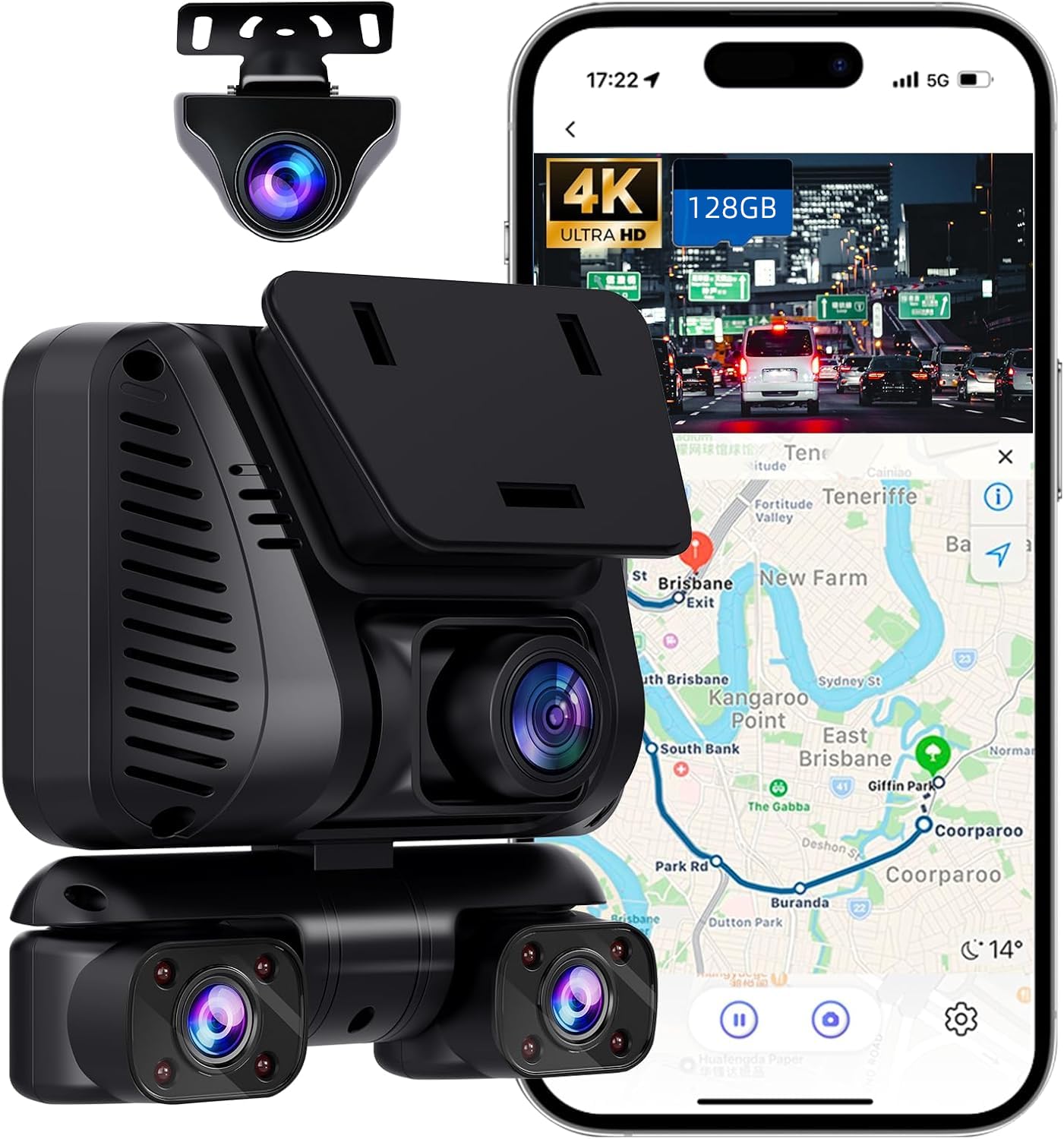
3. Driveye D7 4K 360° Dash Cam
4K 4-channel coverage with voice commands and a free 128GB card that actually works.
The Driveye D7 records 4K on the front camera and 1080P on the other three channels simultaneously, delivering the same front clarity as the PAPAGO!. Its 150° field of view is slightly narrower than the 170° lenses on the IIWEY N6, but the included 128 GB SD card — a Lexar card that reviewers value at around — removes the need for an immediate memory upgrade. The 360° limit is really only set by your vehicle interior; you can mount the side cameras to capture whatever angle matters most to you.
Unlike the Zunfly W3 which includes a 64 GB card (a 2.0x gap), the Driveye gives you double the included storage and supports up to 256 GB. The F1.8 aperture and WDR technology balance exposure in tricky light, while each side camera has four infrared lights for black-and-white night recording. Reviewers mention that the app makes reading license plates easy and that loop recording automatically manages storage.
The 24-hour parking mode requires a separate add-on kit, same as the other 4-channel systems. One reviewer noted that the D7 does not stay on while driving (unlike their cheap previous model) and that Bluetooth could conflict with phone music, but the GPS, app, and video quality all earned high marks.
Why It Impresses: Includes a premium Lexar 128 GB card, voice control, and 4K front recording at a mid-range price.
One Trade-off: 150° field of view is slightly tighter than the 170° lenses on the IIWEY, and some users report Bluetooth interference with phone audio.
Pick this for: The bundled 128 GB card value and reliable 4K front recording that removes guesswork from storage.
Pass if: You need the widest possible lens angle or want a system with zero potential phone connection hiccups.
4. PRUVEEO 360° 4 Channel Dash Cam

Three camera angles you can physically rotate to capture whatever angle your setup needs.
The PRUVEEO system records at 1080P across all four channels, which is lower front resolution than the 4K options above, but it makes up for it with adjustable viewing angles on the front three cameras. You can twist each lens to catch more of the interior or focus on a specific blind spot outside. The F1.8 cabin lens and four infrared lights provide solid night vision, and the time-lapse parking mode compresses 60 minutes of footage into 1 minute to save storage space.
Buyers highlight clear front, rear, and interior coverage with a sturdy build and a reliable suction cup mount. The 128 GB microSD card is included, and the system supports up to 256 GB. One buyer mentioned that while the phone app can be fiddly and the screen failed after 9 months, the overall build and video quality were strong enough that they planned to buy again. The strong adhesive and straightforward fuse-box wiring earned praise from DIY installers.
The PRUVEEO has no internal battery and requires a hardwire kit for parking mode, just like the others. It includes a push-button control alongside the app, so you are not forced to rely solely on your phone.
Best Feature: Physically adjustable lenses let you dial in exactly what each camera sees without repositioning the entire unit.
One Trade-off: Front video is 1080P only, so you lose some plate-reading sharpness compared to 4K front cameras.
Choose it for: The ability to physically angle the cameras to capture interior details or specific blind spots.
Avoid if: You want the highest front resolution for reading distant license plates.
5. VROAVIE Mirror Dash Cam
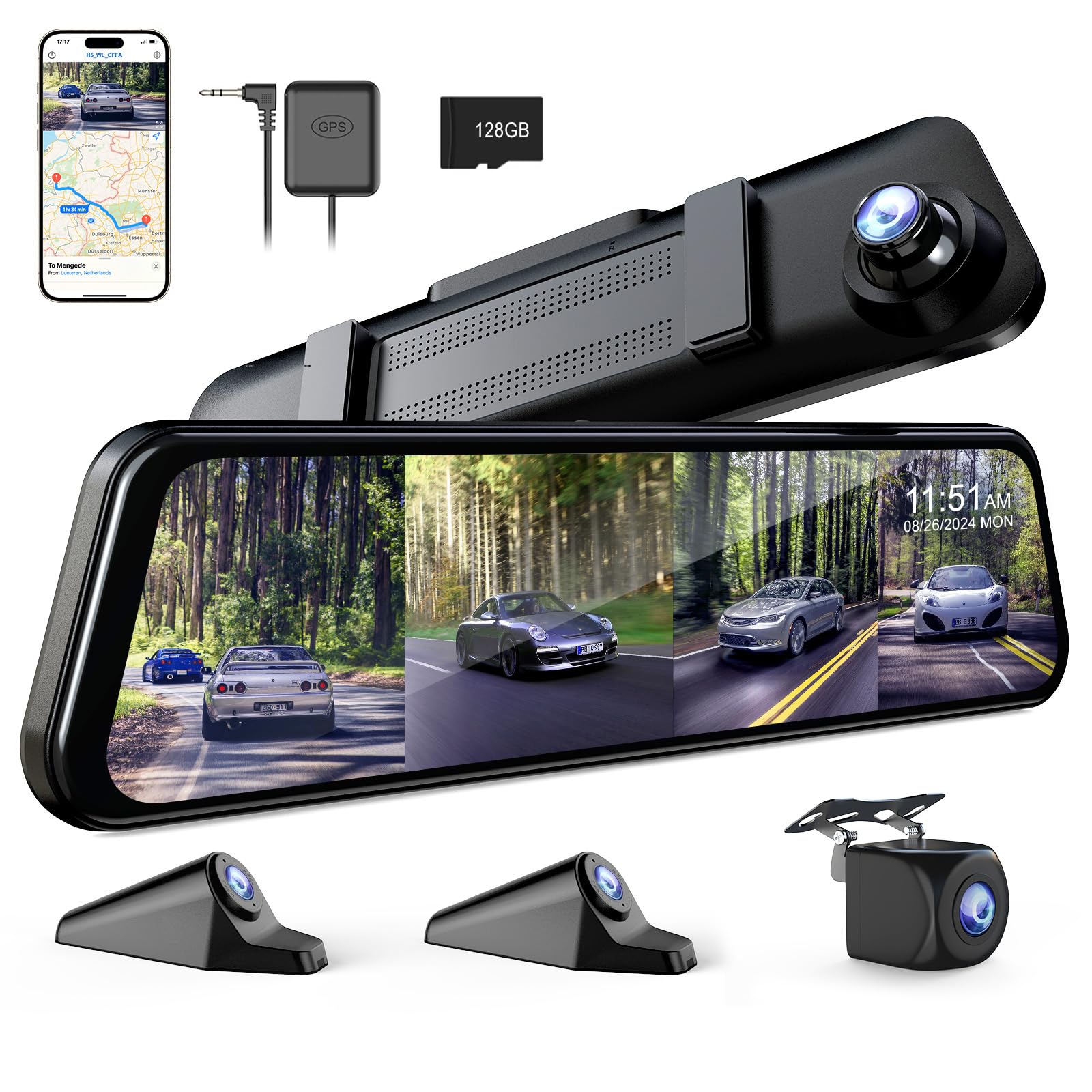
A rearview mirror replacement that adds side cameras without cluttering your windshield.
The VROAVIE replaces your stock rearview mirror with a 12-inch IPS screen that shows feeds from four detachable cameras — front, rear, left side, and right side. The left and right cameras each sit outside the cabin and use a 150° field of view to cover your blind spots. The front camera has an F1.8 aperture for better low-light performance. Unlike the IIWEY or PAPAGO systems that mount on the windshield, this mirror-style design keeps your dashboard clear and uses rubber straps to attach directly over the factory mirror.
Customers note the fast boot time and dual-pane side view are impressive for the price, and the included GPS module tracks speed and route. One owner noted that the mirror is heavy and tends to drop on bumps, and the screen may not be bright enough in direct daylight. Another warned that night headlights cause severe bloom, reducing rear visibility. The package includes a 128 GB SD card, and parking mode requires a separate hardwire kit.
A major difference from the PRUVEEO and IIWEY is the screen placement: because this replaces your mirror, you look up to see the camera feed rather than down at a dashboard screen. That helps you keep your eyes closer to the road, but the dynamic range issues reported by some reviewers mean you should test the daytime visibility before relying on it as your primary mirror.
Unique Angle: Frees up dashboard space by integrating into the rearview mirror, with detachable side cameras for full 360° coverage.
One Trade-off: Some reviewers point out the screen lacks brightness in daylight and suffers from headlight bloom at night, which affects usability as a mirror replacement.
Get this for: A clean dashboard look with side cameras and a mirror-style display that keeps your view high.
Pass on this if: You drive in strong sunlight often or need a reliable rearview mirror replacement — the screen brightness may not cut it.
6. Weivision BDV09-HD 360° System

A commercial-grade 360° surround view designed for the massive blind spots of trucks and RVs.
The Weivision BDV09-HD is a completely different class of product from the dash cams above. It uses four 190° wide-angle fisheye cameras and a dedicated 7-inch monitor to produce a bird’s-eye view, and it is specifically built for large vehicles like fire engines, buses, school buses, semi-trailers, box trucks, and RVs. The system weighs 11 pounds and measures 17 by 8 by 10.6 inches, so it is not a compact dash cam you tuck behind the mirror — it is a full installation project. The cameras connect via an LVDS signal that is only compatible with the included Weivision monitor, not a standard aftermarket head unit.
One RV owner reports that the view looks like live drone footage and that parking and backing up become almost easy. The same reviewer mentions that at night the video looks like overcast daylight — everything is visible and clear. The trade-offs include camera housings with open holes on top that need sealant, and the rear view only sees a few car lengths back. The system records in 1080P and uses a 64 GB maximum card for loop recording.
Installation is demanding. Another reviewer warns that the documentation is confusing about voltage range (the manual says 8–32 volts but later warns against 24-volt systems), and the image fusion around the camera stitching points can disappear, meaning you lose situational awareness exactly where the video tiles meet. Professional installation is strongly recommended.
What It Does: Generates a true overhead 360° bird’s-eye view on a dedicated 7-inch monitor with 190° fisheye cameras, tune for large vehicles.
Biggest Catch: The LVDS signal is proprietary — you cannot use a different monitor — and the image stitching can fail, creating blind spots at the fusion points.
Perfect for: RV, bus, or truck owners who need a dedicated 360° monitor that delivers live-drone-like overhead awareness.
Not for: Passenger car drivers who want a simple dash-cam install — this is a major integration project best handled by a professional shop.
7. Weivision BDV09-09 360° System (9-Inch)

The same heavy-duty 360° system with a larger 9-inch screen for better visibility from the driver seat.
The BDV09-09 is essentially the same system as the BDV09-HD above but with a 9-inch monitor instead of a 7-inch one. That extra screen real estate matters inside a large vehicle cab where the driver sits farther from the display. The four 190° fisheye cameras, 1080P recording, and 64 GB max storage are identical. It still uses the LVDS signal that is exclusive to Weivision monitors, so you cannot plug it into a standard car stereo screen.
Multiple reviewers praise the customer support from Lucy at Weivision, who helped with replacement cables and form-factor issues. One owner noted that the rear camera was not compatible with their vehicle mount, and Lucy found a replacement that worked. The installation remains challenging — one user spent hours running cables and recommends a professional installer. The video quality is described as crisp and clear, though another reviewer warns that the 360° image stitching is not perfect and that objects can disappear at the fusion points, so you always need to keep your situational awareness up.
The unit has no internal battery and runs directly from vehicle power. Weivision states it is compatible with trucks, RVs, trailers, emergency vehicles, buses, school buses, and industrial vehicles under 22 feet.
Key Difference: The 9-inch screen offers a bigger, easier-to-read picture, which makes a real difference in a large truck or RV cab.
Same Caveat: LVDS-only compatibility means you are locked into the Weivision monitor, and the image stitching has known gaps.
Choose it for: The larger screen and responsive customer support that helps with installation quirks.
Pass on it if: You want a passenger-car system that integrates with your existing stereo screen or aftermarket head unit.
8. Weivision 360° Bird View DVR (Standalone)

A standalone 360° DVR system with four 190° cameras that feeds into your own aftermarket monitor.
This Weivision system is different from the BDV09 kits above because it does not include a screen. It is a DVR recorder with four 190° fisheye cameras that output via RCA connectors, meaning you supply your own monitor — typically an aftermarket Android head unit or a separate display. The cameras are 1080P with wide-angle coverage, and the DVR supports up to 128 GB of storage for loop recording. It is designed for vehicles under 22 feet and uses calibration mats (with a passcode of 111 according to one reviewer) to stitch the four feeds into a single 360° overhead view.
Jeep Wrangler shoppers say that this system works great when paired with a PAC interface for automatic activation during reverse and turn signals, but side cameras mounted on the A-pillar can cause fender-flare blockage and stitching issues. The fish-eye distortion is extreme on the standalone cameras, and you cannot view the DVR footage directly on your head unit — you must remove the USB stick and use a PC. One reviewer who had the system professionally installed by BestBuy found that it stopped working after a battery swap because there is no battery backup to keep settings alive.
The resolution is advertised as 1080P, though one owner measured it as below that. The auto-calibrate feature is described as poor, so manual calibration with the mats is the only reliable path to a usable bird’s-eye view.
Best Use: An add-on for cars that already have an aftermarket monitor or Android head unit, especially for custom builds like Jeeps.
One Trade-off: Setup requires calibration mats and a passcode, the user interface feels outdated, and there is no app or on-screen playback — you need a PC to review footage.
Consider this for: A custom 360° integration into an existing aftermarket screen, especially if you have experience with calibration mats.
Skip it for: A simple plug-and-play install or a system that lets you view and share clips from your phone.
9. Zunfly W3 360° View 4 Channel Dash Cam
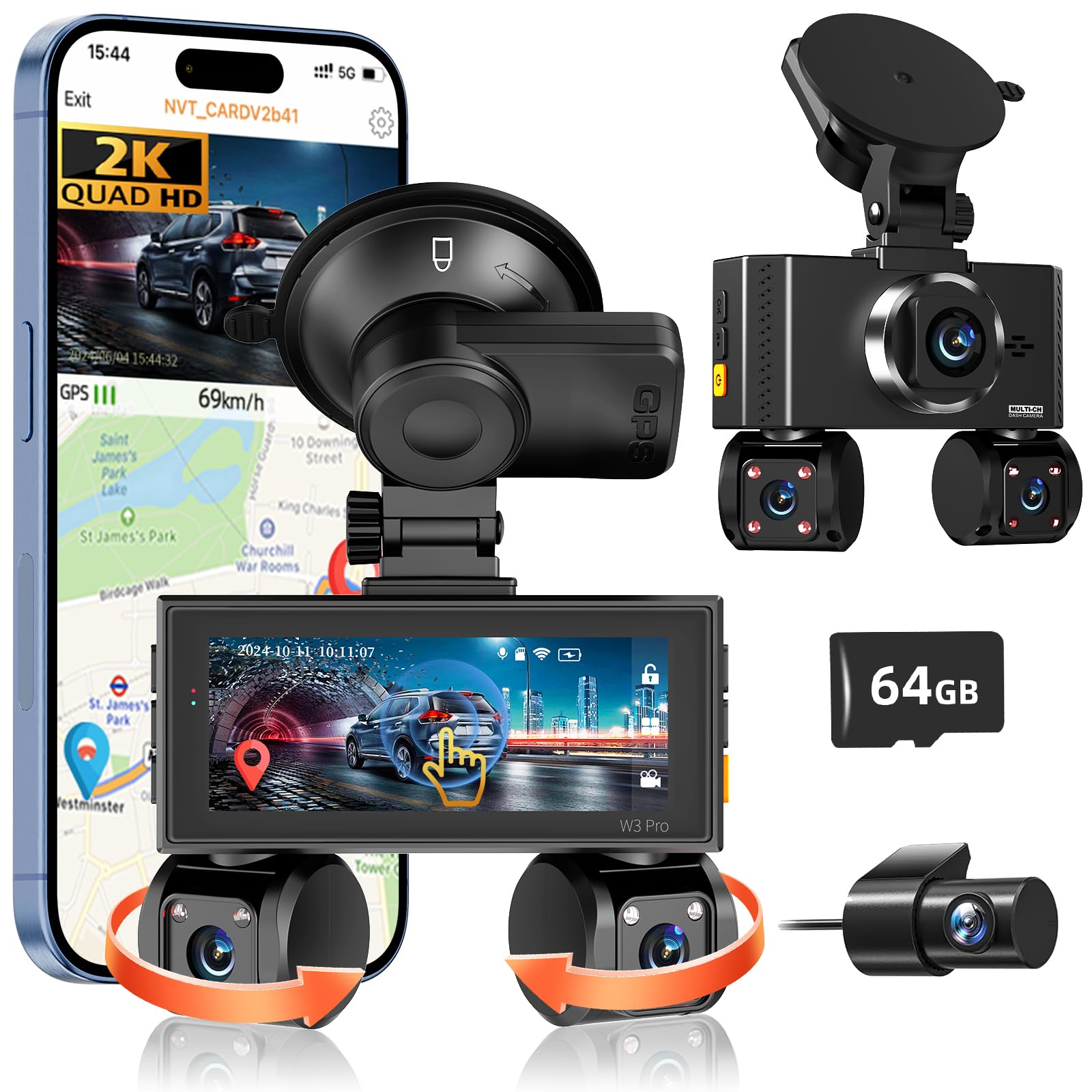
The most affordable way to get 360° coverage, with a 2K front camera and a 3.16-inch touchscreen.
The Zunfly W3 gets you into 360° recording without the premium price. The front camera records at 2K resolution, and the three other cameras are 1080P, covering rear and both sides with 360° coverage. The F1.8 aperture and six-layer lens array capture 30% more light than standard models, according to the maker. The 3.16-inch IPS touchscreen lets you adjust angles, start emergency recording, and review footage right on the camera without needing your phone.
Buyers report that the dual side cameras provide excellent blind-spot coverage, the installation takes about 15 minutes, and the video stays crisp during the day and night. The built-in 5 GHz WiFi transfers video four times faster than standard WiFi, and the GPS tags speed and location onto the footage. The included 64 GB card is enough to get started, though the system only supports up to 64 GB, so you cannot upgrade to 128 GB or 256 GB like you can with the IIWEY N6 or Driveye D7.
Parking mode requires a separate hardwire kit, same as every other system here. One owner reported that the camera is great, but you must buy that extra part if you want surveillance while the car is off. The rear camera connection is optional — one reviewer simply did not plug it in and found the system still worked well for front and side coverage.
What Works
- 2K front camera is noticeably sharper than 1080P-only systems.
- Fast 5 GHz WiFi for app transfers.
- 15-minute installation with included tools.
What Limits It
- Max SD card capacity is 64 GB, which fills faster with four channels recording.
- Parking mode hardwire kit is not included.
- Rear camera cable may be left unconnected by some buyers, but that limits coverage to front and sides only.
Best for: Entry-level buyers who want 360° coverage on a budget and do not need 4K front resolution or massive storage capacity.
Not for: Those who want to upgrade to a 256 GB card later or need 4K front footage for reading plates at a distance.
Understanding the Specs
Field of View — How Much Road You See
The field of view (FOV) is the angle each camera captures. A higher number means the lens sees more of the road to the left and right. Most 360° dash cams use a 150° to 170° FOV for each camera. The wider the FOV, the fewer cameras you need to cover your blind spots, but the image at the edges will have some fisheye distortion. Systems like the Zunfly W3 claim 360° coverage across four cameras, which works because the combined FOV from all four lenses overlaps to create the bird’s-eye view. A single camera with a 170° lens on the front only covers the area ahead — the other three cameras handle the sides and rear.
Storage — What a 128 GB Card Actually Holds
Four channels recording simultaneously use up storage fast. A 128 GB card records roughly 6 to 8 hours of continuous looped footage across all four channels at 1080P. If the front camera records at 4K, that drops to about 4 to 5 hours before the oldest files are overwritten. That is why a 256 GB card is valuable for higher-resolution systems: it roughly doubles the available loop time before overwriting begins, which means you have a better chance that an incident from hours earlier is still on the card when you go to retrieve it.
FAQ
Will a 360° dash cam work on any car?
Does parking mode work without a hardwire kit?
How long does it take to install a 4-channel 360° dash cam?
Can I view the 360° view on my factory car screen?
Is the 2K front camera good enough to read license plates?
Do I need an SD card, or does the camera come with one?
What happens if the SD card fills up?
Do these cameras work in extreme heat or cold?
What is the difference between 360° coverage and a regular dash cam with a wide-angle lens?
Can I install the side cameras myself without drilling?
Final Thoughts: The Verdict
Across the board, the best 360° bird view camera for car winner is the IIWEY N6 because it combines 4K front recording, a supercapacitor for heat resistance, fast WiFi-6 transfers, and a 128 GB included card at a mid-range price that beats most of the competition in value. If you want the highest front resolution and fastest downloads, grab the PAPAGO!. And for a budget-friendly entry point into 360° coverage, the Zunfly W3 gives you the same 4-channel awareness with a 2K front camera and a simple touchscreen interface.
How We Picked
We do not accept paid placement. Every pick is matched to a real buyer and a real use-case; we do not hands-on test units.
Sources & Methodology
Specifications: manufacturer listings and product documentation. Review insights: verified customer reviews, as of July 2026. Pricing: not shown on this page (it changes often); check the current price via the retailer link.
As an Amazon Associate, Gadgets Feed earns from qualifying purchases. This does not affect which products we feature.