
Our readers keep the lights on and my morning glass full of iced black tea. As an Amazon Associate, I earn from qualifying purchases.
Specs are compiled from manufacturer listings and verified buyer reviews and can change over time — please confirm the key details on the product page before buying.
Keeping your RV comfortable in any weather depends on one rooftop machine. Pick the wrong one, and you get noisy nights, weak airflow, or a drained battery that leaves you sweating. You need to match the unit to your rig’s size, your electrical system, and your tolerance for hum—so this guide focuses on the real specs: BTU output (cooling power), power draw (how much electricity it uses), noise ratings (how loud it gets), and physical weight (how much it adds to your roof).
I’m Min — the founder and writer behind Gadgets Feed. This guide is built by comparing the manufacturers’ published specifications and the patterns across verified customer reviews, so you get each pick’s real strengths and trade-offs instead of marketing spin.
The three specs that matter most for an ac for rv are cooling power (measured in British Thermal Units, or BTUs), how much electricity it pulls (measured in amps), and whether it can run off your generator or solar batteries without tripping a breaker.
Our Picks at a Glance


How To Choose The Best AC For RV
You need to balance three things: cooling power (BTUs), power source (110V AC vs 12V DC), and physical fit (weight and roof opening size). The wrong match in any category will leave you hot, broke, or unable to install it.
Match BTU to Your RV Length
BTU stands for British Thermal Unit, which measures how much heat the unit can remove per hour. A 13,500 BTU unit is generally fine for trailers up to roughly 30 feet in mild climates. For larger rigs—or for the brutal southern sun—15,000 to 18,000 BTU is needed to keep the interior comfortable without running non-stop. Undersizing means the compressor never shuts off; oversizing can lead to short cycling and poor humidity removal.
12V or 110V — Your Power Source Decides
Standard rooftop units run on 115V AC, which means you need shore power or a generator (and sometimes a soft-start device to handle the inrush current). A 12-volt DC unit, on the other hand, lets you run the air conditioner directly off your house battery bank while boondocking, as long as you have enough amp-hours stored. If you camp off-grid often, the 12V path is the more practical choice, even though the cooling capacity (usually 10,000 BTU) is lower than a 110V model.
Noise Level and Airflow Design
Noise is measured in decibels (dB). A unit around 60 dB is about as loud as a normal conversation; 43 dB is whisper-quiet and lets you sleep through the night. The airflow design—ducted or non-ducted—affects how evenly the cold air distributes across the RV. Ducted systems route air through ceiling vents for even coverage, while non-ducted units blow directly from the unit’s shroud. The choice depends on whether your RV already has ductwork.
Quick Comparison
| Model | Best For | Cooling Power | Power Source | Noise Level | Amazon |
|---|---|---|---|---|---|
| Coleman-Mach 15 48204C966★ Best Overall | High BTU for large rigs | 15,000 BTU | 115V AC | — | $1,185.99Amazon |
| ASA Electronics Advent AirEntry-Level Powerhouse | Budget-friendly 13.5K BTU | 13,500 BTU | 115V AC | — | Amazon |
| Dometic FreshJet 3 SeriesLightweight & Quiet | Lighter weight, quieter run | 13,500 BTU | 115V AC | — | $861.23$1,049.99Amazon |
| Outequip OutEquipPro 12V | Off-grid 12V cooling | 10,000 BTU | 12V DC | 54 dB | $895.00Amazon |
| Outequip 12V with Heater | Off-grid plus heat pump | 10,000 BTU | 12V / 24V / 48V DC | 40 dB | $946.00Amazon |
| RecPro 13.5K Non-Ducted | Ultra-quiet non-ducted | 13,500 BTU | 115V AC | 59.7 dB | $959.95$1,028.95Amazon |
| Coleman-Mach Signature 48204-666 | Premium 15K BTU non-ducted | 15,000 BTU | 115V AC | — | $1,044.99Amazon |
| TOSOT 16000 BTU | Ultra-quiet heat pump + WiFi | 16,000 BTU | 115V AC | 43 dB | $999.99$1,149.00Limited time dealAmazon |
| Furrion Chill Cube 18k | Highest capacity with variable speed | 18,000 BTU | 115V AC | Quiet (variable speed compressor) | $1,199.00Amazon |
In‑Depth Reviews
1. Coleman-Mach 08-0080 Mach 15 48204 Series Air Conditioner Upper Unit 48204C966-15,000, Arctic White
Our pick — over 4★ from 450+ verified ratings; the strongest balance of quality and price.
The brute-force cooling champ that turns a 33-foot Class A into a walk-in freezer.
With 15,000 BTU and a 1.25-ton scroll compressor, this unit delivers the high-volume cold that larger rigs demand. That is 15,000 BTU versus the Outequip’s 10,000 BTU, and 1.25 tons versus 1 ton, so you do not need a second AC to handle a south Florida summer. Buyers report the single unit keeps a 33′ A Class RV “FRIGID cold” even in brutal heat, which is the exact outcome you want when the sun is punishing the roof all afternoon.
The catch is it is the upper unit only—you need the separately purchased lower control panel and all mounting hardware, so plan that extra expense and part tracking before you tear off your old shroud. At over 80 pounds, installation is strictly a two-person job (buyers recommend keeping it in the shipping box to haul it up safely without damaging the shroud).
The 115V AC, 60Hz single-phase electrical requirement means you need shore power or a generator; there is no 12-volt DC option for boondockers.
What you get with this brute
- 15,000 BTU cooling—the highest standard output in the lineup
- Scroll compressor is dependable and efficient
- 1/3 HP fan motor moves serious air
Before you buy, know this
- Upper unit only—lower control panel and hardware sold separately
- Weighs 80+ lbs; needs two people and careful handling to install
- 115V AC; not suitable for off-grid 12V battery systems
Reach for this if: you have a large rig (30+ ft) in a hot climate and need one powerful unit to handle the whole space.
Look elsewhere if: you want a plug-and-play complete kit (shroud + control box) or you need low-weight, one-person installation.
2. ASA Electronics ACM135 Advent Air 13,500 BTU Roof Top AC, White
The affordable workhorse that one buyer ran continuously for months in Arizona’s 115°F heat.
This unit delivers 13,500 BTU of cooling from a rigid metal base pan with a thick watertight gasket and six dense foam support pads—real construction details that matter when the road is rough. Reviewers report it kept a trailer cool in 115+°F Arizona heat, powered by a 3500W generator, and ran continuously from May through October without issues. That kind of endurance is the real test a budget-priced unit has to pass.
One buyer who replaced a Dometic that lasted only three years says this runs smoother, colder, and quieter. The optional plug-in heat strip is a smart add-on for cool shoulder-season nights, though the unit itself is cooling-only from the start. Note that this is the rooftop upper unit only—no ceiling assembly, manual, or mounting bracket is included, so factor that into your total cost and installation plan.
Why it’s a strong value
- 13,500 BTU fits most trailers under 30 ft
- Three fan speeds let you balance noise and airflow
- Washable filter cuts maintenance time
But watch for
- Upper unit only—no control kit included
- Some buyers found mounting screws too short for their roof thickness
- Rotary/scroll compressor, not a high-efficiency inverter type
Ideal for: the budget-conscious RV owner who needs a reliable 13.5K unit on shore power or a generator and can handle sourcing the separate control package.
Not for you if: you want a complete kit with all hardware and a long-term warranty against compressor failure.
3. Dometic FreshJet 3 Series, 13.5K BTU RV Rooftop Air Conditioner unit, White
The refreshing upgrade that drops 80°F to 64°F in under an hour, with noticeably less weight on your roof.
This 13,500 BTU rooftop unit makes installation less of a struggle—owners mention a 30- to 45-minute job when swapping out an older Dometic. One reviewer says it cools from 80°F to 64°F in 30-45 minutes, and they measured startup power at about 2000W with continuous draw of 1.6-1.7kW. That power profile matters if you are running it off a generator or a limited shore outlet.
Dometic claims 4 dB less noise than select competitive rooftop units, and multiple reviews confirm it is “much quieter” than the old Brisk Air II it replaced. It is backwards-compatible with existing Dometic and competitor air distribution boxes, so you may not need to replace the ceiling trim.
What stands out
- 14% lighter than Dometic Brisk II—easier solo install
- Quieter operation: 4 dB less than select competitors
- Backwards-compatible with many existing air boxes
What to watch
- Some units arrived with damaged shroud tabs
- A handful of reviews mention compressor wire failure
- No new control box or trim included—reuse old parts
Grab this for: a straightforward swap of an older Dometic where you want a lighter, quieter unit that still uses your existing ceiling control box.
Skip if: you are installing on a non-Dometic roof cutout and need a full control kit included.
4. Outequip RV Air Conditioner, 12V 10000 BTU Rooftop Air Conditioner for RVs, Trucks, Vans, Campers, Tractor
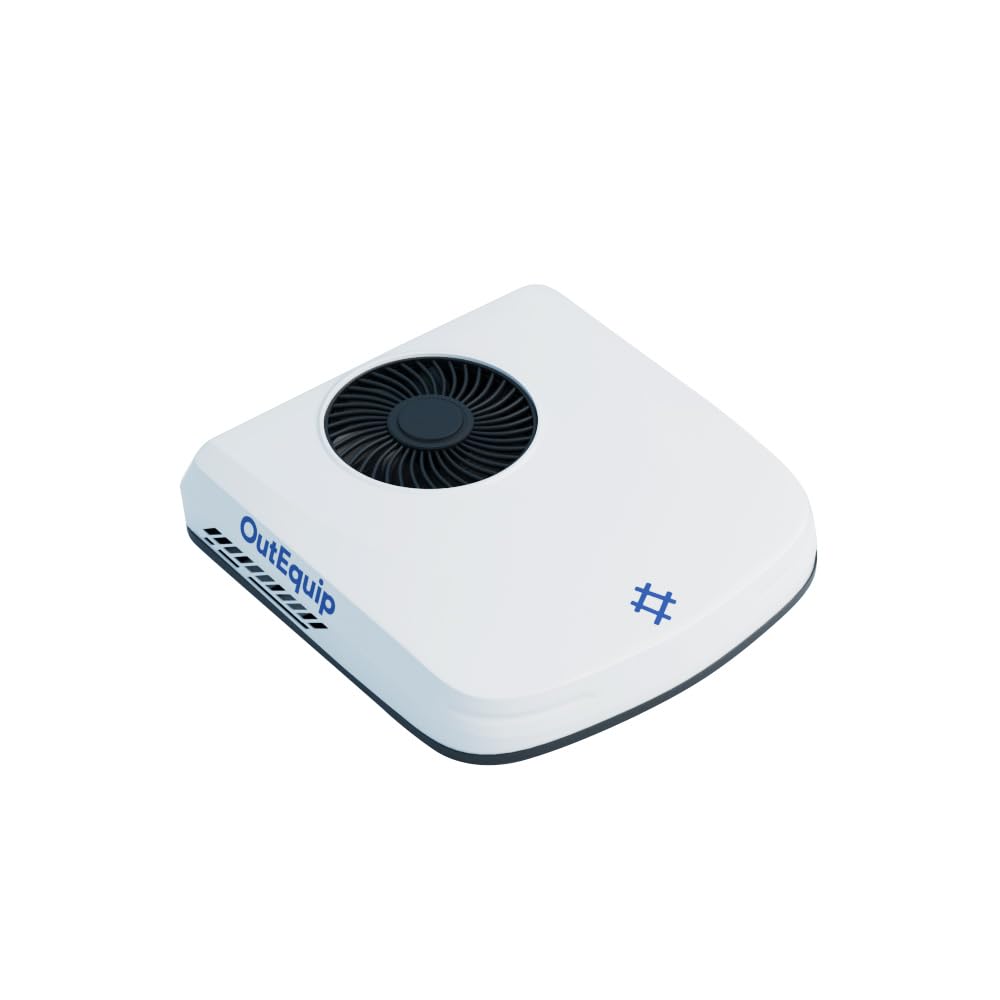
The off-grid specialist that runs 8 hours on a battery, so you never need a generator just to sleep cool.
This 10,000 BTU unit runs directly off your vehicle’s 12-volt electrical system, cutting the need for shore power. According to the maker, an 8-hour cooling session uses a 480Ah power source, and a 600Ah battery setup gives 10 hours of runtime. Customers note a 54 dB sound level, lightweight 45-pound design, and easy one-person install with internal wire routing. One reviewer cooled their van from 89°F to 79°F in 25 minutes, pulling 55A on high and dropping to just 20A in Eco mode.
It has eco, sleep, and turbo modes, plus a remote control and Bluetooth app. The built-in variable-speed compressor is the key to its battery-friendly behavior—it ramps down instead of cycling on and off like a standard unit.
The off-grid advantage
- 12V DC—no inverter needed, runs on house batteries
- 54 dB noise level is notably quiet
- 43-45 lbs makes solo rooftop installation realistic
The trade-offs
- 10,000 BTU is less than the 13.5K-18K units, so limited to smaller rigs
- No heating function (cooling only)
- 48Ah battery draw on high may require a large battery bank
Perfect for: van-lifers, campervan owners, or anyone boondocking who wants reliable AC without a generator running all night.
Not for you if: you have a large RV (over 25 ft) that needs more than 10,000 BTU to keep comfortable on a hot day.
5. RV Air Conditioner, 12V 10000 BTU Rooftop Air Conditioner with 4500 BTU Heater
The same 12-volt platform as above, but with a 4500 BTU heater to take the chill off spring mornings.
This version adds a 4,500 BTU PTC heater to the cooling core that the previous Outequip runs on. That means you can warm the cabin during shoulder-season camping without firing up the propane furnace. The maker is clear this heater is supplementary—it works best in mild temperatures and small spaces, not as a primary heat source in extreme cold. One buyer who installed it on a 24V system with 870W solar says it draws impressively low power and that the heat pump takes the chill off.
The unit runs on 12V, 24V, or 48V DC, giving you flexibility in battery bank configuration. At 43 pounds and roughly 6 inches tall, it is one of the lowest-profile options, which means less wind drag and a cleaner roofline for solar panels. Reviewers point out the variable-speed compressor draws about 16A on Eco mode with a 600Ah LiFePO4 battery setup, making it an excellent fit for a well-solar-equipped van.
Why this version stands out
- Includes a 4,500 BTU heater for mild-weather warmth
- Ultra-low profile (6″ tall) fits under solar panels
- Multi-voltage: 12V, 24V, or 48V DC input
A few notes
- 10,000 BTU cooling may struggle in a large RV or extreme heat
- Heater wattage is 4,500 BTU—not enough for freezing conditions
- Some buyers found lid screws difficult to remove during install
Best suited for: the off-grid van or small-trailer owner who wants both cooling and a light heating option without touching propane.
Pass on this if: you need serious heating capacity (below 32°F) or more than 10,000 BTU of cooling for a larger rig.
6. RecPro 13.5K Non-Ducted RV Air Conditioner, White, Cooling Only

The ultra-quiet 13.5K unit that one buyer says is 20 dB quieter than their old Furrion.
RecPro engineered this unit for low amp draw, making it friendly for solar and generator setups—you can run other appliances without tripping the breaker. At 59.7 dB, the manufacturer says it is as loud as a gentle rain, and one reviewer confirmed it is “much quieter (20 dB)” than the noisy Furrion it replaced. The unit works with both ducted and non-ducted systems, and the included wireless remote plus LED touch panel let you switch between cool, dry, fan, sleep, and timer modes.
One buyer in a 23-foot GMC motorhome says it cooled well in 99°F SoCal sun while running on a 2200W generator with a SoftStart. However, a reviewer in humid Florida reported that the fan stays on after the compressor cycles off, which can dump moisture back into the space—making this unit less ideal for the Gulf Coast. The plastic construction also leaves some buyers concerned about long-term durability, though 373 ratings at 4.4 stars suggest the majority are satisfied.
The strong points
- Low amp draw works well with generators and solar
- Ducted and non-ducted compatible
- Multi-function remote with LED touch display
The caveats
- Not ideal for humid climates—fan can recirculate moisture
- Remote requires direct line-of-sight to unit
- Plastic construction; some buyers had minor damage in shipping
Choose this for: a dry-climate RV where quiet operation and low power draw are your top priorities.
Look elsewhere if: you camp in a consistently humid region like the Southeast, where the fan-off delay could make things muggy inside.
7. Coleman-Mach 48204-666 Signature Series MACH 15 Medium-Profile Air Conditioner – 15,000 BTU, Textured White
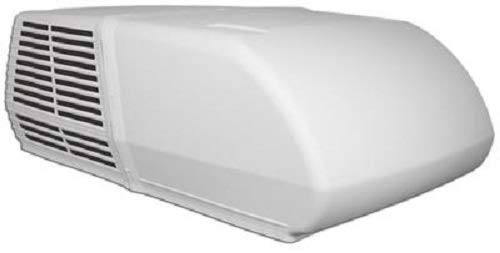
The medium-profile 15K BTU that fills a 31-foot Airstream with cold air without a second unit.
This Signature Series delivers the same top-tier cooling power (15,000 BTU / 1.25 tons) as the Mach 15 upper unit but in a medium-profile shroud that is less bulbous on your roof. The textured white finish blends in better than shiny plastic. One buyer installed it on a 31-foot Airstream and reports the unit works great, though they needed three people to get it onto the roof—two helpers on ladders plus one person on the roof itself. The non-ducted design means it blows directly into the RV rather than through ceiling ducts.
The shroud has been criticized as “a bit flimsy” in reviews, and one buyer found that two of three compressor mounts were unattached from the factory—a concerning quality-control miss at this price level. If you go this route, inspect the base pan thoroughly before hauling it onto the roof. The 115V AC electrical requirement means you will need shore power or a generator, and this unit is notably loud if installed close to the sleeping area (one reviewer noted it was noisy 4 feet from the bed).
What you pay for
- 15,000 BTU—enough to cool a large trailer or motorhome
- Medium-profile shroud is lower than older designs
- Scroll compressor is reliable and efficient
What to watch for
- Quality control: reports of loose compressor mounts from the start
- Heavy and requires at least two helpers for rooftop installation
- Non-ducted; cannot be used with an existing ducted system
Go with this if: you need 15,000 BTU in a medium-profile package and have help getting it on the roof.
Think twice if: you want a ducted air distribution system or are concerned about factory build quality on a premium-priced unit.
8. TOSOT 16000 BTU RV Air Conditioner, 43dB Ultra Quiet, Non-Ducted Rooftop AC Unit with Heat Pump and Cooling

The whisper-quiet 16K unit with a built-in heat pump that changes how you camp in spring and fall.
This TOSOT unit combines powerful 16,000 BTU cooling with a 12,500 BTU heat pump, covering year-round comfort in one rooftop package. The standout spec is the 43 dB noise level—reviewers confirm it is impressively silent for its output. One buyer with a Winnebago Revel Sprinter says the quiet operation “changed how we sleep.” The unit works in ambient temperatures from 23°F to 115°F, making it usable in most North American climates.
Smart control is built in: WiFi-ready via the Gree+ app plus a standard remote. One boondocker measured power draw at only 800 watts on high cooling, making it feasible for solar setups. The built-in heat pump eliminates the need to run a propane furnace for mild chilly mornings—just tap the control for electric warmth. However, a handful of buyers reported units that arrived with internal damage and never worked, highlighting the importance of checking both shipping packages before installation.
The strongest features
- 16,000 BTU cooling + 12,500 BTU heat pump
- 43 dB—whisper-quiet operation for undisturbed sleep
- WiFi and app control via Gree+
Potential issues
- Ships in two packages—some arrive damaged internally
- Non-ducted only; not compatible with ducted systems
- May struggle to maintain cool above 95°F, per one reviewer
Ideal for: the tech-savvy RVer who wants WiFi control, a heat pump, and the lowest noise level in this class.
Not ideal if: you need a ducted system or you want a single-box shipment that simplifies receiving and inspection.
9. Furrion Chill Cube 18k BTU Variable Speed RV Rooftop Air Conditioner, Black, Ducted, R32 Refrigerant

The 1.5-ton beast with a variable-speed compressor that delivers over a ton of cooling quietly.
At 18,000 BTU and 1.5 tons, this Furrion Chill Cube is the highest-capacity rooftop unit in the lineup, designed for large fifth wheels and Class A motorhomes. The variable-speed compressor is the key feature here—it runs continuously, ramping up and down instead of the abrupt on-off cycling that shakes the RV and draws huge surge currents. One buyer confirmed it runs at around 850 watts on a lower speed setting, making it surprisingly efficient for its size. The unit uses R32 refrigerant, which is more energy efficient than older R410A.
Weighing 72.4 lbs, it is lighter than other units in its class, and the aerodynamic black shroud reduces drag. Note that this is the AC unit only—the air distribution box (ADB) is sold separately (part B0F147CJCT), so factor that extra cost into your project. One reviewer experienced an extremely loud compressor vibration that shook the entire RV, though this seems to be an outlier among mostly positive feedback praising the quiet variable-speed operation.
Why it earns the top spec
- 18,000 BTU—the highest cooling output in this comparison
- Variable-speed compressor for quiet, efficient, continuous operation
- R32 refrigerant is more efficient and eco-friendly
What to consider
- ADB (air distribution box) sold separately—adds to total cost
- Some units have experienced loud compressor vibration
- Ducted design only; not compatible with non-ducted roof cutouts
Best for: owners of large RVs (35+ ft) who want the most cooling power available and are willing to piece together the separate ADB assembly.
Pass on it if: your rig has a non-ducted system or you want a complete kit in one box without extra parts to buy.
Understanding the Specs
BTU — Cooling Power Explained
BTU stands for British Thermal Unit, which is the amount of energy needed to raise one pound of water by one degree Fahrenheit. In an RV rooftop AC, a higher BTU rating means the unit can remove more heat from the interior air every hour. A 13,500 BTU unit is standard for small to medium trailers (up to about 30 feet), while 15,000 to 18,000 BTU is needed for larger rigs or hotter climates. The right BTU for your RV depends on its length, insulation, window area, and sun exposure.
Noise Level (dB) — How Loud is Your AC?
Decibels (dB) measure sound intensity on a logarithmic scale. A 60 dB unit is about as loud as a normal conversation; 43 dB is whisper-quiet, similar to a library. Most traditional RV ACs run between 55-65 dB, which can be disruptive for sleep. Variable-speed inverter units typically run quieter because the compressor does not cycle on and off. If you are a light sleeper or camp near other people, look for a unit rated at or below 55 dB.
FAQ
Can I install an RV rooftop AC myself?
Do I need a soft start for my generator?
What is the difference between ducted and non-ducted RV ACs?
Will a 12V DC AC work with my existing battery bank?
How long does an RV AC unit typically last?
What size AC do I need for a 30-foot RV?
Can I run my RV AC on solar power?
What is the difference between R410A and R32 refrigerant?
Final Thoughts: The Verdict
For most people, the ac for rv winner is the Coleman-Mach 15 48204C966 because its 15,000 BTU scroll compressor handles large rigs and brutal climates without a second unit. If you want off-grid freedom with 12V battery power, grab the Outequip OutEquipPro 12V. And for the quietest operation plus a built-in heat pump, the TOSOT 16,000 BTU is a strong choice.
How We Picked
We do not accept paid placement. Every pick is matched to a real buyer and a real use-case; we do not hands-on test units.
Sources & Methodology
Specifications: manufacturer listings and product documentation. Review insights: verified customer reviews, as of July 2026. Pricing: not shown on this page (it changes often); check the current price via the retailer link.
As an Amazon Associate, Gadgets Feed earns from qualifying purchases. This does not affect which products we feature.
Related Guides
Product prices and availability are accurate as of the date/time indicated and are subject to change. Any price and availability information displayed on Amazon at the time of purchase will apply to the purchase of this product. As an Amazon Associate I earn from qualifying purchases.
CERTAIN CONTENT THAT APPEARS ON THIS SITE COMES FROM AMAZON. THIS CONTENT IS PROVIDED "AS IS" AND IS SUBJECT TO CHANGE OR REMOVAL AT ANY TIME.
Amazon and the Amazon logo are trademarks of Amazon.com, Inc. or its affiliates.