
Our readers keep the lights on and my morning glass full of iced black tea. As an Amazon Associate, I earn from qualifying purchases.
Specs are compiled from manufacturer listings and verified buyer reviews and can change over time — please confirm the key details on the product page before buying.
You have just set up a new batting cage in your backyard. Before you even swing, you need to know one thing: will the netting catch everything you throw at it, or will it tear the first time you hit a real line drive? This guide cuts through the jargon to tell you exactly which batting cage netting is worth buying and why, based on the brand’s published specs and what actual buyers report after months of use.
I’m Min — the founder and writer behind Gadgets Feed. This guide is built by comparing the manufacturers’ published specifications and the patterns across verified customer reviews, so you get each pick’s real strengths and trade-offs instead of marketing spin.
These five nets represent the best across different setups and budgets, with the batting cage netting choices tested by families, travel-ball players, and coaches who put them through daily use for months on end.
Our Picks at a Glance

How To Choose The Best Batting Cage Netting
Batting cage netting looks simple — a square grid that stops balls. But three core decisions separate a net that lasts years from one you replace next season: the material it is made from, the size of the mesh holes, and the overall strength grade of the twine.
Material: Nylon vs. Polyethylene vs. HDPP
Nylon is the go-to for tear resistance and a high breaking strength — the 163lb break strength on the Wiseek net shows you what nylon can handle. Polyethylene (PE) is UV-stabilized (treated to resist damage from sunlight) by default, so it survives direct sunlight better without chemical treatments, but it has less raw impact resistance than nylon. High-Density Polypropylene (HDPP) sits between them: lighter than nylon, more weather-resistant than PE, and used on premium commercial-grade nets like the Fortress line.
Mesh Size and Net Grade
Mesh size (the distance between knots) matters for what you are stopping. A 1.75-inch mesh catches standard baseballs and softballs cleanly, while a 2-inch mesh (like the Aoneky uses) might let a golf-ball-sized training ball slip through. Net grade (#36, #42, #45, #62) refers to the denier and twist of the twine — higher numbers mean thicker strands and more mass to absorb ball impact. A #45 mesh (used by ORIENGEAR) is the standard for serious backyard cages.
Fully Enclosed vs. Open-Ended vs. Panel Net
A fully enclosed net (four walls and a roof) gives you true cage feel — balls stay inside, no chasing. A panel net is a flat sheet you hang on an existing frame or fence, which is cheaper but leaves the top and sides exposed. Some nets, like the Fortress, offer both open-ended (8x8x8 and 10x10x10 sizes) and fully enclosed versions depending on the dimensions you pick.
Quick Comparison
| Model | Best For | Material | Mesh Size | Weight | Amazon |
|---|---|---|---|---|---|
| Baseball Softball Backstop Nets, Wiseek #18★ Best Overall | Multi-sport backyard barrier | Nylon with tar coating | — | 3.69 kg | $73.71$77.60Amazon |
| NQB Baseball Net NettingTop Performer | Easy-hang kit for fences/garages | Nylon | 1.8 in | 4.03 kg | $80.74$84.99Amazon |
| ORIENGEAR Batting Cage Net | Fully enclosed backyard cage | PE, UV-stabilized | 1.88 in #45 | — | $379.99$399.99Amazon |
| Fortress Baseball Batting Cage Net | Premium commercial-grade build | HDPP, UV-stabilized | 1.75 in | 168 lb | $389.99Amazon |
| Aoneky Baseball Netting | Budget-friendly DIY cage build | Nylon, UV-resistant | 2 in | — | $389.99Amazon |
In‑Depth Reviews
1. Baseball Softball Backstop Nets, Wiseek #18 Nylon 10x30ft
Our pick — over 4.5★ from 600+ verified ratings; the strongest balance of quality and price.
Stops lacrosse rockets at 75-80mph and keeps chickens out, all on a single nylon panel rated by 602 buyers.
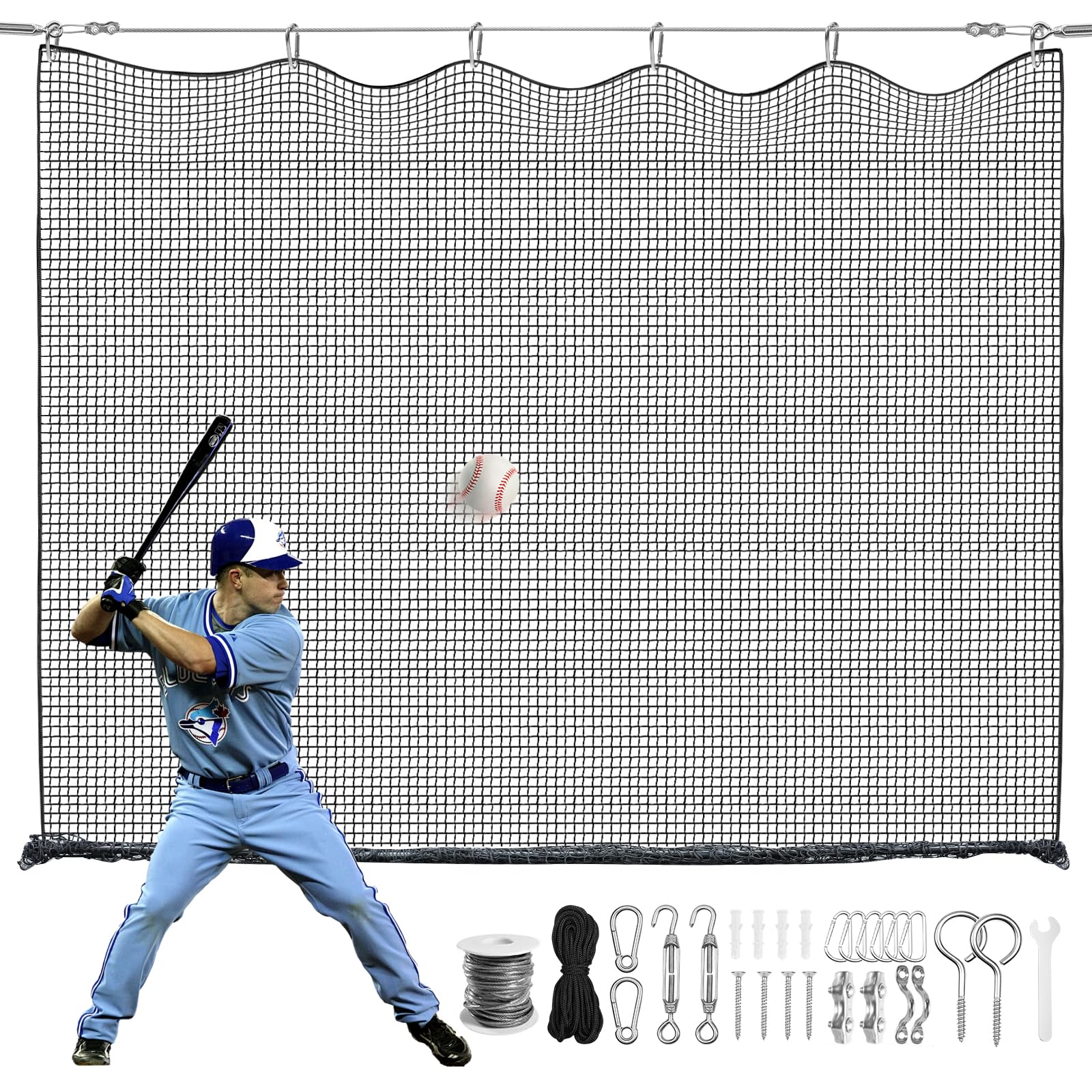
This panel net stops lacrosse rockets and cat escapes alike because it uses nylon with a tar coating (a weatherproof layer that resists UV rays and rot) to deliver a breaking strength of 163lb — that is the force each individual strand can take before snapping. It is noticeably heavier than the NQB competitor at 3.69 kilograms, which tells you the material density is there. Owners mention “my son swings a lacrosse ball at 75-80mph and so far no holes after catching missed shots,” backing up the nylon’s real-world performance.
The 10x30ft size gives you a generous backstop for a standard batting lane or a full soccer-goal extension. It mounts with carabiners, zip ties, or rope (none included), so you need your own hanging hardware. One reviewer noted using it for 18 months in hot Tijuana sun as fence extensions for soccer and volleyball — the tar coating clearly holds up. The trade-off is that this is a flat panel, not a fully enclosed cage, so side and top shots can escape if you do not build a frame around it.
Real-world winner: The sheer buyer base (602 ratings at 4.7 stars) plus the multi-sport versatility — lacrosse, baseball, chicken-run cover — make this the safest bet for anyone wanting a single panel that stops hard hits across multiple sports.
Know before buying: No included rope or hardware, so factor in a few bucks for zip ties or bungee cords.
Reach for this if… you want the most-reviewed, multi-sport nylon panel that handles daily 75+mph hits without fraying.
Look elsewhere if… you need a fully enclosed cage with walls and a roof — this is a single backstop panel only.
2. NQB Baseball Net Netting with 33ft Rope & Steel Hanging Kit
Ships with the rope and steel clips you need, so this nylon net is ready to hang on a fence or garage beam in one afternoon.
Unlike the Wiseek panel that asks you to source your own rope, the NQB comes with a 33ft rope and steel hanging kit — carabiners or clips you can attach directly to fence posts, garage beams, or a PVC frame. The net itself uses nylon with a 1.8-inch square mesh, which is tight enough to catch a regulation baseball but, as one buyer mentioned, “the holes are too big for small training baseball balls (golf ball size), they fly through the net.”
At 4.03 kilograms it is slightly heavier than the Wiseek panel at 3.69 kilograms, meaning you get a bit more material mass per square foot. This net works as a backstop or as a multi-sport barrier — buyers have used it for basketball, soccer field extensions, and volleyball court dividers. One owner reported using it “for 18 months in hot Tijuana sun for soccer field and volleyball court extensions above fences” with no wear. The 1-year manufacturer warranty adds confidence that the Wiseek’s 60-day policy does not offer.
Ready to hang
- Includes the rope and steel hanging kit — no separate trip to the hardware store
- Tight 1.8-inch mesh catches regulation baseballs and softballs cleanly
One limitation
- Training balls (golf-ball-sized) can slip through the mesh openings
- Still a panel net — not fully enclosed for side or top shots
Starting-point verdict: The kit approach (net + hanging gear) makes this the easiest install for anyone mounting to an existing fence or structure. If you value a one-year warranty over a 60-day one, the NQB earns the nod over the Wiseek.
One real catch: The 1.8-inch mesh is not small enough for lightweight training balls, so factor in the ball type you will be hitting.
3. ORIENGEAR Baseball Batting Cage Net, 55x12x12ft, #45 PE Mesh
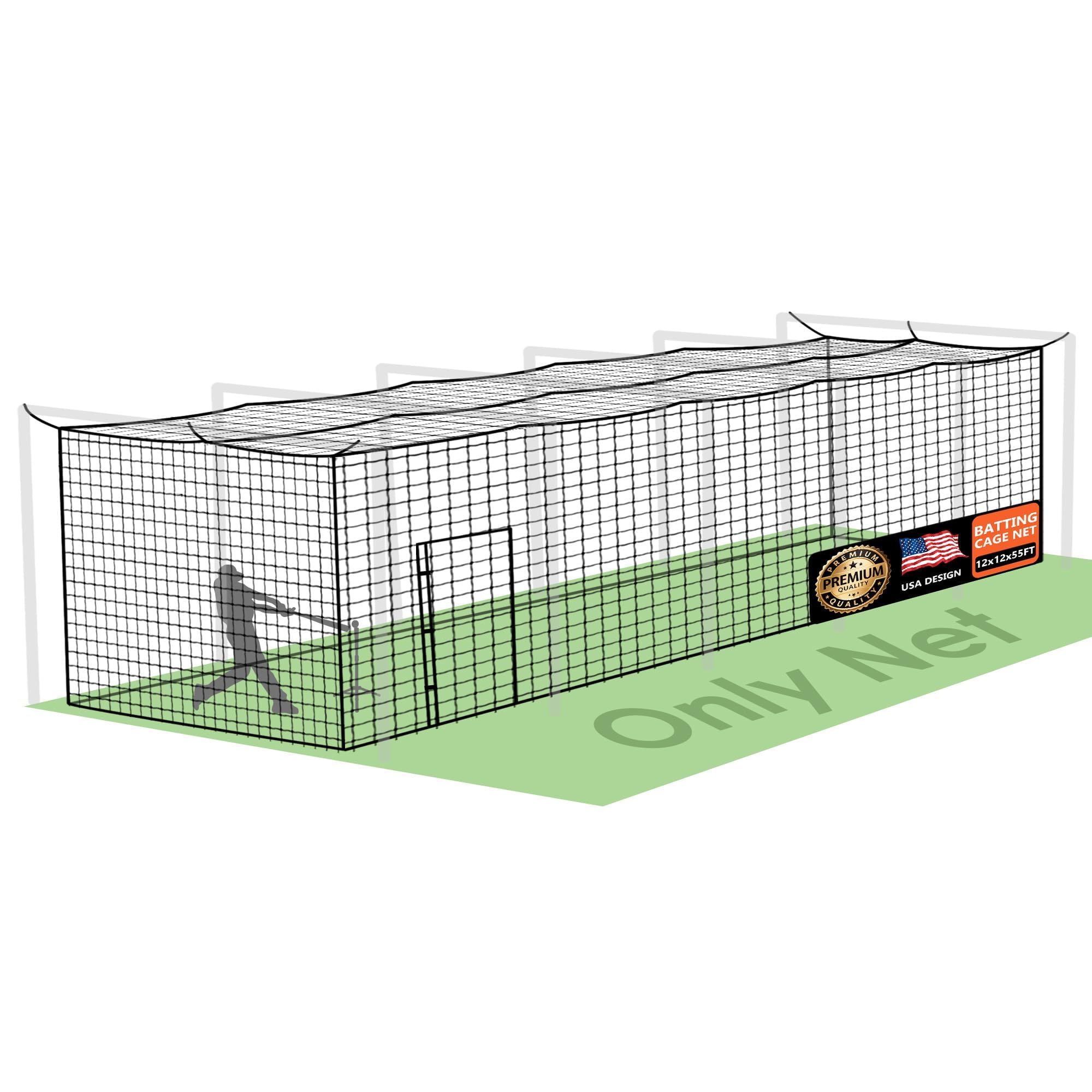
A true four-wall cage with a self-closing door and #45 PE mesh that customers note held up to a year of daily swings in the rain.
Most panel nets leave the top open. The ORIENGEAR is a fully enclosed cage net measuring 55ft long by 12ft wide by 12ft high, with four walls, a roof, and a side entry door (78.7 inches high by 31.5 inches wide) that sags closed on its own so balls stay inside. It uses 1.88-inch #45 knotted polyethylene (PE) mesh — the #45 grade is a mid-high denier that serious home cages rely on, thicker than basic #36 but not as heavy as commercial #62.
Reviewers point out “sturdy, daily use for a year with no rips” and that it held up to “constant Hawaiian rain and sun.” The three pull cords (two tethers plus a center roof tether) make setup a two-person afternoon job, though poles and hooks are not included — you supply the frame. One customer observed the lack of a pitching-machine opening as a con, so you may need to cut your own access if you plan to feed balls from outside. Unlike the Fortress net below, the ORIENGEAR gives you a built-in door from the start, which saves you having to DIY one.
All-in-one cage feel: The side door + enclosed roof + #45 mesh deliver the closest experience to a commercial batting cage without the commercial price tag.
Plan around this: No poles, no hooks, and no pitching-machine pass-through — you supply the frame and may need to modify for outside ball feeding.
Best for… the backyard builder who wants a true fully enclosed cage with a walk-in door, no DIY net-cutting required.
skip it if… you want a drop-in kit with all hardware included — this is net-only and requires a separate frame purchase.
4. Fortress Baseball Batting Cage Net, HDPP, #36 Grade, 55x12x12ft

Toughest mesh here at 1.75 inches, with HDPP twine that resists weather better than the ORIENGEAR’s PE, but you will have to cut your own door.
The Fortress uses High-Density Polypropylene (HDPP) — a material that achieves a rare balance: tougher than standard PE against UV and moisture, yet lighter than the nylon nets above. The 1.75-inch mesh is the tightest in this lineup, meaning even smaller training balls have a harder time squeezing through. The net has reinforced overlocked edges (stitched borders that resist fraying where the net meets the frame) and built-in 6ft tie cords at each corner for fast attachment. It weighs 168 pounds (whole package), a figure that reflects the commercial-grade mass of the #36 grade twine.
One reviewer who bought the 55ft size said they “ran a wire along the ground, under the dirt, to anchor the bottom edges down” and rated it highly after months of use. Another noted “no tears yet and we have hit over 1000 balls over 6 months.” The catch — and it is a real one — is that this net has no built-in door. Shoppers say having to lift the net to get in and out, or making a DIY door from PVC pipes. Unlike the ORIENGEAR which includes a side entry, the Fortress basically requires you to cut your own access if you want walk-in convenience.
Commercial-grade structure
- HDPP material is more weather-resistant than standard nylon
- Tightest mesh in the lineup (1.75 inches) stops nearly all ball sizes
- Available in three net grades (#36, #42, #62) — you can upgrade the twine thickness
Missing a door
- No built-in entry — you have to lift the net to get inside or cut your own opening
- One user highlighted holes forming at 8 months, though most reviews praise durability
Go for this if… you prioritize weather resistance and the tightest mesh, and you are comfortable making a DIY door from PVC or carabiners. If you are comparing it to the ORIENGEAR, pick the Fortress for better weather resistance and a tighter mesh; pick the ORIENGEAR if you want a door included.
Pass on it if… you want a net that comes with a walk-in door ready to use from day one.
5. Aoneky Baseball Softball Batting Cage Netting, Nylon, 45x10x10ft

Real nylon with a reinforced border, priced to let you build a backyard cage while staying affordable.
The Aoneky uses high-strength nylon cord that is UV-resistant and rot-treated, with a 2-inch square mesh — the largest spacing in this lineup. That means regulation baseballs and softballs are caught cleanly, but smaller lightweight training balls (golf-ball-sized) can pass through, similar to the NQB net above. The reinforced rope border around every edge adds structural integrity where the net takes the most stress from being stretched over a frame. This is a net-only product — no frame, no hardware, no hanging kit — so you need to supply your own structure.
Buyers report using it for cricket practice with daily use, and one noted a “professional feel with a lesser price.” At 45x10x10ft, it is sized for a medium backyard cage, and the 2-inch mesh keeps the overall weight manageable for a single-person install using conduit pipe frames and carabiner hooks. One reviewer pointed out that the door opening stitching is nearly invisible, making it hard to find during setup — a minor frustration that is note before you hang it.
Entry-level value: For the price point, you get genuine nylon with a reinforced border and UV treatment — not flimsy PE that cracks after one season.
The practical trade-off: The 2-inch mesh is your widest option here, so stick with regulation balls; anything smaller may escape.
Smart pick for the budget buyer: You get a nylon net with a reinforced border for a smaller cost than the other panels — just plan to supply your own frame and hardware.
Give it a miss if… you commonly hit with lightweight training balls that need sub-2-inch mesh to stay contained.
Understanding the Specs
Breaking Strength
This is the force (in pounds) a single strand of the net can withstand before snapping. The Wiseek net rates at 163lb break strength, meaning each individual yarn holds 163 pounds of tension before it gives. Higher break strength equals better protection against 80-mph line drives — a net with a low break number will tear on the first hard-hit ball. For reference, standard PE recreational netting often tests below 100lb, so anything in the 150lb+ nylon range is considered heavy-duty.
Net Grade (#36, #42, #45, #62)
Grade numbers refer to the denier and construction of the twine itself — the higher the number, the thicker and more durable the individual strands. A #36 net is entry-level, good for light recreational use. #45 (used by the ORIENGEAR) is the standard mid-grade choice for regular backyard practice, while #62 is commercial-grade thickness found in pro batting cages. Thicker grade means more mass to absorb ball impact and less stretch over time, but also adds overall weight to the net.
FAQ
What is the difference between nylon and polyethylene batting cage netting?
What size mesh do I need for baseball vs. softballs?
Can I use batting cage netting for other sports?
How do I hang a batting cage net without a frame?
What does the # number mean on netting (like #36, #45)?
How long does batting cage netting last outdoors?
Do I need a fully enclosed net or will a flat panel work?
Is a net with a built-in door worth paying more for?
Can I use a batting cage net indoors?
What kind of maintenance does batting cage netting need?
Final Thoughts: The Verdict
For most people, the batting cage netting winner is the Wiseek #18 Nylon Backstop Net because its proven 163lb break strength and 4.7-star rating from over 600 buyers make it the most reliable single-panel option for multi-sport use. If you want a true fully enclosed cage with a walk-in door, grab the ORIENGEAR 55x12x12ft PE Net. And for the tightest mesh (1.75-inch) in a premium HDPP build, the Fortress #36 Net sets the standard for commercial-grade durability.
How We Picked
We do not accept paid placement. Every pick is matched to a real buyer and a real use-case; we do not hands-on test units.
Sources & Methodology
Specifications: manufacturer listings and product documentation. Review insights: verified customer reviews, as of July 2026. Pricing: not shown on this page (it changes often); check the current price via the retailer link.
As an Amazon Associate, Gadgets Feed earns from qualifying purchases. This does not affect which products we feature.
Related Guides
Product prices and availability are accurate as of the date/time indicated and are subject to change. Any price and availability information displayed on Amazon at the time of purchase will apply to the purchase of this product. As an Amazon Associate I earn from qualifying purchases.
CERTAIN CONTENT THAT APPEARS ON THIS SITE COMES FROM AMAZON. THIS CONTENT IS PROVIDED "AS IS" AND IS SUBJECT TO CHANGE OR REMOVAL AT ANY TIME.
Amazon and the Amazon logo are trademarks of Amazon.com, Inc. or its affiliates.