
Our readers keep the lights on and my morning glass full of iced black tea. As an Amazon Associate, I earn from qualifying purchases.
Specs are compiled from manufacturer listings and verified buyer reviews and can change over time — please confirm the key details on the product page before buying.
Handheld 3D scanners promise to turn real objects into digital files you can edit, print, or archive, but the gap between what the box says and what you actually get can feel enormous — tracking that drifts, software that crashes, or a scan that looks like a melted blob.
I’m Min — the founder and writer behind Gadgets Feed. This guide is built by comparing the manufacturers’ published specifications and the patterns across verified customer reviews, so you get each pick’s real strengths and trade-offs instead of marketing spin.
Whether you are designing parts, preserving antiques, or feeding a 3D printer, these are the best options for a handheld 3d scanner that actually delivers usable results without demanding a second mortgage or a degree in photogrammetry.
Our Picks at a Glance


How To Choose The Best Handheld 3D Scanner
Choosing a handheld 3D scanner means matching its accuracy, light source, and software to the objects you scan. The biggest mistake is chasing resolution without checking if it works on dark plastic or if your laptop can run the software.
Accuracy vs Reality
Accuracy figures like 0.1mm and 0.02mm tell you the finest detail the scanner can distinguish, but that number only matters if the scanner can actually track on your object. A glossy black car bumper will defeat a budget 0.1mm scanner, while a 0.02mm blue-laser unit can capture the grain in a leather wallet without spray.
Light Source Determines What You Can Scan
Blue LED light is great for small detailed objects indoors. NIR (near-infrared) handles medium objects and people well but struggles with tiny features. Blue laser is the most versatile — it cuts through black, reflective, and even transparent surfaces without needing powder spray, and it handles outdoor light up to 100,000 lux.
Computer Power You Actually Need
Many mid-range scanners demand a gaming-class PC — think Intel i7 Gen10 or better, 32GB of RAM, and a dedicated GPU with 8GB VRAM. If your computer is older than three years, check the minimum specs before buying or consider an all-in-one model that processes scans on-device.
Quick Comparison
| Model | Best For | Accuracy | Light Source | Capture Speed | Amazon |
|---|---|---|---|---|---|
| Creality CR-Scan Ferret Pro★ Best Overall | Beginner entry-level scanning | 0.1mm | Infrared Structured Light | — | Amazon |
| Creality CR-Scan Raptor ProTop Performer | Pro-grade reverse engineering | 0.02mm | 22+7 Blue Laser + NIR | 60fps | Amazon |
| Shining 3D Einstar VegaStandalone Vision | Standalone on-device scanning | — | VCSEL + MEMS | 20fps | Amazon |
| EINSTAR 2 | Versatile wireless scanning | — | 17 Blue Laser + VCSEL | 90fps | Amazon |
| Revopoint POP3 Plus | Medium-object color scanning | 0.04mm | Structured Light (IR) | 18fps | Amazon |
| Revopoint INSPIRE 2 | Reflective/dark surfaces indoors | 0.03mm | Multi-line Laser + Structured Light | — | Amazon |
| Shining 3D Einstar | Body and large-object scanning | 0.1mm | 3 Infrared VCSEL | 14fps | Amazon |
| 3DMakerpro Moose Lite | Budget medium-format scanning | 0.05mm | NIR | 10fps | Amazon |
| 3DMakerpro Seal Lite | Tiny objects high detail | 0.02mm | Blue LED | 10fps | Amazon |
In‑Depth Reviews
1. Creality 3D Scanner CR-Scan Ferret Pro
An ultra-light 105g wireless scanner built for 3D printing beginners on a tight budget.
The Ferret Pro is the entry-level gateway into 3D scanning, weighing just 105g and offering Wi-Fi 6-powered wireless scanning with Android, iOS, Windows, and macOS. It captures full-color 24-bit scans with up to 0.1mm accuracy for objects ranging from 50mm to 2000mm — making it a versatile starter tool for DIY creators and 3D printing enthusiasts. The anti-shake tracking technology helps keep scans stable in your hand, and it works in outdoor light up to 30,000 lux. The all-in-one kit includes a Wi-Fi box, tripod, power bank, phone holder, and carrying case.
One buyer called it a “good unit to start with” but warned “don’t expect miracles” after struggling with tracking loss. Another buyer who has been using it for two months reported being “less than impressed with the software,” noting limited functionality and that STL is the only export format. On the positive side, a review that scanned a Rite in the Rain pen found the detail “way better than I expected” and used the scan to 3D print a custom glasses holder. It also lacks AMD graphics card support — the software crashes on AMD hardware, a known issue posted on forums and Reddit.
The Ferret Pro is 0.08mm less accurate than the Seal Lite (0.1mm vs 0.02mm), but it scans larger objects and includes color texture. If you have an Intel-based PC and want to dip your toes into 3D scanning without a major investment, this is the logical start.
Best for beginners: 105g weight, Wi-Fi 6 wireless, and full-color scans for objects up to 2000mm at an entry-level price.
Be aware: Software is buggy and limited, STL-only export, and AMD hardware is not supported.
Grab this if: You are new to 3D scanning, have an Intel-based PC, and want an affordable color scanner for larger objects.
Think twice if: You need accurate scans of small items, you use an AMD graphics card, or you want advanced software features.
2. Creality 3D Scanner CR-Scan Raptor Pro
The powerhouse that nails 0.02mm accuracy on black metal and glass without a drop of spray.
If your work demands industrial-grade detail on challenging surfaces, this is the scanner that delivers measurement-grade accuracy up to 0.02mm at a capture rate of 60fps — meaning you can scan a full human body in about two minutes. The 22 crossed blue lasers and 7 parallel blue lasers, combined with NIR infrared structured light, let it handle black, metallic, and even 71% transparent glass surfaces without any powder. Buyers report the 0.02mm accuracy is “crazy good, picking up every little detail perfectly.”
Wireless scanning via the handle and outdoor capability up to 100,000 lux make it a true field tool for automotive, industrial design, or reverse engineering — the 22-line laser mode works even in direct sunlight. You will need a serious computer — Creality recommends an i7-Gen10 CPU with 32GB RAM and an 8GB VRAM GPU.
Unlike the Revopoint INSPIRE 2 (0.05mm accuracy) that requires careful calibration and struggles with beginners, the Raptor Pro’s multi-laser system offers a wider scope: it scans objects from 5mm all the way up to 4000mm.
Why It Dominates
- 0.02mm accuracy rivals professional desktop scanners
- No spray needed on black, metallic, or 71% transparent surfaces
- 60fps capture speed with 660,000 points/second
- Full-color 24-bit RGB camera for texture
The Known Trade-offs
- Requires a high-end PC (i7 Gen10, 32GB RAM, 8GB VRAM GPU)
- Software experience is workable but not polished
- Heavy at 9.06 pounds for extended handheld use
Grab it for: Professional reverse engineering, industrial design, and automotive scanning where accuracy on any material is non-negotiable.
Think twice if: Your computer is older than three years or you want a beginner-friendly out-of-box experience without a learning curve.
3. Shining 3D Einstar Vega Wireless 3D Scanner
The scanner that holds its own computer so you can scan anywhere without a laptop.
The Einstar Vega is a completely self-contained 3D scanner — it packs an 8-core 2.4GHz CPU, 32GB RAM, and a 512GB SSD right into the handle, plus a 6.4-inch 2K AMOLED screen. That means you pick it up, scan, and save without ever connecting to a PC. It uses two scanning technologies — VCSEL projectors for medium-to-large objects and MEMS projectors for small-to-medium objects — covering a range from 100mm to 1500mm. The infrared light source works outdoors in sunshine and can scan dark surfaces and hair directly.
Wireless transfer via the Shining 3D Cloud gives you 5GB of free storage, and the hybrid alignment and 12mm markers alignment help track large objects with fewer stickers. One buyer who upgraded from the standard Einstar said it was “fast compared to other scanners” and worked on a black car interior without spray. But other reviewers point to battery life that delivers just over an hour and a user interface that “really lacks compared to the MIRACO.” The accuracy is not specified in the product data, so you are trading a defined spec for total portability.
Its all-in-one design offers mobility over the tethered Einstar 2, but the premium price and mixed accuracy reviews make it a specialist tool for cable-free workflow.
True freedom: No PC required — scan, save, and share on-device with a 6.4-inch screen, 512GB SSD, and 5GB cloud storage.
The catch: Battery lasts just over an hour, and the UI is less capable than similarly priced competitors’ software.
Reach for this if: You need to scan in the field away from any computer and want an all-in-one solution.
Look elsewhere if: You need a published accuracy guarantee or plan long scanning sessions without access to a power bank.
4. EINSTAR 2 Wireless 3D Scanner
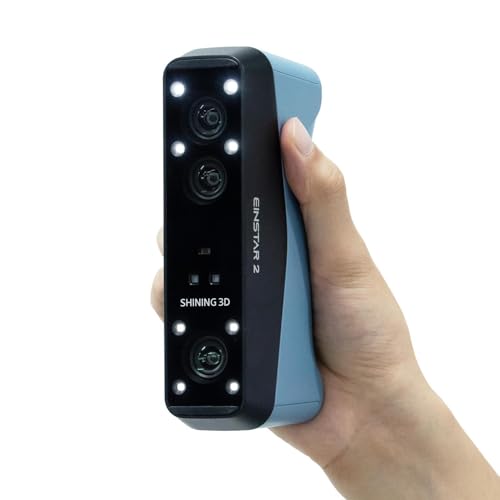
A dual-light wireless scanner that hits 90fps and handles black surfaces outdoors without spray.
The EINSTAR 2 pairs a 17-line blue laser array with VCSEL infrared scanning, so you get both high-resolution detail for small objects and fast broad-area capture for large items. In blue laser HD mode it reaches up to 90fps, while VCSEL rapid mode runs at 20fps — and it switches automatically based on what you scan. The blue laser tackles reflective and metallic surfaces directly, and outdoor performance is rated at 110,000 lux in laser mode and 70,000 lux in IR mode. A swappable built-in battery gives you up to 3 hours of wireless scanning, or you can connect via USB-C.
Buyers upgrading from the original Einstar say the “scan quality and speed is noticeably better” and that wireless range is strong enough to scan from 10-13 feet away through a window. The software — EXStar Hub — is described as easy to use and simple to start, though one buyer had a complete failure with tracking and called it junk. That split suggests a learning curve around positioning and lighting. It supports 3mm, 6mm, and 12mm markers for tracking different object sizes.
Compared to the Raptor Pro above, the EINSTAR 2 is lighter (5.72 pounds vs 9.06 pounds) and achieves a higher top speed (90fps vs 60fps), but it does not advertise a specific accuracy figure in its data — so the Raptor Pro wins on guaranteed precision while the EINSTAR 2 wins on speed and material adaptability.
Fast and flexible: 17 blue laser lines for reflective surfaces up to 90fps, plus a 3-hour swappable battery for true wireless freedom.
Watch for: No published accuracy spec, and the software setup can fail entirely on some hardware.
Best suited for: Users who scan both small mechanical parts and large objects, especially if you work outdoors or on reflective materials.
skip it if: You need a guaranteed sub-0.05mm accuracy figure or a fully turnkey experience.
5. Revopoint POP3 Plus 3D Scanner

The medium-format color scanner that upgraded its accuracy 20% over the previous generation.
The POP3 Plus is built for medium objects (20x20x20mm up to 2x2x2 meters) and brings refined precision with a new calibration board that keeps accuracy within 20 microns. Its projector adds a 1.5x and 2x optical zoom function, which extracts 30% more point cloud detail. Scanning speed reaches up to 18fps, and a 9-axis IMU stabilizes the scan to cut out frames ruined by shaky hands. It captures full-color textures using an HD RGB camera, Flash LED lighting, and advanced pixel mapping, and it uses Class 1 infrared light so it is eye-safe for scanning body parts.
The kit is comprehensive — a turntable, tripod, gimbal, tilt table, and tracking markers all come in the box. One reviewer called it “a complete and mostly user-friendly 3D scanner kit” that exceeded their needs for dimensional accuracy. But the catch is that scans take patience: you “have to move extremely slow” and often need tracking stickers unless the object has a rough texture. A few owners mention that fine edges come out too rounded for precision CAD work. It exports in PLY, OBJ, STL, ASC, 3MF, GLTF, and FBX formats and works with Revo Scan software (free) and Revo Design (paid, Windows-only).
Against the Einstar Vega above, the POP3 Plus is tethered but cheaper, and its 0.04mm precision gives you a known spec that the Vega lacks. If you need guaranteed accuracy for medium-sized objects and full color, this is the safer bet.
Detail-rich scans: 20-micron accuracy with 1.5x and 2x optical zoom for 30% more point cloud detail on medium objects.
The trade-off: Requires slow, steady movements and tracking markers for smooth results; some fine edges round off.
Choose this for: High-fidelity full-color scans of medium objects like product prototypes, art, or body parts with a complete kit included.
Not for: Fast turnaround scanning or situations where you cannot place tracking markers on the object.
6. Revopoint INSPIRE 2 3D Scanner
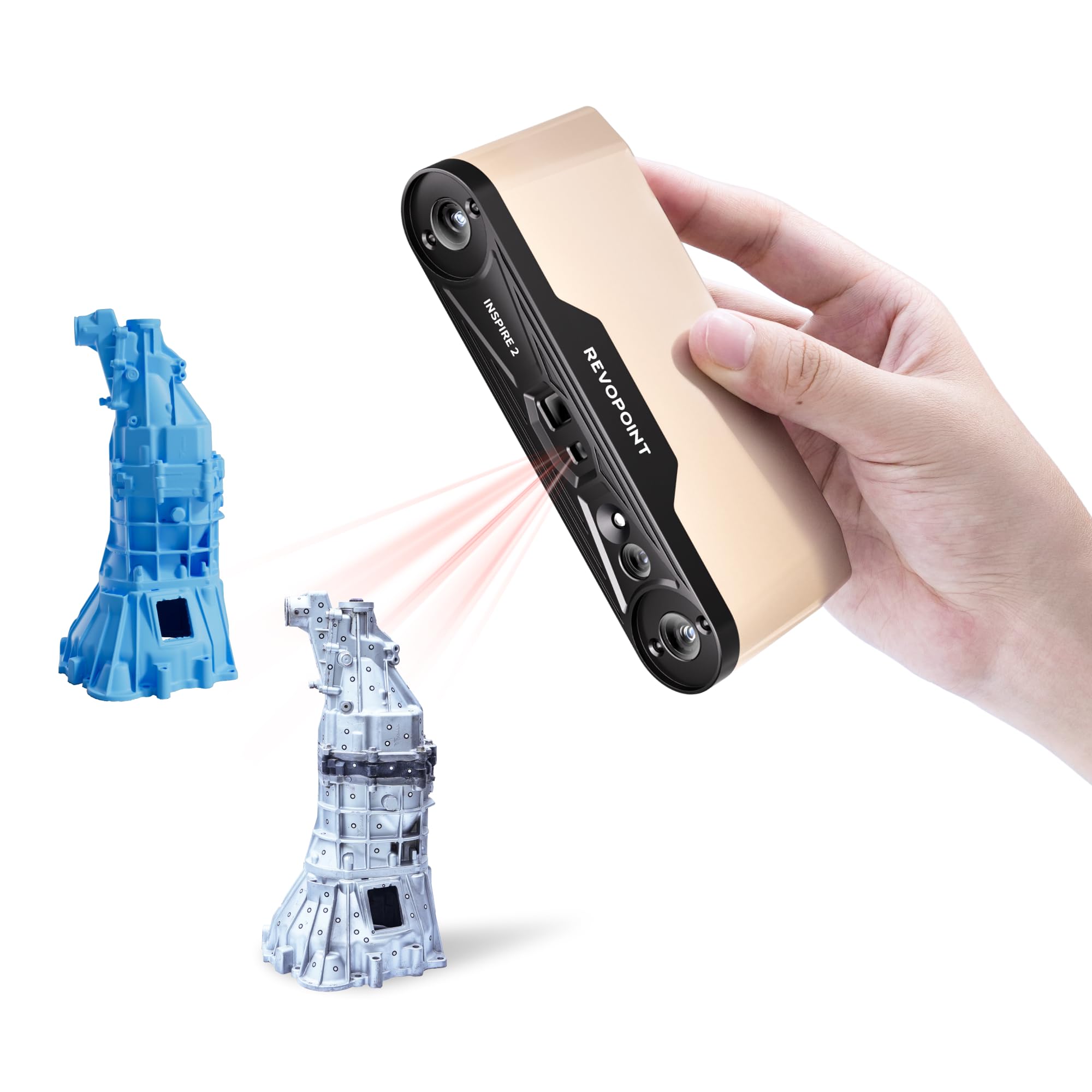
The dual-sensor scanner that switches between structured light and multi-line laser for tough surfaces.
The INSPIRE 2 gives you two scanning modules in one body: infrared structured light for general use and 11 infrared laser lines for cutting through reflective or dark surfaces — no scanning spray required. It achieves an accuracy of up to 0.05mm and precision up to 0.03mm, with a high-precision calibration board that claims to boost point cloud accuracy by 75%. It weighs only 190g and is built with an aerospace-grade aluminum alloy front panel. Built-in Wi-Fi 6 enables wireless scanning on Android, iOS, Windows, or macOS, plus real-time PC-to-mobile streaming.
Customers note that it delivers “amazing” accuracy in both laser and optical modes, with results within 0.5mm tolerance for 3D printing. The full-color RGB camera captures true-to-life textures synchronized with the geometry. However, the learning curve is real — one buyer called it “not new user friendly” and spent 30 minutes trying to calibrate without success. The included tripod is also reportedly too weak to hold the camera steady, slowly sinking over time. It comes with a mini turntable, calibration board, markers, and outdoor filters.
Compared to the Raptor Pro at the top, the INSPIRE 2 is far lighter (190g vs 9.06 pounds) and supports dual modes, but its 0.05mm accuracy is lower than the Raptor’s 0.02mm, and its outdoor limit of 20,000 lux means it is strictly for shaded or semi-bright conditions.
Versatile scanning: Dual IR structured light and multi-line laser modules handle reflective and dark surfaces without spray at 190g.
Heads up: The learning curve is steep, the tripod is underwhelming, and outdoor use is limited to shaded areas.
Ideal for: Portable indoor scanning of mixed-material objects where you need both high precision (0.03mm) and color texture.
pass on it if: You want a plug-and-play experience or plan to scan outdoors in direct sunlight.
7. Shining 3D Einstar Handheld 3D Scanner
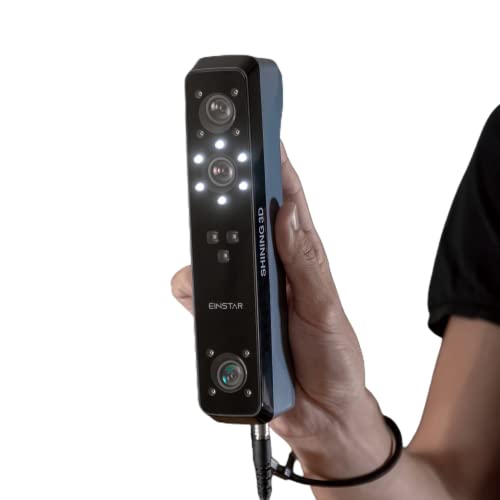
The body-and-car scanner that captures hair and dark interiors without sticky dots.
The original Einstar is designed for scanning larger objects and people, with three infrared VCSEL projectors, two stereo depth cameras, and one RGB camera for high-density point cloud data at a point distance of up to 0.1mm. It includes a dedicated “Hair Mode” that captures hair data for human scans and improves overall data completeness, and the data quality indicator on-screen guides you toward better results. The scanning speed reaches up to 14fps, and it works outdoors with stable tracking thanks to the infrared projectors. It is also the most beginner-friendly of the larger scanners — one buyer scanned the interior of their SUV “almost perfectly without adding any indicator dots, or using scanning spray.”
A buyer with 20 years of modeling experience called this “the best consumer grade scanner currently on the market” as of May 2023, praising its tracking over the Revopoint Range. But buyers also warn that it is poor with small objects — action figures and toys yield “mediocre to poor results.” It exports in OBJ, STL, PLY, ASC, 3MF, and P3 formats.
Compared to the much more expensive Einstar Vega, this model requires a tethered PC connection and has no built-in screen, but it costs significantly less and has a proven track record for large-object scanning with generous tolerance for dark surfaces.
Big-scan specialist: Captures people, car interiors, and large objects up to 14fps without spray or tracking dots on dark surfaces.
Not for small stuff: Struggles with toys and items under 5 inches — software has a steep learning curve.
Choose this for: Scanning car parts, furniture, or people with reliable outdoor performance and no need for spray.
Avoid if: Your main use is scanning small intricate objects or you want a software interface with built-in tutorials.
8. 3DMakerpro 3D Scanner Moose Lite
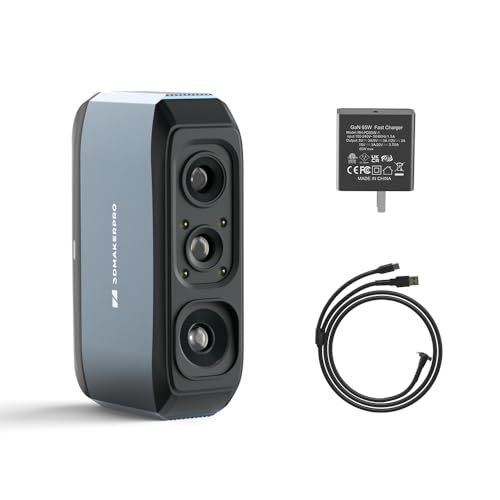
A budget-friendly medium-format scanner that trades color and speed for NIR affordability.
The Moose Lite uses an NIR light source to achieve 0.05mm accuracy and 0.1mm resolution, making it a cost-effective choice for medium objects from 15mm to 1500mm. The working distance is 150-400mm, and it captures mono texture only — no color. Scanning runs at 10fps with scan-back and anti-shake features for stability. The free JMStudio software handles alignment, error correction, and exports in OBJ, STL, PLY, and ASC formats, with lifetime free updates for Windows and macOS.
One buyer found the NIR light “improves capture quality” and the 0.05mm accuracy “sufficient for base mesh” work, with a 30-minute learning curve for CAD-experienced users. But the reviews are sharply divided — multiple buyers call it “garbage” and “does not work as intended,” specifically failing on dark objects and returning scans that are “all wrong.” The software is described as needing an overhaul, and one reviewer noted it is “not worth ” compared to scanners starting at. It comes in Standard, Premium, and Luxury kits, but the base model includes only the scanner, 65W charger, data cable, and a 1-year warranty.
Against the Seal Lite from the same brand (which offers 0.02mm accuracy at the same price), the Moose Lite handles larger objects at a lower resolution. The Seal Lite is the better choice for tiny high-detail items, while the Moose Lite is for bigger projects where absolute precision is less critical.
Budget medium-format: 0.05mm accuracy and 150-1500mm range for medium objects at a lower cost.
Hard trade-offs: Mono texture only, 10fps speed, and unreliable performance on dark surfaces with poor software.
Consider this if: You are on a tight budget and scanning lighter-colored medium objects where mono output is acceptable.
Skip if: You need color capture, fast scanning, or reliable results on dark surfaces.
9. 3DMakerpro 3D Scanner Seal Lite
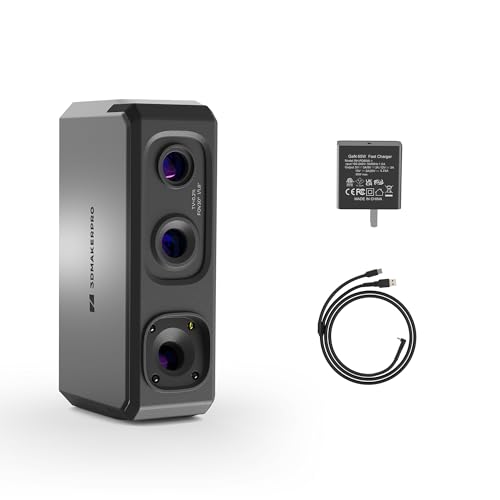
A blue-light scanner that brings 0.02mm accuracy to small-tabletop objects for just over.
The Seal Lite uses a blue LED light source (400-500nm wavelength) to project finer structured light, achieving an impressive 0.02mm accuracy — the same spec as the Raptor Pro at a fraction of the price. It is designed specifically for small-format scanning of objects from 10mm to 300mm, with a recommended working distance of 180-280mm. It runs at 10fps with scan-back and anti-shake features for stable results, and it captures mono texture only (no color). The free JMStudio software supports visual tracking, error correction, auto-alignment, and export in OBJ, STL, PLY, and ASC formats.
Reviewers point out that it is “refreshingly simple” to set up and “produces decently accurate scans” after overcoming the learning curve, but the documentation is poor. One buyer returned the unit after days of failed scans because it “cannot scan anything black or tiny” — a 1/2 inch flag from a Christmas ornament was too small. That 0.02mm accuracy is only achievable on suitable objects within the 10-300mm range, and it requires a powerful PC to run the JMStudio software smoothly. It includes a 65W charger and data cable but no turntable or tripod.
This is the direct alternative to the Creality Ferret Pro below — the Seal Lite offers five times better accuracy (0.02mm vs 0.1mm) but only for small objects, while the Ferret Pro handles items up to 2000mm. If your focus is tiny tabletop items, the Seal Lite is the better tool; if you need versatility, the Ferret Pro wins.
Why It Shines
- 0.02mm accuracy rivals scanners ten times its price
- Blue LED captures fine edge textures on small objects
- Scan-back and anti-shake features for stable handheld use
- Lifetime free JMStudio software updates
The Limits
- Cannot scan black or very tiny objects reliably
- Needs a powerful PC — gaming laptop or desktop
- Mono texture only, no color capture
- Poor documentation adds to the learning curve
Reach for this if: You scan small detailed objects like coins, jewelry, or mechanical parts and need the best accuracy your budget allows.
Look elsewhere if: You need to scan dark, black, or tiny items, or you want color textures.
Understanding the Specs
Accuracy and Precision
Accuracy (the spec you see in millimeters, like 0.1mm or 0.02mm) tells you how close the scan is to the real object’s measurements. A 0.02mm scanner can resolve details as fine as a human hair, while 0.1mm is fine for larger objects like car bumpers or furniture. Precision, sometimes listed separately, means the scanner can repeat that measurement reliably. For reverse engineering or parts fitting, aim for 0.05mm or better. For hobby 3D printing, 0.1mm is often plenty.
Light Source Types
The light source determines which surfaces the scanner can read. Blue LED light (400-500nm wavelength) projects fine structured light for small objects and high accuracy indoors. NIR (near-infrared) light covers medium objects and people but struggles on dark surfaces. Blue laser is the most powerful — it reflects off black, metallic, and even transparent surfaces without spray, and it works outdoors in bright sunlight up to 100,000 lux. If your objects include dark plastic, painted metal, or glass, blue laser is your friend.
FAQ
Can a handheld 3D scanner scan black or reflective objects without spray?
What computer specs do I need for a handheld 3D scanner?
How accurate is a budget handheld 3D scanner compared to an expensive one?
Can I use a handheld 3D scanner outdoors in sunlight?
What is the difference between 0.1mm and 0.02mm accuracy in real use?
Do I need a turntable to use a handheld 3D scanner?
Can I scan a person with a handheld 3D scanner?
What file formats do handheld 3D scanners export?
How long does it take to learn to use a handheld 3D scanner?
Final Thoughts: The Verdict
For most people, the handheld 3d scanner winner is the Creality CR-Scan Raptor Pro because it delivers professional 0.02mm accuracy on any material — black, metallic, glass — without spray, at a speed that makes large scans practical. If you want a standalone device that works without a computer, grab the Shining 3D Einstar Vega. And for the best budget entry point with full color and wireless scanning, the standout is the Creality CR-Scan Ferret Pro for beginners with Intel-based PCs.
How We Picked
We do not accept paid placement. Every pick is matched to a real buyer and a real use-case; we do not hands-on test units.
Sources & Methodology
Specifications: manufacturer listings and product documentation. Review insights: verified customer reviews, as of July 2026. Pricing: not shown on this page (it changes often); check the current price via the retailer link.
As an Amazon Associate, Gadgets Feed earns from qualifying purchases. This does not affect which products we feature.