
Our readers keep the lights on and my morning glass full of iced black tea. As an Amazon Associate, I earn from qualifying purchases.
Specs are compiled from manufacturer listings and verified buyer reviews and can change over time — please confirm the key details on the product page before buying.
If you have sliding or crank-out windows, standard air conditioners usually do not fit — and that is the exact problem a casement window air conditioner solves. This guide compares the top models that actually slide into your window’s track, so you get real cooling without fighting the hardware.
I’m Min — the founder and writer behind Gadgets Feed. This guide is built by comparing the manufacturers’ published specifications and the patterns across verified customer reviews, so you get each pick’s real strengths and trade-offs instead of marketing spin.
You will see how much floor area each unit handles, which ones fit narrow casement openings, and what real owners discovered during installation — everything you need before buying a casement window air conditioner.
Our Picks at a Glance

How To Choose The Best Casement Window Air Conditioner
Casement windows slide left to right or crank outward — the frame is different from a standard double-hung window. That means you cannot just buy any window AC; you need one engineered for this shape. Here is what matters most.
BTU Rating vs. Room Size
The British Thermal Unit (BTU) rating tells you how much heat the unit can push out of the room. A higher number means faster cooling in a larger space. For casement units, 8,000 BTU typically handles rooms up to 350 square feet, and 10,000 BTU covers 400 to 450 square feet. Match the BTU to your actual room size — too high and the unit short-cycles without removing humidity; too low and it never catches up on hot days.
Window Dimensions and Fit
Casement window ACs come with a sliding bracket that must match your window’s minimum and maximum width and height. Check the smallest opening your window allows: many units work between roughly 15 and 16 inches wide and need at least 21 inches of vertical clearance. Measure your window frame before you buy — one reviewer noted that a 14.5-inch opening was a tight squeeze but eventually fit.
Extra Features That Matter
A built-in dehumidifier removes moisture while cooling, which helps in humid climates. Remote control with Follow Me technology lets the thermostat sense temperature near the remote rather than at the unit. A programmable timer and Sleep or Energy Saver modes cut electricity use when you are not in the room. Tilt-out filter access makes cleaning simple without removing the whole unit from the window.
Quick Comparison
| Model | Best For | BTU | Room Area | Annual Energy Use | Amazon |
|---|---|---|---|---|---|
| Perfect Aire 10,000 BTU★ Best Overall | Best Overall Versatility | 10,000 | 400 to 450 sq. ft. | 1,000 kWh | Amazon |
| Keystone 8,000 BTU | Truly Narrow Windows | 8,000 | 350 sq. ft. | 734 Watts | Amazon |
| Durastar 10,000 BTU | Strong Cooling per Dollar | 10,000 | 450 sq. ft. | 977.5 Watts | Amazon |
In‑Depth Reviews
1. Perfect Aire 10,000 BTU Slider Air Conditioner
Our pick — over 4★ from 300+ verified ratings; the strongest balance of quality and price.
The room-filling 10,000-BTU unit that fits both horizontal and crank casements.
The Perfect Aire cools the largest room in this lineup — 400 to 450 square feet — with a 10,000 BTU (British Thermal Units, a measure of cooling power) output. That covers most living rooms or master bedrooms, and you can set the temperature from 62°F to 86°F to dial in exactly where you want it. The expandable window kit fits horizontal sliding or crank-out casement windows with a minimum width of 15½ inches and a maximum height of 39½ inches, generous enough for most narrow openings. You also get three speeds in both cool and fan modes, plus a full-function remote with Follow Me technology — the remote acts as a portable thermostat, sensing temperature right where you sit rather than at the loud unit.
Buyers report that installation requires window sill modification and drilling a drain hole, but once in place it “cools uninsulated apartment fantastically” and outperforms portable ACs. One owner noted constant water drainage from the compressor, so plan for a drip pan or exterior hose. On the upside, the front-mounted tilt-out air filter makes cleaning a breeze — you do not have to wrestle the unit out of the window every spring.
The Perfect Aire consumes 1,000 kWh annually, which is higher than the smaller Keystone but expected given the larger BTU output. The main trade-off: at 0.8 tons, this is a heavy unit, and the required sill modification might scare off renters.
Versus the field: The Perfect Aire leads on room area — 400 to 450 square feet — matching the Durastar but serving a wider window-height range. If your windows are tall or you need crank-window compatibility, this one beats the others on fit.
The honest caveat: The required drain-hole drilling and constant water drainage mean this is not a “set and forget” unit — expect some ongoing management.
Reach for this if: you have a large room (up to 450 sq. ft.) with a crank or slider window and want remote-controlled thermostat sensing from anywhere in the room.
Look elsewhere if: you cannot drill into your window sill or you are avoiding any water-drain maintenance — the constant compressor drainage is a real hassle.
2. Keystone 8,000 BTU Slider Window Air Conditioner and Dehumidifier
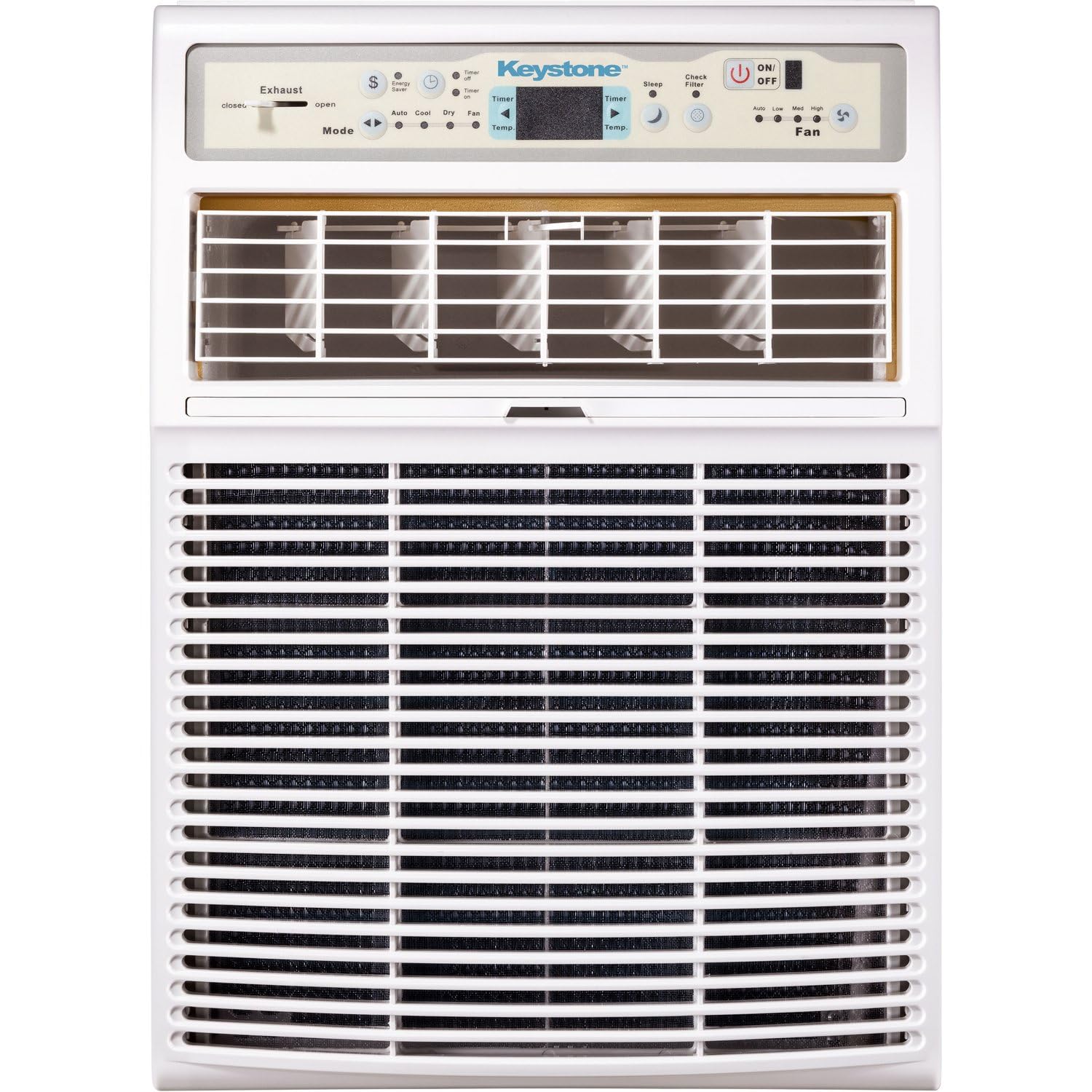
The 8,000-BTU unit that slid into a 14.5-inch casement opening without a fight.
The Keystone is built for truly narrow windows — its adjustable kit fits a minimum window width of just 15.5 inches, and one verified buyer confirmed it “fits in my 14.5 inch casement window.” That is narrower than the Perfect Aire or Durastar can handle. It cools rooms up to 350 square feet, making it a strong match for bedrooms and small living rooms. On top of cooling, it pulls 0.9 liters of moisture from the air every hour via the built-in dehumidifier — a real bonus in humid climates where sticky air makes the room feel warmer than it is.
You get three cooling modes, three fan speeds, and 4-way adjustable air louvers so you point the breeze exactly where you want it. The Energy Saver and Sleep modes automatically cycle the compressor to cut electricity use — a clear benefit given its annual energy consumption of 734 Watts, which is significantly lower than the 977.5 Watts of the Durastar. Buyers noted the unit is heavy (around 73 lbs) and the included instructions are not intuitive, so set aside a couple of hours for a careful installation. One owner mentioned repairing minor damage to the louvers and foam from shipping, but still found the cooling powerful enough to recommend the unit.
Compared to the higher-BTU picks, the Keystone gives up 2,000 BTU and 100 square feet of coverage, but it compensates with lower energy use and a smaller footprint that fits windows the others cannot. The removable chassis also works for through-wall installation if that fits your space better.
Why it fits tight spots
- Fits windows as narrow as 14.5 inches (verified by buyers)
- Built-in dehumidifier removes 0.9 liters of moisture per hour
- Energy Saver and Sleep modes reduce power draw to 734 Watts
Installation reality check
- Heavy at roughly 73 lbs — requires two people for safe mounting
- Instructions are unclear; save the manual to decode the button functions
Made for you if: your casement window is extra narrow (under 16 inches) and you want a dehumidifier built into the cooling cycle so your room feels less sticky.
Not your unit if: you need to cool more than 350 square feet — step up to a 10,000 BTU model for larger spaces.
3. Durastar DRCAC101XNA1 10,000 BTU 115V Casement Air Conditioner
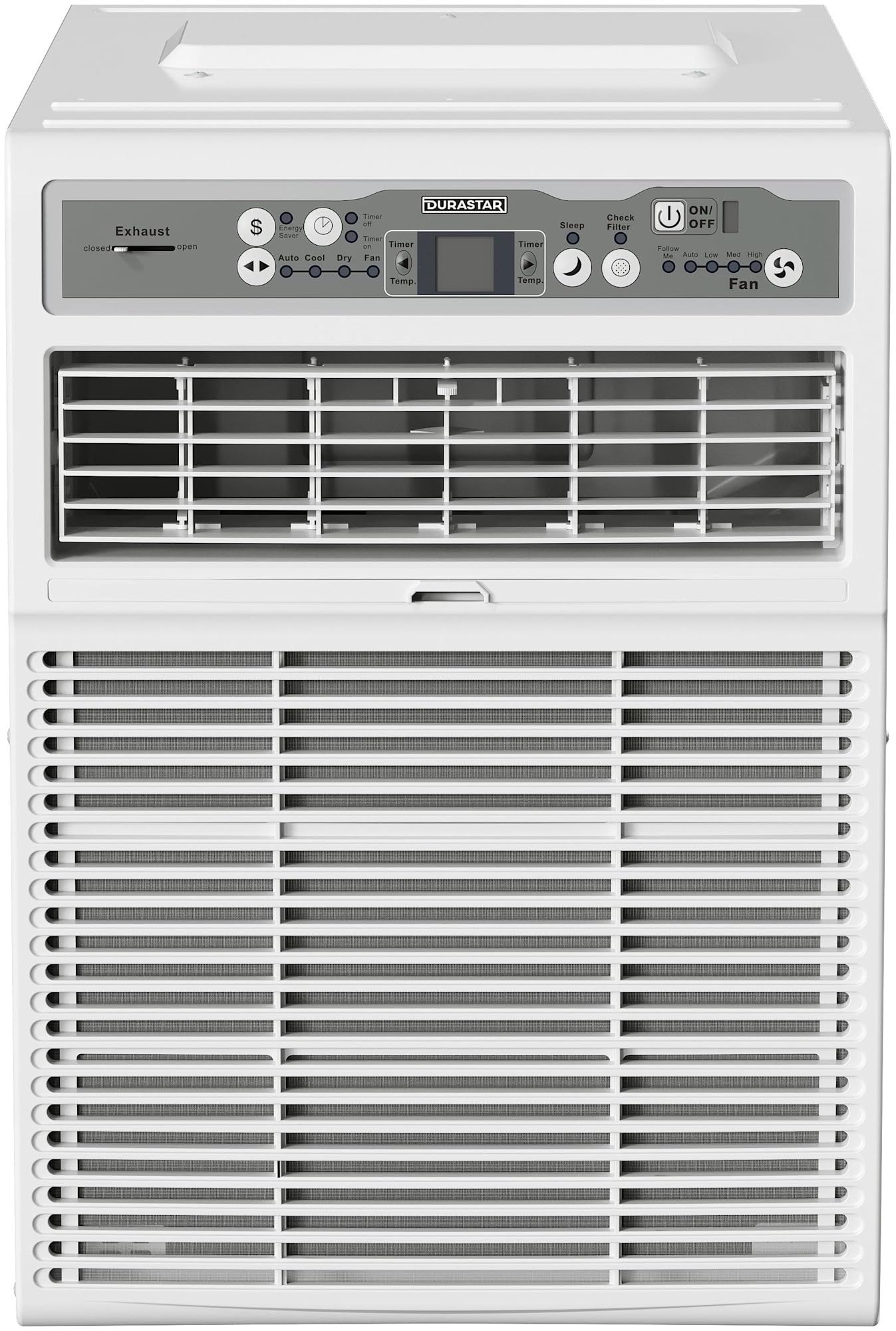
The 10,000-BTU brute that is designed strictly for left-right slider windows.
The Durastar packs the same 10,000 BTU cooling power as the Perfect Aire, covering 400 to 450 square feet, but it is engineered exclusively for casement (side-sliding) windows — it will not fit a vertical double-hung frame. That laser focus means the bracket fits casements tightly. It includes a digital display, three fan speeds (offering 324, 294, and 265 CFM, or cubic feet per minute of airflow), a sleep mode, and a dehumidifier function. The remote control has a 16-foot range, and the Nema 5-15P plug works with any standard 115V outlet at 8.5 amps.
Buyer experiences are mixed: one owner says it runs “well made runs great,” while another reported their unit “lasted 8 months and locked up.” A third reviewer described the unit as “decent ac but noisy.” That reliability concern is worth weighing — especially compared to the Perfect Aire’s stronger 4.2-star average across 341 ratings. On the bright side, the Energy Efficiency Ratio (EER, a measure of cooling output per watt) of 10.4 with energy saver mode is solid, and the annual energy consumption of 977.5 Watts is noticeably lower than the Keystone’s 734 Watts — however, remember the Durastar is pushing 10,000 BTU versus the Keystone’s 8,000 BTU, so you are getting more cooling per watt.
One factor that may tip the decision: unlike the Perfect Aire which needs a drain hole, the Durastar includes a dehumidifier and reportedly has fewer water-drainage complaints. But the smaller sample size (only 20 ratings) makes long-term durability harder to judge than the competition.
If you push for maximum power: The Durastar matches the Perfect Aire on BTU and room area (10,000 BTU / 450 sq. ft.) while costing less on the sticker. You trade some reliability confidence and a slightly noisier operation for higher raw cooling per dollar.
The deal-breaker to watch: Multiple owners mention units arriving damaged or failing within a year — inspect yours immediately after delivery and test it before the return window closes.
Choose the Durastar if: you have a casement-only window, want the strongest BTU for the price, and are comfortable checking the unit right away for defects.
Pass on it if: confidence matters more — the Perfect Aire’s longer track record and higher average rating make it a safer bet for the same cooling area.
Understanding the Specs
BTU (British Thermal Unit)
This number tells you how much heat the air conditioner can remove from the room per hour. A higher BTU cools a larger space faster. For a casement window AC, 8,000 BTU handles rooms up to about 350 square feet, while 10,000 BTU covers 400 to 450 square feet. Too-low BTU means the unit runs nonstop and never catches up; too-high BTU cools too fast without removing humidity, leaving the room clammy.
Annual Energy Consumption (Watts / kWh)
Annual energy use shown in Watts or kilowatt-hours tells you how much electricity the unit draws during normal operation. Lower numbers are easier on your electric bill. The Keystone uses 734 Watts, the Durastar uses 977.5 Watts — but remember, the Durastar also pushes 25% more cooling power (10,000 BTU vs. 8,000 BTU). Always compare energy use within the same BTU class for a fair read.
Window Fit (Min / Max Dimensions)
Casement ACs include a sliding bracket that must match your window’s opening width and height. Minimum width is usually around 15 to 16 inches, and minimum height is around 21 inches. If your casement window is narrower than the spec, the unit will not fit. Measure your window frame at its narrowest and shortest points, then check that against the product’s listed dimensions.
Dehumidifier (Liters per Hour)
This spec tells you how much moisture the unit pulls from the air while cooling. The Keystone removes 0.9 liters per hour, which helps in humid areas. A built-in dehumidifier makes the room feel cooler at the same temperature setting because less moisture means your sweat evaporates more easily. If you live in a humid climate, this feature can make a bigger comfort difference than an extra 1,000 BTU.
FAQ
What is the difference between a casement and a standard window AC?
Will an 8,000 BTU casement AC cool a bedroom?
How do I measure my window to see if a casement AC fits?
Do casement window ACs come with a remote control?
Can I install a casement AC in a double-hung window?
What does the dehumidifier function do in a window AC?
How loud are casement window air conditioners?
Do I need to drill a drain hole for a casement AC?
What is the Energy Efficiency Ratio (EER) and why does it matter?
How long do casement window ACs typically last?
Final Thoughts: The Verdict
Across the board, the casement window air conditioner winner is the Perfect Aire 10,000 BTU Slider AC because it covers the largest room area (400 to 450 sq. ft.), fits both slider and crank windows, and has the strongest buyer track record. If you want a unit that fits a truly narrow casement opening and adds a dehumidifier, grab the Keystone 8,000 BTU. And for maximum cooling power per dollar in a casement-only window, the Durastar 10,000 BTU delivers the most BTU per watt — but be ready to inspect it promptly for defects.
How We Picked
We do not accept paid placement. Every pick is matched to a real buyer and a real use-case; we do not hands-on test units.
Sources & Methodology
Specifications: manufacturer listings and product documentation. Review insights: verified customer reviews, as of July 2026. Pricing: not shown on this page (it changes often); check the current price via the retailer link.
As an Amazon Associate, Gadgets Feed earns from qualifying purchases. This does not affect which products we feature.