
Our readers keep the lights on and my morning glass full of iced black tea. As an Amazon Associate, I earn from qualifying purchases.
Specs are compiled from manufacturer listings and verified buyer reviews and can change over time — please confirm the key details on the product page before buying.
You can put away the squeegee, the bucket of soapy water, and definitely the ladder. An automatic window washer is a robot that crawls across your glass, scrubs off the grime, and dries it streak-free — all while you stay on the ground. The trick is picking one that actually sticks, navigates your window frames, and leaves glass clear instead of smeared.
I’m Min — the founder and writer behind Gadgets Feed. This guide is built by comparing the manufacturers’ published specifications and the patterns across verified customer reviews, so you get each pick’s real strengths and trade-offs instead of marketing spin.
The goal is to help you find the right automatic window washer for your home, based on suction power, battery life, and how well it handles tricky edges.
Our Picks at a Glance


How To Choose The Best Automatic Window Washer
Not every robot handles every window the same way. Before you pick one, you need to match the machine to your windows, your safety needs, and how much you want to be involved in the process.
Suction Power and Safety
A suction motor’s grip on the glass is measured in Pascals (Pa). More suction means the robot is less likely to fall, especially on large or outdoor windows. Look at the peak suction number — models around 3000Pa are adequate for indoor panes, while 6500Pa provides a much more secure hold for high-rise glass.
Navigation and Edge Cleaning
Smart navigation (often called SLAM, which stands for Simultaneous Localization and Mapping, or AI path planning) determines whether the robot cleans in a systematic S-pattern or wanders randomly. Good navigation means it hits every spot without missing corners. The best models have edge detection that guides them right up to the frame, though few get into the very corner.
Water Spray and Cleaning Modes
Most robots spray water or a cleaning solution onto the glass before scrubbing. Dual-nozzle and triple-nozzle designs cover a wider area per pass, which cuts down on time. Some offer multiple cleaning modes — like spot clean for a single dirty pane or edge mode for focused work — which can be useful for homes with mixed window types.
Quick Comparison
| Model | Best For | Max Suction | Battery Life | Water Tank | Amazon |
|---|---|---|---|---|---|
| ECOVACS W2 PRO Omni★ Best Overall | All-round premium with station | — | 110 min | — | Amazon |
| ECOVACS W2S OmniPrecision Edge | TruEdge edge-to-edge precision | — | 110 min | 80 microliters | Amazon |
| HUTT S55 Pro | High suction for high-rise windows | 6500Pa | 30 min | 80 ml | Amazon |
| Tosima W5 | Value with adaptive suction | 6400Pa | 40 min | 65 ml | Amazon |
| Tosima W3 | Budget-friendly entry model | — | — | 80 ml | Amazon |
| CHOVERY CL3 | Budget pick with dual spray | 3300Pa | 30 min backup | — | Amazon |
In‑Depth Reviews
1. ECOVACS WINBOT W2 PRO Omni
Our pick — over 4★ from 650+ verified ratings; the strongest balance of quality and price.
This robot cleans up to 55 square meters on a single charge, using a 6-in-1 station that handles everything.
You get a 6-in-1 multifunction station that acts as a control panel, charger, stabilizer, and storage box so you do not have to hunt for parts. The triple-nozzle wide-angle spray wets the glass ahead of the scrubbing pad, and buyers report that “it exceeded my expectations” after watching it clean a glass door in about 20 minutes. The WIN-SLAM 4.0 path planning (its smart navigation system) means it navigates around frames and edges with fewer gaps.
It includes 12-stage protection hardware and software safety, which covers an anti-drop sensor and emergency backup. The robot runs for up to 110 minutes in battery mode, covering around 55 square meters, and switches to plugged-in mode for continuous cleaning on large panes. The robot is heavier than some, at about 20 pounds with the station, but that weight is part of the stability.
The main downside is that it still sometimes struggles with tight corners and needs a clean rag to avoid leaving marks. One reviewer noted that the pad can slip if too much liquid is left on the glass. Still, for a mix of indoor and outdoor windows where you want minimal hands-on time, this is the most complete package.
Why it wins: The W2 PRO Omni combines a long battery life of 110 minutes, triple spray, and a full station into one box that handles most windows with little babysitting.
One trade-off: At 20 pounds with the station it is not portable for quick spot-cleaning, and the initial setup involves learning the app controls.
Best for: Homeowners with multiple large windows both inside and out who want a single premium device that charges, stores, and operates from one station.
skip it if: You want to clean a few small bathroom windows — the station detail and 20-pound weight are overkill for tiny panes.
2. ECOVACS WINBOT W2S Omni
Its TruEdge scrubbing pads clean within millimeters of the frame, so you get fewer missed strips than the W2 PRO Omni leaves behind.
The defining feature of the W2S Omni is its TruEdge technology — high-speed scrubbing pads that reach closer to the edge of the glass than standard robots. This matters if you have floor-to-ceiling panes or large glass doors where corner grime is visible. Upgraded triple-nozzle spray handles dust, fingerprints, and light stains in fewer passes than the earlier W2 PRO.
It uses the same 6-in-1 OMNI station as its sibling, giving you 110 minutes of cordless cleaning. Owners mention it “sticks securely to the glass, cleans thoroughly, and leaves windows looking crisp.” A reviewer with a 2-story home mentioned it handled 7 surfaces (4’x7′ each) before the battery gave out. The included safety rope and 12-level safety system give you real confidence for outdoor or second-story use.
The catch some owners flagged: the sensor feet can leave dust lines on outside windows, and the robot leaves a small dirty spot at the end of each cleaning cycle. It also gets hung up on low window glazing beads. The 80-microliter water tank is very small — you will refill it often. The price is also higher than the W2 PRO Omni, but for buyers who need that extra millimeter of edge cleaning, it justifies the premium.
Precision cleaning: TruEdge pads are the clear advantage here — they reduce those missed corner strips that other robots leave behind.
One real frustration: The 80-microliter tank means frequent refills, and the battery takes around 2 hours to recharge after a 110-minute session.
Grab this if: You have large, open-plan windows or floor-to-ceiling glass where edge-to-edge precision matters more than tank size.
Look elsewhere if: You clean many small panes — the small water tank means constant stops to refill, and the price is higher than most entry models.
3. HUTT S55 Pro
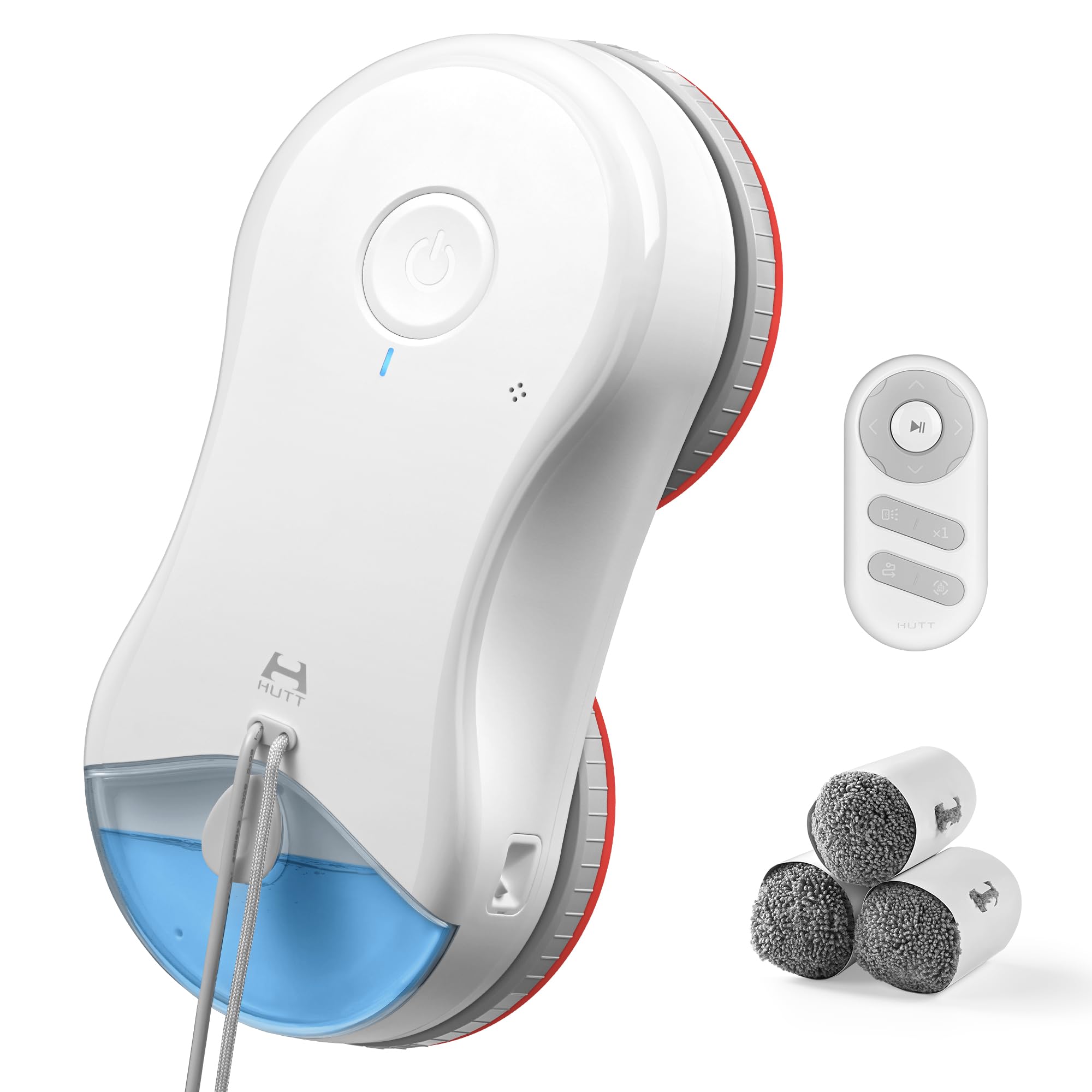
An 80ml tank and 6500Pa peak suction give you the strongest grip in this list, so it stays secure on high-rise glass.
The HUTT S55 Pro centers on a patented 3D floating pad system with spring suspension that keeps the cleaning surface in constant contact with the glass. This design, paired with adaptive suction that adjusts automatically up to 6500Pa, means it holds steady on vertical panes even when the pad gets wet. The HydroJet pump spray delivers large droplets for dissolving common stains, and the 80ml tank is visible so you know when to refill.
Its SLAM 4.0 navigation uses dual drive motors and multi-sensor detection for a systematic Z-path pattern. One reviewer called it “kick ass” and noted it saves per year in professional cleaning costs. Another owner found the remote control sluggish but said the robot works fine without it. Buyers especially like it for high windows where a ladder simply isn’t an option.
One trade-off: at a 30-minute battery life, it is shorter than the ECOVACS W2 PRO Omni’s 110 minutes, and multiple passes are often needed for very dirty glass. The pad clips are also a tight fit — a few reviewers complained they are hard to install. For the price, though, it gives you the highest peak suction of any model in this list, which is a big safety plus for exterior windows.
Why it stands out
- 6500Pa peak suction is among the highest here — great for outdoor or large vertical panes.
- 80ml water tank with HydroJet spray covers more glass per refill than the W2S Omni’s 80 microliters.
- Customers note it eliminates ladder work for high exterior windows.
The two main drawbacks
- 30-minute battery life means you need a power outlet or a quick break between zones.
- The remote control can be unresponsive, though the machine works fine via the button on the unit itself.
Reach for this if: You have exterior windows on a second story or higher and suction security is your top concern — 6500Pa is the strongest in this roundup.
Look elsewhere if: You want a single unbroken cleaning session for more than 30 minutes without a nearby wall outlet.
4. Tosima W5
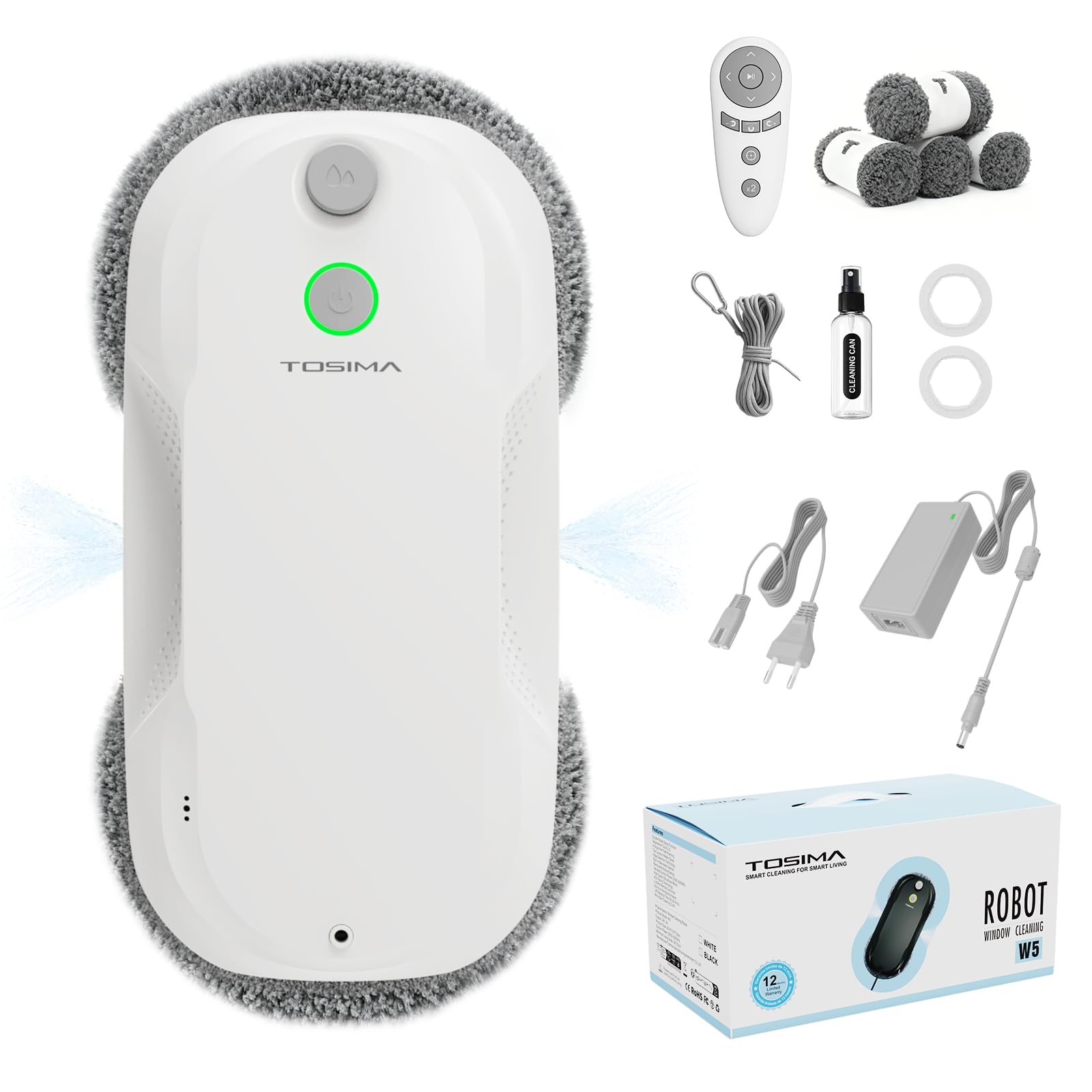
It has 6400Pa adaptive suction and a bidirectional ultrasonic atomization spray that turns water into a fine mist to reduce streaking.
The Tosima W5 uses variable-frequency suction that ramps up to 6400Pa and adapts to the dirt level on the glass, so it applies more hold when it hits a stubborn spot. Its bidirectional ultrasonic atomization spray means the water turns into a fine mist before hitting the glass, which can reduce streaking compared to older spray nozzles. The externally visible 65ml tank is small but easy to monitor, and the robot intelligently stops spraying when it detects the edge of the window.
Reviewers point out that it “cleans well and saves time” and one owner noted it paid for itself after cleaning half the house. The dual-spiral cleaning pattern helps it cover the glass systematically. It weighs about 4 pounds, making it one of the lighter options here, which is convenient for moving it between rooms.
There are some real-world limits: the W5 leaves a round mark where it stops, and the corner cleaning is not perfect. A reviewer had it fall off the glass twice when the pads were too wet, so the included safety strap is mandatory. The 40-minute battery is better than the HUTT S55 Pro’s 30 minutes, but still shorter than the ECOVACS models. It is a solid mid-range pick that balances suction strength with a lower weight.
Strong value: 6400Pa adaptive suction at this price tier is rare, and the ultrasonic spray gives it a streak edge over basic models.
Mandatory note: You must use the safety strap every time — a wet pad can cost it suction, as a few buyers discovered the hard way.
Best for: Someone who wants 6400Pa of suction power without paying the premium for the HUTT model, and who is okay with a 65ml tank and occasional edge touch-ups.
Not for you if: You expect a complete hands-off experience — this robot needs wet-pad management and safety attention.
5. Tosima W3

A budget-friendly dual-spray robot that works best on large, unblocked panes, with an 80ml tank for fewer refills.
The Tosima W3 is the entry-level model in this roundup. It features a dual-direction auto-spray system that covers the cleaning area well, plus an anti-drop sensor, edge detection, and a powerful suction motor to hold it in place. The included remote control lets you steer it or pick one of three auto cleaning paths. It works on all smooth surfaces — windows, glass doors, mirrors, tiles.
Shoppers say it “cleans well but misses corners” and “leaves circles at termination points.” One owner noted it is noisy and struggles with narrow windows or car windshields. The 80ml tank is generous for the price, but the robot itself is heavy at about 2.91 kilograms (around 6.4 pounds) and some users found the safety rope impractical. It has a 25-minute backup battery for power-loss situations but is not rechargeable — you need to keep it plugged in.
The main issue reported by multiple users: after the first use, some units stopped moving or the spray slowed down significantly. A reviewer mentioned it “worked perfectly initially but stopped moving after 10 minutes in second use.” The low rating (3.9/5 from 829 ratings) reflects these reliability concerns. Still, if you have large, simple windows and want to spend less, it is a functional starting point.
Bottom-line value: Dual spray and an 80ml tank for a low entry price — it can work, but expect some noise and corner gaps.
Watch out for: Reliability issues show up in reviews; a few units fail early, and customer support is hard to reach.
Ideal for: A first-time buyer who wants to test automatic window cleaning on a budget and has large, simple windows without narrow frames.
Better to skip if: You need reliable performance every time — lower ratings and inconsistent reviews suggest this model is a gamble.
6. CHOVERY CL3

Dual-side spray coverage and 3300Pa suction make it a light, compact pick for indoor windows — plus a 30-minute backup battery if the power cuts.
The CHOVERY CL3 uses dual-side auto-spray outlets that cover the full width of the cleaning area and claim to clean up to 30 square meters of window without slipping. Its suction power ranges from 2700Pa to 3300Pa, and a built-in lithium battery provides an additional 30 minutes of backup if the power goes out — a safety feature that prevents it from dropping. The smart navigation detects frames and obstacles and switches between three auto cleaning paths.
One buyer mentioned using it on 17 windows so far “and it has not failed.” Another reviewer loved the result on a second-floor sunroom. The robot is light (2.5 pounds) and compact at 11.81″ x 5.9″ x 2.95″. It includes a remote control and a soft safety rope. The 3300Pa suction is lower than the premium models like the HUTT S55 Pro’s 6500Pa, but buyers report it handles standard indoor windows well.
Two common drawbacks: the bottom wet pad can cause slippage if it soaks through, and the cord and safety rope are described as cumbersome. One reviewer had issues with the spray not working on the first unit, though a simple exchange fixed it. The 4.0/5 rating from 223 reviews suggests most users are satisfied, but the lower suction means it is best for indoor or smaller panes.
What works: Dual-side spray coverage and a compact 2.5-pound body make it easy to move between rooms and handle indoor windows.
What to manage: The wet pad needs careful wringing to avoid slippage, and the cord is a bit messy to handle.
Pick this for: Indoor windows on a tight budget — it is small, cheap, and most users get good results on standard panes.
Skip it for: Large exterior windows or any high-rise glass — the 3300Pa max suction is not as reassuring as the 6500Pa models.
Understanding the Specs
Suction Power (Pa)
Measured in Pascals (Pa), this is how much force the robot’s fan uses to stick to the glass. Higher suction means the robot is less likely to slide or fall, especially on outdoor windows where wind and moisture are factors. For indoor cleaning, 2700–3300Pa is usually enough. For big exterior panes or high-rise use, look for 6400–6500Pa.
Battery Life and Backup
Battery life determines how many windows you can do without recharging. A 110-minute battery covers a lot of ground, while a 30-minute one might require a break. The backup battery is a safety feature — if the main power cuts, the robot stays on the glass for around 20-30 minutes so you can go retrieve it. Some entry models are not rechargeable and need to stay plugged in.
Water Tank and Spray System
The water tank capacity (in ml or microliters) dictates how often you refill. A 65ml or 80ml tank is typical for a few windows. Spray systems range from single-nozzle to triple-nozzle, and some use ultrasonic atomization for finer mist and less streaking. Note that a very small tank (like 80 microliters) means constant refills on large glass areas.
Navigation and Edge Detection
SLAM (Simultaneous Localization and Mapping) is the technology that lets the robot map the glass and plan a route. Good navigation means it cleans in an S-pattern rather than randomly. Edge detection helps it turn around at the frame, but very few robots clean right into the corner. Look for models that mention “TruEdge” or “precision edge” if corner cleaning is a priority.
FAQ
Do automatic window washers work on all window types?
How long does the battery last on a window cleaning robot?
Will a window cleaning robot fall off the glass?
How often do I need to replace the cleaning pads?
Can I use any cleaning solution in the water tank?
How noisy is an automatic window washer during operation?
Can my window robot clean outdoor windows from the inside?
Do these robots scratch the glass?
What is the difference between SLAM 4.0 and older navigation systems?
Will a window robot work on my French doors or sliding patio doors?
Final Thoughts: The Verdict
For most people, the automatic window washer winner is the ECOVACS WINBOT W2 PRO Omni because it combines a long 110-minute battery, a clever 6-in-1 station, and triple-nozzle spray that handles most indoor and outdoor windows with real authority. If you need the absolute best edge cleaning for floor-to-ceiling glass, grab the ECOVACS WINBOT W2S Omni. And for the highest suction power you can get while staying affordable, the HUTT S55 Pro delivers 6500Pa of hold with a reliable SLAM 4.0 navigation system.
How We Picked
We do not accept paid placement. Every pick is matched to a real buyer and a real use-case; we do not hands-on test units.
Sources & Methodology
Specifications: manufacturer listings and product documentation. Review insights: verified customer reviews, as of July 2026. Pricing: not shown on this page (it changes often); check the current price via the retailer link.
As an Amazon Associate, Gadgets Feed earns from qualifying purchases. This does not affect which products we feature.