
Our readers keep the lights on and my morning glass full of iced black tea. As an Amazon Associate, I earn from qualifying purchases.
Specs are compiled from manufacturer listings and verified buyer reviews and can change over time — please confirm the key details on the product page before buying.
You walk down to the dock, turn the key, and hear… nothing. A boat battery switch is your first line of defense, letting you isolate a drained battery, cut all power for storage, or flip between banks so you always have a reserve to start the engine.
I’m Min — the founder and writer behind Gadgets Feed. This guide is built by comparing the manufacturers’ published specifications and the patterns across verified customer reviews, so you get each pick’s real strengths and trade-offs instead of marketing spin.
if you need a simple on/off disconnect or a multi-position selector for a dual-battery setup, this guide to the best boat battery switch breaks down the seven most reliable models by their real-world specs and owner experiences.
Our Picks at a Glance

How To Choose The Best Boat Battery Switch
Picking the right switch for your boat depends on three factors: how many battery banks you run, how much current your engine or inverter pulls, and if you need protection from alternator surges when you switch off under load. A mismatch here can mean a cooked alternator or a switch that melts on a hot day.
1-2-Both-Off vs. On/Off vs. Selector
A simple on/off switch (like the Perko 9601DP) disconnects one single battery bank — ideal for a small boat with one battery. A 1-2-Both-Off switch (like the Nilight) lets you choose battery 1, battery 2, or both combined, giving you emergency starting power if your main bank is dead. A multi-position selector (like the Attwood or SEAFLO) adds more flexibility for complex house/start setups.
Amp Rating — Continuous vs. Momentary
Look for the continuous amp rating, not the peak. A switch rated for 350 continuous amps can run a big trolling motor or inverter all day. The momentary rating (often called “cranking”) is only for the few seconds it takes to start the engine. If your starter motor pulls 300 amps and the switch is only rated for 230 continuous, you are pushing it too far.
Build Materials and Corrosion Resistance
In a marine environment, brass and tinned copper studs resist corrosion far better than bare steel or standard copper. A polycarbonate or ABS housing with an IP66 waterproof rating keeps water out of the internals. Buyer reviews consistently flag loose studs on cheaper models — look for one-piece stud construction that will not spin or loosen when you torque down the cable.
Quick Comparison
| Model | Best For | Continuous Amps | Circuit Type | Voltage Max | Amazon |
|---|---|---|---|---|---|
| Blue Sea Systems 9003e★ Best Overall | Simple on/off disconnect | 350A | 1-way (On/Off) | 48V DC | Amazon |
| Attwood 14230-3Best Value | Budget multi-position selector | 300A | 4-way | 32V DC | Amazon |
| Nilight Switch | Highest current capacity | 600A | 3-way (1-2-Both-Off) | 48V DC | Amazon |
| Guest Battery Switch | Compact dual-battery control | 230A | Selector | 12V (typical marine) | Amazon |
| SEAFLO 4-Position | Fully sealed marine environment | 300A | 4-way (Off/1/2/1+2) | 48V DC | Amazon |
| Blue Sea Systems 9002e | Multi-bank with alternator protection | 325A | 4-way | 32V DC | Amazon |
| Perko 9601DP | Heavy-duty single disconnect | 250A | 1-way (On/Off) | 12V (typical marine) | Amazon |
In‑Depth Reviews
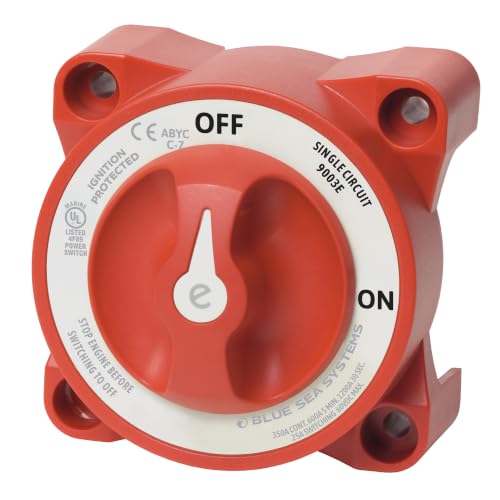
1. Blue Sea Systems e-Series Battery Switch Single Circuit, On/ Off, 48V DC, 350 A, Red, 9003e
Our pick — over 4.5★ from 700+ verified ratings; the strongest balance of quality and price.
Simple, rugged, and trusted — the switch that quietly solved a 120hp outboard’s parasitic drain.
This is a 1-way (on/off) switch that turns a single battery bank on or off, so you can kill all power during storage or isolate a battery for maintenance. The tinned copper studs accept multiple cables and let you torque them down securely — buyers report using it with 2x LiFePO4 230Ah batteries and a 3000W inverter without issue. The compact body and flexible surface or rear-panel mounting mean it fits in tight spaces where larger switches will not.
One reviewer noted it “solves parasitic battery drain on 120hp Yamaha outboard by disconnecting battery when not in use.” The textured knob and face let you operate it by feel in low visibility, which matters when you are reaching into a dark bilge. It handles voltages up to 48V DC (48V DC, while a standard 12V system operates at 12V), so it works with golf carts and high-voltage battery banks too. The flush-mount install requires a 3 5/8-inch hole saw — buyers warn that smaller saws will ruin the bezel.
Built to Last
- High 350A continuous rating easily handles inverters and winches
- Tinned copper studs resist corrosion in saltwater
- Flush-mount option gives a clean, professional look on the panel
Know Before You Install
- Surface-mount has no rear cover exposing live studs
- Needs a precise 3 5/8″ hole saw for flush mount — not a standard size
Best for: Boat owners who want a no-fuss, high-quality on/off disconnect with the amp capacity to handle big loads.
Look elsewhere if: You need a 1-2-Both selector for multiple battery banks — this is a single circuit switch only.
2. Attwood 14230-3 Single Pole 4-Way Selector Marine Battery Switch
A four-way selector with alternator protection that costs less than a tank of fuel.
This is a real step up from a basic on/off switch. The Attwood gives you a 4-way selector circuit — you can choose which battery to run, combine both, or cut all power. It also includes an automatic alternator field circuit disconnect (a feature that safely shuts down the alternator to prevent voltage spikes), which means when you turn the switch to “off” while the engine is running, it safely shuts down the alternator field to prevent surge damage to your electronics. The Bakelite housing, copper washers, and solid brass terminals and nuts are exactly what you want in a wet environment.
At 300 continuous amps, it sits below the top-tier 350A and 600A switches, but that is plenty for most outboards and small-to-mid-size boats. One reviewer who installed it on a sailboat with dual batteries said “the only issue I noticed is the studs became loose when the cables are attached to it. I was able to tighten them again. I do not know if this is going to become an issue, but time will tell.” Another buyer called it “huge but effective” and used it as an RV battery disconnect, praising the easy frame mount with self-tapping screws.
Why It Stands Out
- Built-in alternator field disconnect protects sensitive electronics
- Bakelite and brass construction resists corrosion
- Four-way switching gives you full control over dual batteries
Trade-Offs
- Owners mention studs loosening under cable tension — must be re-tightened
- Physically very large, so measure your space before ordering
Reach for this if: You want a multi-position switch with built-in alternator protection at a budget-friendly price.
Be aware: The loose-studs issue appears in multiple reviews — add thread locker and check torque periodically.
3. Nilight Battery Switch 1-2-Both-Off 12V 24V 48V 600A High Current Heavy Duty
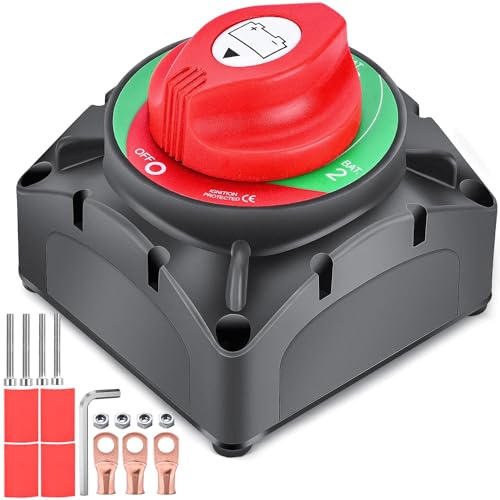
This 600-amp switch can handle a monster dual-battery setup — if you have the room for it.
The Nilight carries a massive 600-amp continuous rating (600A continuous, while the Guest 230A switch is 230A), making it one of the highest-rated switches you can buy for the money. It is a 1-2-Both-Off selector, so you can run on battery 1, battery 2, combine both for extra starting power, or cut everything. The ABS plastic housing includes a rear cover that insulates the terminals against accidental short circuits — a safety feature not all switches offer. A buyer with a bass boat said “I had zero issues fitting 4/0 welding wire and the terminals inside,” which tells you the lugs are genuinely big enough for heavy cable.
It is compatible with 12-48V DC systems, so it works on boats, RVs, campers, trucks, ATVs, and even off-grid battery banks. One important caveat from a buyer who installed it on a Polaris RZR: “the first one I received was literally in pieces. All the pre-installed screws fell out during shipping. The replacement was better packed and arrived intact.” The recommendation: tighten every pre-installed screw before mounting. The switch is physically large — a challenge to fit in tight battery compartments, but buyers confirm the solid clicks and quality hardware make it worth the squeeze.
Raw Power
- 600A continuous rating handles huge inverters and dual alternators
- Rear terminal cover prevents accidental shorts
- Comes with copper ring terminals, heat shrink tubing, and hex wrench
Watch For
- Screws can loosen during shipping — inspect and tighten before install
- Very large footprint; measure your compartment space first
Who it fits: Anyone running high-current loads (large inverters, dual alternators, heavy 4/0 cable) who needs a 1-2-Both selector.
Who should skip: Boaters with tight battery compartments — this switch needs real estate.
4. Guest Battery Switches

A replacement switch with crisp detents and a positive lock that solved one owner’s mysterious electrical gremlins.
This Guest switch runs at 230 continuous amps with a 345-amp momentary rating — a step down in capacity from the 350A and 600A switches above, but enough for a typical dual-battery setup on a smaller boat or RV. The longer stud lengths make cable routing easier, and the heavy-duty copper sweep contacts (rotating internal contacts that maintain connection as you turn) ensure positive circuit control. The impact-resistant polycarbonate housing is impervious to the elements, and the 3/8-inch cable lug size accommodates standard marine battery cable.
Customers note that a “replacement unit fixed initial defects: distinct detents with positive lock, indicator aligns with labels. Original had mushy feel, misalignment, easy to overshoot.” That tells you the production quality is consistent — if you get a good one, it is excellent. At 5.0 x 2.75 inches, it is compact enough for most battery compartments. One point of confusion: the “feed” lug is not labeled “output,” so trace your wiring carefully on first install.
What Buyers Love
- Smooth rotary action with positive-lock detents
- Compact dimensions fit tight compartments
- Long stud lengths simplify cable routing
Limits
- 230 continuous amps is lower than most competitors
- “Feed” lug not labeled “output” — verify wiring before use
Choose this if: You need a compact, smooth-operating selector for a standard dual-battery marine setup and value positive-switch feel.
Not for: High-current applications like big inverters — the 230A limit is too low.
5. SEAFLO 300A 4-Position Battery Disconnect Switch – 12V/24V/48V Heavy-Duty Isolator Switch, OFF/1/2/1+2, IP66 Waterproof
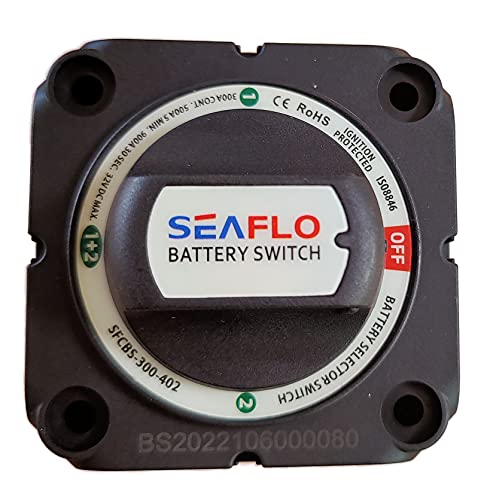
The only switch in this roundup with an official IP66 waterproof rating — and a 900-amp cranking burst for big engines.
The SEAFLO is built for the wet world. It carries an IP66 waterproof rating (protected against powerful water jets, like a pressure washer or a hosed-down deck), plus meets ABYC, UL 1500, and SAE J1171 ignition protection standards — so you can mount it in an engine room with gasoline fumes. The 4-position selector (Off/1/2/1+2) gives you standard dual-battery control, and the specs are generous: 300A continuous, 500A intermittent for 5 minutes, and a 900-amp cranking rating for 30 seconds. That last number is important if you are starting a big diesel or a high-compression outboard.
The one-piece tinned copper studs prevent loosening over time, and the vibration-resistant design holds up on rough water. A buyer who installed one on an RV liked the easy 4-hole mount and the fact that the removable access panels make wire routing simple. “ON” and “OFF” lettering is hard to read in dim light, and the white casing shows dirt quickly. Side panels can fall out during installation but secure properly once mounted. The switch action is deliberately stiff — one owner says that “keeps from accidentally switching when bumped.”
What Seals the Deal
- IP66 waterproof — the most weather-resistant switch here
- 900-amp cranking burst handles big engines
- Meets ABYC and SAE J1171 ignition protection standards
Minor Annoyances
- ON/OFF markings hard to read in low light
- Side access panels can fall loose during install
Ideal for: Any exposed mounting location on a boat where rain, spray, or wash-down hoses are a concern.
Consider something else: If you need a clearly readable indicator label at night — the markings are faint.
6. Blue Sea Systems e-Series Battery Switch Selector 4 Position with Alternator Field Disconnect, 32V DC, 325A, Red, 9002e
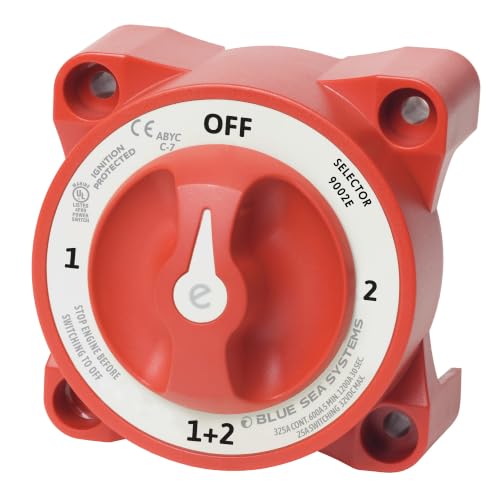
The multi-bank upgrade that one owner called the “nice replacement for my junk Perko” — and it has alternator protection.
This is the big brother of the 9003e. It is a 4-way selector (Off/1/2/Both) that includes an alternator field disconnect (AFD), so you can safely switch between battery banks or turn everything off without frying your alternator. The one-piece copper studs are 7/8 inch long and accept multiple cables, giving you plenty of thread engagement. It is ignition protected, meaning it can be mounted in the engine room of a gasoline-powered boat without sparking a disaster.
At 325 continuous amps, it sits between the 300A SEAFLO and the 350A Blue Sea 9003e on raw capacity. A buyer who installed it in a Sea-Ray praised the “strength of the battery connection terminals ensuring a good contact.” Another reviewer who replaced a Perko switch said the 9002e “clicks easily and you are assured it is setting correctly. Perko was hard to turn.” The flush-mount option needs a precise diameter hole (use calipers to measure), and there is no back cover to protect the exposed studs — one owner used a rubber grommet to cover the contacts.
Professional-Grade
- Alternator field disconnect protects electronics when switching off under load
- Ignition protected for gasoline engine rooms
- One-piece copper studs for secure, high-torque connections
Installation Notes
- Flush-mount needs precise hole measurement — no template provided
- Exposed studs on surface-mount config — add a cover
Reach for this if: You run a dual-bank system and need the safety of alternator field disconnect combined with Blue Sea’s build quality.
Pass if: A simple on/off is all you need — the 9003e costs less and does the same job for single-bank setups.
7. Perko 9601DP Battery Disconnect Switch, Red

A simple, waterproof on/off switch with a perfect 4.8-star rating — and brass contacts that resist corrosion.
Sometimes you just need a heavy-duty on/off switch. The Perko 9601DP is a 1-way (on/off) disconnect with 250 continuous amps — less capacity than the Blue Sea 9003e (350A) but built with brass terminals and contacts that hold up well in a saltwater environment. One buyer called it the “perfect battery shutoff for travel trailer,” noting it is waterproof and sturdy. The manual rotary actuator is intuitive: twist to connect, twist back to disconnect all power from your battery.
It is designed specifically for marine batteries and boat electrical circuits. A camper owner said “the quality was better than expected. Installation was very easy and it looks and operates like it was factory installed.” At 250A, it is fine for starting an outboard or running lights and pumps, but you will exceed that rating quickly if you add a large inverter or heavy trolling motor. One buyer summed it up simply: “This is the Bomb! Don’t get a substitute.”
Simple & Solid
- Brass construction resists corrosion
- Waterproof and sturdy for exterior mounting
- Easy install with factory-quality fit and feel
Not For Big Loads
- 250A continuous rating limits use with large inverters
- On/Off only — no ability to select between multiple batteries
Best for: A straightforward, trustworthy on/off disconnect on a small to medium boat or RV with modest electrical demands.
skip it if: You need a 1-2-Both selector, or your system draws more than 250 continuous amps.
Understanding the Specs
Continuous vs. Intermittent vs. Cranking Amps
This is the single most misunderstood spec on a battery switch. Continuous amps is the steady current the switch can carry indefinitely without overheating — your inverter, sound system, and bilge pump all draw continuous current. Intermittent (or “momentary”) amps is a short burst the switch can survive for a few minutes, like running a windlass (a winch that pulls in the anchor). Cranking amps is a 30-second burst for starting the engine. Always choose a switch whose continuous rating comfortably exceeds your biggest load.
Alternator Field Disconnect (AFD)
If you ever turn your battery switch to “off” while the engine is running, the alternator is still spinning and producing voltage — without a battery to absorb it, that voltage can spike and fry your electronics. An AFD-equipped switch safely grounds the alternator field when you disconnect, preventing that surge. Switches like the Attwood 14230-3 and Blue Sea 9002e include this feature; if you have an alternator and ever switch off under load, it is a must-have.
FAQ
What is the difference between a 1-2-Both-Off switch and a simple on/off switch?
How many continuous amps do I actually need in a boat battery switch?
Can I mount a battery switch in the engine room of a gasoline boat?
Will a 12V battery switch work on a 24V or 48V system?
How do I know if my switch needs an alternator field disconnect?
What size hole saw do I need for a flush-mount battery switch?
Is a higher amp rating always better?
Will my 4/0 welding cable fit the terminal studs?
Can I use a boat battery switch on my RV or camper?
How do I prevent the terminal studs from loosening over time?
Final Thoughts: The Verdict
For most boat owners, the best boat battery switch is the Blue Sea Systems 9003e because it delivers a high 350-amp continuous rating, tinned copper corrosion resistance, and a compact design that fits tight spaces — all backed by a 4.7-star rating from over 700 buyers. If you run a dual-battery setup and need alternator protection, grab the Blue Sea 9002e. And for maximum current capacity in a 1-2-Both-Off selector, the Nilight 600A handles 4/0 cable with room to spare.
How We Picked
We do not accept paid placement. Every pick is matched to a real buyer and a real use-case; we do not hands-on test units.
Sources & Methodology
Specifications: manufacturer listings and product documentation. Review insights: verified customer reviews, as of July 2026. Pricing: not shown on this page (it changes often); check the current price via the retailer link.
As an Amazon Associate, Gadgets Feed earns from qualifying purchases. This does not affect which products we feature.