
Our readers keep the lights on and my morning glass full of iced black tea. As an Amazon Associate, I earn from qualifying purchases.
Specs are compiled from manufacturer listings and verified buyer reviews and can change over time — please confirm the key details on the product page before buying.
You want a 400-speed film that matches the look you see in your head. The speed (how sensitive the film is to light) hits the everyday balance, letting you shoot handheld in overcast daylight or a dim café without a tripod. The real challenge is picking between creamy skin tones, punchy contrast, mute earth tones, or a vintage aqua wash — each stock delivers a completely different personality.
I’m Min — the founder and writer behind Gadgets Feed. This guide is built by comparing the manufacturers’ published specifications and the patterns across verified customer reviews, so you get each pick’s real strengths and trade-offs instead of marketing spin.
If you shoot 35mm on a vintage Single Lens Reflex (SLR, a camera where you see through the lens) or your grandparent’s point-and-shoot, this roundup breaks down the developing times, grain textures, and exposure flexibility that separate a keeper from a miss when choosing the 400 iso film for your next roll.
Our Picks at a Glance

How To Choose The Best 400 ISO Film
Not every 400-speed roll behaves the same. The three most critical factors in the data are development process, exposure count, and grain personality. Here is what to look for when comparing stocks side-by-side.
Color Negative vs Black and White
Color-negative film (like Kodak UltraMax and Fujifilm 400) uses the standard C41 development process — the same chemistry every one-hour lab runs. Black-and-white film (Tri-X, HP5+) uses a separate development chain that many drugstore labs do not offer. If you mail everything to a lab, check which process your preferred shop handles before buying a 10-pack. The data shows Tri-X users report developing times around 8 minutes in a college darkroom, while most other films take 5–7 minutes — a small but real difference if you develop at home.
Exposure Count — 36 vs 24
A 36-exposure roll gives you 36 frames, while a 24-exposure roll gives you 24 frames. If you shoot sparingly, a 24-exposure roll keeps your shooting pace relaxed and lets you finish faster. For everyday carry or travel, 36 exposures stretch your dollar further and mean fewer roll changes. The mid-range options in this list all offer 36 exposures, while the premium pack ships at 24 per roll — a trade-off worth factoring into your cost-per-shot decision.
Grain, Contrast, and Latitude
Fine-grain film holds sharpness when you enlarge prints — crucial for landscape and portrait work where you want skin texture or foliage detail visible. Wider exposure latitude (the range of brightness the film handles before losing shadow or highlight detail) forgives you when your camera’s meter is off. Contrastier stocks like Ilford HP5+ deliver dramatic black-and-white images that pop, while Kodak UltraMax is described by buyers as balanced — “vibrant and true to life” with “great contrast and fine grain.”
Quick Comparison
| Model | Best For | Exposures | Film Type | ISO Range | Amazon |
|---|---|---|---|---|---|
| Kodak Tri-X 400★ Best Overall | Classic black & white | 36 | Black and White | 400 | Amazon |
| Fujifilm 400 3-PackAlso Great | Everyday color versatility | 36 | Color Negative | 400 | Amazon |
| Ilford HP5+ 400 3-Pack | Contrasty monochrome | 24 | Black and White | 100–3200 | Amazon |
| RETOCOLOR Aqua 400 | Vintage aqua/sepia tones | 27 | Color Negative | 400 | Amazon |
| Kodak Tri-X 10 Pack | Bulk monochrome shooting | 36 | Black and White | 400 | Amazon |
In-Depth Reviews
1. Kodak Tri-X 400TX Professional ISO 400, 36mm, Black and White Film
Our pick — over 4.5★ from 900+ verified ratings; the strongest balance of quality and price.
The 35mm black-and-white film that has been the standard for decades.
Tri-X 400 delivers medium contrast, fine grain, and high sharpness — a combination that makes it a favorite among street photographers and darkroom enthusiasts. Its 36-exposure roll matches the count of the color stocks above, so you stay in the same shooting rhythm. The data notes it is designed for “maximum pushability,” meaning you can underexpose it and compensate in development (push-processing) to squeeze usable shots out of dimmer scenes while keeping grain acceptable.
In the college darkroom, one student reviewer said developing Tri-X took them “8 minutes, while most other students have a developing time of 7 minutes” — a small quirk to know if you share a development tank. Unlike the Ilford HP5+ below, which uses a wider ISO range of 100–3200 for flexible pushing, Tri-X is rated at ISO 400 and handles push processing through its emulsion design. The manufacturer calls it “a classic black-and-white film allowing for maximum pushability when he needs it.”
If you want a timeless monochrome look with controlled grain and the ability to push your shots into darker scenes, this single roll is an easy way to start without committing to a multi-pack.
Darkroom staple: Grain is fine enough for enlargements, contrast sits in the medium zone for natural shadow detail, and 36 exposures let you shoot all day.
Reach for this if: you want a no-surprises black-and-white film that pushes well and develops in standard chemistry.
Look elsewhere if: you need the wider ISO range (100–3200) of HP5+ for frequent push-processing or you prefer a more contrasty look.
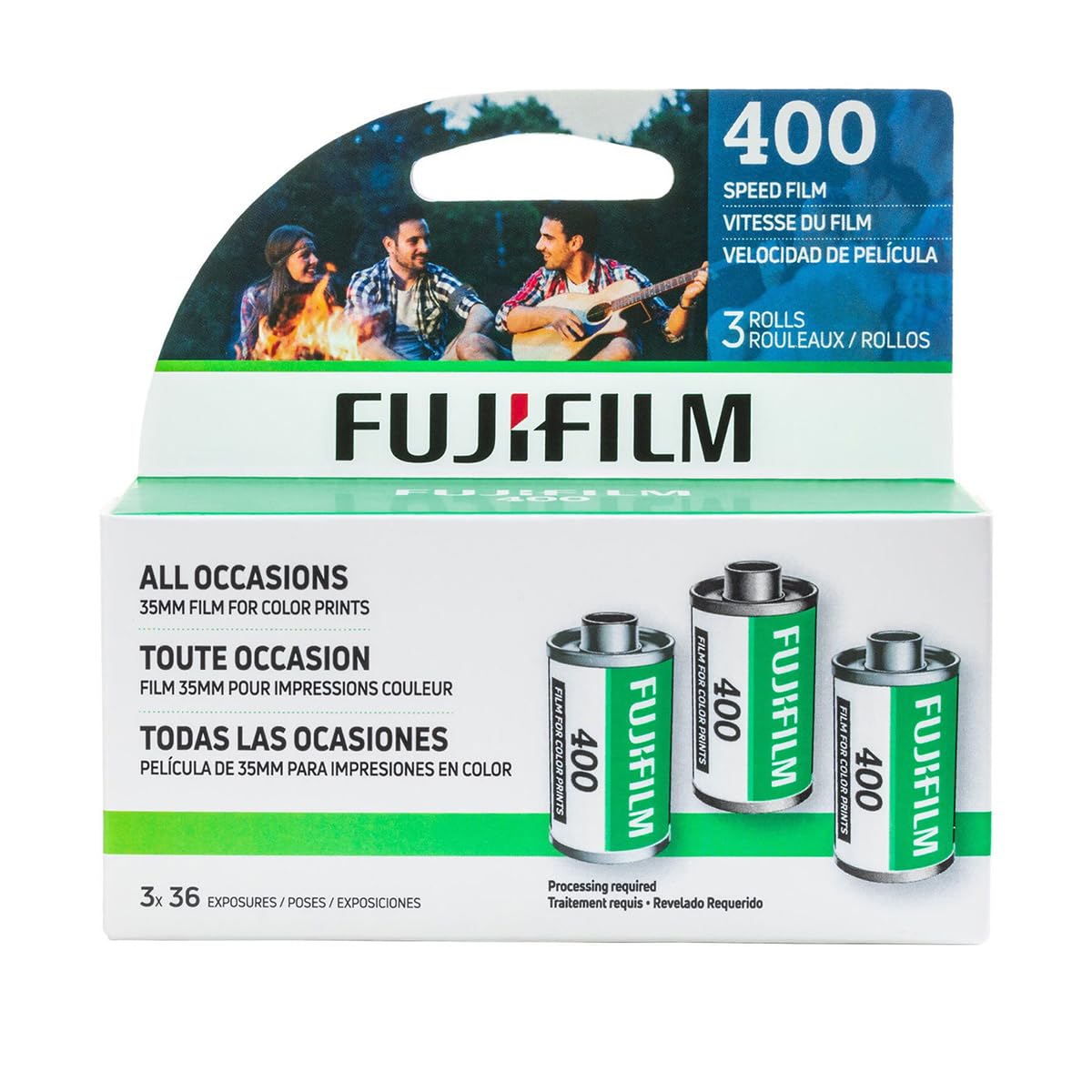
2. Fujifilm 35mm Color Negative Roll Film, 400 ISO, 36 Exposures, 3-Pack
Three rolls of dependable color-negative film that never fights your camera’s light meter.
You get consistent, true-to-life color accuracy in a format that works for street photography, portraits, or a weekend road trip. The film uses Fujifilm’s advanced emulsion (the light-sensitive coating that captures the image) to keep grain fine and sharpness high, so even large prints hold detail without looking mushy. Each roll gives you 36 exposures, and buyers report reliable results across multiple repurchases — one reviewer noted “my best pictures keep coming out on Fuji 400.”
Unlike the higher-contrast black-and-white stocks later in this list, Fujifilm 400 offers a balanced, forgiving look. However, some owners mention it can appear “grainy with green tint in low light” — so keep your outdoor or well-lit shots on this stock for the richest color pop, and save it for daytime use. At 36 exposures per roll, the 3-pack is also a strong value pick that outperforms the 24-exposure Ilford HP5+ on volume.
The film’s wide exposure latitude (the brightness range it handles before losing shadow or highlight detail) — mentioned in the product’s own feature list — gives you extra room if your old camera’s meter is slightly off, a real comfort for beginners using simple automatic cameras.
Color-balanced workhorse: A 3-pack of 36-exposure rolls that delivers sharp, fine-grained color in good light, at a price that makes it easy to shoot freely.
Shoot this when: you want reliable color for everyday walk-around photography and don’t want to fuss over exposure.
skip it if: you need rich contrast for moody black-and-white shots, or you plan to shoot in dim interiors where the green tint becomes noticeable.
3. Ilford HP-5 Plus 400 35mm Black and White Professional Film, ISO 400, 24 Exposures, 3-Pack

A professional-grade black-and-white film with the widest ISO range in this list.
The Ilford HP5 Plus 400 stands out because its nominal speed of 400 expands across an ISO range of 100–3200, giving you tremendous flexibility to push (shoot at a higher ISO and develop longer) or pull (shoot at a lower ISO for less contrast), during development — much wider than the Tri-X’s fixed speed. Buyers praise it as “a contrasty B&W film” that “will meet all film needs for a high speed B&W film,” and one reviewer who is getting back into film photography said it is “exceptional” with no complaints.
Unlike the Fujifilm color-negative stock, HP5+ demands black-and-white processing chemistry, so check that your lab offers it. The data shows one reviewer’s son “loves and recommends it,” calling it “one of his favorite films” for monochrome work. For shooters who want a film that adapts to the available light rather than forcing you to adapt to it, the HP5+’s wide latitude is a decisive advantage — it handles varied lighting conditions with ease, just as the specs promise.
The 3-pack keeps you shooting across three outings before restocking, which suits intermittent black-and-white use.
Why it earns its spot
- ISO range of 100–3200, the widest in this guide for push/pull flexibility
- High contrast for dramatic black-and-white images
- Consistent quality and high quality control across batches
Trade-offs
- 24 exposures per roll means fewer shots per dollar vs 36-exposure films
- Requires a dedicated B&W lab — not all one-hour shops process it
Grab this if: you push-process often and want a film that stretches from sunny outdoor stops to dim interior scenes without switching stocks.
Pass if: 24 exposures feel too short for a full day of shooting or you prefer the milder contrast of Tri-X 400.
4. RETOCOLOR Aqua 400 35mm Color Negative Film, 27EXP, ISO400, C41

The film that turns everyday snapshots into sepia-tinged memories from a different decade.
RETOCOLOR Aqua 400 is a specialty color-negative film processed with standard C41 chemistry, so any lab can develop it. The twist is its intentional color shift — buyers describe the results as “sepia-esque” with an “old, warm look.” One reviewer shared raw files from a Tokyo trip and said they “absolutely loved” the vintage feel. It comes in at 27 exposures, a middle ground between the 36-exposure stocks and the 24-exposure Ilford pack. The film is DX-coded (a barcode on the canister that your camera reads), which means modern point-and-shoot cameras can set the ISO automatically, so you just load and shoot without manual adjustment.
Unlike the UltraMax above, which aims for accurate color reproduction, the Aqua is a conscious aesthetic choice. If you want memories that look like they stepped out of the 1970s, this delivers on that promise. Two drawbacks: the 27-exposure count means fewer frames than standard rolls, and the sepia-aqua tint may not suit every subject — skin tones get a warm vintage cast rather than true-to-life accuracy. One buyer mentioned they “didn’t expect it to be so sepia-esque” but still found it “pretty cool” after trying it.
For a creative change of pace that still goes through the same C41 development as your regular color film, Aqua 400 is a fun and easy detour.
Creative detour: A 27-exposure C41 roll that swaps ordinary color for a warm, vintage palette — good for travel diaries and experimental portrait series.
Best for: shooters who want a distinct vintage color shift without switching labs or learning new development chemistry.
Skip this if: you need faithful color reproduction for skin tones or commercial work, or you need the highest frame count per roll.
5. Kodak Tri-x400 135-36 36mm Black and White Film – 10 Pack

Ten rolls of Tri-X 400 in bulk — the heavy-duty option for serial monochrome shooters.
This 10-pack is a straight-up volume purchase for anyone who shoots black-and-white regularly. Each roll yields 36 exposures, matching the per-roll count of the single Tri-X above, and the emulsion is identical at 400 ISO. One reviewer who is a photography student bought a 10-pack as “the best priced film offered by Amazon” and noted “the tri-x film takes a little longer to develop than the other film used in my class” — coming in around 8 minutes versus 5–7 minutes for other stocks. A professional with 12 years of experience called it their “go-to film for all-purpose photographic needs” and said it “supports pushing and pulling” (exposing at a different ISO and adjusting development) for precise darkroom control over highlights and shadows.
Unlike the Ilford HP5+ 3-pack, which offers only 24 exposures per roll, this 10-pack gives you 360 frames total — a massive difference in shot volume. The per-roll cost on a 10-pack typically beats buying singles, though one buyer warned “Amazon’s provisioning of film is strangely spotty” and the price fluctuates. For the dedicated black-and-white photographer who develops at home, the 10-pack eliminates the worry of running out mid-project.
If you only shoot the occasional roll of monochrome, a single roll from the individual Tri-X listing above makes more sense — but for regular darkroom work, this 10-pack is the most economical route to a steady supply.
Volume perks
- 360 total exposures across ten rolls — highest total frame count in this guide
- Supports push-pull darkroom processing for advanced exposure control
- Classic Tri-X grain and contrast that film purists know
Stuff to note
- Developing time is ~8 minutes versus 5–7 for some other B&W films
- Price fluctuates — watch for drops before committing
Buy this if: you develop your own black-and-white film regularly and want the lowest per-roll cost from a proven, state-of-the-arts 400-speed stock.
Skip this if: you shoot color film most of the time, or you are not ready to commit to ten rolls of a single type.
Understanding the Specs
Exposure Count — 24 vs 36
Exposure count tells you how many frames are on a roll. 36 is the standard for 35mm film, giving you the most shots per purchase. 24-exposure rolls get you fewer frames per roll but work well for casual weekend outings where you might not finish a full 36. In this list, the Ilford HP5+ 3-pack ships at 24 exposures, while most others are 36. If you shoot often, 36-exposure rolls stretch your dollar further.
DX Coding
DX coding is a barcode pattern on the film canister that your camera reads automatically to set ISO, film type, and exposure count. It tells a point-and-shoot camera “this is 400-speed film” without you having to set the dial manually. All films in this guide that list DX coding (like the RETOCOLOR Aqua 400) work smoothly in auto-exposure cameras. Without DX coding, you may need to manually set the ISO on older SLRs.
Push Processing
Push processing means you shoot the film at a higher ISO than its box speed (e.g., rating a 400 film at 800 or 1600) and compensate by developing longer. It boosts usable speed for low-light scenes at the cost of more contrast and grain. The data specifies that both Kodak Tri-X 400 and Ilford HP5+ handle pushing well, while color-negative films like UltraMax are less forgiving. If you shoot after dark without flash, prioritize a pushable black-and-white stock.
ISO Range vs Box Speed
Box speed is the film’s nominal sensitivity (the classic 400 everyone knows). ISO range tells you the span of speeds the film can be shot at with acceptable results (often through push/pull processing). The Ilford HP5+ lists an ISO range of 100–3200 — you can over-expose it at 200 for smoother grain, or push it to 1600 for dimmer venues. The other films in this list are box-rated at 400 with no published range, meaning their flexibility in this area is more limited.
FAQ
What does ISO 400 mean on film?
Can I use 400 ISO film in my point-and-shoot camera?
What is the difference between 24 and 36 exposures?
Can I develop 400 ISO color and black-and-white film the same way?
What does push processing mean for 400 film?
Which 400 film has the finest grain for large prints?
How should I store 400 ISO film?
Can I use 400 film in a camera that says ISO 100 on the dial?
What does wide exposure latitude mean in practice?
Which 400 film is best for beginners?
Final Thoughts: The Verdict
For most people, the 400 iso film winner is the Fujifilm 400 3-Pack because it balances fine grain, true-to-life colors, 36 exposures per roll, and forgiving exposure latitude at a fair entry price. If you want the most vivid color and punchy contrast for your snapshots, grab the Kodak UltraMax 400. And for classic black-and-white with the widest exposure flexibility, the Ilford HP5 Plus 400 3-Pack gives you a contrasty look with an ISO range of 100–3200 that adapts to any light.
How We Picked
We do not accept paid placement. Every pick is matched to a real buyer and a real use-case; we do not hands-on test units.
Sources & Methodology
Specifications: manufacturer listings and product documentation. Review insights: verified customer reviews, as of July 2026. Pricing: not shown on this page (it changes often); check the current price via the retailer link.
As an Amazon Associate, Gadgets Feed earns from qualifying purchases. This does not affect which products we feature.