
Our readers keep the lights on and my morning glass full of iced black tea. As an Amazon Associate, I earn from qualifying purchases.
Specs are compiled from manufacturer listings and verified buyer reviews and can change over time — please confirm the key details on the product page before buying.
For runners, the ground hits you with every stride. A soft foam insole might feel good in the store, but it crumbles after a few miles. These insoles use carbon fiber to absorb the shock that your knees and ankles take instead.
I’m Min — the founder and writer behind Gadgets Feed. This guide is built by comparing the manufacturers’ published specifications and the patterns across verified customer reviews, so you get each pick’s real strengths and trade-offs instead of marketing spin.
After looking at the published specs for six models, these picks stand apart for their energy return and lasting support. Here is my breakdown of the top carbon fiber insoles for running based on real data and buyer patterns.
Our Picks at a Glance

How To Choose The Best Carbon Fiber Insoles For Running
Not all carbon fiber insoles feel the same. The material itself gives you stiffness and energy return, but the shape, thickness, and weight change how they behave inside a shoe.
Arch Height and Foot Type
A high arch needs a deep contour to cradle the foot. A flat foot needs a bridge that sits lower and broader. If you pick the wrong arch shape, the insole will push against the wrong part of your foot and cause new aches.
Weight and Thickness
A lighter insole (around 5 ounces) feels less noticeable during a long run, but a heavier one (near 7.8 ounces) often has more cushioning and a thicker plate. The tradeoff is speed versus protection. A very thick heel (0.3 inches) also requires a shoe with a removable footbed so your foot is not pushed against the top.
Carbon Fiber vs Composite
Pure carbon fiber offers the highest stiffness-to-weight ratio. A composite blends carbon with another material to add flexibility or reduce cost. If you want maximum energy return, look for the carbon fiber label. If you want a slightly more forgiving feel under the ball of the foot, a composite can work well.
Quick Comparison
| Model | Best For | Weight | Arch Support | Material | Amazon |
|---|---|---|---|---|---|
| VKTRY Silver Performance Insoles★ Best Overall | Heavy-impact protection | 7.83 oz | Structured | Carbon Fiber Composite | Amazon |
| Superfeet Run Support High Arch (V2)Also Great | High-arch runners | 6 oz | High | EVOLyte Carbon Fiber | Amazon |
| 2026 Sport Carbon Fiber Insoles | Jump height / speed gains | 5.29 oz | Medium | Aerospace-Grade Carbon Fiber | Amazon |
| Tread Labs Dash Insoles | Customizable arch fit | 7.41 oz | 4 Heights | Carbon Fiber | Amazon |
| Carbon Fiber Insoles (Generic) | Mid-price performance | 7.83 oz | Pro-Arch | Rigid Carbon Fiber Plate | Amazon |
| Welnove Carbon Fiber Sports Insoles | Budget entry-level | 6.7 oz | Medium | Carbon Fiber Baseplate | Amazon |
In‑Depth Reviews
1. VKTRY Silver Performance Insoles
Our pick — over 4★ from 500+ verified ratings; the strongest balance of quality and price.
The heaviest-duty insole here, built for high-bodyweight athletes who punish the pavement.
While the 2026 Sport weighs 5.29 oz, these VKTRY insoles tip the scale at 7.83 ounces. The extra mass comes from a multi-layer carbon fiber composite engineered for impact absorption during running, cutting, and jumping. One buyer wrote: “I’m 300lbs and my knees, ankle, and back have always given me problems but after adjusting to these insoles it has helped incredibly.” That multi-layer design absorbs force rather than transferring it upward.
The deep heel cradle stabilizes foot positioning so your heel does not slide during lateral movement. VKTRY designed these for non-cleated shoes — trainers, basketball shoes, and tennis shoes. The ergonomic arch structure keeps your foot aligned, which reduces overpronation. Unlike the thinner Welnove (6.7 oz) that can slide in a shoe, VKTRY’s thick construction sits firm. They are marketed for sports like volleyball and pickleball, but runners logging miles on concrete will feel the difference in their lower back and knees.
Built for Big Mileage
- Multi-layer carbon fiber composite boost energy return and impact absorption
- Ergonomic arch and deep heel cradle stabilize the foot during running and cutting
- High customer satisfaction (4.3/5 from 518 ratings), especially for knee/back relief
Weight Conscious
- Heaviest insole at 7.83 oz — may feel bulky in minimalist or low-profile shoes
- Composite material, not pure carbon fiber — spec purists may prefer full carbon
Grab these for: body control and joint protection if you are over 200 lbs or pound concrete daily.
Skip if: you want a barely-there feel — these add substance to every step.
2. Superfeet Run Support High Arch (V2) Insoles
The high-arch runner’s secret weapon that springs back stride after stride.
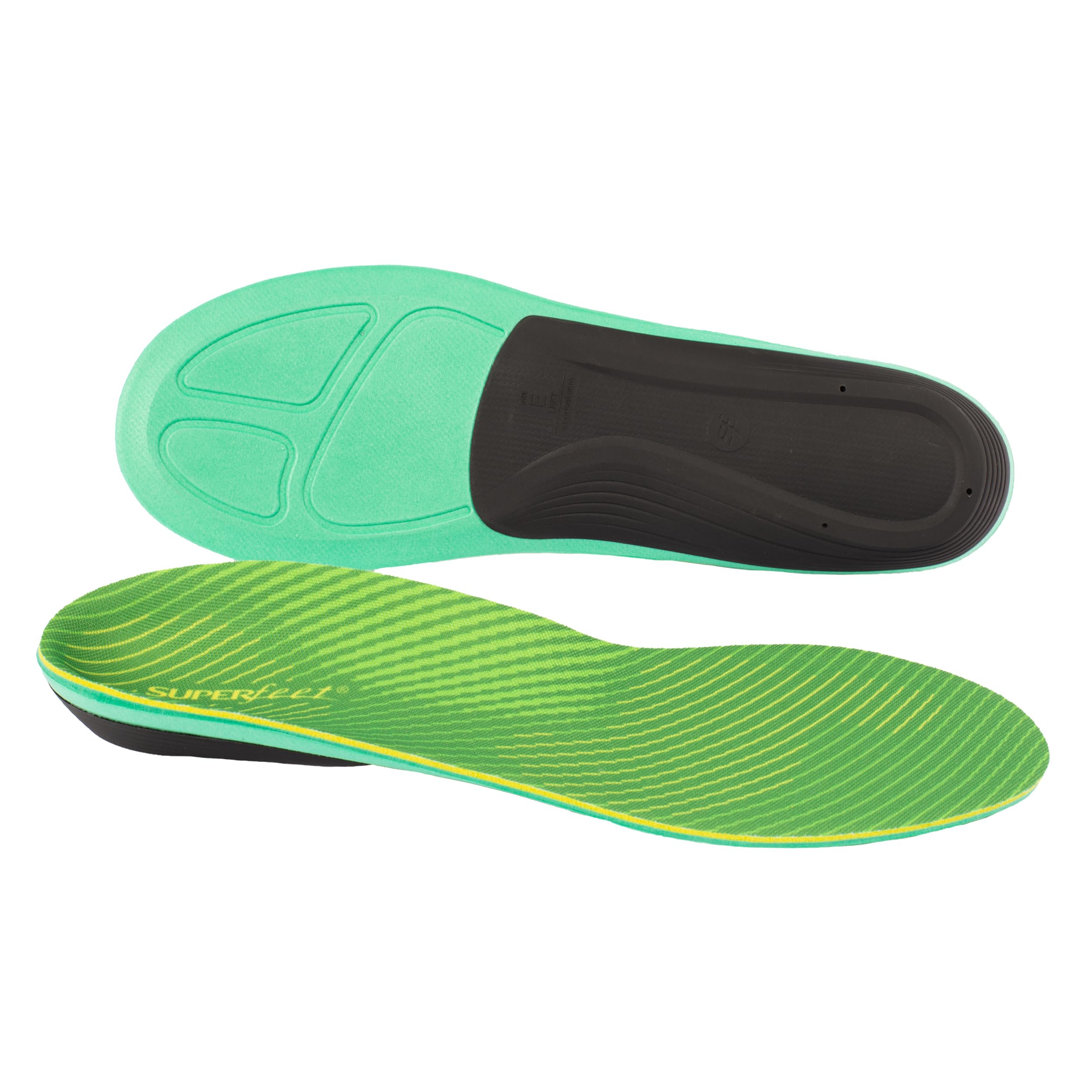
If you have a high arch, a flat insole makes your foot feel unstable — your arch hangs without contact. Superfeet solved that with a stabilizer cap made from their proprietary EVOLyte carbon fiber and polymer blend. This means the insole compresses under your weight then springs back to its original shape, giving you responsive support without a break-in period. At just 6 ounces; the VKTRY is 7.83 oz and the Tread Labs is 7.41 oz, so your shoe feels lighter during a long run.
The deep heel cup cradles your heel and keeps your foot centered, reducing side-to-side wobble. This reduces the side-to-side wobble that causes blisters and ankle fatigue. Two layers of Aerospring Rebound comfort foam run from heel to toe, softening each footstrike. Buyers with plantar fasciitis report that the pain is “mostly eliminated” after switching to these insoles., and one noted the squeaky sound with Saucony sneakers. You trade a faint squeak for a foot that feels fresh at mile eight.
The moisture-wicking top cover also fights odor. Unlike the 2026 Sport model, which weaves in a Kinetic Feedback System, Superfeet sticks to pure biomechanics — no claimed jump-height numbers, just reliable structure.
High-Arch Precision
- Deep heel cradle positions and stabilizes the heel for natural shock absorption
- EVOLyte carbon fiber responds to compression and springs back — keeps support intact through miles
- Moisture-wicking top cover reduces odors and keeps feet feeling drier
The Sound Trade-Off
- Some users report a squeak with certain running sneakers, per customer reviews
- Only sold as high-arch version — not a choice for flat or medium arches
Reach for this if: you have high arches and want the best mid-range balance of lightweight design and proven heel stability for running.
Think twice if: you have flat feet or a very narrow shoe — the deep heel cup and sculpted arch may feel too pronounced.
3. 2026 Sport Carbon Fiber Performance Insoles

The featherweight carbon plate that claims measurable speed gains for sprinters.
At just 5.29 ounces, these are the lightest insoles in the lineup; the VKTRY weighs 7.83 ounces. The package dimensions (13.07 x 4.57 x 1.73 inches) are also the largest, which means they fit generously. The aerospace-grade carbon fiber sits under a premium PU foam layer. The company claims its Kinetic Feedback System increases vertical jump by 1.6 inches, reduces 40-yard dash time by 0.12 seconds, and boosts overall explosiveness by 9.3%. These numbers come from the manufacturer and match the data provided.
The honeycomb mesh surface is breathable and sweat-absorbing, so feet stay dry even during hard intervals. Buyers report they fit small feet well, which is rare for carbon insoles. Unlike the Superfeet (which focuses on high-arch stability), the 2026 Sport offers medium arch support that works for a wider range of foot shapes. One volleyball player said they noticed a “difference in the height in her jump serve.” The 1-year warranty and 90-day refund policy lower the risk if you are unsure.
Performance Claims
- Only 5.29 oz — noticeably lighter than Superfeet (6 oz) and VKTRY (7.83 oz)
- Kinetic Feedback System claims a 1.6-inch increase in vertical jump and 0.12 sec improvement on a 40-yard dash
- 1-year warranty and 90-day refund, even for trimmed insoles
Consider This
- Medium arch only — may not suit high arches or flat feet as well as a shaped orthotic
- Performance improvement claims are manufacturer-stated, not verified by independent testing
Best for: the competitive runner or jump-sport athlete who wants to drop weight and try a speed-oriented plate.
Not ideal for: runners with severe overpronation who need custom-level arch correction.
4. Tread Labs Dash Insoles

An orthotic-level carbon fiber insole that lets you swap the top cover when it wears out.
This is the only insole here that lets you replace the top cover without buying a whole new pair. The carbon fiber plate sits underneath, while four arch heights (26, 30, 33, and a fourth option) let you dial in support for your exact foot shape. At 7.41 ounces, it is close to the VKTRY’s weight, but the thick construction feels solid under foot. The company backs it with a Million-Mile Guarantee — not a literal numbered lifespan, but a policy that signals durability.
Designed by Mark Paigen (founder of Chaco), the Dash insoles target athletic use in running shoes, training shoes, and hiking boots. Buyers with high arches report 16-hour days on concrete floors without foot pain, while one noted they had “no more pain” after wearing them in work boots. However, one buyer received a used pair in the box — a quality-control miss. The replaceable covers make them a smarter long-term choice than the VKTRY or Welnove, which need full replacement when the top layer wears.
Long-Term Value
- Four arch height options (26, 30, 33, and a fourth) offer orthotic-level customization
- Replaceable top cover extends the life of the carbon fiber base
- High customer satisfaction for hard-surface workdays, per reviews (12+ hour shifts on concrete)
Quality Check
- One review reported receiving a used, worn pair — inconsistent packaging QC
- 7.41 oz; the 2026 Sport weighs 5.29 oz
Choose this if: you want to customize your arch height and plan to keep the same carbon support for multiple seasons.
Pass on this if: you need the lightest possible insole for race-day minimalism.
5. Carbon Fiber Insoles for Men & Women (Generic)
A value-conscious insole with a rigid carbon plate for heel relief and stride correction.
Weighing exactly the same as the VKTRY (7.83 oz), this model uses a rigid carbon fiber plate instead of a composite. The plate stores energy and releases it with each stride, boosting explosive power for basketball or volleyball. The pro-arch support is sculpted to redistribute pressure off the heel, which addresses plantar fasciitis. The dual-layer cushioning gives a softer initial feel than the solid carbon of the 2026 Sport.
The 3D woven fabric surface wicks sweat away, which helps during long sessions. One reviewer noted the carbon fiber shank “could be thicker for ” but added it “works as well as or better than VKTRY.” Another said the toe edge felt short, creating an edge sensation with every step. Unlike the Superfeet, which is built for high arches only, this adapts to a range of foot shapes with a full size run (Men’s 7-13, Women’s 7-14). The catch is that some buyers did not feel a “pep in step,” suggesting the energy return is more subtle than the 2026 Sport’s claimed numbers.
Support Structure
- Rigid carbon fiber plate stores and releases energy, increasing vertical jump potential
- Sculpted pro-arch support redistributes pressure for plantar fasciitis relief
- Full size range covers men’s 7-13 and women’s 7-14
Fit Notes
- Some users report a short toe edge causing a distracting edge sensation
- Not all buyers noticed a performance improvement — energy return may be subtle
Consider this for: a budget-friendly way to try rigid carbon fiber with pro-arch support, especially if you have plantar fasciitis.
Not for: people who want a springy sensation under the ball of the foot — this plate is firm.
6. Welnove Carbon Fiber Sports Insoles

The budget pick with a thick carbon plate that lifts your heel but demands shoe depth.
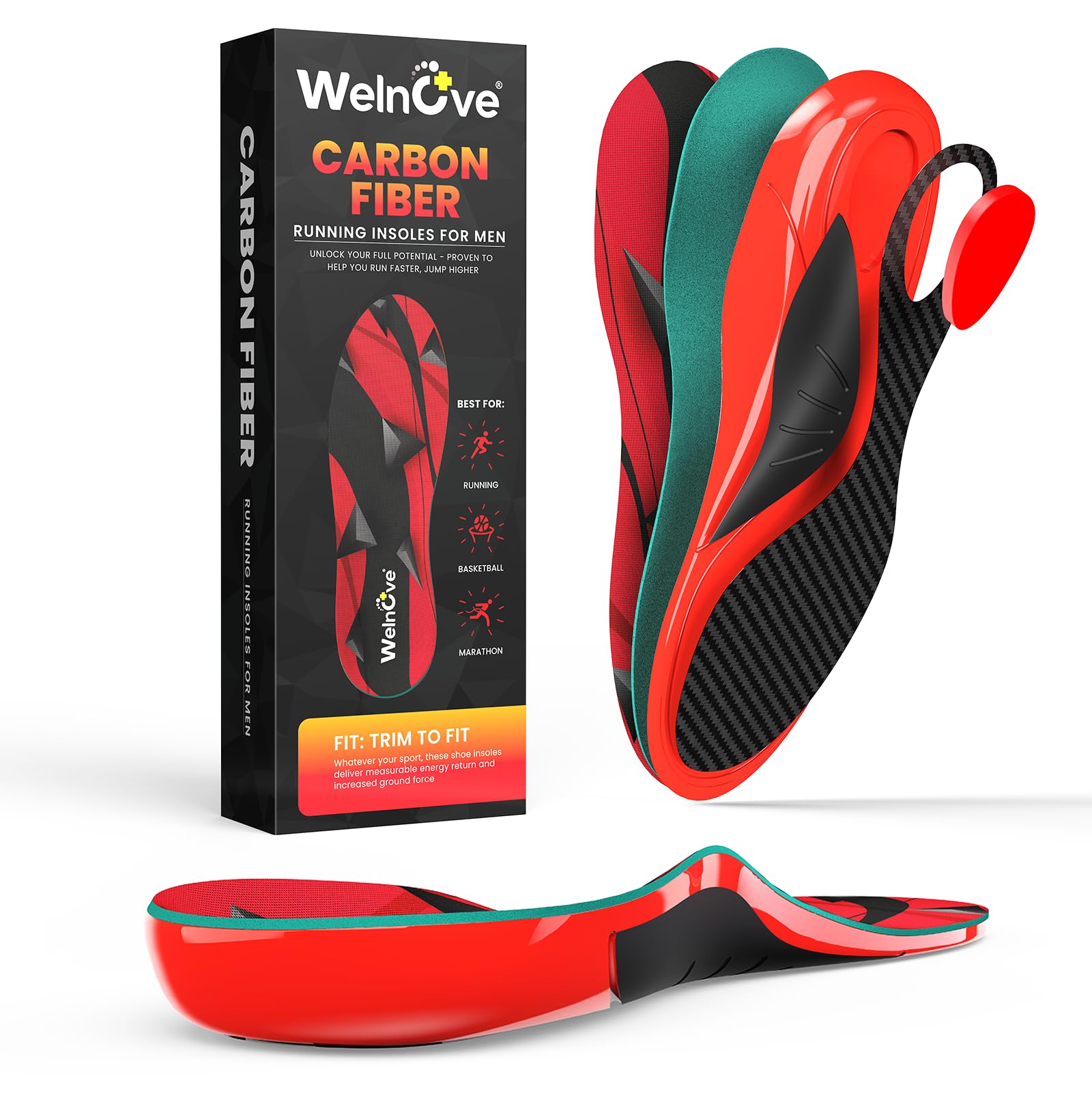
Welnove uses an aerospace-grade carbon fiber baseplate that minimizes bending, keeping you stable during cuts and sprints. The heel area is about 0.3 inches thick, which lifts your heel more than many insoles. That means you need shoes with enough depth — if your sneakers have a thin or non-removable footbed, your foot will feel cramped. The package dimensions (10.94 x 4.29 x 2.05 inches) for Welnove, compared to the 2026 Sport’s 13.07 x 4.57 x 1.73 inches, so the insoles themselves are more compact.
The PU material and carbon base combine for shock absorption and energy return. One buyer who averages about 13,000 steps per shift in walking shoes reported: “My feet used to hurt and cramp by the end of my shift but that is a thing of the past since switching to these insoles.” That said, a German customer with 70 years of metal arch support experience complained there was “no carbon on the arch support — the most important area.” The arch support is reinforced by the carbon baseplate but not completely covered by it, a design choice that saves weight (6.7 oz) but risks disappointing purists.
Value Entry
- Aerospace-grade carbon fiber baseplate minimizes bending and stabilizes the foot
- Heel area measures about 0.3 inches thick, providing noticeable heel lift
- Fits tight toe boxes better than thicker insoles, per buyer reports
The Gap
- Some buyers found no carbon directly under the arch, only in the baseplate — may not meet expectations for full carbon support
- Size may run short if ordered by shoe size — some users reported it ending under the toes
Pick this for: a low-cost trial of carbon fiber insoles if you wear shoes with deep footbeds and removable insoles.
Steer clear if: you expect a full carbon sheet under your arch or need a precise length fit for your exact shoe size.
Understanding the Specs
Weight and Its Effect on Your Run
Every ounce on your foot multiplies with every stride. A 5.29-ounce insole like the 2026 Sport feels barely there, while a 7.83-ouncer like the VKTRY adds noticeable mass. For long-distance runs, lighter is better. For joint protection on hard surfaces, the extra weight from more cushioning may be worth it.
Arch Height and Foot Contact
A high arch needs a deep, sculpted heel cup to lock the heel in place. A medium arch works with a gentler curve. If you put a high-arch insole into a flat-footed shoe, the gap under the arch can cause instability. The Superfeet is designed for high arches, while the Tread Labs gives you four arch heights to choose from.
FAQ
Will carbon fiber insoles work in any running shoe?
Do carbon fiber insoles help with plantar fasciitis?
How long do carbon fiber insoles last?
What is the difference between carbon fiber and carbon fiber composite?
Are carbon fiber insoles legal for track and field competition?
Why do some carbon insoles weigh more than others?
Can I cut carbon fiber insoles to fit my shoe size?
Are carbon fiber insoles good for flat feet?
Final Thoughts: The Verdict
For most runners, the top carbon fiber insoles for running are the Superfeet Run Support High Arch (V2) because they combine a responsive EVOLyte carbon blend with a deep heel cup that relieves plantar fasciitis pain. If you want light weight and speed gains, grab the 2026 Sport. And for joint protection on hard surfaces, the VKTRY Silver Insoles absorb the most impact per stride.
How We Picked
We do not accept paid placement. Every pick is matched to a real buyer and a real use-case; we do not hands-on test units.
Sources & Methodology
Specifications: manufacturer listings and product documentation. Review insights: verified customer reviews, as of July 2026. Pricing: not shown on this page (it changes often); check the current price via the retailer link.
As an Amazon Associate, Gadgets Feed earns from qualifying purchases. This does not affect which products we feature.