
Our readers keep the lights on and my morning glass full of iced black tea. As an Amazon Associate, I earn from qualifying purchases.
Specs are compiled from manufacturer listings and verified buyer reviews and can change over time — please confirm the key details on the product page before buying.
Threaded rod feels simple — a long steel stick with threads wrapped around it — but pick the wrong one and you are dealing with bent metal, mangled threads, or rust spots that ruin your project weeks later. You need a 3/4-inch rod that actually holds your dock cleats, supports your suspension, or pulls bushings out of a 20-ton press without deforming. This guide sorts through the seven most commonly bought options so you know which one matches your real job, not just what looks right on a screen.
I’m Min — the founder and writer behind Gadgets Feed. This guide is built by comparing the manufacturers’ published specifications and the patterns across verified customer reviews, so you get each pick’s real strengths and trade-offs instead of marketing spin.
Whether you are hanging lighting fixtures or fabricating a heavy-duty repair tool, finding the right 3/4 all thread means matching thread pitch, material strength, and length to your specific load and environment — not just grabbing the first zinc-coated rod you see.
Our Picks at a Glance


How To Choose The Best 3/4 All Thread
Buying a 3/4-inch threaded rod is more than matching the diameter to a nut. You need the thread pitch, material strength, length, and finish to match the environment and load you are working with. Here are the three things to lock in before you click buy.
Thread Pitch: Coarse vs. Fine
The thread pitch tells you how many threads per inch (TPI) the rod has. A 3/4″-10 rod has 10 coarse threads per inch — this is the standard UNC (Unified National Coarse) pattern used in most construction, plumbing, and structural work. A 3/4″-16 rod has 16 finer threads per inch, which gives you more precise adjustment and better resistance to vibration in mechanical setups. The trade-off: coarse threads are faster to screw on and less likely to strip if you are working in dirty or tight spaces.
Material and Strength Grade
The metal determines how much weight the rod can hold and whether it survives exposure to moisture. Zinc-plated carbon steel (like ASTM A307 Grade A) is the everyday choice for indoor projects with a safe working load up to 6,750 lbs. Stainless steel grades like 304 or 316 add serious corrosion resistance for outdoor, marine, or chemical environments — but they cost more and are slightly softer. For high-tension jobs like bolting down machinery, look for Grade B7 alloy steel with a black-oxide finish, which handles heat and pressure better than standard carbon steel.
Length and Quantity Per Pack
Threaded rods commonly come in lengths from 12 inches up to 36 inches or longer. If you are cutting the rod down, buy the next size up to minimize waste — a 36-inch rod might leave you with short unusable offcuts if your needed length does not divide evenly. Some packs sell a single rod, while others give you two or four rods in one box. The per-rod cost drops significantly in multi-packs, especially when you are doing a large installation with many hangers or brackets.
Quick Comparison
| Model | Best For | Thread Pitch | Length | Material | Amazon |
|---|---|---|---|---|---|
| National Hardware N179-556★ Best Overall | General indoor structural work | 3/4″-10 UNC | 36 inches | Zinc-plated carbon steel | Amazon |
| Value Brand 24304 (Grainger Approved)Budget Pick | Budget-friendly single-rod jobs | 3/4″-6 | 36 inches | Plain carbon steel | Amazon |
| Small Parts 316 Stainless Rod | Saltwater or corrosive environments | 3/4″-16 | 12 inches | 316 stainless steel | Amazon |
| Lamons Sterling Seal Grade B7 | High-tension mechanical repairs | 3/4″-10 UNC | 2 feet (24 inches) | Black-oxide alloy steel | Amazon |
| Small Parts Zinc-Plated Grade 8 | Custom tool fabrication | 3/4″-16 | 36 inches | Zinc-plated alloy steel | Amazon |
| Blulu 304 Stainless 4-Pack | Multi-point stainless installations | 3/4″-10 UNC | 36 inches each | 304 stainless steel | Amazon |
| Chenango Supply 304 Stainless 2-Pack | Industrial-grade outdoor builds | 3/4″-10 UNC | 3 feet (36 inches) each | 304 stainless steel | Amazon |
In‑Depth Reviews
1. National Hardware N179-556 Steel Threaded Rods in Zinc Plated, 3/4″-10 x 36″
Our pick — over 4.5★ from 700+ verified ratings; the strongest balance of quality and price.
The 3/4-inch rod with a 6,750-lb safe working load that indoor projects trust.
This is the rod you reach for when you need a dependable structural connection and do not want to overthink it. The coarse 3/4″-10 UNC thread pattern makes it compatible with standard nuts and couplers, and the zinc plating gives a basic corrosion shield for dry indoor settings. At 3.4 pounds, it feels solid without being awkward to handle — one reviewer noted using it to install 12-inch dock cleats on a new dock and wished it came in longer lengths so less material would go to waste on offcuts.
The 36-inch length is generous for most hanger and support jobs, but you will lose a few inches per cut if your fasteners only need 10 inches each. The ASTM A307 Grade A rating means it is built for general-purpose loads, not extreme heat or chemical exposure. For typical plumbing, electrical, or DIY framing applications, the combination of clean threading, predictable strength, and a low per-rod cost makes this the one to beat.
Workhorse for indoor builds: The 6,750-lb safe working load and 4.6-star average across 722 ratings show this rod delivers consistent quality for standard projects without surprises.
One cutoff downside: At 36 inches, buyers report the leftover stubs are often too short to reuse, so measure your exact needed cut length before ordering.
Reach for this if: you are doing indoor structural hanging, plumbing support, or DIY builds that need a strong, straightforward zinc-plated rod at a reasonable per-rod cost.
Look elsewhere if: you need outdoor-grade corrosion resistance or a thread pitch finer than 10 TPI for vibration-prone mechanical assemblies.
2. Value Brand, 24304, Threaded Rod, Low Carbon Steel, 3/4-6×3 ft
A Grainger-approved plain-steel rod that is cheap but can arrive with rough threads.
If you are on a tight budget and only need one rod for a light-duty indoor job, this Grainger-approved option gets the job done — some of the time. At 2.25 pounds it is noticeably lighter than the National Hardware rod above (a 51% difference), which reflects the lower density of plain low-carbon steel. Several buyers had no complaints: threads mated well with nuts, and one builder used it to make a custom scissor lift. The 3/4″-6 thread pitch is coarser than the standard 10 TPI, so confirm you have matching nuts before ordering.
The catch is quality consistency. One frustrated buyer wrote, “The threads are so messed up. It took about an hour to kinda get them straightened out.” That kind of variability means you are gambling a little on the thread-forming process. If your project demands a nut that spins on without a fight, spend the extra few dollars on a rod with a better track record. For a non-critical backdrop where you already plan to run a die over the threads, this is the cheapest entry point into 3/4-inch rod territory.
What works
- Lowest per-rod cost among the 36-inch options
- Plain finish works fine for dry indoor environments
- Grainger Approved brand carries industrial supply credibility
Where it stumbles
- Thread quality is inconsistent — multiple reports of deformed threads
- Plain steel offers zero corrosion protection
- Unusual 3/4″-6 pitch may not match standard nuts
Choose it when: you need a single rod for a non-structural indoor prop and you are prepared to chase the threads with a die if needed.
skip it if: you cannot afford downtime fixing bad threads on a deadline or you need a load-rated rod for a structural application.
3. 316 Stainless Steel Fully Threaded Rod, 3/4″-16 Thread Size, 12″ Length

A 316 stainless 12-inch rod that resists saltwater and survived a 20-ton hydraulic pull.
When the environment is wet, salty, or chemically aggressive, 316 stainless steel is the right call — and this rod is a clear example of why. The 3/4″-16 fine thread gives you 16 threads per inch for vibration-resistant fastening in mechanical assemblies, and the 12-inch length works well for compact setups where a shorter rod minimizes flex. A buyer who used it to pull leaf spring bushings in a 20-ton hydraulic press noted it “has not deformed at all” under that extreme force — a strong indicator of the material’s toughness.
The trade-off is reach: at 12 inches, this rod is 36 inches shorter than the 36-inch options you see on this list (a 3.0x gap in length). That makes it a specialty piece for tight spaces, not a general-purpose support rod. The fine 16-TPI thread also means slower turning when you are threading nuts on and off. For a bowfishing reel conversion or a precise mechanical jig where every millimeter of adjustment counts, this short stainless rod delivers where a longer coarse-thread rod would be overkill.
Corrosion champion: 316 stainless provides noticeably better rust resistance than 18-8 or 304 grades, and buyers confirm the threads arrive clean with no burrs that need filing.
Short-stick limitation: The 12-inch length suits niche jobs but cannot replace a 36-inch hanger rod — verify your required length before buying.
Ideal for: marine environments, high-moisture outdoor projects, or any compact mechanical assembly where corrosion resistance and fine-thread precision matter.
Not for: long hanging runs, multi-point installations that need a single continuous rod, or jobs where standard coarse-thread compatibility is required.
4. Lamons Sterling Seal THRROD.MED.B7.BOS.3/4-10x2ftx2 Medium-Strength Threaded Rod

A black-oxide B7 rod built to handle the stress of machinery and suspension work.
Grade B7 alloy steel is the step-up when standard carbon steel might stretch or snap under high-tension or high-temperature conditions. This Lamons rod uses a black-oxide finish that adds mild corrosion resistance while keeping the dimensional precision needed for Class 2A thread fit. It comes as a 2-pack, each rod 2 feet long running a standard 3/4″-10 UNC thread pattern. One owner welded a nut onto one end and used it as a replacement bolt on a case swather suspension spring, reporting it “has held up to 40 acers so far” — a real-world test of its durability under constant field vibration.
The shorter 24-inch length compared to the 36-inch National Hardware rod means less waste per cut for many repair jobs, and the hardened surface resists thread galling better than plain steel. The per-rod cost is higher, but you are paying for the metallurgical upgrade that keeps a machine running. If you are repairing agricultural equipment, bolting down industrial machinery, or building a jig that needs to hold alignment under load, this is the rod that does not flinch.
What earns the cost
- Grade B7 alloy steel handles higher stress than standard carbon steel
- Black-oxide finish resists surface rust during storage and use
- Two rods per pack for multi-point repairs without re-ordering
What to weigh
- More expensive per rod than zinc-plated carbon steel options
- 24-inch length may be too short for long hanger or support runs
- Only 19 ratings — less crowd-sourced validation than higher-volume products
Reach for this: if you are repairing heavy equipment, bolting down machinery, or building a high-tension jig where standard carbon steel would risk fatigue failure.
Pass on it: for simple indoor hanger jobs or budget-conscious projects — standard zinc-plated rod gives you the length and cost savings you need.
5. Steel Fully Threaded Rod, Zinc Plated, 3/4″-16 Thread Size, 36″ Length

Grade 8 alloy with a fine 16-TPI thread — perfect for custom tools that need precise adjustment.
If you are fabricating a tool that must thread into a fine-pitch nut or tapped hole with tight clearance, this 36-inch rod gives you the length and the thread count to do it. The Grade 8 alloy steel is stronger than standard Grade 5 or plain carbon steel, and the zinc plating provides a modest corrosion barrier for indoor workshops. One buyer used it to make a clutch removal tool for a Polaris 250 Xplorer — the factory tool cost, and they built it for the price of the rod alone. That is the kind of project this rod was made for: short-run custom fabrication where you control the machining.
The catch is quality control. Multiple buyers reported bent rods and distorted threads — one called it “poor workmanship, inferior materials, no Q.C.” and said the rod was unusable out of the package. Given the higher price point, that kind of variability is frustrating. If you need a precise fine-thread rod and cannot risk rework, consider the 316 stainless option above, which has cleaner thread reviews. If you do buy this one, plan to inspect the rod thoroughly before starting your build.
Fabricator-friendly specs: The 36-inch length combined with 3/4″-16 fine threads gives you enough material to make several tools or jigs in one go.
Inconsistent out-of-box quality: Reports of bent rods and poor threads mean you should budget time to check and correct the rod before using it for precision work.
Best for: DIY fabricators who need a long fine-thread rod for custom tool-making and have the tools to correct minor thread issues.
Avoid if: you need a guaranteed straight, clean-thread rod for a time-sensitive project or you are not comfortable running a die over fresh threads.
6. Blulu 4 Pcs 3/4″-10 Fully Threaded Rod, 36″ Length, 304 Stainless Steel

Four 36-inch 304 stainless rods in one box — the multi-point corrosion solution.
When you need stainless steel at multiple locations — hanging sprinkler heads across a greenhouse, installing light fixtures along a covered patio, or assembling frames that all see moisture — this Blulu 4-pack delivers the quantity and the material in one order. Each rod is 36 inches long with a standard 3/4″-10 UNC coarse thread, and the 304 stainless construction resists rust far better than any zinc-plated or plain steel option. That is 4.0x more rods than the single-rod packs, which matters when you are threading multiple hangers or supports and do not want to place four separate orders.
Buyers describe the steel as high quality with threads that “easily threaded onto” matching nuts. The per-rod cost works out significantly lower than buying four individual stainless rods, making this the smart buy for anyone planning a project that eats up multiple lengths. The hardness is rated at B90 on the Rockwell B scale, so the rods are tough but still machinable if you need to cut or drill them. If you only need one rod, the four-pack feels like overstock — but if you need two or more, the math leans hard toward this box.
Why it earns its spot
- Four rods per pack at 36 inches each — 12 total feet of stainless thread
- 304 stainless provides strong corrosion resistance for damp environments
- Consistent 3/4″-10 UNC thread works with standard hardware
One practical trade-off
- Higher upfront cost than a single rod — not ideal if you need just one piece
- 304 stainless is less corrosion-resistant than 316 in marine environments
Buy this if: you are installing multiple stainless-steel hangers, supports, or brackets in a moisture-prone building or outdoor covered area.
Pass if: you need just one stainless rod — a single-rod pack saves money and avoids unused inventory sitting in your shop.
7. Chenango Supply 304 Stainless Steel Fully Threaded Rod – 2 Pack (3/4-10 x 3)
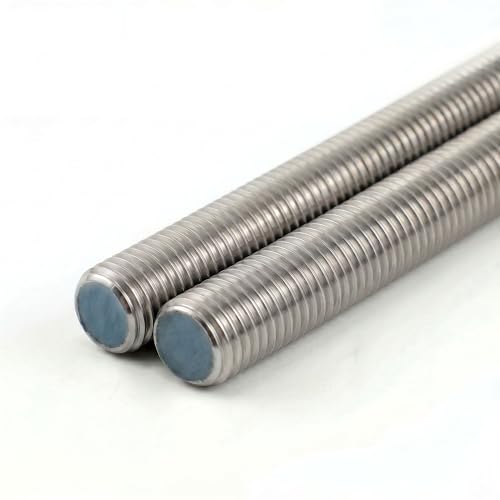
Two 3-foot 304 stainless rods with industrial-grade quality claims and a clear pack design.
Chenango Supply positions this as an industrial-grade product for professional and commercial workshop use, and the specs back that up: each rod is fully threaded in Type 18-8 (304) stainless steel with standard 3/4″-10 UNC coarse thread, 3 feet long, and left unfinished — no coatings that could flake or corrode. The two-rod pack gives you 6 total feet of stainless thread, which fits somewhere between the single-rod options and the Blulu 4-pack above. One buyer simply said “Excellent quality,” though the overall rating of 3.9 out of 5 across 24 ratings suggests some variability in how buyers see the value.
The “clear pack” design means you can inspect the rods through the packaging before opening — a small but thoughtful detail for a product in this price tier. The unfinished exterior means the rods arrive with no coating at all, so they rely entirely on the 304 stainless itself for corrosion resistance. That is fine for most outdoor and workshop environments, but if you are working in a saltwater setting, the 316 stainless rod would be the safer choice. For a pair of heavy-duty stainless rods that you can trust for framing, supports, or custom fabrication, this pack delivers the material consistency professionals expect — as long as you are comfortable with the per-rod cost.
Shop-ready duo: Two 3-foot rods with clear packaging and solid 304 construction give you a flexible inventory for medium-scale stainless projects.
Higher per-rod cost: The 2-pack sits at a premium vs. the Blulu 4-pack on a per-rod basis, so buy it when you need exactly two rods or prefer the Chenango brand’s quality rep.
Reach for it when: you need two stainless rods for professional or commercial fabrication where 304 corrosion resistance is essential and you want clear packaging for inspection.
Consider alternatives if: you need more than two rods — the 4-pack gives you a better per-rod value for larger installations.
Understanding the Specs
Thread Pitch: 10 TPI vs. 16 TPI
The number after the dash tells you how many threads are cut per inch of rod. A 3/4″-10 rod has 10 threads per inch — this is the standard coarse pattern for construction and hanger work because nuts spin on quickly and the deeper thread profile resists stripping in dirty conditions. A 3/4″-16 rod has 16 finer threads per inch, which lets you make smaller adjustments and holds tighter against vibration, but takes longer to thread and is more prone to cross-threading if you rush the installation.
Material Grade and Strength
The grade tells you how the steel was treated and how much load it can take. ASTM A307 Grade A is the baseline for general-purpose carbon steel rods with a typical safe working load around 6,750 lbs. Grade B7 is alloy steel hardened for high-temperature and high-pressure bolting applications. Grade 8 is a stronger alloy often used in automotive and tool-making. Stainless steel grades like 304 and 316 skip the plating entirely and rely on chromium for rust resistance — 316 adds molybdenum for extra protection against salt and chemicals.
FAQ
Can I cut a 3/4-inch threaded rod to a shorter length?
What is the difference between 3/4″-10 and 3/4″-16 thread?
Will a 3/4-inch threaded rod fit a standard 3/4-inch nut?
Which material is best for outdoor use: zinc-plated, stainless, or plain steel?
How much weight can a 3/4-inch threaded rod hold?
Can I weld a 3/4-inch threaded rod to another piece of metal?
What does “fully threaded” mean compared to partially threaded?
Is a 3/4-inch rod the same as a 3/4-inch bolt or screw?
How do I clean up damaged threads on a threaded rod?
Can I use a 3/4-inch rod as a hanger for ceiling fixtures?
Final Thoughts: The Verdict
For most buyers, the 3/4 all thread winner is the National Hardware N179-556 because it combines a 6,750-lb safe working load with clean zinc-plated threads, a 36-inch length that suits most common jobs, and a track record backed by 722 ratings averaging 4.6 stars. If you need multi-point stainless corrosion protection, grab the Blulu 304 Stainless 4-Pack. And for high-tension mechanical repairs where standard steel might fail, the standout is the Lamons Sterling Seal Grade B7 with its hardened alloy construction and black-oxide finish.
How We Picked
We do not accept paid placement. Every pick is matched to a real buyer and a real use-case; we do not hands-on test units.
Sources & Methodology
Specifications: manufacturer listings and product documentation. Review insights: verified customer reviews, as of July 2026. Pricing: not shown on this page (it changes often); check the current price via the retailer link.
As an Amazon Associate, Gadgets Feed earns from qualifying purchases. This does not affect which products we feature.