
Our readers keep the lights on and my morning glass full of iced black tea. As an Amazon Associate, I earn from qualifying purchases.
Specs are compiled from manufacturer listings and verified buyer reviews and can change over time — please confirm the key details on the product page before buying.
You walk into a stuffy room and your head starts to fog, but you are not sure if it is the CO2 from a closed window, the formaldehyde from a new bookshelf, or the VOC from a fresh coat of paint. An air quality testing kit gives you the actual numbers for each pollutant, so you know exactly when to open a window or turn on a purifier instead of guessing.
I’m Min — the founder and writer behind Gadgets Feed. This guide is built by comparing the manufacturers’ published specifications and the patterns across verified customer reviews, so you get each pick’s real strengths and trade-offs instead of marketing spin.
We cover six of the most capable monitors available now, from pocket-sized sensors to professional-grade units, so you can find the right air quality testing kit for your home, office, or workshop.
Our Picks at a Glance
How To Choose The Best Air Quality Testing Kit
Not every air quality monitor measures the same things or measures them accurately. Before you buy, you need to know which sensors actually matter for your space—here is what separates a useful tool from a decorative box of numbers.
Pick the Pollutants You Actually Care About
A basic monitor might only show temperature and humidity, but a real air quality testing kit tracks CO2 (carbon dioxide, a gas you exhale that builds up in stuffy rooms, making you drowsy), PM2.5 and PM10 (tiny particles from cooking smoke, candles, and outdoor pollution that can reach your lungs), TVOC (total volatile organic compounds from paint, cleaning products, and new furniture), and HCHO (formaldehyde, a common off-gas from pressed-wood cabinets and flooring). If you are worried about wildfire smoke, you need a laser particle sensor for PM2.5 (particles under 2.5 micrometers in size). If your house was recently renovated, a formaldehyde sensor becomes the priority.
Battery Life Changes How You Use It
A portable monitor with 8 to 12 hours of battery lets you move from the bedroom to the kitchen to the basement in one day without hunting for an outlet. Models with only a few hours of battery become corded units in practice—fine for a fixed desk spot, but less useful for spot-checking a damp crawlspace or a nursery across the house. The premium e-ink units stretch battery life to weeks or months by using a screen that only updates occasionally, saving power.
Screen Readability vs. App Smarts
A big color screen with an AQI number (Air Quality Index) and color-coded alerts is the fastest way to glance at your air and know if something is wrong. But if you want trend graphs, a 30-day history, or remote alerts when you are away, you need a monitor with a companion app. The trade-off is that app-connected models often cost more and sometimes have buggy software. Pick the style that fits you: glance-and-react or analyze-and-tune.
Quick Comparison
| Model | Best For | Sensors | Battery Life | Display | Amazon |
|---|---|---|---|---|---|
| KDWKD 11-in-1★ Best Overall | Everyday home awareness | CO2, PM0.3-10, HCHO, TVOC | 9 hours | Large color screen | Amazon |
| BREATHE Airmonitor PlusProfessional Grade | Professional insight | CO2, PM1/2.5/10, TVOC, HCHO | Few hours | Compact LCD | Amazon |
| YNAK 16-in-1 | Easy-to-read at a glance | CO2, PM1.0/2.5/10, HCHO, TVOC | 8 hours | 7-inch LED | Amazon |
| LifeBasis 11-in-1 | Long runtime between charges | CO2, PM1.0/2.5/10, HCHO, TVOC | 11-12 hours | LCD screen | Amazon |
| 22 HOBBIES 8-in-1 | Budget-friendly basics | CO2, TVOC, HCHO, AQI | 9-10 hours | Color screen | Amazon |
| Temtop M10+ | Ultra-long battery & quiet use | CO2, PM2.5, TVOC | Up to 60 days | E-Ink | Amazon |
In‑Depth Reviews
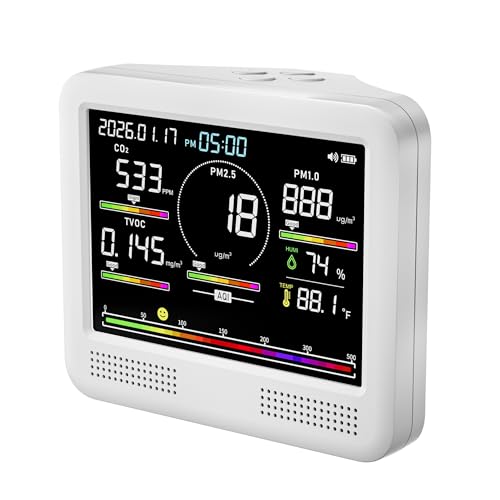
1. KDWKD Indoor Air Quality Monitor (11-in-1)
Our pick — over 4.5★ from 850+ verified ratings; the strongest balance of quality and price.
Its 9-hour battery is a real upgrade over the BREATHE Airmonitor Plus (which lasts only a few hours), so you can carry it from bedroom to kitchen without always hunting for an outlet.
This monitor gives you 11 parameters including CO2, PM0.3 through PM10 (particles ranging from 0.3 to 10 micrometers), formaldehyde, TVOC, temperature, and humidity—and wraps it all in a portable battery-operated design that runs for 9 hours on a charge. That battery life is a meaningful upgrade over the BREATHE Airmonitor Plus (which lasts only a few hours), so you can actually carry the KDWKD from the bedroom to the kitchen to the RV without hunting for an outlet.
The large color screen shows a 7-level AQI display with an audible alert system that beeps when pollution levels turn unhealthy. One buyer shared that they use it as their indicator to switch on an air purifier: whenever the reading shifts from green to yellow, they take action. The compact design sits easily on a nightstand or desk, and buyers specifically note that the built-in battery allows use in different rooms without being plugged in.
Reviewers also found it matches readings from another monitor they own, though the temperature reads about 2–3°F higher—confirmed with a separate keyring thermometer. The companion app is basic (really only for syncing the time), but for a standalone monitor that just works, that is not a dealbreaker.
Portability & Sensor Depth
- 9-hour battery for true room-to-room flexibility
- 7-level AQI plus audible alerts for quick action
- Great for detecting cooking smoke, wildfire smoke, pet odors, and paint fumes
- Lightweight and compact enough for a backpack or suitcase
Minor App Limitations
- App is bare-bones—mainly used for time sync
- Temperature reading runs slightly high vs external thermometer
Reach for this if: you want a genuinely portable air quality testing kit that covers all the important pollutants without needing to stay plugged in.
Look elsewhere if: you need deep app analytics or a screen that doubles as a clock.
2. BREATHE Airmonitor Plus Indoor Air Quality Monitor
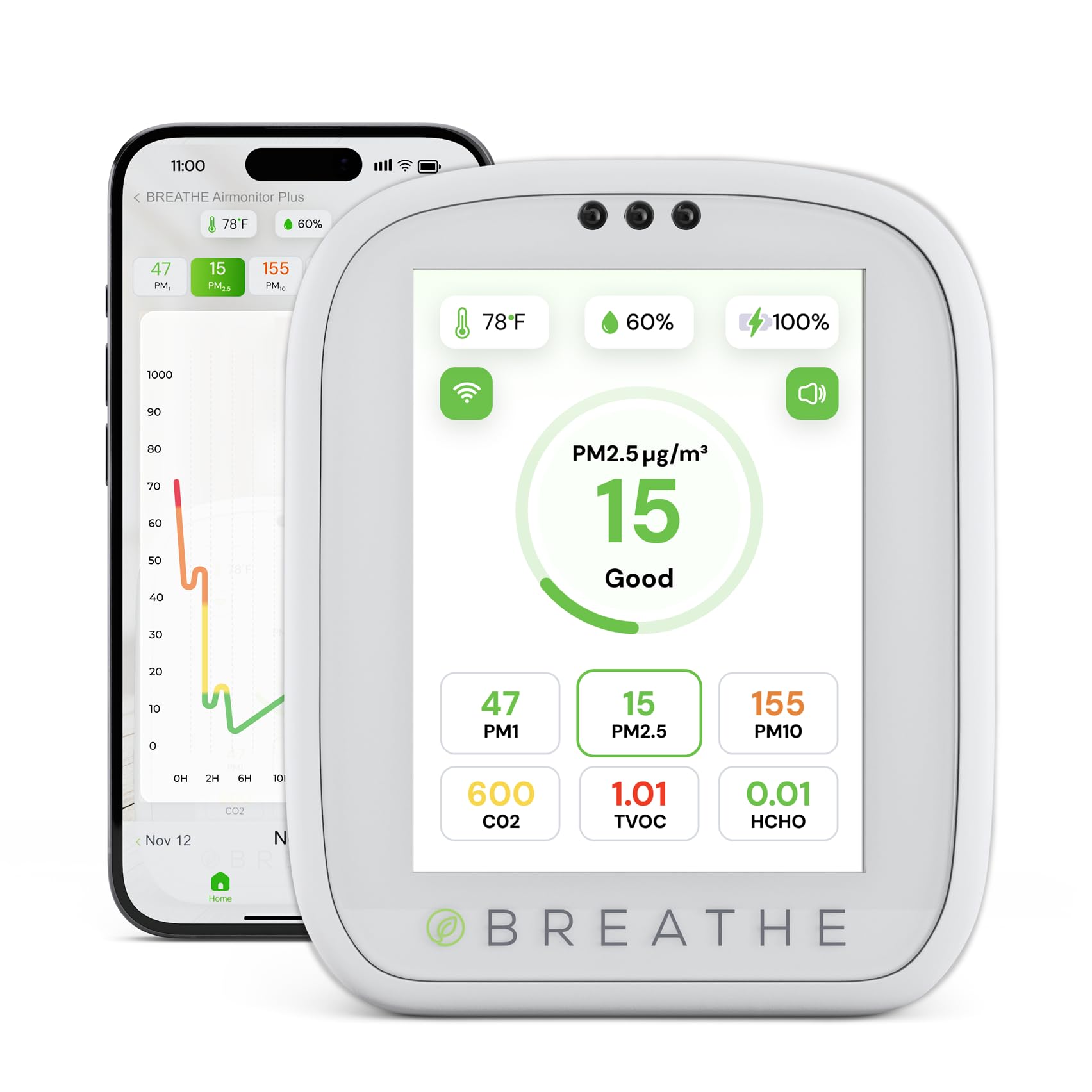
Tracks CO2, PM1/2.5/10, TVOC, and formaldehyde (HCHO) simultaneously—a wider net than most home monitors—so you know whether cooking particles, off-gassing furniture, or stale CO2 is the problem.
You get a complete picture of what you are breathing because the Airmonitor Plus tracks CO2, PM1, PM2.5, PM10, TVOC (total volatile organic compounds), and formaldehyde (HCHO) all at once. That is a wider net than most home monitors cast—instead of just a single AQI number, you see the breakout for each pollutant so you know whether you are dealing with cooking particles, off-gassing furniture, or stale CO2 from too many people in one room.
The free Breathe Tech app gives you real-time remote monitoring, instant air quality alerts, and a 30-day data history so you can spot trends—for example, that your CO2 spikes above 4,500 ppm (parts per million, a measure of concentration) every afternoon in a poorly ventilated office, as one reviewer noted. But buyers report that the battery only lasts a few hours, so you will need to keep it plugged in for continuous monitoring; the display also has a proximity sensor meant to dim the screen, but some owners mention it does not work reliably.
Unlike the KDWKD 11-in-1, which relies on standalone readings, this unit comes with built-in quick-calibration tools for CO2, VOC, and HCHO, making it easier to trust the numbers over time. The trade-off is that some users report the automatic recalibration can drift low, so manual outdoor calibration every few days keeps it honest.
Sensor Breadth That Matters
- Covers CO2, PM1/2.5/10, TVOC, and formaldehyde—the full picture
- 30-day data history and remote alerts via the app
- Compact modern design fits on a desk without being an eyesore
- 2-year manufacturer warranty for confidence
Battery Limits Its Mobility
- Short battery life (a few hours) means it is effectively a corded monitor
- Proximity sensor to dim the screen reportedly inconsistent
- Auto-recalibration may under-report CO2 without manual correction
Your best bet if: you want professional-grade multi-sensor accuracy and trend tracking for a home office or nursery.
Choose differently if: you plan to carry the monitor from room to room—you will be tethered to an outlet.
3. YNAK 16-in-1 Air Quality Monitor
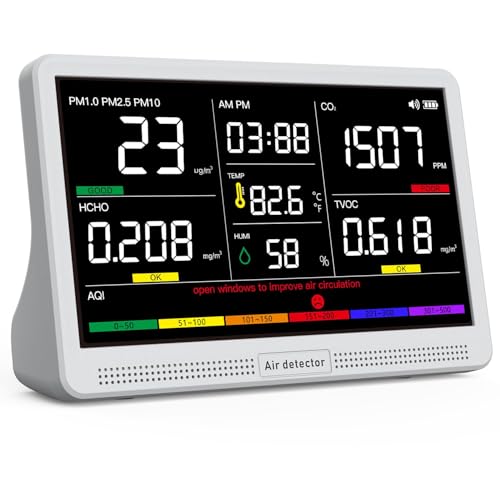
The defining feature is its 7-inch LED display—noticeably bigger than the compact screens on the LifeBasis or 22 HOBBIES—so you see CO2, PM2.5, PM1.0, HCHO, TVOC, and more without squinting from across the room.
The defining feature here is the 7-inch LED display—it is noticeably bigger than the compact screens on the LifeBasis or 22 HOBBIES, which means you get a crisp view of CO2, PM2.5, PM1.0, PM10, HCHO, TVOC, temperature, humidity, AQI, and even the time without squinting. Three brightness settings let you dial it down for a bedroom or crank it up in a bright sunlit room. One reviewer called it “surprisingly accurate, painfully honest, and now I am watching my air like it is reality TV.”
It uses external high-precision sensors that sample air directly and claim accuracy down to 0.001 units (the smallest increment the device shows). Owners mention it responds fast to cooking, candles, and opening windows. The 2500mAh battery delivers 8 hours of cordless use—enough for a workday but shorter than the LifeBasis which offers 11-12 hours. It also includes 7 distinct AQI alert buzzers and a mute button so you can silence alarms during sleep.
The trade-off is that some users raised accuracy doubts when initial readings stayed green despite strong chemical cleaners being used weekly. The device also requires you to avoid touching the sensors or exposing them to perfumes and strong odors to maintain calibration.
Glanceable Display & Fast Response
- 7-inch LED screen shows all parameters at once—no menu navigation needed
- Fast updates with color-coded AQI and seven distinct alert sounds
- External sensors with 0.001 accuracy for precise readings
- Doubles as a clock with 12/24-hour format and °F/°C switching
Battery & Calibration Caveats
- 8-hour battery is decent but not the longest in this lineup
- Sensors can be thrown off by perfumes, strong odors, or touching
- Initial readings may stay green even with chemical cleaners present
Ideal for: anyone who wants a large, easy-to-read display for a living room or open-plan space where you check the air from across the room.
Not for: people who need the longest possible battery life or a pocketable design for travel.
4. LifeBasis 11-in-1 Air Quality Monitor

With a 2500mAh battery delivering 11-12 hours of continuous use, the LifeBasis outlasts the YNAK (8 hours) and the KDWKD (9 hours) by a solid margin—so you can monitor from morning to bedtime without reaching for the Type-C cable.
With a 2500mAh battery delivering 11-12 hours of continuous use, the LifeBasis outlasts every other portable monitor here—including the YNAK (8 hours) and the KDWKD (9 hours)—by a meaningful margin. That means you can start monitoring in the morning and still have power left at bedtime without reaching for the included Type-C charging cable. One buyer mentioned that morning CO2 reads around 950 ppm in their bedroom, dropping to 450-500 after opening windows, confirming the monitor’s real-world value for ventilation timing.
It tracks 11 parameters including CO2 (via an NDIR infrared sensor, which is the gold standard for carbon dioxide detection), PM1.0, PM2.5, PM10, HCHO, TVOC, temperature, and humidity. The LCD screen uses a four-color alert system (green, yellow, orange, red) and emits a ticking alert sound when any reading goes abnormal. Reviewers praise its accurate VOC detection—spiking with fresh paint and dropping near ventilation—as well as its flat, pocketable size that makes it easy to slide into a bag.
The catch is that the CO2 sensor requires manual calibration outdoors, and some customers note the CO2 reading stays persistently high if you do not calibrate it correctly. It also lacks Wi-Fi or Bluetooth, so there is no app or remote monitoring—this is purely a standalone device.
Battery Life & Sensor Quality
- 11-12 hour battery—longest in its class among these portable monitors
- NDIR infrared CO2 sensor for accurate carbon dioxide readings
- Color-coded alerts with audible alarm; screen brightness adjustable
- Compact, flat shape fits in a pocket or on a desk stand
Manual Calibration & No Connectivity
- CO2 sensor needs outdoor calibration to stay accurate
- No Wi-Fi or Bluetooth—no app, no remote data, no historical graphs
- Ultrasonic humidifiers can cause false high PM readings
Grab this if: you want the longest battery life in a portable air quality testing kit and can handle a quick manual calibration once in a while.
skip it if: you need app integration, data logging, or remote alerts for your monitoring.
5. 22 HOBBIES 8-in-1 Air Quality Monitor
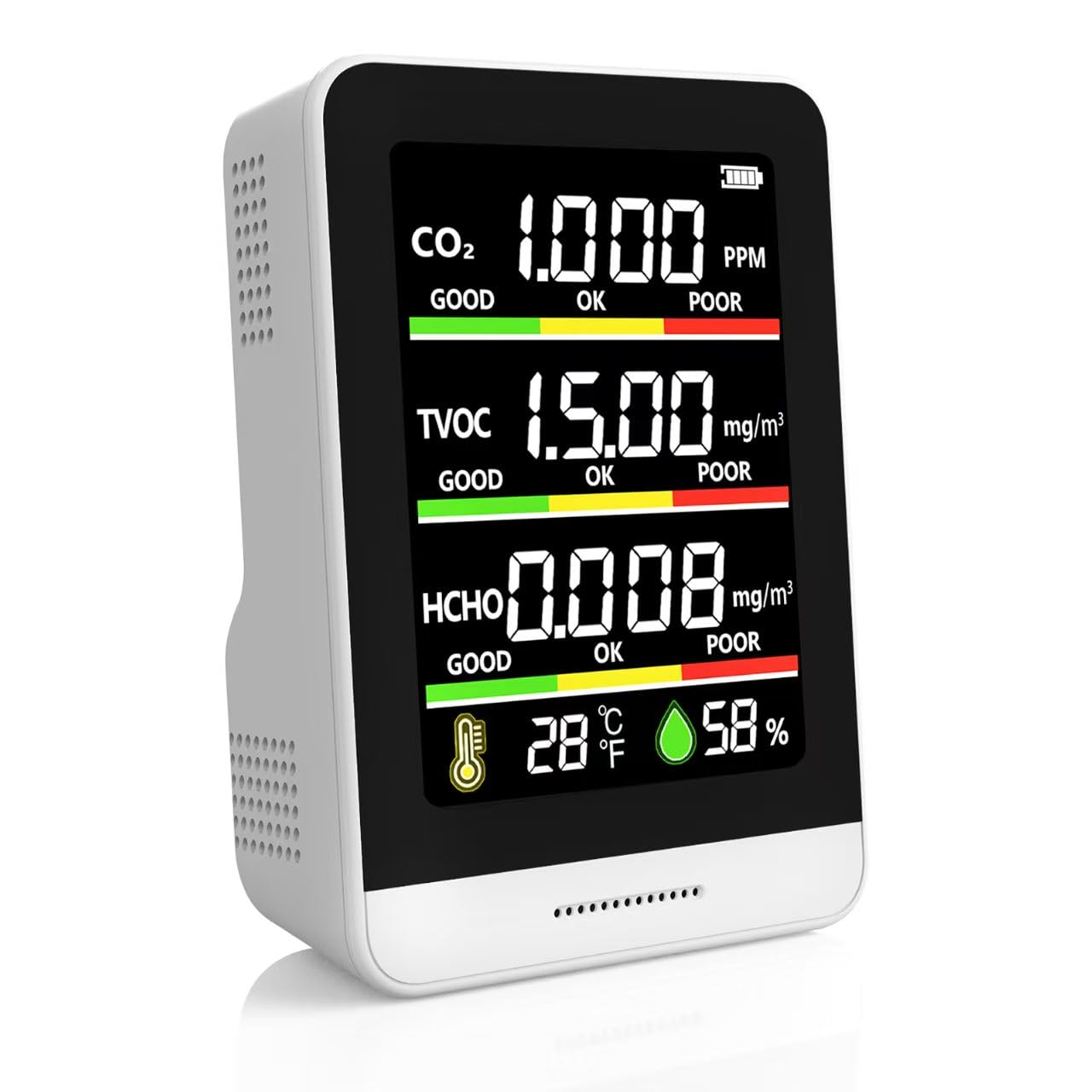
Covers CO2, TVOC, HCHO (formaldehyde), temperature, and humidity on a color screen for a lower cost, but it skips PM2.5 and fine dust measurement that the KDWKD and LifeBasis include.
For the price, you get a capable 8-in-1 tester that measures AQI, CO2, TVOC, HCHO (formaldehyde), temperature, and humidity on a colorful screen. The 1200mAh battery keeps it running for 9-10 hours on a full charge (about 3-4 hours to recharge via USB-C), which puts it on par with the KDWKD for runtime. One owner reported that CO2 levels rise with breath, confirming the sensor is responsive enough for practical use.
The double ventilation structure and high-performance chip are designed to capture weak electrochemical signals, particularly for HCHO detection. The screen shows five types of data at once with color-coded indicators, so you can see at a glance whether your air is healthy. It is small enough at 0.41 pounds and roughly 3.86 inches tall to toss in a bag for use at home, school, or in a hotel room.
Where it falls short relative to the KDWKD and LifeBasis is sensor breadth—it does not track particle counts (PM1.0, PM2.5, PM10), so you will not know if wildfire smoke or dust is the problem. Also, the battery is described by some reviewers as a backup rather than for heavy portable use, so treat the 9-10 hour claim as a best-case scenario.
Essential Coverage at Low Cost
- Measures CO2, TVOC, HCHO, temp, and humidity—covers the most common indoor concerns
- 9-10 hour battery on a 1200mAh cell; USB-C charging
- Compact and lightweight for portable use
- Color screen with real-time display of five data points
No Particle Sensor
- Does not measure PM2.5, PM10, or fine dust particles
- Battery life may feel minimal for continuous portable use
- Fewer parameters than similarly priced options
Best suited for: someone on a budget who primarily needs CO2, VOC, and formaldehyde readings without particle monitoring.
Consider a different model if: you live in an area prone to wildfire smoke or want a full particle count.
6. Temtop M10+ 6-in-1 CO2 Meter & Indoor Air Quality Monitor
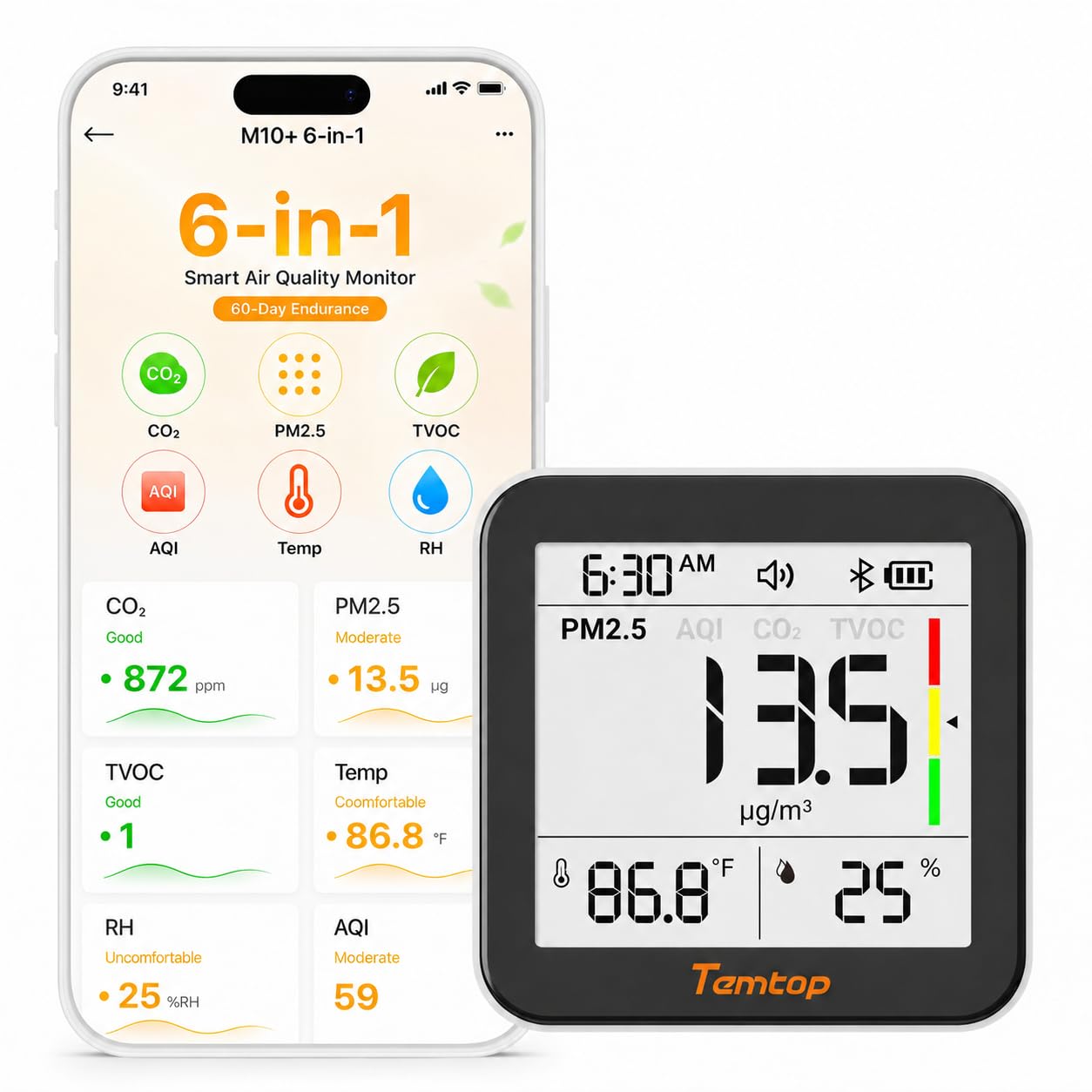
Its e-ink display and energy-efficient algorithm give it up to 60 days of battery life—a massive leap over the LifeBasis’s 11-12 hours and the YNAK’s 8 hours—so you can set it on a nightstand and forget about charging for two months.
Thanks to its energy-efficient algorithm and e-ink display (the same low-power screen technology used in e-readers), the M10+ achieves up to 60 days of battery life—a staggering leap over the 11-12 hours of the LifeBasis and the 8 hours of the YNAK. That means you can set it on a nightstand and essentially forget about charging for two months while it continuously tracks CO2, PM2.5, TVOC, temperature, and humidity.
The e-ink screen is crisp and easily readable in normal lighting, and it can be muted completely for zero sleep disruption—making it ideal for bedrooms, nurseries, and home offices where you do not want blinking lights or beeping alarms. Reviewers point out it is excellent for monitoring PM2.5 and VOCs in a laser engraving workspace, and one customer observed that the constant screen rotation drains the battery faster, but leaving it on a single CO2 reading allows weeks of use. The Temtop app provides real-time updates, historical data analysis, and OTA (over-the-air, meaning it updates via Wi-Fi) firmware updates so the device never goes out of date.
The main limitation is that it tracks only 6 parameters, so you do not get PM1.0, PM10, or formaldehyde readings that the KDWKD or BREATHE units offer. Some reviewers also found the app so-so and noted it can take a few days for the sensors to stabilize and pick up everything in the air properly.
Battery Life That Changes Everything
- Up to 60 days of battery life with e-ink display and smart algorithm
- App connectivity with OTA updates for future-proofing
- Completely silent with mute-able alarm—perfect for bedrooms
- Compact, clear display readable in normal lighting
Fewer Sensors Than Competitors
- Only 6 parameters—no PM1.0, PM10, or formaldehyde (HCHO)
- App is limited in functionality per some user reports
- Sensors may require a few days to stabilize after first use
Choose this for: a bedroom, nursery, or home office where you want continuous, silent monitoring that you only need to charge twice a year.
Pass on it if: you need a full suite of particle sizes (PM1.0, PM10) or formaldehyde tracking.
Understanding the Specs
CO2 Monitoring
Carbon dioxide is the gas you exhale, and it builds up fast in a closed room with several people or poor ventilation. Levels above 1,000 ppm (parts per million) can cause drowsiness, headaches, and poor concentration. An NDIR (non-dispersive infrared) sensor is the most accurate type for CO2, and monitors that include it—like the LifeBasis and BREATHE—give you readings you can actually rely on for ventilating your space.
PM2.5 and Fine Particles
PM2.5 refers to particles smaller than 2.5 micrometers—small enough to get deep into your lungs and even your bloodstream. Sources include cooking smoke, candle soot, wildfire smoke, and dust. A laser particle sensor is the best standard for counting these tiny particles, and it is essential if you live near a busy road or fire-prone area. The KDWKD, YNAK, and LifeBasis all include PM2.5 tracking, while the 22 HOBBIES does not.
TVOC and Formaldehyde
TVOC (Total Volatile Organic Compounds) is a catch-all for gases emitted by paints, cleaning supplies, air fresheners, new furniture, and building materials. Formaldehyde (HCHO) is a specific VOC common in pressed-wood cabinets and flooring. A good monitor separates these two so you know if a spike is from cleaning spray or your new bookshelf. The BREATHE and KDWKD track both; the Temtop M10+ tracks TVOC but not formaldehyde separately.
Battery Life and Display Type
Battery life determines whether your monitor is portable or effectively corded. A unit with 8-12 hours lets you walk around the house spot-checking rooms. The Temtop M10+ breaks the mold with up to 60 days thanks to its e-ink display, but it updates data less frequently than an LCD or LED screen. Big color displays like the YNAK’s 7-inch screen make the data instantly readable from across the room, but they use more power—so you trade battery life for visibility.
FAQ
What is the most important pollutant to monitor in my home?
How long does it take for an air quality monitor to calibrate?
Can I use an air quality monitor outdoors?
What is the difference between AQI and CO2 readings?
Do I need a monitor with app connectivity?
Why does my air quality monitor show different readings in different rooms?
What does HCHO mean on an air quality monitor?
How often should I calibrate my air quality monitor?
Final Thoughts: The Verdict
For most buyers, the best air quality testing kit is the KDWKD 11-in-1 because it covers CO2, multiple particle sizes, formaldehyde, and TVOC with a 9-hour battery that lets you walk through the whole house—all without needing a constant connection to an outlet. If you need professional-grade sensor depth with app-driven trend analysis, grab the BREATHE Airmonitor Plus. And for a silent, set-and-forget bedroom solution that runs for two months on one charge, you will not find a better fit than the Temtop M10+.
How We Picked
We do not accept paid placement. Every pick is matched to a real buyer and a real use-case; we do not hands-on test units.
Sources & Methodology
Specifications: manufacturer listings and product documentation. Review insights: verified customer reviews, as of July 2026. Pricing: not shown on this page (it changes often); check the current price via the retailer link.
As an Amazon Associate, Gadgets Feed earns from qualifying purchases. This does not affect which products we feature.