
Our readers keep the lights on and my morning glass full of iced black tea. As an Amazon Associate, I earn from qualifying purchases.
Specs are compiled from manufacturer listings and verified buyer reviews and can change over time — please confirm the key details on the product page before buying.
A stray shows up, and the first question is always the same: does it have a chip, and how do you read it without dragging it to a vet? An animal chip scanner is the tool that answers that right there on the spot — a handheld device that reads the microchip under an animal’s skin and gives you the ID number so you can track down the owner. But not all scanners actually read every chip, and the wrong one can leave you staring at a blank screen with a lost animal and no leads.
I’m Min — the founder and writer behind Gadgets Feed. This guide is built by comparing the manufacturers’ published specifications and the patterns across verified customer reviews, so you get each pick’s real strengths and trade-offs instead of marketing spin.
The best scanner depends on chip compatibility, data transfer method, and build durability for your specific field work.
Our Picks at a Glance

How To Choose The Best Animal Chip Scanner
Picking the right scanner depends on three things: which microchips it can read, how you get that number out of it, and whether the build matches the conditions you work in. Here is what to watch for.
Chip Compatibility is Everything
The single most common complaint in buyer reviews is that a scanner simply will not read a certain brand of microchip. Most budget scanners handle the international standard (ISO 11784/11785 and FDX-B — the 15-digit protocol used by most modern chips), but they almost always fail on AVID chips and older 9-digit formats. If you work with a mix of animals from different sources, a universal reader that explicitly covers FDX-A, FDX-B, and AVID is the only way to avoid blank scans.
Data Transfer Matters More Than You Think
If you are scanning dozens of animals a day, typing a 15-digit number by hand is a recipe for errors. Scanners with Bluetooth or wireless 2.4GHz let you send the chip number straight to a phone or laptop. Some models also store multiple records on the device — typically 240 to 256 — so you can upload them in a batch later. For a rescue or shelter, that feature alone saves hours of data entry.
Build, Battery, and Real-World Use
A scanner that lives in a truck or a barn needs to survive bumps, dust, and the occasional drop. Look for a protective case included with the unit, a rechargeable battery that lasts a full shift, and a screen you can read in direct sunlight. Reviewers frequently note that lightweight models (under 3 ounces) are easier to handle during long scanning sessions, while heavier units with more sturdy cases feel sturdier in the field.
Quick Comparison
| Model | Best For | Weight | Data Storage | Connectivity | Amazon |
|---|---|---|---|---|---|
| Halo Pet Microchip Reader Scanner, Pink★ Best Overall | Proven rescue workhorse | 8 oz | No internal memory | USB | Amazon |
| Hero Universal Microchip ScannerUniversal Pro | Universal all-chip coverage | 12.5 oz | On-screen display hold | Bluetooth | Amazon |
| Symcode Q30 Bluetooth Scanner | Bluetooth + wireless uploads | 240 records | 240 records | Bluetooth 6.1 / 2.4G / USB | Amazon |
| Alacrity 3-in-1 Scanner | Multiple connection options | 240 records | 240 records | 2.4GHz / Bluetooth / USB | Amazon |
| Symcode 1.44″ TFT Scanner | Budget-friendly multi-connection | 240 records | 240 records | Bluetooth 6.1 / 2.4G / USB | Amazon |
| NetumScan Upgraded Scanner | Ultra-light portable scanning | 2.89 oz | 256 records | USB | Amazon |
| ISENVO 190S Scanner | Entry-level budget pick | 6.4 oz | No internal memory | None (standalone) | Amazon |
In‑Depth Reviews
1. Halo Pet Microchip Reader Scanner, Pink
Our pick — 4.5★ from 450+ verified ratings; the strongest balance of quality and price.
4.5-star rated from 485 reviews, with verified reports of reading AKC and 9-digit Avid chips despite the specs.
The Halo scanner has a 4.5-star rating from 485 reviews, and the stories tell you everything: “I have actually been able to locate owners of dogs and trace their entire history!” one buyer reports. It reads most 10-digit and 15-digit microchips, including HomeAgain and Pro ID, and it has an unexpected trick — multiple verified reviews say it also reads AKC and 9-digit Avid FriendChips despite the product description saying it does not. That kind of real-world flexibility makes it a surprisingly reliable tool for rescue work.
It connects via USB and works with Windows 98 or later, but it is NOT compatible with Mac. At 8 ounces, it is lighter than the 12.5-ounce Hero scanner but heavier than the ultra-portable NetumScan. The unit runs on a rechargeable battery charged through a USB cable, though multiple reviewers warn that the charging cable is non-standard — if you lose it, you will struggle to find a replacement at local stores. There is no internal data storage, so you need to write down chip numbers as you scan.
The Halo scanner has a resolution of 800 and uses an LED light source. It is built by MICRO-ID and carries no warranty. One reviewer who has used it for over 3 years in a breeding program called it “great” but noted the charger issue as a real frustration.
Why It Works
- 4.5 stars from 485 reviews — the most validated track record in this list
- Reports of reading AKC and 9-digit Avid chips despite the specs, giving broader real-world compatibility
- Simple operation: charge via USB, scan, and read the number — no software needed
Watch Out For
- No Mac compatibility at all — Windows only
- Proprietary charging cable is difficult to replace if lost
- No internal memory for storing chip numbers
Go for it if: you run a rescue or do regular stray work and want a proven, battle-tested scanner with a deep review history — the Halo has probably reunited more pets than any other model here.
Pass if: you need Mac compatibility, plan to store scans internally, or hate dealing with proprietary cables.
2. Hero Universal Microchip Scanner
Reads FDX-A, FDX-B, and all 9/10/15-digit chips, including AVID — the only scanner here that doesn’t skip legacy formats.
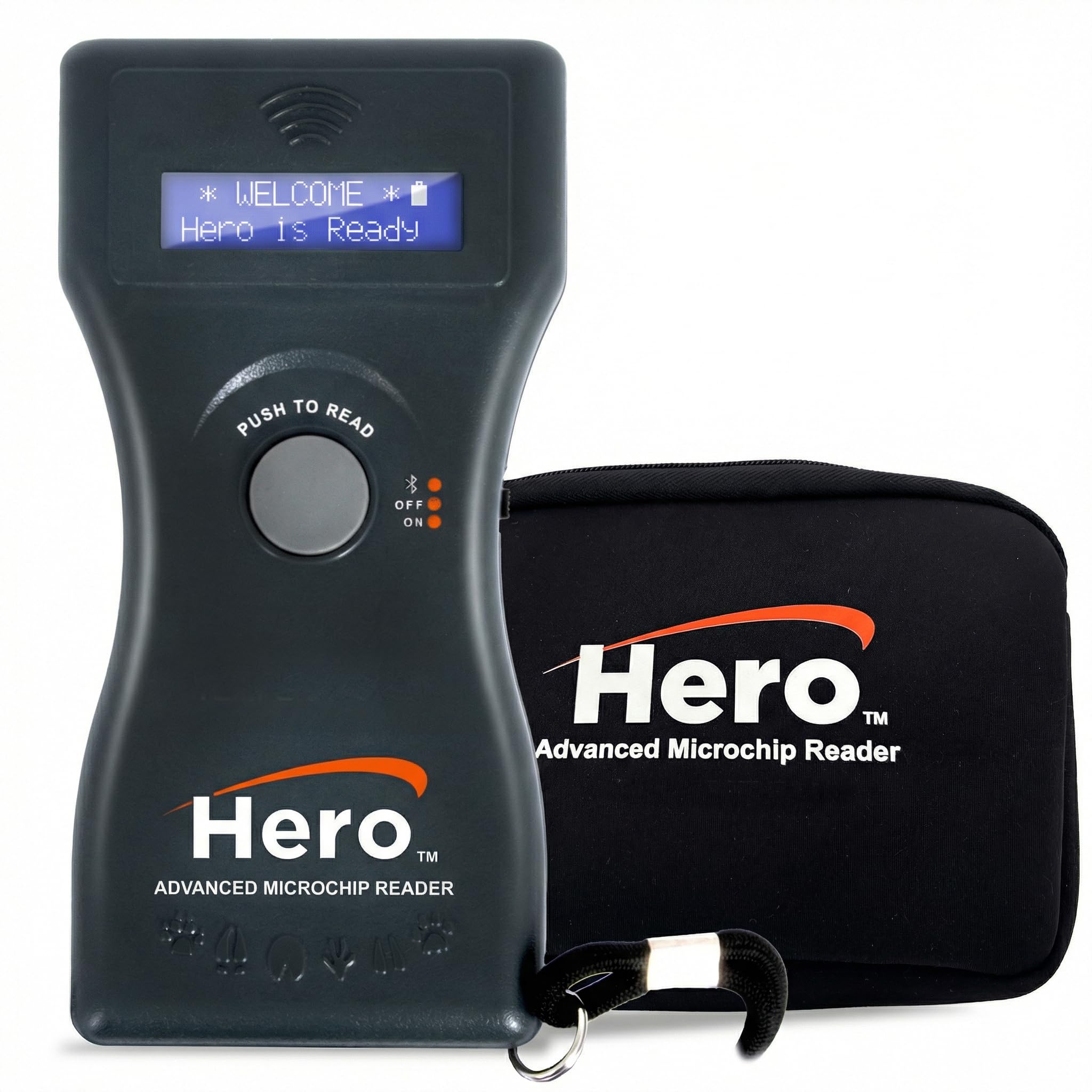
The biggest headache with most scanners is that they flat-out refuse to read AVID and older 9-digit chips — leaving you with nothing when the chip is from a brand you did not expect. This Hero model sidesteps that entirely by supporting ISO and non-ISO microchips, including FDX-A, FDX-B, and 9, 10, and 15-digit formats. That means it works with nearly every major pet microchip brand on the market, from the newest ISO chips to the legacy ones still under plenty of older dogs and cats.
It sends scanned chip numbers via Bluetooth to a phone or tablet within a 25-foot range, and buyers report it can even paste the number straight into the iPhone Notes app. The backlit LCD screen holds the chip number for a full 15 minutes after scanning — so you are not scrambling to write it down while a nervous animal squirms. It runs on a rechargeable 9V battery, includes a protective case, and weighs 12.5 ounces, making it noticeably heavier than the ultra-light models but far more sturdy for field conditions.
One reviewer noted that replacement rechargeable 9V batteries can be hard to find locally, so ordering a spare upfront is smart. Reviewers also report that the beeper is not particularly loud, which can be an issue in noisy shelter environments.
Why It Stands Out
- Reads FDX-A, FDX-B, and all 9/10/15-digit chips — the only scanner here that does not skip AVID chips
- Bluetooth sends chip numbers to your phone automatically within a 25-foot range
- 15-minute display hold gives you time to record without rushing
- Comes with a rugged protective case for field durability
Trade-offs to Consider
- At 12.5 ounces, it is the heaviest scanner here, noticeably chunkier than the 2.89-ounce NetumScan
- Rechargeable 9V batteries are not a standard USB form factor, so spares are harder to find
- Beeper volume is low, which some reviewers found hard to hear in loud spaces
Reach for this if: you work with a wide variety of animals from different sources and cannot risk a scanner that misses certain chips — this is the only one here that handles FDX-A, FDX-B, and AVID formats.
Look elsewhere if: you need the lightest possible carry and are okay with a scanner that only reads ISO/FDX-B chips.
3. Symcode Animal Microchip Scanner Q30

Bluetooth 6.1, wireless 2.4GHz, and USB connectivity with 240-record internal storage for automated uploads.
This Symcode Q30 model brings three connection methods — Bluetooth 6.1, wireless 2.4GHz, and USB cable — so you can pick whichever fits your setup. It stores up to 240 tag records internally and uploads them to a computer via Bluetooth or wireless dongle. That is a major step up from the Halo scanner, which has no memory at all. The 1.44-inch OLED display is bright enough to read in sunlight, which owners mention makes a real difference when scanning outside.
It reads ISO 11784/11785 FDX-B and EMID (15-digit) microchips, but like most mid-range models, it does NOT support AVID chips. It runs on a lithium polymer battery and has a claimed 16-hour run time. At a weight that is not explicitly stated on the product page, it feels compact and one-hand friendly based on buyer reports. One reviewer called it “compact, lightweight, easy menus” and appreciated that the beep volume is adjustable — a fix for the beeper-too-quiet complaint on the Hero model.
There is an important caution: a small number of buyers reported the unit freezing or crashing after a few scans. The manufacturer offers a 1-year warranty, which is better than most scanners in this price range. Customers note it detects 15-digit chips instantly and accurately, and one shared a success story of using it to reunite a lost cat with its owner.
What You Get
- Three connection options: Bluetooth 6.1, wireless 2.4G, and USB cable
- Stores 240 chip records internally and uploads them to a computer
- 1.44-inch OLED display readable in direct sunlight
- Adjustable beep volume
What to Know
- Does not read AVID or Trovan chips — limited to ISO/FDX-B/EMID
- A few reviewers experienced the unit freezing after initial use
- Some reviewers point out inconsistent performance on horses
Choose this for: a shelter or clinic that wants to log chip numbers digitally without manual typing — the Bluetooth and 240-record storage make data handling smooth.
skip it if: you regularly encounter AVID-chipped animals or need simple to use reliability from the start — the freeze reports are rare but worth noting.
4. Alacrity 3-in-1 Bluetooth Pet Microchip Reader

Three connection options plus an 800mAh battery delivering 16 hours of use, verified by reviewers.
The Alacrity scanner offers the same 3-in-1 connectivity as the Symcode Q30 (2.4GHz wireless, Bluetooth, and USB) at a similar price point. It supports ISO 11784/11785 FDX-B and EMID protocols and can output chip numbers in either hexadecimal or decimal format — a feature that matters because some registries and databases use one or the other, and most budget scanners only do hex. It stores up to 240 records in storage mode or transmits instantly in upload mode.
It packs an 800mAh rechargeable battery that the manufacturer rates for 16 hours of continuous operation. Reviewers confirm the battery life is genuinely long — one buyer mentioned they had not charged it yet after multiple uses. The 1.44-inch TFT screen shows battery level, working mode, connection type, and microchip data. At a claimed weight that aligns closely with the Symcode models, it is light enough for one-handed use.
The catch is chip compatibility: it does NOT read AVID or Trovan microchips. Multiple reviewers point this out clearly. One buyer also reported that the device cannot be properly turned off — accidental bumps cause it to activate loudly, and the long battery life means it stays on for days if bumped in a bag. It charges via USB-C, which is a modern convenience the Halo scanner lacks.
Standout Features
- 3-in-1 connectivity: 2.4GHz wireless, Bluetooth, and USB cable
- 800mAh battery delivers a genuine 16 hours of use, verified by reviewers
- Hex and decimal output modes for compatibility with different databases
- USB-C charging
Limitations
- Cannot read AVID or Trovan chips, just like the other mid-range models
- No proper off switch — accidental bumps in a bag cause the scanner to activate loudly
Best for: someone who wants the connectivity flexibility of Bluetooth, wireless, and USB in one package and values long battery life above all else.
Not right for: anyone who stores their scanner loose in a bag — the accidental-activation issue is a genuine annoyance noted by multiple buyers.
5. Symcode 1.44″ TFT Pet Microchip Scanner

1.44-inch TFT display, Bluetooth 6.1, wireless 2.4G, USB, and 240-record storage at a budget-friendly price.
This Symcode model shares almost the same feature set as the Q30 above — 1.44-inch TFT display, 800mAh battery rated for 16 hours, Bluetooth 6.1 and wireless 2.4G connectivity, and 240-record storage capacity. It supports ISO 11784/11785 FDX-B and EMID protocols and outputs both hex and decimal data. It is priced similarly to the Alacrity and the NetumScan, making it a direct alternative if you want the Symcode ecosystem or prefer its button layout.
Buyers give it a 4.4-star rating from 48 reviews, calling it “easy to use” and noting it “works great to verify chip placement” in puppies. One breeder microchips their own puppies and uses this scanner to confirm the chip is there before the new owners pick them up. It stores chip numbers, and the Bluetooth upload works with PC software for logging. Reviewers also mention the screen is clear and the scan is fast — “it found chips on three dogs with no issues.”
The main limitation is that one reviewer found it inconsistent on horses — it worked on dogs but gave unreliable results on equine scans. It also cannot read AVID or Trovan chips, which is standard at this price tier. For the average pet owner or small rescue working with dogs and cats, the limited feedback is positive.
What Shines
- Clear 1.44-inch TFT screen with battery level and connection info
- Three connectivity options and 240-record storage
- Fast scanning with good battery life per buyer reviews
What Does Not
- Inconsistent performance on horses according to one reviewer
- No AVID or Trovan chip support
A good fit for: a small rescue or individual who scans mostly dogs and cats, wants Bluetooth logging, and appreciates a budget-friendly price.
Not ideal for: scanning horses or any animals likely to carry AVID chips — look at the Hero scanner for that.
6. NetumScan Upgraded Pet Microchip Scanner Reader

Weighs 2.89 ounces with 256-record storage — the lightest and highest-capacity scanner here.
At 2.89 ounces, the NetumScan is a fraction of the weight of the 12.5-ounce Hero scanner and even lighter than the 8-ounce Halo. That makes it the most pocket-friendly option here, easy to carry on a belt or in a small bag during field rescues. It supports ISO 11784/11785 FDX-B and EMID protocols with a reading range of 0-20cm, and it stores up to 256 tag records — the most storage of any scanner in this lineup, beating the 240-record cap on the Alacrity and Symcode models.
The OLED display is bright enough for outdoor use, and the unit runs on a built-in lithium battery charged via USB. among the most useful features is the ability to export stored chip numbers to a PC using the included USB cable. Reviewers highlight this: “Exports chip numbers to PC, saving manual entry and preventing transcription errors.” For anyone running a shelter or clinic, that automated data transfer is a major time saver compared to the Halo scanner which requires manual note-taking.
The scanner measures 6.61 x 3.46 x 0.59 inches and is easy to operate one-handed. It has an intelligent power-saving mode that shuts down after 180 seconds of inactivity. However, like the other mid-range models, it does NOT read AVID chips or support the FDX-A protocol. One owner reported it could not read two sheep tags that used the A-series format from a breeder, so it is limited to 15-digit B-series tags.
Why It Wins
- At 2.89 ounces, it is 2.8 times lighter than the 8-ounce Halo scanner — genuinely pocketable
- Stores 256 tag records, the highest capacity on this list
- USB export to PC eliminates manual typing errors
- OLED screen is readable in direct sunlight
The Catch
- Does not read AVID chips or FDX-A protocol — limited to FDX-B/EMID
- One reviewer found it skipped A-series sheep tags from a breeder
Reach for this if: portability is your top priority and you work with ISO-standard chips — the 2.89-ounce weight and 256-record storage make it the best travel companion here.
Pass if: you need universal chip coverage including AVID — go with the Hero scanner instead.
7. ISENVO 190S Pet Microchip Scanner
Reads 15-digit ISO/FDX-B chips at the lowest cost, with a backlit screen and auto shut-off.
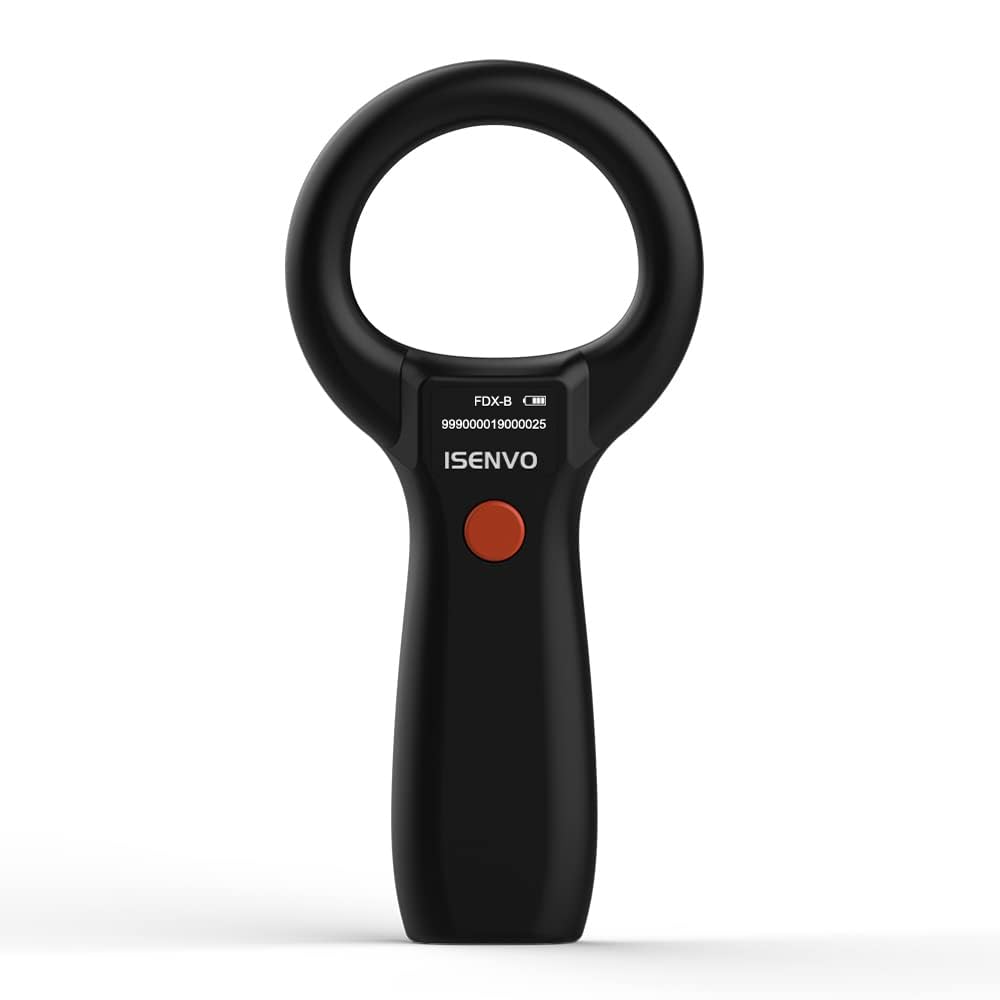
If you just need to occasionally confirm a chip and do not need Bluetooth or data storage, the ISENVO 190S gets the job done at the lowest cost. It reads 15-digit FDX-B ISO 11784/11785 standard microchips and has a backlit screen for dim conditions. One customer observed: “I tried it on my cat and it worked! The code it showed matched the records I have for my cat’s microchip.” It is straightforward — press the button, scan in an S-pattern from the shoulder blades, and read the number.
The unit weighs 6.4 ounces, which is heavier than the 2.89-ounce NetumScan but still manageable. It runs on a built-in lithium-ion battery that reportedly arrives partially charged based on buyer feedback. The device auto-shuts off after 180 seconds of inactivity to save battery, or you can hold the button for 3 seconds to power it down manually. It comes from brand ISENVO and has a 4.6-star average from 51 ratings.
The limitations are clear: it CANNOT read AVID chips or 9-digit IDs. Only 15-digit international standard protocol chips work. One reviewer described it as “no frills but does the job” and noted it “feels cheap like a toy” with no charge indicator. The blue numbers on the screen could be larger. For someone who just wants to verify their own pet’s chip or scan the occasional stray, it is perfectly functional. For serious rescue work with varied chip types, you will want something more capable.
Best Bang for Buck
- Lowest cost option that reliably reads 15-digit ISO/FDX-B chips
- Backlit screen and auto-shut-off for battery conservation
- Shoppers say it arrived partially charged and worked immediately
Where It Falls Short
- Cannot read AVID or 9-digit chips — strictly 15-digit ISO only
- No data storage or connectivity for exporting numbers
- Feels lightweight and toy-like with a small, dimmer display
Get this if: you only need to verify your own pet’s modern microchip and want the lowest entry price possible.
pass on it if: you rescue strays from unknown sources — you need a scanner that handles AVID and other non-ISO chips.
Understanding the Specs
Chip Protocols: ISO vs AVID vs FDX-B
The biggest reason a scanner fails to read a chip is protocol incompatibility. ISO 11784/11785 is the international standard — most modern pet microchips use this 15-digit FDX-B format. AVID chips use a different 9-digit or 10-digit protocol that most budget scanners simply cannot read. If you only scan pets from one shelter or brand, ISO-only works. If you scan strays from everywhere, you need a scanner that explicitly supports AVID and FDX-A in addition to FDX-B.
Data Storage and Transfer
Scanners with internal memory (240 to 256 records) let you scan a batch of animals and upload the chip numbers to a computer later via USB, Bluetooth, or wireless 2.4GHz. That saves hours of manual typing and eliminates transcription errors. Standalone scanners with no memory force you to write down each 15-digit number by hand. If you scan more than a few animals at a time, storage and transfer features are worth the small premium.
FAQ
Will an animal chip scanner read my pet’s microchip?
What is the difference between FDX-B and FDX-A microchips?
Can I connect an animal chip scanner to my phone?
How do I use a microchip scanner on my pet?
How long does the battery last on these scanners?
Do all pet chip scanners store scan history?
Will a scanner work on horses, cats, rabbits, or other animals?
Can a microchip scanner damage the chip or hurt my pet?
How do I find the owner using the chip number from a scanner?
Why does my scanner say it supports ISO but still cannot read some chips?
Final Thoughts: The Verdict
For most buyers, the best animal chip scanner winner is the Hero Universal Microchip Scanner because it reads every major chip format including AVID and FDX-A, transfers data via Bluetooth, and comes with a protective case for field durability. If you want the lightest pocket-friendly option with 256-record storage, grab the NetumScan Upgraded Scanner. And for a proven rescue workhorse with an class-leading track record, the standout is the {“@context”: “https://schema.org”, “@graph”: [{“@type”: “ItemList”, “name”: “7 Best Animal Chip Scanner”, “url”: “https://gadgetsfeed.com/best-animal-chip-scanner/”, “numberOfItems”: 7, “itemListElement”: [{“@type”: “ListItem”, “position”: 1, “name”: “Halo Pet Microchip Reader Scanner, Pink”, “url”: “https://gadgetsfeed.com/best-animal-chip-scanner/#product-1”}, {“@type”: “ListItem”, “position”: 2, “name”: “Hero Universal Microchip Scanner”, “url”: “https://gadgetsfeed.com/best-animal-chip-scanner/#product-7”}, {“@type”: “ListItem”, “position”: 3, “name”: “Symcode Animal Microchip Scanner Q30”, “url”: “https://gadgetsfeed.com/best-animal-chip-scanner/#product-6”}, {“@type”: “ListItem”, “position”: 4, “name”: “Alacrity 3-in-1 Bluetooth Pet Microchip Reader”, “url”: “https://gadgetsfeed.com/best-animal-chip-scanner/#product-4”}, {“@type”: “ListItem”, “position”: 5, “name”: “Symcode 1.44\” TFT Pet Microchip Scanner”, “url”: “https://gadgetsfeed.com/best-animal-chip-scanner/#product-5”}, {“@type”: “ListItem”, “position”: 6, “name”: “NetumScan Upgraded Pet Microchip Scanner Reader”, “url”: “https://gadgetsfeed.com/best-animal-chip-scanner/#product-3”}, {“@type”: “ListItem”, “position”: 7, “name”: “ISENVO 190S Pet Microchip Scanner”, “url”: “https://gadgetsfeed.com/best-animal-chip-scanner/#product-2”}]}, {“@type”: “Product”, “position”: 1, “name”: “Halo Pet Microchip Reader Scanner, Pink”, “image”: “https://m.media-amazon.com/images/I/81rTXvqL7ZL.jpg”, “brand”: {“@type”: “Brand”, “name”: “Halo”}, “url”: “https://www.amazon.com/dp/B00WFP7L14/?tag=gadgetsmin-20”, “offers”: {“@type”: “Offer”, “url”: “https://www.amazon.com/dp/B00WFP7L14/?tag=gadgetsmin-20”}}, {“@type”: “Product”, “position”: 2, “name”: “Hero Universal Microchip Scanner”, “image”: “https://m.media-amazon.com/images/I/711Aot8QB4L.jpg”, “brand”: {“@type”: “Brand”, “name”: “Hero”}, “url”: “https://www.amazon.com/dp/B088SMBQ3P/?tag=gadgetsmin-20”, “offers”: {“@type”: “Offer”, “url”: “https://www.amazon.com/dp/B088SMBQ3P/?tag=gadgetsmin-20”}}, {“@type”: “Product”, “position”: 3, “name”: “Symcode Animal Microchip Scanner Q30”, “image”: “https://m.media-amazon.com/images/I/51Cw23h5a7L.jpg”, “brand”: {“@type”: “Brand”, “name”: “Symcode”}, “url”: “https://www.amazon.com/dp/B0CJV4H77S/?tag=gadgetsmin-20”, “offers”: {“@type”: “Offer”, “url”: “https://www.amazon.com/dp/B0CJV4H77S/?tag=gadgetsmin-20”}}, {“@type”: “Product”, “position”: 4, “name”: “Alacrity 3-in-1 Bluetooth Pet Microchip Reader”, “image”: “https://m.media-amazon.com/images/I/511YnIZ3j1L.jpg”, “brand”: {“@type”: “Brand”, “name”: “Alacrity”}, “url”: “https://www.amazon.com/dp/B0CJNLLVBL/?tag=gadgetsmin-20”, “offers”: {“@type”: “Offer”, “url”: “https://www.amazon.com/dp/B0CJNLLVBL/?tag=gadgetsmin-20”}}, {“@type”: “Product”, “position”: 5, “name”: “Symcode 1.44\” TFT Pet Microchip Scanner”, “image”: “https://m.media-amazon.com/images/I/61YFxXTNw0L.jpg”, “brand”: {“@type”: “Brand”, “name”: “Symcode”}, “url”: “https://www.amazon.com/dp/B0CN6XQFLM/?tag=gadgetsmin-20”, “offers”: {“@type”: “Offer”, “url”: “https://www.amazon.com/dp/B0CN6XQFLM/?tag=gadgetsmin-20”}}, {“@type”: “Product”, “position”: 6, “name”: “NetumScan Upgraded Pet Microchip Scanner Reader”, “image”: “https://m.media-amazon.com/images/I/519dBjQUSPL.jpg”, “brand”: {“@type”: “Brand”, “name”: “NetumScan”}, “url”: “https://www.amazon.com/dp/B0CF296HN4/?tag=gadgetsmin-20”, “offers”: {“@type”: “Offer”, “url”: “https://www.amazon.com/dp/B0CF296HN4/?tag=gadgetsmin-20”}}, {“@type”: “Product”, “position”: 7, “name”: “ISENVO 190S Pet Microchip Scanner”, “image”: “https://m.media-amazon.com/images/I/41sKBVSlRnL.jpg”, “brand”: {“@type”: “Brand”, “name”: “ISENVO”}, “url”: “https://www.amazon.com/dp/B0BN3B6GJ1/?tag=gadgetsmin-20”, “offers”: {“@type”: “Offer”, “url”: “https://www.amazon.com/dp/B0BN3B6GJ1/?tag=gadgetsmin-20”}}, {“@type”: “FAQPage”, “mainEntity”: [{“@type”: “Question”, “name”: “Will an animal chip scanner read my pet’s microchip?”, “acceptedAnswer”: {“@type”: “Answer”, “text”: “It depends on the chip protocol. If your pet has a modern ISO 11784/11785 FDX-B chip (15 digits), almost any scanner on this list will read it. If your pet has an older AVID or Trovan chip, you need a universal scanner like the Hero that specifically supports FDX-A and non-ISO formats. Check with your vet which brand of chip your pet has before buying.”}}, {“@type”: “Question”, “name”: “What is the difference between FDX-B and FDX-A microchips?”, “acceptedAnswer”: {“@type”: “Answer”, “text”: “FDX-B is the international ISO standard — most modern pet microchips use this 15-digit format. FDX-A is an older protocol used primarily by AVID-brand chips. Most budget scanners only read FDX-B. Universal scanners like the Hero handle both, plus 9-digit and 10-digit formats. If you work with rescue animals, the distinction matters because you cannot predict which chip a stray will have.”}}, {“@type”: “Question”, “name”: “Can I connect an animal chip scanner to my phone?”, “acceptedAnswer”: {“@type”: “Answer”, “text”: “Only scanners with Bluetooth capability can send the chip number directly to your phone. The Hero scanner sends numbers to any Bluetooth-enabled device within 25 feet, and reviewers report it works with the iPhone Notes app. The Alacrity and Symcode models also offer Bluetooth connectivity for transferring stored records to a phone or computer.”}}, {“@type”: “Question”, “name”: “How do I use a microchip scanner on my pet?”, “acceptedAnswer”: {“@type”: “Answer”, “text”: “Turn the scanner on, hold it close to the animal’s skin, and move it slowly in an S-pattern between the shoulder blades — that is where most microchips are implanted. If the chip is present, the scanner will beep and display the ID number. Reviewers recommend covering the full area from the base of the neck to just behind the front legs, as chips can migrate slightly from the original injection site.”}}, {“@type”: “Question”, “name”: “How long does the battery last on these scanners?”, “acceptedAnswer”: {“@type”: “Answer”, “text”: “The Alacrity and Symcode models claim 16 hours of continuous operation from their 800mAh batteries, and reviewers confirm the battery lasts through long sessions. The Halo scanner runs on a rechargeable battery that lasts through multiple scans per charge. The Hero uses a replaceable 9V rechargeable battery. Most units include an auto shut-off feature (typically after 180 seconds of inactivity) to preserve power between uses.”}}, {“@type”: “Question”, “name”: “Do all pet chip scanners store scan history?”, “acceptedAnswer”: {“@type”: “Answer”, “text”: “No. Basic standalone scanners like the ISENVO 190S and the Halo reader do not store any data — you must write down the chip number immediately. Mid-range models from NetumScan, Alacrity, and Symcode store 240 to 256 records internally and allow you to upload them to a computer later. For shelter or clinic use, storage is a major time saver.”}}, {“@type”: “Question”, “name”: “Will a scanner work on horses, cats, rabbits, or other animals?”, “acceptedAnswer”: {“@type”: “Answer”, “text”: “Yes, as long as the animal has an ISO-standard microchip implanted. The Hero scanner is listed as compatible with \”all species, all breeds, all sizes\” and reviewers have used it on horses, dogs, and cats. However, one reviewer of the Symcode TFT model found it inconsistent on horses, so if you mainly scan equines, a universal reader like the Hero is the safer bet. The Halo scanner has been used successfully on horses by at least one reviewer.”}}, {“@type”: “Question”, “name”: “Can a microchip scanner damage the chip or hurt my pet?”, “acceptedAnswer”: {“@type”: “Answer”, “text”: “No. The scanner is a passive RFID reader — it sends out a low-frequency radio signal that powers the chip momentarily so the chip can transmit its ID number back. It does not physically contact the chip and cannot damage it. The scan is painless for the animal; the sensation, if any, is similar to a gentle tap. Multiple reviewers mention their pets did not react at all during scanning.”}}, {“@type”: “Question”, “name”: “How do I find the owner using the chip number from a scanner?”, “acceptedAnswer”: {“@type”: “Answer”, “text”: “Write down the full 15-digit or 9-digit number displayed on the scanner. Then call a local vet or shelter — they can look up the number in a national pet recovery database like HomeAgain, AKC Reunite, or PetLink. You can also use an online universal lookup tool like petmicrochiplookup.org. The scanner itself only provides the ID number; the owner contact information is stored in the registry database linked to that number.”}}, {“@type”: “Question”, “name”: “Why does my scanner say it supports ISO but still cannot read some chips?”, “acceptedAnswer”: {“@type”: “Answer”, “text”: “ISO 11784/11785 covers several sub-protocols, and \”ISO-compatible\” does not always mean universal. Some older chips use a 9-digit or 10-digit format that predates the 15-digit ISO standard. Additionally, some manufacturers (like AVID) use FDX-A, which is not the same as FDX-B. Always check the scanner’s specific language: \”reads FDX-B\” is not the same as \”reads FDX-A and FDX-B plus 9-digit and 10-digit formats.\” The Hero is the only model in this list that explicitly covers all of these.”}}]}]}