
Our readers keep the lights on and my morning glass full of iced black tea. As an Amazon Associate, I earn from qualifying purchases.
Specs are compiled from manufacturer listings and verified buyer reviews and can change over time — please confirm the key details on the product page before buying.
You have a plumbing shutoff, an electrical junction box, or an HVAC damper hidden behind your drywall, and the thought of tearing into fresh paint or perfectly textured wallboard every time you need to reach it feels like a bad deal. A proper access door solves that — it covers the opening cleanly, blends into the wall, and lets you get back to the utility in seconds without patching and repainting each time. The catch is that not all access panels are built the same way, and the wrong choice can mean a wobbly plastic cover that never sits flush or a steel unit that turns a five-minute job into a struggle with screws.
I’m Min — the founder and writer behind Gadgets Feed. This guide is built by comparing the manufacturers’ published specifications and the patterns across verified customer reviews, so you get each pick’s real strengths and trade-offs instead of marketing spin.
Whether you are hiding access to a PEX manifold or creating a neat cover for a ceiling attic entry, this breakdown of the best access doors for drywall will show you which material, latching system, and size profile actually fits your project.
Our Picks at a Glance

How To Choose The Best Access Doors For Drywall
Finding the right access door is mostly about matching the material, the mounting style, and the latching mechanism to where you are putting it. A plastic panel works fine under a kitchen sink where you want insulation, but a steel panel holds up better in a high-traffic hallway or a garage ceiling. Here are the main decision points.
Material: Plastic vs. Steel
Plastic panels (ABS or impact-resistant polymer) are lighter, easier to cut, and often come with insulation or UV stabilizers that make them suitable for outdoor or damp spots. Steel panels (usually 18-gauge or thicker) are heavier — the Premier 12×12 weighs 4.9 pounds versus Oatey’s 1-pound plastic — but they resist warping over large openings and provide a more solid feel when you push on the door. Steel is the right call for ceilings or walls where the panel needs to support the weight of the wall finish around it.
Mounting Style: Flush vs. Surface vs. Spring-Fit
Flush-mount panels sit level with the drywall so they disappear once painted. Surface-mount panels have a visible flange that rests on top of the wall, which is faster to install but looks more utilitarian. Spring-fit panels snap directly into the opening with no screws or framing — the EASY-EXS design covers openings from 10×10 to 14×14 inches with a 30-second press-in installation. The trade-off is that spring-fit panels are limited to smaller sizes, while flush-steel doors require precise framing.
Latching System
A flush cam latch uses a screwdriver slot to twist a metal tab against the frame, creating a secure, rattle-free closure. A simple screwdriver-pry cover (like the Oatey 34044) is child-safe and low-profile but can be a nuisance to open. The Elite 1000 uses three cam-lock latches for a firm seal across the whole door, while spring-fit panels rely on tension alone. Think about how often you will need access — weekly adjustments justify a tool-less latch, while rarely-used utility panels can get away with a screwdriver-only design.
Quick Comparison
| Model | Best For | Material | Mounting Depth | Latching Type | Amazon |
|---|---|---|---|---|---|
| Oatey 14×29★ Best Overall | Large Lightweight Cover | ABS Plastic | 1.6 in. (approx) | Snap-In / Pry Open | Amazon |
| Elite 1000 Cam LatchAlso Great | USA-Made Secure Fit | 18-Gauge Steel | Flush (7/16 in. lip) | Three Cam Latches | Amazon |
| EASY-EXS Spring-Fit | No-Frame Quick Install | High-Grade Plastic | 1.25 in. | Spring Tension | Amazon |
| Premier 12×12 Flush Steel | Heavy-Duty Steel Feel | Steel | Flush (no trim) | Screwdriver Keyhole | Amazon |
| Joogto 24×24 | Large Ceiling & Attic | 1mm Steel + Aluminum | 1-3/5 in. | Screwdriver Slot | Amazon |
| Bozzon Insulated 14×29 | Insulated Outdoor Access | UV-Stabilized Plastic | Self-contained | Lift-Pry | Amazon |
| Premier 24×24 2002 Series | Large Commercial/Residential | Thick Steel | 24-3/8 in. rough opening | Screwdriver Latch | Amazon |
In‑Depth Reviews
1. Oatey 34044 Access Panel, 14 x 29-Inch
Our pick — over 4.5★ from 900+ verified ratings; the strongest balance of quality and price.
A large, lightweight ABS panel that flips between flush and surface mount.
When you need big coverage on a modest budget, the Oatey 34044 covers a 14- by 29-inch opening with a reversible frame that installs either flush with the drywall or as a surface-mount overlay. At just 1 pound, it is the lightest full-size panel here, which is helpful when you are working overhead in a ceiling. The material is ABS plastic with UV stabilization, so it can handle damp environments like a shower ceiling without corroding. It installs easily between studs or ceiling joists with basic hand tools — no special hardware required. A buyer who used it to patch a large, poorly cut hole in a shower ceiling noted that “no mounting hardware included; used adhesive and drywall anchors.” The screwdriver-required opening provides child safety, but several buyers mention the snap-in design is difficult to install and the cover is tough to pry off without a tool.
Compared to the EASY-EXS spring-fit panel, the Oatey is less convenient for quick installation — it does not have spring-tension fingers — but it offers a much larger size (14×29 vs. 14×14) for covering big utility panels or PEX manifolds. The trade-off for the low weight and cost is that the ABS plastic can flex if you push against it, and the lack of a cam latch means the door relies on a friction fit that can loosen over time.
Big, Light, and Versatile
- 14×29-inch coverage is the largest standard size in this roundup for the money.
- Reversible frame lets you choose flush or surface-mount installation.
- UV-stabilized ABS works indoors and in covered outdoor locations.
Snap-In Struggle
- Reviewers point out the snap-in panel is difficult to install and needs a flat tool to pry open — “minus one star” per one review.
- Larger size means the lightweight plastic panel can bow or vibrate with air movement.
- No springs or hinges; the door is completely separate from the frame once removed.
Most practical for: a one-time installation behind a large utility panel where you rarely need access and want to keep costs minimal.
Not for you if: you want tool-less, hinge-connected clean access — the lack of a proper hinge makes this feel less like a door and more like a removable cover.
2. Elite 1000 Interior Metal Access Door (Cam Latch Lock)
American-built steel door that locks flush with three twist-to-secure cam latches.
If you want a door that feels like it is part of the wall, not a cover slapped over a hole, this is your pick. The Elite 1000 is built from 18-gauge steel with a 7/16-inch door return lip that hides the raw drywall edge, so once painted it practically disappears. The two stainless steel pin hinges let the door swing open 165 degrees — enough room to get a wrench or a multimeter inside without the door blocking your forearm. Buyers report that the three twist locks provide a secure latching all around the door, and the cam slots are large enough that the latches stay aligned without sagging over time. Unlike the Premier flush panel that uses a single keyhole screw, the three-point cam system distributes clamping pressure evenly, making this feel more solid on larger openings.
The raised screwdriver slot on each cam latch is easy to turn even if your hands are greasy from a plumbing repair. The primed white baked enamel finish is paintable, but many owners mention leaving it as-is because the factory white matches common trim. One owner mentioned that the door arrived well-packaged and was ready to install in minutes with standard framing behind the drywall.
Three-Point Lockdown
- Three separate cam-lock latches prevent the door from rattling or bowing.
- Stainless steel 14-gauge cam latches resist corrosion and strip-out better than plain steel.
- Hinges at top and bottom allow a full 165° opening for easy tool access.
Framing Matters
- Requires parallel framing supports around the opening, which adds prep time if the studs are wide-spaced.
- At roughly the same price point as lighter plastic panels, the extra weight (similar to a 4.9-pound steel panel) requires solid wall support.
Reach for this if: you want a long-term, USA-made steel door with a secure three-latch system for a wall or ceiling that gets regular access.
Consider a different pick if: your opening is larger than 24 inches or you need a tool-less snap-in panel for a temporary cover situation.
3. EASY-EXS Access Panel Spring-Fit 14″x14″

A spring-loaded plastic panel that pops into place in 30 seconds with zero framing.
For a quick fix where you just need to hide a hole behind an access plate, this is the most installer-friendly option on the list. The EASY-EXS panel uses a spring mechanism that grips the inside edges of the wall opening, covering any hole from 10 inches by 10 inches up to 14 inches by 14 inches. The external flange measures 16 inches by 16 inches, so it overlaps the drywall around the opening for a clean, flush fit. Customers note that the high-quality plastic is scratch-resistant and takes paint or wallpaper without issue. One owner specifically said, “Quick pop-in installation, no framing needed,” and that is the core benefit — you can install this in the time it takes to cut the drywall.
Unlike the heavy steel Premier doors that need studs for support, the EASY-EXS relies solely on spring tension. A few reviewers mentioned they wish the springs had a little more tension for a tighter fit, but the majority describe the hold as sturdy and the appearance as inconspicuous once painted. At just 1.56 pounds, it is the lightest option here that still covers a 14-inch span.
True Drop-In Convenience
- Spring mechanism holds the panel in place without screws, adhesive, or framing.
- Wide coverage range — installs in holes from 10×10 up to 14×14 inches.
- Paintable surface matches drywall texture and decor.
Limited to Lighter Duty
- Plastic construction means it could deform under heavy pressure or in extreme attic heat.
- Spring tension may weaken over time, especially if opened and closed frequently.
- The 1.25-inch depth requires the wall cavity to have enough clearance behind it.
Who it suits: DIYers who want a clean access cover without cutting studs or doing any framing work — ideal for electrical panels and under-sink plumbing access.
Better options exist if: you need a steel door for a heavily trafficked hallway or a large ceiling opening where weight support matters.
4. Premier Access Doors 24×24 2002 Series Steel Access Door

A large-format steel door with deep mounting flanges that grab studs through 5/8-inch drywall.
When you need to cover a big opening — think a full-size attic crawl space or a massive wall cutout for an HVAC plenum — this Premier 2002 delivers. It is built for a rough opening of 24-3/8 by 24-3/8 inches, giving you a full 24×24-inch clear door panel once installed. The deep mounting flanges are long enough to reach studs even after 5/8-inch Sheetrock, something that many other aluminum or thin-steel panels cannot do, as buyers have noted. The steel is thick and the powder coating is well-applied, so the door resists the dents and sagging that can happen with large plastic panels like the Bozzon unit. One purchaser described the packaging as “wrapped in Styrofoam and form-fitting cardboard,” so damage in transit is rare despite the large size.
The screwdriver latch offers a simple, tool-based closure — no key to lose — and the door seals without rattling. This is a step up in terms of weight and rigidity over the Joogto 24×24 aluminum panel; the Premier uses all-steel construction for a more industrial feel. It is well-suited for both light-duty commercial and residential applications, and the flush mount gives it a clean look that accepts paint easily.
Built for Big Openings
- 24×24 inch clear opening fits most attic and crawlspace entry points.
- Deep flanges anchor securely to studs behind thick drywall.
- Powder-coated finish is durable and paintable.
Not a One-Person Install
- Steel construction makes it heavier, requiring two hands or a helper to hold while fastening.
- No cam-lock latches — uses a single screwdriver slot, so clamping is less even than the Elite 1000.
- The large size may not fit between standard 16-inch on-center studs without custom framing.
Best for: large attic or service openings where you want a steel door that feels permanent and withstands vibrations or incidental contact.
skip it if: your rough opening is smaller than 24 inches; the 2002 series is designed specifically for a 24-3/8-inch hole and won’t adapt down.
5. Premier Access Doors 12×12 Flush Mount Steel Access Panel

A heavy 4.9-pound steel door that feels bank-vault solid once mounted.
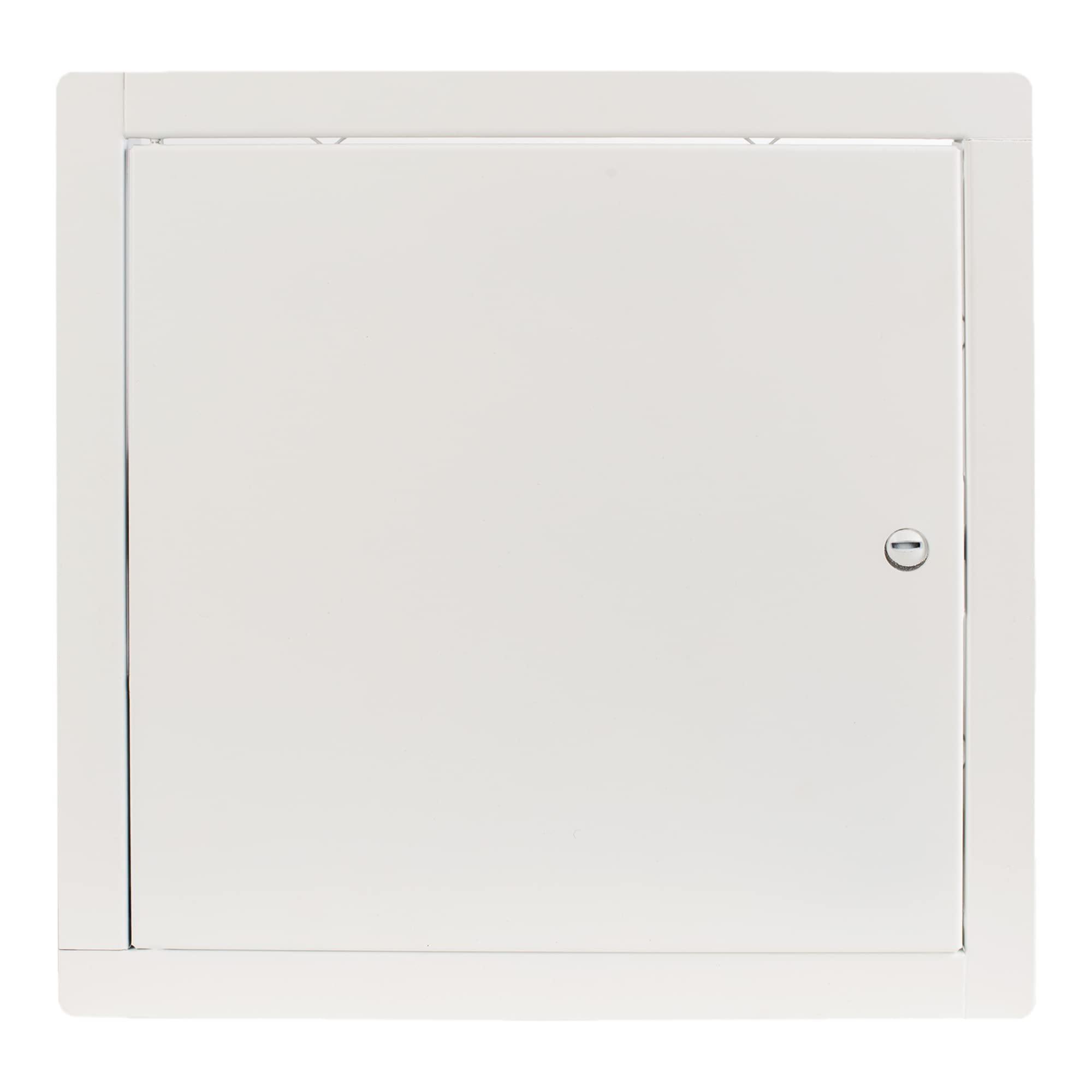
If you need a small access door that you do not want to flex or feel cheap when you push on it, this Premier 12×12 is the answer. The steel construction and powder-coated finish give it a weight — 4.9 pounds versus the Oatey 1-pound plastic panel — that immediately tells you it is not a flimsy cover. The flush-mount design installs in drywall, stucco, or masonry, and the white finish works as-is or takes paint easily. A keyhole latch opens with a flathead screwdriver, providing a secure lock that prevents the door from accidentally popping open. One reviewer noted the panel is a “sturdy 10×10 white metal panel, locks with flathead screwdriver,” adding that it looks good unpainted. The trade-off is that the hinge-side screws are tricky to reach when the door is open, so you will want to mount through the other three sides.
Compared to the Elite 1000, this Premier door is simpler: one latch instead of three, and no cam system. But for a 12-inch opening in a bathroom wall behind a shower valve or in a utility closet, the single latch does the job. Reviewers highlight that the steel is medium-gauge and sturdy enough for light commercial use, though it is not fire-rated.
Bank-Vault Feel
- 4.9 pounds of steel provides a solid, heavy feel that plastic panels cannot match.
- Keyhole latch with screwdriver slot keeps the door securely closed.
- Can be installed in drywall, stucco, or masonry walls.
Installation Quirk
- Hinge-side mounting screws are inaccessible when the door is fully open; use the other three sides.
- The single keyhole latch can mar the metal finish if your screwdriver slips.
- At 4.9 pounds it requires solid framing behind the drywall; you cannot rely on drywall anchors alone.
Grab this for: a small, heavy-duty steel door in a location where you want a premium feel and can anchor to studs.
Look elsewhere if: you need tool-less access or a larger size — this panel is only available in the 12×12 format.
6. Joogto 24×24 Thicken 1mm Access Panel for Drywall

A 1mm-thick metal panel with smooth welding that solves the flimsy-panel complaint for big openings.
Large access doors often suffer from warping and flexing because the metal is too thin or the frame is weak. The Joogto 24×24 tackles this by thickening the panel to a full 1mm using an aluminum-and-galvanized-steel construction, then applying smooth welding so the door sits flat without warped corners. The frame measures 25-1/5 inches and the panel itself is 23-2/5 inches, with a 1-3/5-inch inset depth that lets it sit flush with the ceiling. Two stiffeners on the outer frame keep it rigid over the 24-inch span, making it suitable for attic doors or crawlspace hatch covers where you need fire resistance from a metal panel. A buyer who used it for a crawlspace opening said it “looks great and because it is metal resists fire.” The screwdriver slot opener is simple and convenient, though it offers no security if you need to prevent unauthorized access.
Compared to the Premier 24×24 2002, the Joogto is slightly lighter thanks to the aluminum component, and the baked paint finish is uniform and free of bubbles. Some units arrived with minor packaging damage — one buyer mentioned a bent corner that was easily straightened — but the manufacturer offers free replacement parts without hassle.
Thick and Stable
- 1mm-thick metal resists flexing across a 24-inch span.
- smooth welding produces a flush, smooth surface that takes paint well.
- Two frame stiffeners add structural rigidity for ceiling installations.
Packaging May Not Protect
- Several reports of bent corners during shipping, even when the outer box appears fine.
- No cam-lock system — uses a simple screwdriver slot that could be bumped open in active crawl spaces.
- Aluminum construction is lighter than pure steel, which could dent under impact.
Ideal for: large ceiling access points where you want a thick, rattle-free metal door that can be painted to match the ceiling texture.
Not the best if: you cannot risk a pre-installed damage or need a tool-less access solution for frequent use.
7. Bozzon 14×29 Insulated Access Panel for Drywall

A UV-stabilized plastic door with foil-backed insulation for thermal and sound control.
This is the only panel in the lineup that comes with built-in insulation, making it a smart choice for exterior walls or unconditioned spaces like garages and basements where heat loss and outside noise are concerns. The Bozzon panel uses a 7mm foil-backed insulation layer inside the door that helps retain indoor temperatures in winter and keeps hot attic air from seeping through in summer. The door is made from impact-resistant, UV-stabilized plastic, so it will not yellow or become brittle with sun exposure — useful if your access door is on a south-facing wall. Reviewers report that it “exact dimensions, easy pop-in install under sink,” and that the insulation gives slight sound-deadening over a hollow cutout.
The self-contained panel is designed so you do not need framing, screws, or adhesives — you apply sealant to the back flange and press it into the opening. It can be surface-mounted or flush-mounted, and the hinged door opens 180 degrees and is fully removable for complete access. One drawback flagged by a buyer: the latch is very tight and hard to pry open, and the hinge can dislodge if you pull too aggressively. The panel weighs 3 pounds, which is lighter than the metal options but still feels sturdy for a plastic part.
Thermal + Acoustic Barrier
- 7mm foil-backed insulation reduces heat transfer and muffles sound through the opening.
- UV stabilized for outdoor or sunny locations — will not fade or crack.
- Self-contained, no framing needed; installs with standard sealant or adhesive.
Latch is a Fight
- The door latch is very tight, requiring a flat tool and some force to open — not ideal for quick daily access.
- Hinge can pop out if you pry the door open instead of using the latch release.
- Plastic is sturdy but not as rigid as a steel panel over a 14×29 opening; you may feel slight flex.
Choose this when: you need an insulated cover on an exterior wall or a zone transition where temperature and noise matter more than rock-solid rigidity.
Pass if: you expect frequent access — the tight latch becomes a real annoyance after a few cycles.
Understanding the Specs
Material Thickness (Gauge)
The thickness of the metal or plastic panel directly controls how rigid the door feels and how well it resists sagging over time. Steel doors are measured in gauge numbers — the smaller the number, the thicker the steel (18-gauge is roughly 0.048 inches, which is a solid residential/commercial grade). The Joogto 24×24 uses a 1mm-thick panel, which is about 0.039 inches — similar to 19-gauge steel. Plastic panels like the Oatey or Bozzon use impact-resistant ABS or polymer, which is lighter and cheaper but more prone to flexing across wide spans.
Mounting Depth and Flange Width
This is the measurement from the back of the flange to the back of the door frame, which determines how deep the door sits in the wall. A shallow mounting depth (around 1.25 inches for the EASY-EXS) works in standard 2×4 walls, while deeper panels (1-3/5 inches for the Joogto) need more cavity space. The flange — the lip that overlaps the drywall — hides the rough edge of the cutout. A 7/16-inch lip (like the Elite 1000) is enough to cover a slightly jagged drywall cut, while the Premier 2002 flanges extend far enough to reach studs through 5/8-inch drywall.
FAQ
Can I paint a steel access door to match my wall?
Do I need to frame a wall opening for an access door?
Will a 14×29 access panel fit between standard stud spacing?
Are plastic access doors good for outdoor use?
How do cam-lock latches compare to screwdriver-only latches?
How many cam latches does the Elite 1000 access door have?
Can I use a spring-fit panel on an uneven drywall cut?
Do any of these access doors come with insulation?
How do I remove a flush-mount access door after installing it?
What is the difference between flush mount and surface mount on the Oatey panel?
Final Thoughts: The Verdict
For most people, the best access doors for drywall winner is the Elite 1000 because its three cam-lock latches and 18-gauge steel construction provide the most secure, long-lasting seal in a flush-mount package. If you want a tool-free, no-framing installation for a standard 14-inch opening, grab the EASY-EXS Spring-Fit. And for large ceiling or attic entries requiring a thick metal door that resists sagging, the standout is the Premier 2002 24×24.
How We Picked
We do not accept paid placement. Every pick is matched to a real buyer and a real use-case; we do not hands-on test units.
Sources & Methodology
Specifications: manufacturer listings and product documentation. Review insights: verified customer reviews, as of July 2026. Pricing: not shown on this page (it changes often); check the current price via the retailer link.
As an Amazon Associate, Gadgets Feed earns from qualifying purchases. This does not affect which products we feature.