
Our readers keep the lights on and my morning glass full of iced black tea. As an Amazon Associate, I earn from qualifying purchases.
Specs are compiled from manufacturer listings and verified buyer reviews and can change over time — please confirm the key details on the product page before buying.
A dead deep-cycle battery doesn’t always mean a trip to the store for a replacement. Often, the right charger can bring a deeply discharged battery back to full health, saving you hundreds of dollars. This guide cuts through the specs to show you which units actually handle the unique demands of AGM, gel, and lithium deep-cycle batteries without cooking them.
I’m Min — the founder and writer behind Gadgets Feed. This guide is built by comparing the manufacturers’ published specifications and the patterns across verified customer reviews, so you get each pick’s real strengths and trade-offs instead of marketing spin.
If you need to keep a boat battery alive through winter or revive a dead RV battery bank, these best battery charger deep cycle picks are ranked by real-world buyer feedback, safety features, and charging performance.
Our Picks at a Glance


How To Choose The Best Battery Charger Deep Cycle
Deep-cycle batteries are built differently than standard car starter batteries. They are designed to be drained low and recharged many times, which means the charger you use needs to follow a specific voltage curve. Choosing the wrong one can shorten your battery’s lifespan or fail to fully recharge it.
Match the Amperage to Your Battery Bank Size
The charger’s current rating (measured in amps) determines how fast it fills the battery. A good rule of thumb is a charging current between 10% and 25% of your battery’s amp-hour (Ah) capacity. A 10-amp charger is fine for a single 100Ah battery, while a 20-amp or 30-amp unit better serves a large bank. Too high an amperage on a small battery can cause overheating; too low an amperage on a large bank may take days to fully charge.
Look for Multi-Stage Smart Charging
Smart chargers use a multi-stage process: bulk, absorption, and float. In the bulk stage, the charger pushes maximum current. In the absorption stage, voltage is held constant as current drops. In the float stage, voltage is reduced to maintain the battery without overcharging. Some chargers add a desulfation stage that uses pulses to break down lead sulfate crystals that build up on battery plates over time, effectively restoring lost capacity.
Verify Your Battery Chemistry
Not all chargers work with all battery types. Flooded lead-acid, AGM, gel, and lithium LiFePO4 all have different absorption voltages and charge profiles. A charger that only supports standard lead-acid will undercharge a gel battery or overcharge a LiFePO4 battery, potentially damaging it. Look for a unit with selectable modes for your specific chemistry.
Quick Comparison
| Model | Best For | Amperage | Battery Types | Weight | Amazon |
|---|---|---|---|---|---|
| NOCO GENIUS10★ Best Overall | Best Overall Smarts | 10A | 6V/12V Lead-Acid & LiFePO4 | 4 lbs | Amazon |
| VEVOR Smart 20-AmpBest Value | Best Value High-Power | 20A | 6/12/24V Lead-Acid & LiFePO4 | 1.8 lbs | Amazon |
| TowerTop 10A | Deep Cycle Specialist | 10A | 6V/12V SLA & 12V Deep Cycle | — | Amazon |
| CRAFTSMAN 12A | Budget-Friendly All-Rounder | 12A | 6V/12V Standard & Deep Cycle | 3.36 lbs | Amazon |
| Battery Tender 15 Amp | Premium Maintainer | 15A | 12V Standard, AGM, Gel | 3.5 lbs | Amazon |
| FirstPower Pro 2 Bank | Onboard Dual Battery | 10A (5A/Bank) | 12V SLA, LiFePO4, Calcium | 4.51 lbs | Amazon |
| DeWalt DXAEC100 | Heavy-Duty & Engine Start | 30A | 12V AGM, GEL, WET | 4 lbs | Amazon |
In‑Depth Reviews
1. NOCO GENIUS10: 10A Smart Charger
Our pick — 4.6★ from 20,868 verified ratings — the strongest balance of quality and price.
The compact smart charger that thinks like a battery doctor, not just a power source.
This unit works for 6-volt and 12-volt lead-acid batteries (including AGM, gel, and SLA) and also handles lithium-ion (LiFePO4) batteries, making it a one-stop solution for any deep-cycle setup. An integrated thermal sensor dynamically adjusts the charge based on ambient temperature, preventing overcharging in hot weather and undercharging in cold weather. That matters when your battery lives in an unheated garage or a boat that sees both summer heat and winter storage. One reviewer noted it “revived a dead 12V generator battery (read 11.5V, analyzer said bad) after a 4-hour repair mode,” and the battery held 12.6V overnight.
The GENIUS10 can charge batteries from as low as 1 volt (using Force Mode for fully dead units down to zero volts), which is the difference between recovering a neglected battery and throwing it away. Its precision pulse charging automatically detects and reverses sulfation (crystal buildup on the plates) and acid stratification, restoring lost performance. The unit weighs 4 pounds and measures 4.48″D x 4.41″W x 9.1″H, which means it weighs 4 pounds versus the VEVOR 20-amp’s 1.8 pounds and measures 4.48″D x 4.41″W x 9.1″H compared to the CRAFTSMAN’s 12″D x 16″W x 5″H footprint.
Why it leads
- Built-in temperature compensation adjusts charging for hot and cold conditions
- Force Mode revives batteries as low as 1 volt (or zero volts manually)
- Integrated desulfation technology reverses acid stratification to extend battery life
- Includes mounting bracket and eyelet terminals for permanent installation
What could be better
- At 10 amps, it charges a large battery bank slower than higher-amperage units
- Some buyers report the included cables use aluminum wire rather than copper
Start here if: you want a versatile smart charger that works on every common deep-cycle chemistry and can recover batteries that other chargers give up on.
Watch for: the 10-amp output means this is best for maintaining single batteries or medium banks; for a large RV or marine setup, consider a higher-amperage unit.
2. VEVOR Smart 20-Amp Charger
A 20-amp powerhouse that costs less than many 10-amp competitors and weighs almost nothing.
This charger delivers 20 amps compared to the 10-amp NOCO GENIUS10, while weighing just 1.8 pounds compared to the NOCO’s 4 pounds. That combination of high current and light build makes it a compelling choice for anyone who needs to recharge a large deep-cycle battery bank quickly without lugging a heavy box around. It works with 6-volt, 12-volt, and 24-volt lead-acid batteries (AGM, gel, SLA) and also charges 12-volt and 24-volt lithium (LiFePO4) batteries. The charger features a 3.6-inch LCD screen that shows real-time status, including voltage, current, and charge percentage.
The unit has four modes: charging, maintain, desulfation, and supply. The desulfation mode uses pulse repair to break down lead sulfate crystals. A separate force mode lets you manually start charging batteries as low as 1 volt. Owners mention it works well with lithium marine batteries; one buyer mentioned “it not only worked to charge it but also did the wake up charge to activate the bms” on a new LiFePO4 battery. The charger includes six safety protections: over-current, short-circuit, reverse polarity, overheat, and over-voltage. It is certified to UL, CE, and FCC standards.
What stands out
- 20-amp output charges large deep-cycle banks twice as fast as 10-amp units
- Weighs only 1.8 pounds, making it extremely portable
- 3.6-inch LCD screen provides clear charge status at a glance
- Force mode can wake and charge batteries below 1 volt
What you give up
- Does not include cell balancing for lithium batteries that higher-cost chargers offer
- The charger can get warm during sustained high-current use
Best for: RV and marine owners who need high current without paying a premium, and anyone who wants a charger that handles both lead-acid and lithium with no chemistry switching tricks.
Limit: it lacks the advanced lithium-specific profiles of the NOCO, so full-time lithium users may still prefer a more specialized unit.
3. TowerTop 10A Smart Charger
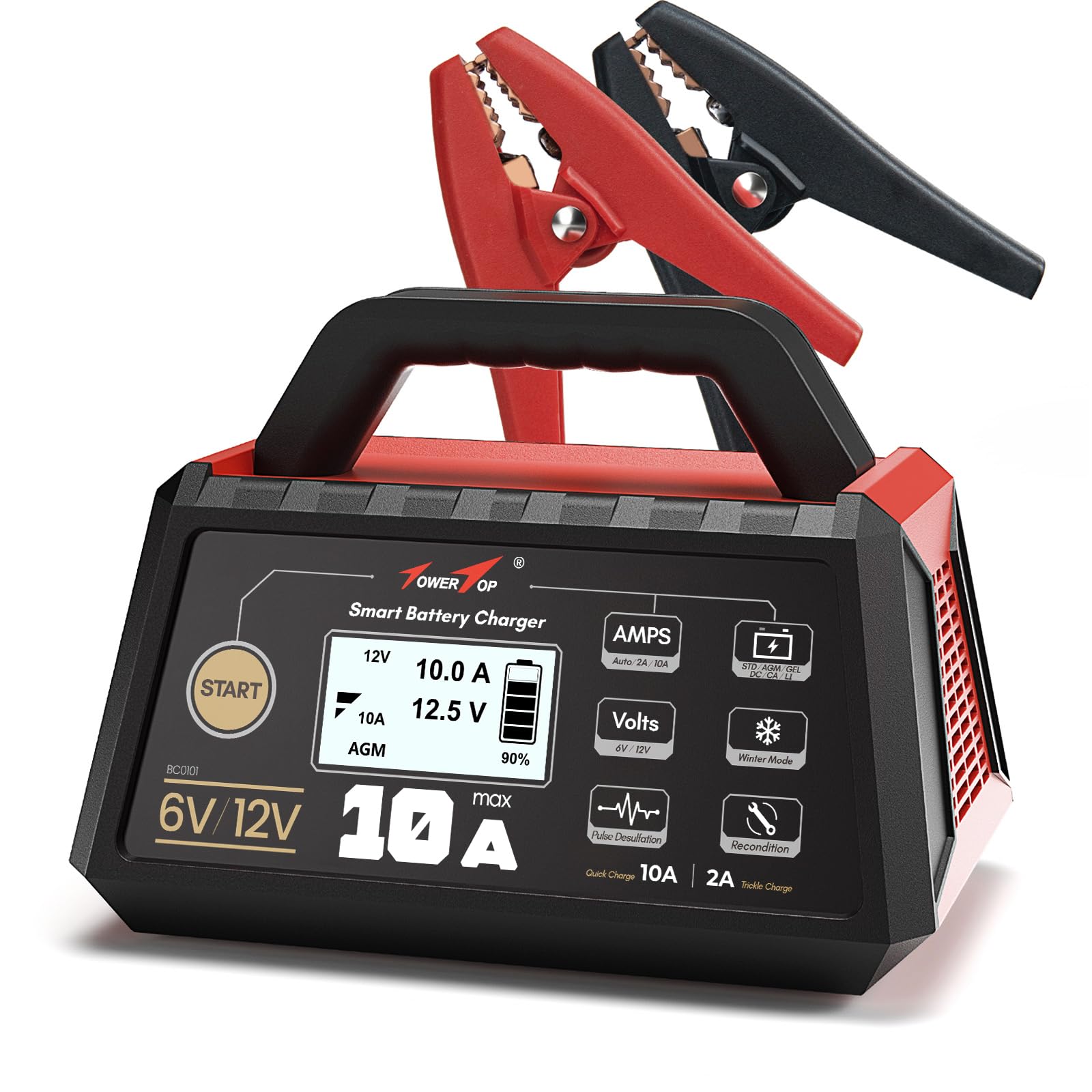
A charger with its own dedicated deep-cycle mode and an 8-stage charging process.
While most smart chargers offer a generic “deep cycle” option, the TowerTop includes a specific Deep Cycle mode as one of its six selectable profiles: STD, GEL, AGM, Deep Cycle, Calcium, and LI (LiFePO4). Each mode uses its own independent charging curve, so a deep-cycle flooded battery gets the correct absorption voltage rather than being lumped into a one-size-fits-all lead-acid setting. The unit can charge a 25Ah battery from empty in about 2 hours at 10 amps.
The 8-stage charging process includes desulfurization, soft start, bulk charge, absorption, analysis, repair, float, and pulse maintenance. Independent desulfurization and repair buttons let you manually trigger a recovery cycle for old batteries. Customers note it brought back a battery that “would not hold charge” after cycling the repair mode a few times. The charger also includes a winter mode that increases charging voltage by 0.2 volts to improve battery activity in low temperatures. Safety protections include spark-proof, reverse polarity, overcharge, overcurrent, and short-circuit. It is RoHS certified.
What’s unique
- Dedicated Deep Cycle charging mode with its own voltage curve
- 8-stage charging with independent desulfation and repair buttons
- Winter mode raises voltage by 0.2V for cold-weather performance
- Memory function remembers last settings after power loss
What’s missing
- At 10 amps, it’s not the fastest option for large battery banks
- Cannot repair completely drained batteries that show zero volts
Reach for this if: you own true deep-cycle batteries (flooded or gel) and want a charger that treats them with the right profile instead of a generic lead-acid mode.
skip it if: your battery is completely dead at 0 volts; you will need a unit with a stronger force mode like the NOCO or VEVOR.
4. CRAFTSMAN 12A 4-in-1 Charger
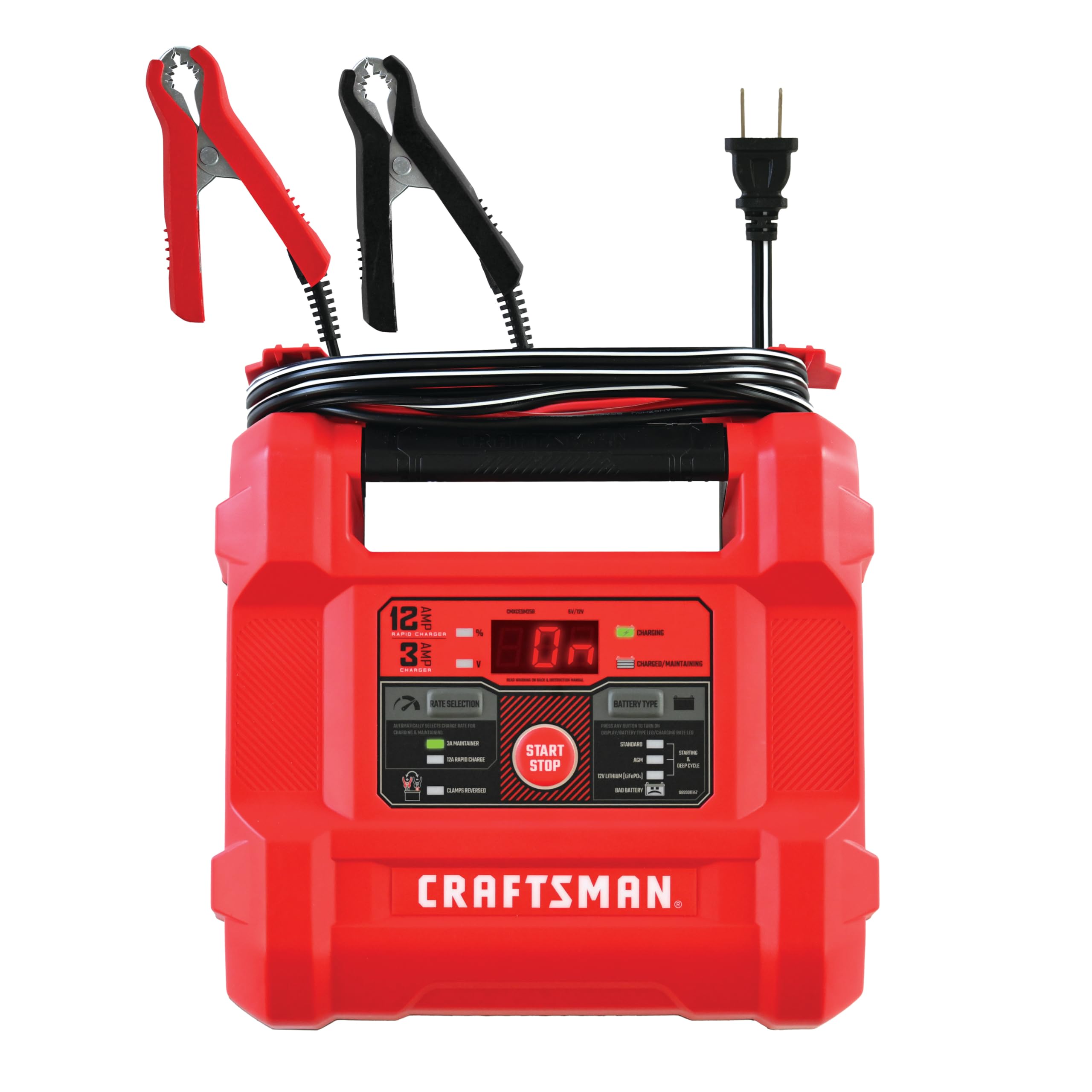
A straightforward 4-in-1 tool that charges, maintains, tests, and reconditions for a fair price.
The CRAFTSMAN delivers 12 amps for 12-volt charging, plus 3 amps for 12-volt maintaining and 2 amps for 6-volt maintaining. It works with standard, AGM, lithium (LiFePO4), and deep-cycle batteries. The unit includes a built-in battery tester that checks health quickly, and an advanced desulfation mode that helps extend battery life by breaking down sulfate crystals. Reverse polarity protection prevents damage if you accidentally connect the clamps backwards. Reviewers point out it “charges dead battery to 100% in ~5 hours,” which is competitive for a 12-amp unit.
The charger is physically large — 12 inches deep by 16 inches wide by 5 inches tall — while the NOCO GENIUS10 measures 4.48″D x 4.41″W x 9.1″H. It weighs 3.36 pounds, which is in the middle of the pack. It comes with a 6-foot power cord and booster cables. The unit can charge gas and diesel vehicles including motorcycles, ATVs, cars, trucks, SUVs, and marine batteries. The lack of an included repair mode button (desulfation is automatic) is a common buyer complaint, but for simple charging and maintaining, it gets the job done reliably.
What works
- Integrated battery tester provides instant health diagnostics
- 12-amp charging replenishes a dead battery in about 5 hours
- Reverse polarity protection guards against accidental clamp mistakes
- Works with standard, AGM, lithium, and deep-cycle batteries
The trade-offs
- Larger footprint (12″D x 16″W) takes up more garage or bench space
- No manual repair mode button; desulfation runs automatically
- Some buyers prefer a more detailed digital display over the basic indicator
Pick this for: a reliable, no-nonsense workhorse charger for occasional deep-cycle use and routine maintenance at a price that won’t break the bank.
Look elsewhere if: you need true portability or the ability to force-charge a battery below 1 volt — the NOCO or VEVOR handle that better.
5. Battery Tender 15 Amp Charger

A trusted name with a switchable 15/8/2 amp output and a clear LCD display.
The Battery Tender 15 Amp charger lets you switch between 15 amps for fast charging, 8 amps for standard charging, and 2 amps for long-term maintenance. It has selectable chemistry modes for standard, AGM, and gel batteries (it does not have a dedicated lithium mode). The unit automatically switches to float mode once the battery is full, maintaining voltage without overcharging. The built-in LCD display shows battery health and voltage, which buyers find useful for monitoring the condition of their batteries over time. One owner reported it “brought a battery back to life that my other tenders couldn’t revive.”
This charger protects you by being spark-proof during connection and automatically detecting reverse polarity (wrong cable hookup) before it sends power. It weighs 3.5 pounds and measures 7.64″D x 9.39″W x 5.28″H. It comes with an integrated carry handle, attached alligator clips, a 5-year warranty, and lifetime customer service. You can leave it connected indefinitely to maintain cars, trucks, SUVs, motorcycles, RVs, and industrial tractors without worry. One downside shoppers say: there is no remote LED indicator, so you have to walk to the unit to see the charging status.
Top features
- Switchable 15-amp, 8-amp, and 2-amp output for different use cases
- Selectable chemistry for standard, AGM, and gel batteries
- Spark-proof connection and automatic reverse polarity detection
- 5-year warranty and lifetime customer service backing
Shortcomings
- No dedicated lithium (LiFePO4) charging profile
- No remote LED light to show charge status from a distance
- Premium price compared to similarly spec’d competition
Best suited for: enthusiasts who want a proven brand with long-term warranty support and the flexibility to switch between high-speed charging and gentle maintenance.
Not for: anyone with a lithium battery bank — the lack of a LiFePO4 mode means you need a different charger for that chemistry.
6. FirstPower Pro 2 Bank Marine Charger

A waterproof onboard charger that independently manages two batteries at once.
This 2-bank charger delivers 5 amps per bank (10 amps total), so it fits dual-battery setups like a boat with a starter and a house battery, or an RV with a chassis and auxiliary bank. Each bank independently selects its own mode: SLA/AGM (sealed lead-acid), lithium (LiFePO4), or calcium. The charger is IP68 waterproof (fully sealed against dust and submersion), so you can permanently mount it on a boat or in a vehicle compartment and leave it charging 24/7 onboard. It also has Force Mode: if a battery drops below 1 volt, you press and hold the “MODE” button for 5 seconds to start charging.
The unit has an automatic repair mode that activates when the “12V Repair” light comes on, meaning you do not need to intervene. Advanced diagnostics flag over-voltage, bad battery, over-temperature, and reverse connection. An integrated thermal sensor adjusts charge based on ambient temperature to prevent overcharging in heat or undercharging in cold. The charger weighs 4.51 pounds and measures 2.16″D x 6.49″W x 7.55″H. Buyers report it “charged my dead batteries in just a little while” after a sump pump drain, with both batteries showing fully charged and green LEDs the next day.
Why it’s unique
- Two independent charging banks with individual mode selection per channel
- IP68 waterproof rating enables permanent onboard mounting
- Force Mode revives batteries below 1 volt
- Automatic repair mode activates without user input
The catch
- Each bank is limited to 5 amps, so charging a single large battery bank takes longer
- Larger and heavier (4.51 lbs) than a single-bank portable charger
Grab this for: any setup with two separate deep-cycle batteries — a boat with a start and trolling battery, or an RV with a chassis and house bank — where you want permanent waterproof mounting.
Avoid if: you only need to charge a single battery; a 10-amp single-bank charger will give you more current per battery for less money.
7. DeWalt DXAEC100 30-Amp Charger

A high-current workhorse with 100-amp engine start and alternator check built in.
The DeWalt DXAEC100 delivers 30 amps of charging and 3 amps for maintenance, plus a 100-amp engine start function — enough to crank a large diesel truck engine. It also includes an alternator check that tests whether your vehicle’s charging system is operating properly. The unit works with any 12-volt AGM, gel, or wet automotive or marine battery. An automatic battery reconditioner function detects if the battery is struggling and switches on to reverse sulfate buildup and extend battery life. Owners mention it “charged diesel truck battery enough to start after 1 hour” and sustained a 20-mile trip afterward.
The charger measures 11 inches deep by 8.75 inches wide by 4 inches tall and weighs 4 pounds. It features an easy-to-read LCD screen that shows charging status and battery condition. However, some customers note the unit fails to recognize AGM batteries correctly, claiming a connection error. There is no amp rate selection or battery type switching, so you rely on the automatic detection. For pure deep-cycle maintenance, the 30-amp output is powerful but the limited chemistry support and the reported AGM recognition issues mean it is best for standard wet-cell deep-cycle batteries rather than advanced chemistries.
Where it shines
- 30-amp charging and 100-amp engine start for heavy-duty use
- Alternator check tests the vehicle’s charging system
- Automatic reconditioner reverses sulfate buildup
- Clear LCD screen shows charge progress and battery status
Where it struggles
- Cannot select battery type or amp rate manually
- Reported issues recognizing AGM batteries in some units
- No lithium (LiFePO4) charging profile
Best for: large diesel trucks, heavy equipment, and anyone who needs the combined function of a high-amp charger, maintainer, and engine starter in one unit.
Not for: AGM or lithium battery owners who need precise chemistry control — the lack of manual mode selection makes it unreliable for those applications.
Understanding the Specs
Amperage (Charge Current)
The amp rating determines how quickly the charger replenishes your battery. A 10-amp charger is fine for a single 100Ah deep-cycle battery, filling it in about 10 hours from empty. A 20-amp charger fills it in about 5 hours. But higher current also risks overheating smaller batteries. The rule of thumb is to stay between 10% and 25% of your battery’s amp-hour capacity. For a large 200Ah bank, a 20-amp or 30-amp unit is appropriate. For a small 50Ah battery, a 10-amp charger is safer.
Multi-Stage Charging
A smart charger follows stages: Bulk (full current until battery reaches absorption voltage), Absorption (constant voltage, current tapers), and Float (reduced voltage to hold full charge). Advanced units add Desulfation (pulse charging that breaks down lead sulfate crystals) and Repair modes. If your charger lacks multi-stage logic, it risks overcharging and damaging your deep-cycle battery over time.
Force Mode / Dead Battery Recovery
Deep-cycle batteries often sit for months and drop below the voltage threshold standard chargers recognize. A Force Mode (sometimes called “dead battery mode”) manually starts charging even when voltage is as low as 1 volt or zero volts. Without this feature, a charger simply refuses to start on a battery that reads below roughly 10.5 volts, leaving you with a dead unit that may actually be recoverable.
Chemistry Compatibility
Flooded lead-acid, AGM, gel, and lithium LiFePO4 all need different absorption voltages. Flooded batteries absorb at around 14.7 volts, while gel batteries top out at 14.1 volts. LiFePO4 requires lithium-specific profiles. Using the wrong mode can undercharge or overcharge your battery, causing premature failure. A deep-cycle charger with selectable chemistry modes protects your investment.
FAQ
What amp charger do I need for a 100Ah deep-cycle battery?
Can I use a regular car battery charger on a deep-cycle battery?
How long does it take to charge a dead deep-cycle battery?
What is force mode on a battery charger?
Do deep-cycle battery chargers work with LiFePO4 lithium batteries?
What does desulfation mode do?
Is a waterproof charger necessary for marine use?
Can I leave a smart charger connected to my battery all winter?
What is the difference between a charger and a maintainer?
Why won’t my smart charger start on my deep-cycle battery?
Final Thoughts: The Verdict
For most buyers, the best battery charger deep cycle winner is the NOCO GENIUS10 because it combines intelligent temperature-compensated charging (adjusts voltage based on battery temperature) with a Force Mode that revives dead batteries and broad chemistry support for both lead-acid and lithium. If you want fast charging for a large bank at a budget-friendly price, grab the VEVOR Smart 20-Amp. And for a dual-battery marine setup that needs permanent waterproof mounting, the FirstPower Pro 2 Bank is the one to get.
How We Picked
We do not accept paid placement. Every pick is matched to a real buyer and a real use-case; we do not hands-on test units.
Sources & Methodology
Specifications: manufacturer listings and product documentation. Review insights: verified customer reviews, as of July 2026. Pricing: not shown on this page (it changes often); check the current price via the retailer link.
As an Amazon Associate, Gadgets Feed earns from qualifying purchases. This does not affect which products we feature.