
Our readers keep the lights on and my morning glass full of iced black tea. As an Amazon Associate, I earn from qualifying purchases.
Specs are compiled from manufacturer listings and verified buyer reviews and can change over time — please confirm the key details on the product page before buying.
An auto impact wrench isn’t a “nice to have” — it’s the difference between a twenty-minute wheel swap and an hour of swearing at a seized lug nut. The best ones hit hard (hundreds of foot-pounds), fit into tight wheel wells, and don’t quit midway through the second tire. But the real trick is picking the one that matches the work you actually do, not the torque number the marketing team wrote.
I’m Min — the founder and writer behind Gadgets Feed. This guide is built by comparing the manufacturers’ published specifications and the patterns across verified customer reviews, so you get each pick’s real strengths and trade-offs instead of marketing spin.
Whether you’re a weekend DIYer pulling wheels twice a year or a pro under a lift every shift, the best auto impact wrench delivers the right torque, fits the space you have, and keeps working as hard as you do.
Our Picks at a Glance


How To Choose The Best Auto Impact Wrench
Picking the right impact wrench depends on three things: how much twist it delivers (torque), where you need to use it (size and weight), and which battery system you already own. Here is how each factor affects your real-world results.
Torque: The Real Number to Watch
Torque is measured in foot-pounds (ft-lbs). For a typical car lug nut torqued to around 100-150 ft-lbs, a wrench with 275 ft-lbs of max fastening torque can handle the job. But for rusted suspension bolts or truck lugs, you want something closer to 550-600 ft-lbs of nut-busting torque — the higher number that measures how much force it can apply to break a stuck fastener loose. Look for “max breakaway torque” or “nut-busting torque” in the specs; this number is always larger than the fastening torque and tells you what the wrench can actually unstuck.
Size and Weight: Why Compact Matters
A wrench that is 4.9 inches long fits between a radiator and an engine block; one that is 9.2 inches likely won’t. The shorter the tool, the more places you can use it, but shorter tools often have smaller motors and less torque. Weigh this trade-off: a 2.5-pound stubby is easier to hold sideways under a dash, but a 4.2-pound high-torque model can break bolts the lighter one cannot.
Battery Platform Lock-In
Most mid-range and premium cordless impact wrenches are sold as “bare tools” — you get the tool itself, no battery or charger. If you already own DEWALT 20V MAX, Milwaukee M12/M18, Makita LXT, or Craftsman V20 tools, you save a lot by buying the bare version and using your existing batteries. If you are starting from scratch, a kit (tool plus battery and charger) is the smarter first buy. Air-powered wrenches avoid this issue entirely but need a large air compressor (typically 6+ horsepower and 30+ gallon tank).
Quick Comparison
| Model | Best For | Max Torque | Speed (RPM) | Weight | Amazon |
|---|---|---|---|---|---|
| DEWALT ATOMIC 20V (DCF921B)★ Best Overall | DIY & light auto work | 300 ft-lbs | 4-speed | 2.8 lbs | Amazon |
| CRAFTSMAN V20 (CMCF921B)Best Value | Budget-friendly lug nut duty | 275 ft-lbs | 2-speed | 3.97 lbs | Amazon |
| Ingersoll Rand 232TGSL | Air-powered shop work | 625 ft-lbs | 10,000 RPM | 6.0 lbs | Amazon |
| Milwaukee M12 Stubby (2563-20) | Tight-space professional | 550 ft-lbs | 4-mode DRIVE CONTROL | 2.5 lbs | Amazon |
| DEWALT 20V MAX XR (DCF892B) | High-torque auto work | 600 ft-lbs | 4-speed | 4.2 lbs | Amazon |
| Makita XWT18Z | Mid-torque pro jobs | 520 ft-lbs | 4-speed (0-2200 RPM) | — | Amazon |
| Milwaukee M18 (2967-21B) | Heavy-duty pro use | 1500 ft-lbs | 4-mode DRIVE CONTROL | 11.22 lbs | Amazon |
In‑Depth Reviews
1. DEWALT ATOMIC 20V MAX* 1/2 in. Cordless Impact Wrench (DCF921B)
Our pick — over 4.5★ from 900+ verified ratings; the strongest balance of quality and price.
The compact powerhouse that makes light work of everyday auto jobs without emptying your wallet.
This little wrench delivers up to 300 ft-lbs of max fastening torque in a body that is only 9.2 inches long and weighs just 2.8 pounds. That makes it easy to hold with one hand while you brace yourself against a stubborn bolt. It has 4 speed settings plus a timber screw mode, so you are not stuck with one power level for every task. The hog ring anvil lets you swap sockets fast — slide one off, snap the next one on.
Buyers report using it to remove lugs from F-150s and travel trailers, and one owner noted the settings: “1 (150 ft-lbs) for lug nuts/99% of work; 2 (300 ft-lbs) for rusty bolts.” The DEWALT ATOMIC weighs 2.8 pounds, while the CRAFTSMAN V20 weighs 3.97 pounds — so you feel the difference after four tires. One trade-off: it relies on DEWALT 20V MAX batteries, so if you are not already in that system, you will need to buy a battery and charger separately.
Why it works for you
- 300 ft-lbs of max fastening torque (enough for most passenger car and light truck work) — the 4-speed settings give you precise control so you don’t overtighten small fasteners
- Weighs only 2.8 pounds, easy to handle for long sessions
- Hog ring anvil makes socket changes a one-second job
The honest drawbacks
- At 300 ft-lbs, it does not match the breakaway torque of higher-end models — you might struggle with heavy rusted bolts on trucks
- Bare tool (no battery or charger included) — you need an existing DEWALT 20V MAX system or buy separately
Reach for this if: you are a home DIYer or weekend mechanic working on cars and light trucks — it has enough torque for 99% of your jobs without the weight or cost of the pro models.
Look elsewhere if: you regularly face heavy equipment, large farm machinery, or deeply rusted suspension bolts that need 600+ ft-lbs of nut-busting torque.
2. CRAFTSMAN V20 Cordless Impact Wrench (CMCF921B)
A wallet-friendly option that punches above its weight for basic automotive work if you are already in the Craftsman system.
This impact wrench delivers 275 ft-lbs of max fastening torque with a brushless motor that the maker claims gives up to 26% more runtime compared to brushed alternatives. It has a hog ring anvil for quick socket swaps and an LED work light for dim garages and dark wheel wells. At 8.7 inches long and 3.97 pounds, it is slightly heavier than the DEWALT ATOMIC but still feels balanced for one-handed use.
One buyer who owns this wrench says it has “sufficient torque to remove and reinstall truck lug nuts” and that the battery life handles all 4 tires on a Ford F250. Another noted they “only bought due to existing Craftsman 20V system investment.” That is the honest catch here: as a bare tool, it shines if you already own Craftsman V20 batteries. If you are starting from scratch, the cost of adding a battery and charger eats into the budget-friendly appeal.
Smart buy reasons
- 275 ft-lbs handles lug nuts, suspension bolts, and routine tire rotations
- Brushless motor means longer runtime and less maintenance over time
- VERSATRACK compatible — clips on your wall organizer (clips sold separately)
What to watch for
- At 3.97 pounds, it is heavier than some competitors — fatigue may set in on longer jobs
- Only 2 speed settings give you less control than the 4-speed rivals
Grab this if: you are already invested in the Craftsman V20 battery system and need a capable spare or second wrench for light-to-medium duty.
skip it if: you do not own Craftsman batteries — the total cost of entry makes a kit from another brand a better deal.
3. Ingersoll Rand 232TGSL 1/2″ Air Impact Wrench

A deafening, hard-hitting air gun that brings pit-crew speed to your shop — if you have the compressor for it.
This pneumatic tool delivers 625 ft-lbs of reverse torque and spins at 10,000 RPM, making it one of the fastest 1/2-inch impact wrenches Ingersoll Rand makes. Owners mention it “breaks nuts instantly” and “zips 110 ft-lb lug nuts off in less than 1 second.” The steel hammer case and metal housing are built to survive a 40-foot fall (yes, a reviewer tested that). It comes with a 1-year standard warranty against manufacturing defects.
The real-world trade-off from the data: it is extremely loud. One owner describes it as “sounds like you are at a race track.” It also weighs about 6 pounds (2.72 kg) and runs front-heavy, so you feel the strain during long sessions. Another owner notes a “minor air leak at the factory fitting” that requires Teflon tape. And because it is air-powered, you need a serious air compressor — one reviewer uses a 6.5 HP / 35-gallon setup. No batteries, no charging, but no portability away from the hose either.
What makes it a pro tool
- 625 ft-lbs reverse torque and 10,000 rpm for instant fastener removal
- Metal housing and steel hammer case survive drops and daily abuse
- Variable-speed trigger with adjustable forward torque for controlled fastening
What holds it back
- Requires a large air compressor — not an option for apartment or portable use
- Weighs about 6 pounds and feels front-heavy, tiring on overhead work
Best for: shop-based pros and DIYers with a big compressor who want NASCAR-grade speed and raw torque without worrying about battery charge.
Not ideal if: you work away from a compressor, need a quiet tool, or plan to work in tight engine bays where a short cordless wrench fits better.
4. Milwaukee M12 FUEL Stubby 1/2 Inch Impact Wrench (2563-20)
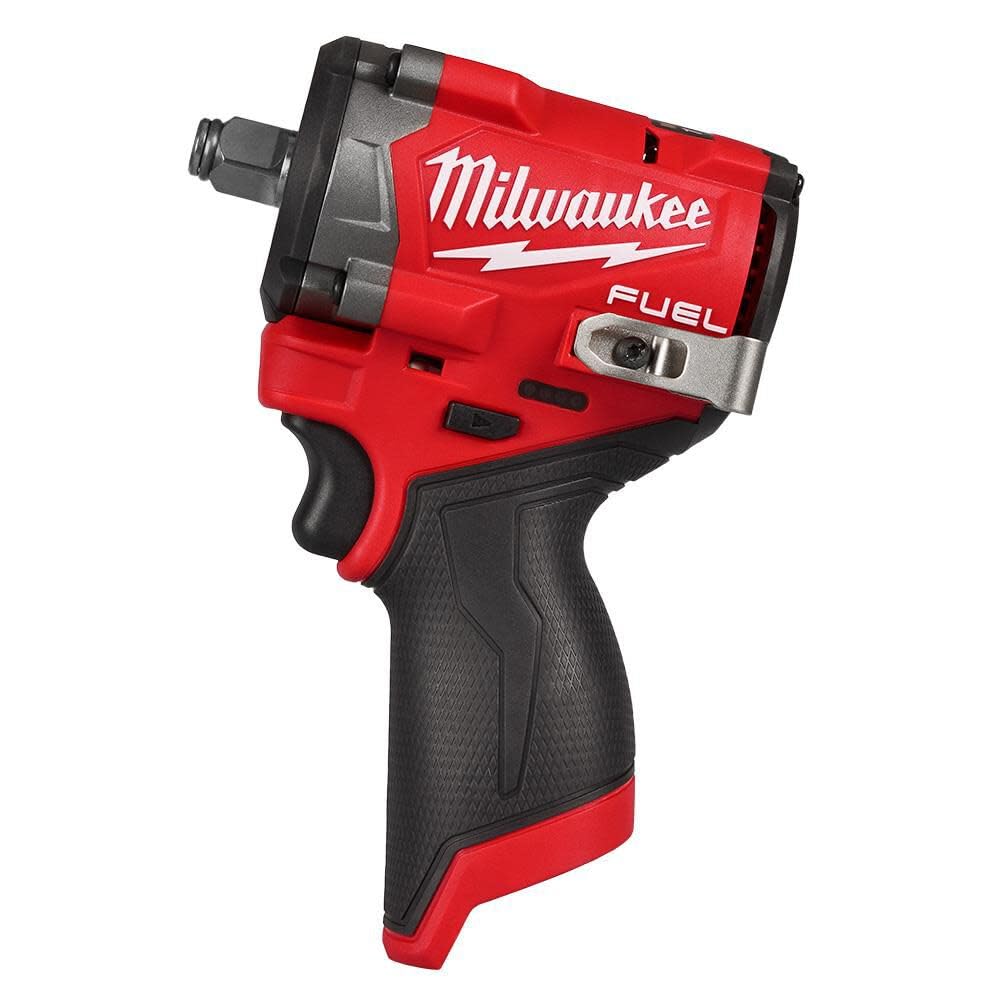
The stubby that fits places other wrenches cannot go, without compromising on the torque you need to break stubborn bolts.
This is the shortest impact wrench in this comparison at just 4.9 inches long — that is shorter than the DEWALT ATOMIC (9.2 inches), giving you a more compact tool. It delivers 550 ft-lbs of nut-busting torque, so even with its tiny size it out-torques many full-length wrenches. At 2.5 pounds (the lightest here), it is lighter than the DEWALT 20V MAX XR (4.2 lbs), a difference that matters when you are holding it sideways deep in an engine bay.
One buyer reports it “removed 19mm crankshaft pulley bolt on 1996 Daihatsu Hijet on setting 2 after hand tools failed,” crediting the compact length for fitting between the pulley and the radiator. The 4-Mode DRIVE CONTROL includes an Auto Shut-Off feature that stops rotation when the fastener is snug — this helps prevent snapping bolts. The trade-off from the reviews: it chews through 3Ah M12 batteries relatively fast, and you may need a cool-down period after removing a full set of tight lugs. As a bare tool, it only works if you own Milwaukee M12 batteries.
Why size matters
- At 4.9 inches long, it reaches between engine components where full-size wrenches cannot fit
- 550 ft-lbs of torque in a 2.5-pound package is an outstanding power-to-weight ratio
- 4-Mode DRIVE CONTROL with Auto Shut-Off protects fasteners from over-torquing
The trade-offs
- M12 batteries drain faster under high torque; have spares ready for multi-wheel jobs
- Bare tool — requires Milwaukee M12 batteries and a charger (sold separately)
Choose this if: you work on cars in tight engine bays, need a tool you can carry in a drawer between radiator and block, or already own M12 batteries.
pass on it if: you need to torque large truck or heavy equipment fasteners all day — the M18 High Torque above has more sustained power for that.
5. DEWALT 20V MAX XR Cordless Impact Wrench (DCF892B)

A mid-torque monster that packs 600 ft-lbs of fastening power into a design that still fits between suspension components.
This DEWALT 20V MAX XR wrench delivers 600 ft-lbs of max fastening torque and 800 ft-lbs of max breakaway torque, giving it a meaningful torque advantage over the Milwaukee M12 Stubby (550 ft-lbs) It has 4 speed settings plus a Precision Wrench control mode that prevents overtightening. The detent pin anvil holds sockets extremely securely (you need the tool’s reverse action to remove them), so sockets never fall off in tight spaces.
Buyers call it a “high torque battery impact wrench” that “breaks loose car lug nuts” with ease. One reviewer says it is a “standout in removing caliper brackets.” At 4.2 pounds, it is heavier than the 2.5-pound M12 Stubby but delivers noticeably more breakaway torque for rusted hardware. The included belt clip is a plus. The honest trade-off is the weight and the fact that the detent pin can be annoying if you swap sockets constantly — you need to press the pin to release each socket.
The torque advantage
- 800 ft-lbs of max breakaway torque for breaking rusted bolts and lug nuts
- 4 speed settings give you fine control from delicate interior work to heavy suspension jobs
- LED work light brightens dark work areas
Know before you buy
- At 4.2 pounds, it is heavier than compact models — fatigue may set in during long overhead use
- Detent pin anvil makes socket changes slower than hog ring models
Reach for this if: you need serious breakaway torque (800 ft-lbs) for rusted suspension bolts, brake caliper brackets, and truck lugs, and you already own DEWALT 20V MAX batteries.
Consider another if: you need a lightweight tool for frequent socket swaps — the hog ring anvil on the DEWALT ATOMIC is faster and the tool is 1.4 pounds lighter.
6. Makita XWT18Z 18V LXT 4-Speed Mid-Torque Impact Wrench

A versatile 4-speed workhorse with auto-stop modes that give you pro-level control over every fastener.
This brushless Makita delivers 520 ft-lbs of fastening torque and 740 ft-lbs of nut-busting torque — more breakaway power than the DEWALT ATOMIC (300 ft-lbs) and the CRAFTSMAN (275 ft-lbs), and a close match to the Milwaukee M12 Stubby’s 550 ft-lbs. It has 4-speed power selection with speeds from 0-500 up to 0-2,200 RPM, plus 3 forward and 3 reverse auto-stop modes for precision work. At 6.68 inches long, it is shorter than the DEWALT 20V MAX XR (8.88 inches) but longer than the Milwaukee M12 Stubby (4.9 inches).
Customers note it is a “beast” for a shade tree mechanic and that it “busted loose all rusty Jeep bolts.” One owner noted the directional switch is “too close to the grip” and hard to operate with gloves — a minor ergonomic gripe. The detent anvil keeps sockets locked in place, but reviewers suggest swapping in the hog ring anvil from the XWT17 model if you want quicker changes. As a bare tool, it requires Makita 18V LXT batteries (not included).
Control & power
- 740 ft-lbs of nut-busting torque handles rusted automotive fasteners with ease
- 4-speed selection with 3 forward and 3 reverse auto-stop modes for precision
- Compact at 6.68 inches long — fits where many full-size wrenches cannot
Honest limitations
- Detent anvil slows socket changes compared to a hog ring — consider swapping for the XWT17 ring if you value speed
- Directional switch placement near the grip may annoy gloved users
Choose this if: you need precise torque control for mixed fasteners (interior + suspension) and you are already in the Makita LXT battery ecosystem.
it’s not for you if: you prefer hog-ring socket changes or think the directional switch will bother you during glove use — try the DEWALT or Milwaukee options instead.
7. Milwaukee M18 FUEL 1/2 HIGH Torque Impact Wrench (2967-21B)
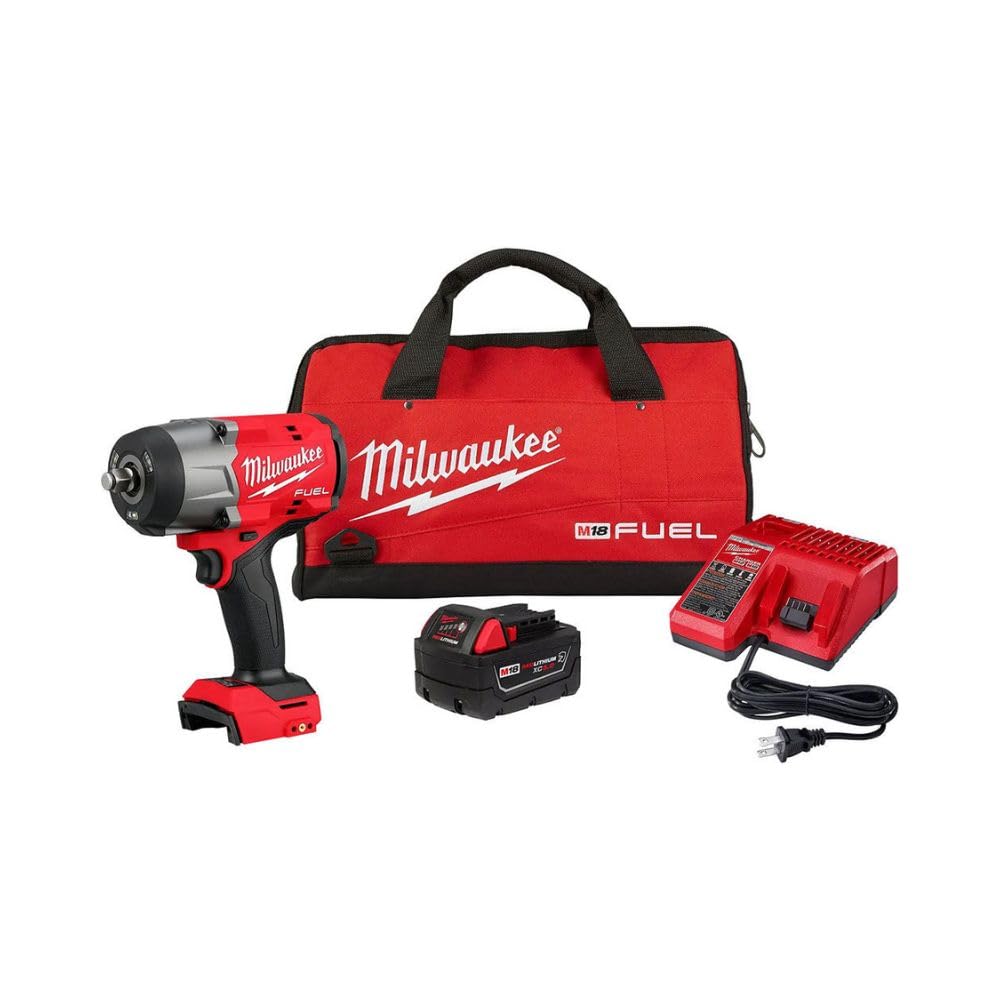
The one you turn to when nothing else moves — 1500 ft-lbs of torque in a kit with a 5.0Ah battery and bag.
This is the heaviest and most powerful option here, with 1500 ft-lbs of max torque (one reviewer notes it hits 1600 ft-lbs nut-busting torque with the 5.0Ah Forge battery). It is part of a kit that includes one 5.0Ah M18 battery and a carrying bag, so you do not need to hunt for batteries separately. The 4-Mode DRIVE Control includes Mode 4, which prevents nut loss by stopping rotation when the fastener is nearly off. At 11.22 pounds, this is a heavy tool — you feel it during extended use, especially overhead.
One daily-use mechanic says he “hasn’t found anything it won’t break loose with ease.” Another reviewer bought it as their first Milwaukee tool and was impressed enough by the charger (which has both M18 and M12 slots) that they later bought the M12 Stubby. But the weight is the catch: at 11.22 pounds, it weighs 11.22 pounds, while the M12 Stubby weighs 2.5 pounds. This is not a tool you grab for a quick wheel rotation — it is for the stuck bolt that has defeated everything else.
Unstoppable torque
- 1500 ft-lbs of max torque breaks the toughest rusted fasteners (beyond any other pick here)
- Kit includes 5.0Ah battery, charger, and bag — ready to work from the start
- 4-Mode DRIVE Control with mode 4 prevents lost nuts and fasteners
The weight penalty
- At 11.22 pounds, it is exhausting for overhead or prolonged use
- Expensive — the premium reflects its pro-grade torque and battery system
Bring this home if: you are a pro mechanic or serious DIYer who regularly fights rusted suspension bolts, truck U-bolts, and heavy equipment fasteners.
Pass on it if: your work is limited to wheel rotations and routine maintenance — a lighter mid-torque wrench is more practical and far less fatiguing.
Understanding the Specs
Torque (ft-lbs)
Torque is the twisting force the wrench applies to a fastener. It comes in two flavors: “fastening torque” (how much force it uses to tighten a bolt) and “nut-busting torque” or “breakaway torque” (how much force it uses to loosen a stuck bolt). The breakaway number is always higher and is the one that matters when you are fighting rust. For example, a typical car lug nut torqued to 100-150 ft-lbs can be removed by a tool with 275 ft-lbs of fastening torque. But a rusted suspension bolt may need 600-800 ft-lbs of breakaway torque to break free.
Anvil Type: Hog Ring vs Detent Pin
The anvil is the square drive that holds the socket. A hog ring anvil uses a spring-loaded wire ring inside the drive. You push the socket on and it snaps into place; to remove it, you pull. This is the fastest type for socket changes. A detent pin anvil has a small spring-loaded pin that locks into a hole on the socket. You press the pin to release the socket. It holds sockets more securely (they never fall off), but changing sockets is slower. For most DIYers, hog ring is handier. For pros who drop tools in engine bays, detent pin is safer.
FAQ
What is the difference between fastening torque and nut-busting torque?
Do I need an air compressor for an impact wrench?
Will a 1/2-inch impact wrench fit my sockets?
How much torque do I need to remove car lug nuts?
What is the best impact wrench for tight engine bay spaces?
Can I use an impact wrench on brake caliper bolts?
What is the difference between a hog ring and a detent pin anvil?
How do I know if a bare tool fits my existing batteries?
Is a cordless impact wrench as powerful as an air impact wrench?
What size impact wrench should I get for my car?
Final Thoughts: The Verdict
For most people, the best auto impact wrench winner is the DEWALT ATOMIC 20V MAX (DCF921B) because it packs 300 ft-lbs of manageable torque into a light 2.8-pound body with a hog ring anvil and 4-speed settings — enough for everyday DIY and most light auto work without the price tag or weight of the pro models. If you want the highest torque in the shortest package, grab the Milwaukee M12 FUEL Stubby — at 4.9 inches with 550 ft-lbs, it is the ultimate space-saving torque weapon. And for heavy-duty professional use where nothing else will move a rusted bolt, the standout is the Milwaukee M18 FUEL High Torque with its 1500 ft-lbs of max torque.
How We Picked
We do not accept paid placement. Every pick is matched to a real buyer and a real use-case; we do not hands-on test units.
Sources & Methodology
Specifications: manufacturer listings and product documentation. Review insights: verified customer reviews, as of July 2026. Pricing: not shown on this page (it changes often); check the current price via the retailer link.
As an Amazon Associate, Gadgets Feed earns from qualifying purchases. This does not affect which products we feature.