
Our readers keep the lights on and my morning glass full of iced black tea. As an Amazon Associate, I earn from qualifying purchases.
Specs are compiled from manufacturer listings and verified buyer reviews and can change over time — please confirm the key details on the product page before buying.
Most people think you need a loud generator or shore power to run an air conditioner in a truck, van, or RV. That assumption is wrong. A 12V air conditioner runs directly off your vehicle’s battery bank, letting you sleep through the night in desert heat without waking the neighbor or burning a gallon of diesel. The trick is picking the right one — because cooling power, noise, and battery draw vary wildly between models.
I’m Min — the founder and writer behind Gadgets Feed. This guide is built by comparing the manufacturers’ published specifications and the patterns across verified customer reviews, so you get each pick’s real strengths and trade-offs instead of marketing spin.
This breakdown of the top 12v air conditioner models covers sprinter vans, fifth-wheels, and semi-truck cabs. It shows you exactly what each unit delivers and where it falls short.
Our Picks at a Glance
How To Choose The Best 12V Air Conditioner
Choosing a 12V AC for your rig depends on three linked decisions: how much cooling you need (BTU, or British Thermal Units, a standard cooling power measure), how much power it will draw from your batteries (watts), and where you will mount it (rooftop, split, or portable). Get these three right and the rest falls into place.
BTU vs. Battery Life — The Real Trade-Off
Cooling power is measured in British Thermal Units (BTU). A 10,000 BTU unit will cool roughly 150-200 square feet of van or RV. But higher BTU often means higher power consumption. Look for a model with an inverter or variable-speed compressor (a compressor that adjusts its speed to match cooling demand) — those units can ramp down when the space is already cool, drawing far fewer amps (amperes, a unit for current flow) and stretching your battery bank through the night.
Rooftop vs. Split System vs. Portable
A rooftop unit (like a traditional RV AC) fits into a standard 14×14-inch roof vent opening. It is self-contained and relatively easy to install, but it adds weight high up on your roof. A split-system mini-split (a system with a separate compressor outside and an air handler inside) puts the compressor outside or underneath the vehicle and the air handler inside, which keeps the weight low and the roof clear for solar panels. A portable unit sits inside and vents through a window or roof hatch — it is the easiest to move but often the least efficient.
Power Consumption Determines Your Battery Bank
Check the unit’s “annual energy consumption” in watts (or the tested average draw in amps, a measure of electrical current). A typical 12V AC will pull anywhere from 350W to 960W while running. To estimate runtime, divide your usable battery capacity (in watt-hours, a unit of total energy) by the AC’s draw. For example, a 400Ah 12V battery bank holds about 4,800 watt-hours. A unit drawing 400W could run for around 12 hours — but only if it cycles on and off efficiently.
Quick Comparison
| Model | Best For | Cooling Power (BTU) | Power Draw (Watts) | Type | Amazon |
|---|---|---|---|---|---|
| Outequip 12V 10000 BTU★ Best Overall | Best Overall Off-Grid | 10,000 BTU | 960W | Rooftop | Amazon |
| Gidrox 10000 BTU w/ HeaterLowest Night Draw | Best Quiet Night Mode | 10,000 BTU | 350W (tested night avg) | Rooftop | Amazon |
| Countrymod 12V 10000 BTU | Best Premium Value | 10,000 BTU | 300-900W | Rooftop | Amazon |
| Treeligo 12000BTU Mini Split | High BTU for Trucks | 10,000 BTU | 960W | Split System | Amazon |
| CNCEST 11000 BTU Split | Budget-Friendly Split | 11,000 BTU | 400W | Split System | Amazon |
| OutequipPro 12V (No Heater) | Lightest Rooftop Pick | 10,000 BTU | 660W | Rooftop | Amazon |
In‑Depth Reviews
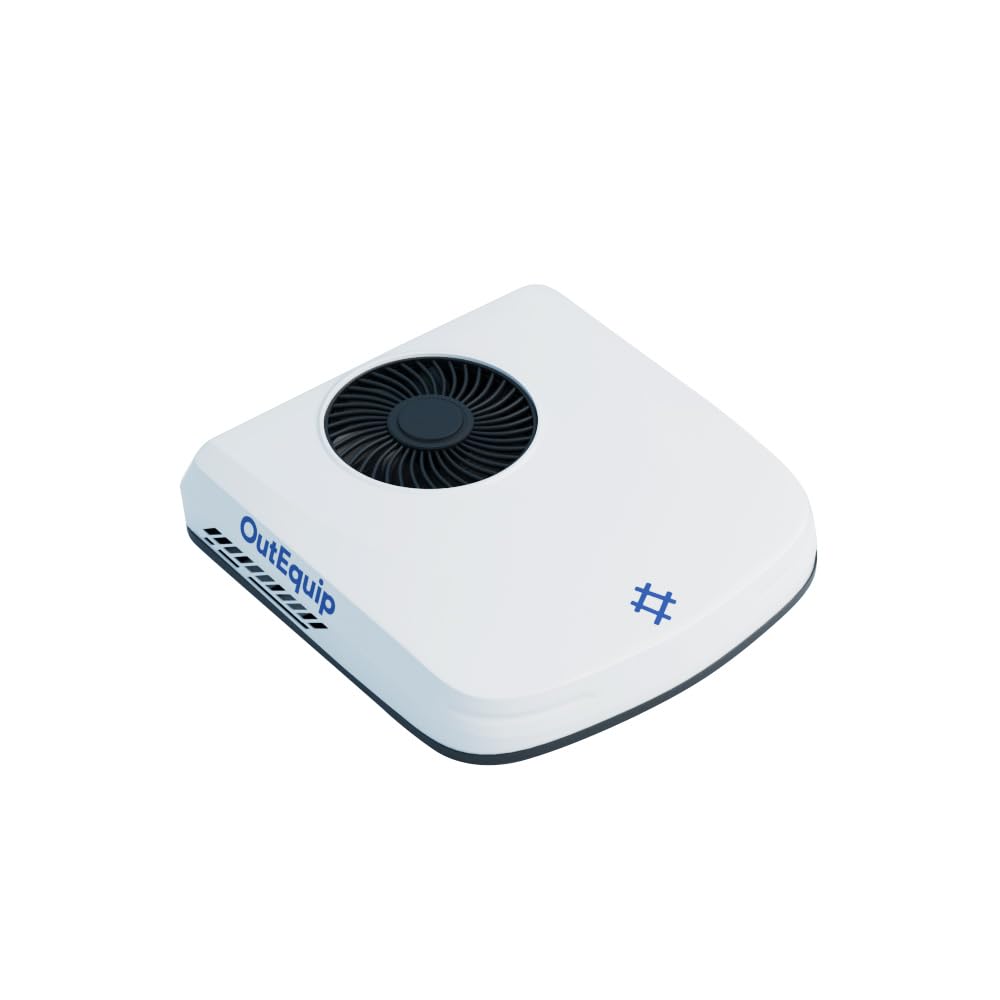
1. Outequip RV Air Conditioner, 12V 10000 BTU
Our pick — 4.5★ from 100+ verified ratings; the strongest balance of quality and price.
The rooftop unit that drops 10,000 BTU of cooling into a 6-inch-tall package weighing just 43 lbs.
This 10,000 BTU rooftop unit gives you fast cooling — buyers report it drops an RV from hot to comfortable in about 15 minutes — and it sits just 6 inches tall on your roof, leaving room for solar panels. The 4,500 BTU PTC heater (a heater that uses a positive temperature coefficient ceramic element for instant warmth) takes the morning chill off without needing a separate furnace for mild nights.
At 43 lbs and 6 inches tall, it is about half the weight of a traditional Coleman Mach 3, so you can install it alone. The brushless copper motor fans keep noise to around 40 dB (decibels, a measure of sound level) — roughly the level of a quiet library. With the Bluetooth app, you can switch between Eco, Sleep, and Turbo modes from your bunk without getting up.
Unlike the 11,000 BTU CNCEST split unit that draws only 400W, this Outequip draws 960W at full power, so you need a larger battery bank. But the inverter-style variable-speed compressor ramps down as the cabin cools, conserving power when you do not need maximum cooling. Multiple owners noted the efficient inverter tech paired well with 500W to 870W solar setups and 200Ah to 600Ah LiFePO4 batteries (lithium iron phosphate batteries, a common deep-cycle type).
Reasons It Works
- Fast 10,000 BTU cooling in a low-profile rooftop design
- Quiet 40 dB operation on low speed
- Inverter compressor saves battery by varying speed
Watch For
- Draws 960W at peak — plan for a large battery bank
- Heat pump is supplemental only, not primary in extreme cold
Pick this if: You want a proven, lightweight roof unit with an inverter compressor for off-grid camping and enough cooling to drop a hot RV to comfortable in minutes.
Look elsewhere if: Your battery bank is under 200Ah — the 960W peak draw will drain smaller setups fast.
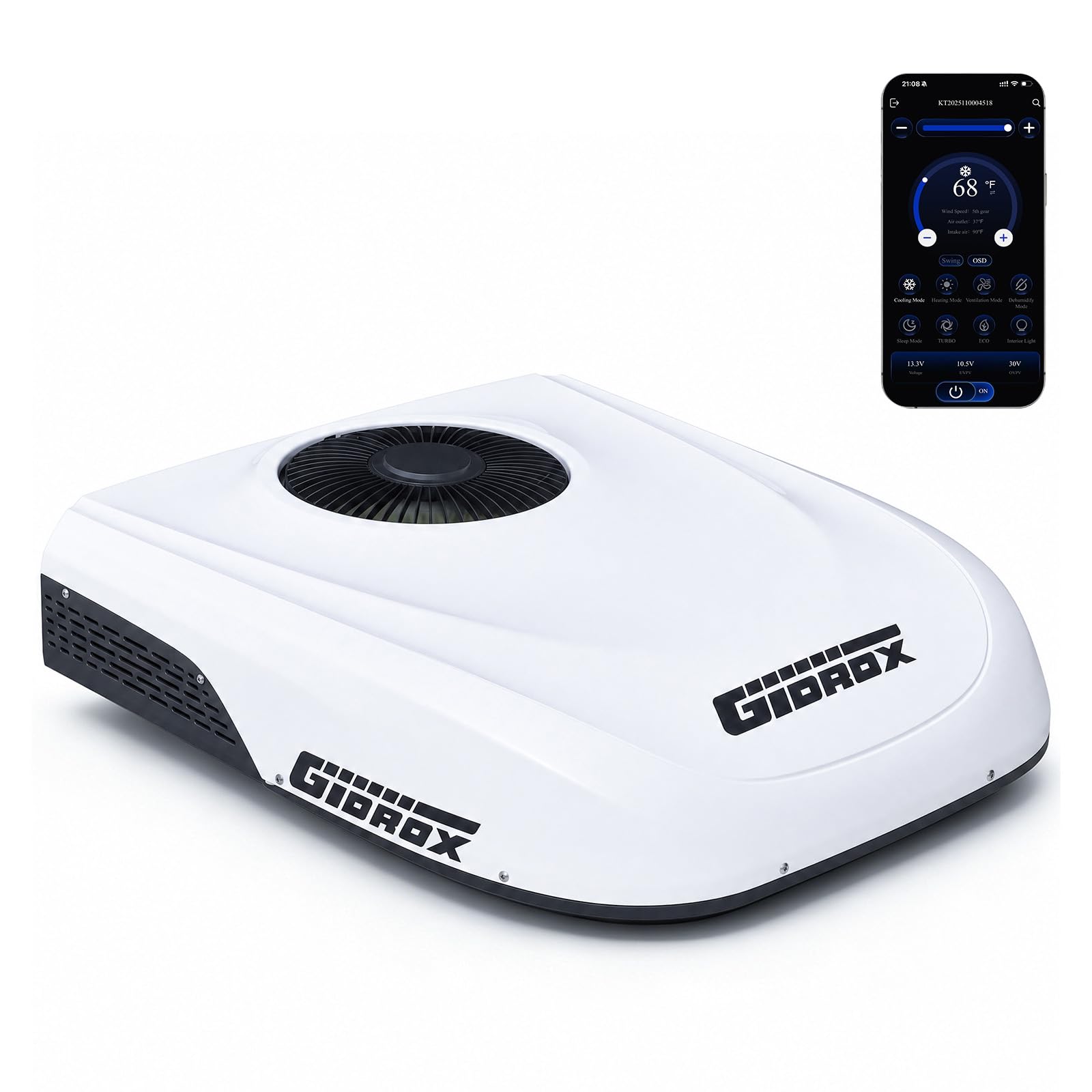
2. Gidrox 10000 BTU 12V DC RV Air Conditioner with Heater
The rooftop AC that sips just 350W at night, saving roughly 60% energy over traditional units.
If you have ever woken up to a dead battery because the AC ran all night, this is the answer. The Gidrox uses an inverter compressor (a variable-speed compressor) plus a brushless fan and a sound-insulation shell to hit a tested average power consumption of about 350W during nighttime operation in 30°C (86°F) ambient conditions. The manufacturer claims that is roughly 60% less energy than a traditional RV AC — and real buyer reports confirm it runs through the night on a 400Ah battery.
It comes with a PTC heater for instant heat, a HEPA filter (a high-efficiency particulate air filter that traps dust and allergens) for cleaner cabin air, and three smart control options: the physical panel, an infrared remote, and a Bluetooth app. The 7-inch total height sits low on the roof, and the weight is 54 lbs — manageable for a two-person lift. Buyers mention the 19.7-foot power cable is long enough to route neatly to the battery compartment.
Compared to the heavier-draw Outequip above (960W vs 350W in night mode), the Gidrox is the smarter choice for smaller battery banks. The trade-off is that it is priced at a premium, and a few buyers reported that the H2 error code can pop up if the unit is not perfectly level — so check your roof plane before mounting.
Standout Features
- Tested 350W average draw at night means all-night runtimes on modest battery banks
- Three control methods: panel, remote, and Bluetooth app
- Built-in PTC heater for instant warmth and a HEPA filter
Things to Consider
- 54 lbs is manageable but heavier than the 43 lb Outequip
- Needs a level roof surface — some users saw H2 errors on sloped installations
Reach for this if: You are boondocking with limited battery capacity (400Ah or less) and need a unit that sips power overnight.
skip it if: Your roof has significant slant — the unit’s leveling tolerance is tighter than most.
3. Countrymod 12V DC RV Air Conditioner 10000 BTU
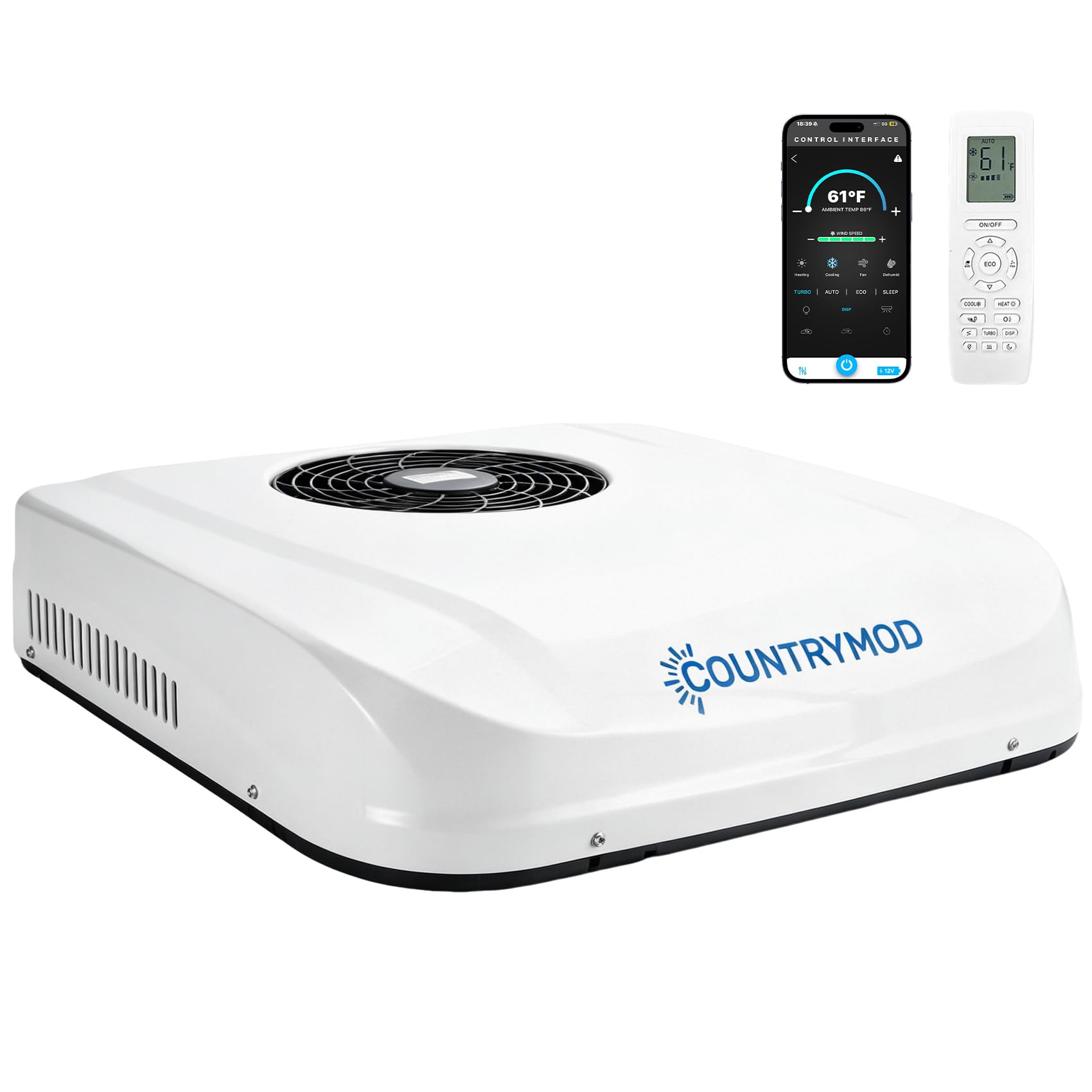
The rooftop unit with a horizontal compressor sits low and runs quiet, drawing as little as 300W in Eco.
Countrymod used a horizontal compressor (one that lays flat instead of standing upright) to lower the center of gravity and reduce vibration. The result is a unit that buyers describe as “nearly silent” — the spec sheet says 45-55 dB (decibels), and owners mention the sleep mode is genuinely quiet enough to not disturb rest. It claims 5 times more efficient than a standard air conditioner, consuming only 0.3 kWh (kilowatt-hours, a unit of energy) per hour versus 1.5 kWh.
The 300-900W variable frequency inverter design allows it to run at just 260W in Eco mode while still pumping 10,000 BTU of cooling. One buyer in the Nevada desert tested it and found it cooled a 100 sq ft space to 72°F (22°C) at night using 260W. You get touch controls, a remote, and Bluetooth app connectivity. It fits the standard 14×14-inch roof opening, and many buyers confirmed a quick 30-minute installation with clear instructions.
Compared to the Gidrox, the Countrymod has a lower peak draw with a wider operating range (260W on Eco vs 350W tested average on Gidrox). The catch is that the annual energy consumption is listed at 3650 watts — which seems to be a different measurement method than the Gidrox’s 2930W rating, so compare real-world amp draw rather than that sticker. Multiple buyers praised Countrymod’s customer service, specifically Tony, for fast replacements on remotes and control boards.
What Stands Out
- Eco mode draws only 260-300W — excellent for sustained off-grid use
- Very quiet at 44-45 dB in sleep mode
- Stellar customer support according to buyer reports
Watch For
- Instructions could be clearer — a few owners found them incomplete
- Annual wattage spec seems inconsistent with real-world draw; check amp meter rather than sticker
Best suited for: Van dwellers and RV owners who want ultra-low Eco mode power consumption (<300W) for all-night cooling without generator noise.
Not ideal if: You need a split system or want the unit to be duct-ready — this is strictly a non-ducted rooftop fit for standard 14×14 openings.
4. Treeligo 12V Truck Cab Air Conditioner 12000BTU
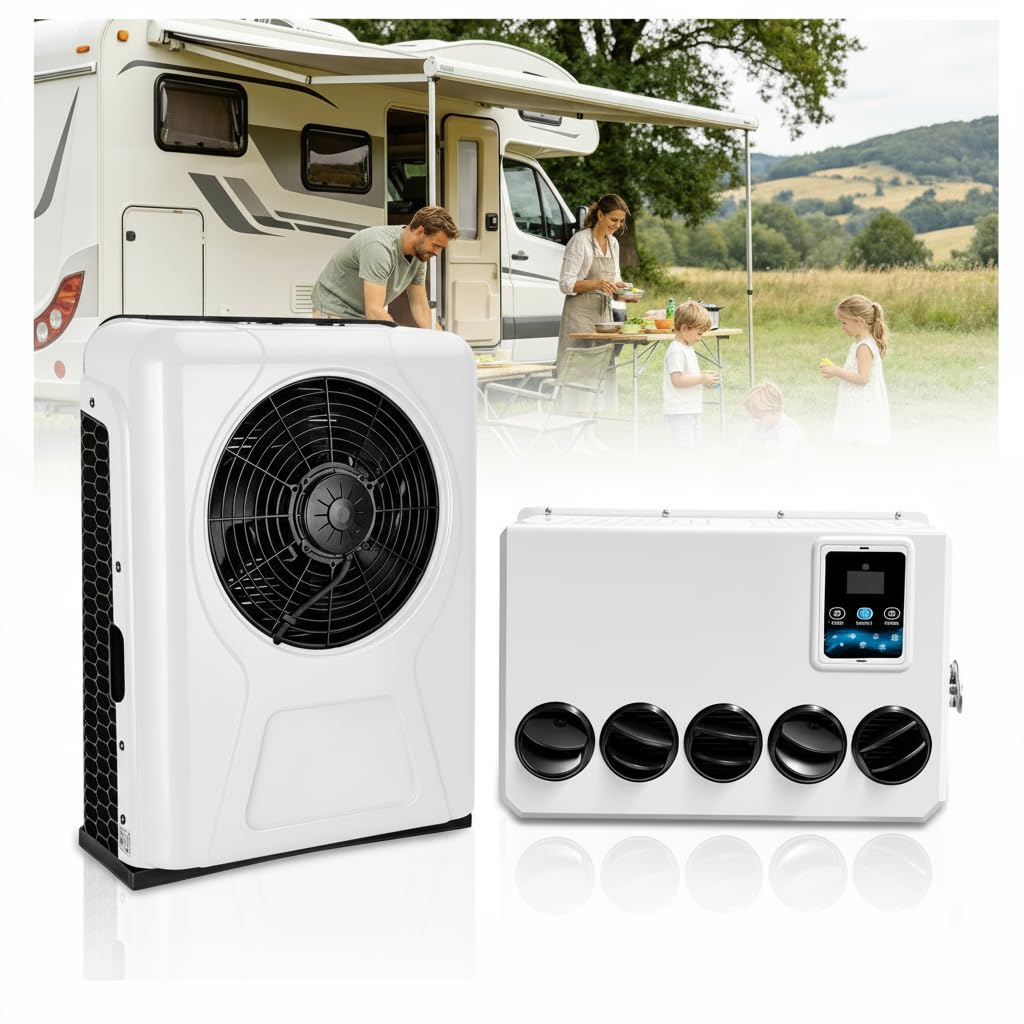
The split-system unit for trucks that packs a 20CC scroll compressor and 12,000 BTU of rated cooling into a versatile DC package.
If you drive a semi-truck, a heavy vehicle, or a custom van where a roof unit is not an option, this mini split keeps the weight low. The compressor unit mounts externally (under or behind the cab) and the indoor air handler fits neatly inside. It delivers 10,000 BTU actual cooling (rated 12,000 BTU on the compressor) at 960W, according to the specs, with a 45 dB rated noise level. The manufacturer claims 8 hours of runtime from a 480Ah battery when parked.
One critical thing buyers flagged: the compressor ships with only 25ml of POE 68 oil (polyolester oil, a type of refrigerant oil), but the service manual indicates it needs 90-125ml. If you pick this unit, add oil before first startup. A few owners also noted that the inside unit can be loud at full fan speed, and one reported the compressor died after 4 months. Treeligo’s customer support was described as responsive in some cases, but the reliability record is mixed.
Compared to the rooftop options above, the split design keeps your roof clear for solar panels and avoids cutting a large hole. However, the Treeligo’s reliability record is weaker than the Outequip or Countrymod roof units, and the build quality concerns (oil quantity, blower motor brushes) mean this is best for the DIY owner who can maintain it. Unlike the 11,000 BTU CNCEST split unit that draws just 400W, the Treeligo pulls 960W — so you are trading higher power consumption for stronger cooling.
Pros to Consider
- Splits the weight — compressor goes outside, air handler inside
- 12,000 BTU rated compressor for strong cooling in large cabs
- Clears the roof for solar panels
Cons to Know
- Ships with insufficient compressor oil — must add 90-125ml POE 68 before running
- Mixed reliability reports; some buyers saw compressor failure after months
Grab this if: You drive a semi or heavy vehicle and need a split-system AC that clears the roof — and you are comfortable with the mandatory oil top-up and occasional DIY maintenance.
Pass on it if: You want a “install and forget” unit — the rooftop options above are more reliable for daily-driven vans and RVs.
5. CNCEST 12V DC Split Air Conditioner 11000 BTU
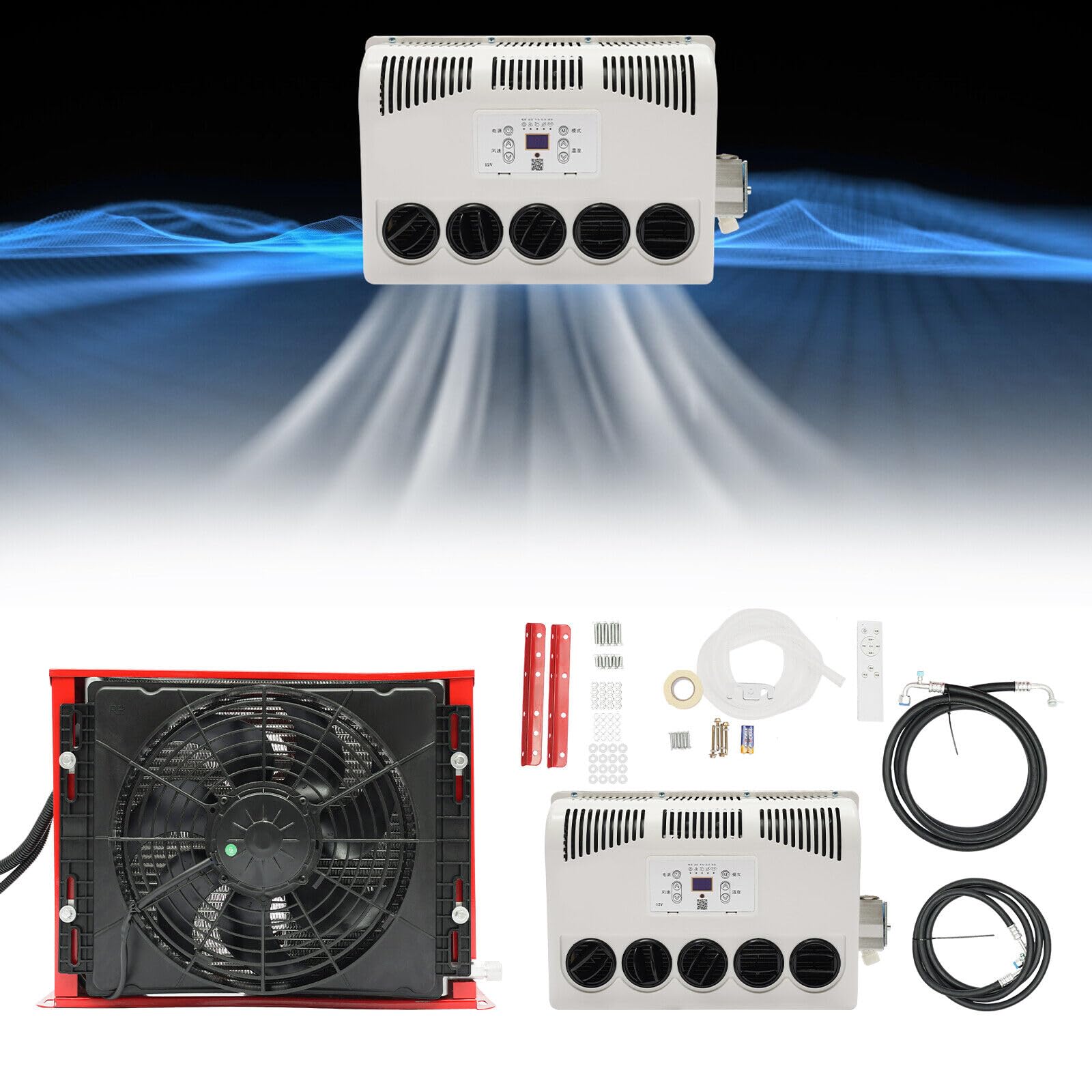
The entry-level split unit that delivers 11,000 BTU of cooling while drawing only 400-600W.
On paper, this is the most energy-efficient split system in the list — 11,000 BTU of cooling power with an annual energy consumption of just 400W. That is a big difference compared to some rooftop units that consume 2930W. The built-in under-voltage protection cuts off below 11V (volts, a measure of electrical potential) to prevent killing your starter battery, and the 5-speed fan gives you fine control over airflow. It is designed for semi-trucks, RVs, caravans, and even excavators.
Customers note that it works great when it works — one owner said it “froze them out” in south Georgia heat after installation in their mobile home toter. Another noted a quick and easy install in an 89 Ford truck that kept the cab “nice and cool in 90+ heat.” However, the reviews reveal a durability concern: at least two separate buyers reported the condenser (the part that releases heat outside) developing a leak after roughly two months of use. While one got excellent customer service with a fast replacement, the other was told to buy a new unit.
Compared to the Treeligo split unit above, the CNCEST draws much less power (400W vs 960W) and costs significantly less. The trade-off is lower build quality — the external case is a mix of iron, plastic, and aluminum, and the control panel labels were reportedly in Chinese characters on some units, making setup harder without translation. At this price point, it is a calculated gamble: big energy savings if it holds up, but be ready for potential repair work.
Why It Stands Out
- Very low power draw of 400W for 11,000 BTU cooling — excellent for small battery banks
- Built-in low-voltage cutoff protects your vehicle battery from over-draining
- Budget-friendly entry into split-system 12V cooling
Concerns
- Condenser leaks reported by multiple buyers after a few months of use
- Control panel labels may be in Chinese on some stock units
- Customer support inconsistent — some get fast help, others do not
Choose this if: Your budget is tight and you have a small battery bank where 400W draw makes a real difference — and you can handle a minor repair if the condenser springs a leak.
Avoid if: You need guaranteed long-term reliability for daily full-time RV or truck use — the mixed reviews suggest you may get a dud.
6. OutequipPro 12V AC (12 Voltage w/o Heater)
The lightweight rooftop champion at 43 lbs with 10,000 BTU cooling, built for one-person solo install.
If you are installing the AC by yourself on a van or pop-up camper, every pound matters. The OutequipPro is the non-heater version of the Best Overall pick above, shaving weight and complexity for pure cooling duty. At 43 lbs, it is lighter than the 52 lb Gidrox and much lighter than the heavy old-school Coleman units it is often replacing. Reviewers point out a straightforward install in a Ram Promaster and a VW Westfalia bus, with clear instructions and internal wire routing for a clean look.
The 10,000 BTU inverter compressor cools a small to medium van quickly — one buyer measured it dropping from 89°F to 79°F (32°C to 26°C) in about 25 minutes. It draws 55A (amps) on high speed and drops to around 20A on Eco mode, making it workable with a 360Ah battery bank for 6-7 hours of maximum cooling. The 54 dB noise level on high is noticeable but not deafening, and on low it is quieter than most portable ACs. You get the Bluetooth app, remote control, and three operating modes (Eco, Sleep, Turbo).
Since this is the heater-free version, you save a bit of money over the Outequip 12V with heater. But you lose the ability to take the chill off spring and fall mornings without a separate heat source. Compared to the Countrymod unit, the OutequipPro is 2 lbs lighter but has a slightly higher Eco draw (20A vs roughly 22A equivalent) — essentially a toss-up on power efficiency. The strong reviews (4.7/5 from 81 ratings) suggest this is the most consistently reliable model in the lineup.
The Upside
- Ultra-light at 43 lbs — truly solo installable
- Very consistent 4.7/5 rating across 81 reviews — few defects reported
- Low 20A draw on Eco mode stretches battery runtime
The Downside
- No built-in heater — need a separate source for cold mornings
- 54 dB on high is louder than the 40 dB Outequip model with heater
Perfect for: Solo builders fitting out a van, pop-up camper, or bus who need the lightest possible roof unit and already have a separate heater.
Not for you if: You want heating and cooling in one unit and do not mind the extra 2 lbs — get the standard Outequip with heater instead.
Understanding the Specs
BTU — British Thermal Units
This is the standard measurement of cooling power. One BTU is roughly the heat given off by a single match. A 10,000 BTU unit can cool approximately 150-200 square feet of living space. For context, a short-wheelbase van is about 50-80 sq ft, a long-wheelbase sprinter is around 100-130 sq ft, and a mid-size RV might be 150-200 sq ft. Do not buy a 6,000 BTU unit for a 200 sq ft space — it will run continuously and drain your battery.
Power Draw (Watts) and Amp Draw
Watts tell you how much electricity the AC uses. Since 12V systems run on amps (amperes, a unit for current), divide watts by 12 to get approximate current draw (for example, 350W ÷ 12V = ~29A). This number is critical for battery planning. A 400Ah lithium battery holds roughly 4,800 watt-hours of usable power. An AC drawing 400W could theoretically run for 12 hours, but real-world draw fluctuates as the compressor cycles on and off.
FAQ
Can I run a 12V air conditioner off my vehicle’s starter battery?
How many solar panels do I need to run a 12V AC?
What is the difference between a rooftop and a split 12V AC?
How long will a 12V AC run on a 100Ah battery?
Can a 12V AC cool a semi-truck cab while the engine is off?
Will a 12V AC work with my existing 14×14 roof vent opening?
Is a 12V AC more efficient than a 110V AC unit run through an inverter?
What does “inverter compressor” mean in a 12V AC?
Final Thoughts: The Verdict
Across the board, the 12v air conditioner winner is the Outequip 12V 10000 BTU because it combines the best balance of lightweight build (43 lbs), low-profile roof height (6 inches), inverter compressor efficiency, and positive buyer reports across hundreds of installations. If you prioritize all-night quiet operation with the lowest power draw, grab the Gidrox 10000 BTU — it sips 350W at night. And for the lightest possible solo-install rooftop unit with the highest reliability rating (4.7/5 from 81 ratings), the standout is the OutequipPro 12V (No Heater) at 43 lbs.
How We Picked
We do not accept paid placement. Every pick is matched to a real buyer and a real use-case; we do not hands-on test units.
Sources & Methodology
Specifications: manufacturer listings and product documentation. Review insights: verified customer reviews, as of July 2026. Pricing: not shown on this page (it changes often); check the current price via the retailer link.
As an Amazon Associate, Gadgets Feed earns from qualifying purchases. This does not affect which products we feature.