
Our readers keep the lights on and my morning glass full of iced black tea. As an Amazon Associate, I earn from qualifying purchases.
Specs are compiled from manufacturer listings and verified buyer reviews and can change over time — please confirm the key details on the product page before buying.
You want a camera that sees everything around you, but you also want a stand so you are not holding it the whole time. The problem is that most 360 cameras treat the stand as an afterthought — either they do not include one, or the included stick is too short for the effect to work. The cameras here pair a spherical lens with a proper stand or selfie stick, so you can actually set it down and walk into the shot.
I’m Min — the founder and writer behind Gadgets Feed. This guide is built by comparing the manufacturers’ published specifications and the patterns across verified customer reviews, so you get each pick’s real strengths and trade-offs instead of marketing spin.
Whether you are shooting real estate tours, mountain bike runs, or family vacations, this roundup of the 360 camera with stand compares 8 models across video resolution, battery life, and sensor size so you know exactly which combo is worth your money.
Our Picks at a Glance

How To Choose The Best 360 Camera With Stand
Not all 360 cameras work the same way with a stand. Some rely on the stand disappearing from the shot through software stitching — if that stitching is sloppy, the pole reappears and ruins the illusion. Others have a 1/4-inch thread that lets you screw onto any tripod, but if the camera is heavy, a flimsy stand tips over. Here is what to check before you buy.
Video Resolution and Sensor Size
The number you see written in the specs — 5.7K, 8K — tells you how much detail the camera can resolve before you reframe the shot. Because you are zooming into a portion of a 360-degree sphere, higher native resolution (like 8K) gives you cleaner slow-motion and tighter crops. A larger sensor (such as a 1-inch sensor) captures more light, so your footage stays usable when the sun drops.
Stand Compatibility and Invisible Selfie Stick
Some cameras bundle a selfie stick that is calibrated to the stitching software, meaning the stick vanishes from the final clip automatically. If you use a random tripod, the pole may stay visible. Look for a model that mentions “invisible selfie stick” if that third-person, drone-like view is your goal. A 1/4-inch thread at the bottom ensures you can mount it on any standard tripod.
Battery Life and Internal Storage
360 video eats battery faster than standard video because the camera is processing two lenses at once. If you plan to shoot continuously for a full day out, a camera with a 190-minute rating is a different tool than one that lasts 60 minutes. Internal storage (like 105GB) is a safety net — you can shoot without hunting for a memory card, but you still want a slot for expansion.
Quick Comparison
| Model | Best For | Video Resolution | Battery Life | Still Resolution | Amazon |
|---|---|---|---|---|---|
| DJI Osmo 360 Standard Combo★ Best Overall | Best Overall 8K Performance | 8K | 190 minutes | 120 MP | Amazon |
| AKASO 360 Action CameraBudget Champion | Budget 360 Entry Point | 5.7K | 60 minutes | 48 MP | Amazon |
| GoPro MAXPro Versatile | Waterproof Versatility | 5.6K30 | — | 16.6 MP | Amazon |
| Insta360 X3 | Proven 360 Workhorse | 5.7K | — | 72 MP | Amazon |
| DJI Osmo 360 Essential Combo | Extended Shooting Sessions | 8K UHD | 190 minutes | 120 MP | Amazon |
| Insta360 X4 Air Starter | Ultralight Travel | 8K | — | 29 MP | Amazon |
| Insta360 X5 Tripod Bundle | All-Day Low-Light Shooting | 8K | 185 minutes | 18 MP | Amazon |
| Ricoh Theta Z1 51GB | Professional Image Quality | 4K | — | 23 MP | Amazon |
In‑Depth Reviews
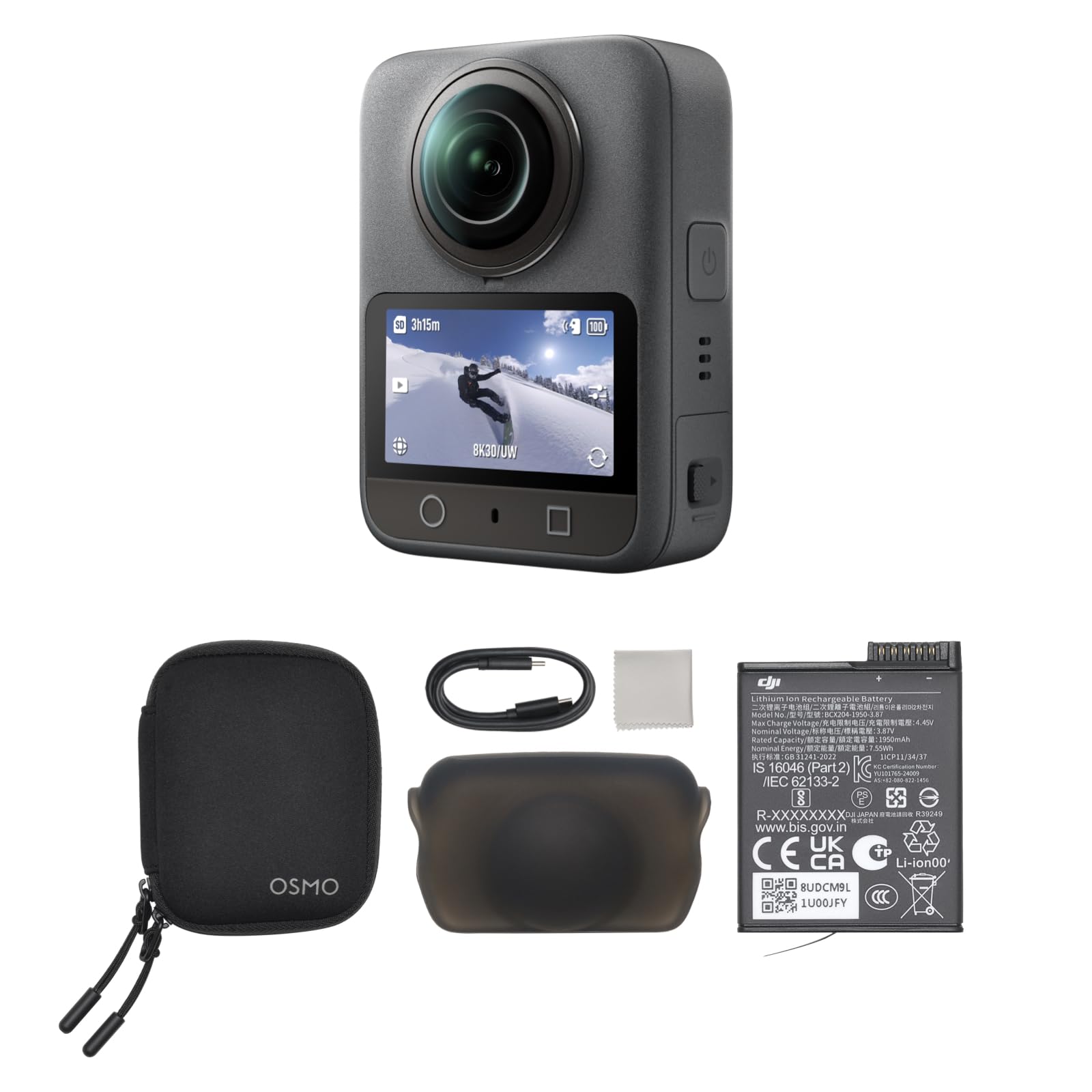
1. DJI Osmo 360 Standard Combo
Our pick — 4.5★ from 1,500+ verified ratings; the strongest balance of quality and price.
The 8K powerhouse that brings a 1-inch sensor and 105GB internal storage to the table.
You get a native 8K resolution, compared to the GoPro MAX at 5.6K30 — so when you zoom into a portion of the sphere, you can still pull a crisp 4K clip. The 1-inch sensor (compared to the 1/2-inch sensors in most other 360 cameras) is what keeps low-light footage usable: instead of noisy shadows, you get clean detail even during city nights or sunrise timelapses.
Buyers report that the built-in 105GB storage and up to 190 minutes (about 3.2 hours) of nonstop recording let you shoot a full afternoon without a memory card. The 120 MP effective still resolution, compared to the 16.6 MP on the GoPro MAX, means your 360-degree photos hold far more detail if you want to print or crop.
Four microphones capture spatial audio (sound that feels like it comes from all around you), and the camera can connect directly to two DJI microphone transmitters without a separate receiver. The catch is that the DJI Mimo app is not available on Google Play — you have to download it from the DJI website, an extra step Android users need to plan for.
Why It Wins
- 8K resolution outresolves every other 360 camera here
- 190-minute battery is the longest in this roundup
- 120 MP stills give you massive cropping flexibility
One Hiccup
- DJI Mimo app not on Google Play; must side-load from DJI website
- Lens exposed — buyers advise a protective case for rough handling
Reach for this if: you want the highest video resolution, the longest battery life, and a proper stand included — this is the one-stop shop for serious 360 shooting.
Look elsewhere if: you are on Android and want a smooth app-store download experience.
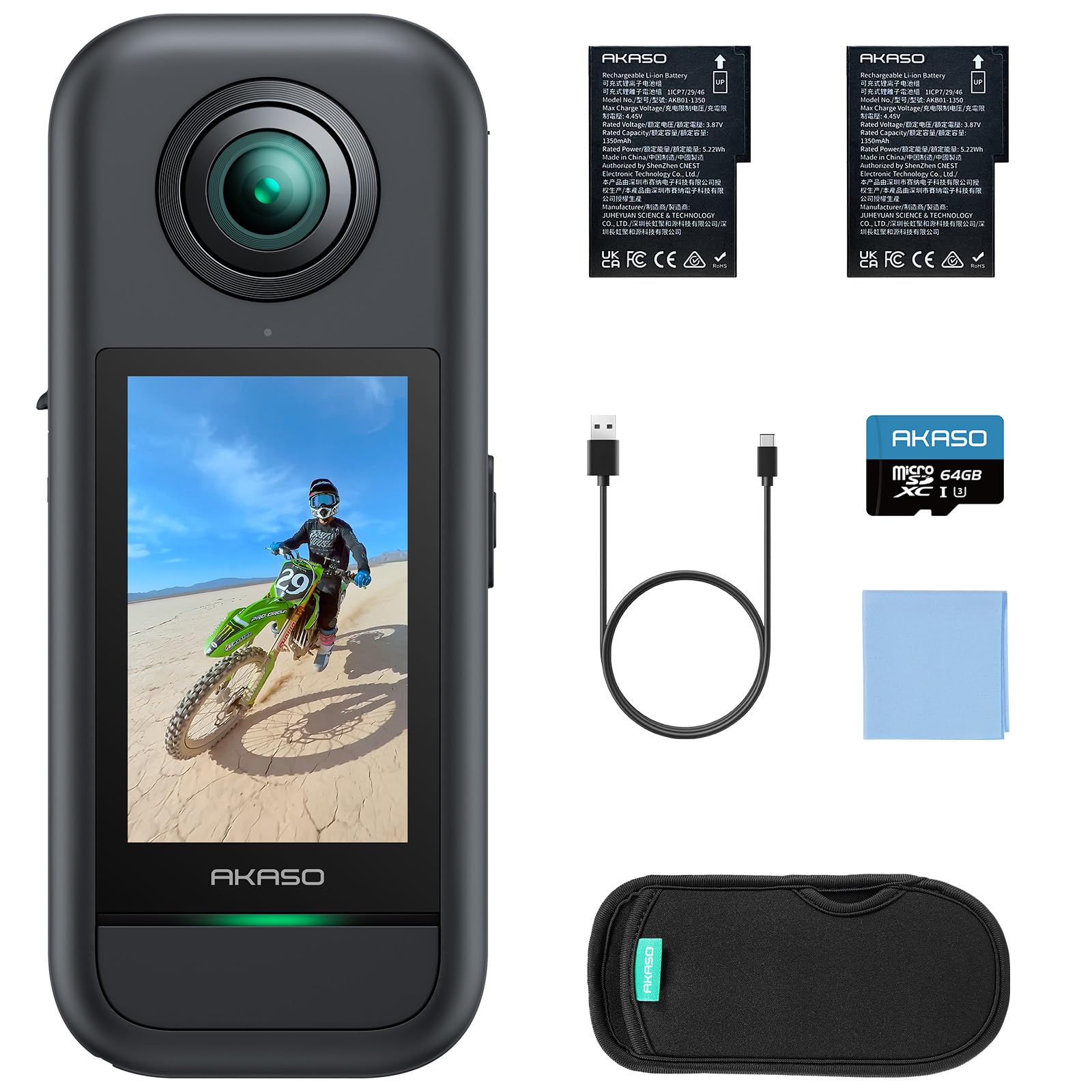
2. AKASO 360 Action Camera Standard Combo
The wallet-friendly route into 360 video that still delivers 5.7K clarity and AI tracking.
AKASO pairs dual 1/2-inch 48MP sensors with a 5.7K maximum video resolution and a 72MP photo mode. The invisible selfie stick effect works here too, so you can get that third-person drone-like shot without seeing the pole. AI Subject Tracking (a feature that keeps a moving person or animal centered in the frame) is useful if you are filming your dog running alongside a bike.
The battery life is the trade-off: AKASO rates it at 60 minutes, and one buyer confirms it recorded for only 54 minutes on a single charge. That is a 3.2x gap compared to the 190 minutes on the DJI Osmo 360, so you will want extra batteries or an external power source for a full day out. On the plus side, the camera can run off USB-C power without a battery installed — owners mention you can record or stream while it charges.
The bundle comes with a 64GB MicroSD card, which saves you the cost of buying one separately. The weatherproof design handles rain and dust well, making it a solid match for motorcycle trips and outdoor adventures where you do not want to risk an expensive flagship camera.
Smart budget move if: you are new to 360 filming and want to test the waters without spending premium-brand money.
The clear limitation: 60-minute battery means you are swapping batteries or charging mid-session — pack spares for anything longer than an hour.
3. GoPro MAX
The dual-mode action cam that switches between 360 and traditional single-lens footage.
GoPro MAX captures spherical 5.6K30 video (5,568 x 2,784 pixels at 30 frames per second) and 16.6 MP 360 photos, but its real a neat extra is the ability to flip into HERO mode — a standard wide-angle action camera that records 1080p or 1440p video. That matters when you do not want to edit 360 footage: just record in single-lens mode and share straight to social media. The 1/4-20 mounting threads at the bottom let you attach any standard tripod or extension pole, and the pole disappears from your footage in 360 mode.
Customers note that the new 1/4-inch tripod mount is a big upgrade over older GoPro 360 models, and the Enduro battery delivers over an hour of recording time. The lens scratches easily — several owners mention that a protective cap is essential. The effective still resolution of 16.6 MP is lower than the 120 MP on the DJI Osmo 360 and the 72 MP on the Insta360 X3, so if you care about high-res 360 photos, the MAX is not your first stop.
The GoPro Quik app handles reframing, object tracking, and transition effects in one place. Object Tracking locks onto a subject and follows it through your spherical footage automatically — no manual keyframing required.
Dual-Feature Strength
- HERO mode gives you a standard action cam without extra gear
- Waterproof design handles rain, spray, and shallow submersion
- Quik app makes reframing simple for beginners
Noted Limits
- 16.6 MP photos are low compared to other 360 cameras here
- Lens scuffs easily — a protective cap is almost mandatory
Best call for: someone who wants both a 360 camera and a standard action cam in one waterproof body.
skip it if: high-resolution 360 stills are your main priority — the photos here are softer.
4. Insta360 X3

The well-rounded 360 shooter that balances resolution, price, and a huge accessory ecosystem.
Insta360 X3 uses dual 1/2-inch 48MP sensors to produce 5.7K 360 Active HDR video and 72MP 360 photos. The FlowState Stabilization (the brand’s name for its digital image stabilization) and 360 Horizon Lock keep footage level even when you spin the camera aggressively — useful for mountain biking or skiing where the camera rattles around. The invisible selfie stick works with any standard pole or tripod arm, so you do not need a proprietary stick for the effect.
Buyers mention that daylight image quality is vibrant and crisp, but low-light performance falls off noticeably. The lens covers are not very durable — several owners advise buying a protective frame immediately. The 2.29-inch touchscreen is bright and responsive, but the menu interface has a small learning curve. One buyer compared it to its pricier sibling, the X5, and said this model is the smart buy if you do not shoot in dark environments regularly.
You can also switch to a single-lens 4K30 mode for standard wide-angle footage, making the X3 a hybrid camera similar to the GoPro MAX but with a higher 72MP photo resolution versus GoPro’s 16.6 MP. The Insta360 app includes AI-powered reframing tools that let you pick your angle after recording, so you never have to frame the shot while filming.
Perfect for everyday adventurers: the X3 hits a balance where you get 5.7K video, solid stabilization, and a proven ecosystem of mounts and accessories.
But be aware: low-light quality is weak, and the lens covers scratch — plan for a third-party protector from day one.
5. DJI Osmo 360 Essential Combo
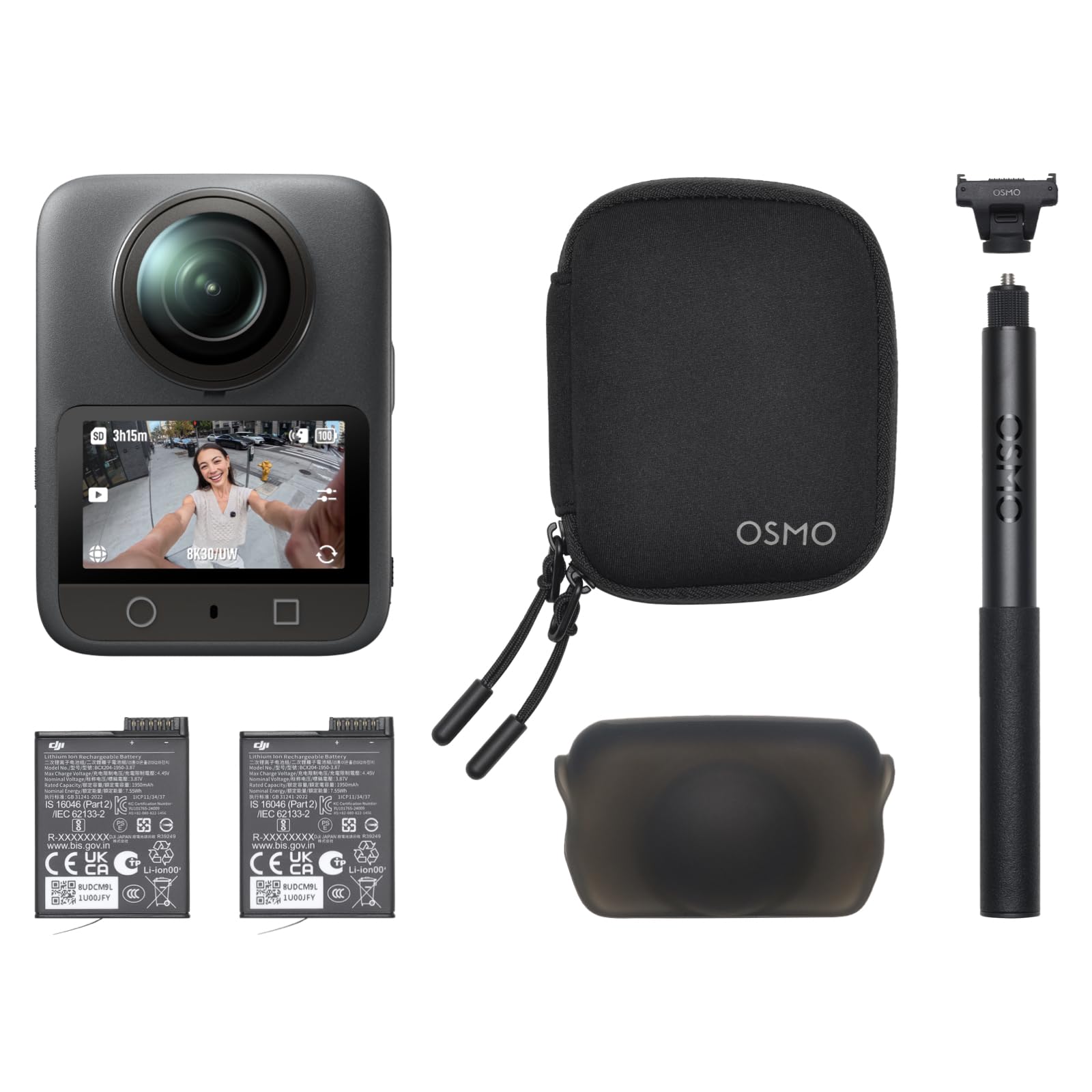
The same 8K sensor as the standard combo, but with an extra battery for back-to-back shoots.
This Essential Combo takes the DJI Osmo 360’s 1-inch sensor and 8K UHD recording and adds a second 1950mAh battery (the same capacity as the first) plus the 1.2m Invisible Selfie Stick. With two batteries, you get up to 380 minutes of total recording capacity — enough for a full day of skiing or a wedding without hunting for an outlet. The 120 MP still resolution and 105GB internal storage carry over from the standard combo, so you get the same 7.2x photo resolution advantage over the GoPro MAX.
Reviewers point out that the low-light performance is incredibly good for a consumer 360 camera — one reviewer called the dynamic range “staggering” with almost no noise in shadow areas. The 10-bit D-Log M color profile (a flat, wide-gamut color space) matches the Mavic 3 Pro drone, so if you already grade (adjust the colors of) DJI drone footage, the color pipeline is consistent. No overheating issues in 8K30 recording — one owner ran it for 45 continuous minutes during a hike with no shutdowns.
The catch is that the selfie stick is not a tripod — you get a pole for the invisible effect, but you do not get folding legs to set the camera on a table. One buyer specifically mentioned they would have liked a tripod included in the package. If you need hands-free stationary shooting, you will need a separate tripod base.
Why The Extra Battery Matters
- Two 1950mAh batteries double your shoot time
- 8K resolution and 1-inch sensor deliver top-tier low-light quality
- 105GB internal storage is a reliable backup for SD cards
The Missing Piece
- Selfie stick only — no tripod legs for stationary placement
- DJI Mimo app not on Google Play
Reach for this if: you record long events and need a spare battery ready to swap without pausing your session.
Look elsewhere if: you expect a tripod with folding legs to set the camera on a table or ground.
6. Insta360 X4 Air Starter Bundle
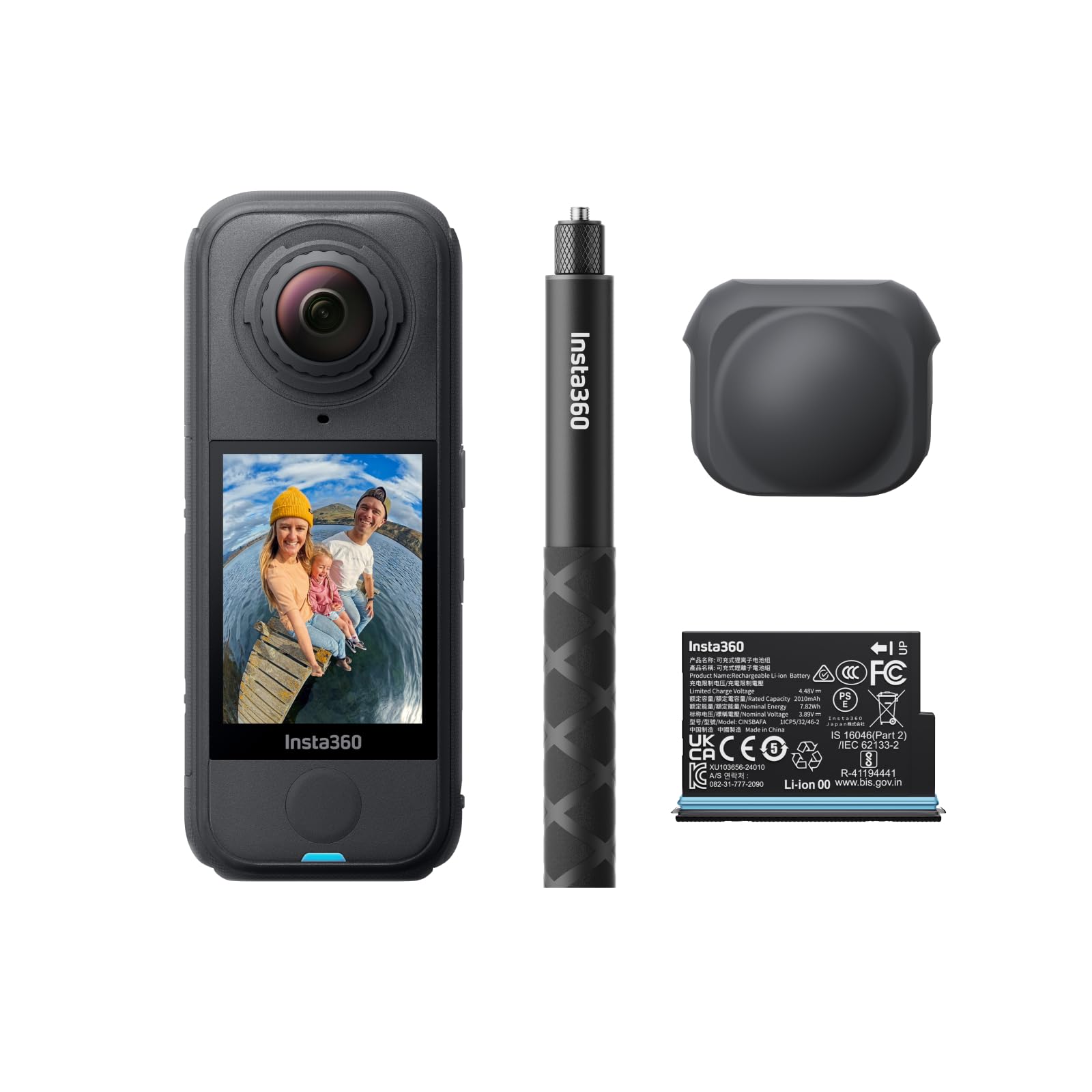
The sub-170g 360 camera you barely feel on a selfie stick or helmet mount.
At 165g (about 5.8 ounces), the Insta360 X4 Air is the lightest 360 camera in this roundup — roughly half the weight of the DJI Osmo 360. It still captures native 8K30fps video with Active HDR for tough lighting, plus FlowState Stabilization and 360 Horizon Lock. The Starter Bundle includes a 114cm Invisible Selfie Stick and an extra battery, so you get the vanishing-pole effect from the start with a spare charge.
Shoppers say that the video quality is better than an iPhone 15 for 360 capture, and the AI-powered editing tools in the Insta360 app let you generate highlight clips with one tap. The replaceable lenses are a practical advantage — if you scratch a lens, you swap it yourself instead of sending the whole camera for repair. Low-light performance is a weak spot; buyers report clarity loss and noise as soon as the sun goes down. One owner advised that if most of your shooting is in dim environments, you should step up to the X5 or Luna.
The effective still resolution of 29 MP is lower than the 120 MP on the DJI or the 72 MP on the X3, so 360 photos are not the primary use case here. It is designed for lightweight travel and social-media-ready video clips where portability matters more than maximum detail.
Ideal for: travelers and cyclists who want an 8K 360 camera that does not weigh down their pack or helmet.
But keep in mind: 29 MP photos are soft compared to higher-res 360 cameras, and low-light footage gets noisy.
7. Insta360 X5 Tripod Selfie Stick Bundle

The X5 with a 2-in-1 tripod selfie stick for hands-free real estate tours and action shots.
Insta360 X5 captures 8K 360 HDR video with enhanced low-light performance through a new PureVideo mode that the brand claims uses AI noise reduction. The 2400mAh battery delivers up to 185 minutes in endurance mode — the second-longest battery life in this roundup, close behind the DJI Osmo 360’s 190 minutes. It also charges from 0% to 80% in about 20 minutes, so a quick break is enough to top up.
The bundle includes a 2-in-1 Tripod Selfie Stick, which means one device works as both a handheld pole and a stationary tripod. That is ideal for real estate photographers who need to shoot Matterport 360 house tours: set the camera on the tripod, start recording, and move through each room without holding the camera. One reviewer noted the product is outstanding but the third-party seller (EVO GIMBAL) had poor customer support — the tripod bundle did not arrive for that reviewer. Check that the seller is Amazon or Insta360 directly.
The upgraded lenses use sapphire glass-level scratch resistance, which is a meaningful improvement over the easily-scuffed lenses on the GoPro MAX and Insta360 X3. The effective still resolution is 18 MP, which is lower than most competitors here — so if high-res 360 photos are your focus, the DJI or Ricoh options are stronger.
Bundle Advantage
- Tripod selfie stick works as both pole and stationary stand
- 185-minute battery + 20-minute quick charge
- Sapphire glass-level lenses resist scratches
Seller Caution
- Some buyers received incomplete bundles from third-party seller
- 18 MP photos are low for the premium price tier
Reach for this if: you shoot real estate virtual tours or need one device that works as both a handheld stick and a tabletop tripod.
Look elsewhere if: you want high-resolution 360 stills — the photo output here is the lowest among the premium picks.
8. Ricoh Theta Z1 51GB

The professional’s choice for still 360 photography with dual 1-inch back-illuminated sensors.
Ricoh Theta Z1 uses two 1-inch back-illuminated CMOS sensors — the same sensor size as the DJI Osmo 360 — but it is tune for still images rather than action video. You get 23MP resolution (approximately 6720 x 3360, equivalent to 7K) with a high-precision stitching process that suppresses ghosting, flare, and fringing (blurred edges, light streaks, and color outlines at object boundaries). Buyers who shoot real estate 3D tours say the Z1 delivers noticeably better white balance and dynamic range than the Insta360 X3, with skies that stay blue instead of blowing out to white.
The 51GB internal memory stores roughly 6350 JPEG still images or 110 minutes of 4K video. You can shoot in RAW (an unprocessed image format) and develop the images in Adobe Photoshop Lightroom Classic CC with the dedicated RICOH THETA Stitcher plug-in — a workflow that no other camera in this roundup supports natively. The magnesium alloy body feels premium and is built for regular professional use.
The trade-off is that video maxes out at 4K, not 8K, and the camera lacks the invisible selfie stick effect for action shots. It also does not include a stand in the box — you need to buy a tripod or monopod separately. One buyer mentioned that battery life runs down fairly fast, so professionals may want a portable charger for full-day shoots.
Best for: real estate photographers and any professional who needs the highest-quality 360 stills and RAW workflow support.
Not for you if: you want 8K video, an invisible selfie stick, or a bundled stand — this camera focuses purely on image quality.
Understanding the Specs
Video Resolution (8K vs 5.7K vs 4K)
The number tells you how many pixels the camera captures across the full 360-degree sphere. Because you reframe by zooming into a rectangle inside that sphere, higher resolution (like 8K) means you can extract a clean 1080p or 4K clip without it looking soft. 5.7K is the current baseline for good reframing; 4K limits how much you can crop before you see pixelation.
Battery Life in Minutes
Manufacturers quote battery run-time under ideal conditions — you will get less in cold weather or with Wi-Fi enabled. A 190-minute rating means you can shoot a full afternoon without swapping; a 60-minute rating is fine for short clips but requires a spare battery for longer outings. Always check whether the camera records while charging via USB-C, because some models can run indefinitely on external power.
FAQ
Does the 360 camera with stand include the tripod in the box?
Can I use any tripod with a 360 camera?
Why does the battery life vary so much between 360 cameras?
What does “invisible selfie stick” mean?
How much internal storage do I need for 360 video?
Is 5.7K resolution good enough for 360 video?
Can I live stream with a 360 camera?
Which 360 camera is best for real estate virtual tours?
Final Thoughts: The Verdict
If you want one dependable pick, the 360 camera with stand winner is the DJI Osmo 360 Standard Combo because it pairs 8K resolution, 190-minute battery life, and a 1.2m invisible selfie stick in one package — the fewest compromises for the widest range of shooting scenarios. If you want professional still-image quality for real estate or architecture work, grab the Ricoh Theta Z1 51GB. And for a budget-friendly entry into 360 filming that still includes a memory card and decent daytime video, the AKASO 360 Action Camera Standard Combo is the smart starting point.
How We Picked
We do not accept paid placement. Every pick is matched to a real buyer and a real use-case; we do not hands-on test units.
Sources & Methodology
Specifications: manufacturer listings and product documentation. Review insights: verified customer reviews, as of July 2026. Pricing: not shown on this page (it changes often); check the current price via the retailer link.
As an Amazon Associate, Gadgets Feed earns from qualifying purchases. This does not affect which products we feature.