
Our readers keep the lights on and my morning glass full of iced black tea. As an Amazon Associate, I earn from qualifying purchases.
Specs are compiled from manufacturer listings and verified buyer reviews and can change over time — please confirm the key details on the product page before buying.
Getting booming bass and crisp vocals in your car without blowing your budget or your speakers is the real challenge. A great Car HiFi system transforms every drive into your personal concert, but the wrong mix can leave you with disappointing sound or costly repairs. This guide cuts through the noise to spotlight the components that deliver on their specs.
I’m Min — the founder and writer behind Gadgets Feed. This guide is built by comparing the manufacturers’ published specifications and the patterns across verified customer reviews, so you get each pick’s real strengths and trade-offs instead of marketing spin.
if you need a powerful amplifier, a head unit with modern connectivity, or a complete speaker package, understanding the key specs is the secret to making a smart choice for your car hifi.
Our Picks at a Glance


How To Choose The Best Car HiFi
Building a car audio system is about matching components that work together. The most common mistake beginners make is buying a powerful amplifier without checking if their head unit or speakers can handle it. Here are the three most critical specs to guide your decision.
Match the Power (RMS Watts)
RMS (Root Mean Square) power is the continuous power an amplifier can deliver cleanly, not the burst of “max” power you see in big numbers on the box. Always match the amplifier’s RMS rating to your speakers’ RMS handling for clear sound without distortion or damage. A 1000-watt max monoblock typically delivers around 500-600 watts RMS, which is a more honest gauge of its bass output capability.
Count the Channels (Monoblock vs. 2/4/5-Channel)
A monoblock amplifier has one channel, purpose-built for powering a single subwoofer or a pair of subwoofers in parallel. A 4-channel amplifier can power your front and rear speakers, or you can “bridge” two channels together to run a subwoofer while the other two handle your door speakers. Choose based on what you need to drive: a subwoofer needs a monoblock or a bridged channel, while a full-range system needs four channels.
Match the Head Unit Outputs
The head unit (receiver) is your system’s brain. High-quality units feature multiple preamp outputs (RCA jacks) with a voltage rating, typically 2.5V to 5V. A higher preamp voltage sends a cleaner signal to your amplifier, reducing background noise. Modern head units also feature built-in Bluetooth, USB charging, and multi-band equalizers to shape your sound without needing an external processor.
Quick Comparison
| Model | Best For | Channels | Max Output Power | Item Weight | Amazon |
|---|---|---|---|---|---|
| Pioneer GM-A6704★ Best Overall | Full-range clarity & value | 4 | 1000 watts | 4.9 Pounds | Amazon |
| AUDIOZERONE ZE1000.1Bass Machine | Budget subwoofer power | 1 | 2000 watts | 6.6 lbs. | Amazon |
| BOSS Audio 656BCKStarter Package | All-in-one starter kit | — | — | 3.10 lbs. | Amazon |
| JVC KD-SR87BT | Feature-packed head unit | — | 200W (50W x 4) | — | Amazon |
| Taramps TS 1200×4 | Compact high-power multichannel | 4 | 1200 Watts RMS | 2.73lb | Amazon |
| Alpine S-A32F | crisp front/rear sound | 4 | 320 Watts | — | Amazon |
| Pioneer DMH-130BT | Modern touchscreen head unit | — | 50W x 4 | 2.4 Pounds | Amazon |
| PRORECK PR-122M | All-in-one bass package | 1 | 1500W | — | Amazon |
| Sony XAV-AX4000 | Wireless Apple CarPlay/Android Auto | — | — | 2.2 Pounds | Amazon |
In‑Depth Reviews
1. Pioneer GM-A6704 4-Channel Car Amplifier – 1000W Max, Class AB
Our pick — over 4★ from 950+ verified ratings; the strongest balance of quality and price.
The versatile 4-channel amp that makes your whole car sound better, from vocals to bass.
This Pioneer amplifier is the foundation for a system that plays everything well. It delivers 60 watts RMS x 4 at 4 ohms to your door speakers for clear mids and highs, and you can bridge the channels to send 190 watts RMS x 2 to a subwoofer, giving you surprising low-end punch without a separate monoblock. The Class AB design (a traditional amp style that balances power and warmth, running slightly less efficiently than Class D but with a more natural sound signature) keeps distortion low and the sound rich, even as you crank the volume.
Buyers report the amp runs cool even when powering a 6.5-inch door setup plus a Kicker 8-inch woofer, and one long-term owner confirmed it has been running strong in a ’92 Geo Prizm for three years without a hitch. The variable high and low-pass filters (which let you set what frequencies each speaker receives) give you fine control over your sound stage. At 4.9 pounds, it is significantly lighter than the AUDIOZERONE ZE1000.1 monoblock (the heavy 6.6-lb subwoofer amp), making installation easier behind the dash or under a seat.
It may not shake the car like a dedicated subwoofer amp, but for a balanced, reliable system that powers all your speakers with 1,000 watts of max power, this is the one to start with.
Smart foundation: Pick this if you want a single amplifier to run your whole car’s audio — front speakers, rear speakers, and a modest subwoofer — in one compact box.
The only trade-off: If your goal is earth-rattling bass over everything else, a dedicated monoblock amp (like the AUDIOZERONE ZE1000.1) pulls far ahead on subwoofer power.
2. AUDIOZERONE Car Audio Amplifier ZE1000.1 2000W Monoblock Class D MOSFET
The affordable monoblock that pours serious power into your subwoofer without draining your wallet.
If your priority is deep, loud bass, this is your amp. The AUDIOZERONE ZE1000.1 is a monoblock (single-channel) amplifier built around a Class D design that produces 2000 watts of max power at 1-ohm. Buyers confirm it “delivers claimed 1000W RMS power,” and some owners even measured it above its rating, hitting approximately 1300 watts RMS. The Class D topology (a high-efficiency amp style that runs cool and draws less power from your car’s electrical system) makes the 6.6-pound, 11 x 6.9 x 2-inch chassis relatively compact for its output. It is 1-channel, whereas the Pioneer GM-A6704 is a 4-channel amp — four channels versus one, but this monoblock’s sole focus is raw bass.
The low-pass crossover (a filter that allows only low frequencies to reach the subwoofer) does its job cleanly, and the thermal, overload, and short-circuit protection circuits give you confidence. One experienced buyer ran two 12-inch Pioneer subs at 1 ohm with the gain only half-open and called it “more powerful than expected.” However, a small number of owners experienced reliability issues over time, with one reporting a dead short after a few months.
For a budget-friendly entry into serious bass that weighs 6.6 lbs. — 6.6 lbs. versus the BOSS Audio Systems 656BCK receiver at 3.10 lbs. — this amp is tough to top for sheer per-dollar punch.
What hits hard
- Legitimate 1000W RMS at 1-ohm for deep, powerful subwoofer bass.
- Compact Class D design runs cool, conserving your car’s electrical power.
Where it stumbles
- Some units have reported reliability issues after a few months of use.
- Speaker wire terminals can pull out if not tightened firmly, per buyer note.
Reach for this when: you want a dedicated, affordable amp to make your subwoofer thump and aren’t worried about powering door speakers with it.
Consider the alternative if: you need bulletproof long-term reliability above all else — the Pioneer GM-A6704 has a longer track record of happy owners.
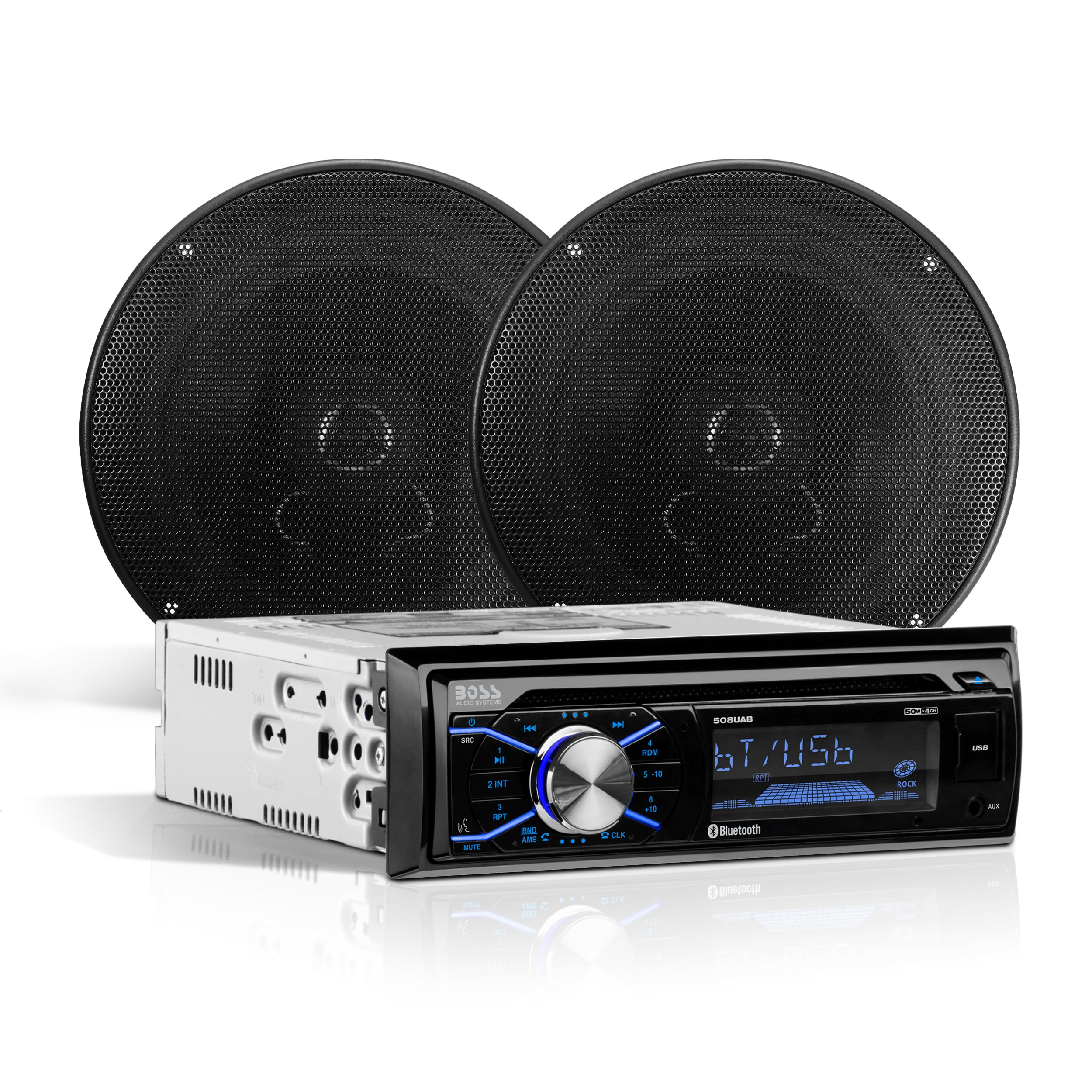
3. BOSS Audio Systems 656BCK Car Stereo Package – Single Din, Bluetooth, CD MP3 USB AM FM Radio
One box with a receiver, CD player, and speakers—perfect for a low-effort audio upgrade.
This is the grab-and-go solution for anyone who just wants better sound than a basic factory system without piecing parts together. The package includes a single-DIN receiver (a standard 2-inch-tall car stereo size that fits most vehicles) with Bluetooth for hands-free calling and music streaming, plus a CD player, a USB port, and an auxiliary input for any audio player. It also comes with a pair of 6.5-inch 2-way speakers rated at 4 ohms with a frequency response from 75 Hz to 18 kHz, covering your midrange and treble needs. The receiver itself weighs just 3.10 lbs. — noticeably lighter than the 6.6-lb. AUDIOZERONE monoblock, so installation is a breeze.
One buyer’s experience highlights the brand’s customer service: they reported the unit was “missing trim plate; BOSS CS sent one next day.” The speakers are the weak link here — several owners say they are mediocre and the mounting holes may require drilling. The receiver is also weatherproofed against splashes, a nice touch if you drive with the windows down. The 50 watts x 4 output is enough for clean background music but will not satisfy a bass head.
It is a fair entry point for a complete system, but plan on upgrading the speakers eventually for real clarity.
One-box convenience: Ideal for a first-time installer or a budget restore of an older car’s audio, with everything needed in one shipment.
The real ceiling: The included speakers and receiver power will not satisfy anyone wanting loud, detailed sound — treat this as a starter, not a forever system.
4. JVC KD-SR87BT Single DIN Car Stereo with CD Player & Bluetooth, 200W Digital Stereo Receiver

A head unit with pro-level tuning tools that lets you shape every frequency band.
This JVC receiver is for the audio nerd who loves dialing in the perfect sound. It packs a 13-band equalizer (letting you boost or cut individual frequency ranges from low bass to high treble) with digital time alignment, which adjusts the timing of each speaker so the sound arrives at your ears at the same moment for a “stage” effect. It also includes K2 technology, a digital processing feature that restores high-frequency detail lost in compressed audio files like MP3s. The receiver plays MP3, WMA, WAV, ACC, and high-resolution FLAC files from a USB drive or your phone via Bluetooth.
Owners mention that sound quality is “excellent from 1/4 to 3/4” volume, though it gets fluttery at max volume and the buttons are quite small. The 2.5-volt preamp outputs (the RCA jacks that send signal to an external amp) are a solid mid-range offering, while the 50-watts-per-channel internal amp is fine for moderate listening. The dual phone connection feature lets you pair two phones at once for calls, handy if you share a car. Owners of older Toyotas report easy installs, with one fitting it in a ’94 Camry with no connectivity issues.
If you plan to add an external amplifier later, the 2-channel preamp outputs (rear/sub at 2.5 volts) support that upgrade path.
What tunes it
- 13-band equalizer and digital time alignment for precise sound shaping.
- Plays high-resolution FLAC files, preserving audio detail from digital libraries.
Where you adapt
- Small buttons can be hard to operate while driving; not ideal for on-the-road adjustments.
- Sound quality dips at the top end of the volume range, per buyer feedback.
Fine-tuning first: Perfect for the listener who wants a powerful equalizer and time alignment in a single-DIN head unit to tune their speaker setup.
skip it if: you need easy, big tactile buttons for quick volume changes while driving — this unit’s controls are small.
5. Taramps TS 1200×4 Amplifier Car Audio 1200W RMS 2 Ohms 4 Channels

A compact 4-channel amplifier that packs 300 watts RMS per channel to each of your speakers.
Taramps has built a reputation for high power density, and the TS 1200×4 is the proof. This 4-channel Class D amplifier delivers 300 watts RMS per channel at 2 ohms, distributing a total of 1200 watts RMS across your front and rear speakers. It measures just 5.43 x 1.89 x 9.84 inches and weighs only 2.73 pounds, making it incredibly easy to mount under a seat or in a tight space. The fixed crossovers offer HPF (high-pass filter for door speakers), LPF (low-pass filter for subwoofers), and full-range modes, so you can bi-amp or run a sub and speakers from the same unit. The recommended 60A circuit breaker or fuse (a safety device that cuts power if there’s an electrical short) keeps your car protected.
Customers note it is a “best seller” and sounds “perfect for small package,” though one reviewer noted theirs only lasted a month before developing a whining noise. The heavy-duty 5 AWG power and 15 AWG output cables are included, which simplifies installation. While the Pioneer GM-A6704 offers a 4-channel Class AB design known for warmth, this Taramps is a 4-channel Class D design known for efficiency and staggering power density — it is louder but runs cooler. At 2.73 lb., it weighs 2.73 lb. versus the AUDIOZERONE monoblock at 6.6 lbs., proving small Class D amps punch well above their size.
This is a serious upgrade for anyone wanting to power component speakers loudly without the bulk of a traditional amplifier.
Power density champion: Pick this if you need massive, clean power for four speakers in a tiny footprint — ideal for builds where space is at a premium.
But be warned: Occasional reliability reports suggest this amp is better suited for experienced users who can diagnose and accept some risk for the power-to-size ratio.
6. Alpine S-A32F, S Series Class D 4 Channel Digital Amplifier, 320 Watts

A compact Class D amplifier built for transparent sound that never distorts at any volume.
Alpine’s S-A32F is the choice for the listener who values sound quality over SPL (sound pressure level — basically, how loud it is). It delivers 55 watts RMS x 4 into 4 ohms, which is modest on paper but punches far above its weight in clarity. The Class D design runs cool and draws only a 40A current, meaning it won’t strain your car’s electrical system like older Class AB amps. Reviewers point out “zero distortion at high volumes” and call it a “night-and-day upgrade” over cheaper units. One buyer mentioned it powers 4 door speakers and 2 sets of tweeters without ever overheating or going into protect mode. Alpine’s reputation in car audio means the build quality and signal-to-noise ratio (98dB at rated power) are class-leading at this price point.
It is noticeably smaller and lighter than the Pioneer GM-A6704, which helps with stealth installations. The fixed crossover points are set to full-range, HPF, or LPF via switches, which is straightforward but less flexible than the continuously variable filters on some competitors. If your goal is a pure, natural sound for daily driving or long road trips, this amplifier rewards that priority with easy detail.
It won’t win a bass competition, but it will make your music sound absolutely beautiful.
What shines through
- Exceptional audio clarity with zero distortion at high volume levels, verified by multiple buyers.
- Compact, cool-running Class D design (40A draw) is gentle on your car’s electrical system.
What it trades
- 55 watts RMS per channel is modest; not for powering loud subwoofers or a loud system.
- Fixed crossover switches offer less tuning flexibility than variable filters on other amps.
For the purist: Get this if pristine sound quality for your main speakers is your top priority — it makes a stock system sound high-end.
Not for bass heads: You will quickly outgrow this amp’s 55 watts if you plan to run subwoofers or want deafening output.
7. Pioneer DMH-130BT 6.8″ Capacitive Touchscreen, Double Din – Bluetooth, Backup Camera, USB, FLAC

A modern double-DIN touchscreen receiver that brings smartphone connectivity and a backup camera to your dash.
This Pioneer receiver modernizes any car with a large 6.8-inch capacitive touchscreen (the same type of responsive glass touch display found on modern smartphones) that lets you swipe and tap through menus easily. It features built-in Bluetooth for hands-free calling and music streaming, plus a USB port that plays FLAC audio files for high-resolution sound. The 50-watt x 4 built-in amplifier drives your factory speakers with enough headroom for clean volume. It also includes a backup camera input — just connect a camera (sold separately) and you get a live view when you shift into reverse. The unit measures 7 inches wide by 3.875 inches tall by 4.375 inches deep, fitting standard double-DIN slots, and weighs only 2.4 pounds.
One owner reported that it “works great to play music off my phone which is what I really wanted,” but warned that the listing doesn’t advertise that it does not play CDs or DVDs. Amazon Alexa integration via a smartphone app is a useful bonus for voice commands. Shoppers say great fitment and easy installs, and the 5 display colors with over 100 illumination options let you match your dashboard’s factory look. The short chassis depth helps in cars with tight space behind the dash.
If you want Apple CarPlay or Android Auto, the more expensive Sony XAV-AX4000 is the upgrade path, but this Pioneer delivers strong value for a pure touchscreen upgrade with backup cam support.
Modernize your dash: Perfect for upgrading an older vehicle with a crisp touchscreen interface, Bluetooth audio, and backup camera support while staying affordable.
Be aware: This unit has no CD/DVD player, so if you still have a physical disc collection, look for a model like the JVC KD-SR87BT that includes a CD player.
8. PRORECK PR-122M 1500W Dual 12″ Car Subwoofer Enclosure Audio with Subwoofer, Mono Block Amplifier and Wiring Kit

A complete bass package with two 12-inch subs and a monoblock amp, ready to shake your car.
If you want the lowest possible bass without hunting for parts, this PRORECK kit bundles everything: a dual 12-inch subwoofer enclosure, a PRORECK PR-1500.1M 1500W monoblock amplifier, and a full wiring installation kit with copper RCA cables, power wires, fuse holder, and all connectors. The enclosure measures 28.7 x 14.2 x 15.7 inches, so measure your trunk space first. The amplifier uses 1.5-inch aluminum 4-layer voice coils and includes bass EQ, a dashboard remote control, and protection circuits against thermal, overload, and speaker short circuits. It is a complete bolt-in solution for deep bass, with one buyer saying “it hits bass like a punch to the face.”
However, the reviews are a mixed bag. One customer observed a subwoofer blowing within 32 days, and another called the system “mediocre” and said it requires heavy tuning to sound decent, recommending spending an extra for better quality. The wiring kit is described as decent but not top-tier. This kit is best approached as an entry-level system for someone who wants to install it and enjoy moderate bass, but it is not built for reliability at high volumes.
For the same budget, you could piece together a single high-quality sub and amp that will outlast this kit, but the convenience of a ready-to-install package is undeniable.
What’s in the box
- Comes with dual 12″ subwoofers, a 1500W monoblock amp, and all wires/cables — nothing else to buy.
- Dashboard remote control for quick bass level adjustments from the driver’s seat.
Where corners are cut
- Inconsistent quality control; several buyers report subwoofers blowing within a month.
- Subwoofer output is underwhelming for a dual 12″ setup, requiring heavy tuning.
Convenience package: Grab this if you want a one-box solution for bass and are willing to accept lower reliability for the low upfront cost.
Better path: If you can stretch your budget and do a little research, a separate single-sub amp kit from Pioneer or AUDIOZERONE will likely last much longer and sound better.
9. Sony XAV-AX4000 7-Inch Multimedia Receiver with Wireless Apple CarPlay/Android Auto and Maestro Ready

The premium head unit that wirelessly mirrors your phone’s apps and navigation, lag-free on a large screen.
For the driver who wants modern smartphone integration without plugging in a cable every time, the Sony XAV-AX4000 is the top-tier choice. Its 6.95-inch capacitive touchscreen is bright, responsive, and visible even in direct sunlight thanks to an anti-glare film. Wireless Apple CarPlay and Android Auto connect automatically and quickly — owners mention it boots in about 10 seconds and the connection is rock-solid. The receiver is Maestro-ready (meaning it can interface with your car’s factory steering wheel controls, gauges, and chimes using an optional iDatalink module) and supports a backup camera for safe reversing. It mounts in a single-DIN space but features a large floating screen, giving a modern aesthetic.
The built-in DSP (Digital Signal Processor) offers 14-band graphic equalization and time alignment down to 1-centimeter precision across 5 addressable channels, which is a professional-level tuning tool for controlling each speaker’s timing and frequency response. This gives you command over 4 speakers plus a subwoofer via the pre-out output. One owner called it a “fantastic upgrade” and noted the sound quality was a huge improvement over a factory stereo. At 2.2 pounds, it is the lightest head unit in this list. The only catch is it lacks a CD/DVD player and a front audio input jack.
If your budget allows, this is the most complete, future-proof media receiver you can install today.
Wireless freedom: Best for anyone who wants smooth Apple CarPlay/Android Auto, excellent sound tuning tools, and a clean interface without wires cluttering the cabin.
The premium hurdle: At a higher investment than the Pioneer DMH-130BT, it is worth it if you rely on phone navigation and music apps daily and want the best visual experience.
Understanding the Specs
RMS Power vs. Max Power
RMS (Root Mean Square) is the continuous power an amplifier can deliver cleanly over time — treat this as the real power rating. Max power is a burst number that the amp can only hit for an instant. When matching an amp to speakers, always compare RMS ratings. For example, the AUDIOZERONE ZE1000.1 is rated at 1000 watts RMS at 1 ohm, and 2000 watts max — the 1000W RMS is the spec that actually drives your subwoofer. A 60W RMS speaker paired with a 75W RMS per channel amp is a great match.
Class AB vs. Class D Amplifiers
Class AB amplifiers, like the Pioneer GM-A6704, offer a warmer, more natural sound with less crossover distortion. They are less efficient, meaning they generate more heat and draw more from your electrical system. Class D amplifiers, like the Alpine S-A32F and the Taramps TS 1200×4, are highly efficient (around 80-90% efficiency), run cool, and are much smaller for the same power output. Class D is the modern standard for power-hungry subwoofer amps and compact multichannel systems.
FAQ
What is the difference between a monoblock and a 4-channel amplifier in a car audio system?
Will a car amplifier work with any car stereo?
How many watts RMS do I need to power a subwoofer?
Can I use a 4-channel amp to run a subwoofer?
What does a high-pass filter (HPF) in a car amplifier do?
Do I need a separate amplifier if I buy a high-power head unit like the Sony XAV-AX4000?
What is the benefit of a Class D amplifier over Class AB for car use?
How do I know if my alternator can handle a new car audio amplifier?
Can I install a car audio amp myself, or do I need a professional?
What is the difference between single DIN and double DIN head units?
Final Thoughts: The Verdict
If you want one dependable pick, the car hifi winner is the Pioneer GM-A6704 4-Channel Amplifier because it balances power, sound clarity, and versatility in one reliable package that can drive your whole system, from door speakers to a small sub. If you want dedicated thunderous bass, grab the AUDIOZERONE ZE1000.1 Monoblock. And for a premium media receiver with wireless phone integration and pro-level DSP tuning, the standout is the Sony XAV-AX4000.
How We Picked
We do not accept paid placement. Every pick is matched to a real buyer and a real use-case; we do not hands-on test units.
Sources & Methodology
Specifications: manufacturer listings and product documentation. Review insights: verified customer reviews, as of July 2026. Pricing: not shown on this page (it changes often); check the current price via the retailer link.
As an Amazon Associate, Gadgets Feed earns from qualifying purchases. This does not affect which products we feature.