
Our readers keep the lights on and my morning glass full of iced black tea. As an Amazon Associate, I earn from qualifying purchases.
Specs are compiled from manufacturer listings and verified buyer reviews and can change over time — please confirm the key details on the product page before buying.
A 24mm prime lens sits right at the balance for a photographer. It is wide enough to capture a whole room or a sweeping landscape, but not so wide that your subjects get distorted at the edges. The real challenge is choosing between a fast F1.4 for low-light work, a compact F2.8 for daily carry, or a value-priced F1.8 that splits the difference, and that is exactly what this guide is built to sort out.
I’m Min — the founder and writer behind Gadgets Feed. This guide is built by comparing the manufacturers’ published specifications and the patterns across verified customer reviews, so you get each pick’s real strengths and trade-offs instead of marketing spin.
24mm prime lens buyers need to weigh aperture speed, autofocus reliability, and build quality against their mirrorless or DSLR system, and this breakdown covers all the leading options across Sony E, Nikon Z, and Canon RF mounts.
Our Picks at a Glance


How To Choose The Best 24mm Prime Lens
Three specs define a 24mm prime: the aperture (how much light it lets in), the mount compatibility (does it fit your camera body), and the build quality (metal vs plastic, weather seals). Here is what each one means for real-world shooting.
Aperture — The Light-Gathering Speed
A lower F-number means a wider opening at the rear of the lens, which lets in more light and creates a blurrier background. F1.4 is ideal for astrophotography and dark indoor events because it pulls in roughly double the light of F2.0. F2.8 lenses are smaller, lighter, and cost less, but you will need to raise the ISO on your camera sooner when light drops.
Autofocus Motor Type
For video work, you want a stepping motor (STM) or a linear motor — these are quiet and smooth, so the camera does not record a clicking or whirring sound. Older ultrasonic motors (USM/HSM) are fast for stills but can be audible during video. If you plan to shoot both, look for “STM” or “linear motor” in the specs.
Image Stabilization
Some 24mm primes include optical image stabilization built into the lens. That helps you hand-hold at slower shutter speeds — the Canon RF24mm F1.8 Macro IS STM, for example, offers up to 5.5 stops of shake correction. If your camera body already has in-body stabilization (IBIS), a non-stabilized lens paired with IBIS may still work well.
Quick Comparison
| Model | Best For | Aperture | Weight | Stabilization | Amazon |
|---|---|---|---|---|---|
| Sony 24mm F1.4 GM★ Best Overall | Pro low-light / astro | F1.4 | 15.68 oz | No (use IBIS) | Amazon |
| Sony 24mm F2.8 GCompact Performer | Compact everyday carry | F2.8 | 162 g | No (use IBIS) | Amazon |
| Sigma 24mm F1.4 DG DN ArtValue Aperture King | High-res full-frame | F1.4 | 0.43 kg | No | Amazon |
| Sigma 24mm F1.4 DG HSM Art | DSLR Sony E adapted | F1.4 | — | No | Amazon |
| Canon RF24mm F1.8 Macro IS STM | Canon RF video/stills | F1.8 | 268 g | Optical (5.5 stops) | Amazon |
| Canon EF 24mm F1.4L II USM | Canon DSLR L-series | F1.4 | — | No | Amazon |
| Nikon NIKKOR Z DX 24mm F1.7 | Nikon APS-C Z cameras | F1.7 | 281 g | No | Amazon |
| VILTROX 24mm F1.8 Nikon Z | Budget Z-mount full-frame | F1.8 | 370 g | No | Amazon |
| Tamron 24mm F2.8 Di III OSD | Budget Sony E-mount | F2.8 | 215 g | No | Amazon |
In‑Depth Reviews
1. Sony E-mount FE 24mm F1.4 GM Full Frame Wide-angle Prime Lens (SEL24F14GM)
Our pick — over 4.5★ from 600+ verified ratings; the strongest balance of quality and price.
The G Master that sets the benchmark for wide-angle sharpness at F1.4.
This lens puts pro-level light gathering in your hands — the F1.4 max aperture gives you extraordinary exposure control, which means you can shoot in dim reception halls or under a star-filled sky without reaching for a tripod. Two XA (extreme aspherical) elements work behind the glass to deliver natural, lifelike high resolution across the frame, and buyers report the autofocus is fast and accurate on bodies like the A7CII and A7R IV.
A key advantage here is the aperture gap: at F1.4, it pulls in more light than an F2.8 lens. Compared to the Sigma 24mm F1.4 DG DN Art, the Sony GM edges ahead on corner-to-corner resolution and build refinement. At 15.68 ounces, it is heavier than the compact Sony 24mm F2.8 G (162g), but that trade-off buys you over a full stop of extra light and dreamy bokeh for portraits. Owners mention the high price stings, but one owner who bought used saved and called it “near-new condition” — a reminder to check the used market for this lens.
For video shooters on the A7R III, the shallow depth of field and creamy bokeh make it an epic video lens. Just know that there is no optical stabilization inside the barrel; you will rely on your camera’s in-body stabilization (IBIS) to smooth handheld footage.
Why it dominates
- Exceptional wide-open resolution and contrast
- Fast, accurate AF with reliable eye-tracking
- Ideal for astrophotography and low-light event work
One compromise
- No in-lens stabilization (relies on IBIS)
Reach for this if: you shoot in low light often and want the absolute sharpest 24mm on Sony E-mount.
Look elsewhere if: you need a featherweight travel lens or you are on a tight budget — this is an investment piece.
2. Sony SEL24F28G – Full-Frame Lens FE 24mm F2.8 G
The everyday carry prime that disappears in your bag without sacrificing image quality.
At just 162 grams, this Sony G-series lens is the lightest full-frame 24mm on this list — it feels like carrying an extra lens cap. Three aspherical elements and one ED (extra-low dispersion) glass element deliver corner-to-corner resolution that rivals heavier glass, while the F2.8, 7-blade circular aperture creates beautiful background defocus for cityscapes and vlogging. The build uses metal (aluminium) for the exterior finish and hood, so the premium feel is there even at this compact size.
Customers note using this as their everyday lens on an A7CR, calling it small, compact, and sharp. Two linear motors drive the autofocus, which is fast, precise, and nearly silent — great for video on a ZV-E1 or A7CII. The trade-off versus the F1.4 GM is obvious: at F2.8 you give up over a full stop of light, so indoor event shooting will push your ISO higher. But the size difference is massive — at 162g it is significantly lighter than the Sigma F1.4 DG DN Art at 0.43 kg (430g), making it the lens you actually want to take on a hike.
One filmmaking reviewer noted this is THE first lens to buy for a compact full-frame setup like the ZV-E1, since it keeps the kit truly pocket-sized while still delivering pro-grade optics.
Why it travels
- Ultra-light 162g metal construction
- Fast silent AF with two linear motors
- Beautiful bokeh from 7-blade circular aperture
The speed compromise
- F2.8 limits low-light performance vs F1.4 primes
Best for: photographers who want one compact walk-around lens for day trips, street photography, and vlogging.
skip it if: you regularly shoot indoors without flash or need astro-level light gathering.
3. Sigma 24mm F1.4 DG DN Art for Sony E Mount
GM-class sharpness at F1.4 for a price that undercuts the flagship by hundreds.
The Sigma DG DN Art is built to compete directly with the Sony GM — at F1.4 it delivers fast and extremely clear images that reviewers point out “compete heavily with the GM version.” The optical formula uses a Super Multi-Layer Coating to cut flare and ghosting, while the internal focus design keeps the barrel length constant during AF. It is a go-to lens for events and weddings because the wide aperture handles dim dance floors without a flash.
One reviewer praised the bokeh, sharpness, and focusing accuracy, saying they’d thought about getting a 24mm F1.4 for years and finally went for it. The catch is weight: at 0.43 kg (roughly 15.2 oz), it is similar to the Sony GM but built with a different balance. The exterior uses metal and the included petal-type hood (LH782-01) is solid. Autofocus is powered by a stepping motor that is quiet enough for video, though dedicated video shooters may still prefer the Sony GM’s linear motor for tracking fast-moving subjects.
Compared to the older Sigma 24mm F1.4 DG HSM Art for Sony E (which is a DSLR-era design adapted for mirrorless), the DG DN is native mirrorless optics — smaller, faster AF, and better corrected for field curvature.
What you gain
- Excellent F1.4 sharpness rivaling the GM
- Super Multi-Layer Coating reduces flare
- Solid metal build with included hood and case
Minor trade-off
- No optical stabilization; heavier than compact F2.8 options
Ideal for: Sony full-frame shooters who want pro-grade F1.4 performance without paying the GM premium.
Consider the GM first if: you need the absolute best corner sharpness and smoother AF for fast action.
4. Canon RF24mm F1.8 Macro IS STM Lens

Canon’s affordable RF prime that pulls double duty — wide-angle and macro.
This lens stands out from every other 24mm on the list because it packs optical image stabilization (up to 5.5 stops of shake correction) and a 0.5x macro magnification ratio into a single barrel. That means you can hand-hold this lens in dimmer conditions than any non-stabilized prime, and you can get as close as 5.5 inches from your subject for detailed close-ups. The F1.8 aperture is a stop faster than F2.8 but not as extreme as F1.4 — a practical middle ground for low-light shooting without the bulk of a bigger optic.
Shoppers say using it on a Canon R7 for motorsports, car shows, portraits, and even astrophotography, calling it a solid lens for the price. The STM (stepping motor) autofocus is quiet and smooth, which makes it ideal for gimbal video work — one reviewer noted it paired perfectly with a DJI RS3 Mini on any RF-mount body. At 268 grams, it is lighter than the Sigma F1.4 primes but heavier than the Sony F2.8 G, yet it offers stabilization that neither of those provide.
The only catch is that the autofocus can produce a faint clicking noise during video in very quiet environments, though most users say it does not ruin recordings. If you are invested in Canon’s EOS R system, this is the RF-native 24mm that covers the most ground per dollar.
Why it is versatile
- Built-in optical stabilization (5.5 stops)
- 0.5x macro close-up capability at 5.5 inches
- Smooth STM autofocus suitable for video
A couple limits
- Motor can produce faint noise in silent video scenarios
- No lens case included despite the price
Grab it for: Canon R-series shooters wanting a single lens that handles wide-angle, macro, and stabilized video.
Pass if: you need the absolute fastest aperture (F1.4) for astro — get the EF 24mm F1.4L II with an adapter instead.
5. Canon EF 24mm f/1.4L II USM Wide Angle Lens

Canon’s pro-grade F1.4 prime that remains a benchmark for DSLR shooters.
This L-series (Luxury) lens uses Canon’s professional build standard — a durable metal barrel, rubber gasket at the mount for dust and moisture resistance, and a 24mm focal length on full-frame that closely mirrors the human eye’s natural perspective. At F1.4, images are superbly sharp even wide open, with color saturation and distortion control that beat zoom lenses like the 16-35mm II. The minimum focus distance is 0.8 feet, letting you get relatively close to your subject for a wide-angle prime.
One experienced photographer who has “used pretty much every Canon L Lens” ranked this 24mm F1.4L II as their favorite lens aside from the 200mm F2.0, noting it is sharper than their 50mm F1.2 and 70-200mm F2.8 even at wide open. That is high praise for a lens launched years ago. The catch is that this is a DSLR EF-mount lens — you will need an adapter (Canon EF-EOS R) to use it on mirrorless R-series bodies. On a DSLR like the 5D Mark III, autofocus via the USM (Ultrasonic Motor) is fast and decisive.
Compared to the RF24mm F1.8 Macro IS STM, this L-series lens gives you one extra stop of light (F1.4 vs F1.8) but loses the built-in stabilization and macro capability. For pure image quality on Canon full-frame cameras, it is still a top-tier pick.
The enduring strengths
- L-series weather-sealed build
- Outstanding sharpness even at F1.4
- Fast, reliable USM autofocus
Modern trade-offs
- No optical stabilization
- DSLR mount requires adapter for mirrorless
Best for: Canon DSLR shooters (5D, 6D, 7D series) who want a pro F1.4 prime.
pass on it if: you are on mirrorless RF — the native RF24mm F1.8 IS STM is smaller, stabilized, and cheaper.
6. Nikon NIKKOR Z DX 24mm f/1.7
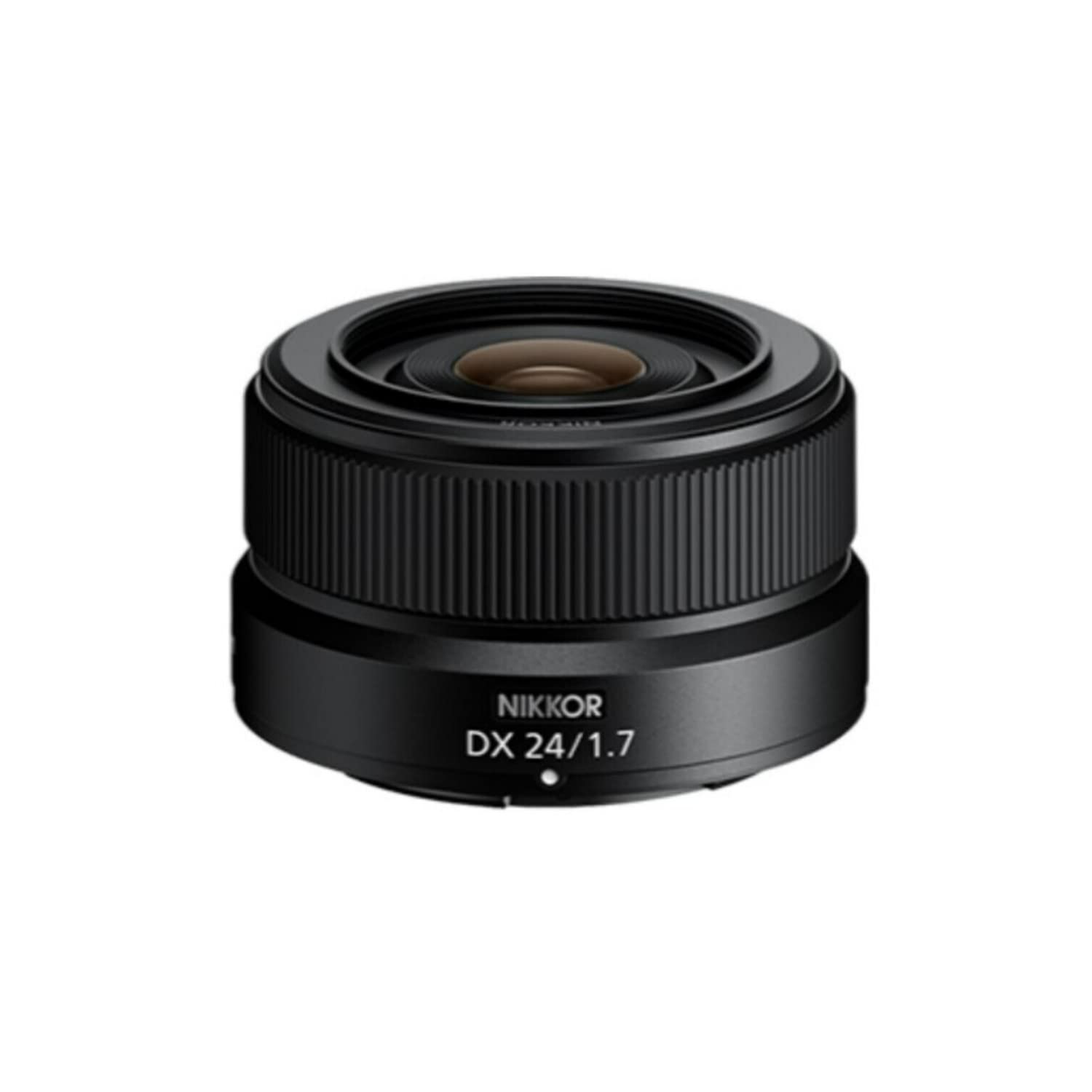
Nikon’s fast aperture for APS-C Z cameras — a 35mm full-frame equivalent.
This lens is designed specifically for Nikon’s APS-C (DX-format) Z-mount mirrorless cameras like the Z50 and Z30. On those bodies, the 24mm focal length captures nearly the same field of view as a 35mm full-frame lens — a classic walk-around perspective. The F1.7 aperture is extra-large for a DX prime, giving you shallow depth of field and better low-light performance than typical kit zooms. The autofocus is tune for video, meaning you won’t hear mechanical noises or focus breathing during recordings.
Buyers report it is “very sharp overall” with “slight corner softness/vignette wide open” that cleans up as you stop down. At 281 grams, it is heavier than the Tamron 24mm F2.8 Di III (215g) for Sony E, but it offers a wider aperture (F1.7 vs F2.8). The lens barrel is plastic but well-made, and the hood is included. One reviewer summed it up as “the best APSC Z lens” and pairs it with the 40mm F2 for a compact two-lens travel kit. The catch: no image stabilization is built in, and the plastic lens mount is a downgrade from the metal rings on higher-end Nikons.
For Nikon DX shooters who want a fast, lightweight prime for family gatherings and general photography, this is the best native option available.
Why it fits DX
- Fast F1.7 aperture for shallow depth of field
- Video-tune AF with no focus breathing
- Dust and drip-resistant sealing
The compromises
- Plastic lens mount; no stabilization
- Corner softness at maximum aperture
Ideal for: Nikon Z50, Z30, and Zfc owners wanting a fast, compact wide-angle prime.
Look elsewhere if: you shoot on full-frame Nikon Z — get the 24mm F1.8 S-line instead.
7. Tamron 24mm F/2.8 Di III OSD M1:2 Lens for Sony E-Mount

An absurdly small and cheap prime that still delivers sharp images and macro-like close-ups.
The Tamron 24mm F2.8 Di III is only 2.5 inches long and weighs just 215 grams (7.6 oz), making it among the most compact full-frame lenses for Sony E-mount. It also offers a 1:2 maximum magnification ratio, meaning you can fill the frame with a subject that is only about twice the size of the lens’s sensor — great for detail shots of food, flowers, or product textures. The minimum object distance is just 4.7 inches from the front of the lens, so you can shoot very close without stepping back.
A wedding photographer bought this as a wide option and reported it “performs beyond what I expected from a lens.” Image sharpness, color, and contrast are surprisingly good for the price point, and distortion is minimal when shooting leveled. The trade-off is the autofocus: owners mention the OSD motor is noisy and sometimes hunts, and the lens mount requires firm pressure to attach to A7-series bodies. This is not the lens for fast action or quiet video, but for landscapes, everyday moments, and controlled stills, the value is class-leading.
Compared to the Sony 24mm F2.8 G (162g, F2.8), the Tamron is slightly heavier and uses a slower, noisier AF motor, but it costs significantly less and adds the 1:2 macro capability that the Sony G does not have.
Where it shines
- Very compact and light for travel
- 1:2 macro ratio for close-up detail
- Sharp images with excellent color and contrast
The downsides
- AF is noisy and can struggle in low light
- Lens mount feels tight and poorly fitted
Grab it for: budget-conscious Sony shooters who want a lightweight prime with macro ability.
it’s not for you if: you need reliable autofocus for video or fast-moving subjects.
8. VILTROX 24mm F1.8 Wide Angle Lens for Nikon Z-Mount

Full-frame F1.8 with metal build and a USB port for firmware updates — at a sharp price.
VILTROX offers an F1.8 wide-angle prime for Nikon Z-mount full-frame and APS-C bodies, using an internal focus design with two aspheric lenses, three ED (extra-low dispersion) lenses, and three high-refractive-index elements. The optical formula is designed to correct coma aberration (which matters for astrophotography), and the F1.8 aperture ensures sufficient light intake in low-light scenarios. A unique feature is the TYPE-C upgrade interface on the lens itself — plug it in to update firmware, making the lens stronger over time.
Customers note it produces “beautiful image and fast focus” and that for the price and sharpness, it “simply can’t be beat.” The manual aperture ring (with an Auto/Manual switch) is handy for video work, though one buyer mentioned the ring can be bumped accidentally during shooting. At 370 grams, it is noticeably heavier than the compact F2.8 options but still lighter than pro F1.4 lenses. The autofocus uses an STM + lead screw stepping motor, which is quiet for video, but the AF struggles to keep up with fast-moving subjects like dogs playing — this is a lens for portraits and static scenes.
Compared to the Nikon NIKKOR Z DX 24mm F1.7 (which is APS-C only), the VILTROX covers full-frame sensors and costs more, but it gives you a true 24mm field of view on both FX and DX bodies.
Why it is a good buy
- Fast F1.8 aperture suitable for low light and astro
- Metal construction with manual aperture ring
- Firmware upgradable via USB-C
Areas to note
- AF is not the fastest for action or pets
- Lens hood can scratch the focus ring when stored reversed
Best for: Nikon Z full-frame owners on a budget who want an F1.8 prime for portraits, landscapes, and video.
Not for: sports or wildlife shooters who need fast, reliable tracking autofocus.
9. Sigma 24mm F/1.4 DG HSM Art Lens for Sony E (401965)

An older Art-series design that is still optically excellent but built like a tank.
This is the DSLR-era version of Sigma’s 24mm F1.4 Art lens, adapted for Sony E-mount. It uses FLD, SLD, and aspherical lens elements with a Super Multi-Layer coating to reduce flare and ghosting, and the angle of view is 84.1 degrees on full-frame. The optical quality is strong — one reviewer called it “one of my favorite lenses,” noting it holds up against Sony G Masters in the same kit. At F1.4, the bokeh is smooth, and sharpness is impressive across the frame for a lens that predates the native mirrorless designs.
The catch is size and weight: multiple reviewers point out the lens is very heavy (around 1.5 lbs) and causes wrist strain on smaller bodies like the A7RII. It also requires a camera with decent autofocus power — one user found their A7II struggled with video AF but the lens worked great after upgrading to an A7RIII. This is not a lens for compact carry; it is a studio or event lens where weight is less of a concern.
Compared to the newer Sigma 24mm F1.4 DG DN Art for Sony E (Product 3), the DG HSM is heavier, uses an older autofocus system, and is a carry-over from Sigma’s DSLR lens lineup. If you already own this lens, the image quality still delivers; if you are buying new, the DG DN is the better choice for size and native mirrorless performance.
The optical strengths
- Sharp with great bokeh at F1.4
- Solid build quality with included case and hood
- Good value for the image quality per dollar
The physical drawbacks
- Very heavy (about 1.5 lbs) — causes fatigue on small bodies
- AF system needs a powerful camera body for video
Reach for this if: you find a good used deal and shoot on an A7RIII or higher where the weight is manageable.
Get the newer DG DN instead if: you want native mirrorless design, lighter weight, and smoother autofocus.
Understanding the Specs
Aperture (F-Stop)
The F-number tells you how wide the lens opens — the smaller the number, the more light hits the sensor. F1.4 is roughly two full stops brighter than F2.8, which means you can shoot in darker conditions without raising the ISO. A wider aperture also creates a shallower depth of field, blurring the background behind your subject. This matters for astrophotography (capturing stars without trailing) and indoor events where flash is not allowed.
Lens Weight and Build
Weight determines whether you leave the lens at home or carry it all day. A 162g lens (like the Sony 24mm F2.8 G) disappears in a jacket pocket, while a 0.43kg lens (like the Sigma 24mm F1.4 DG DN) is a noticeable load on a camera strap. Metal barrels and weather seals add durability but also grams. If you hike or travel, prioritize lighter weight and accept a smaller aperture. If you shoot in rain or dust, look for dust/drip-resistant sealing like the Nikon DX lens offers.
FAQ
Will a 24mm prime lens work on an APS-C or crop-sensor camera?
What is the difference between F1.4 and F2.8 on a 24mm prime?
Can I use a Sony E-mount 24mm lens on a Nikon Z camera?
Which 24mm prime is best for video recording?
Does a 24mm prime need image stabilization?
Is a 24mm lens good for astrophotography?
How much distortion should I expect from a 24mm prime?
What does “macro” mean on a 24mm prime like the Canon RF24mm F1.8?
Should I buy a vintage or used 24mm prime to save money?
Final Thoughts: The Verdict
For most buyers, the 24mm prime lens winner is the Sony FE 24mm F1.4 GM because its combination of F1.4 brightness, razor-sharp optics, and reliable autofocus makes it the most versatile high-end choice. If you want a compact everyday lens that you will actually take everywhere, grab the Sony 24mm F2.8 G. And for the best aperture-to-price ratio on Canon RF, the standout is the Canon RF24mm F1.8 Macro IS STM for its unique built-in stabilization and close-focus ability.
How We Picked
We do not accept paid placement. Every pick is matched to a real buyer and a real use-case; we do not hands-on test units.
Sources & Methodology
Specifications: manufacturer listings and product documentation. Review insights: verified customer reviews, as of July 2026. Pricing: not shown on this page (it changes often); check the current price via the retailer link.
As an Amazon Associate, Gadgets Feed earns from qualifying purchases. This does not affect which products we feature.