
Our readers keep the lights on and my morning glass full of iced black tea. As an Amazon Associate, I earn from qualifying purchases.
Specs are compiled from manufacturer listings and verified buyer reviews and can change over time — please confirm the key details on the product page before buying.
The biggest mistake parents make when buying a battery operated motorcycle is picking one that is either too fast for a beginner or too slow for a kid who is ready to rip. Speed, battery range, and how long the thing actually lasts on a charge matter more than looks. This guide breaks down seven real options — from a 6V cruiser for a toddler to a 36V machine that hits 16 mph — so you match the bike to your child’s skill level, not the marketing photos.
I’m Min — the founder and writer behind Gadgets Feed. This guide is built by comparing the manufacturers’ published specifications and the patterns across verified customer reviews, so you get each pick’s real strengths and trade-offs instead of marketing spin.
Here is what you need to know before buying the battery operated motorcycle that actually fits your kid: the voltage and speed setting options determine how long the fun lasts and how safe it feels for a new rider, and the battery capacity decides whether you are charging every 45 minutes or getting a full afternoon of play.
Our Picks at a Glance

How To Choose The Best Battery Operated Motorcycle
Every battery operated motorcycle is a trade-off between voltage, speed, and how long the battery lasts. A 6V bike is slow and safe for a three-year-old but will bore a five-year-old in a week. A 36V bike with a 16 mph top speed is thrilling for an eight-year-old but dangerous for a four-year-old. Here are the three specs that matter most.
Voltage and Speed — The Real Safety Knob
The voltage of the battery (6V, 12V, 24V, or 36V) directly controls the top speed of the bike. A 6V model like the Lil’ Rider police motorcycle tops out at 1.75 mph — perfect for a toddler learning to steer on a flat driveway. A 12V bike typically runs between 3 mph and 5 mph, which suits ages three to five. Once you go to 24V and 36V, you are looking at speeds of 8 to 16 mph, and those belong in the hands of kids ages eight and up who have already mastered balance and throttle control.
Battery Capacity and Real Playtime
Battery capacity is measured in amp-hours (Ah) and volts (V), but the most useful number is the manufacturer’s stated battery life in minutes or miles. The Aosom 12V bike claims 45 minutes of run time on a full charge. The 24V Okay Run bike claims up to 60 minutes with a 10Ah lead-acid battery. The ECOLEAP K1 uses a 36V 5.2Ah lithium battery and promises a range of up to 14 miles. If your kid wants to ride every day after school, a longer range and a faster recharge time (lithium charges in 5-6 hours, lead-acid takes 8-12 hours) make a huge difference.
Weight Limit and Build Quality
The weight limit tells you how long the bike will physically fit your growing child. A 55 lb limit is typical for 6V and 12V models aimed at ages three to six. The Licensed BMW HP4 holds up to 66 lbs. The ECOLEAP K1 goes up to 176 lbs, which means a tall seven-year-old or even a smaller adult can ride it without breaking the frame. Check the material — PP (polypropylene) and carbon steel frames are lighter and more durable than basic plastic, and metal frames handle rough kids better over time.
Quick Comparison
| Model | Best For | Voltage / Speed | Battery Life | Weight Limit | Amazon |
|---|---|---|---|---|---|
| Lil’ Rider 3-Wheel Police Motorcycle★ Best Overall | First-time riders ages 3-6 at an entry-level price | 6V / up to 1.75 mph | — | 55 lbs | Amazon |
| K1 Kids Electric Dirt Bike 36VTop Performer | Older kids who need real speed & range | 36V / up to 16 mph (3 speeds) | Up to 14 miles (60-120 min depending on mode) | 176 lbs | Amazon |
| AIII Electric Dirt Bike | Young thrill-seekers ages 3-7 | — / up to 8 mph (2 speeds) | Up to 35 minutes | — | Amazon |
| 24V Kids Motorcycle (Okay Run) | Ages 8-12 who want a full-size look | 24V / up to 14.3 mph (3 speeds) | Up to 60 minutes | — | Amazon |
| Costzon Kids Ride On Motorcycle | Confident 3+ year olds wanting features | 12V / up to 4 mph forward, 2 mph reverse | — | — | Amazon |
| Licensed BMW Kids Motorcycle | Young brand-lovers who want a premium look | 12V / — | — | 66 lbs | Amazon |
| Aosom 12V Kids Motorcycle | Beginners needing training wheels and a soft start | 12V / 1.86-5 mph (2 speeds) | Up to 45 minutes | — | Amazon |
In-Depth Reviews
1. Kids Motorcycle – 3-Wheel Ride on Toy with Police Decals
Our pick — over 4★ from 900+ verified ratings; the strongest balance of quality and price.
The slow-stepping 6V police cruiser that a 3-year-old can handle on day one
The Lil’ Rider police motorcycle is the entry point to battery operated motorcycles — a 6V, 1.75 mph machine built for the absolute beginner who has never steered anything before. The 3-wheel design is inherently stable, so there is no leaning or balancing required. The 55 lb weight limit and 31″L x 17″W x 21″H dimensions make it compact enough for indoor riding on hard, flat surfaces, which is a real advantage for rainy days. The included police decals, working headlights, and engine sound effects give it a fun, imaginative element that the data shows kids love — several 5-star reviews mention a child who “absolutely loves it.”
One buyer mentioned their grandson “has been riding it for 3 days on a single charge,” which aligns with the low power draw of a 6V system. Other reviewers point out it is “perfect size for a 3-year-old” and “just the right speed for his age.” The forward and reverse functions and behind-the-seat storage are nice bonuses at this price level. The plastic and carbon steel frame is phthalate-free, adding a safety layer for young children who might put their mouth on the handlebars.
The comparison data shows this 6V bike is far slower and smaller than the 12V Aosom — 1.75 mph vs 5 mph top speed, and 31 inches long vs 42 inches long. That means a child who is tall for their age or already comfortable on a balance bike will outgrow the Lil’ Rider quickly, possibly within a few months. Assembly is required, and one owner reported that the motor on their unit stopped working after a week (Amazon replaced it). For a 2-to-3-year-old who is just learning cause and effect, this is a safe, affordable introduction to electric ride-ons.
Why it is a great starter
- 1.75 mph top speed is slow enough that a toddler cannot hurt themselves on a hard floor
- 3-wheel design means zero balance required — just sit and press the pedal
- Lightweight at 16.8 lbs, making it easy for a parent to carry to the park or store in a closet
Where it runs out of room
- At 31 inches long versus the Aosom at 42 inches, a tall 4-year-old will look cramped quickly
- 6V battery means it will not have the power for grass or any incline — strictly for smooth, flat surfaces
- Reported motor failures in a small number of units means keep your receipt handy for warranty claims
Reach for this if: you need a slow, stable, affordable first electric motorcycle for a 2-or-3-year-old who is still wobbly on their feet. The police decals and sound effects make it a fun imaginative toy.
Move up if: your child is already 4 or older, or if they have any experience on a balance bike — the 1.75 mph speed will feel too slow within a week.
2. K1 Kids Electric Dirt Bike 36V Motorcycle
The 36V rocket that gives older kids a real dirt-bike experience without the gas
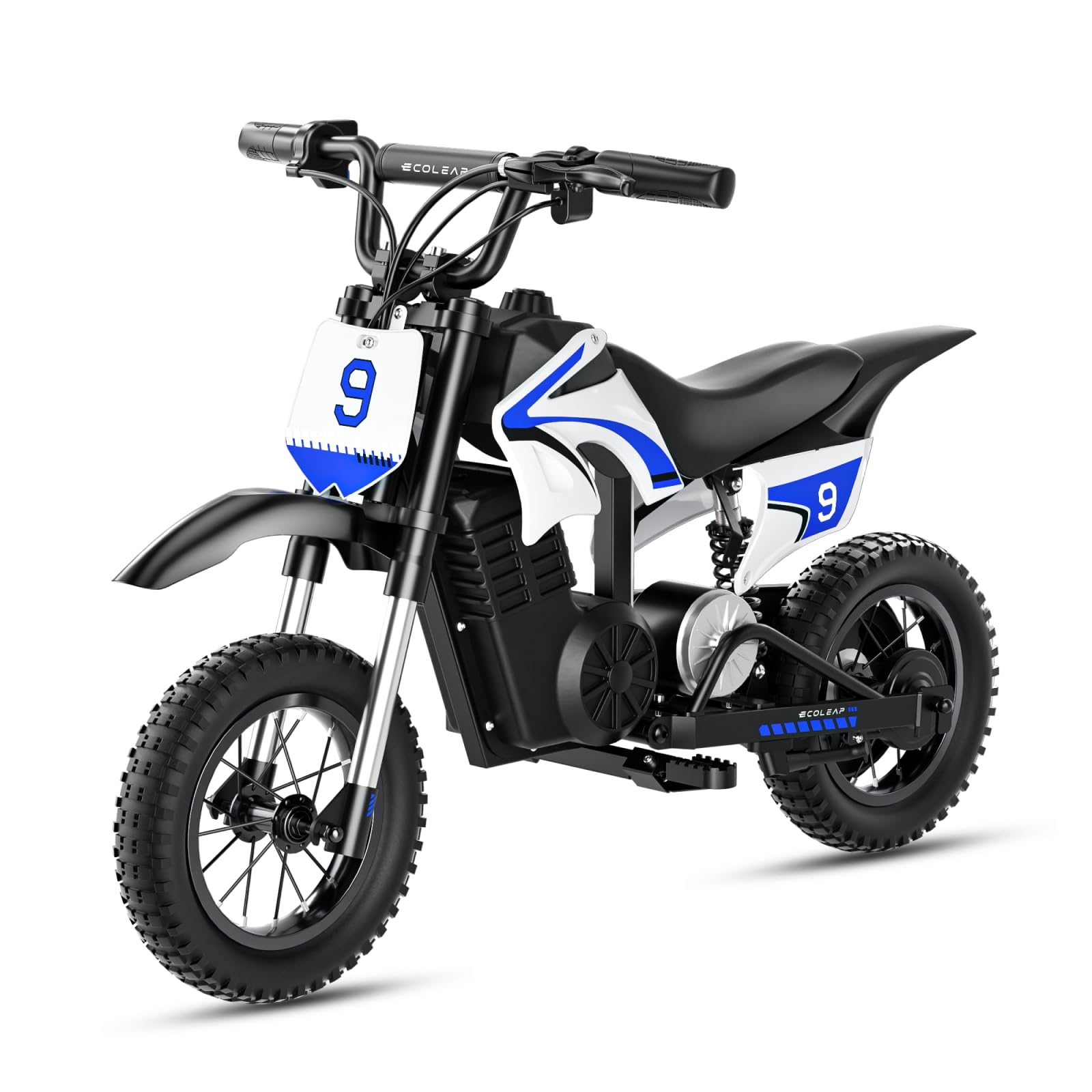
If your kid has outgrown the slow 12V phase and wants something that actually feels like riding a motorcycle, this is the pick. The 36V 5.2Ah lithium battery delivers a range of up to 14 miles, which is more than double what most kids’ electric bikes offer. Three speed modes let you dial it in — low at 6 mph gives a beginner 120 minutes of play, medium at 9 mph runs for 90 minutes, and high at 16 mph lasts 60 minutes. That three-way choice means a single bike can grow with your child from age 3 all the way up to age 10.
The build backs up the speed. An IP54 waterproof rating means rain and mud are not an instant problem. The inverted spring hydraulic front fork and high-strength rear shock absorber soak up bumps on trails, and the 12-inch explosion-proof anti-skid tires grip well on mountain roads, sandy roads, or pavement. At 36 pounds, it is light enough for a kid to maneuver but sturdy enough to support a maximum rider weight of 176 lbs. Buyers report the battery life is good and that it is a solid starter dirt bike — one owner noted the top speed is around 15 mph for a child, and the seller sent a free replacement kickstand in two days when the original arrived damaged.
The only real trade-off is the size. For a tall 7-year-old, the bike fits well, but a 10-year-old near the top of the age range may find it a little small. Assembly is described as a breeze by multiple reviewers, and the 3-speed control is intuitive enough for a kid to learn in one session. If you have a child who is serious about riding, this machine leaves the 12V bikes in the dust.
Why it wins
- 14-mile range from a 36V lithium battery — far more than any 12V or 24V bike here
- 3 speed modes (6 / 9 / 16 mph) let you match speed to skill level, so a single bike lasts years
- IP54 waterproof body and full suspension make it a real off-road machine, not a driveway toy
The catch
- At 36 lbs it is lighter than most, but the physical size may feel compact for a tall 10-year-old
- No training wheels — your kid needs to already have basic balance
- Charging takes 5-6 hours, so plan rides around the charge cycle
Reach for this if: your child is between ages 4 and 9, has some riding confidence, and you want a bike they will not outgrow in a single season. The 14-mile range and three speed options make it the most versatile battery operated motorcycle here.
Look elsewhere if: your kid is still wobbly and needs training wheels, or if you are buying for a 3-year-old beginner who needs a 1.75 mph crawl.
3. AIII Electric Dirt Bike for Kids 3-7

A true mini dirt bike built for the 3-to-7 crowd who want to rip around the yard
The AIII ditches the plastic body panels and training wheels of the typical kids’ ride-on and gives you a proper steel-frame dirt bike with 12-inch off-road tires and a rear disc brake. The mid-mounted 150W motor delivers enough torque that one buyer called it a “torque monster” that maintains speed up steep hills. Two speed settings — 3.72 mph for a beginner and 8 mph for when they are ready — let you introduce speed gradually without buying a second bike. The battery is a 62.4Wh lithium pack that gives up to 35 minutes of ride time and recharges in about 156 minutes.
The frame is lightweight high-strength carbon steel with aluminum alloy handlebars, and the front uses an iron fork with a rear coil spring suspension to absorb bumps. Unlike the 6V or 12V plastic bikes that feel like toys, the AIII looks and rides like a scaled-down real motorcycle. One reviewer noted that it is “better built than Razor, but not Honda/Kawasaki quality” — and that is a fair read. The chain can arrive too tight and the brake may be off-center, so you need a bit of mechanical willingness to tune it after assembly. Another reviewer pointed out that the instructions are terrible, so basic assembly knowledge helps.
For a 3-year-old, the 3.72 mph low speed is a safe introduction. For a 5-to-7-year-old who has already been on a balance bike or a 12V ride-on, the 8 mph mode feels fast enough to be genuinely fun. The lack of training wheels means it is strictly for kids who can already balance on two wheels. If that describes your child, this is the most capable small electric dirt bike in this list.
The real trade-off: the 35-minute battery life is short compared to the K1’s 14-mile range, and the lithium pack takes 156 minutes to recharge. Plan for multiple short sessions, not one long afternoon.
Who it fits: the kid who already rides a pedal bike without training wheels and wants to graduate to electric power. The rear disc brake and full suspension make it a much more serious machine than a typical 12V toy.
Who should skip it: absolute beginners who still need training wheels, or parents who do not want to tweak a chain tension or brake alignment from the start.
4. Licensed BMW Kids Motorcycle – 12V Electric Ride on Toy
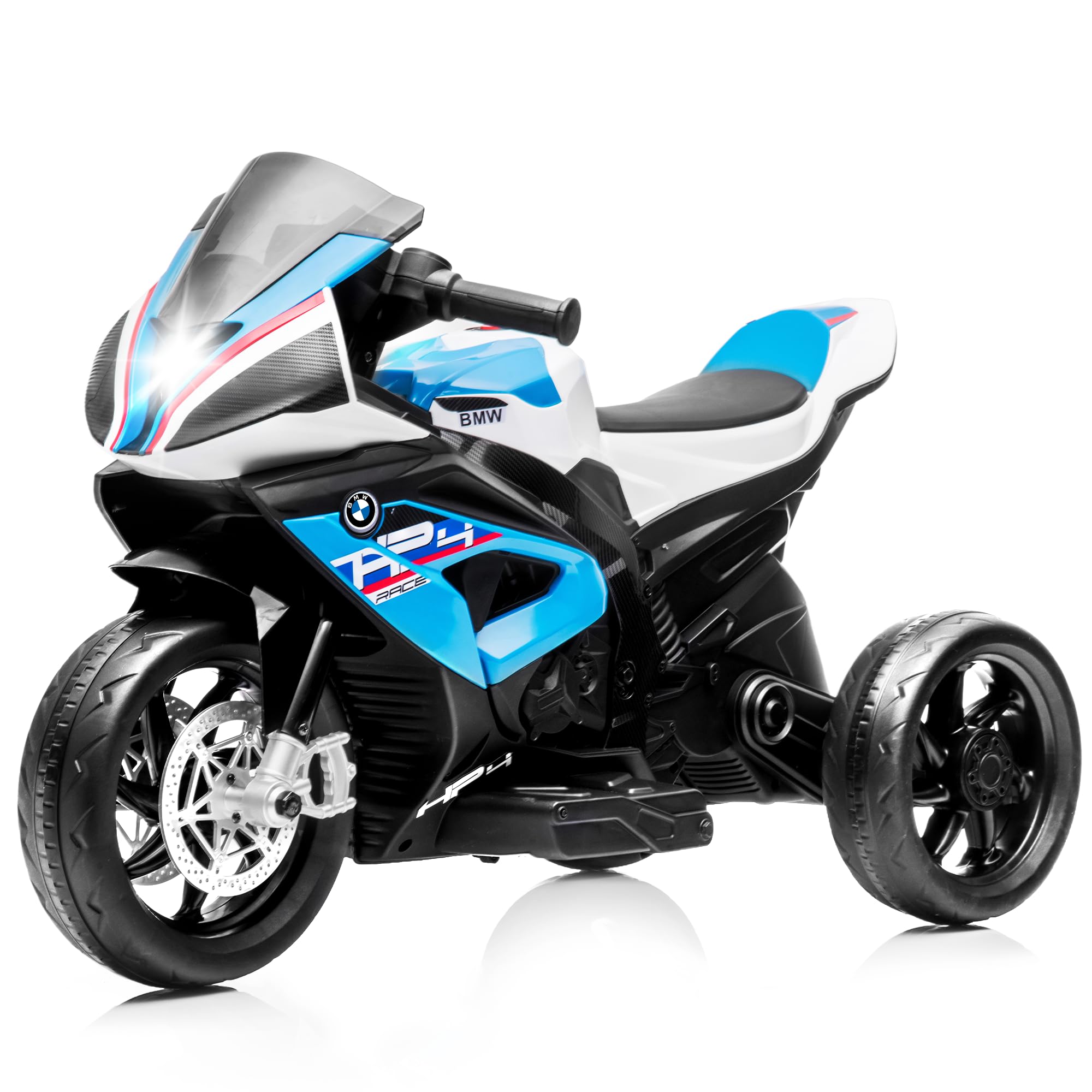
The officially licensed HP4 that looks like a real bike and holds kids up to 66 lbs
This is the pick for the parent whose child cares deeply about branding — the BMW HP4 design is genuine and detailed, from the sporty body lines to the one-button start and responsive foot pedal. That means a taller or heavier 5-year-old can ride it longer before outgrowing it. The 32.5″L x 16.5″W x 21.5″H dimensions make it compact enough for indoor use but still substantial enough for outdoor pavement.
Built-in horn, music, and storytelling functions keep the ride entertaining, and a USB/MP3 slot lets kids connect their own device. The non-slip, wear-resistant wheels handle hardwood floors, grass, rubberized tracks, and asphalt according to the data. One buyer mentioned the “outstanding battery life, realistic look” made it a hit with a 2-year-old who flipped it twice without getting hurt — which tells you the stability is decent for a 3-wheel design. Other buyers call it a “stunning HP4 replica” with “premium build” that assembled in about 10 minutes and arrived with a pre-charged battery ready to go.
Where it falls short of something like the Aosom is speed — the BMW does not list a specific top speed in the data, and there is no adjustable speed mode, so what you get is fixed. It also lacks training wheels, though the three-wheel layout is inherently stable. For a kid who wants to look cool riding a “real” motorcycle around the neighborhood and values the brand over raw performance, this is a strong choice.
What stands out
- Genuine BMW HP4 license — the most realistic-looking bike for brand-conscious kids
- 66 lb weight limit beats most 12V bikes in this list
- USB/MP3 input lets kids play their own music through the speakers
What you lose
- No variable speed adjustment — the speed is fixed, so it cannot grow with a fast learner
- No training wheels at all, though the 3-wheel base provides inherent stability
- Smaller dimensions (32.5 inches long) than the Aosom (42 inches) mean a shorter ride
Best for: the 3-to-5-year-old who is obsessed with BMWs and whose parent wants a certified safe, officially licensed toy with a higher weight capacity than the entry-level options.
Not the one if: you want adjustable speed or a long-range battery for extended off-road play.
5. Costzon Kids Ride On Motorcycle, 12V Electric Bike

The Bluetooth-streaming 12V that lets kids pick their own soundtrack
The Costzon stands out in the 12V category because it packs a Bluetooth connection and an AUX input so kids can stream their own songs through the built-in speakers. The data shows a forward speed of up to 4 mph and a reverse speed of 2 mph, which is a balanced range for a 3-year-old who is still learning. The 2 included training wheels keep it stable while kids build confidence, and the 45.5″L x 19.5″W x 30″H size is the longest of the 12V bikes reviewed here, giving a more stretched-out, realistic riding position. The battery is a 12V rechargeable unit that takes 8-12 hours to charge.
Owners mention the battery life as fantastic — one grandmother even drove it with her 2-year-old grandson on her lap, saying the bike handled a combined weight of about 160 lbs without breaking. Another parent noted their 4-year-old grandson “thinks he is hot stuff driving through the neighborhood with the Bluetooth music going.” The bright LED headlights add a functional safety layer for dusk riding, and the anti-skid pattern tires grip wood floors, rubber tracks, and asphalt. The PP material and metal frame feel sturdy, and multiple reviews mention the bike survives falls without damage.
The main drawback is that the 4 mph forward speed is slower than the Aosom’s 5 mph top end, so a child who has been riding for a year may find it underwhelming. Also, the 33.5 lb weight is the heaviest among the 12V options, so carrying it from the garage to the driveway is a two-person job. For a first bike for a 3 or 4-year-old who loves music and needs the stability of training wheels, the Costzon delivers more entertainment features than almost any other 12V bike here.
Standout spec: Bluetooth music streaming — a rare feature at 12V that kids genuinely love. One owner reported their grandson dances while riding.
The one catch: at 33.5 lbs, it is noticeably heavier than the Aosom (22 lbs) and the Lil’ Rider (16.8 lbs), so moving it around takes adult muscle.
Reach for this if: your child is 3-4 years old, still needs training wheels, and will get a kick from picking their own playlist on the go. The Bluetooth feature makes this feel more like a gadget than a toy.
skip it if: you want the highest possible speed for a confident 5-year-old who already rides well — the Aosom or the AIII will keep them challenged longer.
6. Aosom 12V Kids Motorcycle w/Treaded Tires

The 12V with a soft start and training wheels that makes first rides less terrifying
The Aosom is the most beginner-friendly 12V bike in this list because of two features: soft-start acceleration and detachable training wheels. Soft-start means the bike does not lurch forward when your kid stomps on the pedal — it accelerates smoothly, which builds confidence and prevents tip-overs. The 12V battery powers dual motors that last up to 45 minutes on a full charge, and the adjustable speed has two settings: a low of 1.86 mph for a nervous beginner and a high of up to 5 mph for a child who is ready to go. That 5 mph top speed is nearly 3 times the 1.75 mph of the 6V Lil’ Rider police bike, as shown in the comparison data.
The large treaded tires with front and rear suspension give a much smoother ride on asphalt and brick roads than a typical flat-tire ride-on. At 42″L x 20.25″W x 26.75″H, it is also longer and wider than the Lil’ Rider (31″L x 17″W x 21″H), so it fits bigger kids more comfortably. One customer observed the “battery lasted longer than expected,” and another said their small 3-year-old nephew who is obsessed with dirt bikes “was a huge hit” because the high/low speed kept it from being too fast. The training wheels are detachable, so when your child gains balance, you can remove them and turn the bike into a true two-wheeler.
The trade-off is weight — at 22 lbs it is 5.2 lbs heavier than the Lil’ Rider’s 16.8 lbs, but it is also significantly more capable. The training wheels themselves got a mixed review from one buyer who said they are not the best and recommended bigger training wheel tires for better stability. For a toddler who is between ages 3 and 5 and just starting out, the Aosom gives you a speed range that lasts at least two years before they outgrow it.
Why it works for beginners
- Soft-start acceleration prevents jerky starts that scare young kids or cause falls
- Two speed settings (1.86 mph and 5 mph) let you start slow and increase as skill builds
- Detachable training wheels and front/rear suspension for a stable, comfy ride on rough surfaces
What could be better
- The included training wheels are not heavy-duty — one user highlighted to swap for bigger ones for better balance
- At 22 lbs it is heavier than the 6V alternatives, which matters if you carry it up stairs often
- 45-minute battery life means you will be recharging after every afternoon play session
Best for: first-time riders ages 3 to 5. The soft start and dual training wheels make this the least intimidating 12V option, and the adjustable speed gives you room to grow.
Not ideal for: a 5-year-old who already rides a pedal bike confidently — they will want the 8 mph or 16 mph speed of the AIII or K1 within a few weeks.
7. 24V Kids Motorcycle, 350W Electric Moped Scooter
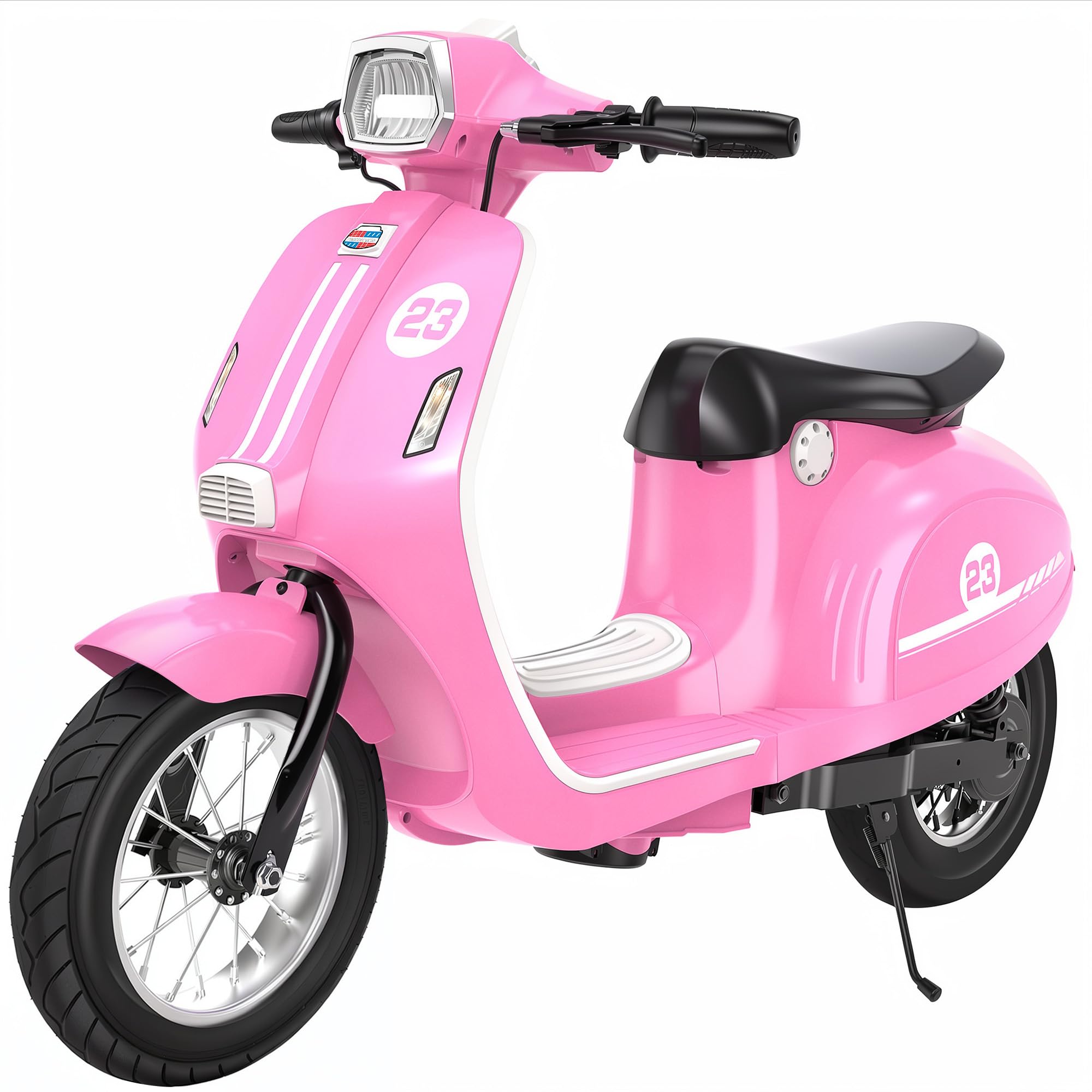
The 24V chopper for ages 8-12 that goes 14.3 mph on a 10Ah lead-acid battery
The Okay Run is the only bike here designed specifically for the 8-to-12 age range, and it shows in the numbers. A 350W motor powered by a 24V 10Ah lead-acid battery gives a top speed of 14.3 mph on the high setting, with medium at 9.2 mph and low at 6.2 mph. The battery claims up to 60 minutes of continuous use — about 50% longer than the average kids’ ride-on according to the manufacturer. The 51.2″L x 21.6″W x 31.1″H dimensions are the largest in this list, so it looks and feels like a real motorcycle for an older child. The pink color scheme and LED headlights add a stylish touch that younger teens might actually want to be seen on.
The three speed settings are a strong safety feature because they let a parent lock in a lower speed for a nervous kid and open up higher speeds as confidence grows. Soft-start technology prevents abrupt acceleration, and the ASTM safety certification backs up the stability claims. Customers note the bike is “sturdy, easy assembly, long battery life” and that the 24V motor is smooth and safe. One shopper added the pink design is “adorable” and that the built-in music and stories kept the ride entertaining. The 8-12 hour charge time is typical for lead-acid, but the trade-off is you get that longer run time per charge.
The biggest red flag is reliability. One reviewer noted that after about 5 rides, the motor started losing power even with a full battery, and by the time the return window closed they were stuck with a broken bike. That same reviewer said similar failures were reported by others. For a price point, that kind of durability risk is a serious consideration. If you do buy it, put several full charge cycles through it during the return window to verify the motor holds up.
The head-to-head: the 24V Okay Run offers 14.3 mph and 60-minute run time, which is comparable to the 36V K1’s 16 mph but with a lead-acid battery that takes longer to charge (8-12 hours vs 5-6 hours for the K1’s lithium).
Who it fits: a fashion-conscious 8-to-10-year-old who wants a larger, motorcycle-style ride with adjustable speed and enough battery for a solid hour of cruising around the neighborhood.
Who should be cautious: anyone who expects this to last through multiple seasons — the reported motor failures after a handful of rides mean you should test it hard during the return window.
Understanding the Specs
Voltage and What It Does to Speed
The voltage of the battery (6V, 12V, 24V, or 36V) is the single biggest factor in how fast the motorcycle will go and how long the battery lasts. A 6V battery powers a motor that tops out around 1.75 mph — basically a walking pace for an adult. A 12V battery gives you a range of roughly 3 to 5 mph, which is a comfortable jogging pace next to your kid. At 24V and 36V, the speed jumps to 8-16 mph, which requires a child who already has good balance, throttle control, and the sense not to ride into the street. Higher voltage also generally means heavier batteries and longer charging times.
Battery Chemistry: Lead-Acid vs Lithium
The two main battery types in kids’ electric motorcycles are sealed lead-acid (SLA) and lithium-ion. SLA batteries are cheaper and more common on budget and mid-range models, but they are heavy and take 8-12 hours to charge fully. Lithium batteries are lighter, charge faster (often 5-6 hours), and can deliver more consistent power as the charge depletes. The trade-off is cost — a lithium-powered bike like the AIII or the K1 costs more upfront but gives you better performance per pound and a longer battery lifespan overall. An SLA battery may start losing capacity after 200-300 charge cycles, while a lithium battery can last 500 or more.
FAQ
What age is a 6V battery operated motorcycle suitable for?
How long does a 12V battery last on a single charge?
Can a battery operated motorcycle go on grass or dirt?
Are training wheels removable so the bike becomes a two-wheeler?
What is the difference between a 12V and a 24V kids motorcycle?
How fast is too fast for a 4-year-old on an electric motorcycle?
Do I need to charge the battery before the first ride?
Can an adult ride a kids electric motorcycle?
How do I choose between a 3-wheel and a 2-wheel with training wheels?
What safety gear does a child need when riding an electric motorcycle?
Final Thoughts: The Verdict
For most buyers, the battery operated motorcycle winner is the K1 Kids Electric Dirt Bike 36V because it offers three speed settings (6, 9, and 16 mph) and a 14-mile range from a lithium battery that charges in 5-6 hours, making it the single bike that can serve a child from age 3 to age 10. If your kid is just starting out and needs training wheels, grab the Aosom 12V Kids Motorcycle for its soft-start acceleration and dual training wheels. And for the absolute beginner aged 2-3 who needs a slow, stable, and affordable first ride, the standout is the Lil’ Rider Police Motorcycle for its 1.75 mph crawl and 3-wheel stability.
How We Picked
We do not accept paid placement. Every pick is matched to a real buyer and a real use-case; we do not hands-on test units.
Sources & Methodology
Specifications: manufacturer listings and product documentation. Review insights: verified customer reviews, as of July 2026. Pricing: not shown on this page (it changes often); check the current price via the retailer link.
As an Amazon Associate, Gadgets Feed earns from qualifying purchases. This does not affect which products we feature.