
Our readers keep the lights on and my morning glass full of iced black tea. As an Amazon Associate, I earn from qualifying purchases.
Specs are compiled from manufacturer listings and verified buyer reviews and can change over time — please confirm the key details on the product page before buying.
Nothing kills a winter morning faster than a car that won’t start. The right battery keeps your engine turning over when single-digit temps turn oil into sludge and every crank matters more. This guide compares the batteries that actually hold up through a polar vortex—rated by cold cranking amps, reserve capacity, and real owner experience in the worst conditions.
I’m Min — the founder and writer behind Gadgets Feed. This guide is built by comparing the manufacturers’ published specifications and the patterns across verified customer reviews, so you get each pick’s real strengths and trade-offs instead of marketing spin.
Whether you daily a diesel truck in Montana or need your sedan to start after a week of sub-zero parking, we break down the battery for winter that delivers reliable power when the thermometer drops.
Our Picks at a Glance

How To Choose The Best Battery For Winter
Winter starting power depends on a few key numbers that most buyers overlook. Here is what separates a battery that fires up on a -20°F morning from one that leaves you calling a tow truck.
Prioritize Cold Cranking Amps (CCA)
CCA measures how many amps a battery can deliver for 30 seconds at 0°F while maintaining at least 7.2 volts. A higher CCA means your starter motor gets enough current to spin a cold, thickened engine. Look for at least 650 CCA for most sedans; diesels and large V8s need 800 CCA or more. Every product in this guide meets or exceeds a high CCA threshold for reliable winter starts.
Choose Between AGM, Flooded, and Lithium
AGM (Absorbed Glass Mat) batteries use fiberglass mats to hold electrolyte, making them spill-proof and far more resistant to vibration than traditional flooded batteries. They also recharge faster and handle deep discharges better. Lithium iron phosphate (LiFePO4) batteries are dramatically lighter and deliver higher CCA for their size, but they require a battery management system (BMS) that can shut them down in extreme cold if not designed for winter use. Flooded lead-acid batteries are cheaper but less reliable in sub-zero temps and more prone to freezing if discharged.
Check Reserve Capacity (RC) for confidence
Reserve capacity tells you how many minutes the battery can run your car’s essential electronics if the alternator fails. A higher RC gives you more time to reach a shop or call for help before the battery goes dead. In winter, when a failing alternator is more common, 100 minutes or more of reserve capacity is a solid safety net.
Quick Comparison
| Model | Best For | CCA | Ah Capacity | Weight | Amazon |
|---|---|---|---|---|---|
| OPTIMA REDTOP 34★ Best Overall | Daily drivers needing extreme vibration resistance | 800 | 50 Ah | 37.9 lbs | Amazon |
| G48 LithiumTop Performer | Weight-saving performance builds | 1100 | 60 Ah | 16.09 lbs | Amazon |
| OPTIMA YELLOWTOP D34 | High-demand dual-purpose (starting + deep cycle) | 750 | 55 Ah | 42.9 lbs | Amazon |
| Interstate MTX-35 | Long-life daily driver in cold climates | 650 | 55 Ah | 42 lbs | Amazon |
| Goodyear 47-H5-AGM | Budget-friendly AGM upgrade | 680 | 60 Ah | 39 lbs | Amazon |
In‑Depth Reviews
1. OPTIMA REDTOP 34
Our pick — over 4★ from 750+ verified ratings; the strongest balance of quality and price.
The gold standard for winter starts that shrugs off road vibration like a tank.
The REDTOP is built around OPTIMA’s SpiralCell technology, which uses 99.99% pure lead coiled into spiral cylinders rather than flat plates. This design gives you 800 CCA in a compact Group 34 package that weighs just 37.9 pounds — 4.1 pounds lighter than the Interstate MTX-35. In real terms that means your starter gets a powerful jolt of current even when the engine oil is the consistency of honey, and the battery can withstand fifteen times more vibration than a standard flooded battery without internal damage.
The 100-minute reserve capacity gives you a solid hour and forty minutes of run time if your alternator quits in a blizzard. Buyers report impressive longevity — one owner noted it “lasted 8 years in a 2001 V8 Grand Cherokee” before developing a bulge and losing charge, but added it never left them stranded. The caveat: this is a starting battery, not a deep-cycle battery. If you regularly drain it with accessories or winches, the YELLOWTOP is a better fit.
Winter Warrior Strengths
- 800 CCA delivers reliable starts in deep cold
- SpiralCell design resists vibration damage fifteen times better than flooded batteries
- Maintenance-free with faster recharge than standard AGM
What to Watch
- Not designed for repeated deep discharge cycles
- At 37.9 lbs it is light for its class, but still heavy if you frequently swap batteries
The cold-start specialist: if you drive a gas truck, SUV, or sedan in real winter and want max cranking confidence without worrying about vibration damage, this is the pick.
skip it if: you need a dual-purpose battery that can handle deep discharges from winches, plows, or heavy accessories.
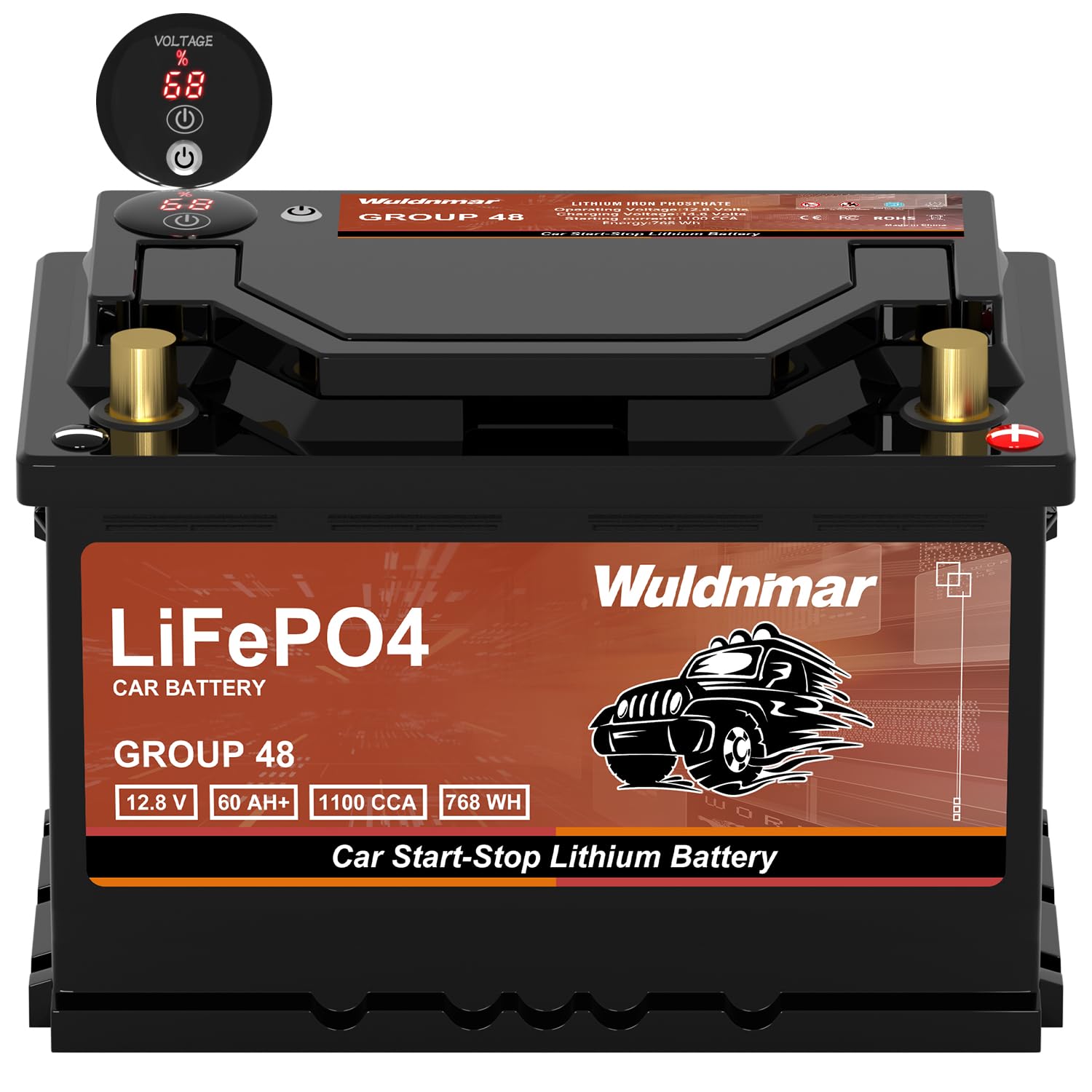
2. G48 Lithium Automotive Battery (Wuldnmar)
A lithium battery that cuts weight by 26 lbs while delivering monster CCA for cold mornings.
This is the wildcard of the list: a 12.8V lithium iron phosphate (LiFePO4) battery that pushes 1100 CCA from a package weighing only 16.09 pounds. For context, the OPTIMA REDTOP weighs 37.9 pounds — so you are saving 21.8 pounds off the front axle. That weight reduction improves handling, acceleration, and braking, as owners mention using it in Corvette C6 and C8 Z06 builds.
The built-in BMS (battery management system) protects against overcharging, over-discharging, overvoltage, and overcurrent, which is critical in winter when charging systems work harder. Customers note it is “much lighter at 16 pounds compared to 52 pounds replaced” and that cold cranking is “exceptional.” The manufacturer claims up to 2000 cycles and 50,000 engine starts. The major consideration: at 10.8 inches long it is 15% longer than the Goodyear 47-H5-AGM’s 9.37 inches, so triple-check your battery tray dimensions before buying.
The Weight Advantage
- 1100 CCA — highest in this roundup for extreme cold confidence
- 16.09 lbs saves significant weight over any lead-acid battery
- BMS protection prevents cold-weather charging damage
Fitment Notes
- Size 10.8″ may not fit all factory battery trays
- Polarity is [- +], verify orientation before installing
Weight-saver’s choice: a no-brainer for sports cars, track builds, or anyone who wants the highest CCA-to-pound ratio on the market.
Measure twice: confirm your group size and terminal orientation — this does not fit every vehicle without modification.
3. OPTIMA YELLOWTOP D34
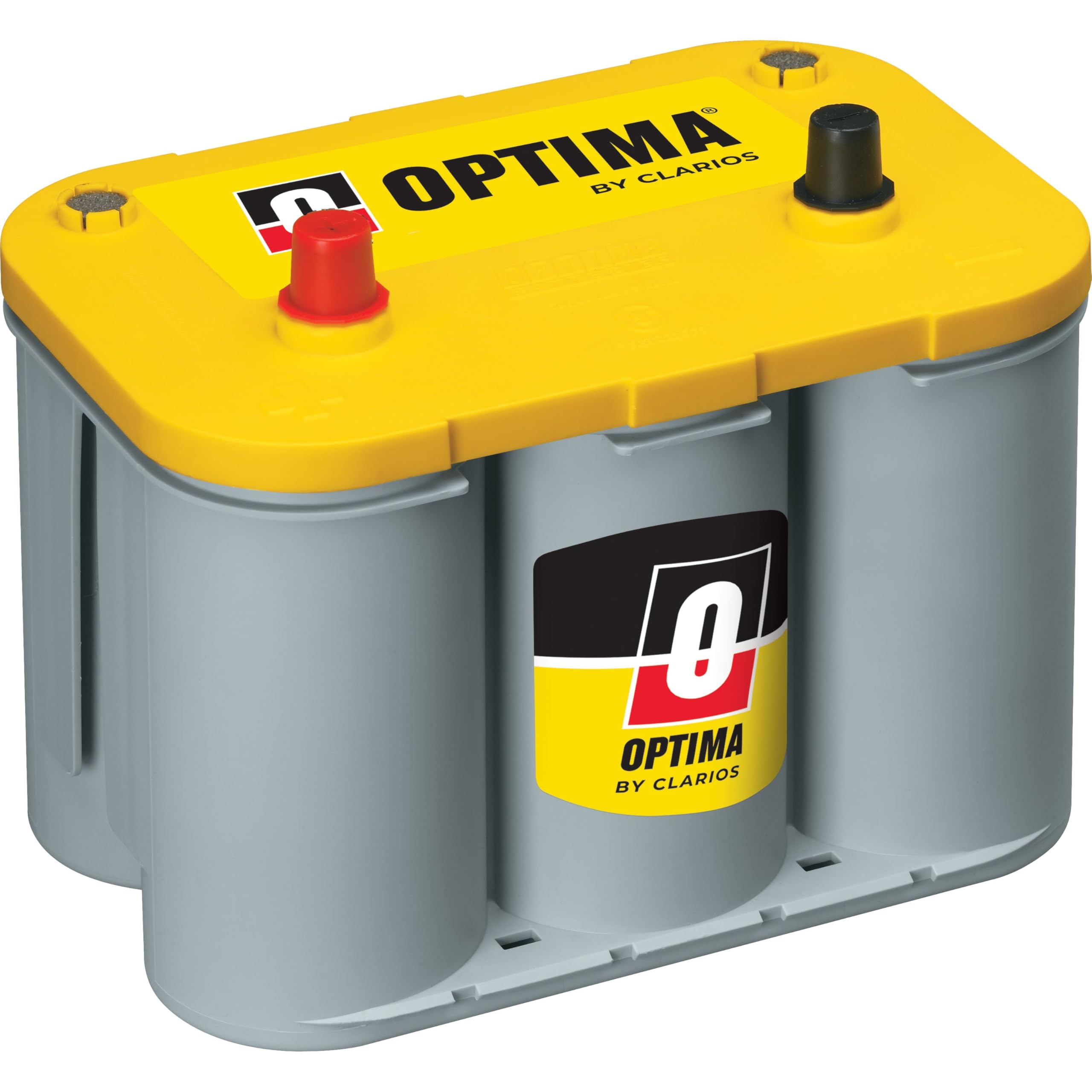
The dual-purpose AGM that handles both winter starts and accessory drain without flinching.
Unlike the REDTOP, the YELLOWTOP D34 is designed as a dual-purpose battery: it provides strong starting power with 750 CCA while also tolerating repeated deep discharges from winches, plows, lights, and stereos. At 42.9 pounds it is 5 pounds heavier than the REDTOP, but that extra mass comes from additional lead for deep-cycle durability.
Reviewers point out it survives severe abuse: one owner says it has been “constantly being drained and still kicking” after 5 years, starting a 40-year-old Jeep 360 V8 in sub-30°F temps. Another uses it in an ’84 Jeep with a plow and notes it “can handle the demand when plowing without draining the battery.” The trade-off is the same SpiralCell 99.99% pure lead technology that makes it tough, but some shoppers say fitment issues—one required a 6-inch wire extension on a 2015 Equinox.
Deep Freeze Credentials
- 750 CCA plus dual-purpose design for winches and plows
- 120-min reserve capacity — longest backup run time in this comparison
- SpiralCell resists vibration and corrosion longer than standard AGM
Installation Notes
- 42.9 lbs is the heaviest in its size class
- Some vehicles need terminal straightening or wire extensions for fit
For accessory-heavy rigs: the right choice if you run a plow, winch, or extra lights and need a battery that survives both cranking and deep discharge.
Check your tray: verify the Group D34 dimensions against your vehicle before ordering — it is not a universal fit.
4. Interstate Batteries MTX-35 (Group Size 35)
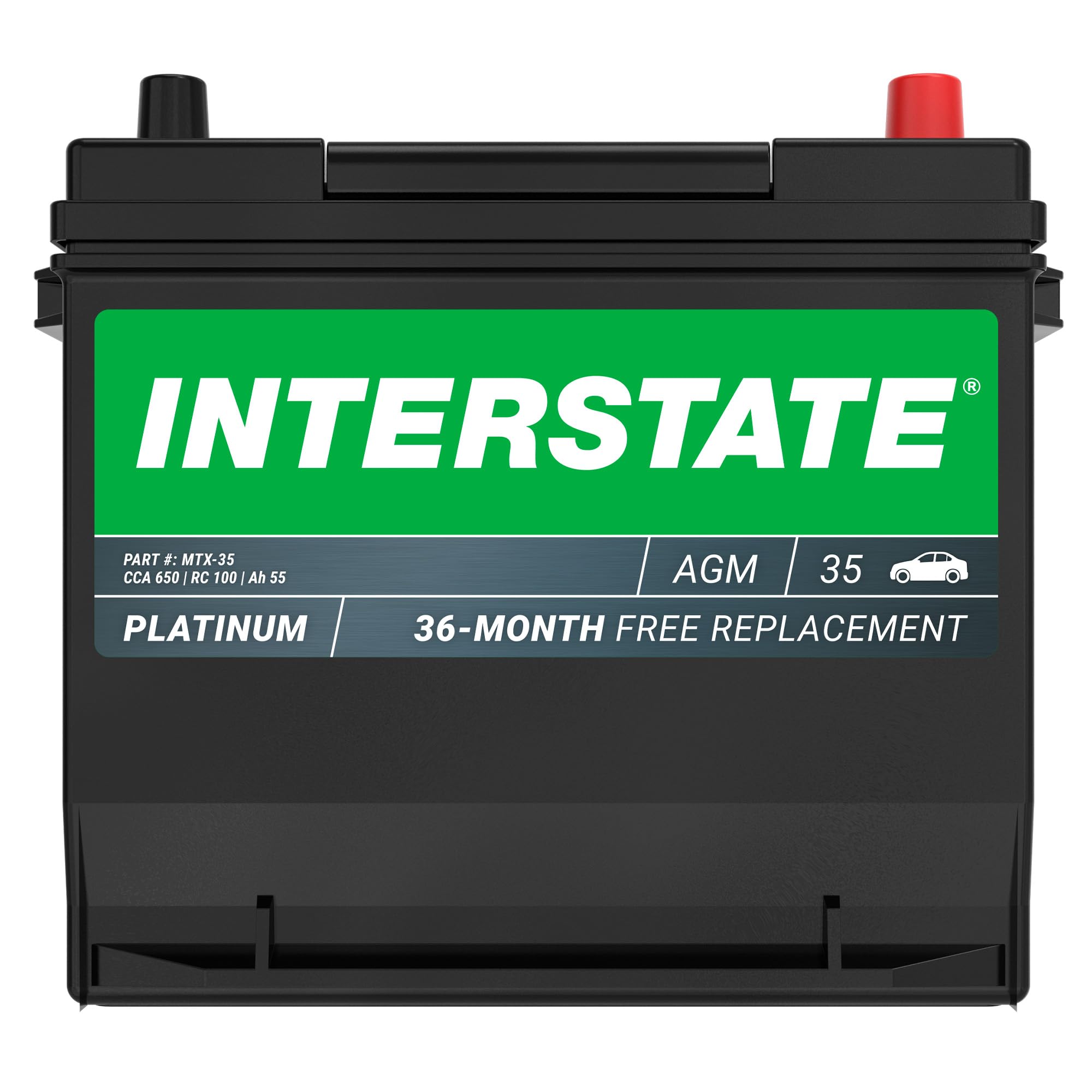
A 70-year legacy battery that an owner says saved a Suburban from the junkyard in an Indiana winter.
Interstate’s MTX-35 is a pure-lead AGM battery that prioritizes longevity over raw CCA. For a daily driver in moderate winter climates, this trade-off makes sense: you get reliable starts without overspending on peak CCA you may never use.
Buyers confirm the reputation in harsh conditions — one owner reported it “saved my brothers old suburban from being junked in the cold snows of Indiana. started right up.” The AGM construction makes it spill-proof and vibration-resistant, and the 36-month warranty matches the Goodyear’s coverage. The 42-pound weight makes it the second-heaviest here behind the DH7, but that heft comes from the dense lead plates that deliver the promised longevity.
Longevity Focus
- Pure-lead AGM design for 2-3 times longer life than standard AGM
- Maintenance-free, spill-proof, and vibration-resistant construction
- Backed by 36-month warranty and Interstate’s 70-year reputation
Winter Limits
- 650 CCA is the lowest in this roundup — may struggle in extreme sub-zero with big engines
- At 42 lbs it is relatively heavy for its 55Ah capacity
For moderate-winter daily drivers: the smart value pick if you need a proven AGM that outlasts cheaper competitors and starts reliably in normal cold.
Skip for deep cold: if you regularly face -20°F or drive a large V8/diesel, the higher-CCA options above will serve you better.
5. Goodyear 47-H5-AGM (Group Size 47)
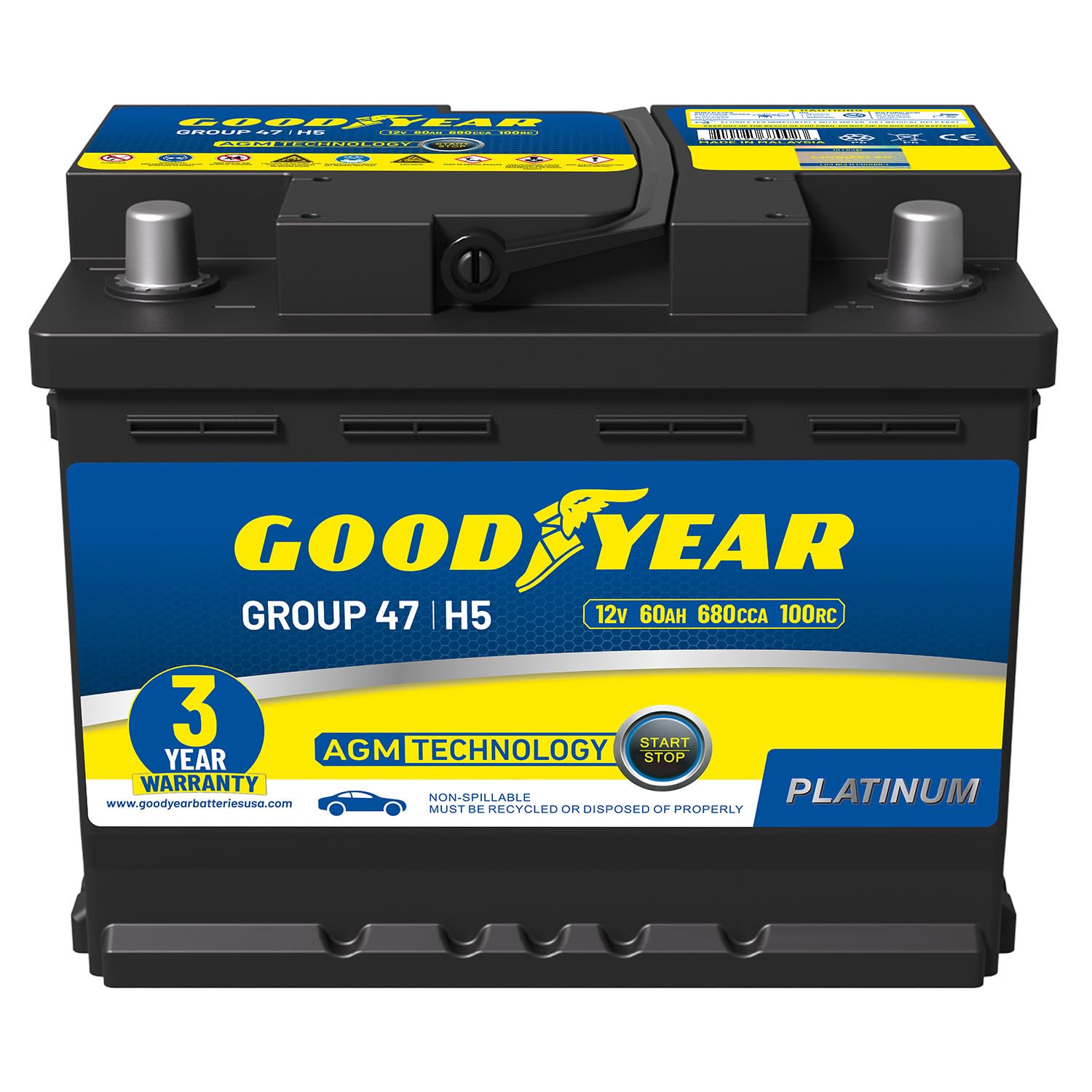
The entry-level AGM that gets you into spill-proof winter performance while staying affordable.
Goodyear’s 47-H5-AGM delivers 680 CCA and 60Ah capacity in a compact Group 47 case that measures just 9.37 inches long — the shortest battery in this comparison. The 100-minute reserve capacity matches the OPTIMA REDTOP, providing a solid backup window. The AGM construction is spill-proof and vibration-resistant, and the 3-year warranty matches Interstate’s coverage.
The real-world experience is mixed. Several buyers report it worked perfectly — one upgraded from flooded lead-acid and noted “LED headlamps now brighter and flicker-free at idle.” But one reviewer noted a critical failure: “bought Good Year battery with 3-year warranty; failed after 6 months,” with both the manufacturer and Amazon refusing replacement. While this is a single review among 260 ratings, it highlights the risk of budget-tier AGM batteries from brand-name licensing. It fits many European and Asian vehicles (like Mercedes and Jeep) but the warranty fulfillment gap is a real concern.
Low-Cost Upgrade
- 680 CCA and 60Ah capacity in a compact 9.37″ case — fits tight trays
- 100-min reserve capacity matches premium batteries
- 3-year warranty and AGM spill-proof design
Reliability Concern
- One buyer mentioned failure after 6 months with warranty issues
- CCA is lower than premium picks — not ideal for extreme sub-zero on large engines
Budget-friendly entry point: a solid choice if your vehicle takes Group 47 and you want AGM advantages without the premium price tag.
Buy with caution: the failure + warranty denial report is a red flag — if you need guaranteed cold-weather reliability, spend up for the OPTIMA or Interstate.
Understanding the Specs
Cold Cranking Amps (CCA)
This is the single most important number for winter starting. CCA tells you how much current a battery can deliver for 30 seconds at 0°F while maintaining a voltage above 7.2 volts. Think of it as the battery’s short-burst strength — the higher the number, the more raw power your starter gets when the engine is stiff from cold. A typical 4-cylinder needs around 500-600 CCA; a V8 or diesel needs 700+ CCA; extreme cold or modified engines benefit from 800+ CCA.
Reserve Capacity (RC)
Reserve Capacity measures how many minutes the battery can supply 25 amps (enough to keep your engine’s computer, fuel pump, and lights running) before dropping below 10.5 volts. This is your safety net if the alternator fails. In winter, when a failing alternator is more likely to strand you, a higher RC gives you precious extra time to drive to a shop or call a tow. Look for 100 minutes or more for a comfortable winter margin.
AGM vs. Flooded Lead-Acid
AGM (Absorbed Glass Mat) batteries suspend the electrolyte in fiberglass mats rather than letting it slosh around as free liquid. This makes them spill-proof, allows mounting at angles, and makes them far more resistant to vibration — up to fifteen times more in OPTIMA’s case. AGM batteries also recharge faster than flooded batteries and handle deep discharges better. Flooded batteries are cheaper but can freeze if discharged in winter and are prone to vibration damage on rough roads.
Group Size and Physical Fit
Every battery has a BCI (Battery Council International) group size that defines its length, width, height, and terminal layout. The wrong group size simply will not fit your battery tray or may short against the hood. Always check your owner’s manual or measure your old battery before buying. Common winter-friendly group sizes include 34, 35, 47, and 94R. A lithium battery like the G48 may use a non-standard size, so measure twice.
FAQ
Will a higher CCA battery damage my car’s starter?
Can I use a lithium battery in sub-zero temperatures?
What is the difference between a starting battery and a dual-purpose battery?
How long should a winter battery last?
Is the Goodyear 47-H5-AGM battery warrantied by Amazon or Goodyear?
What does reserve capacity (RC) mean for winter driving?
Can a winter battery freeze?
Will an AGM battery fit where my old flooded battery was?
Is the G48 Lithium battery safe to install in a trunk or enclosed space?
Which battery is best for a diesel truck in extreme cold?
Final Thoughts: The Verdict
Across the board, the battery for winter winner is the OPTIMA REDTOP 34 because it combines 800 CCA, SpiralCell vibration resistance, and proven 8-year real-world longevity in a manageable 37.9-pound package. If you want to shed serious weight and gain the highest CCA available, grab the G48 Lithium. And for accessory-heavy rigs with winches or plows that need both starting and deep-cycle capability, the standout is the OPTIMA YELLOWTOP D34.
How We Picked
We do not accept paid placement. Every pick is matched to a real buyer and a real use-case; we do not hands-on test units.
Sources & Methodology
Specifications: manufacturer listings and product documentation. Review insights: verified customer reviews, as of July 2026. Pricing: not shown on this page (it changes often); check the current price via the retailer link.
As an Amazon Associate, Gadgets Feed earns from qualifying purchases. This does not affect which products we feature.