
Our readers keep the lights on and my morning glass full of iced black tea. As an Amazon Associate, I earn from qualifying purchases.
Specs are compiled from manufacturer listings and verified buyer reviews and can change over time — please confirm the key details on the product page before buying.
A battery Sawzall cuts through the cord, not your freedom, but picking the wrong one leaves you with a tool that bogs down on the first branch or runs out of juice halfway through the job. You want a cordless reciprocating saw that actually keeps cutting — through wood, metal, thick limbs — without constant battery swaps or chatter that numbs your hands. This guide walks through seven top contenders, calling out exactly how each one handles real cutting situations so you know which model stays on the job and which goes back in the box.
I’m Min — the founder and writer behind Gadgets Feed. This guide is built by comparing the manufacturers’ published specifications and the patterns across verified customer reviews, so you get each pick’s real strengths and trade-offs instead of marketing spin.
Whether you are trimming tree limbs or demoing a shed, the right battery sawzall needs enough stroke length and battery life to finish the task without making you stop and swap packs every few minutes.
Our Picks at a Glance
How To Choose The Best Battery Sawzall
A cordless reciprocating saw is a simple tool on the surface — you pull the trigger and the blade moves back and forth. But the differences in motor design, battery platform, and stroke length separate a saw that powers through a day of work from one that leaves you frustrated.
Stroke Length and Strokes Per Minute (SPM)
Stroke length is the distance the blade travels in one back-and-forth cycle — measured in inches. A longer stroke, like 1-1/8 inches, moves the blade deeper into the material on each pass, so it cuts faster through thick wood or metal. Strokes per minute (SPM) tells you the speed of that cycle. Higher SPM means cleaner cuts in softer materials like plastic or drywall. A variable-speed trigger lets you slow down for metal and speed up for wood, giving you control instead of just full-throttle.
Brushless vs Brushed Motor
A brushless motor uses electronic controllers instead of physical brushes to transfer power, which cuts down on friction and heat. The result is longer runtime per battery charge, more torque when the blade hits a dense knot in the wood, and less noise while you work. Most mid-range and premium battery Sawzalls now use brushless motors, and they are worth the small premium because the motor lasts longer and the batteries drain slower.
Battery Capacity and Platform
Amp-hours (Ah) measure how much energy a battery holds — think of it as the fuel tank. A 5.0Ah pack runs roughly twice as long as a 2.5Ah pack before needing a recharge. Once you pick a brand, you are locked into that battery system: DeWalt 20V, Ryobi ONE+ 18V, Bosch 12V Max, Milwaukee M18. Each platform offers different sizes and power outputs, so consider which tools you already own or plan to buy. A tool-only saw (no battery included) can save money if you already have compatible packs.
Weight and One-Handed Use
A full-size reciprocating saw can weigh 7 to 9 pounds with a battery, and holding it overhead or in a tight crawlspace tires your arm fast. Compact one-handed models weigh around 3.75 pounds and let you grip the body like a large power tool, which gives you better control when cutting vertically or in cramped areas. The trade-off is that compact saws typically have a shorter stroke length and less raw cutting force for big demo work.
Quick Comparison
| Model | Best For | Stroke Length | Max SPM | Weight | Amazon |
|---|---|---|---|---|---|
| DEWALT DCS387P1★ Best Overall | All-day power with tight-space control | 1-1/8″ | 2,900 | 7 lbs | Amazon |
| Olmlmo RS09-MT ProBudget Champion | Budget-friendly kit with two batteries | 1.1″ | 3,200 | 3 lbs | Amazon |
| CRAFTSMAN CMCS351B | Corded power feel on a battery platform | — | 3,200 | — | Amazon |
| RYOBI PSBRS01B | One-handed cutting in tight spots | — | 3,000 | 3.75 lbs | Amazon |
| Bosch PS60-102 | Ultra-light 12V for overhead work | — | 3,600 | 2.3 lbs | Amazon |
| DEWALT DCS368B | Power Detect for max battery output | 1-1/8″ | 3,000 | 8.34 lbs | Amazon |
| Milwaukee 2719-21 | Heavy-duty pro cutting performance | — | — | 9.52 lbs | Amazon |
In‑Depth Reviews
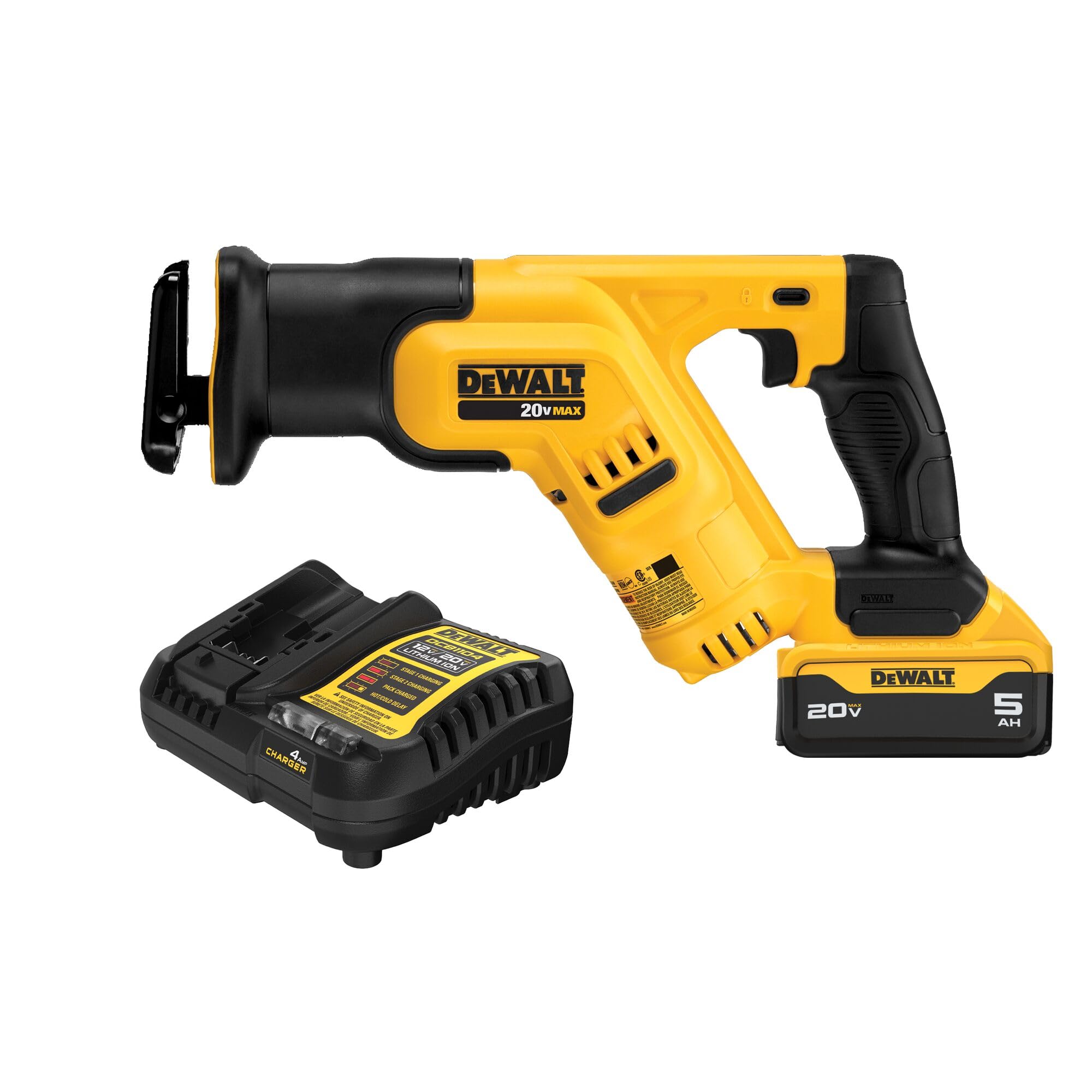
1. DEWALT 20V MAX* Cordless Reciprocating Saw Kit, 5 Amp-Hour Battery (DCS387P1)
Our pick — over 4.5★ from 800+ verified ratings; the strongest balance of quality and price.
The 7-pound workhorse that fits between studs and doesn’t quit on a full charge.
The defining spec here is the 1-1/8-inch stroke length paired with a variable-speed trigger (0 to 2,900 SPM) — the longer stroke means each pass digs deeper into the material, so you slice through pressure-treated lumber or thick branches faster than a shorter-stroke saw. The 5.0Ah battery gives you enough runtime for a full day of pruning and light demo work without swapping packs. Buyers report it “cuts iron, wood, branches effectively with firm hold,” backing up the claim that this saw handles mixed materials without stalling.
At 14.75 inches long, this DEWALT slips into the space between wall studs, making it a solid pick for flush cutting in tight framing. The 4-position blade clamp lets you orient the blade for flush cuts against a surface, and the tool-free change keeps the job moving. It weighs 7 pounds, which is noticeably heavier than the 3.75-pound RYOBI compact, but that extra heft translates to stability when you are pushing the blade through a tough knot.
The pivoting shoe gives you control over cut depth and helps brace the saw against the work surface. The bright LED light does a decent job of lighting up dark corners in a crawlspace or under a deck.
Why reach for this one
- 1-1/8-inch stroke length cuts faster through thick material than saws with a shorter throw
- 5.0Ah battery provides all-day runtime — twice the capacity of the Bosch 2.5Ah
- Compact 14.5-inch length fits between studs for confined-space cutting
One real caveat
- At 7 pounds it is heavier than compact models — overhead work gets tiring after a while
Who it fits: Homeowners and small contractors who need one saw that handles pruning, metal cutting, and confined-space demo without quitting on battery life.
One trade-off to know: The trembly feel during long cuts, mentioned in reviews, makes it less ideal for precision work — you trade some vibration isolation for raw cutting power.
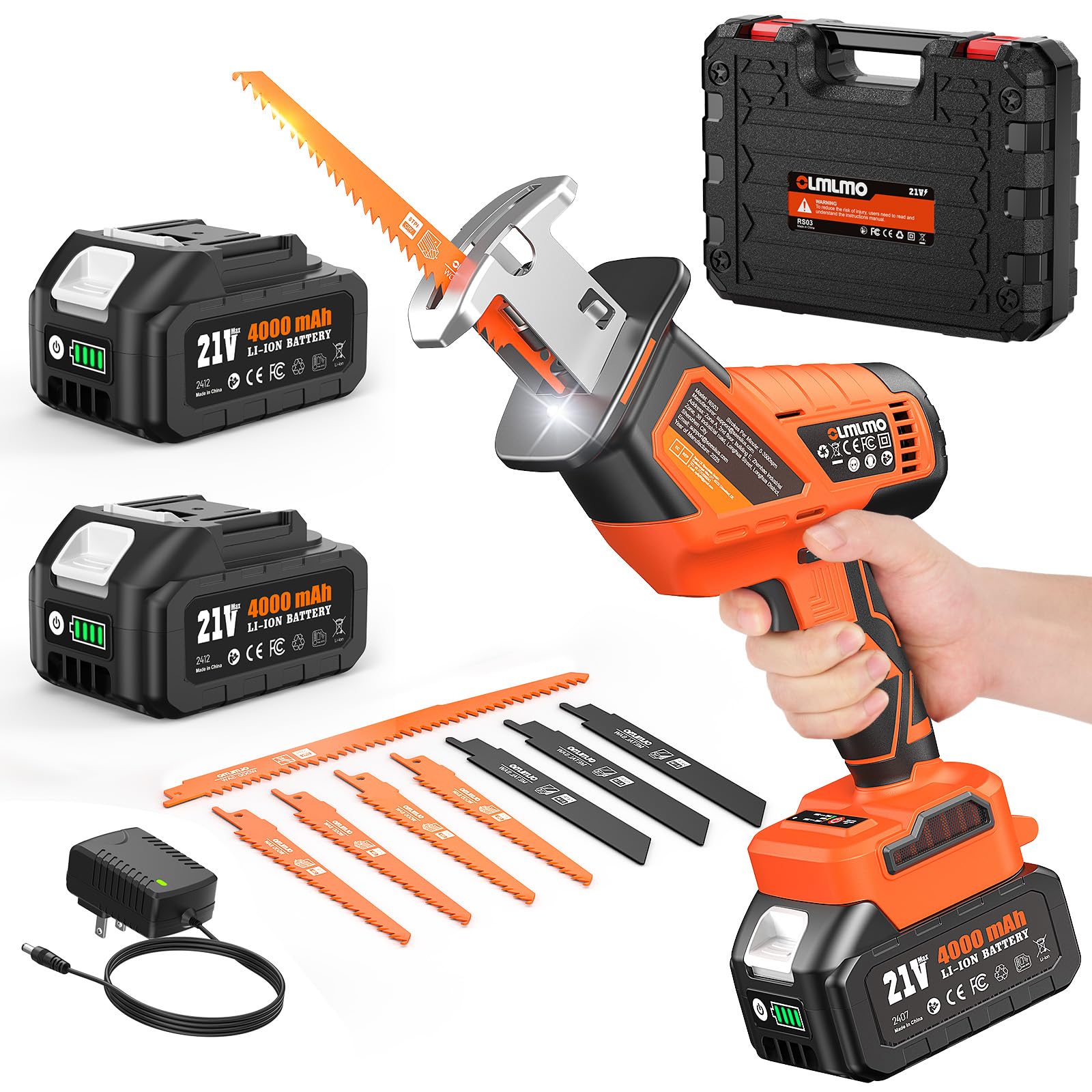
2. Cordless Reciprocating Saw With 8 Blades – 2×4000mAh Batteries, Brushless Motor (Olmlmo RS09-MT Pro)
A 3-pound saw that outlasted a buyer’s hands while cutting metal nonstop.
At just 3 pounds, this Olmlmo feels almost toy-like in the hand, but the 500W brushless motor delivers 0 to 3,200 SPM and a 1.1-inch stroke — enough to cut through 2×4 lumber in about 5 seconds, according to the maker. The kit comes with two 4.0Ah batteries that the brand says provide about 30 minutes of runtime, which covers over 60 cuts in PVC, wood, or light metal. Owners mention “I used this saw very hard cutting metal; the saw would get hot but kept going,” which suggests the thermal management holds up under sustained use.
The tool-free blade change works like you expect — pull the lever, swap the blade in about 5 seconds. The kit includes 8 carbide-tipped blades covering wood, plastic, aluminum, steel, and even frozen meat bone, so you have the right blade for the job right from the start. The rotating shoe adjusts for depth control, and the safety button prevents accidental starts. One sharp difference from the DEWALT above: at 3 pounds versus 7 pounds, this saw is much easier to handle one-handed for overhead pruning or cutting in an attic.
The storage case is basic plastic, and customers note it lacks a molded foam insert to keep the batteries from sliding around during transport. For the price point, you trade a premium case feel for a fully functional saw that arrives with everything you need to start cutting immediately.
What stands out
- Includes 2×4.0Ah batteries and 8 blades — you don’t need to buy anything else to start cutting
- 3-pound weight makes it easy to handle overhead or in tight spots
- Brushless motor runs cooler and delivers reliable power for metal cutting
Where it cuts corners
- Basic plastic storage case does not secure the loose items during carrying
Who it fits: Homeowners and DIYers who want a complete ready-to-use kit with two batteries and eight blades for under without needing to invest in a battery platform.
One real limitation: It does not replace a pro-grade name brand saw in raw power, as one reviewer noted, but the long battery life compensates for typical home jobs.
3. CRAFTSMAN V20 RP Cordless Reciprocating Saw, 3,200 RPM, 8 inch, Bare Tool Only (CMCS351B)

A brushless saw that reviewers point out runs like a corded tool and demoed a shed on two charges.
The CRAFTSMAN V20 RP uses a brushless motor that the brand says delivers up to 75% more power than brushed equivalents, and two speed settings let you pick between 0-2,300 SPM for controlled cuts and 0-3,200 SPM for fast ripping. Shoppers say that this saw is “as powerful as corded saw; batteries last long (demo’d a shed on 2 charges),” which shows that the motor and platform together deliver real sustained cutting power without draining a pack every few minutes.
The variable-speed trigger gives you feathering control — you can start slow to set the blade groove and then squeeze full throttle. The tool-free blade release speeds up swaps, and the LED light illuminates the cut line. This is a bare-tool purchase, so you need a V20 battery and charger unless you already own Craftsman tools. One reviewer compared it directly to a Black+Decker saw and noted it was “much more powerful and sturdy,” with better battery life and an easier blade change system.
The saw is VERSATRACK compatible, meaning you can hang it on a wall organizer using clips (sold separately). At 3,200 max SPM, it matches the Olmlmo for speed but likely delivers more sustained torque thanks to the Craftsman V20 battery platform.
Strengths that matter
- Brushless motor with up to 75% more power than brushed models
- Two speed ranges (low 2,300 / high 3,200 SPM) for material-specific cutting
- Buyers confirm it can demo a full shed on two battery charges
One thing to know
- Sold as tool only — you need existing V20 batteries or a separate starter kit purchase
Who it fits: Craftsman V20 platform owners who want a reciprocating saw that cuts like a corded tool and can handle full-day demo jobs without running out of steam.
Where it falls short: No included battery or charger, which raises the effective cost if you are starting from scratch.
4. RYOBI ONE+ HP 18V Brushless Compact One-Handed Reciprocating Saw (Tool Only) PSBRS01B

A 3.75-pound lightsaber that cuts 4×4 fence posts with one hand and no strain.
The RYOBI HP compact reciprocating saw packs a brushless motor that delivers up to 3,000 strokes per minute, and the one-handed body design means you can grip the saw like a large drill rather than a two-handed demolition tool. At 3.75 pounds, it is less than half the weight of the DEWALT DCS387P1 (7 pounds), so overhead pruning or cutting in a cramped attic does not wear out your arm after a few cuts. Buyers report it is “excellent for cutting branches up to 4×4 fence posts,” which is impressive for a compact form factor that fits in a tool bag.
The rapid blade change system works without tools, so swapping between a wood blade and a metal blade takes seconds. The saw is part of the RYOBI ONE+ 18V system, which means it works with over 300 compatible batteries — if you already own Ryobi tools, you can buy this as a bare tool and use your existing packs. One buyer mentioned the saw used two 4Ah batteries over 3-4 hours of active cutting, which is efficient for a compact model.
The biggest trade-off versus full-size saws like the Milwaukee 2719-21 is that a short-stroke compact design lacks the raw demolition power for thick stumps or all-day framing cuts. The kit includes only one blade, so you will want to pick up a multi-pack for different materials.
Why it earns its spot
- One-handed design at 3.75 pounds makes it the easiest saw here for overhead and tight-space work
- 3,000 SPM brushless motor cuts through 4×4 posts without bogging
- Fits the massive Ryobi ONE+ battery ecosystem — over 300 compatible tools
One limitation
- Only one blade included in the box — you will need to buy a multi-material set right away
Who it fits: Homeowners and hobbyists who already own Ryobi ONE+ batteries and want a lightweight one-handed saw for pruning, fence work, and small cuts.
Not the best for: Heavy demolition or cutting thick stumps where a longer stroke and higher torque are necessary to avoid stalling.
5. BOSCH PS60-102 12V Max Pocket Reciprocating Saw Kit with 2.5Ah Battery

A 2.3-pound pocket saw that fits in a glovebox and cuts farm T-posts all day.
At 2.3 pounds with the battery installed, this Bosch 12V Max reciprocating saw is by far the lightest pick here — nearly 6 pounds lighter than the DEWALT DCS387P1. The 0-3,600 SPM brushless motor runs fast, and the kit includes a 2.5Ah battery (though some owners mention they received a 2.0Ah battery instead, so check the included package). Buyers describe it as “excellent for farm repairs (fences, limbs, T-posts)” and say it cuts more than five T-posts per battery charge, which shows how efficient the 12V platform is for light-to-medium cutting.
The design focuses on portability and accessibility. The pocket-sized body means you can toss it in a truck glovebox or tool belt, and the front rubber wrap dampens vibration while protecting the internal components from dust and water. The built-in LED light and battery fuel gauge add convenience. The motor brake stops the blade quickly after you release the trigger, which improves safety when you are making quick cuts in tight spaces.
Because it runs on 12V, the Bosch cuts slower through thick material than 18V or 20V saws — it is not designed for heavy demolition or cutting 6-inch stumps. The battery capacity is also lower than the 5.0Ah pack on the DEWALT, so you will swap batteries more often on longer jobs.
The big pluses
- Ultra-light 2.3-pound weight makes it the best pick for overhead pruning and one-handed use
- Compact size — fits in a truck glovebox or tool belt for farm and ranch work
- Motor brake and electronic cell protection for safer, more controlled cuts
The trade-off
- 12V platform delivers less cutting power than 18V or 20V saws — not suitable for heavy demo work
Who it fits: Farmers, landscapers, and homeowners who need a featherweight saw for pruning, PVC cutting, and quick fence repairs — especially if portability matters more than raw demolition force.
Who should pass: Anyone planning to cut thick stumps, heavy framing lumber, or all-day metal — the 12V output will leave you frustrated.
6. DEWALT 20V MAX XR Reciprocating Saw with Power Detect, Tool Only (DCS368B)
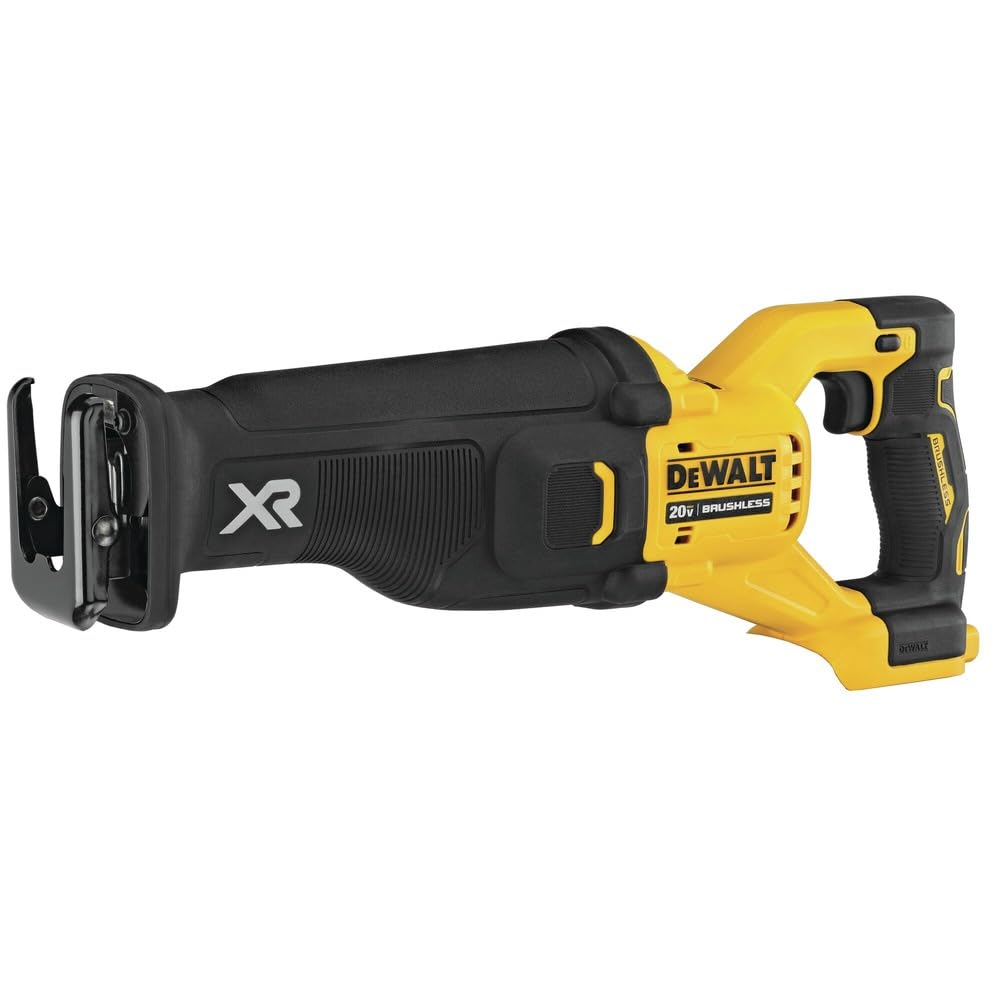
The saw that reads your battery and adjusts output — a 2Ah pack runs differently from a 5Ah Powerstack.
DEWALT’s Power Detect technology is the standout feature here — the saw communicates with the battery to detect whether you have inserted a high-capacity pack (like a 5.0Ah or a Powerstack) and automatically adjusts the motor’s power output to boost cutting speed. Buyers confirm “the difference between a 2Ah, 5Ah and 5Ah Powerstack were noticeable,” meaning this saw genuinely gives you more cutting force when you use a beefier battery, unlike standard saws that draw the same power regardless of the pack.
The 1-1/8-inch stroke length at up to 3,000 SPM provides fast cutting speed through thick lumber and metal. The keyless lever-action blade clamp makes blade swaps quick, and the variable-speed trigger gives you control. The bright LED light is useful for low-light job sites. At 8.34 pounds, it is heavier than the DCS387P1 (7 pounds), so it is a saw you want two hands on — the weight indicates a beefier internal build designed for sustained pro use.
The catch is that the Power Detect feature only works with compatible DEWALT 20V MAX XR and Powerstack batteries — if you use a standard 2Ah pack, the saw performs like a regular brushless tool. It is also sold as tool only, so you need existing DEWALT 20V batteries.
Why pros pick it
- Power Detect Technology boosts output when high-capacity batteries are attached
- 1-1/8-inch stroke at 3,000 SPM cuts fast through thick material
- Keyless lever-action blade clamp for quick blade swaps on the job site
One consideration
- At 8.34 pounds it is the heaviest saw here — not ideal for overhead work or all-day one-handed use
Who it fits: Pro contractors and serious DIYers who already own DEWALT 20V batteries and want the ability to boost cutting power simply by swapping to a larger battery pack.
Who should skip it: Homeowners without existing DEWALT tools — buying batteries separately adds significant cost, and the Power Detect feature is wasted if you only use small-capacity packs.
7. Milwaukee Electric Tools 2719-21 M18 Fuel Hackzall Kit
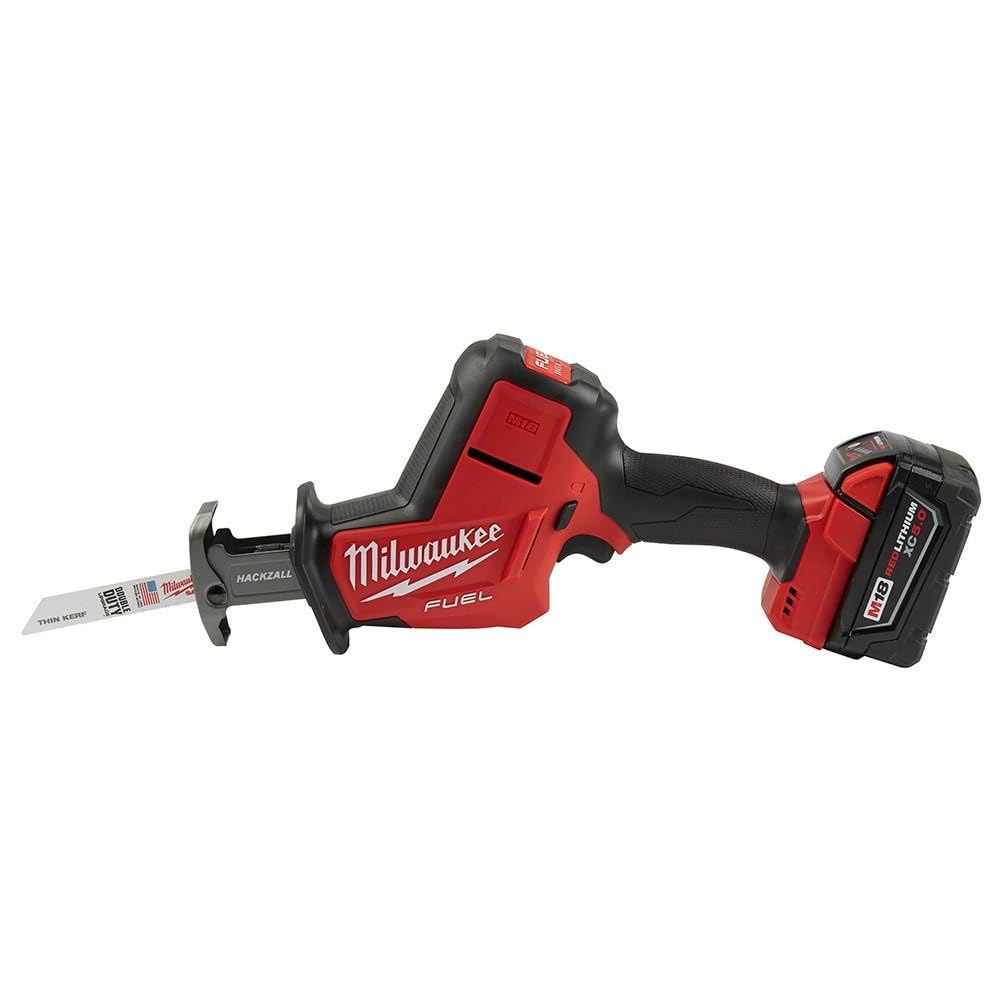
The only saw here that cuts 6-inch diameter stumps flush with the ground without stalling.
The Milwaukee M18 Fuel Hackzall is the heaviest saw in the lineup at 9.52 pounds, but that weight comes from a brushless motor and build quality that customers note “matches corded Sawzall performance.” One reviewer described cutting 6-7-inch diameter stumps flush with the ground using a 9-inch blade, and the blade “never stalled,” then processed a full 25-foot storm-felled tree. That level of sustained cutting power is what separates this saw from lighter compact models — it is built for real demolition and tree work, not light pruning.
The kit includes one M18 5.0Ah battery, and the reviewer noted it recharged from one LED light bar in about 30 minutes, meaning you can work through multiple packs without long downtime. The Hackzall design is compact for its class, so it excels in tight spaces and overhead work where a full-size corded saw would be awkward. The tool-free blade change is fast. It runs on Milwaukee’s M18 platform, which covers hundreds of tools.
The biggest factor stopping most homeowners is the weight — at nearly 10 pounds with the battery, this saw taxes your arm during extended overhead use. It is also the most expensive option, sitting at the premium end of the range. For light home tasks, a lighter saw like the Ryobi compact or the Olmlmo kit is a smarter choice.
What makes it elite
- Pro-grade power cuts 6-inch stumps and heavy tree limbs without stalling
- Includes one M18 5.0Ah battery — fast recharge in about 30 minutes from one LED
- Compact Hackzall body fits tight spaces despite the heavy build
The price of power
- At 9.52 pounds, it is the heaviest saw here — overhead work gets tiring quickly
Who it fits: Professional contractors, arborists, and serious homesteaders who need to cut thick stumps and large tree limbs without the saw bogging down or stalling.
Not for the casual user: If your cutting needs top out at 2×4 lumber and occasional pruning, the weight and price are overkill — a compact model gets the same jobs done with less fatigue.
Understanding the Specs
Stroke Length
Stroke length is the distance the blade moves back and forth in one cycle, measured in inches. A longer stroke — like the 1-1/8 inches you get on the DEWALT DCS387P1 and DCS368B — pushes the blade deeper into the material on every pass. This means you cut through thick wood, metal, or branches in fewer strokes, which translates to faster work without pushing harder. Saws with stroke lengths under 1 inch cut slower and are better suited for light pruning, PVC, and drywall.
SPM (Strokes Per Minute)
Strokes per minute controls the speed of the cut. Higher SPM numbers (3,000-3,600) work well for fast cuts in softer materials like wood and plastic, while slower speeds prevent the blade from overheating or binding in metal. A variable-speed trigger gives you the control to dial the speed up or down based on the material — start slow to set the blade groove, then squeeze full throttle to rip through the cut. Fixed-speed saws are cheaper but force you to cut everything at the same pace, which leads to rougher edges and wasted battery life.
Amp-Hours (Ah)
Amp-hours tell you the energy capacity of the battery — think of it as the size of the fuel tank. A 5.0Ah battery holds roughly twice the charge of a 2.5Ah battery, so the saw runs longer before needing a recharge. For heavy cutting like demo or pruning thick limbs, a 4.0Ah or 5.0Ah pack keeps the saw running through the job. For quick cuts and light tasks, a 2.0Ah pack saves weight but needs to be swapped more often. Some saws come with two batteries (like the Olmlmo), which compensates for lower individual capacity by letting you swap and keep working.
Brushless vs Brushed Motor
A brushless motor eliminates the physical brushes that transfer electricity inside the motor, replacing them with electronic controls. The result is less friction, less heat buildup, and more of the battery’s energy going directly to the cutting action. Brushless saws run quieter, deliver more torque when the blade hits a dense knot, and the batteries last longer per charge because the motor wastes less energy as heat. Most modern cordless reciprocating saws over the price point are brushless, and the extra cost is worth it for the runtime and cutting consistency.
FAQ
Can a battery Sawzall really replace a corded reciprocating saw?
How long does a battery last on a cordless reciprocating saw?
What is the difference between a Sawzall and a reciprocating saw?
Do I need a brushless motor in a battery reciprocating saw?
Can I use a battery Sawzall to cut metal?
Is a one-handed reciprocating saw worth buying?
What blade length do I need for a battery Sawzall?
Can I use other brand batteries in a DeWalt or Milwaukee reciprocating saw?
How do I maintain a cordless reciprocating saw?
Is the Olmlmo reciprocating saw a good brand?
Final Thoughts: The Verdict
If you want one dependable pick, the battery sawzall winner is the DEWALT DCS387P1 because it combines a 1-1/8-inch stroke length, a 5.0Ah battery, and a compact 14.5-inch body that fits between studs — giving you cutting speed, all-day runtime, and tight-space maneuverability in one package. If you need a lightweight one-handed saw for overhead trimming, grab the RYOBI PSBRS01B at 3.75 pounds. And for professional heavy-duty cutting where the blade must never stall, the standout is the Milwaukee 2719-21 M18 Fuel Hackzall Kit.
How We Picked
We do not accept paid placement. Every pick is matched to a real buyer and a real use-case; we do not hands-on test units.
Sources & Methodology
Specifications: manufacturer listings and product documentation. Review insights: verified customer reviews, as of July 2026. Pricing: not shown on this page (it changes often); check the current price via the retailer link.
As an Amazon Associate, Gadgets Feed earns from qualifying purchases. This does not affect which products we feature.