
Our readers keep the lights on and my morning glass full of iced black tea. As an Amazon Associate, I earn from qualifying purchases.
Specs are compiled from manufacturer listings and verified buyer reviews and can change over time — please confirm the key details on the product page before buying.
If you have ever woken up to a burst pipe after a hard freeze, you already know that not all foam insulation is the same. A 4 inch inner diameter is a common size for larger plumbing, HVAC, or outdoor pipes, but unless the foam is thick enough and closed-cell (each bubble sealed so water cannot travel through the material), you are just wrapping the problem in something that looks warm. The real question is which insulation stops cold penetration without tearing during installation or rotting after one season.
I’m Min — the founder and writer behind Gadgets Feed. This guide is built by comparing the manufacturers’ published specifications and the patterns across verified customer reviews, so you get each pick’s real strengths and trade-offs instead of marketing spin.
Each option below comes from a specific real-world scenario — if you need a foil-faced sleeve for outdoor freeze protection, a super-dense neoprene tube (a synthetic rubber that resists moisture and extreme cold) for severe winters, or a lightweight general-use foam wrap for handle grips and indoor pipes. This is your straight-to-the-point guide to the best 4 inch foam pipe insulation.
Our Picks at a Glance

How To Choose The Best 4 Inch Foam Pipe Insulation
Picking pipe insulation is more than matching the inner diameter. The wrong material — or the wrong installation method — means the pipe still freezes, or the foam falls off after a few months. Here are the three numbers that actually decide whether your pipes stay warm and dry.
Inner Diameter vs Wall Thickness
The inner diameter (ID) must match your pipe’s outer diameter exactly — for a 4-inch pipe, you need a foam with a 4-inch ID. But the wall thickness matters just as much; it determines how much cold air the insulation stops. A thicker wall (1.18 inches or more) gives a higher R-value (a rating of how well the material resists heat flow). If you live where winter temps drop into the teens for days at a time, thin foam at 3/8-inch wall thickness is not going to cut it — reviewers report that products with a 1.18-inch wall protect pipes successfully through temperatures in the teens and twenties for several days.
Pre-slit vs Solid Tube Design
Pre-slit insulation has a cut down the length of the foam so you can open it and snap it over an already-installed pipe. Solid tubes must be cut open lengthwise yourself, which takes extra work. If your pipe is already in place and you cannot slide the foam over an open end, a pre-slit or split design is almost mandatory. Buyers report that some solid tubes do not come split to wrap around installed pipe, so you have to make your own cut with a utility knife and secure the seam with tape or cable ties.
Foil Facing and Water Resistance
The outer layer of the insulation can be bare foam, or it can have an aluminum foil film (a thin metal coating bonded to the outside). Foil facing serves two jobs: it reflects radiant heat back toward the pipe, and it blocks water vapor from soaking into the foam. For outdoor pipes exposed to rain, snow, or ground moisture, a foil-faced sleeve prevents the insulation itself from turning into a soggy sponge. One reviewer warned that with bare foam outdoors, you need to tape the split closed every six inches and use aluminum foil tape between sections to stop water intrusion.
Quick Comparison
| Model | Best For | Wall Thickness | Weight | Design Type | Amazon |
|---|---|---|---|---|---|
| MObyat Water Pipe Insulation Sleeve★ Best Overall | Outdoor freeze protection with foil | 1.18 Inches | 150 Grams | Pre-slit with self-adhesive | Amazon |
| Plerile Pipe Insulation Tubing | Severe winter freeze defense | 1.18 Inches | — | Solid tube (no split) | Amazon |
| LZXNFZY Foam Tube Insulation | Budget-friendly multi-purpose use | 20 Millimeters | 480 Grams | Solid tube (no split) | Amazon |
In‑Depth Reviews
1. MObyat Water Pipe Insulation Sleeve (Foil-Faced)
Our pick — over 4★ from 40+ verified ratings; the strongest balance of quality and price.
The foil-faced sleeve that snaps on and stays put, handling outdoor freeze and rain head-on.
The MObyat sleeve saves you from wrestling with a solid foam tube. It comes pre-slit — you open the cut, clamp it around the pipe, peel off the self-adhesive paper on the film, and wrap. The adhesive on the outer foil film (a thin metal layer bonded to the rubber) locks the seam so it does not peel open. At a 1.18-inch wall thickness, the manufacturer rates it for indoor and outdoor use on water, gas, and solar lines. The rubber material is flame retardant (it resists burning and self-extinguishes) and resists high temperatures. Because it is pre-slit, you do not need to disconnect your plumbing — unlike the solid Plerile tube, which requires a DIY cut.
Owners mention it is “nice insulation for a four inch pipe” and easy to install, though the foil outer facing feels less sturdy than it looks in photos. One reviewer advised: since there is no built-in adhesive on the foam itself, use aluminum tape over the split every six inches and between sections outdoors to stop water from getting inside. This MObyat sleeve weighs 150 grams (about 0.33 lbs), while the LZXNFZY weighs 480 grams. The lighter foam is easier to handle but compresses more easily under physical pressure. If your pipe sits where it will take repeated bumps, the denser Plerile tube below holds up better.
Why It Works
- Pre-slit with self-adhesive seam saves installation time
- Foil facing reflects heat and blocks moisture for outdoor pipes
- Flame-retardant rubber material with 1.18-inch wall thickness
- Buyer-tested: worked well on a 4-inch pipe straight from the package
Watch For
- No adhesive on the split itself — you need tape to seal the seam
- Foil outer layer is not heavy-duty; some buyers called it subpar
- Comes folded in packaging, so letting it sit to straighten out helps
The takeaway: This is the pick for a fast install on an already-installed outdoor pipe. But if your pipe takes physical abuse, the softer 150-gram foam dents more easily than the denser Plerile or LZXNFZY tubes.
2. Plerile Water Pipe Insulation Tubing

The dense, closed-cell neoprene tube that takes sub-freezing temperatures in stride for years.
One buyer specifically noted this Plerile tubing “protects pipes for 2 years so far with temperatures in the teens and twenties for several days” — the strongest real-world freeze test in this lineup. The insulation uses a closed-cell rubber structure (each bubble of foam is sealed, so moisture cannot travel through the material), which gives it low thermal conductivity (it holds heat inside the pipe much better than open-cell foam). The manufacturer pitches it as industrial-grade for home use, fully flame retardant and waterproof. The foam arrives as a solid tube with no lengthwise cut, so unlike the pre-slit MObyat, you will need to split it yourself with a utility knife before wrapping it around an installed pipe.
The same reviewer called it “very thick and durable.” However, because the foam is a solid tube, you have to create your own split — and there is no adhesive, so buyers have used velcro, cable ties, or tape to secure the seam. Density figures are not listed for this Plerile, but reviewers describe it as thick and dense, suggesting it will handle physical bumps better than the MObyat. The manufacturer lists uses including pipe protection, fitness equipment handle grips, and general hose insulation. Delivery can take about a month from overseas (China), so if you need insulation this week, the MObyat sleeve is the faster option.
What Stands Out
- Closed-cell neoprene stops moisture penetration in wet outdoor conditions
- Buyer-proven: survived temperatures in the teens and twenties for two years
- Thick rubber material that buyers call durable and high-quality
- Fully flame retardant and waterproof for industrial-grade coverage
The Catch
- No pre-split — you must cut the tube open yourself for installation
- No adhesive, so you need tape, velcro, or cable ties to close the seam
- Shipping from China can take ~1 month and arrive in multiple packages
Who picks this over the MObyat: anyone with exposed outdoor pipes in hard-winter areas who needs proven freeze protection beyond a single season and is willing to wait a month and do a DIY split.
3. LZXNFZY Foam Tube Insulation
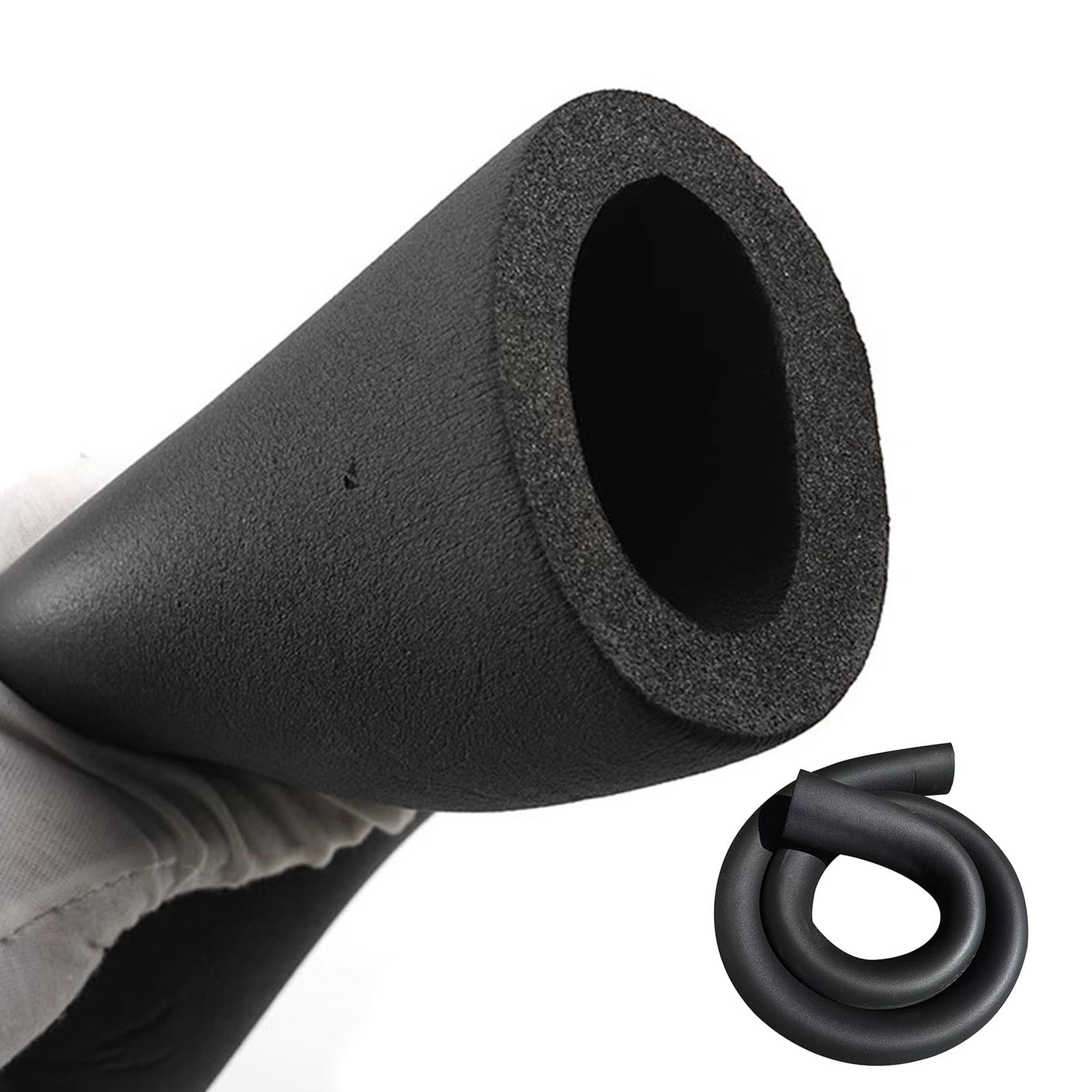
The heavier, low-density foam tube that pulls double duty as pipe wrap and handle grip padding.
At 480 grams (roughly 1.06 lbs), this LZXNFZY tube is the heaviest option here, while the MObyat sleeve weighs 150 grams. — but that weight comes from the foam being physically larger rather than denser. The wall thickness is 20 millimeters (about 0.79 inches), which is thinner than the 1.18-inch wall on the MObyat and Plerile picks. The manufacturer lists it for thermal insulation, moisture protection, and anti-freeze on water pipes, HVAC lines, copper pipes, and as a buffer for shock absorption and sound dampening. One buyer used it to make wraps for the straps on a backpack blower to stop them from slipping.
The catch is the same as the Plerile tube: this is a solid foam tube with no longitudinal split. Customers note it “does not come split to wrap around installed pipe,” so you need a utility knife to cut it open yourself. One reviewer found it easy to cut and used cable ties to fasten it around the pipe since the smooth surface did not hold tape well. The 4.1-star rating from 22 reviews is decent but the sample is small. If your main use is insulating an installed pipe outdoors, the pre-slit MObyat is far more convenient. But if you need a few feet of foam for indoor handle padding, crafts, or a non-freeze pipe you can slide the tube over an open end, this is the cheapest entry point.
Best For
- Lowest cost option for 4-inch ID foam insulation in this lineup
- Flexible rubber foam buyers describe as strong and easy to cut
- Multi-purpose: use on water pipes, HVAC, or as handle grip padding
- 20mm wall thickness offers reasonable protection in mild climates
Limitations
- Solid tube only — no pre-split, no adhesive for fast installation
- Thinner wall (20mm) than the 1.18-inch picks above
- Smooth surface makes tape adhesion tricky; cable ties work better
Price-to-value choice: Get this if you have an accessible pipe end to thread the tube over and you want the lowest price. For severe outdoor freeze protection, the thicker wall of the MObyat or Plerile is worth the extra cost.
Understanding the Specs
Wall Thickness vs R-Value
The wall thickness of foam insulation — how many inches or millimeters of foam sit between the pipe and the outside air — directly controls how much cold gets through. A thicker wall means a higher R-value (a standard industry number that tells you how well the material resists heat transfer). For a 4-inch pipe, a 1.18-inch wall (about 30 mm) is considered heavy-duty; a 20 mm wall (roughly 0.79 inches) is light-duty. If your winters hit the teens, aim for the 1.18-inch wall.
Closed-Cell vs Open-Cell Foam
Closed-cell foam has sealed bubbles that prevent water vapor from soaking into the material. Open-cell foam absorbs moisture over time, which kills its insulating power and can cause mold on the pipe. Every foam listed here uses closed-cell rubber. For outdoor or underground pipes, closed-cell is mandatory — otherwise the insulation becomes a wet sponge that actually transfers cold faster than bare pipe. Check the listing for “closed cell structure” in the description.
Pre-Slit vs Solid Tube
Pre-slit foam has a factory cut along the full length so you can snap it over a pipe without disconnecting plumbing. Solid tubes require you to make your own split with a utility knife. If the pipe is already installed and you cannot slide the tube over an open end, pre-slit is essential. Solid tubes are cheaper and leave a cleaner surface if you need the foam for a new build where the pipe is accessible. Self-adhesive on the split seam is an extra convenience — it keeps the seam closed without tape.
Foil Facing vs Bare Foam
Foil facing is a thin layer of aluminum bonded to the foam’s outer surface. It reflects radiant heat back toward the pipe (helping in hot or cold conditions) and acts as a vapor barrier to stop moisture from seeping into the foam. Bare foam works fine indoors, but outdoors — exposed to rain, sprinklers, or ground moisture — foil facing dramatically extends the insulation’s life. The tradeoff is that foil can dent or tear more easily than the rubber foam itself, so it needs careful handling.
FAQ
What size foam do I need for a 4-inch pipe?
Will any 4-inch ID foam work for outdoor pipes exposed to rain and snow?
How thick should the foam be for freeze protection?
Can I use foam pipe insulation on gas pipes?
What does “pre-slit” mean and do I need it?
How do I secure the seam on a solid foam tube?
How long does foam pipe insulation last?
Can I paint or cover foam pipe insulation?
Is heavier foam always better insulation?
Final Thoughts: The Verdict
For most homeowners, the best 4 inch foam pipe insulation winner is the MObyat Water Pipe Insulation Sleeve because it combines a pre-slit design, foil weather facing, and a 1.18-inch wall thickness in a package that snaps on fast without disconnecting your plumbing. If you need proven severe-winter defense with a track record of surviving temperatures in the teens for two years, grab the Plerile Pipe Insulation Tubing. And for a lightweight multi-purpose foam meant for handle grips or non-critical indoor pipes where you can slide the tube over an open end, the standout is the LZXNFZY Foam Tube Insulation on price.
How We Picked
We do not accept paid placement. Every pick is matched to a real buyer and a real use-case; we do not hands-on test units.
Sources & Methodology
Specifications: manufacturer listings and product documentation. Review insights: verified customer reviews, as of July 2026. Pricing: not shown on this page (it changes often); check the current price via the retailer link.
As an Amazon Associate, Gadgets Feed earns from qualifying purchases. This does not affect which products we feature.