
Our readers keep the lights on and my morning glass full of iced black tea. As an Amazon Associate, I earn from qualifying purchases.
Specs are compiled from manufacturer listings and verified buyer reviews and can change over time — please confirm the key details on the product page before buying.
A battery backup generator silently powers your fridge, internet, and lights during an outage—no fumes, no noise. The trick is matching the unit’s capacity (Wh) and output (W) to your actual appliances—most buyers get this wrong.
I’m Min — the founder and writer behind Gadgets Feed. This guide is built by comparing the manufacturers’ published specifications and the patterns across verified customer reviews, so you get each pick’s real strengths and trade-offs instead of marketing spin.
This roundup of the best battery backup generator models cuts through the conflicting numbers to show you exactly which unit fits your life and your budget.
Our Picks at a Glance
How To Choose The Best Battery Backup Generator
Picking the wrong unit usually means underestimating your fridge’s starting surge or ignoring recharge speed. These three specs separate a useful backup from a frustrating one.
Capacity (Wh) vs. Output (W): The Real Math
Capacity is the total energy tank, measured in watt-hours (Wh)—think of it like the size of your gas can. Output is the instantaneous power it can deliver, measured in watts (W), which determines whether that tank can start a refrigerator’s compressor motor. A unit with 2000Wh but only 1500W output may still trip on a freezer’s starting surge, so you need both numbers to match your heaviest appliance’s running and peak draw.
Battery Chemistry: LiFePO4 vs. Older Lithium-Ion
LiFePO4 (lithium iron phosphate) batteries last thousands of charge cycles—often 4,000 or more—before dropping to 80% capacity. Older lithium-ion chemistries typically degrade after 500 cycles. For a backup that still holds a meaningful charge a decade from now, LiFePO4 is non-negotiable.
UPS Switchover Speed
If you plug a desktop computer or a medical device into the generator, the time it takes to switch from wall power to battery matters. A 10ms (millisecond) UPS transfer is fast enough that a PC or router never resets. A slower 20ms switch might still be fine for a refrigerator but can reboot sensitive electronics.
Quick Comparison
| Model | Best For | Capacity (Wh) | AC Output (W) | Weight (lbs) | Amazon |
|---|---|---|---|---|---|
| EF ECOFLOW DELTA 3 Classic★ Best Overall | Versatile Home Backup | 1024 | 1800 | 15 | Amazon |
| BLUETTI Elite 100 V2Compact Power | Compact Portability | 1024 | 1800 | 25 | Amazon |
| Anker SOLIX S2000Fridge Specialist | Fridge Runtime | 2010 | 1500 | 35.7 | Amazon |
| Jackery Explorer 2000 v2 | High Capacity, Compact | 2042 | 2200 | 39.5 | Amazon |
| BLUETTI AC200L | Expandable Whole-Home | 2048 | 2400 | 61.4 | Amazon |
| Anker SOLIX C2000 Gen 2 | Fastest Recharge | 2048 | 2400 | 41.7 | Amazon |
| AFERIY P310 | Huge Capacity Value | 3840 | 3600 | 104.7 | Amazon |
| Jackery HomePower 3000 | RV-Ready 30A Outlet | 3072 | 3600 | 59.52 | Amazon |
| EF ECOFLOW DELTA Pro | Maximum Expandability | 3600 | 3600 | 99 | Amazon |
In‑Depth Reviews
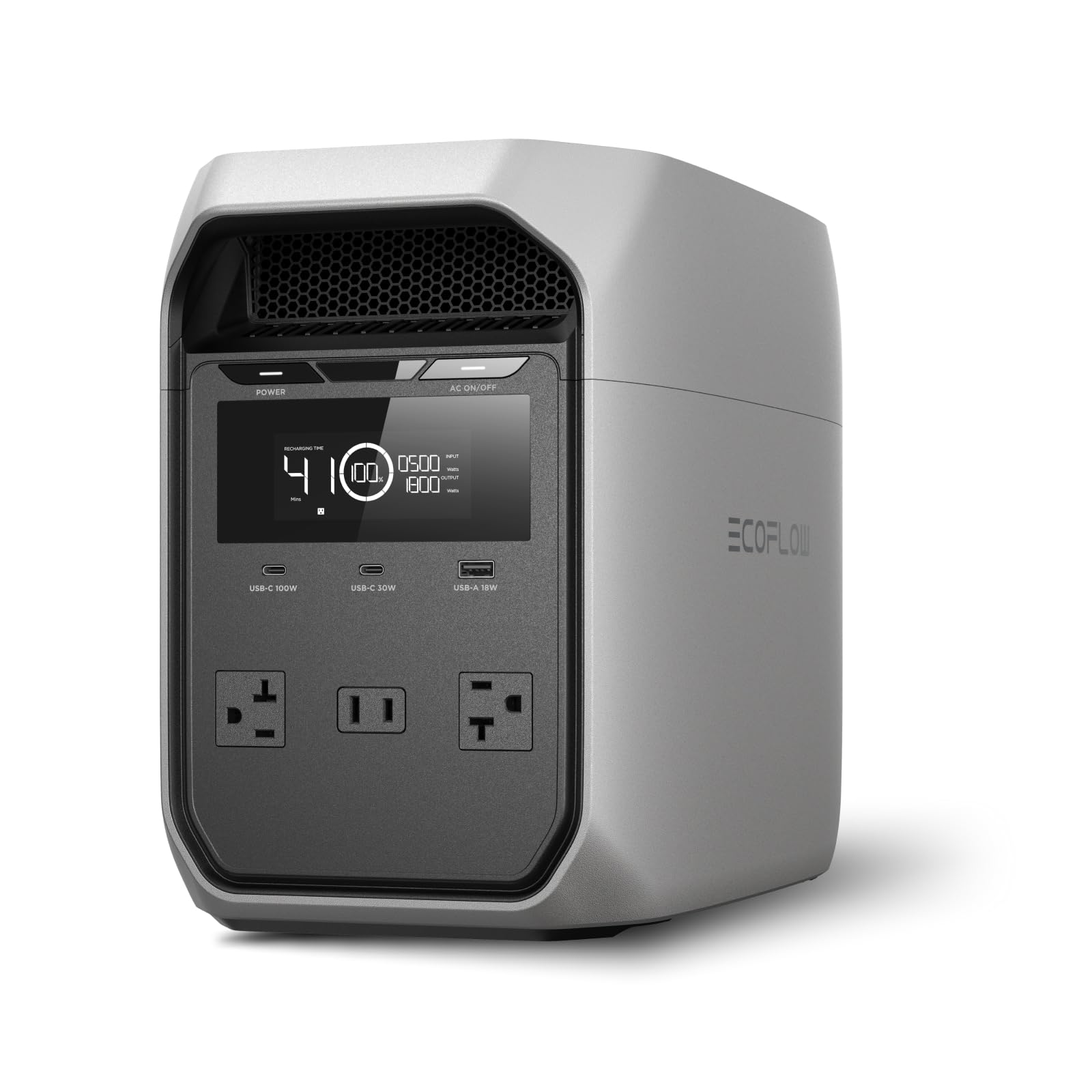
1. EF ECOFLOW DELTA 3 Classic
Our pick — over 4.5★ from 850+ verified ratings; the strongest balance of quality and price.
A 15-pound power station that charges faster than you can finish lunch.
The DELTA 3 Classic earns its spot because it packs 1800W AC output (alternating current, the standard household power) with a 3600W surge for starting motors, all from a 1024Wh LiFePO4 (lithium iron phosphate, a long-lasting battery chemistry) battery, yet weighs just 15 pounds. That is 2.6 times lighter than the Jackery Explorer 2000 v2, though Jackery holds twice the capacity. What makes it a daily driver is the 0% to 80% charge in 45 minutes — a full 47% faster than the Jackery’s 66-minute sprint to 80%. If you need a lightweight unit for short outages or camping, this is your pick. skip it if you need more than 1kWh of capacity for a multi-day outage.
Buyers report using it as a “convenient UPS with 400% more battery than dedicated UPS,” noting the <10ms automatic switchover that keeps a PC or router running through a blink. The 100W USB-C output handles a laptop directly, and the smart app lets you set charging schedules or activate storm alerts. Skip this if you need a full-day refrigerator backup—at 1024Wh, it is best for an evening outage, a weekend camping trip, or keeping your Wi-Fi and medical device alive, not running a whole house.
Instant power, tiny footprint: At 15 pounds and a 7.9 x 11.1 x 15.7-inch frame, this is the one you grab without groaning.
Know the limit: 1024Wh runs a fridge for roughly 6-10 hours, not days. Pair it with a solar panel for extended off-grid use.
Perfect for: anyone who needs a portable, fast-charging backup for short outages, camping, or protecting a home office PC.
Reconsider if: you need sustained multi-day capacity—step up to the 2kWh+ models below.
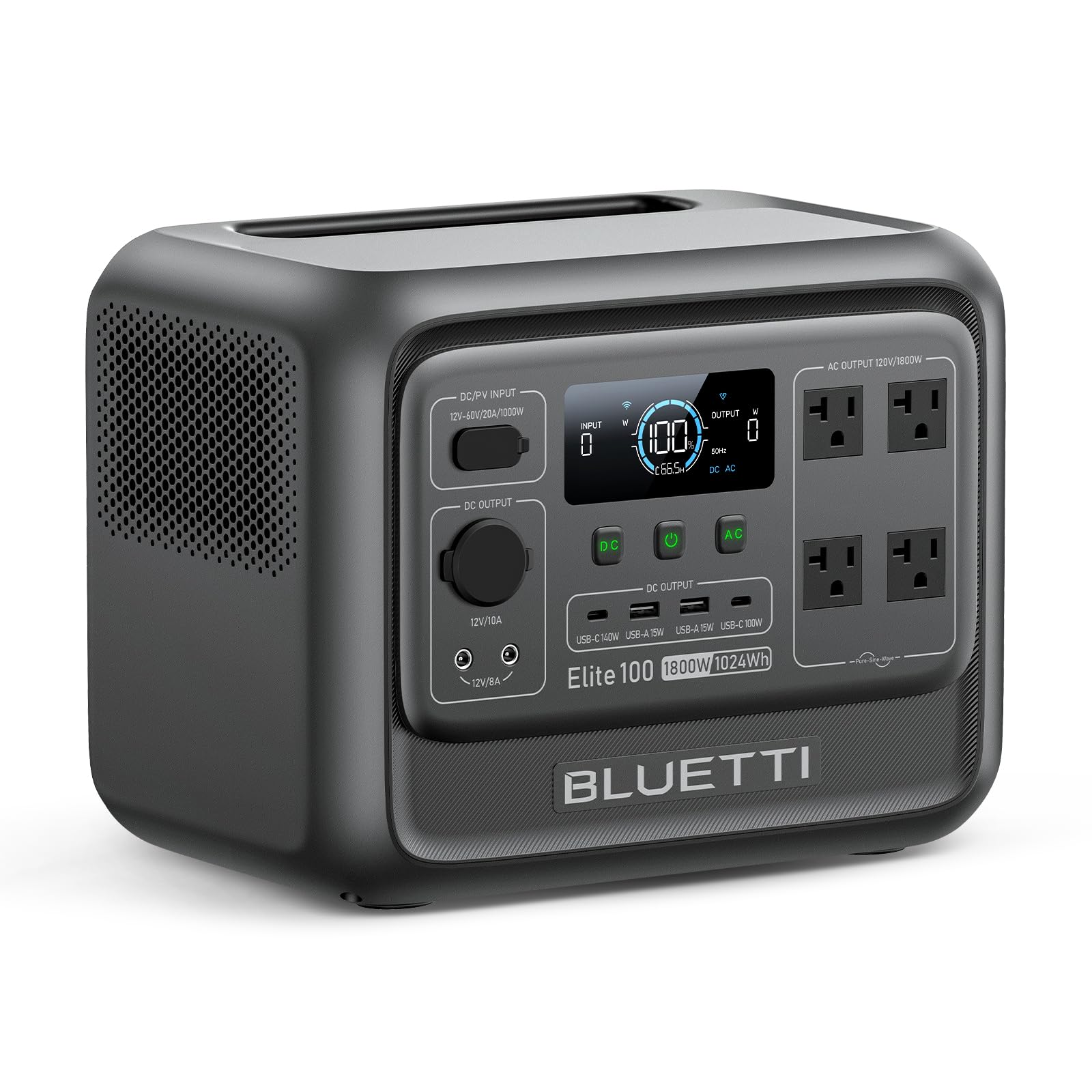
2. BLUETTI Elite 100 V2
A 25-pound midsize champ that slips into a car trunk and runs a mobile office all day.
BLUETTI took the same 1024Wh capacity and 1800W output as the EcoFlow DELTA 3 Classic and compressed it into a body that is 35% smaller than their previous generation. At 12.6 x 8.5 x 9.8 inches, it takes up 59% more volume than the DELTA 3 Classic but adds a hidden carry handle and an extra 10 pounds of ruggedness. In silent mode it hums at just 30dB (decibels, a measure of sound level), which owners mention is “50% quieter than other 1kWh power stations,” making it ideal for an overnight camper van or a bedside CPAP (continuous positive airway pressure, a sleep apnea machine) backup. This one suits campers and CPAP users who value quiet operation over the smallest size.
One owner reported it “powered two electric chainsaws cutting 8-10″ limbs from mesquite trees after storm; still had 51% charge remaining,” a solid endorsement for storm cleanup. The 10ms UPS switchover protects electronics, and the app handles remote monitoring. The catch: at 25 pounds it is not a pocket unit, and customers note the app is clunky and cannot power on the unit via Bluetooth.
Why it works
- Fast 70-minute full charge via 1200W TurboBoost or up to 1000W solar input.
- Runs at 30dB silent mode—quieter than a library.
- 4,000+ life cycles to 80% means a 10-year usable lifespan.
Small friction points
- App lacks Bluetooth/Wi-Fi power-on feature.
- Heavier than the EcoFlow DELTA 3 Classic at 25 lbs vs 15 lbs.
Grab this if: you want a near-silent, compact 1kWh generator that rides in your trunk and charges faster than most rivals.
Look elsewhere if: absolute minimum weight is your priority—the 15-lb EcoFlow DELTA 3 Classic is lighter.
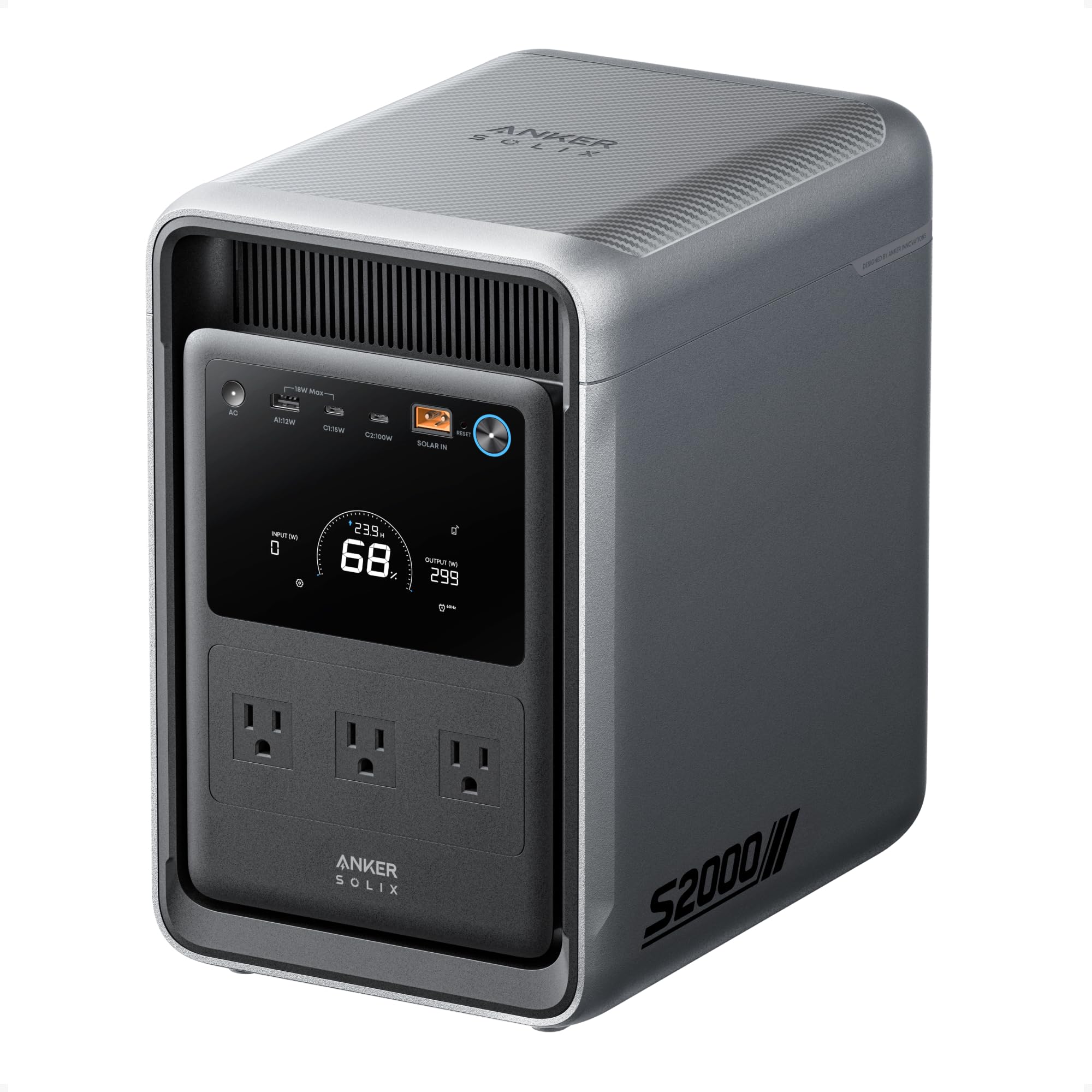
3. Anker SOLIX S2000
A 2kWh unit that sips its own power, stretching a fridge backup to 35 hours.
Anker engineered the S2000 around idle draw — it pulls only 6W on standby, so the 2010Wh LiFePO4 battery keeps a refrigerator running 20% longer than other 2kWh systems. It delivers 1500W continuous AC output (3000W peak), which is a 47% lower continuous output than the Jackery Explorer 2000 v2’s 2200W, but the trade-off is a smaller, lighter body: 35.7 pounds and 8.2 x 11.1 x 12.7 inches. One reviewer noted it “powered through 30-hour outage” without breaking a sweat. If you want 35 hours of refrigerator runtime and a 15-year battery lifespan, this is your unit. pass on it if you need 2200W continuous output for high-draw appliances.
The six recharge methods are a standout—AC, solar, car, generator, alternator, or combined AC+solar. The 10,000-cycle LFP cells are rated for a 15-year lifespan, the longest of any unit in this roundup. The missing 12V DC port is a bummer for running a car fridge or CPAP directly, but the front-and-rear AC outlet layout keeps your always-on devices tidy.
Runtime champion: At 6W idle draw, the S2000 wastes almost no power, so your fridge runs 35 hours instead of 28.
One omission: No 12V DC barrel or cigarette port—if you need that, look at the BLUETTI or EcoFlow units.
Best for: anyone who needs a long-running, compact fridge backup with smartphone app control and a 15-year battery lifespan.
Not for: users who need a 12V DC port for a car cooler or CPAP machine.
4. Jackery Explorer 2000 v2

The 2kWh market’s balance — bigger capacity than most, yet 34% smaller than the category average.
Jackery calls this the “smallest and lightest 2kWh power station” at 39.5 pounds and a 13.2 x 10.4 x 11.5-inch frame, and the numbers back it up: it is 41% lighter and 34% smaller than typical 2kWh LiFePO4 units. The 2042Wh battery drives a 2200W AC output — a 2200W vs 1500W advantage over the Anker S2000 — and the 66-minute 0-80% charge is fast enough to top up between outage cycles. Reviewers point out using it to “power the refrigerator, kitchen appliances, and family room TV for several hours and still had power to spare.” This is the pick if you want the highest continuous output in a 2kWh package.
The 20ms UPS switchover is UL-certified, and the silent charging mode runs at under 30dB. The CTB (cell-to-body) construction gives it the structural feel of an EV battery pack. The weak points: the solar input barrel connectors are mounted on a flexible side panel, and the Bluetooth app connection is not persistent—you may need to re-pair when you check in.
Space-saving win
- 39.5 lbs—41% lighter than typical 2kWh stations.
- 2200W AC output can handle a refrigerator plus a microwave simultaneously.
- 10-year LiFePO4 lifespan with 4000 cycles.
Real-world annoyances
- Solar input barrel connectors flex the housing when plugged in—a design concern for regular solar users.
- Bluetooth pairing is not persistent, so the app sometimes fails to connect.
Reach for this if: you want the best capacity-per-pound ratio in a 2kWh class, with enough juice to run a fridge, TV, and lights for several hours.
Consider something else if: you plan to plug in solar panels daily—the barrel connector housing flex is a durability concern.
5. BLUETTI AC200L

A 2400W powerhouse that scales to 8192Wh—enough to run a whole home for a day.
The AC200L starts at 2048Wh and 2400W AC output (3600W Power Lifting surge), but its real a neat extra is expansion: add up to two B300K, B210, B300, or a single B230 battery pack to reach 8192Wh total. That is four times the base capacity of the Anker S2000 or Jackery 2000 v2, letting you power a full refrigerator, freezer, 64-inch OLED TV, and security cameras for roughly 10 hours, per one reviewer’s setup. It also includes a 30A RV port and a 48V/8A DC port for charging an RV’s battery directly.
The 0-80% charge takes only 45 minutes at 2400W AC input, and up to 1200W solar input keeps it topped off off-grid. The 61.4-pound weight is a commitment—this is a “stationary backup that can be moved” rather than a daily carry. One RV owner noted it starts a roof air conditioner with no surge issue, which many smaller units struggle with.
Grow-as-you-go capacity: Start at 2048Wh and add up to 8192Wh with expansion batteries—perfect for scaling from weekend camping to whole-home backup.
Weight reality: At 61.4 lbs without added batteries, this is a two-hand carry. Not for frequent camping tote.
Ideal for: homeowners who want a base unit today that can grow into a whole-house system without replacing the core.
it’s not for you if: you need a daily carry or a unit under 30 pounds—look at the EcoFlow DELTA 3 Classic instead.
6. Anker SOLIX C2000 Gen 2
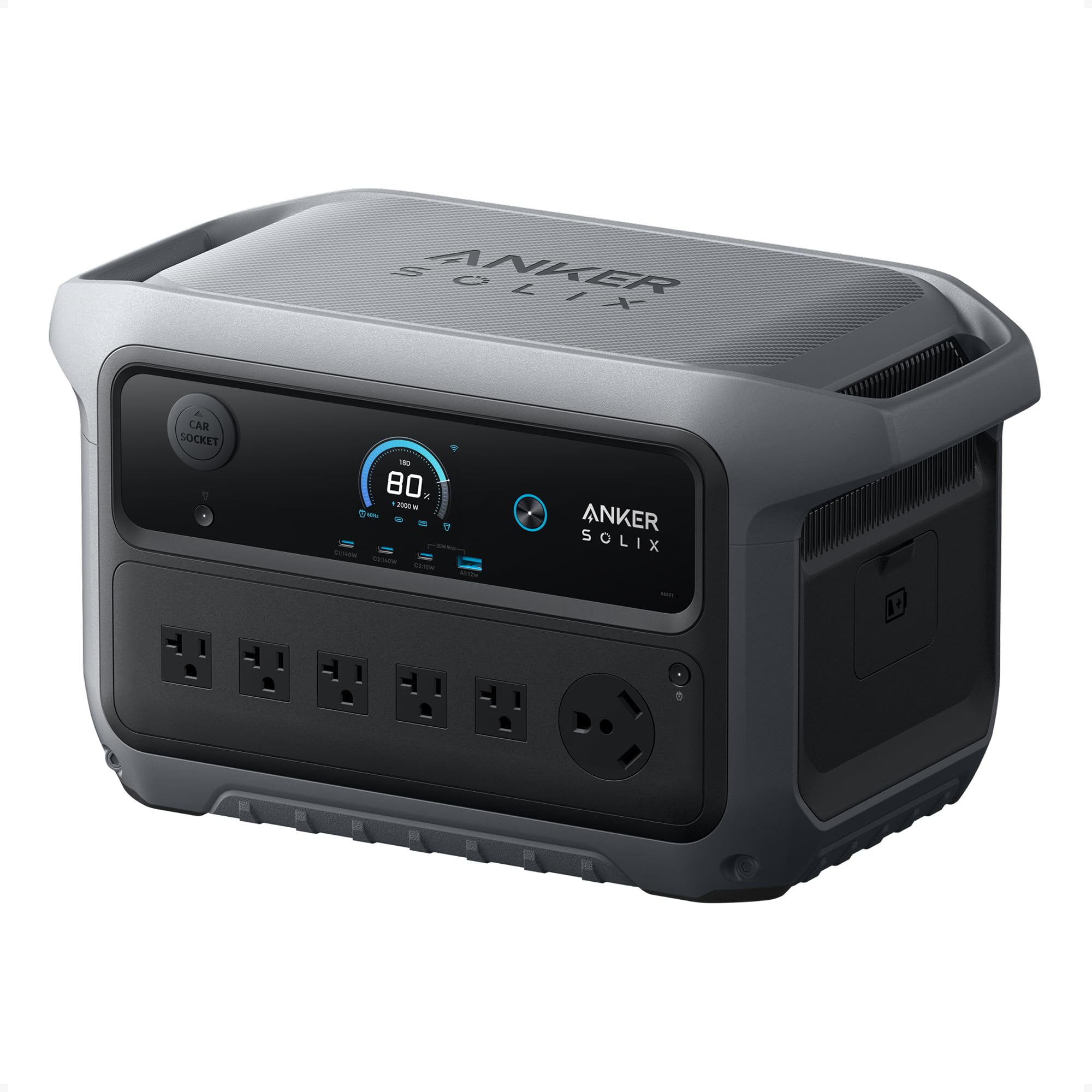
A 2kWh station that recharges fully in 58 minutes—faster than most people’s lunch break.
The C2000 Gen 2 delivers 2400W continuous (4000W peak) from a 2048Wh LiFePO4 battery, and it recharges from empty to 100% in 58 minutes via AC+ solar, which beats the Jackery 2000 v2’s 66-minute 0-80% sprint to full. It is also 25% lighter and 29% smaller than similar products, at 41.7 pounds and 18.1 x 9.8 x 10.1 inches. Shoppers say using it to run a BougeRV 30-quart fridge for 5-7 days straight on a road trip, and one buyer mentioned it powered two fridges, a freezer, and multiple devices for months without drop.
The expandable design accepts an extra battery to reach 4kWh (64 hours of fridge runtime), and the 800W alternator charging tops up from your car in 3 hours. The 9W standby draw is ultra-efficient. The main competition is the Anker S2000 above—the C2000 Gen 2 trades a marginally larger footprint for 900W more continuous output and faster recharge.
Speed highlights
- 0-100% in 58 minutes—the fastest full recharge in this lineup.
- 2400W continuous output handles most window and RV A/Cs.
- Expandable to 4kWh for extended backup.
Minor gripes
- At 41.7 lbs, it is not a one-hand carry.
- No 12V DC port—car accessory users need an adapter.
Best for: anyone who needs a fast-recharging 2kWh generator that can run a window A/C during a heat-wave outage.
Look elsewhere if: you need a 12V DC port for a car fridge or CPAP—go with the EcoFlow DELTA 3 Classic or BLUETTI Elite 100 V2.
7. AFERIY 3840Wh P310

Nearly 4kWh of power for a budget-friendly price—the best Wh-per-dollar ratio you will find.
The AFERIY P310 packs 3840Wh of LiFePO4 storage and 3600W continuous output (7200W surge) into a wheeled cart that weighs 104.7 pounds. That is nearly double the base capacity of the Jackery HomePower 3000 (3072Wh) at a significantly lower cost per watt-hour. It includes 15 output ports: five 120V AC outlets, USB-A, USB-C (PD 3.0), DC5521, XT60, and a 12V car socket. The UPS transfer is under 10ms, protecting sensitive electronics.
Reviewers praise the build quality—”high-quality accessories, rugged wheels, sturdy cable”—and note it runs an entire RV (except the air conditioner) off-grid. The 2.5-hour fast charge is competitive for the capacity class. The catch is customer support: some buyers reported slow warranty communication, and a few units shipped with a non-functional LCD screen that required a replacement unit. The 7-year warranty is long, but actual support responsiveness has been spotty.
Insane capacity for the price: 3840Wh base, expandable to 11.5kWh, at a fraction of the cost of premium brands per Wh.
Customer support is a gamble: Several reviews cite delayed email responses and a multi-week exchange process for defective units.
Perfect for: budget-conscious buyers who prioritize raw capacity per dollar and can handle a 104-lb cart.
Skip if: you need reliable, fast customer support or a unit that is easy to move up stairs.
8. Jackery HomePower 3000
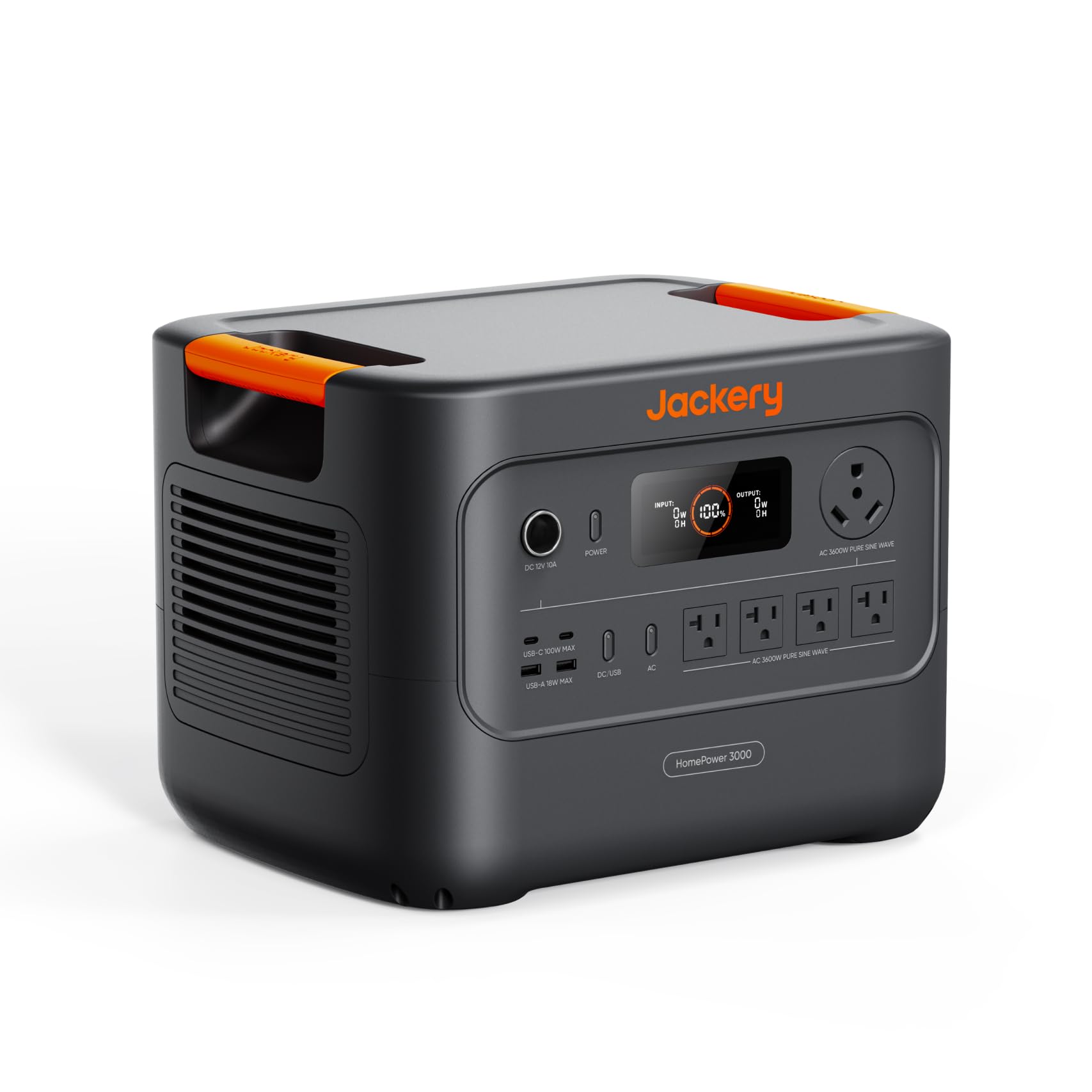
The 3kWh generator that plugs directly into your RV’s 30-amp service and runs it for days.
The HomePower 3000 delivers 3600W continuous output (7200W surge for starting motors) from a 3072Wh LiFePO4 battery, and it is the only unit here that claims “world’s first 3kWh portable power station with CTB technology” (cell-to-body, a design that integrates cells into the chassis), making it 47% smaller and 43% lighter than comparable 3kWh models — weighing 59.52 pounds. The built-in TT-30 RV port (a 30-amp standard RV outlet) lets you plug your camper directly without a separate adapter. One reviewer confirmed it “runs AC power sensibly for 3+ days without AC” while dry camping in a 30-foot travel trailer. This is for RV owners who want a single unit that powers a camper for days.
Charging is flexible: 1.7 hours via hybrid AC+DC, 2.2 hours via AC alone, or solar. ChargeShield 2.0 with AI algorithms extends battery life to 4,000 cycles at 70% capacity. The ≤20ms UPS is UL-certified, though the fan runs at roughly 60dB under load—noisier than the BLUETTI Elite 100 V2’s 30dB silent mode. Buyers love the 30-amp port but note the unit is “heavy but portable” at 60 pounds.
RV-friendly features
- Built-in TT-30 plug connects directly to RV power inlet.
- 3600W output (7200W surge) runs a microwave, coffee maker, and TV simultaneously.
- ChargeShield 2.0 extends battery to 4,000 cycles at 70% capacity.
Noise and weight
- Fan runs at ~60 dB under load—noticeable in a quiet RV or bedroom.
- 59.52 lbs is heavy; you will want the wheels or a dolly.
Ideal for: RV owners and homeowners who need a 30-amp hookup and enough power to run a small household for 1-2 days.
Not for: anyone who needs a silent bedside backup—the fan noise is louder than the whisper-quiet BLUETTI models.
9. EF ECOFLOW DELTA Pro
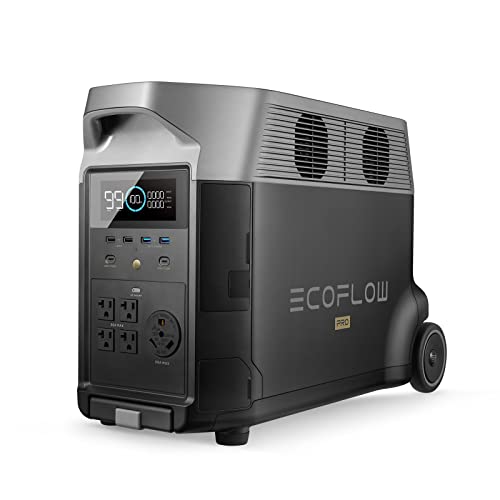
The 3600Wh flagship that partners with an EV battery to reach a staggering 25kWh.
The DELTA Pro starts with a 3600Wh LFP (lithium iron phosphate) battery and 3600W AC output (up to 4500W with X-Boost, a feature that lets it power higher-draw devices), and it can pair with DELTA Pro Extra Batteries or a Smart Generator to expand from 3.6kWh all the way to 25kWh — enough to power an entire home for multiple days. It accepts a 240V input for 3000W charging (1.8 hours to full), or 1800W from a standard wall outlet (2.7 hours). The solar input supports up to 1600W (four 400W panels) for a 2.8-hour solar recharge. This is the pick if you need whole-home expansion that can grow from 3600Wh to 25kWh.
Buyers are using it for serious commercial work: one runs a heat press at a vendor market without voltage drops, and another powers a home oxygen concentrator for 10 hours and 47 minutes straight. The 99-pound weight and 25 x 11.2 x 16.4-inch footprint make it a stationary unit that can be wheeled, not a daily carry. The five 120V AC outlets and 15 total output ports (including two 100W USB-C) cover almost any device.
System expandability: Pair two units for 7200W output or add extra batteries to reach 25kWh—a true whole-home solution.
Weight: 99 lbs: This is furniture-grade. Plan where it lives and add the optional wheel kit.
Best for: homeowners and mobile business owners who need a scalable, high-output system that can run heavy appliances all day.
Skip if: you need a portable unit for frequent camping trips—the 15-lb EcoFlow DELTA 3 Classic is better suited.
Understanding the Specs
Watt-Hours (Wh) vs. Watts (W)
Watt-hours tell you how much total energy the battery holds—like the size of a gas tank. Watts tell you how much power the unit can deliver at any given second—like the engine’s horsepower. A refrigerator with a 700W startup surge needs a generator that can handle that peak, even if its continuous load is just 150W. Always check the “surge” or “peak” wattage, not just the continuous output.
LiFePO4 Battery Cycles
LiFePO4 (lithium iron phosphate) batteries are rated for thousands of charge cycles before degrading to 80% capacity — typically 3,000 to 10,000 cycles. Older lithium-ion chemistries often last only 500 cycles. A higher cycle rating means the generator stays useful for a decade or more of weekly use, which is why every product in this guide uses LiFePO4.
FAQ
How long will a battery backup generator run a refrigerator?
Can a battery backup generator power a whole house?
What is the difference between a UPS and a battery backup generator?
How long does a LiFePO4 battery backup generator last?
Can I charge a battery backup generator with solar panels?
Is a battery backup generator safe to use indoors?
What does the UPS switchover speed number mean?
Can I expand the capacity of my power station later?
How heavy are these units, and can I move them easily?
What is the real wattage difference between 1024Wh and 2048Wh units?
Final Thoughts: The Verdict
Across the board, the battery backup generator winner is the EF ECOFLOW DELTA 3 Classic because it packs 1800W output and a 45-minute 0-80% charge into a 15-pound package — perfect for short outages, camping, and protecting a home office. If you want 35 hours of refrigerator runtime and a 15-year battery lifespan, grab the Anker SOLIX S2000. And for whole-home expansion that can grow from 3600Wh to 25kWh, the EF ECOFLOW DELTA Pro is the one to choose.
How We Picked
We do not accept paid placement. Every pick is matched to a real buyer and a real use-case; we do not hands-on test units.
Sources & Methodology
Specifications: manufacturer listings and product documentation. Review insights: verified customer reviews, as of July 2026. Pricing: not shown on this page (it changes often); check the current price via the retailer link.
As an Amazon Associate, Gadgets Feed earns from qualifying purchases. This does not affect which products we feature.