
Our readers keep the lights on and my morning glass full of iced black tea. As an Amazon Associate, I earn from qualifying purchases.
Specs are compiled from manufacturer listings and verified buyer reviews and can change over time — please confirm the key details on the product page before buying.
Tired of soggy sandwiches and lukewarm drinks from a melting ice chest? A 12V compressor cooler freezes food using a real compressor, powered by your car’s 12-volt outlet or a portable power station. This guide identifies which models keep food safe, which drain batteries, and which deliver real value.
I’m Min — the founder and writer behind Gadgets Feed. This guide is built by comparing the manufacturers’ published specifications and the patterns across verified customer reviews, so you get each pick’s real strengths and trade-offs instead of marketing spin.
If you live out of your truck for weeks, take weekend camping trips, or just want cold groceries on a long drive, the right 12v car cooler changes everything — this is the honest, spec-by-spec breakdown you actually need before you buy.
Our Picks at a Glance

How To Choose The Best 12V Car Cooler
A 12V car cooler transforms a warm lunch into a reliably cold one. Here are the three specs that actually decide if you get a good one.
Compressor vs Thermoelectric
This is the single biggest decision. A compressor cooler uses a real refrigeration pump — the same thing in your home fridge — and can freeze down to -4°F or lower. A thermoelectric cooler (often marked “cooler/warmer”) can only get about 40°F below the outside air temperature, so on a 95°F day your drinks stay lukewarm. Every pick in this guide uses a compressor. Do not buy a thermoelectric unit if you want real cold food.
Battery Protection Levels
Your car battery can be drained flat if you leave a cooler running overnight while the engine is off. Good compressor coolers have a three-level battery protection system (usually labeled Low, Medium, High) that shuts the compressor off before your battery gets too low to start the engine. Set it to High if you are running on battery alone, and bump it down to Low or Medium when the engine is running. A cooler without this feature is a risk.
Capacity and Energy Use
You need to match the size to your trip. A 10-quart unit holds around 12 cans and fits behind the seat of a truck. A 40-quart model can feed a family for a weekend but takes up significant trunk space. Check the annual energy consumption in kWh — a lower number means it pulls less from your battery or power station. The quietest and most efficient models also use less power, which matters if you are running it off a portable power station.
Quick Comparison
| Model | Best For | Capacity | Annual Energy | Weight | Amazon |
|---|---|---|---|---|---|
| Megiu 23 Quart★ Best Overall | Best Overall Size & Power | 23 qt | 113 kWh/yr | 18.5 lb | Amazon |
| VEVOR 10 QTUltra Compact | Compact & Quick Cooling | 9L (10 qt) | 45 kWh/yr | — | Amazon |
| Alpicool C9PT | Small & Budget-Friendly | 9.09 L (10 qt) | 130 kWh/yr | 14.8 lb | Amazon |
| Kohree 19QT | Mid-Size With Fast Chill | 19 qt | 53 Wh (per cycle) | — | Amazon |
| Setpower 21 Quart | 50-Hour Backup Cooling | 21 qt | — | 22.1 lb | Amazon |
| BODEGACOOLER 42 Quart | Large Dual Zone Capacity | 42 qt | 102 kWh/yr | — | Amazon |
In‑Depth Reviews
1. Megiu Car Refrigerator 23 Quart
Our pick — 4.5★ from 850+ verified ratings; the strongest balance of quality and price.
A 45W average draw keeps your food frozen without crushing your power station, and the 23-quart capacity feeds two for a week.
You get a genuine compressor cooler that drops to 32°F in 17 minutes and hits -0.4°F in under an hour. That is fast enough to chill a six-pack on the way to the campsite. The average operating power is only 45W, so you can run it off a modest power station for days — buyers report running one for 17 hours straight on a 618Wh battery in Florida July heat, keeping frozen meals frozen the whole time.
At 18.5 lb it is not the lightest, but it is manageable for one person to carry. The ABS shell (a tough, impact-resistant plastic) is designed to handle bumps on rough roads. Battery protection (a system that monitors voltage and shuts off the compressor) is automatic, preventing a dead start when the car battery gets low.
One honest catch: some units arrive with a temperature display error. Owners mention a 13°F difference between what the screen says (32°F) and the actual interior (45°F). The first unit one owner received never got below 62°F, though the replacement worked perfectly on a two-week sailboat trip. The 3-year compressor warranty covers you if you get a lemon, but check the temp with a separate thermometer on day one.
Why It Earns the Top Spot
- Cools to freezing in 17 minutes
- 45W average draw — easy on batteries
- 23 quarts fits 2 weeks of frozen food
- Impact-resistant shell for rough roads
Know Before You Buy
- Some units have temperature display errors
- Minimal insulation — warms up fast unplugged
- Strong plastic smell reported by buyers
Your best bet if: You want the biggest usable capacity at a mid-range price, with power draw low enough for boondocking.
Look elsewhere if: You need absolute display accuracy from the start, or you want the lowest possible energy consumption.
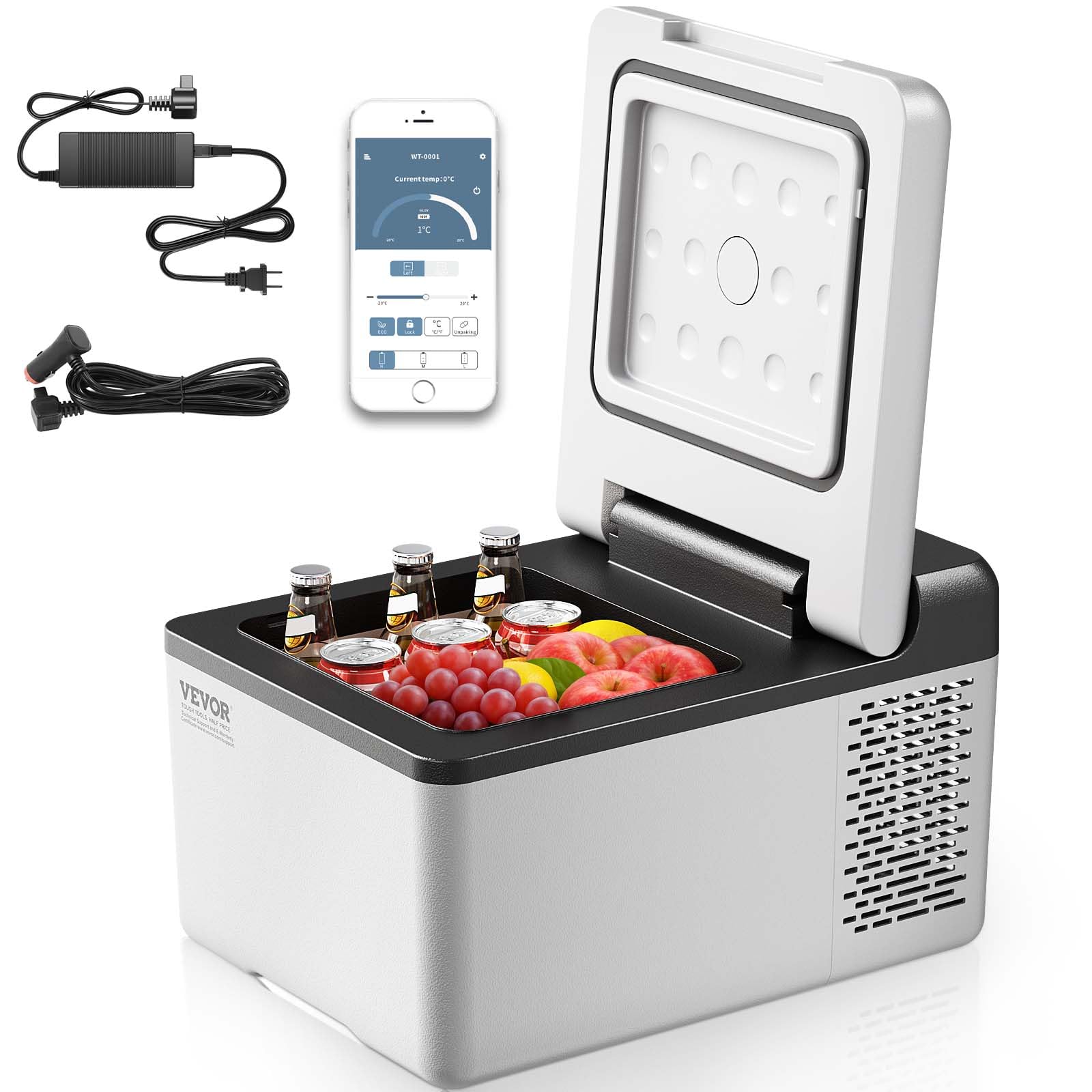
2. VEVOR 12V Car Refrigerator 10 QT
At 45 kWh per year, it uses less than half the energy of the Alpicool C9PT, and it chills drinks faster than any other unit here.
This 9-liter unit (10 quarts) is surprisingly fast — customers note cooling from 94°F down to 36°F in about 15 minutes. That is quicker than many bigger models. The secret is its efficient compressor and the fact that it only has a small space to chill. It runs off both 12/24V DC and 110-220V AC, and includes a built-in USB port (a universal serial bus port for charging electronics) to charge your phone, which is a handy extra on a campsite.
The annual energy consumption is just 45 kWh — the lowest in this entire list by a wide margin. By comparison, the Alpicool C9PT uses 130 kWh per year. This matters if you plan to run it off a small portable power station or a solar setup. The three-level battery protection keeps your car battery safe, and the reversible door orientation lets you open it from either side to fit tight spaces.
One drawback: the lid does not have a proper latch — just indents for your fingers — and there are no handles, only cutouts. Reviewers point out that Guinness cans barely fit upright, and longnecks (tall beer bottles) have to go on their side. The Bluetooth app is intuitive, but the temperature fluctuates about 4-5°F, so set it a few degrees colder than you actually want.
What Makes It Special
- Fastest cooling in this list — 15 min to 36°F
- Only 45 kWh annual energy consumption
- Has a USB charging port built in
- Reversible door for flexible placement
What to Watch For
- No latch on the lid, no real handles
- 4-5°F temperature fluctuation
- Tall cans barely fit upright
Reach for this if: You need the absolute most efficient, fastest-chilling little cooler for a single person’s drinks and medication.
Not for you if: You need to store large bottles upright, or you want a latching lid for rough terrain.
3. Alpicool C9PT Portable Car Freezer Cooler

At 14.8 lb, it is the lightest unit here, but its 130 kWh per year energy draw is nearly triple the VEVOR’s.
The Alpicool C9PT is a no-frills unit that gets the job done. It has a 9.09-liter capacity (10 quarts) and weighs just 14.8 lb, making it the lightest pick here — easy to carry one-handed or move between vehicles. It cools from -4°F up to 68°F, so you can use it as a refrigerator or a freezer depending on what you are carrying. It runs on both 12/24V DC and 100-240V AC.
The trade-off for the low price is energy efficiency. This model consumes 130 kWh per year, which is nearly three times the VEVOR’s 45 kWh. That means it draws more power from your battery over time. It also has noticeable condensation (water droplets forming on the surface) and ice buildup at high temperature differentials — shoppers say sweating heavily at 80°F ambient with the unit set to 20°F. You will want to place it on a mat inside your vehicle.
The temperature fluctuates about 4-5°F before the compressor kicks on, and some buyers report a high-pitched noise when the compressor engages. The newer model (May 2024 production) is quieter and has a cooler that cools quickly, but one buyer’s 2023 unit failed with an “F1” under-voltage error (a fault code indicating low battery voltage) after sitting in storage. The 3-level battery protection helps prevent that, but the insulation is thin, so it warms up fast when unplugged.
The Good Parts
- Lightest at 14.8 lb — easy to carry
- Dual freeze/refrigerate modes
- Quiet operation per buyer reports
- Good value for a real compressor cooler
The Downsides
- High energy use — 130 kWh/yr
- Condensation and ice buildup at low temps
- 4-5°F temp fluctuation before compressor kicks on
- Thin insulation; warms up quickly unplugged
Perfect for: A tight budget where you still need a true compressor freezer that freezes and fits behind a truck seat.
skip it if: You are running off a small power station and need the lowest possible power draw, or you need to keep things cold for hours after unplugging.
4. Kohree 19QT Car Refrigerator

It drops to 32°F in 15 minutes — matching the VEVOR for speed — and holds 24 cans plus 3 kg of food at a quiet 45 dB.
The Kohree 19QT uses an efficient compressor that drops from 68°F to 32°F in 15 minutes and reaches -4°F in about 50 minutes. That is fast enough to keep drinks icy even under a scorching sun. The 19-quart capacity holds up to 24 cans plus 3 kg of food — enough for a weekend trip for two. It runs at 45 dB (decibels, quieter than normal conversation), so it will not disturb sleep in a tent or truck cab.
Battery protection is three-level (Low, Medium, High) and owners mention it works well — the Kohree kept running for 12+ hours without draining the vehicle battery. The ergonomic top handle makes it easy to carry one-handed, and the non-slip base keeps it stable during driving, even on a 40-degree incline. One reviewer noted it held 40°F within ±2°F in Texas heat, which is tighter stability than the VEVOR’s 4-5°F fluctuation.
One limitation: the lid is thin and customers note you have to set the temperature lower than you actually want to get the interior cold enough. It failed to freeze an ice pack or freeze water at its stated -4°F in one test. It is also not waterproof, so put a mat underneath. On the plus side, it works on both 110/240V AC and 12/24V DC, and buyers love the dual-zone thermostat selection on some versions (refrigerator and freezer separate).
Why You’d Pick It
- 15-minute cool-down to 32°F
- 19 quarts holds 24 cans plus food
- 45 dB — quiet enough for overnight
- 3-level battery protection works well
Before You Decide
- Thin lid; must set temp lower than desired
- Failed to freeze ice pack at -4°F in test
- Not waterproof — use a mat underneath
Go for this if: You need mid-size capacity with the fastest practical chill-down speed and stable temperature hold.
Think again if: You absolutely need to freeze ice cream hard, or you expect the lid to double as a seat or cutting board.
5. Setpower 12V Refrigerator 21 Quart

At 28W in ECO mode, it pulls less power than any other pick here, and a built-in ice pack keeps food frozen for 50 hours after a power loss.
This Setpower 21-quart cooler has a built-in ice pack that keeps food cool for up to 50 hours after a power loss — a real safety net for long drives or camp stays without stable power. It is also a true dual-zone unit (two separate compartments), meaning you can set one compartment to fridge and the other to freezer, or both to the same temperature. The power draw is impressively low: 28W in ECO mode and 40W in MAX mode, with buyers reporting real-world usage under 1 kWh per day.
It cools from 77°F to 32°F in 15 minutes and hits -4°F in 45 minutes, which is competitive with the fastest units here. The 3-year warranty on the compressor (with 1 year on other parts) is a strong peace-of-mind factor. Buyers consistently praise the build quality — sturdy handles, good seal, and stable temperature hold. One buyer mentioned that after a 3-hour power outage in low 80s°F weather, the contents were still frozen.
The downside is the weight: at 22.1 lb, it is the heaviest in this lineup, and its dimensions (24.3 inches deep) make it slightly large for a standard trunk. Some buyers felt it was pretty tight on interior space for 21 quarts. The Bluetooth app works well, though you do need to stay near the unit for connection. Despite these caveats, owners say it makes regular coolers “feel primitive.”
Standout Features
- 50-hour backup cooling with built-in ice pack
- True dual-zone — fridge and freezer independent
- 28W in ECO mode — lowest power draw here
- 3-year compressor warranty
What to Consider
- Heaviest at 22.1 lb
- Large footprint — check trunk dimensions
- Bluetooth app connection limited range
Your unit if: You run on solar or a small battery and need the lowest possible power draw with the safety of hours of cold hold after a power outage.
Maybe not if: You need the lightest possible cooler or you have very limited trunk space.
6. BODEGACOOLER 42 Quart Dual Zone
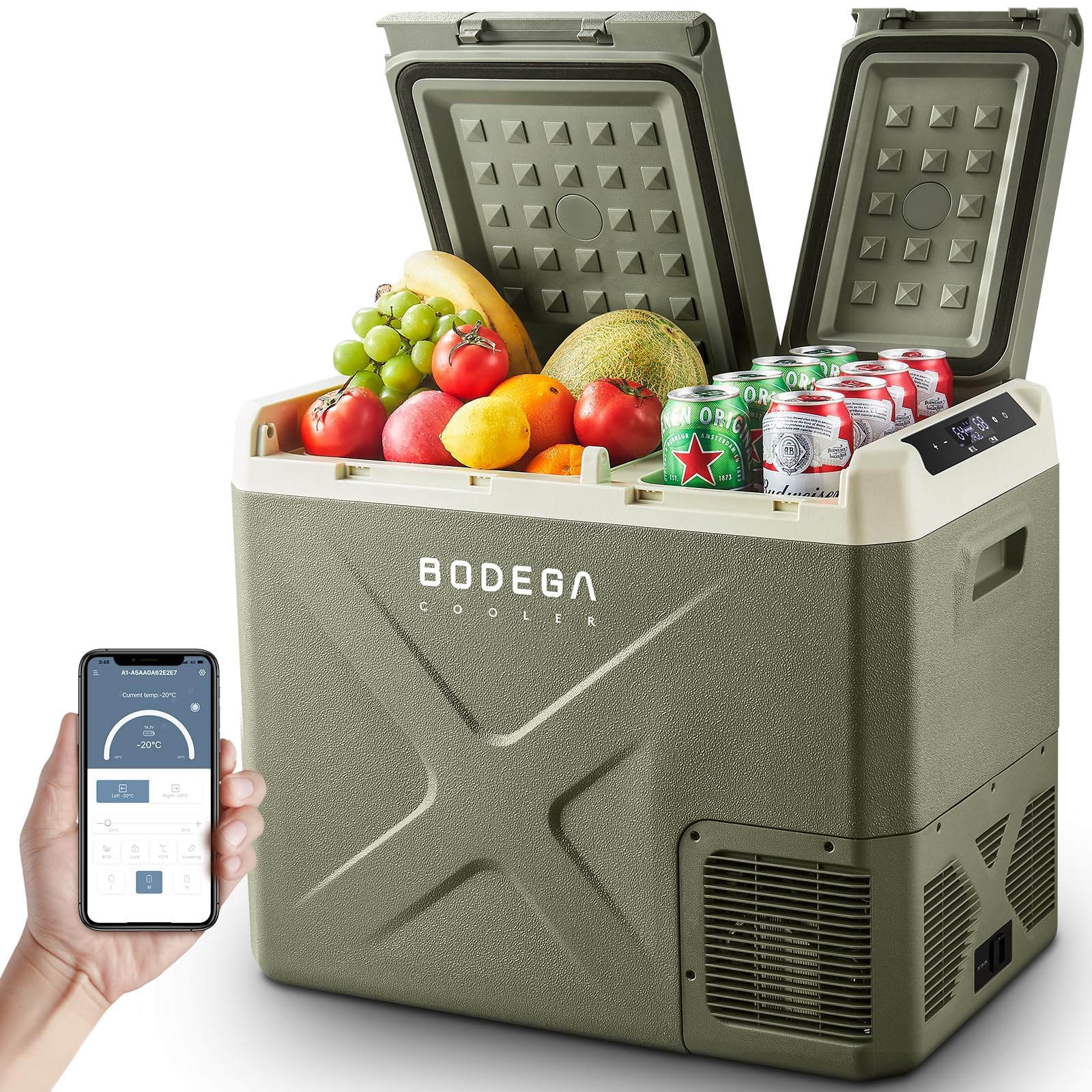
Holds 58 cans in two separate zones that can chill to 32°F in 15 minutes — all at 102 kWh per year.
The BODEGACOOLER is a 42-quart (40L) unit with two independently controlled zones: a large 28.5L section and a smaller 8.3L section. Each zone can be set from 68°F down to -4°F, so you can keep drinks cold in one side and frozen meat in the other. It holds up to 58 cans of soda or 47 bottles of water — enough for a full family camping trip. It cools from 68°F to 32°F in 15 minutes, same as the fastest units here, despite the large interior.
The energy draw is moderate for its size at 102 kWh per year. It operates under 45 dB, which is quiet, and it has a bottom drain hole for easy cleaning — a practical feature for washing out spills. The dual-zone design uses a reversible lid (you can open it from either side), which is useful when the cooler is tucked against a wall. It also includes cup slots on top to prevent spills. The 3-level battery protection (High/Medium/Low) works as expected, and reviewers point out it runs fine on a 277Wh battery for 6+ hours.
The main trade-off is the size and weight. It is a large, heavy unit that takes up a significant chunk of trunk space. Buyers also report that the iPhone Bluetooth app is generic and loses connection easily — you have to stay close to the cooler to reconnect, and there is no on/off control through the app when Bluetooth is active. The power button deactivates when the app is connected, which is a small annoyance. One owner wished it had a built-in battery option.
Big Advantages
- Massive 42-quart capacity for a whole family
- True dual-zone with independent controls
- Fast 15-min cooling to 32°F
- Bottom drain hole for easy cleaning
- Reversible lid for flexible placement
Heads Up
- Large and heavy — significant trunk space needed
- Bluetooth app loses connection easily
- Power button disabled when Bluetooth is active
- Insulation loses temp in hot sun when unplugged
Best for: Families or groups who need a massive dual-zone cooler and can afford the trunk space.
pass on it if: You run off a small battery and need the lowest power draw, or you want a reliable app that stays connected.
Understanding the Specs
Annual Energy Consumption (kWh)
This number tells you how much electricity the cooler uses over a full year of running. Lower is better — especially if you are powering it from a portable power station or solar setup. The VEVOR uses 45 kWh per year, while the Alpicool C9PT uses 130 kWh. A lower kWh rating means less drain on your car battery when the engine is off, and longer run times on a power station.
Compressor vs Thermoelectric
All six picks here use a real compressor, the same technology as your home refrigerator. A compressor can freeze down to -4°F or lower, regardless of outside temperature, and does not use thermoelectric Peltier plates (electronic cooling modules) that can only cool about 40°F below ambient. If a cooler says “thermoelectric,” it will never get truly cold on a hot day — always look for “compressor” in the specs.
FAQ
Can a 12V car cooler drain my car battery?
How many watts does a 12V car cooler use?
Can I run a 12V car cooler on a portable power station?
Will a 12V cooler work while my car is parked and turned off?
How cold can a 12V car cooler get?
How long does a 12V cooler take to get cold?
Can I use a 12V car cooler at home?
What is the difference between a 12V car cooler and a regular ice cooler?
How long does food stay cold in a 12V cooler when unplugged?
Can a 12V car cooler tilt or be used off-road?
Final Thoughts: The Verdict
For most people, the 12v car cooler winner is the Megiu 23 Quart because it combines the best balance of large capacity, low power draw (45W average), and real freezing performance without the premium price of dual-zone models. If you want the absolute most efficient and fastest-chilling little unit for a single person, grab the VEVOR 10 QT — it uses only 45 kWh per year and hits 36°F in 15 minutes. And for a family or group needing massive dual-zone flexibility, the BODEGACOOLER 42 Quart holds 58 cans with independent fridge and freezer zones.
How We Picked
We do not accept paid placement. Every pick is matched to a real buyer and a real use-case; we do not hands-on test units.
Sources & Methodology
Specifications: manufacturer listings and product documentation. Review insights: verified customer reviews, as of July 2026. Pricing: not shown on this page (it changes often); check the current price via the retailer link.
As an Amazon Associate, Gadgets Feed earns from qualifying purchases. This does not affect which products we feature.