
Our readers keep the lights on and my morning glass full of iced black tea. As an Amazon Associate, I earn from qualifying purchases.
Specs are compiled from manufacturer listings and verified buyer reviews and can change over time — please confirm the key details on the product page before buying.
A storm rolls through, the lights go out, and suddenly everything in your house is a question mark — the fridge, the internet, the sump pump, even the ability to charge your phone. A backup home power system keeps your coffee brewing and Wi-Fi humming while the rest of the block sits in the dark. The trick is matching the right system to your home’s actual needs — how many watts, for how long, and with how much hassle.
I’m Min — the founder and writer behind Gadgets Feed. This guide is built by comparing the manufacturers’ published specifications and the patterns across verified customer reviews, so you get each pick’s real strengths and trade-offs instead of marketing spin.
if you need a portable battery for a weekend camping trip or a heavy-duty dual-fuel generator that can power your whole house for days, the best backup home power systems in this list cover every scenario with clear-headed, spec-by-spec analysis.
Our Picks at a Glance


How To Choose The Best Backup Home Power Systems
Picking the right backup power setup depends on three questions: what do you need to run, for how long, and can you handle the fuel or recharging logistics. Here is how to break it down.
Battery Capacity (Wh) vs. Power Output (W)
Capacity, measured in watt-hours (Wh), tells you the total energy tank — like a gas tank’s size. Power output, in watts (W), tells you how much energy the inverter can deliver at a single moment, like the engine’s horsepower. A unit with 2000Wh and a 1500W inverter can run a 1500W microwave for about an hour, but it cannot start a 2000W appliance because the inverter will max out.
Battery Chemistry: LiFePO4 Is the Standard
Lithium Iron Phosphate (LiFePO4 or LFP) batteries last far longer than older lithium-ion or lead-acid cells. Many makers quote 3,000 to 10,000 charge cycles before capacity drops to 80%, which translates to a 10-year or longer lifespan for most homeowners. They are also safer — far less likely to overheat or catch fire.
Gas vs. Battery: The Fuel Trade-Off
A gas or dual-fuel generator delivers unlimited runtime as long as you have fuel and provides much higher wattage for whole-house loads like a central air conditioner. But it requires ventilation (never run it indoors), regular maintenance, and fuel storage. A battery power station is silent, fume-free, and can be used indoors — but once its capacity is drained, it needs hours to recharge, unless you have solar panels.
Quick Comparison
| Model | Best For | Capacity (Wh) | Inverter Output (W) | Weight (lbs) | Amazon |
|---|---|---|---|---|---|
| Jackery Explorer 1000 v2★ Best Overall | Compact home & camping use | 1070Wh | 1500W | 23.8 lbs | Amazon |
| AFERIY P210 (2048Wh)Also Great | Long-lasting heavy loads | 2048Wh | 2400W | 54 lbs | Amazon |
| EF ECOFLOW DELTA 3 ClassicPremium UPS Pick | Fast-charging UPS backup | 1024Wh | 1800W | 15 lbs | Amazon |
| EF ECOFLOW DELTA 3 Plus | Expandable smart power station | 1024Wh | 1800W | 27 lbs | Amazon |
| Anker SOLIX S2000 | Long fridge runtime, compact | 2010Wh | 1500W | 35.7 lbs | Amazon |
| WEN DF680iX | Gas/propane whole-home backup | — | 5100W (gas) | 99.2 lbs | Amazon |
| Jackery Explorer 2000 v2 | Large-capacity portable backup | 2042Wh | 2200W | 39.5 lbs | Amazon |
| BLUETTI AC200L | Expandable, high-output system | 2048Wh | 2400W | 61.41 lbs | Amazon |
| Anker SOLIX C2000 Gen 2 | Fastest recharge, light weight | 2048Wh | 2400W | 41.7 lbs | Amazon |
| AFERIY P310 (3840Wh) | Massive off-grid power | 3840Wh | 3600W | — | Amazon |
| Westinghouse iGen12000DFc | Whole-house gas/propane | — | 12000W (gas) | 187.4 lbs | Amazon |
In‑Depth Reviews
1. Jackery Explorer 1000 v2 Portable Power Station
Our pick — over 4.5★ from 3,000+ verified ratings; the strongest balance of quality and price.
A compact 1000W-class station that beats competitors in real-world efficiency tests.
The Jackery Explorer 1000 v2 is a 1070Wh LiFePO4 station with a 1500W inverter (3000W surge). It weighs just 23.8 pounds and has a foldable handle, making it easy to carry. Shoppers say it outperformed the DJI Power 1000 in a 1-hour test with a 1000W heater — the Jackery had 40% battery remaining while the DJI had only 7% after 45 minutes. It was also quieter, cooler, and lighter.
Charging hits 100% in one hour using emergency charging via the Jackery App, or defaults to 1.7 hours to preserve battery health. The ChargeShield 2.0 technology tune charging safety. With three AC ports, two USB-C (100W PD), and one USB-A, it can power a refrigerator for 8 hours (dropping from 100% to 53% — about 14 hours projected runtime). One reviewer used it daily for 7 months running a DC fridge at 23°F without issues.
Why Buyers Choose It
- Real-world efficiency beats competitors — 40% battery left vs 7% for DJI in a 1-hour heater test.
- Lightweight at 23.8 lbs with a foldable handle for easy portability.
- Smart app control with emergency charging (1 hour) and silent overnight mode (30 dB).
The Limits
- 1070Wh capacity is on the lower end — fine for short outages, less for multi-day events.
- 1500W output cannot run high-draw appliances like a large window A/C.
Best for: Quick, lightweight backup for camping, short power outages, or running a single fridge. The 1-hour recharge means you can top it off between uses.
Skip if: You need whole-house backup capabilities; this is a supplement to a larger system, not the main event.
2. AFERIY 2048Wh Portable Power Station 2400W (P210)
The heavyweight champ that keeps a whole house running through a hurricane night.
The AFERIY P210 packs 2048Wh of LiFePO4 battery power with a strong 2400W inverter (4800W surge peak), so you can run a refrigerator, a microwave, and lights all at once. Buyers report using it as an overnight hurricane backup — a 150-200W load kept the essentials going for about 10-12 hours. At 54 pounds, it is noticeably heavier than the ECOFLOW DELTA 3 Classic at 15 pounds. But the trade-off is a 2048Wh capacity versus 1024Wh, giving you far more runtime.
The P210 also works as a server-level UPS with a rapid switch-over time. The included app lets you monitor battery status, and the 7-year extended warranty is two years longer than what most brands offer. Its pure sine wave AC output protects sensitive electronics from damage.
Who it saves: This is for the homeowner who wants one powerful battery station to handle a multi-day outage and does not mind the weight. Its 2400W AC output beats the Jackery Explorer 1000 v2’s 1500W.
One catch to know: The UPS mode is limited to about 1200W (10A) in practice, not the full 2400W, so heavy-draw appliances during a switch-over may need a separate UPS.
Best for: Homeowners who need a single, high-capacity battery that can power a fridge, lights, and a microwave for a full night — the P210 delivers that with minimal noise.
Look elsewhere if: You need a lightweight unit you can carry on camping trips; 54 pounds is too heavy for casual portability.
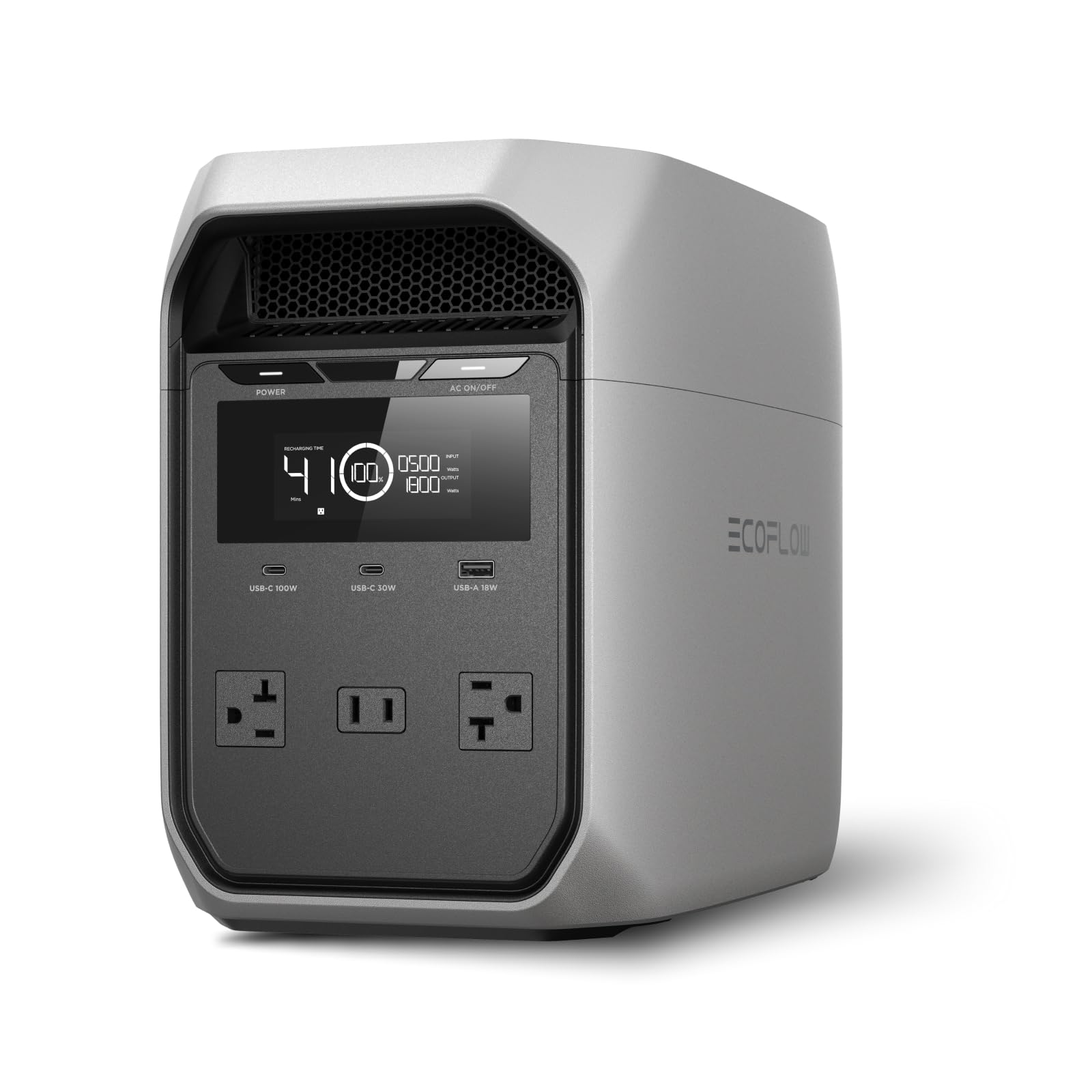
3. EF ECOFLOW Portable Power Station DELTA 3 Classic
The featherweight UPS that switches in under 10ms to protect your gear.
At just 15 pounds, the DELTA 3 Classic is a remarkable 3.6x lighter than the AFERIY P210 (54 pounds), making it the most portable 1kWh-class station in this guide. It delivers 1800W of AC output (3600W surge) with X-Boost technology, enough to power a refrigerator, microwave, and laptops. Owners mention they use it as a UPS with a larger battery than a dedicated UPS, giving smooth backup for computers and servers. The <10ms switch-over means your PC or network gear never blinks.
Recharging is ultra-fast — from 0-80% in 45 minutes with X-Stream AC charging. Solar recharging takes about 2.5 hours with a 500W panel (sold separately). The EcoFlow app gives you smart controls like storm alerts, charging schedules, and power monitoring. The LiFePO4 battery is rated for 10+ years of daily use, and its 1024Wh capacity is smaller than the AFERIY’s 2048Wh, a trade-off for compactness.
Why it shines: The weight-to-power ratio is class-leading — 15 pounds for 1800W output means you can grab it and go in seconds. The UPS functionality is genuinely useful for home offices.
The limitation: The 1024Wh capacity limits run time on big appliances. A space heater or refrigerator will drain it in a few hours, so keep it for shorter outages or supplement with solar.
Reach for this if: Portability is your top priority — you want a powerful backup that you can carry from room to room or take camping without straining your back.
Not for you if: You need to run high-wattage loads for a full day without recharging; the 1024Wh battery will run out of steam.
4. Anker SOLIX S2000 Portable Power Station
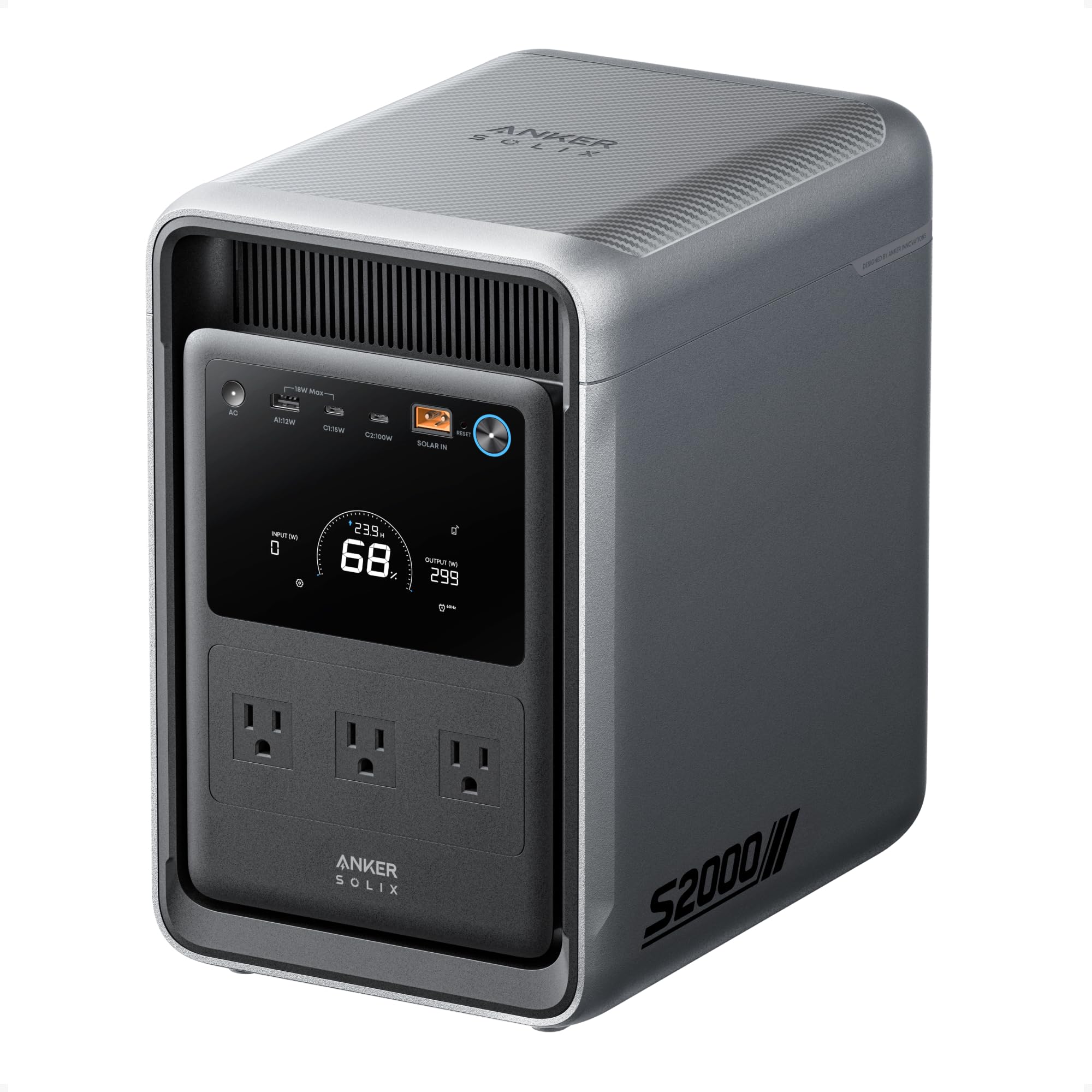
A mid-range battery that runs your fridge for a day and a half on a single charge.
The Anker SOLIX S2000 is a 2kWh-class power station that uses premium 314Ah LFP cells rated for 10,000 charge cycles — that is a 15-year lifespan, the longest of any battery in this guide. It delivers 1500W continuous output (3000W peak), powering 99% of home essentials. Its standout feature is the low 6W idle power draw, giving it longer runtime than other 2kWh systems — enough to keep a fridge running for up to 35 hours.
Weighing just 35.7 pounds, the S2000 is 25% lighter and 30% smaller than the industry average for a 2kWh station. It measures 8.19 x 11.1 x 12.7 inches, compact enough to tuck under a counter. Customers note it powered through a 30-hour outage, recharged from 33% to 100% in 1.5 hours, and its quiet fan stayed unobtrusive. The app lets you set charge limits, monitor usage, and activate UPS mode.
Why Buyers Love It
- Up to 35 hours of fridge backup — ideal for extended outages.
- Smallest and lightest 2kWh station at 35.7 lbs.
- 15-year lifespan with 10,000 cycles.
The Trade-Off
- 1500W output is lower than the 2400W AFERIY P210 — cannot run a large window A/C or well pump.
- No 12V DC port; instead uses front/rear AC outlets.
Best for: Homeowners who want a compact, long-lasting backup that can run a fridge for over a day — the S2000’s efficiency and longevity are tough to top at its price point.
Skip if: You need to power a high-wattage appliance like a large A/C right now; the 1500W inverter is limiting.
5. EF ECOFLOW Portable Power Station DELTA 3 Plus

An expandable smart station that learns your habits and saves you money.
The DELTA 3 Plus starts with a 1024Wh LiFePO4 battery but can be expanded up to 5kWh with additional EcoFlow battery packs. Its 1800W inverter (with X-Boost for higher resistive loads) powers 13 appliances simultaneously through a generous port selection.
Recharging is versatile: AC input at 1500W gets you to 80% in 40 minutes; solar charging reaches 100% in 70 minutes with an 800W panel; and an alternator charger hits 80% in 1 hour. The smart app includes Time-of-Use mode, storm alerts, and a 10ms UPS switch-over for critical gear. The IP65 battery pack adds splash-proof and dust-proof protection.
Its best trick: The Time-of-Use mode automatically charges during low-rate hours and discharges during peak rate, helping you save on electricity bills. The 140W USB-C is genuinely faster than most competitors.
The catch: At 27 pounds, it is heavier than the 15-pound DELTA 3 Classic but lighter than many 2kWh stations. The phantom load from the large inverter is noticeable.
Reach for this if: You want a system that grows with your needs — start with the base 1024Wh and add batteries later. The smart energy management makes it a long-term investment.
Look elsewhere if: You only need a fixed-capacity backup; the expandable design adds cost if you never use it.
6. Jackery Explorer 2000 v2 Portable Power Station

The 2kWh station at 39.5 pounds, but just as strong.
The Jackery Explorer 2000 v2 uses CTB (Cell-to-Body) technology borrowed from electric vehicles to pack 2042Wh of capacity into a unit that weighs just 39.5 pounds — that is lighter than typical 2kWh LiFePO4 stations. It delivers 2200W of AC output across three ports, enough to run a fridge, kitchen appliances, and a TV simultaneously. UL1778 certified for UPS use, it switches in just 20ms during an outage.
Charging is fast: AC fast charging takes it from 0 to 80% in 66 minutes, or a full charge in 102 minutes using the emergency super charging mode via the app. Solar charging hits full in about 6 hours with 400W panels. Silent charging mode operates below 30dB — quieter than a library — so it works overnight in a bedroom without waking anyone. Reviewers point out a 21.3-hour fridge runtime and smooth pass-through charging.
What Stands Out
- Weighs 39.5 lbs, lighter than typical 2kWh stations.
- 2200W AC output powers most home essentials.
- Silent charging mode at <30dB for overnight use.
What to Consider
- 20ms UPS switch-over is slower than the 10ms of the ECOFLOW DELTA stations.
- Solar panels and expansion batteries sold separately, so initial cost can grow.
Best for: Homeowners who want a large-capacity battery station that is genuinely portable — 39.5 pounds is easy to move from room to room or load into a car.
Skip if: You need an ultra-fast <10ms UPS for sensitive computer gear; the 20ms switch-over might cause a brief reboot.
7. BLUETTI AC200L Portable Power Station

An expandable system that starts at 2kWh and grows to over 8kWh for whole-home backup.
The BLUETTI AC200L starts with a built-in 2048Wh LiFePO4 battery and 2400W AC output (3600W Power Lifting mode). But its real strength is expansion: you can add two B300K batteries (2764Wh each) or two B300 batteries (3072Wh each) to push total capacity up to 8192Wh. That is enough to run home security, a 64″ OLED TV, a fridge, a freezer, and a modem/router for about 10 hours through a 30A manual transfer switch, as one reviewer demonstrated.
Recharging is fast: 2400W AC input takes it from 0-80% in 45 minutes. Solar input reaches up to 1200W for a full charge in 1.7-2.2 hours. It includes 11 ports, including a 30A RV port and a 48V/8A DC port for charging an RV battery with a voltage regulator. The <10ms UPS backup keeps critical devices running without interruption.
Why it is unique: The expandability is genuinely versatile — you can start with the AC200L and add capacity as your budget allows. The 30A RV port is a rare feature that simplifies RV charging.
The downside: At 61.41 pounds, it is the heaviest battery station here (aside from the small generator class). The expansion batteries add even more weight and cost.
Reach for this if: You plan to scale up your backup power over time — the AC200L is the starting point for a multi-kWh system. The 30A RV outlet is great for camper owners.
Not for you if: You need an all-in-one portable unit; the weight makes it a low-maintenance station, not a grab-and-go device.
8. Anker SOLIX C2000 Gen 2 Portable Power Station
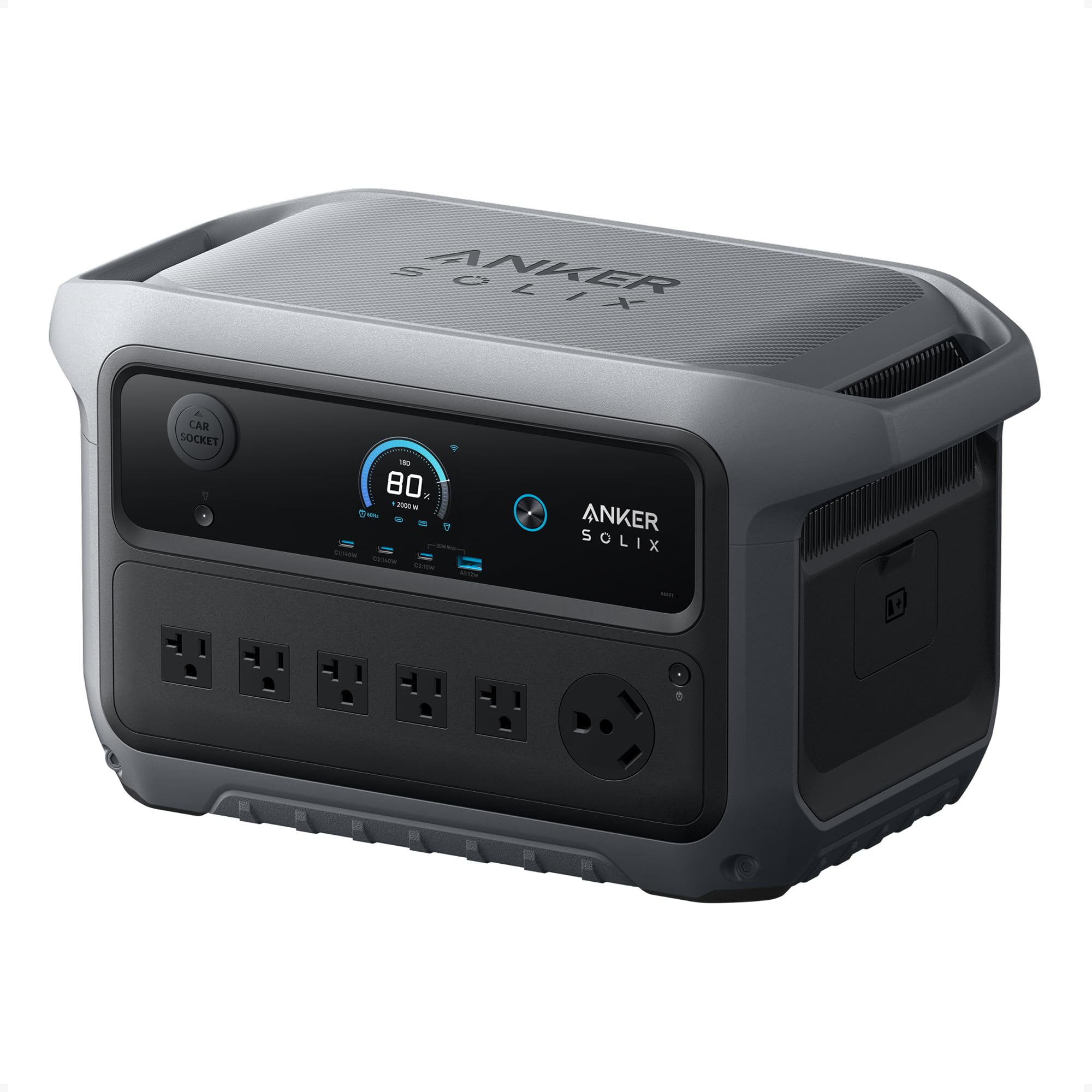
Recharges from zero to full in under an hour — faster than any other 2kWh station here.
The Anker SOLIX C2000 Gen 2 is built for speed: with AC and solar charging combined, it goes from 0% to 100% in 58 minutes. That is 58 minutes, compared to the Jackery Explorer 2000 v2’s 102 minutes. It packs 2048Wh of LiFePO4 battery capacity and delivers 2400W rated output (4000W peak), so it can start most window and RV air conditioners. At 41.7 pounds, it is lighter and smaller than similar products.
Standby power draw is just 9W, enabling up to 32 hours of fridge runtime. Expansion is possible up to 4kWh with an extra battery, which bumps the fridge runtime to 64 hours. Six charging methods include 800W alternator charging — full recharge from your car in 3 hours. One reviewer noted keeping a BougeRV 30-quart fridge running for 5-7 days on a cross-country trip.
The Speed Advantage
- Full charge in 58 minutes — the fastest in this guide.
- Lightweight at 41.7 lb and compact at 18.1 x 9.8 x 10.1 inches.
- 800W alternator charging for on-the-road top-ups.
The Compromise
- No 12V DC port — relies on AC and USB-C for all device charging.
- Expansion battery adds cost for those who want the full 4kWh.
Best for: Anyone who needs to recharge quickly between outages — 58 minutes means you can cycle power in a single afternoon. The fast alternator charging is ideal for road trips.
Skip if: You rely on 12V DC appliances; the lack of a DC port means you will need an adapter.
9. AFERIY 3840Wh Portable Power Station (P310)

A 3.8kWh battery that expands to 11.5kWh — enough for days of off-grid living.
The AFERIY P310 starts with a massive 3840Wh (3.8kWh) LiFePO4 battery and a 3600W inverter (7200W peak), making it among the most powerful battery stations in this guide. Expandable to 11.5kWh with additional battery packs, it can run a refrigerator, phones, a WiFi router, and lights for about 17 hours of typical household use, and 1-2 days for a fridge alone. Buyers use it for off-grid RV setups, powering everything except the air conditioner.
Recharging takes about 2.5 hours via AC input, and it supports up to 15 output ports including AC outlets, USB-C PD 3.0, and an XT60 port. The smart app monitors charge/discharge status, lets you schedule charging, and remotely power off. The built-in UPS provides <10ms transfer time for smooth backup during storms. The P310 includes rugged wheels and a telescoping handle for moving the large unit.
Its biggest selling point: The 3.8kWh base capacity is double the 2048Wh of the AFERIY P210, and the expandable design to 11.5kWh rivals whole-home generator levels. The 3600W inverter beats the 2400W P210 by a significant margin.
The trade-off: The P310 is large and heavy, designed as a semi-permanent home installation rather than a portable unit. Some buyers reported initial display issues, though customer support handled replacements.
Reach for this if: You need a multi-day home backup that can scale up to 11.5kWh — this is an off-grid solution that rivals gas generators for silent, fume-free power.
Not for you if: You need true portability for camping trips; the unit’s size and weight make it best for one-location setup.
10. WEN 6800-Watt Dual Fuel Inverter Generator (DF680iX)

A gas-and-propane inverter generator that can even charge your EV.
The WEN DF680iX runs on either gasoline (6800W surge, 5100W rated) or propane (6000W surge, 4500W rated) via its 224cc dual-fuel engine. Its bonded-neutral 240V configuration enables low-power Level 2 charging for battery and hybrid electric vehicles — a rare feature at this price point. The inverter technology produces clean power safe for electronics, and the WEN Watchdog CO Shutdown Sensor automatically turns the generator off if carbon monoxide reaches dangerous levels.
Weighing 99.2 pounds, the DF680iX includes onboard wheels and a telescoping pull handle for easier movement. It has one L14-30R 120V/240V receptacle, two three-prong 120V receptacles, one TT-30R RV receptacle, one 12V DC receptacle, and two 5V USB ports. The fuel shut-off boost the generator’s lifespan by using up remaining fuel in the carburetor. Buyers report it runs a water pump at an off-grid cabin, and the eco mode keeps noise low enough to fade at about 100 yards.
Why it stands out: Dual-fuel flexibility means you can run on propane for cleaner storage or gasoline for higher output. The 240V EV charging capability is a unique bonus. The CO watchdog adds important safety.
The catch: At 99.2 pounds, it is heavy and not particularly quiet under heavy load. Some buyers experienced quality control issues with the CO sensor, though others reported reliable operation.
Reach for this if: You need a portable generator for RV trips, home backup, and occasional EV charging — the dual-fuel flexibility and CO safety sensor make it a practical choice.
Not for you if: You want a silent, fume-free indoor battery solution; this requires outdoor operation with proper ventilation.
11. Westinghouse 12000 Peak Watt Dual Fuel Inverter Generator (iGen12000DFc)
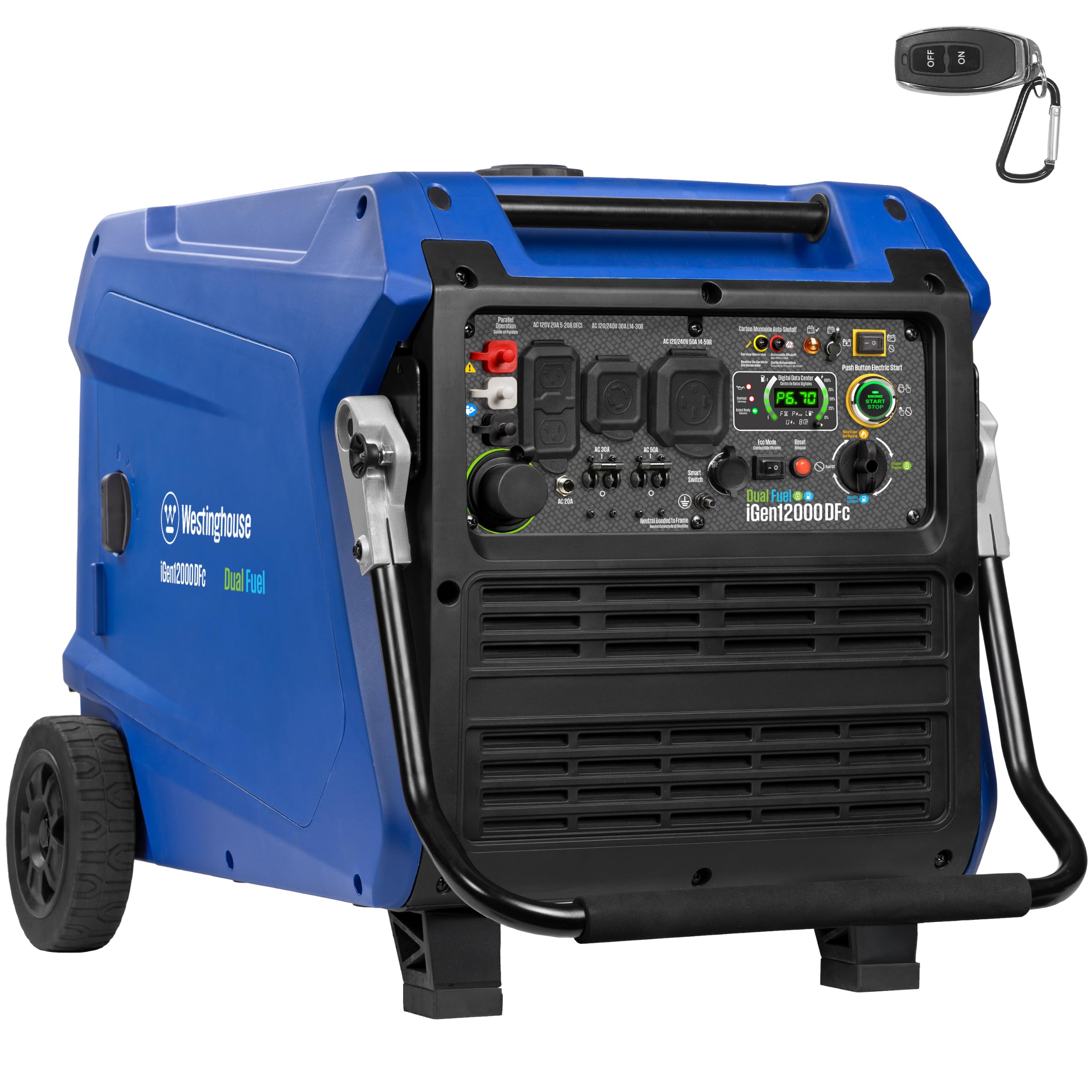
A 12kW inverter generator that powers a whole house — including a Tesla charger.
The Westinghouse iGen12000DFc is a heavy-duty dual-fuel inverter generator that delivers 12,000W peak and 9,000W running on gasoline, or 11,000W peak and 8,100W running on propane. With a 457cc 4-stroke engine and a 7.9-gallon fuel tank, it runs up to 19 hours at 25% load. The <3% THD (total harmonic distortion) means clean power safe for sensitive electronics. Owners mention it powers a heat pump, fridge, freezer, computers, TV, and dryer without strain — and even charges a Tesla at 20-25 miles per hour via the 50A 14-50R outlet.
Its inverter technology matches engine speed to power demand, cutting fuel consumption compared to traditional generators. At just 64 dBA, it is quiet for its class. The remote start key fob works from up to 50 feet away. An LED data center displays fuel level, power output, remaining run time, voltage output, and lifetime hours. The generator is transfer switch or interlock kit ready with a 50A outlet and a 30A twist-lock outlet.
What Makes It a Beast
- 12,000W peak on gas — enough for a whole house plus EV charging.
- Inverter tech with <3% THD protects electronics and cuts fuel use.
- Remote start, large fuel tank (7.9 gal), and 19-hour runtime at 25% load.
The Realities
- Heavy at 187.4 pounds despite wheels — setup is a two-person job.
- Dual-fuel hoses and regulator need careful routing; some buyers found the LP connection awkward.
Best for: Homeowners who want a single generator that can power the entire house, including sensitive electronics and even an EV, through extended outages. The remote start and inverter efficiency make it a premium choice.
Skip if: You need a portable battery solution for indoor use — this is an outdoor-only gas generator for serious whole-home backup.
Understanding the Specs
Watt-Hours (Wh) vs. Watts (W)
A power station’s capacity is measured in watt-hours (Wh) — the total energy it holds, like a gas tank. Its power output is measured in watts (W) — the amount it can deliver at any moment, like an engine. A 2048Wh station with a 2400W inverter can run a 2400W microwave for about 51 minutes, but it cannot power a 3000W appliance because the inverter maxes out. Match the inverter’s continuous watt rating to your highest-draw appliance, then match the Wh rating to how long you need to run it.
LiFePO4 Battery Chemistry
Lithium Iron Phosphate (LFP) batteries are the standard for modern backup power. They last 3,000 to 10,000 charge cycles before degrading to 80% capacity — that is 10 years or more of daily use. They are also inherently safer than older lithium-ion chemistries; they resist overheating and do not catch fire easily. Most portable power stations in this guide use LiFePO4 cells.
UPS Pass-Through
Uninterruptible Power Supply (UPS) mode means the station stays plugged into your wall outlet and runs your devices through its inverter. When the grid goes down, it switches to battery power in milliseconds — typically 10-20ms, fast enough to keep a computer running without rebooting. Not all power stations support this; check for explicit <10ms or <20ms switch-over claims if you plan to use it with a PC, server, or medical device.
Solar Input (Watts)
The solar input rating, measured in watts, tells you how fast the station can recharge from solar panels. Higher input means faster recharging on sunny days. For example, a station with 500W solar input can fully charge a 1024Wh battery in about 2 hours with a perfect 500W panel array. Most stations support a range of 200W to 1200W solar input. Pairing solar panels with a power station makes it a true off-grid system.
FAQ
Can I run a refrigerator on a portable power station?
What is the difference between a power station and a gas generator?
How long will a 2000Wh power station run my house?
What does dual fuel mean on a generator?
Can I use a portable power station as a UPS for my computer?
How do I recharge a power station when the grid is down?
What is the difference between 120V and 240V output?
How long do LiFePO4 batteries last before needing replacement?
Is it safe to run a gas generator indoors?
Can I connect two generators together for more power?
Final Thoughts: The Verdict
If you want one dependable pick, the best backup home power systems winner is the AFERIY P210 (2048Wh) because it delivers the best balance of high capacity (2048Wh), strong inverter output (2400W), and pure sine wave power at a competitive price point, with a 7-year warranty that beats the market standard. If you want ultra-fast recharging and a compact form factor, grab the Anker SOLIX C2000 Gen 2 — full charge in 58 minutes and only 41.7 pounds. And for whole-home gas backup that can also charge your EV, the standout is the Westinghouse iGen12000DFc, a 12,000W dual-fuel inverter generator built for serious power needs.
How We Picked
We do not accept paid placement. Every pick is matched to a real buyer and a real use-case; we do not hands-on test units.
Sources & Methodology
Specifications: manufacturer listings and product documentation. Review insights: verified customer reviews, as of July 2026. Pricing: not shown on this page (it changes often); check the current price via the retailer link.
As an Amazon Associate, Gadgets Feed earns from qualifying purchases. This does not affect which products we feature.