
Our readers keep the lights on and my morning glass full of iced black tea. As an Amazon Associate, I earn from qualifying purchases.
Specs are compiled from manufacturer listings and verified buyer reviews and can change over time — please confirm the key details on the product page before buying.
You are not just buying a battery — you are buying your camp’s entire electrical system. A weak one kills your weekend: no coffee in the morning, dead phones by nightfall, and a cooler full of warm food by day two. The real question cuts through everything else: which one actually has enough capacity and the right ports to keep your specific gear running, and which one is just a glorified phone charger with a huge price tag?
I’m Min — the founder and writer behind Gadgets Feed. This guide is built by comparing the manufacturers’ published specifications and the patterns across verified customer reviews, so you get each pick’s real strengths and trade-offs instead of marketing spin.
Whether you are a weekend car-camper or a van-life nomad, you need a portable power station that won’t die on you. I sorted through the specs and real user reports to find the best camping battery that delivers real power for real gear.
Our Picks at a Glance

How To Choose The Best Camping Battery
Picking a camping battery is about matching your gear’s appetite to the battery’s tank. A unit that runs your phone charger for three days might not even finish one load of coffee from a drip maker. Here is what you actually need to check.
Capacity: Watt-Hours Are the Fuel Tank
Think of watt-hours (Wh) like gallons of gas. A 288Wh unit can run a 32″ TV for 3-4 hours, and a 1024Wh unit can power a small CPAP machine for several nights. If you need to run a mini-fridge and lights all weekend, aim for 500Wh or more. Do not judge by “amp-hours” alone — that number is often given at a different voltage and is misleading without the full picture.
Output Ports: More Than Just USB
A good camping battery gives you a pure sine wave AC outlet (that is the standard wall plug, but with clean power so your laptop or CPAP does not hum or break). You also want USB-C PD (Power Delivery, which charges laptops at full speed), and maybe a 12V car port for a fridge. Too many cheap units only have USB-A ports, which charge phones and tablets slowly (5W to 12W max) and cannot run real appliances.
Recharge Method: How Fast It Fills Up
AC wall charging is the fastest way to fill up between trips — look for under 2 hours for a full charge. Solar input dictates how quickly you can recharge off-grid: 100W to 110W solar input is common for mid-range units, letting you top off in about 3-5 hours with a single 100W panel. If you camp in deep shade, fast AC charging matters more.
Battery Chemistry: Why LiFePO4 Wins
LiFePO4 (lithium iron phosphate) batteries last for 3,000 to 4,000 charge cycles before they degrade to 80% capacity. That is roughly 10 years of weekly use. Older lithium-ion (NMC) batteries die after 500 cycles. LiFePO4 also handles heat and cold better, and it is far less likely to catch fire. Every product in this guide uses LiFePO4 unless noted.
Quick Comparison
| Model | Best For | Capacity | AC Output | Solar Input | Amazon |
|---|---|---|---|---|---|
| EF ECOFLOW RIVER 2★ Best Overall | Fast AC Recharge | 256Wh | 600W | 110W | Amazon |
| BLUETTI Elite 100 V2Also Great | Full Camp Power | 1024Wh | 1800W | 1000W | Amazon |
| LIBRIDS C600 | Mid-Weekend Power | 640Wh | 600W | — | Amazon |
| EF ECOFLOW RIVER 3 | Silent UPS & Camping | 245Wh | 300W | 110W | Amazon |
| BLUETTI Elite 30 V2 | Ultra-Fast Top-Ups | 288Wh | 600W | — | Amazon |
| GRECELL EB300 | Value & Versatility | 288.6Wh | 330W | 60-120W | Amazon |
| Anker SOLIX C200 DC | Ultra-Compact Backup | 192Wh | 200W | 100W | Amazon |
In‑Depth Reviews
1. EF ECOFLOW Portable Power Station RIVER 2
Our pick — over 4★ from 4,500+ verified ratings; the strongest balance of quality and price.
One hour to full from a wall outlet, and it handles a surprising 600W surge.
The RIVER 2 is the fastest-refueling small battery on this list. Thanks to EcoFlow’s X-Stream fast charging technology (their proprietary circuit that pushes full power without needing a bulky adapter), it goes from zero to 100% in 1 hour via AC. That matters when you have a short window at a hotel or a friend’s RV to recharge your camp battery before the next adventure. Its 256Wh LiFePO4 battery — which lasts for 3,000 cycles before hitting 80% capacity, or roughly 10 years — is slightly larger than the RIVER 3’s 245Wh, though the RIVER 3 has better GaN efficiency for low-power gear. In a head-to-head with the Anker SOLIX C200 DC (192Wh), the RIVER 2 holds a 50% larger capacity and delivers a full 600W AC output compared to the Anker’s 200W DC-only output, meaning it can run a small coffee maker or a toaster while the Anker cannot.
One reviewer specifically highlighted running 6 essential appliances simultaneously without overloading, and another mentioned the 75-minute runtime at a 300W load as a reliable benchmark. The 7.7 lb weight and built-in handle make it genuinely portable — you do not need a separate dolly or a second person to move it around a campsite. Solar input of 110W means you can top it off in about 2.3 hours with a 110W panel, which is competitive with the Anker’s 100W input.
The app tracks power usage in real time, which owners mention is handy for understanding which devices drain the battery fastest. It also acts as a UPS (uninterruptible power supply) during outages, though EcoFlow does not specify the switchover speed like the RIVER 3 does. The main limitation: at 256Wh, it will not run a CPAP for a full night for most users (a typical CPAP draws about 30-60W, lasting about 4-8 hours). It is best as a fast-charging daily companion, not a weekend workhorse.
Lightning-Fast Recharge
- 1-hour AC recharge is the fastest among 256Wh-class units
- 600W AC output runs small appliances, not just USB devices
- 7.7 lb with handle is easy to carry around a campsite
- App shows detailed power flow and battery stats
Short-Range Capacity
- 256Wh is tight for overnight CPAP use (75 min at 300W load per a buyer’s test)
- Solar charging cable is not included, adding to the cost if you need it
Buy it for: fast day-trip power where you can plug into a wall between activities. The 1-hour recharge is the key differentiator here.
skip it if: you need to run a CPAP, mini-fridge, or multiple devices for a full weekend without access to a wall outlet.
2. BLUETTI Elite 100 V2
The whole weekend’s electrical system in a box you carry with one hand.
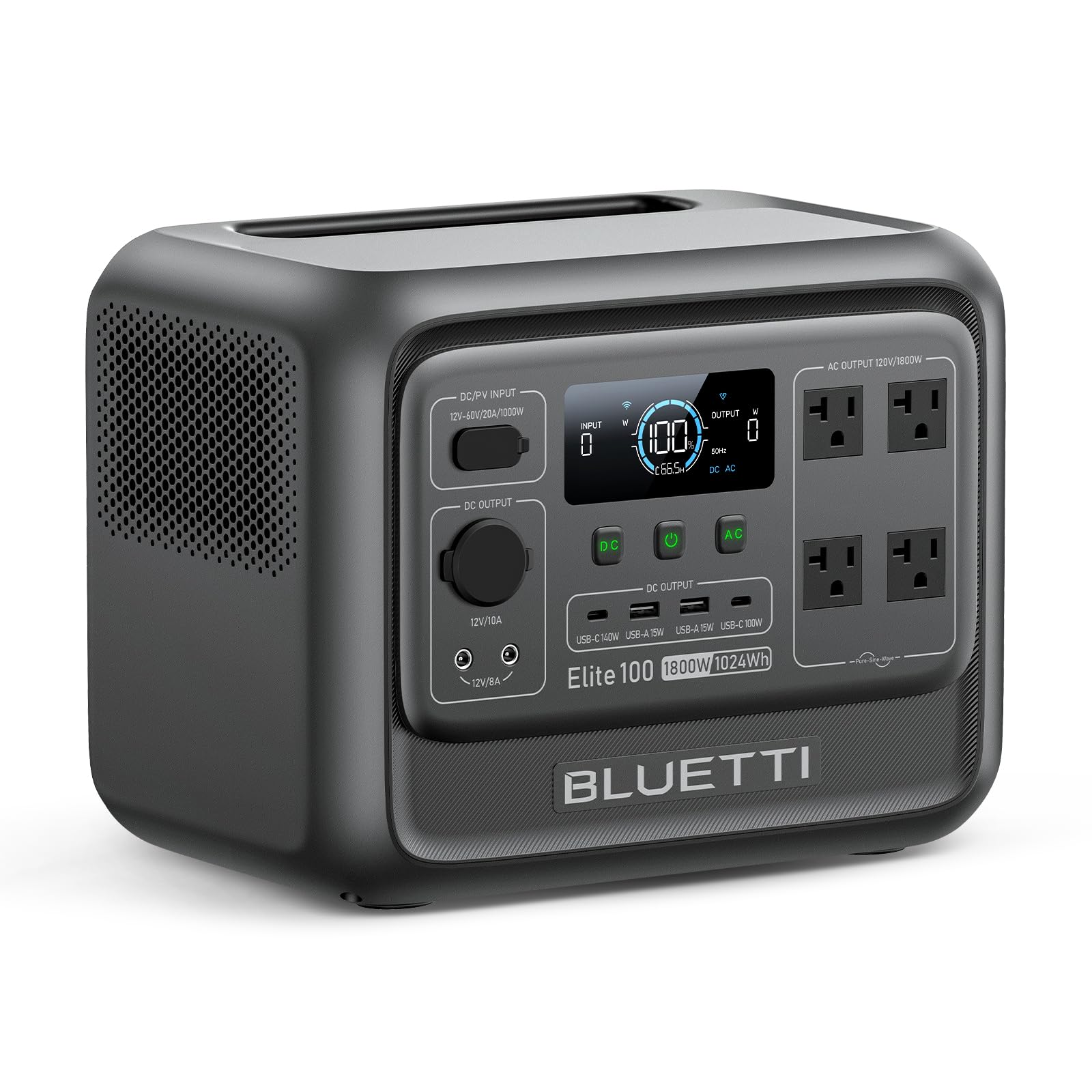
This is the one that changes how you camp. With a 1024Wh capacity and 1800W rated AC output (power lifting up to 2700W), it runs 90% of the appliances you would plug in at home — your electric cooler, a drip coffee maker, lights, laptops, and a fan — all at once. You can set up a proper camp kitchen and a charging station without rationing power like you are on a sailboat. It covers a CPAP machine for multiple nights, which the 288Wh units cannot do.
Recharging is almost absurdly fast. At 1200W TurboBoost AC charging, you go from empty to full in about 70 minutes. That is faster than many smaller units. The solar input is equally impressive: up to 1000W, which is the fastest solar charge for a 1kWh power station. That is the real-world reliability you pay for.
Weighing 25 lbs and measuring 35% smaller than other 1kWh stations, it fits under a truck seat or in a closet. The hidden handle makes one-handed carry easy. It also acts as a 10ms UPS backup (Ultra-fast Power Supply — it switches to battery in 10 milliseconds if the grid goes out), keeping your router or CPAP running through power blips. The BLUETTI app gives you remote control via Wi-Fi or Bluetooth. The downside: at this capacity, it is physically large, and the price is higher than the smaller picks below. Buyers report the app helps them manage power consumption precisely, which is useful for stretching a charge.
Full-On Camp Power
- 1024Wh capacity runs a mini-fridge, TV, and CPAP all weekend
- 1800W AC output handles a toaster or electric kettle easily
- 70-minute AC recharge is faster than almost anything at this size (1024Wh)
- 10ms UPS backup keeps gear safe during outages
The Trade-Offs
- At 25 lbs and 12.6 x 8.5 x 9.8 inches, it is heavy for backpacking or foot carries
- Higher investment than smaller 288Wh units; you buy once for serious capacity
Verdict: Buy this if you want one device that does everything — weekend camp, emergency home backup, and RV power — with zero compromises.
Reach for this when: you need to run real appliances, not just charge phones. The 33-hour router battery life and the ability to power chainsaws prove its mettle.
3. LIBRIDS Portable Power Station C600
The 640Wh balance that runs your camp fridge all weekend without breaking your budget.
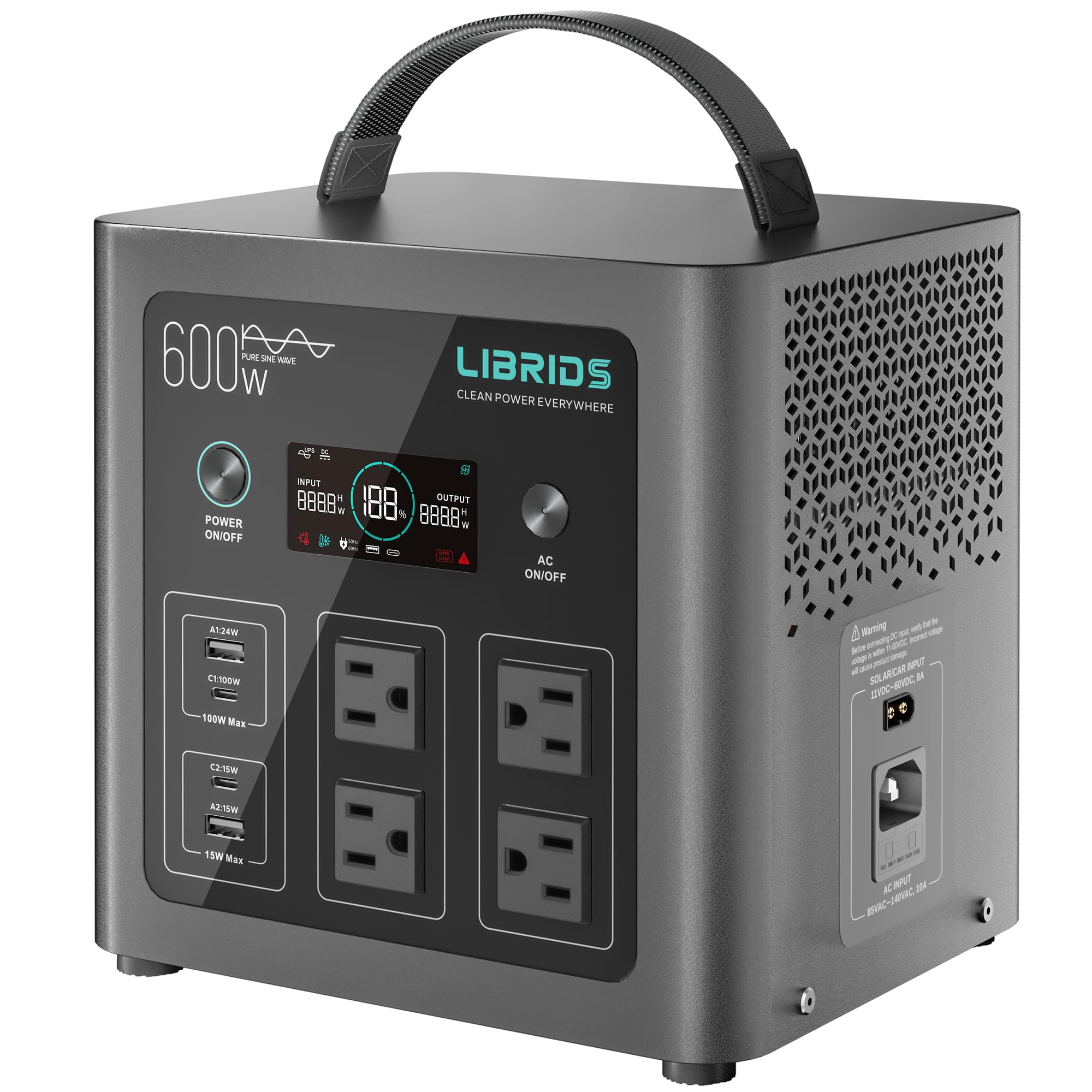
The LIBRIDS C600 splits the difference between a tiny 256Wh unit and the giant 1024Wh models. Its 640Wh LiFePO4 battery (an automotive-grade battery chemistry that lasts 4,000+ cycles — that is about 10 years) and 600W AC output (with 1200W surge to start motors like a small pump or fridge compressor) give you the confidence to run a CPAP, a 32″ TV, or a mini-fridge without anxiety. Unlike the RIVER 2 at 256Wh, this has the headroom for two full days of moderate use. One reviewer noted it powered a marine reef tank’s pumps without damaging sensitive aquatic equipment, which speaks to the clean pure sine wave output.
The build quality stands out at this price. The metal enclosure feels solid and helps with heat dissipation — you can place it in a tent or camper without worrying about fire risk. It has 4 AC outlets plus multiple USB ports, so you can power up to 8 devices at once. The charging speed is a highlight: full in 1.5 hours via AC, which is faster than the Anker SOLIX C200 DC (which took three hours from 50% with a 65W charger). The smart LCD screen shows real-time battery percentage, input power, and output power, so you are never guessing how much juice you have left. The only surprise: you need to buy your own 12V car charging cable if you want to top off while driving.
The 10ms UPS backup (Ultra-fast Power Supply — switches to battery in 10 milliseconds if the grid dies) means it doubles as a home backup for your router and security system. It is quiet enough to use in a tent without keeping you awake. The catch: the “Indoor Use Only” label is real — it is not fully waterproof, so keep it dry under a canopy or in a dry RV bay. For campsite use in clear weather, you are fine.
Solid Mid-Range Power
- 640Wh capacity powers a CPAP for 2-3 nights or a fridge for a weekend
- Metal enclosure dissipates heat better than plastic rivals
- 1.5-hour AC charge gets you back up fast after draining it
- 4 AC outlets let you run multiple appliances without constantly unplugging
Missing Pieces
- No solar cable included — you have to order that separately
- 12V car charging cable not included either; it is a separate purchase
- It is not designed for wet conditions; keep it sheltered from rain
The metal build and 4 AC outlets make it a durable choice for mid-length camps.
Look elsewhere if: you need solar from the start without buying extra cables, or you often camp in rainy weather without shelter.
4. EF ECOFLOW Portable Power Station RIVER 3

The 245Wh unit that runs whisper-quiet and doubles your runtime on small loads.
The RIVER 3 uses EcoFlow’s new X-GaNPower technology (gallium nitride components that make the electronics smaller and more efficient). This gives it a unique trick: for appliances under 100W — like a phone, laptop, fan, or LED light — it delivers double the runtime compared to a standard battery of the same capacity. So while it is only 245Wh, you get more usable hours from the same charge than the RIVER 2 (256Wh) when powering low-draw gear. It also stays incredibly quiet, running at less than 30 dB at 1.5 feet away — that is quieter than a whisper. One reviewer used it as a daily UPS for a Wi-Fi router, which ran for days without needing a recharge.
The <20 ms auto-switching UPS (Uninterruptible Power Supply — it switches to battery in under 20 milliseconds if the grid power cuts out) is the fastest among small units. Unlike the RIVER 2, which does not advertise a specific switchover speed, the RIVER 3 is explicitly rated for sensitive equipment. A reviewer running a network DVR confirmed the switchover worked flawlessly, with no reboot or hiccup. The IP54 battery protection rating (the “5” means dust-proof, the “4” means it can handle water splashes) gives it an edge over the RIVER 2 for damp conditions. It is also 30% smaller than the industry average, measuring just 8.3 x 4.4 x 10 inches — small enough to slide into a backpack. The 300W standard output is lower than the RIVER 2’s 600W, but X-Boost (their surge technology) can temporarily push to 600W for startup loads on fridges or pumps.
The catch: the fan, while silent under normal use, can be audible if you push it near its 600W X-Boost limit. And at 300W continuous output, you cannot run high-wattage appliances like a hairdryer or a standard microwave simultaneously. Customers note the app is excellent for monitoring, and the 5-year warranty adds confidence. For tent campers who value quiet and efficiency over raw power, this is a strong pick.
GaN Efficiency Wins
- Double runtime on devices under 100W (phone, laptop, fan)
- <20ms UPS switchover protects sensitive electronics
- IP54 dust and splash resistance for damp campsites
- 30% smaller than average — fits in a backpack
Lower Peak Output
- Only 300W continuous — cannot run a kettle or toaster directly
- 245Wh is smaller than the RIVER 2’s 256Wh, though GaN compensates at low loads
- Fan noise can increase under heavy load close to X-Boost limit
Who it fits: the quiet camper who needs long-lasting power for low-draw gear (phone, laptop, router, fan) and wants a compact, splash-resistant unit.
Who should pass: anyone needing full 600W output for a coffee maker or mini-fridge — the RIVER 2 is better for that at a similar price.
5. BLUETTI Elite 30 V2
This 288Wh pocket station packs 600W continuous and a Power Lifting surge of 1500W.
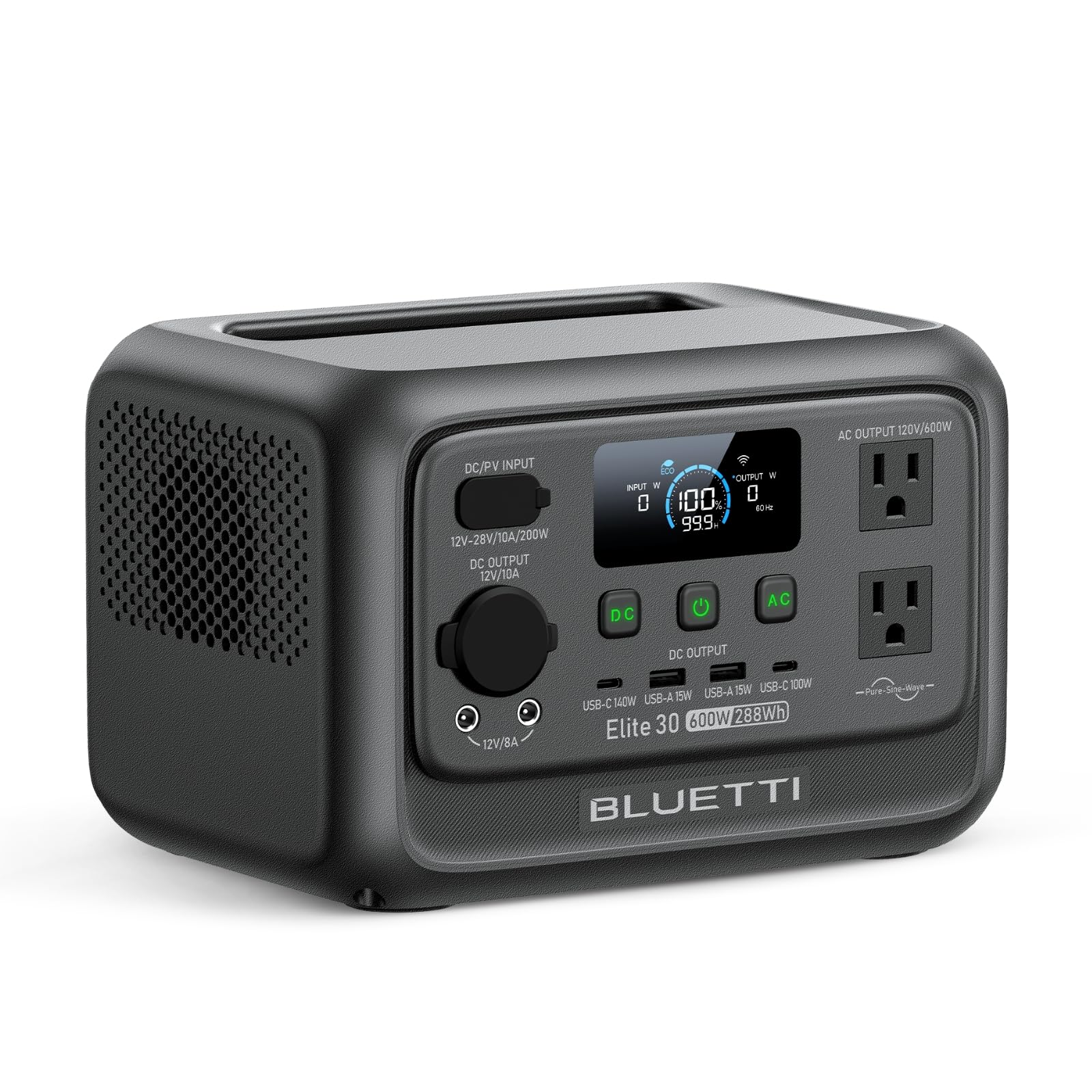
The BLUETTI Elite 30 V2 gives you the full 600W output of the larger RIVER 2 but in a lighter 9.4 lb package with a clever boost feature. When you activate Power Lifting Mode (their name for a temporary surge circuit that lets the inverter run harder for a few seconds), it can deliver 1500W — enough to start a small kettle or a toaster, which no other 288Wh unit can do. One reviewer in Venezuela uses it as a UPS for a MacBook Pro, a 24-inch monitor, and a modem/router, getting 33 hours of internet-only runtime with just the router connected. That is a real-world endurance test that beats the generic “up to X hours” marketing.
The 8 charging modes and 380W fast wall charge (adjustable down to 200W for safer, slower charging if needed) get you 0-80% in 45 minutes and 0-100% in 70 minutes. That is competitive with the RIVER 3, though the RIVER 3’s GaN tech gives better low-power efficiency. The upgraded UltraCell tech and smart cooling system cut standby power consumption by 50% (standby power is just 4.5W, DC 5W, AC 8W). In plain terms: when you are not actively using the battery, it slowly drains itself much slower than the competition. The 10ms UPS switchover is identical to the LIBRIDS C600’s spec, making either a strong home backup for a modem and router. A reviewer reported running a home server and networking stack without a single hiccup during power transitions.
The main drawback: solar input specs are not clearly listed as a single number in the data, and the included accessories are minimal (just the AC and car charging cables). Unlike the GRECELL EB300, which comes with a wireless charging pad and multiple DC ports from the start, the BLUETTI Elite 30 V2 expects you to buy extras. The 288Wh capacity is still a weekend companion, not a full-camp solution. For short trips or backup power for a single device, it is excellent; for multi-night off-grid with a fridge, look at the BLUETTI Elite 100 V2 instead.
Surge Power in a Small Frame
- 1500W Power Lifting Mode starts a kettle or toaster, unlike other 288Wh units
- 45-minute 0-80% charge via AC wall (380W Turbo mode) is very fast
- 9.4 lbs is lighter than both the RIVER 2 and RIVER 3
- 33-hour router runtime is a real-world endurance winner
Compact Limits
- 288Wh is still a single-night capacity for moderate use
- Solar input is not clearly specified — you may need to test with your own panel
- Limited accessories included; no solar panel, no extra cables
Grab it for: fast-charging portable power that can briefly handle a small heating appliance. The 1500W surge is unique at this size.
Pass on it if: you need full weekend capacity or solar-ready specs from the box — the GRECELL EB300 offers more for less in that area.
6. GRECELL EB300 Portable Power Station 330W
The 330W budget champion that powers a CPAP for two to four nights straight.
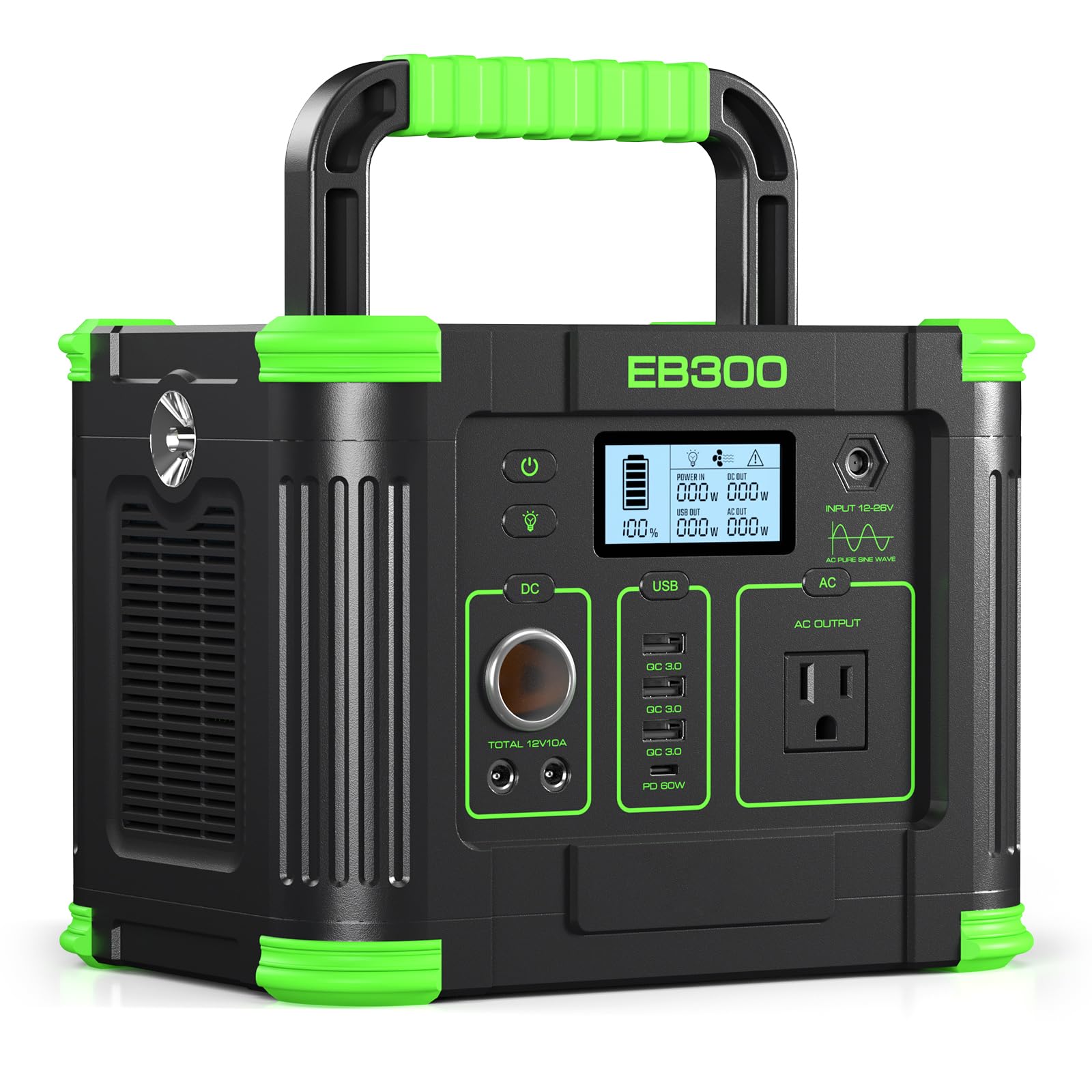
The GRECELL EB300 is the most versatile value station on this list. Its 288.6Wh capacity and 330W AC output are modest, but it packs features you do not expect at this price: a 60W USB-C PD port (Power Delivery — fast enough to charge a MacBook Pro at full speed), a 5W wireless charging pad on top, dual USB-A QC 3.0 (Quick Charge — charges phones three times faster than standard USB-A), two DC ports, and a 12V car socket. One reviewer specifically mentioned using it to power a microwave in their RV, which is impressive for a 330W unit, though it likely means they ran it with minimal other loads. The 32″ TV runtime of 3-4 hours and the mini-fridge runtime of 5+ hours are realistic benchmarks that buyers confirm.
The charging versatility is a highlight. It supports AC wall (6-7 hours), car 12V (7-9 hours), and solar (5-9 hours with 60-120W panels). The built-in MPPT solar controller (Maximum Power Point Tracking — a circuit that actively adjusts the charging voltage to pull maximum wattage from your solar panel) is claimed to improve solar efficiency by 30% compared to standard controllers. That matters if you rely on solar to keep your campsite running. The 3W LED flashlight with high, strobe, and SOS modes is a practical addition the Anker and BLUETTI units do not offer in the same way. At 5.3 lbs and measuring 9.6 x 6.7 x 7 inches, it is lighter than the RIVER 2 (7.7 lbs) and fits in a truck bed or RV storage easily.
The trade-off: the 330W maximum output means you cannot run high-wattage appliances. A standard coffee maker (600-800W) or a hairdryer (1200W+) will trip the overload protection. Reviewers point out it is ideal for tent camping and power outages where you just need to charge phones, run a fan, and keep a mini-fridge going. The 2-year warranty and US-based support add confidence. It is the clear value leader in this group, beating the Anker SOLIX C200 DC on port count and AC output.
Value Overload
- 9 ports including 60W USB-C PD, wireless charging pad, and 12V car port
- Runs a CPAP for 2-4 nights or a mini-fridge for 5+ hours per charge
- Built-in MPPT solar controller boost solar efficiency by 30%
- 5.3 lbs and compact size make it easy to carry everywhere
Power Ceiling
- 330W output cannot run a coffee maker, kettle, or hairdryer
- Slow wall charge (6-7 hours) compared to EcoFlow’s 1-hour AC charging
- Limited to small appliance use — not suitable for heavy simultaneous loads
Best for: budget-conscious campers who need a versatile, multi-device charger with real CPAP and mini-fridge capacity. The port selection is class-leading at this price.
pass on it if: you need to power high-wattage appliances (kettle, coffee maker) or want a recharge time under 2 hours.
7. Anker SOLIX C200 DC Power Bank Station

A 192Wh footlocker that fits in your daypack and powers a Starlink Mini for an afternoon.
The Anker SOLIX C200 DC is the “small but mighty” pick of this list, but with a catch: it is DC-only, meaning it does not have a standard AC wall outlet. You get 200W total via two USB-C ports (one 140W PD 3.1, one 100W PD), one USB-C 15W, and two USB-A 12W ports. That is enough to charge a MacBook Pro, two iPhones, and a fan simultaneously, but you cannot plug in an AC device like a fan on AC or a lamp. Shoppers say using it to power a Starlink Mini for 5-6 hours and still having 40% power left — one buyer mentioned it worked “great for a mini with no need for inverter or worry about draining my starting battery.” Another uses it for continuous PD (Power Delivery) to a Linux single-board computer, which stays running through charge cycles — something cheaper batteries cannot do.
At 39% smaller than similar power stations, the C200 DC measures just 3.94 x 7.28 x 4.33 inches. It fits in a cupholder or a side pocket of any backpack. The 100W solar input is competitive with the RIVER 2’s 110W, though the actual W gap is only 10% less. The LiFePO4 battery is rated for 3,000 cycles, same as the RIVER 2 and RIVER 3. It recharges to 80% in 1.3 hours via the 140W USB-C PD 3.1 port — though you need to supply your own wall charger (18W or higher, Anker recommends a 65W for best speed). A reviewer noted it took about three hours to charge from 50% with a 65W charger, and an actual 140W charger would be faster.
The honest limitation is the lack of an AC outlet (standard wall plug). You cannot run a fan on AC, a mini-fridge, a CPAP (most need AC), or a TV. It is strictly a device charger, not a replacement for a power station with AC outlets. For that reason, it is the most niche product here. Buyers who pair it with a Starlink Mini or use it to keep phones and tablets charged on car camping trips love it; anyone expecting to run camp appliances will hit a wall. It is also the smallest capacity at 192Wh, so its runtime on high-draw devices like Starlink is limited.
Pocket-Sized Power
- 39% smaller than similar power stations — fits almost anywhere
- 140W USB-C PD 3.1 is the fastest single-port charging here
- 100W solar input matches the RIVER 2’s 110W (10% gap), good for off-grid
- 3,000-cycle LiFePO4 battery lasts for years
No AC Outlet
- No AC outlet means you cannot power any standard appliance (fan, CPAP, fridge, TV)
- 192Wh is the smallest capacity on this list — best for short trips
- Wall charger not included; you must buy that separately
Ideal for: ultralight campers, Starlink users, and anyone who only needs to charge USB-C devices. The 140W PD port is unique.
Not for: anyone who needs a standard AC wall plug for camp appliances. The GRECELL EB300 is a better value here if you need AC.
Understanding the Specs
Watt-Hours (Wh) vs. Watts (W)
Watt-hours are the fuel tank — how much energy the battery stores. A 256Wh unit can run a 10W phone charger for 25.6 hours, or a 100W laptop for 2.5 hours. Watts are the spigot — how fast the battery can deliver that energy at once. A 600W unit can power a 600W microwave directly, while a 300W unit cannot. For camping, you need enough Wh to last the trip and enough W to start your largest appliance. Most mini-fridges draw about 40-80W running, but they spike to 100-200W when the compressor kicks on, so a 330W or higher unit is safer.
LiFePO4 vs. Lithium-Ion (NMC)
LiFePO4 (lithium iron phosphate) batteries last 3,000-4,000+ charge cycles before dropping to 80% capacity. That is about 10 years of weekly use. They also handle temperature extremes better and are much safer — they rarely catch fire even if punctured. Older lithium-ion (NMC, or nickel manganese cobalt) batteries typically die after 500 cycles. Every product on this list uses LiFePO4, which is the right choice for a camping battery you want to use for years. The trade-off: LiFePO4 batteries are slightly heavier and more expensive per Wh than NMC, but the longevity pays off in the long run.
FAQ
Will a 300W camping battery run my CPAP machine all night?
How long does a camping battery last before I need to replace it?
Can I charge my camping battery from my car’s 12V port?
What does “pure sine wave” mean, and why does it matter for camping?
Can I run a mini-fridge directly from a camping battery?
What is the difference between USB-C PD and standard USB-A charging?
Can I use a camping battery indoors safely?
What size solar panel do I need to recharge my camping battery in a day?
How do I know if a camping battery can power my electric cooler?
Can I leave my camping battery plugged in all the time?
Final Thoughts: The Verdict
How We Picked
We do not accept paid placement. Every pick is matched to a real buyer and a real use-case; we do not hands-on test units.
Sources & Methodology
Specifications: manufacturer listings and product documentation. Review insights: verified customer reviews, as of July 2026. Pricing: not shown on this page (it changes often); check the current price via the retailer link.
As an Amazon Associate, Gadgets Feed earns from qualifying purchases. This does not affect which products we feature.