
Our readers keep the lights on and my morning glass full of iced black tea. As an Amazon Associate, I earn from qualifying purchases.
Specs are compiled from manufacturer listings and verified buyer reviews and can change over time — please confirm the key details on the product page before buying.
You want crisp 4K footage without that seasick wobble, and you want a camera that keeps up with fast action without complicated menus. The right pick makes you the hero of the highlight reel rather than the person who missed the shot. Whether you are filming your kid’s soccer match, strapping it to a mountain bike helmet, or taking it snorkeling, stabilization is what separates a camera you use from one that gathers dust.
I’m Min — the founder and writer behind Gadgets Feed. This guide is built by comparing the manufacturers’ published specifications and the patterns across verified customer reviews, so you get each pick’s real strengths and trade-offs instead of marketing spin.
The 5 cameras here each handle motion, light, and mounting differently, so we match each one to a specific real-world scenario you will actually face. Read on to find the best 4k sports camera for the way you actually play and record.
Our Picks at a Glance

How To Choose The Best 4K Sports Camera
Buying a sports camera is about matching specs to your actual sport. A cyclist needs different stabilization than a soccer coach does, and a snorkeler cares more about waterproof depth than frame rate. Focus on these three things first, and the decision gets much easier.
Stabilization and Shaky Hands
Your camera cannot fix a bumpy trail if the stabilization is weak. Look for electronic image stabilization (EIS) or gimbal-like systems that smooth out the bumps. The term “FlowState Stabilization” or “Horizon Lock” tells you the camera works to keep the horizon level even when you tilt. A 4K sports camera with strong stabilization — like the 360° HorizonSteady on the DJI model — produces watchable footage from a helmet mount without extra editing.
Battery Life and Recording Time
Nothing ends a game recording faster than a dead battery. A single battery that lasts 3 to 4 hours of continuous 4K recording covers most soccer matches or a long bike ride. Some cameras come with multiple batteries (the DJI Adventure Combo gives you three) so you can swap and keep going. The rating you see — “battery average life” — is typically measured under ideal conditions, so expect slightly less in cold weather or when using stabilization at high frame rates.
Field of View and Lens Options
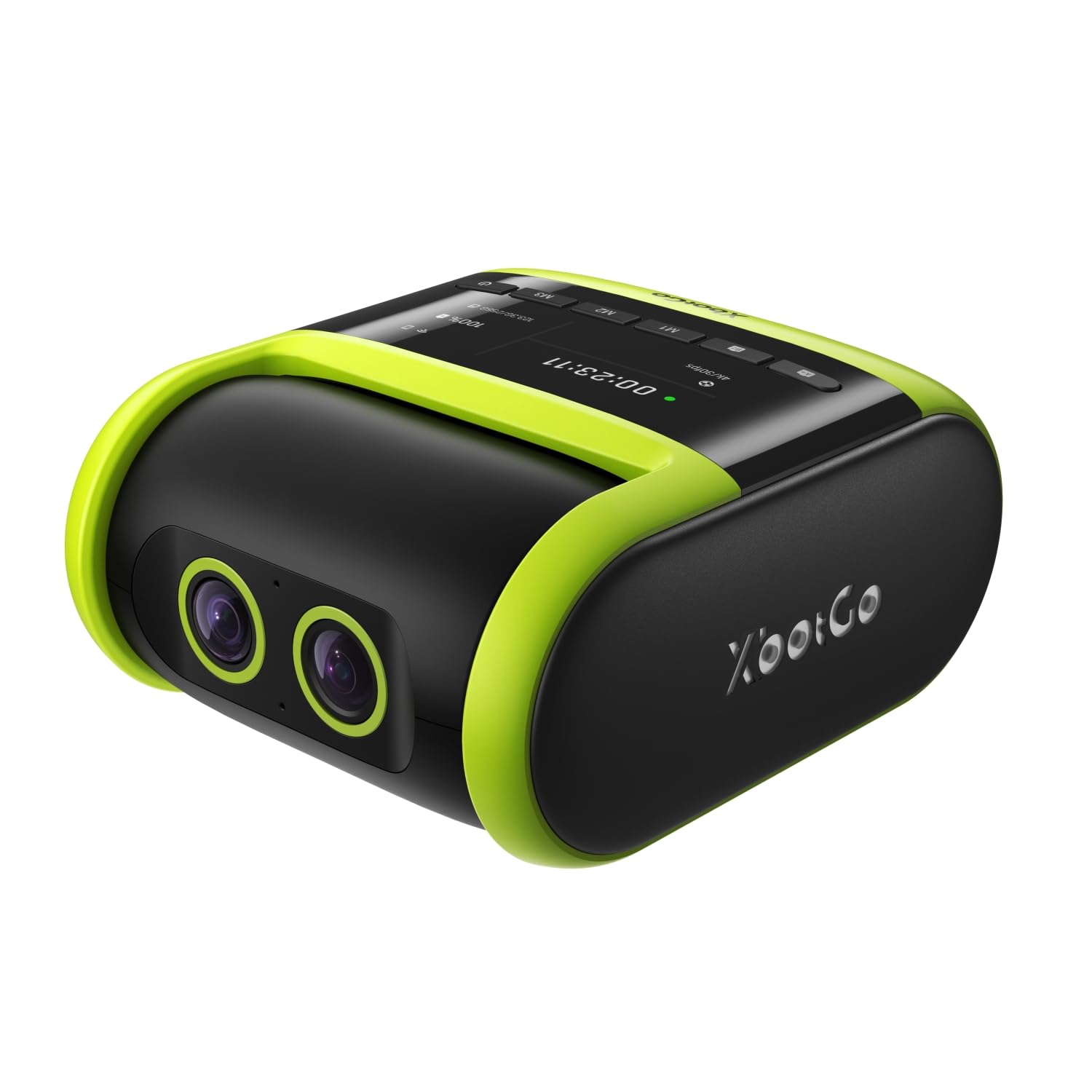
A wide-angle lens (155° or similar) captures the whole field or the full trail ahead, which is great for action. But a wide lens also means more distortion around the edges. Some cameras, like the Insta360 GO 3S, use an ultra-wide “MegaView” mode that reduces that barrel distortion. If you are filming a team sport from the sideline, a dual-lens camera with AI tracking (like the XbotGo Falcon) can follow the ball automatically, giving you a zoomed-in view without missing the wider play.
Quick Comparison
| Model | Best For | Stabilization | Battery Life | Still Resolution | Amazon |
|---|---|---|---|---|---|
| DJI Osmo Action 5 Pro★ Best Overall | All-around pro-grade action | 360° HorizonSteady | 4 hours per battery | 40 MP | $419.00Amazon |
| XbotGo FalconBest for Team Sports | Team sports auto-tracking | AI-assisted dual lens | — | 4 MP | $699.00Amazon |
| Insta360 GO 3S | Tiny, portable hands-free | FlowState + Horizon Lock | 140 minutes (Action Pod) | 35 MP | $349.99Amazon |
| Xtra Edge Action Camera | Mid-range value with great sensor | Hyper Stabilization | 160 minutes (3 hours) | — | $199.00$299.00Amazon |
| AKASO Brave 7 LE | Budget-friendly starter kit | EIS 2.0 (6-axis) | 2 hours per battery | 20 MP | $139.49$154.99Limited time dealAmazon |
In‑Depth Reviews
1. DJI Osmo Action 5 Pro Adventure Combo
Our pick — over 4.5★ from 900+ verified ratings; the strongest balance of quality and price.
The do-everything action camera that makes shaky footage a thing of the past.
You get a big 1/1.3″ sensor (the sensor that captures light) with 2.4 µm pixels — larger pixels mean brighter images in low-light conditions, so your evening soccer game looks clear rather than grainy. The 40 MP effective still resolution (compared to the AKASO’s 20 MP) gives you room to crop photos without losing detail. Buyers report using it as a motorcycle dash cam: “I have mine on a MotoRadds chin mount, didn’t do it to be a blogger or anything. It’s caught a few funny things on the road.”
The stabilization here is the headline. 360° HorizonSteady (a stabilization system that keeps the horizon level even when the camera spins) eliminates roll-axis shakes entirely — the camera handles the wobble, not you. You also get dual OLED touchscreens (front and back) so framing a selfie or checking your shot is just a glance away. The IP68 waterproof rating means it works underwater down to 20 meters without a housing, a big advantage over the Xtra Edge which needs a separate case for deep water. This is the camera you grab when you want one device that does mountain biking, snorkeling, and vlogging equally well.
The Adventure Combo includes three 1950mAh batteries and a multifunctional battery case, giving you up to 4 hours of recording per battery. In freezing conditions at -20°C (-4°F), it still shoots for 3.6 hours — the battery chemistry handles cold better than budget cameras. The only real trade-off is the price, which sits at the higher end, but you get the 40 MP stills (the AKASO offers 20 MP), the best stabilization in its class, and a proven ecosystem of mounts.
The strengths that stand out
- Industry-leading 360° HorizonSteady stabilization keeps your horizon level no matter how rough the ride
- 40 MP still resolution gives you crisp photos you can crop heavily — the AKASO Brave 7 LE offers 20 MP
- Dual OLED touchscreens make framing easy from either side of the camera
A couple of honest drawbacks
- The premium price puts it out of reach for casual budget shoppers
- Some owners mention it generates noticeable heat after a few minutes of continuous 4K recording
Reach for this if: you want the most versatile, pro-grade action camera that handles low light, rough motion, and underwater use without compromise.
The only real reason to pass: you need a simple, low-cost starter camera for occasional use — the price is overkill for that.
2. XbotGo Falcon All-in-One AI Action Camera
The sideline camera that tracks the ball so you do not have to touch the viewfinder.
This one is built for a very specific job: recording a full team sport from a single spot. The dual-lens system uses a 4K recording lens and an AI-assisted lens (a second lens dedicated to tracking movement) to follow the ball and players automatically. It runs on an 8-core processor with 6 TOPS (trillion operations per second — a measure of how fast the AI can process what it sees), so the tracking is responsive enough for soccer, basketball, and football. Unlike the DJI, which needs you to keep the subject roughly in frame, the Falcon handles the pan and zoom itself.
Owners mention it is perfect for sideline use: “Great 4K action camera for soccer; easy setup, phone connection, good ball tracking, no subscription.” The lack of a monthly fee is a big deal — many AI sports cameras charge for cloud tracking features, but here you get local tracking for free. The IPX5 water-resistant rating (it handles rain and splashes but not full submersion) means it survives typical outdoor conditions without a housing. One reviewer noted that during a 70-minute lacrosse match the camera only lost the play 3-4 times, which is impressive for an AI system that runs entirely on-device.
The main limitations come down to hardware. The effective still resolution is only 4 MP — this is not a camera for photo quality; it is a video-first tool for recording games. It also does not include a battery (batteries sold separately) and requires a microSD card (sold separately) for recording. The digital zoom tops out at 1.6x, so you cannot punch in for a tight closeup. But for a coach or parent who wants to record a full game, stream it live, and never spend a penny on a subscription, the Falcon is in a class of its own.
What makes it special
- AI auto-tracking with dual-lens precision follows the ball and players automatically
- No subscription required for tracking or live streaming — a rare and valuable perk
- IPX5 water-resistant design handles real sideline weather conditions
Things to know before buying
- Only 4 MP still photos — this is a video tool, not a photo camera
- Battery and microSD card are sold separately, adding to the initial cost
Grab it for: recording youth or high school team sports from the sideline without needing a person to operate the camera.
skip it if: you want a general-purpose action camera for biking, hiking, or underwater use — this one is laser-focused on team sports only.
3. Insta360 GO 3S

A thumb-sized 4K camera that mounts anywhere your imagination takes it.
At just 1.4 ounces (39 grams) and roughly the size of your thumb, the GO 3S is tiny enough to mount on a dog collar, a bike helmet, or a skateboard deck. The 35 MP effective still resolution captures detailed photos, and the 4K video with MegaView FOV (a field-of-view mode that reduces edge distortion from the ultra-wide lens) gives you wide shots that look natural. The Action Pod — a larger housing with a 2.2-inch flip screen — acts as a remote and a charger, extending the total battery life to 140 minutes.
FlowState Stabilization (Insta360’s gimbal-like smoothing system) keeps footage steady even when the camera is bouncing around on a pet or a chest strap. The Horizon Lock feature keeps the horizon level when you rotate the camera — useful for first-person POV shots where the wearer tilts their head. The IPX8 waterproof rating on the GO 3S itself means it can be submerged down to 10 meters (or 60 meters with the optional Dive Case). One buyer summed it up: “Good video quality in good light, poor in low light. Compact, stable, easy setup, good value.” The biggest trade-off is the battery life of the camera itself — users report it overheats after roughly 20 minutes of use and needs a cooldown. You get around this by using the Action Pod as an extended battery and control hub, but it is a genuine limitation for long continuous recordings.
The internal 64 GB storage (no microSD card needed for the camera itself) is convenient — just charge and shoot. The magnetic mounting system (with included Magnet Pendant, Easy Clip, and Pivot Stand) makes it easy to attach the camera to metal surfaces or clip it onto a strap. This is the camera for creative, short-duration POV shots where size and weight matter more than long battery life.
Where it excels
- Incredibly small and light at 1.4 oz — you can mount it where no other 4K camera fits
- FlowState Stabilization with Horizon Lock keeps footage smooth and level
- 64 GB of internal storage means you do not need to buy a memory card to start
Honest limitations
- The camera body itself runs hot and shuts down after about 20 minutes of continuous recording
- Image quality drops noticeably in low-light conditions
Best fit: anyone who wants a super-portable camera for short, creative POV clips — pet walks, helmet mountain biking, or hands-free travel vlogging.
Not your match if: you need to record a full-length soccer match or any event over 20 minutes without the Action Pod.
4. Xtra Edge Action Camera
A big sensor and 4K cinematic video at a price that undercuts the usual suspects.
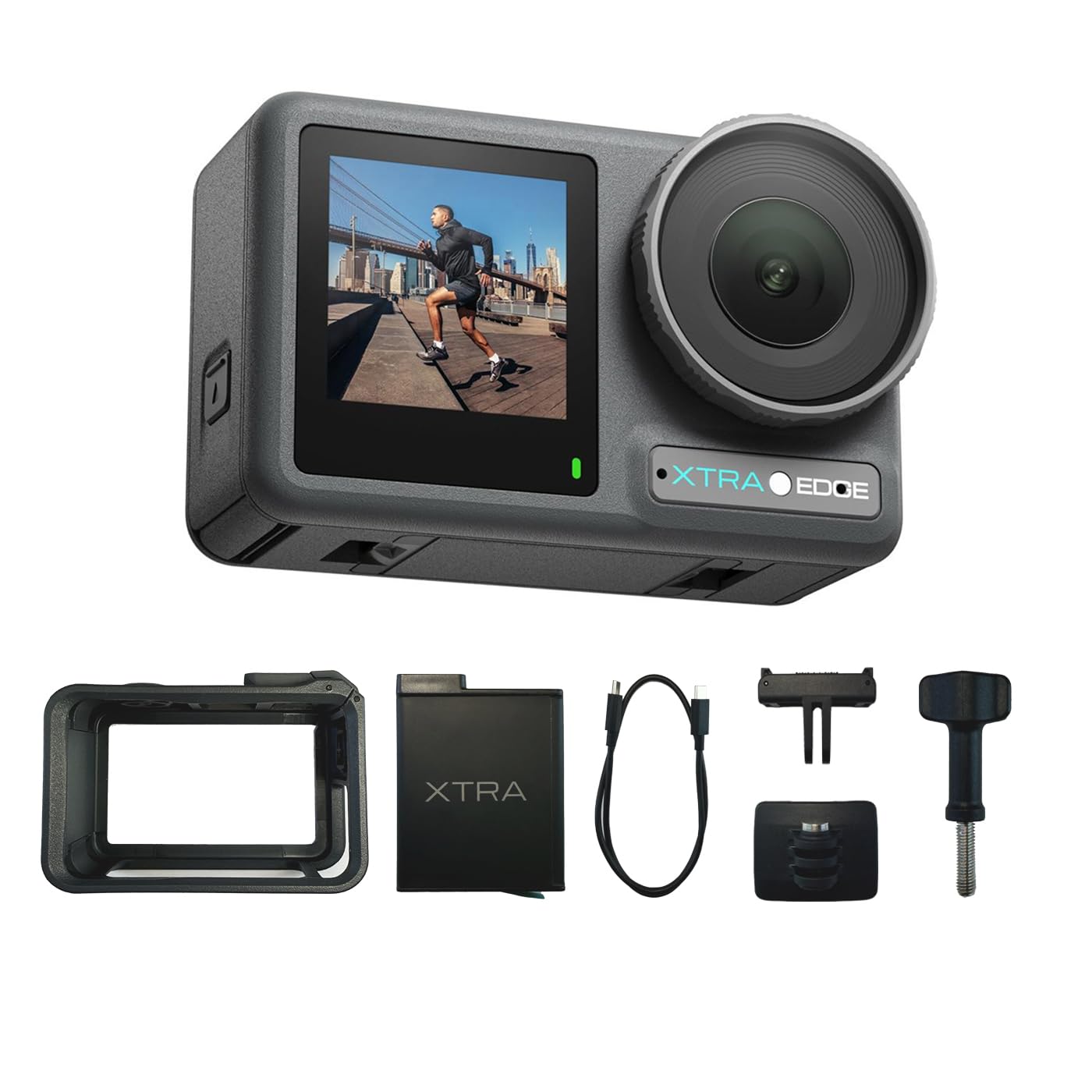
The Xtra Edge packs the same 1/1.3″ sensor size as the DJI — the large sensor that captures more light — but at a significantly lower price. Customers note the video quality is “crisp and stable, making it a solid choice for action shots” and one reviewer took it snorkeling in Hawaii: “The underwater footage came out super clear, and I was able to film sea turtles pretty close.” The manufacturer describes the 4K video as “cinematic,” which in plain terms means the colors look vibrant and the footage holds up well on a big TV screen. The Hyper Stabilization (their name for the electronic image stabilization) smooths out bike trail bumps and running motion so your footage does not look like a shaky phone video.
The waterproof depth is 52 feet (about 16 meters) with the included housing — good for snorkeling and rainy hikes but not deep diving. The battery life is a genuine strong point: 160 minutes (3 hours) of continuous recording. That beats the 140-minute Action Pod of the Insta360 and the 2-hour per battery of the AKASO, so you can film a long soccer match on a single charge. The Universal Quick Mount uses a magnetic lock for switching between horizontal and vertical shooting, which is useful for social media clips. The whole package feels premium according to owners: “It’s incredibly compact… the matte finish gives it a clean, modern look.”
The main compromise is that the brand is less established than DJI or Insta360, so the ecosystem of accessories and mounts is smaller. Some buyers might also miss features like a front-facing screen or voice control. But if you want a large sensor for better low-light footage and long battery life without paying flagship prices, the Xtra Edge delivers.
What you will love
- The 1/1.3″ sensor captures bright, colorful footage even in challenging light
- 160-minute battery covers a full-length soccer game or long hike on one charge
- Magnetic quick mount makes switching between horizontal and vertical shooting easy
A couple of things to consider
- The brand is newer, so the accessory ecosystem is not as broad as DJI or GoPro
- No front-facing screen for vlogging or selfie framing
The smart pick for: a buyer who wants a large-sensor 4K camera with great battery life but does not need the premium name or advanced stabilization of the DJI.
Look elsewhere if: you absolutely need a front-facing screen for vlogging or a huge selection of mounts and accessories.
5. AKASO Brave 7 LE

A dual-display starter kit that proves you do not need to spend big for decent 4K.
The Brave 7 LE is the budget pick that does not cut corners on the features you actually use most. It has a front color screen — unusual at this price — so you can frame yourself properly when vlogging or filming solo. The 4K resolution runs at 30 frames per second (30fps), which is smooth enough for most sports but not as fluid as the 120fps of the DJI. The effective still resolution is 20 MP, which is half the 40 MP of the DJI but still plenty for sharing on social media or cropping lightly. Reviewers point out the “image stabilization works great—it smooths out the normal riding vibrations perfectly” and that “the battery lasts about 2 hours of constant filming, which is great for our nature walks.”
The included accessories kit is generous: 2 rechargeable batteries, a remote control for self-filming, a waterproof housing rated to 131 feet (40 meters), and multiple mounting brackets. That waterproof depth is deeper than the Xtra Edge’s 52 feet, so if snorkeling or shallow diving is your thing, the AKASO handles it without a separate housing upgrade. The digital zoom reaches 4x (compared to the DJI’s 2x), letting you punch in closer on distant action. One buyer mentioned the camera is “durable, advanced, user friendly… comes with everything you need to plug and play from the start.” The EIS 2.0 (electronic image stabilization with 6-axis correction) does a solid job on bike rides and walks, though it is not as smooth as the DJI’s HorizonSteady on heavy bumps.
The biggest catch is that the battery life per battery is about 2 hours in 4K, so you will want to swap in the second battery for longer events. Also, the camera ships with a confusing array of adapters — one owner reported “I feel like an idiot trying to figure out these adaptors… I just want to simply mount my camera on my chest harness.” Take a few minutes with the manual and you will be fine, but it is not as plug-and-play as some rivals. For the price, though, this is the best entry point into 4K sports recording.
The budget-friendly wins
- Front-facing color screen for vlogging is rare and valuable at this price
- Comes with dual batteries, a remote, waterproof housing to 131 ft, and many mounts
- 20 MP stills and 4K video provide solid quality for casual enthusiasts
The trade-offs you get
- Stabilization is good but not as smooth as premium models on big bumps or high-speed trails
- The adapter system is confusing from the start — plan time to figure out mounting
Grab it: as your first 4K action camera, for a child starting a YouTube channel, or for casual hikes and snorkel trips where budget matters.
pass on it if: you need rock-solid stabilization for high-speed mountain bike racing or you want the absolute best low-light performance.
Understanding the Specs
Stabilization Systems
Stabilization is what makes your footage watchable when you are moving. There are two main types: electronic image stabilization (EIS) which uses software to smooth out the motion, and horizon-leveling systems (like DJI’s HorizonSteady or Insta360’s Horizon Lock) which keep the horizon line flat even when the camera tilts or spins. A camera with basic EIS is fine for walking, but for mountain biking, trail running, or any high-vibration activity you want the horizon-lock type. The number of axes (6-axis, etc.) refers to the directions the camera can detect and compensate for movement — more axes generally means smoother footage, but the quality of the algorithm matters more than the number alone.
Waterproof Depth Ratings
Waterproof ratings tell you how deep the camera can go without a separate housing. Look for “IPX8” for cameras that work underwater on their own (the Insta360 GO 3S is IPX8 to 10 meters). Many budget cameras need an included waterproof housing to go deep — the AKASO Brave 7 LE hits 131 feet (40 meters) with its housing. The number after “IPX” indicates the level of protection: IPX8 is continuous submersion, IPX5 (like the XbotGo Falcon) only handles splashing rain. If you plan to snorkel or dive, make sure the camera has a housing or is rated for the depth you need. Never rely on “water-resistant” (IPX4-IPX6) for underwater filming — that is for rain and splashes only.
FAQ
Which 4K sports camera has the best stabilization for mountain biking?
Can I use the XbotGo Falcon for sports other than soccer and basketball?
How long does the Insta360 GO 3S battery actually last for continuous recording?
Is the AKASO Brave 7 LE waterproof without the housing?
Does the Xtra Edge Action Camera support live streaming?
What memory card do I need for the XbotGo Falcon?
Can I mount the DJI Osmo Action 5 Pro on a motorcycle helmet?
Which camera has the best low-light performance for evening games?
Does the Insta360 GO 3S need a separate charger?
Is the XbotGo Falcon compatible with my iPhone for live streaming?
Final Thoughts: The Verdict
If you want one dependable pick, the 4k sports camera winner is the DJI Osmo Action 5 Pro because it combines the best stabilization, highest still resolution at 40 MP, waterproofing to 20 meters, and 4-hour battery life into one complete package. If you want AI auto-tracking for team sports with no subscription fees, grab the XbotGo Falcon. And for the tiniest hands-free POV camera that mounts anywhere you can imagine, the standout is the Insta360 GO 3S.
How We Picked
We do not accept paid placement. Every pick is matched to a real buyer and a real use-case; we do not hands-on test units.
Sources & Methodology
Specifications: manufacturer listings and product documentation. Review insights: verified customer reviews, as of July 2026. Pricing: not shown on this page (it changes often); check the current price via the retailer link.
As an Amazon Associate, Gadgets Feed earns from qualifying purchases. This does not affect which products we feature.
Related Guides
Product prices and availability are accurate as of the date/time indicated and are subject to change. Any price and availability information displayed on Amazon at the time of purchase will apply to the purchase of this product. As an Amazon Associate I earn from qualifying purchases.
CERTAIN CONTENT THAT APPEARS ON THIS SITE COMES FROM AMAZON. THIS CONTENT IS PROVIDED "AS IS" AND IS SUBJECT TO CHANGE OR REMOVAL AT ANY TIME.
Amazon and the Amazon logo are trademarks of Amazon.com, Inc. or its affiliates.