
Our readers keep the lights on and my morning glass full of iced black tea. As an Amazon Associate, I earn from qualifying purchases.
Specs are compiled from manufacturer listings and verified buyer reviews and can change over time — please confirm the key details on the product page before buying.
Getting the right central air conditioner means your whole house stays cool even through the worst summer heat waves. With Goodman’s lineup ranging from 3-ton packaged units up to a 5-ton split system, choosing the wrong tonnage or efficiency rating can leave you with a room that never gets cool or a utility bill you dread opening. This guide breaks down exactly what each model delivers so you match the system to your home’s actual needs.
I’m Min — the founder and writer behind Gadgets Feed. This guide is built by comparing the manufacturers’ published specifications and the patterns across verified customer reviews, so you get each pick’s real strengths and trade-offs instead of marketing spin.
Before you invest thousands, you need to understand the specs and real-world performance that separate a great cool from a costly mistake when shopping for a central air conditioner.
Our Picks at a Glance

How To Choose The Best Central Air Conditioner
Choosing the right central air conditioner requires matching tonnage and efficiency to your home’s size and climate. A correctly sized and efficient unit avoids constant cycling, high utility bills, and premature wear over its 10+ year lifespan.
Tonnage — The Cooling Muscle
Tonnage is not about weight. It measures how much heat the unit can remove per hour. A 3-ton unit pulls out 36,000 BTUs (British Thermal Units, a heat measurement) of heat each hour. If your home is around 2,000 square feet with standard ceilings, a 3-ton system is the common starting point. Go too small, and the unit runs constantly. Go too big, and it short-cycles, wearing out faster while leaving the air feeling damp. The Goodman lineup offers 3, 4, and 5-ton options, so you need to match the tonnage to your home’s size and your local climate.
SEER2 — The Efficiency Score
SEER2 stands for Seasonal Energy Efficiency Ratio 2. It is the current rating standard that tells you how much cooling you get per unit of electricity. A higher number means lower operating costs. The units here range from 13.4 SEER2 up to 14.5 SEER2. While a 14.5 SEER2 unit costs more upfront, it uses less power over its life. If you live in a hot climate where your AC runs many months each year, the premium for a higher SEER2 pays you back in lower monthly bills.
Split System vs. Packaged Unit
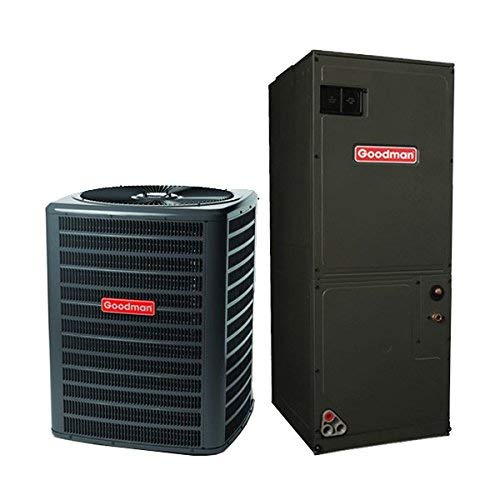
A split system has two main parts: a condenser outside and an air handler inside, usually in a closet or attic. This gives you more flexibility for placement. A packaged unit keeps everything in one cabinet outside your home. Packaged units are simpler to install because all connections are in one place, and you make no space inside your house for equipment. Manufactured homes often use packaged units because they sit on a slab outside. Your installer’s recommendation and your existing ductwork layout determine which type fits your home.
Quick Comparison
| Model | Best For | Tonnage | SEER2 | Cooling Capacity (BTU) | Amazon |
|---|---|---|---|---|---|
| Goodman GPCH33631 | Manufactured homes, easy install | 3 Tons | 13.4 | 36,000 | $3,540.00Amazon |
| Goodman GLXS4BA3610 + AMST36CU1300 | Split system with precise airflow | 3 Tons | 14.0 | 36,000 | $3,972.00Amazon |
| Goodman 4 Ton System | Larger homes needing more power | 4 Tons | 14.0 | 48,000 | $4,595.00Amazon |
In‑Depth Reviews
1. Goodman 3 Ton 14.5 SEER2 Condenser with Multi-positional Air Handler R32 (GLXS4BA3610 + AMST36CU1300)
This 3-ton split system delivers 14.5 SEER2 efficiency and 36,000 BTU to keep a typical 2,000-square-foot home cool.
This pair delivers the highest SEER2 rating in the whole lineup at 14.5 SEER2, which means you get better energy efficiency compared to older units. The 3-ton capacity (36,000 BTU) is the standard recommendation for many average-sized homes. The air handler includes a 9-speed ECM blower motor, which is a motor that adjusts its speed electronically to maintain steady airflow and comfort. The system uses R-32 refrigerant, a more modern refrigerant that has a lower environmental impact than older types.
Buyers report being very impressed with this unit. One reviewer noted it cools a two-story 2,000-square-foot home in south Louisiana with ease, even in oppressive summer heat. Another mentioned the cost was not astronomical and that the unit is much quieter than their previous system which made banging noises. However, one buyer did warn about the potential for refrigerant leaks on the indoor coil after a few years, noting that while parts are covered under the 10-year warranty, the cost of refrigerant is on you. This is a common trade-off across the industry, not unique to Goodman.
When you compare it to the 3-ton packaged unit (GPCH33631), this split system offers a higher SEER2 (14.5 vs 13.4), so it will cost less to run each month. The efficiency gap is about 8% more between this and the Value Series condenser. If you plan to stay in your home long-term and want the lowest operating cost in the 3-ton class, this is the one to aim for.
The real-world payoff: A quiet, efficient system that keeps a typical home ice-cold.
The hidden gotcha: Potential refrigerant leaks mean you may pay out of pocket for refrigerant after a warranty claim.
Ideal for: Homeowners who want the best energy efficiency in a 3-ton package and can handle the split-system installation.
Not for you if: You want a simple all-in-one outdoor unit or are on a very tight budget.
2. Goodman 4 TON 14 SEER2 Multi-Position R-32 AC Only System (GLXS4BA4810 + AMST48CU1300)
This 4-ton system provides 48,000 BTU for homes over 2,500 square feet or those with high ceilings.
If your home is larger than average, say over 2,500 square feet with high ceilings, a 3-ton unit may not cut it. This 4-ton system (48,000 BTU) provides 33% more cooling capacity than the 3-ton models above. It runs on R-32 refrigerant and includes an air handler with a 9-speed ECM blower motor for consistent airflow. The condenser is pre-charged for 15 feet of line set, which is the copper tubing that connects the outdoor unit to the indoor air handler. The air handler cabinet is corrosion-resistant aluminum with grooved tubing to improve heat transfer.
One buyer gave a 5-star rating for the excellent customer service from the seller. Another reviewer described the system as working “perfect” and called it a fantastic unit. This system is cooling-only, so it does not provide heat. You would need to add a heat kit for emergency heating or go with a heat pump if you need primary heating from the same unit. The air handler can be installed in upflow, horizontal right, or horizontal left configurations, giving your installer flexibility in tight attics or basements.
The upgrade you feel: 48,000 BTU of cooling power for homes where 3-ton units struggle.
The catch to know: Requires professional installation and a separate heat kit if you need backup heat.
Best suited for: Homeowners with larger houses or those who want some headroom in cooling capacity.
Look elsewhere if: A 3-ton unit is adequate for your home and you want to keep upfront costs lower.
3. Goodman 3 Ton 14.3 SEER2 Value Series Air Conditioner Condenser GLXS4BA3610 (Free Thermostat Included)
Get It On Amazon
This 3-ton packaged unit houses everything in one cabinet, simplifying installation for mobile homes and small houses.
Instead of two separate boxes, this packaged unit houses everything in a single outdoor cabinet. It is a horizontal-discharge unit, meaning it pushes air out horizontally, which suits mobile homes and homes with limited space. The 3-ton (36,000 BTU) capacity is the same as the split-system competitors, but the SEER2 rating is lower at 13.4, so your electricity costs will be slightly higher. It comes fully charged and tested from the factory. The condenser fan motor is totally enclosed and permanently lubricated, so you never need to oil it.
Buyers really like this unit. One reviewer in Florida said they bought it in November 21 and it has been doing great. Another homeowner mentioned the system works great for a double wide and was easy for a homeowner with basic skills to install because there is no brazing or copper to run. But the same buyer pointed out the unit is very heavy, so you need a tractor or a strong helper to move it into place. The unit can accept a field-installed heat kit, but the manufacturer notes it is for occasional emergency use, not primary heating, so do not rely on it as a primary heat source.
The simplicity win: A single cabinet means fewer connections and a faster install.
The upfront trade-off: 13.4 SEER2 is the lowest efficiency here, so your utility bills will run higher over time.
Best for: Mobile homes, manufactured homes, and anyone who wants the simplest possible installation.
Not ideal for: Homeowners with existing split-system ductwork or those who prioritize long-term energy savings.