
Our readers keep the lights on and my morning glass full of iced black tea. As an Amazon Associate, I earn from qualifying purchases.
Specs are compiled from manufacturer listings and verified buyer reviews and can change over time — please confirm the key details on the product page before buying.
Getting a drone should be about the thrill of the flight, not the terror of breaking it on the first landing. For a new pilot, the difference between a good starter drone and a frustrating one depends on how much abuse it can take and how hard it is to fly. This guide cuts through the noise to find the models that actually survive a learning curve and make you look good doing it.
I’m Min — the founder and writer behind Gadgets Feed. This guide is built by comparing the manufacturers’ published specifications and the patterns across verified customer reviews, so you get each pick’s real strengths and trade-offs instead of marketing spin.
Whether you are shopping for a child or taking your own first flight, these are the models that offer the best mix of durability, easy controls, and real safety features for anyone just starting out on their hunt for the perfect beginner drone.
Our Picks at a Glance

How To Choose The Best Beginner Drone
Not every drone is built to survive a first flight. For a beginner, you need to look past the flashy video specs and check the features that actually prevent a crash or make the drone easy to control.
Safety and Durability Features
The most important part of a starter drone is how well it protects itself. Look for full propeller guards (a plastic cage around the blades) that keep them from hitting walls or fingers. Obstacle avoidance sensors are even better — they automatically stop the drone from bumping into furniture or trees. A “child lock” or “emergency stop” button adds an extra layer of protection when things go wrong.
Flight Stability and Control
New pilots struggle with keeping the drone steady. Features like “Altitude Hold” let the drone hover in place without you touching the controls, giving you a moment to think about your next move. “Headless Mode” is another lifesaver — it makes the drone move in the direction you push the joystick, regardless of which way the drone is facing, so you do not get confused. Multiple speed modes let you start slow and build up your skills.
Camera and Flight Time
While a 4K camera sounds great, a beginner will find a 2K or 1080p camera perfectly fine for learning. The real bottleneck is battery life. A drone with a larger battery capacity (measured in milliamp hours, or mAh) will let you fly longer, but you should always look for a model that comes with at least two batteries so you can swap them and keep flying while the other charges.
Quick Comparison
| Model | Best For | Camera | Battery Capacity | Safety | Amazon |
|---|---|---|---|---|---|
| SYMA X100★ Best Overall | Kids first flight | None | 700 mAh | 360° Guard, Obstacle Avoidance | $44.99$49.99PrimeAmazon |
| TOPBLASTERBOX H11Also Great | Your first real flight | 4K EIS | 2200 mAh | GPS Auto Return | $145.99Amazon |
| RELIDOL PK01 | No-phone flying | 1080P | — | Child Lock, Guards | $83.99Amazon |
| mcokoe L105 | Learning stunts safely | 4K | — | Guards, Low-Weight | $59.99$69.99Amazon |
| PLEGBLE PL516 | Indoor safety | 4K | 1500 mAh | Anti-Lost Alarm, Child Lock | $41.99Amazon |
| AAMYUP M10 | Lightweight travel | 2K | — | Altitude Hold | $49.99Amazon |
| BLINORY 2K | Long practice time | 2K | 1800 mAh | Propeller Guards | $40.60$65.99Limited time dealAmazon |
In‑Depth Reviews
1. SYMA X100
Our pick — over 4★ from 900+ verified ratings; the strongest balance of quality and price.
The toy-grade flyer that bounces off walls instead of breaking against them.
The SYMA X100 is built for kids and absolute beginners who will crash. It has a fully enclosed propeller guard that wraps around all blades so the spinning parts never touch fingers or furniture. Four infrared sensors detect obstacles within about 12 inches and automatically steer away. Owners mention that “the obstacle avoidance feature helps beginners feel more confident.” At 5.16 by 5.16 inches, it is 2.8 times smaller than the PLEGBLE PL516 (14.37 inches), making it perfect for indoor flying in living rooms. The battery is 700 mAh (milliamp hours) — smaller than the bigger drones here — but it comes with two batteries for up to 20 minutes of total flight time. Altitude hold (the drone hovers in place when you let go) and headless mode (controls stay intuitive) make it stress-free. One-touch 360° flips add a fun a neat extra kids love. It weighs just 58 grams (0.14 pounds), so if it hits someone, it will not hurt. The trade-off is clear: no camera. This is a flying toy for learning control, not for aerial photos.
Best for beginners
- Full propeller guard and obstacle avoidance prevent crashes
- Compact 5.16-inch size for safe indoor flights
- Weighs only 58g, so impacts are harmless
What is missing
- No camera — this is a flight trainer, not a photo tool
- Battery capacity (700 mAh) is low compared to others on the list
Choose this for: The youngest pilots. It will survive a full week of living-room crashes and still fly. Not for you if: You want to take photos or videos — look at the BLINORY or mcokoe L105 for that.
2. TOPBLASTERBOX H11
The GPS-guided guardian angel that brings itself home when you lose your nerve.
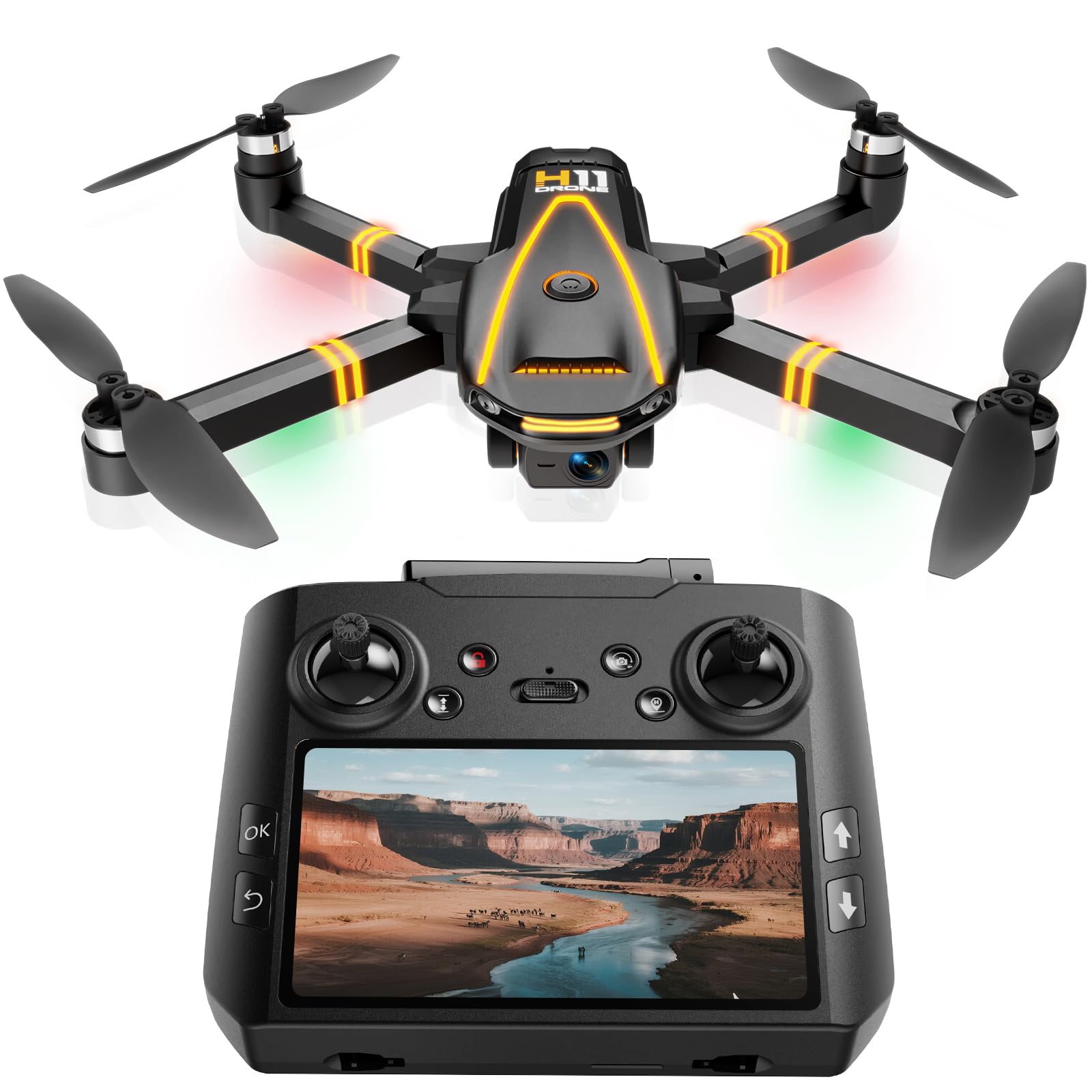
This is the only drone on this list that uses GPS positioning, so it knows exactly where it is and where you are. That saves a beginner’s day: if the signal cuts or the battery gets low, it triggers a GPS Auto Return and flies back to you on its own — no panic-piloting required. Its 4K camera uses Electronic Image Stabilization (EIS, which smooths out vibrations in the video) to give you cleaner footage than you would expect at this level.
The controller itself has a 4.5-inch HD (high-definition) screen built in, so you see the drone’s view without strapping a phone to the remote. Buyers report it is an “excellent beginner drone” with a “sharp 4K camera” and “stable” flight. One reviewer noted the batteries did not charge properly, so watch for quality-control issues. It comes with two 2200 mAh (milliamp hours) batteries for up to 45 minutes of total flight time, which is generous for this tier. The “Follow Me” mode locks onto you via GPS so the drone tracks your movement automatically. It weighs under 249 grams, though one buyer says FAA registration may still be needed — check your local rules.
The sharpest competition here is the BLINORY 2K, which gives you more flight time per dollar but lacks the H11’s GPS return and built-in screen. The H11 is safer and more convenient, making it the better choice if you worry about losing your drone on the first flight.
Why this wins for most
- GPS auto-return saves a lost drone on day one
- Controller screen removes the phone tether completely
- 4K video with EIS stabilization for clean footage
What to watch for
- Battery/charger quality control reported as inconsistent
- User says FAA registration may still be required despite the listing
The bottom line: This is the beginner drone with the most “save yourself” features — GPS return, a built-in screen, and 4K EIS video — all in one forgiving package. Buy from a seller with a good return policy in case you get a dud battery.
3. RELIDOL PK01
The drone you fly with your voice and a screen, leaving your phone in your pocket.
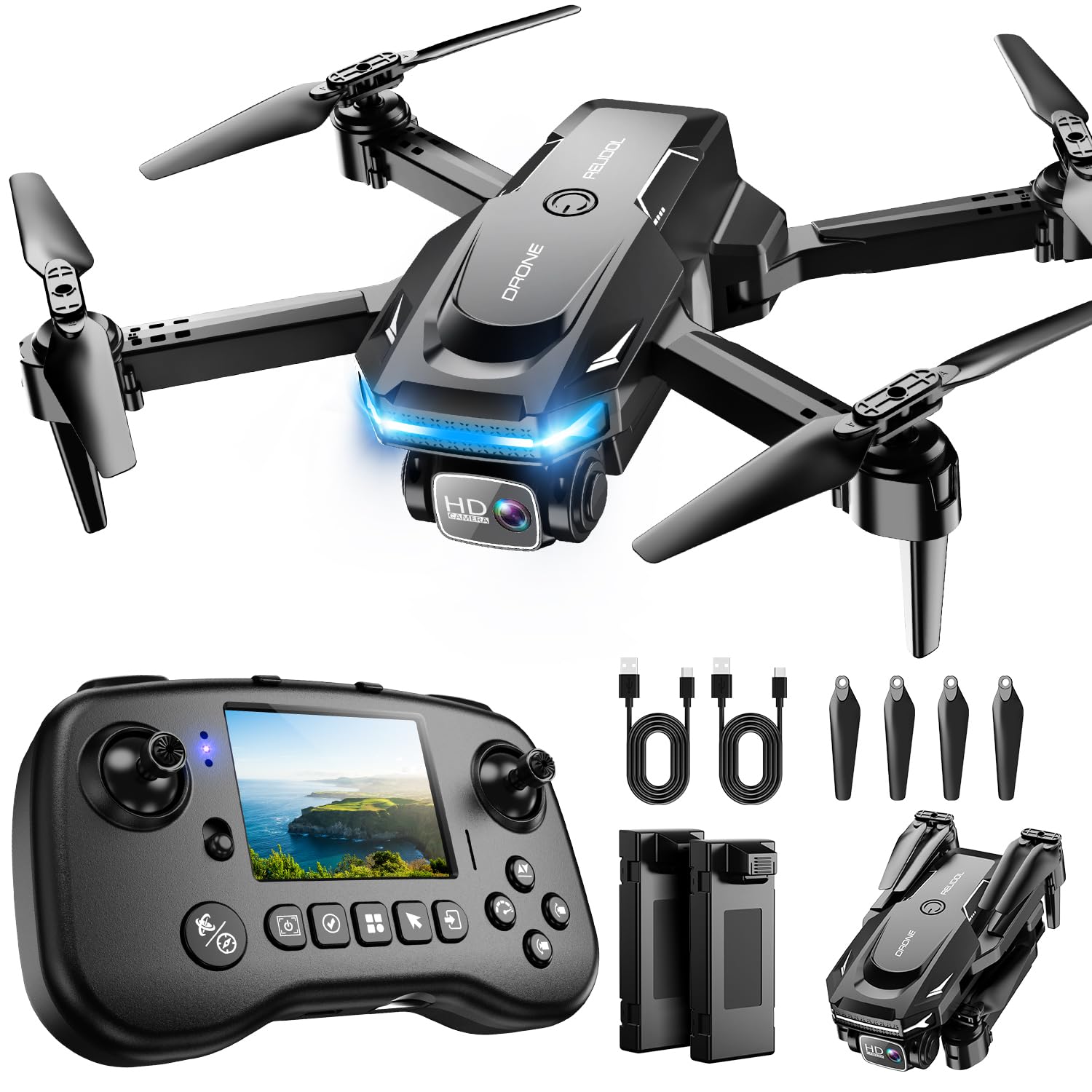
The RELIDOL PK01 solves the annoyance of fumbling with your phone to fly. Its remote has its own screen that shows the live feed from the 1080P camera, so no app pairing is needed. One buyer mentioned they were flying “with just a couple clicks on the controller.” You can even say “take off” and the drone lifts without pressing a button — that is voice control at work.
It uses brushless motors (which run quieter and last much longer than cheap brushed motors), and the 1080P adjustable lens works well for checking rooftops or taking a selfie. You need to buy an SD card separately to save photos. Safety features include a child lock to stop accidental starts and 4 propeller guards (plastic cages around the blades) for indoor practice. The trade-off: the maximum range is only 30 meters (about 98 feet), so you keep it close. The two batteries together give roughly 25 minutes of flight time. Buyers agree it is “durable enough to handle a few crashes,” making it a great pick for teens or any first-timer expecting bumps.
Why this stands out
- Controller screen for live video without a phone
- Voice control and app control for flexible flying
- Brushless motors for quieter, longer lasting performance
Consider this first
- Maximum range of only 30 meters restricts your flight area
- SD card required for saving footage, not included
Ideal for: Anyone who hates phone apps and just wants to fly immediately. The voice control makes it almost toy-like in simplicity, which is a compliment for a starter drone. Do not buy this if you plan to fly far from your position — the 30-meter range will frustrate you.
4. mcokoe L105
A stunt performer that keeps you safe while you learn the tricks.
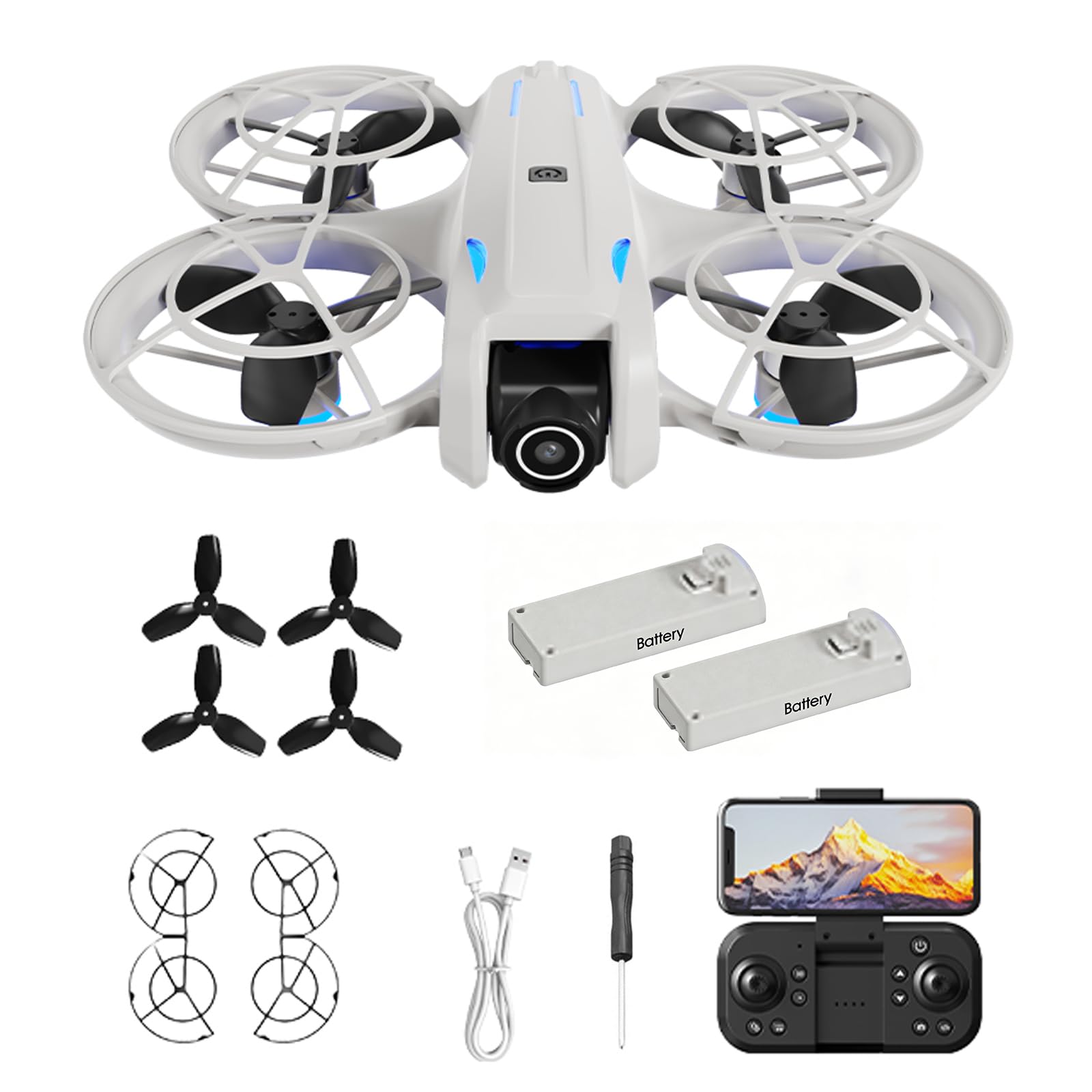
If you want to learn by doing 360° rolls, the mcokoe L105 is the pick. It packs a 4K camera that buyers call “crisp,” with four brushless motors for a smooth, quiet flight that holds in light wind. The Auto Follow mode tracks you automatically, turning a walk into an aerial video. It ships with two batteries, each giving 10–12 minutes of flight time, with a snap-in design for fast swaps. You get full propeller guards (plastic cages), a one-key takeoff/landing button, and 3-speed settings so you start slow and graduate to faster flight.
The listing does not publish the battery capacity in milliamp hours, so you cannot compare its stamina directly against the BLINORY or TOPBLASTERBOX H11. Still, the 4K camera and brushless motors make it a strong value. Compared to the PLEGBLE PL516, the L105 is more stunt-friendly with its 360° rolls but lacks the PL516’s child lock and anti-lost alarm. This makes the L105 a better fit for a teen or adult who wants to practice tricks, not for a family with younger kids.
Why it works for beginners
- 4K camera delivers sharper footage than most in this class
- Brushless motors give stable flight in breezy conditions
- Auto Follow mode creates impressive video automatically
Where it lacks
- Battery capacity not listed, so you cannot compare mAh directly
- No obstacle avoidance or GPS — you are the pilot in full control
Pick this if: You learn best by doing stunts. The flips and auto-follow make it feel like playing, not training. Avoid it if: You want a drone that can self-rescue with GPS return home — crashes are part of the learning curve here.
5. PLEGBLE PL516

The drone that locks itself down so your kid does not accidentally launch it.
Safety comes first on the PLEGBLE PL516. You have to press a specific button combination to start the motors, so a toddler cannot accidentally send it flying. The 130-degree wide-angle 4K lens and 90-degree adjustable view let you capture more of the scenery without moving the drone, which is handy for beginners learning to frame shots. If it sits idle for 10 minutes, the Anti-Lost Alarm beeps so you can find it in the grass. Optical flow positioning (a small camera on the bottom that tracks the ground) helps it stay stable without GPS, useful indoors or under trees. It weighs under 250 grams, so no FAA registration is needed for recreational flying.
The foldable design packs into the included storage box, and dual 1500 mAh batteries give up to 28 minutes of flight time. At 14.37 inches long, it is much larger than the SYMA X100 (5.16 inches), so it is more stable but harder to fly in a small room. Customer reviews are not yet available for this model, so flight quality feedback is limited. Compared to the TOPBLASTERBOX H11, the PL516 lacks GPS auto-return, so you are more responsible for bringing it home.
Built-in babysitters
- Child lock prevents accidental starts
- Anti-Lost Alarm beeps after 10 minutes of inactivity
- 130° wide-angle lens for more in each shot
Watch out for
- Large size (14.37 inches) makes tight indoor flights tricky
- No published customer reviews are available to assess real-world experience.
Best for: Families with young kids — the child lock and loss alarm make this the least-stress choice for parents. The big 14.37-inch body is stable outdoors but too large for small rooms, so stick to parks or open indoor spaces.
6. AAMYUP M10
The packable pocket drone that slips into a bag without a second thought.
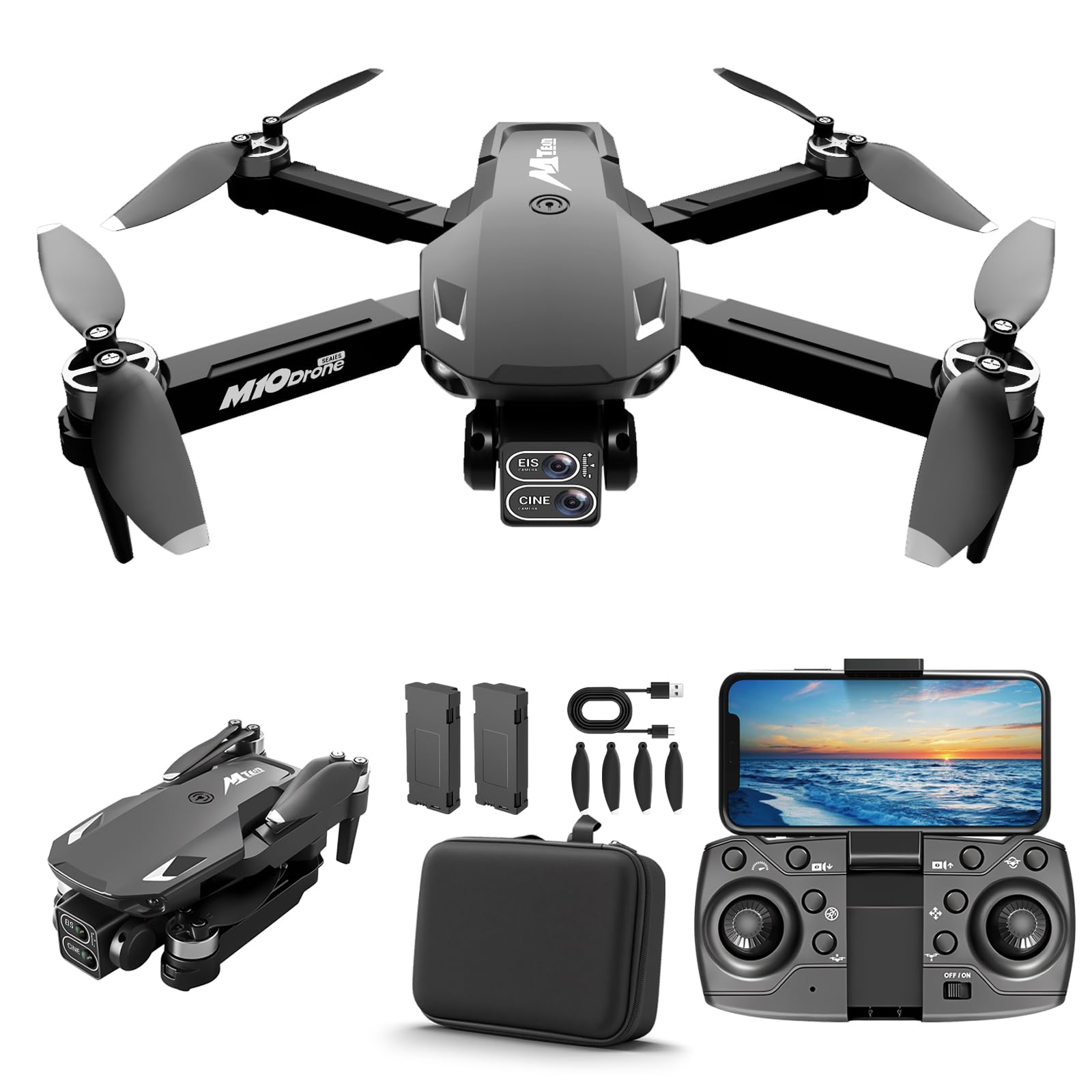
If portability is your priority, the AAMYUP M10 is the pick. It weighs 249 grams — right at the FAA registration limit but exempt — and its foldable body collapses to 8.7 inches long. It comes with a protective storage bag so you can toss it in a backpack for a hike or road trip. It uses a high-efficiency brushless motor, which means quieter and lower-maintenance flights than a toy drone. The 2K camera has a 90-degree remote angle adjustment and streams First Person View (FPV, real-time video) to your phone via the app.
Intelligent hovering and altitude-hold (the drone fixes its height so you focus on movement) make it beginner-friendly. It comes with two extra batteries, though the battery capacity in milliamp hours is not listed, so you cannot compare flight potential against the BLINORY’s 1800 mAh packs. No customer reviews are available to verify the durability claim. Compared to the BLINORY 2K, the M10 is much more travel-friendly but offers less flight time and no 4K camera.
Why it travels well
- Foldable design with a carrying bag for easy portability
- Lightweight 249g frame, no FAA registration needed
- Brushless motor for quiet, low-maintenance flights
Where it is thin
- No battery capacity (mAh) listed in the specs
- No customer reviews are available to validate performance.
Take this when: Portability is your top concern — you can shove it in a daypack and forget it. skip it if: You want known reliability, because with no reviews you are buying on specs alone.
7. BLINORY 2K Drone
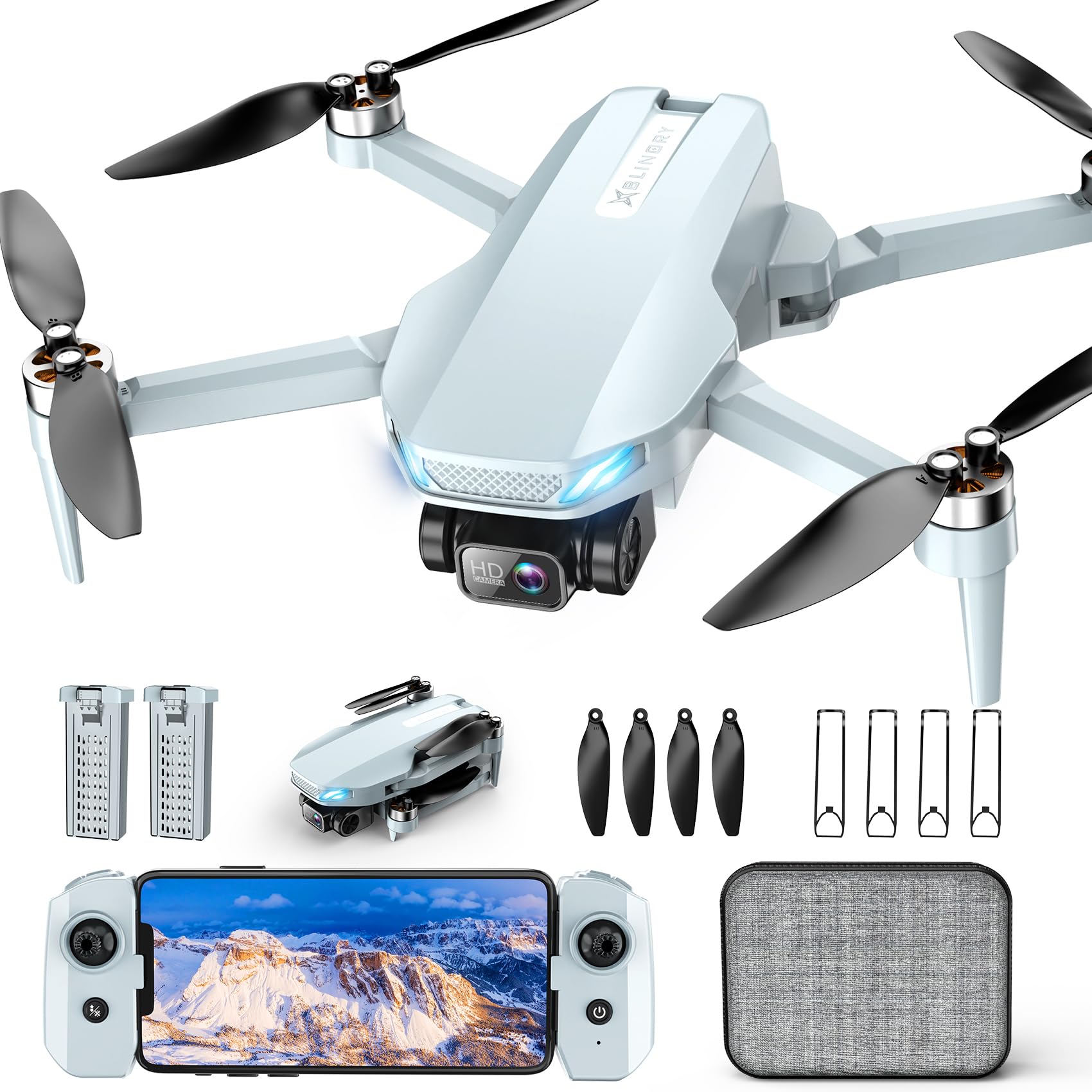
The endurance pick that keeps flying long after the others have landed to recharge.
When you want to fly at the park without swapping batteries every ten minutes, the BLINORY 2K Drone wins. It comes with two 1800 mAh (milliamp hours) batteries — 2.6 times the capacity of the SYMA X100’s 700 mAh packs. The manufacturer claims up to 36 minutes of total flight time. Buyers back that up, with one noting “the battery life has lasted hours” and that the drone “seems 100% durable” even after several crashes. It runs on upgraded brushless motors, which are quieter and last longer than brushed motors. The 2K camera has a 90-degree adjustable lens and streams First Person View (FPV, real-time video) to your phone via the BLINORY GO app.
One-key takeoff/landing, altitude hold (the drone locks height so you steer freely), and headless mode (controls stay intuitive no matter the drone’s orientation) keep the learning curve shallow. The emergency stop button is a nice safety net. It folds up small and comes with a carrying case for the remote, batteries, and propeller guards. It weighs under 250 grams, so no FAA registration is needed. The trade-off is the 2K camera, which is not as sharp as the 4K on the TOPBLASTERBOX H11, but you get way more flight time for the price.
Why battery life wins
- Large 1800 mAh batteries (2.6x more than the SYMA X100)
- Brushless motors provide quiet, stable performance
- Complete starter kit with carrying case included
Small concessions
- 2K camera is good, but not as sharp as the 4K models
- No GPS or obstacle avoidance — piloting is all on you
Pick this for: Longer practice sessions. If your only complaint about cheap drones is short flight time, the BLINORY is the answer. Pass on this if: You want a 4K camera or auto-return safety — this is a manual pilot’s drone with a big battery, not a self-flying one.
Understanding the Specs
Battery Capacity (mAh)
The battery capacity is measured in milliamp hours, or mAh. This tells you how much energy the battery stores. A higher mAh number usually means longer flight time, but you also have to consider the drone’s weight and how hard the motors work. For a beginner drone, look for models that come with at least two batteries. The SYMA X100 has 700 mAh batteries, while the TOPBLASTERBOX H11 has 2200 mAh batteries — a significant jump that gives you much more air time each session.
Brushless vs. Brushed Motors
The motor type makes a huge difference in how long your drone lasts. Brushed motors are cheap and common in toy drones, but they wear out after a few hours of use. Brushless motors cost more but run cooler, quieter, and last much longer without needing replacement. Drones like the BLINORY 2K and the mcokoe L105 use brushless motors, which is a good sign for anyone who plans to fly more than a few times.
Altitude Hold and Headless Mode
Altitude Hold uses a barometer sensor to keep the drone at a fixed height when you release the throttle. This lets you focus on moving left or right without also worrying about climbing or falling. Headless Mode reorients the controls: no matter which way the drone is facing, pushing the joystick forward always moves it away from you. These two features are the biggest stress-reducers for a brand new pilot.
Obstacle Avoidance and Propeller Guards
Obstacle avoidance uses sensors (like the infrared ones on the SYMA X100) to detect walls or furniture and automatically steer the drone away. Propeller guards are physical plastic cages around each blade. Both prevent crashes, but guards also protect people from getting hurt by the spinning blades. For indoor beginners, these are not optional — they are essential.
FAQ
Does a beginner drone need a camera?
Why do I see “under 250g” in so many drone specs?
What does “FPV” mean on a beginner drone?
How long does a beginner drone battery last?
Is a brushless motor worth the extra money for a beginner?
Can I fly a beginner drone indoors?
What does “GPS Auto Return” do for a beginner?
Headless Mode vs Altitude Hold — what do I need first?
Do I need to register a beginner drone with the FAA?
What is “optical flow positioning” in a drone?
Final Thoughts: The Verdict
For the majority of shoppers, the beginner drone winner is the TOPBLASTERBOX H11 because it combines GPS auto-return, a built-in screen, and a 4K stabilized camera in a package that is forgiving enough for a first-timer. If you want the longest practice time for the lowest price, grab the BLINORY 2K Drone with its massive 1800 mAh batteries. And for a young child’s first flight where crashes are guaranteed, the standout is the SYMA X100 with its full guard and obstacle avoidance.
How We Picked
We do not accept paid placement. Every pick is matched to a real buyer and a real use-case; we do not hands-on test units.
Sources & Methodology
Specifications: manufacturer listings and product documentation. Review insights: verified customer reviews, as of July 2026. Pricing: not shown on this page (it changes often); check the current price via the retailer link.
As an Amazon Associate, Gadgets Feed earns from qualifying purchases. This does not affect which products we feature.
Related Guides
Product prices and availability are accurate as of the date/time indicated and are subject to change. Any price and availability information displayed on Amazon at the time of purchase will apply to the purchase of this product. As an Amazon Associate I earn from qualifying purchases.
CERTAIN CONTENT THAT APPEARS ON THIS SITE COMES FROM AMAZON. THIS CONTENT IS PROVIDED "AS IS" AND IS SUBJECT TO CHANGE OR REMOVAL AT ANY TIME.
Amazon and the Amazon logo are trademarks of Amazon.com, Inc. or its affiliates.