
Our readers keep the lights on and my morning glass full of iced black tea. As an Amazon Associate, I earn from qualifying purchases.
Specs are compiled from manufacturer listings and verified buyer reviews and can change over time — please confirm the key details on the product page before buying.
Picking your first band saw is a lot like a first car — you want something that starts reliably, doesn’t drift sideways as you cut, and won’t cost you a second mortgage. The problem is most entry-level band saws wobble, vibrate, or come with blades that wander. This guide walks you through the eight models serious enough for a home shop, the specs you actually need to care about, and the real deal with blade tension and drift so your first cuts are straight.
I’m Min — the founder and writer behind Gadgets Feed. This guide is built by comparing the manufacturers’ published specifications and the patterns across verified customer reviews, so you get each pick’s real strengths and trade-offs instead of marketing spin.
My goal is to help you find the perfect band saw for beginners that balances power, precision, and price without overwhelming you with a massive floor model you can barely fit in your garage.
Our Picks at a Glance
How To Choose The Best Band Saw For Beginners
Buying your first band saw means balancing cutting depth, motor power, and table stability. You do not need a 14-inch floor model to start. A solid 9-inch or 10-inch benchtop saw handles nearly every beginner project — from cutting curves in plywood to resawing small hardwoods — without taking over your workspace. The trick is picking one that stays true to its cut line, comes with quality blade guides, and has a motor that doesn’t bog down on a 2×4.
Throat Depth and Cutting Height
The “throat depth” is the distance from the blade to the vertical support frame — it determines how wide a piece of wood you can feed through. A 9-inch throat lets you cut boards up to about nine inches wide. The “cutting height” (or resaw capacity) tells you how thick a piece you can slice vertically. Beginners should look for at least a 3-inch cutting height for most small furniture and craft projects. Going too small with a 6 or 8-inch throat will frustrate you the first time you try to cut a cabinet door.
Motor Power and Blade Speed
Band saw motors are measured in amps and horsepower. For a benchtop model, look for 2.5 to 3.5 amps — that gives you enough torque to cut through hardwood without burning the motor. Blade speed is measured in feet per minute (FPM). A single-speed saw running at about 2500 FPM handles general woodwork. A dual-speed saw (typically 1700/2500 FPM or 1500/2600 FPM) lets you slow down for tight curves in thin material and speed up for straight ripping. Induction motors run quieter and last longer than brushed motors, making them a better choice if your workshop is in your garage or basement.
Table Size, Tilt, and Build Quality
The table is your work surface. A cast-aluminum table resists warping and stays flat much better than a stamped-steel one. Most beginner band saws tilt from 0 to 45 degrees for bevel cuts, which is useful for making mitered picture frames or angled joinery. A larger table (around 12×12 inches gives you more stability for larger workpieces. Look for a table with laser-etched measurement grids for easy reference without needing a ruler every time. A heavy steel base or metal stand also matters — it absorbs vibration that would otherwise make the blade wander.
Blade Guides and Tracking
Blade guides keep the blade from twisting sideways during a cut. Ball-bearing guides are vastly better than plastic block guides — they reduce friction and let the blade run truer. You also want a blade-tracking adjustment that lets you center the blade on the rubber tires. A blade-tracking sight window (a small clear window on the side of the upper wheel cover) makes this much easier. Beginners often struggle with blade drift — when the cut veers off the line. A sturdy frame with precision blade guides is your best defense against that frustration.
Quick Comparison
| Model | Best For | Motor Power | Cutting Height | Table Material | Amazon |
|---|---|---|---|---|---|
| Woodskil 9-Inch★ Best Overall | Best Overall beginner pick | 3 Amp | 3.5 Inches | Cast Aluminum | $222.77Amazon |
| QD-KYOHO 9-InchPremium Pick | Premium beginner value | 2.5 Amp | 3.5 Inches | Cast Aluminum | $208.99$219.99PrimeAmazon |
| VIGO POWER 9-InchQuiet Leader | Quiet operation | 2.8 Amp Induction | — | Cast Aluminum | $199.99$269.99Amazon |
| SKIL 9-Inch | Brand reliability | 2.8 Amp Induction | — | — | $239.00Amazon |
| SEESII 8-Inch | Tight spaces | 3 Amp | 3.125 Inches | Steel | $154.98$219.99Limited time dealAmazon |
| ShopMax 10-Inch | Power on a budget | 4.2 Amp | 4.5 Inches | Steel | $199.99Amazon |
| VEVOR 10-Inch | Metal & heavy material | 370W (1/2 HP) | 6 Inches | — | $236.70$279.90Amazon |
| WEN 10-Inch | Full-feature floor model | 3.5 Amp | 6 Inches | Cast Aluminum | $382.24Amazon |
In‑Depth Reviews
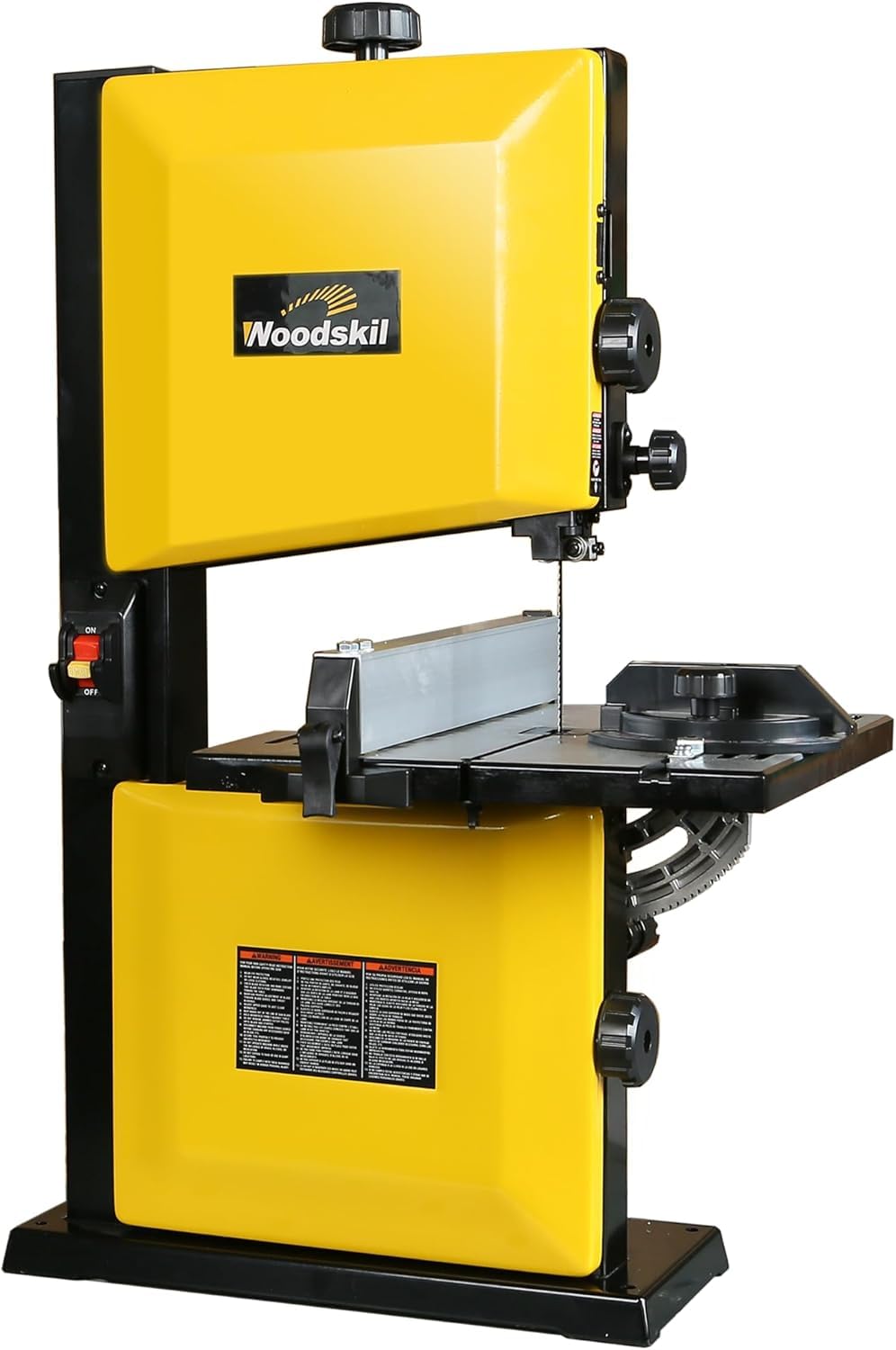
1. Woodskil 3-Amp 9-Inch Band Saw
Our pick — over 4★ from 500+ verified ratings; the strongest balance of quality and price.
The yellow workhorse that cuts hardwood without complaining
Two numbers tell you everything about this beginner band saw. The blade speed is 2500 FPM (feet per minute — how fast the blade travels through the wood), which is fast enough for clean rips and curves. The motor speed is 1720 RPM (revolutions per minute — how fast the motor spins), and that combination means you are not fighting the saw to get a straight cut. The 3-amp motor pulls through pine and oak alike, and buyers report it cuts hardwood fine at slow speed.
Your cuts are not limited to straight lines. The cast-aluminum table tilts from 0 to 45 degrees, and it comes with a miter gauge that locks at common angles — useful for picture frames and beveled edges. The cutting depth maxes out at 3.5 inches with a 9-inch throat, so you can resaw small stock and cut curves in plywood for crafts. One drawback versus the SKIL or VIGO POWER models is the single-speed — you cannot drop to a lower FPM for very tight scroll-style curves — but for a first saw, the balance of power and simplicity is a strong argument.
The Woodskil also packs a 120-degree miter gauge, a 120-degree miter gauge, compared to the SEESII’s 45-degree cutting angle, so you have more room to angle your workpiece without bumping the frame. Owners mention the miter gauge feels a bit lightweight, but the fence and gauge do the job from the start. It is 40 pounds, compared to the 38-pound VIGO POWER, but the steel base and dust exhaust port keep it stable and your workspace clean.
What Owners Love
- 2500 FPM blade speed cuts through hardwood cleanly
- Cast-aluminum table stays flat and resists warping
- 120-degree miter gauge gives generous angle range for bevels
- Reviewers highlight easy setup and accurate 90-degree cuts from the start
A Few Trade-Offs
- Single-speed motor limits tight-curve control
- Ball race guides do not fully dampen vibration; needs careful setup for narrow blades
- Miter gauge feels lightweight and may need upgrading later
Your first saw if: you want an affordable, reliable 9-inch benchtop model that cuts hardwood without hesitation and includes a fence and miter gauge right in the box.
Look elsewhere if: you plan to cut a lot of delicate curves and want a two-speed saw that lets you switch between fast rips and slow scrollwork.
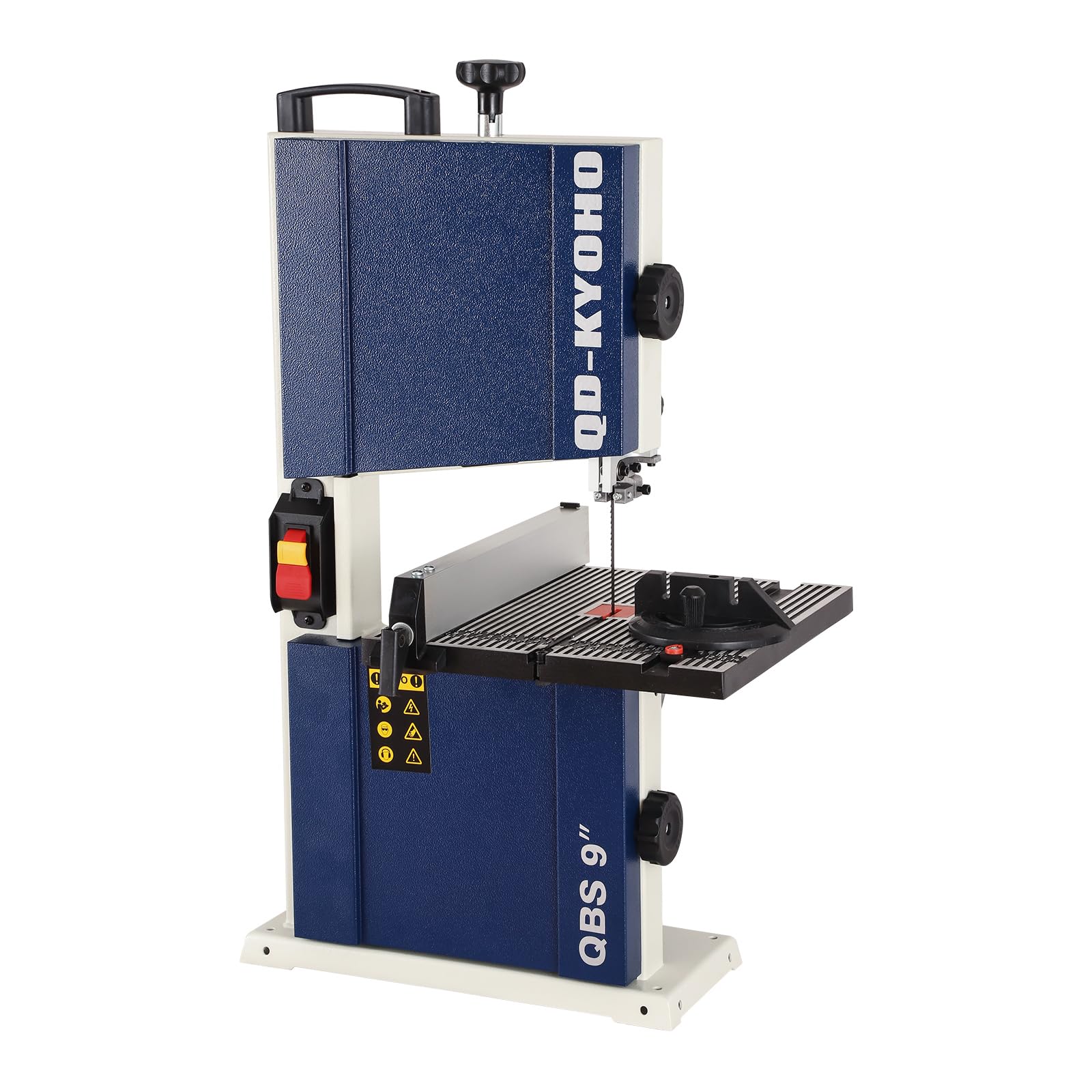
2. QD-KYOHO 9-Inch Bandsaw
The Rikon clone that punches way above its price tag
Several owners noticed this 9-inch band saw is essentially the same design as the Rikon 9-inch model — but for significantly less money. Do not let the lower price fool you. The 2.5-amp motor cuts wood up to 3.5 inches tall with a 62-inch blade, and it runs fast at 2526 FPM. The table is cast aluminum and measures 11.75 x 11.75 inches, which gives you a stable platform for both straight-line cuts and curved work. Customers note that vibration stays under 6 mm/s thanks to the 2 mm steel plate construction, so the blade wanders less than on many cheaper saws.
The tilt range on the table is better than most. It tilts 45 degrees to the right and 5 degrees to the left — that left tilt is a rarity at this price, and it helps when cutting bevels on narrow stock without flipping the workpiece. The table has laser-etched measurement grids so you can set your fence position without dragging out a tape measure. It also features a quick-release blade tension lever and tool-free blade-guide adjustment, two features that beginners honestly appreciate every time they swap a blade.
At over 40 pounds and with an integrated top-carry handle, it is portable enough to move between a workbench and storage but solid enough to stay planted during a cut. One reviewer described it as “hard to carry around” but worth it for the stability. The included 2.5-inch dust extraction port and self-cleaning brush keep the sawdust off the blade and out of your workspace. If you are looking for one saw to grow with for a few years, the QD-KYOHO is the pair to beat in this lineup.
The Big Wins
- Cast-aluminum table with left AND right tilt (45° right / 5° left) for versatile beveling
- Quick-release blade tension and tool-free guide adjustment make blade swaps painless
- Laser-etched measurement grids on the table for fast fence positioning
- 2.5-inch dust port and self-cleaning brush keep the cut line visible
Watch For
- Some reviewers point out the tabletop developed slight rust; a dry lubricant coating helps
- Blade guides can take some fiddling to get perfect alignment
- Single-speed motor (2526 FPM) limits slow-speed control for very tight curves
Reach for this if: you want the build quality and design of a well-known brand (Rikon) without paying the premium, and you value a large cast table with flexible tilt for bevel cuts.
A different pick if: you need a dual-speed motor to switch between fast rips and slower, more controlled scrollwork for delicate projects.
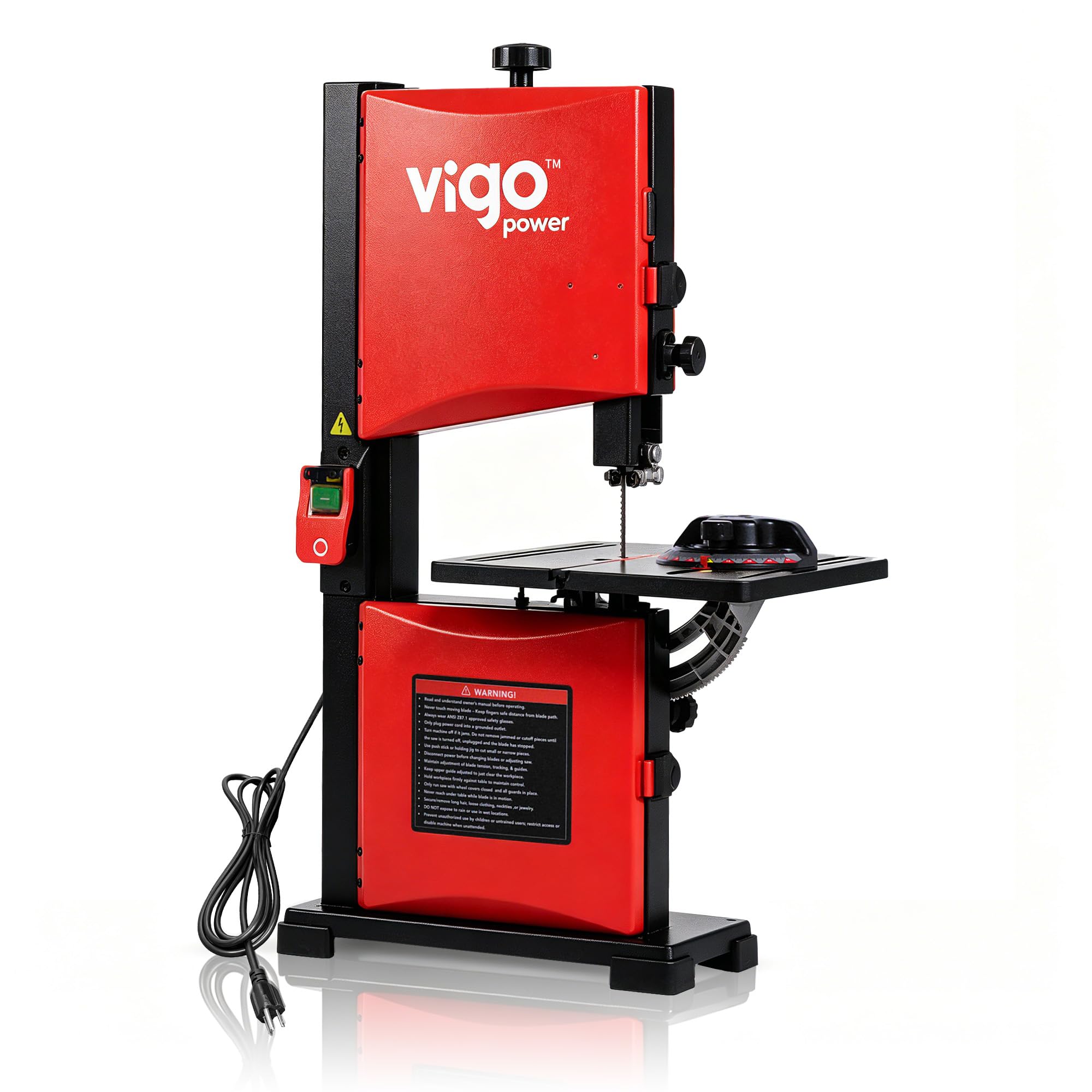
3. VIGO POWER 9-Inch Benchtop Band Saw
A dual-speed saw that stays quiet enough for apartment workshops
The VIGO POWER band saw runs an induction motor (a motor type that uses electromagnetic induction rather than brushes, so it is quieter and lasts longer), rated at 2.8 amps with a noise output under 75 decibels. That is quiet enough to use in a home garage or even an apartment without bothering neighbors. But noise is not the only trick. The saw gives you two speeds: 1700 FPM for tight, slow curves and 2500 FPM for straight rips. That flexibility matters for beginners who may not know which speed they prefer yet.
The frame is reinforced steel, which shoppers say keeps blade drift under control. One owner noted: “The Vigo Power bandsaw is a good home user saw with plenty of power to repeatedly cut through hard woods like oak (1x material).” It comes with a 62-inch SK5 steel blade (a premium high-carbon steel known for edge retention) and a 12×12-inch cast-aluminum table that tilts 0 to 45 degrees. The table is die-cast rather than stamped, meaning it stays flat and does not warp over time. The included miter gauge locks at common angles for crosscuts, and the 2-inch dust port hooks to any shop vacuum.
Setup is straightforward for a beginner, though some reviewers found the table needed calibrating to get the blade and miter gauge perfectly square. The reinforced steel frame makes this saw heavier than many in its class at 38 pounds, which actually helps with stability during cuts. Unlike the Woodskil single-speed saw above, the VIGO POWER lets you drop to 1700 FPM for those tight curves, making it a better choice if you plan to cut silhouettes, toys, or detailed craft shapes. The trade-off is a slightly smaller 9.45-inch depth (width) versus the 12.2-inch on the Woodskil — fine for most small projects, but noticeable if you need to rip wider panels.
Standout Features
- Dual-speed motor (1700/2500 FPM) handles both tight curves and fast rips
- Quiet induction motor runs under 75 dB — good for shared workshops
- Reinforced steel frame and die-cast aluminum table reduce wobbly cuts
- Buyers confirm it powers through 1x oak repeatedly without bogging
Downsides
- Plastic housing and decals feel a bit cheap for the price point
- Miter gauge may need calibration to sync with the blade for perfect 90-degree cuts
- 9.45-inch depth is smaller than the Woodskil; limits wider panel cutting
Your starter saw if: you value a quiet motor and want the flexibility of a dual-speed drive for both gentle curves and straight rips from a single machine.
Skip it for: a larger 10-inch model if you plan to cut wide panels or need a deeper throat for bigger workpieces.
4. SKIL 2.8 Amp 9-Inch 2-Speed Benchtop Band Saw

The SKIL that replaced a 35-year-old Delta and outperformed it
SKIL has been making power tools for nearly a century, and the BW9501-00 benefits from that engineering heritage. It runs a 2.8 amp induction motor — the same quiet, long-lasting motor type used in the VIGO POWER — and it offers a two-speed drive system with tool-free belt tensioning. That makes swapping between speeds for rips and curves far faster than fiddling with a wrench. The real standout is the precision ball-bearing blade guides (upper and lower), which ensure the blade tracks straight and does not drift. Buyers notice the difference compared to plastic block guides on cheaper saws, calling it “fantastic” and noting it replaced a 35-year-old Delta that this saw beat out even when new.
The rack-and-pinion table adjustment (a gear system that lets you tilt the table smoothly and precisely) makes angle changes easy. A built-in blade-tracking sight window lets you see exactly how the blade is riding on the rubber tires during setup, which is a huge help for beginners who are still learning to tension a blade. The steel base stabilizes the saw, though the included miter gauge is functional rather than premium. The dust port accepts standard 2.5-inch vacuum hoses, so you can keep your workspace clear.
One limitation: the SKIL does not ship with a fence. If you need a fence for straight ripping, owners have found that the WEN 3959 fence fits perfectly and costs about 20-25 dollars separately. That is a minor hassle compared to the overall build quality and the 3-year limited warranty SKIL backs it with. At 2.8 amps it has slightly less raw power than the 3-amp Woodskil, but the two-speed flexibility and ball-bearing guides make it a stronger pick for precision work.
Why It Stands Out
- Ball-bearing blade guides top and bottom keep cuts accurate and reduce blade drift
- Two-speed drive with tool-free belt tensioning for easy speed changes
- Rack-and-pinion table tilt adjustment for precise angle setting
- Blade-tracking sight window simplifies blade centering for new users
- 3-year limited warranty from a major brand
What to Know
- Does not include a fence; you will need to buy one separately (WEN 3959 fits)
- 2.8 amp motor is adequate but not as powerful as the 3-amp or 4.2-amp models
- Some units arrive with box damage; inspect carefully on delivery and return if needed
Buy this one if: you want a two-speed saw from a trusted brand with ball-bearing guides and a warranty — and you are comfortable ordering a separate fence.
skip it if: you want a ready-to-cut setup with a fence included in the box, or you need more than 2.8 amps of cutting power for heavy resawing.
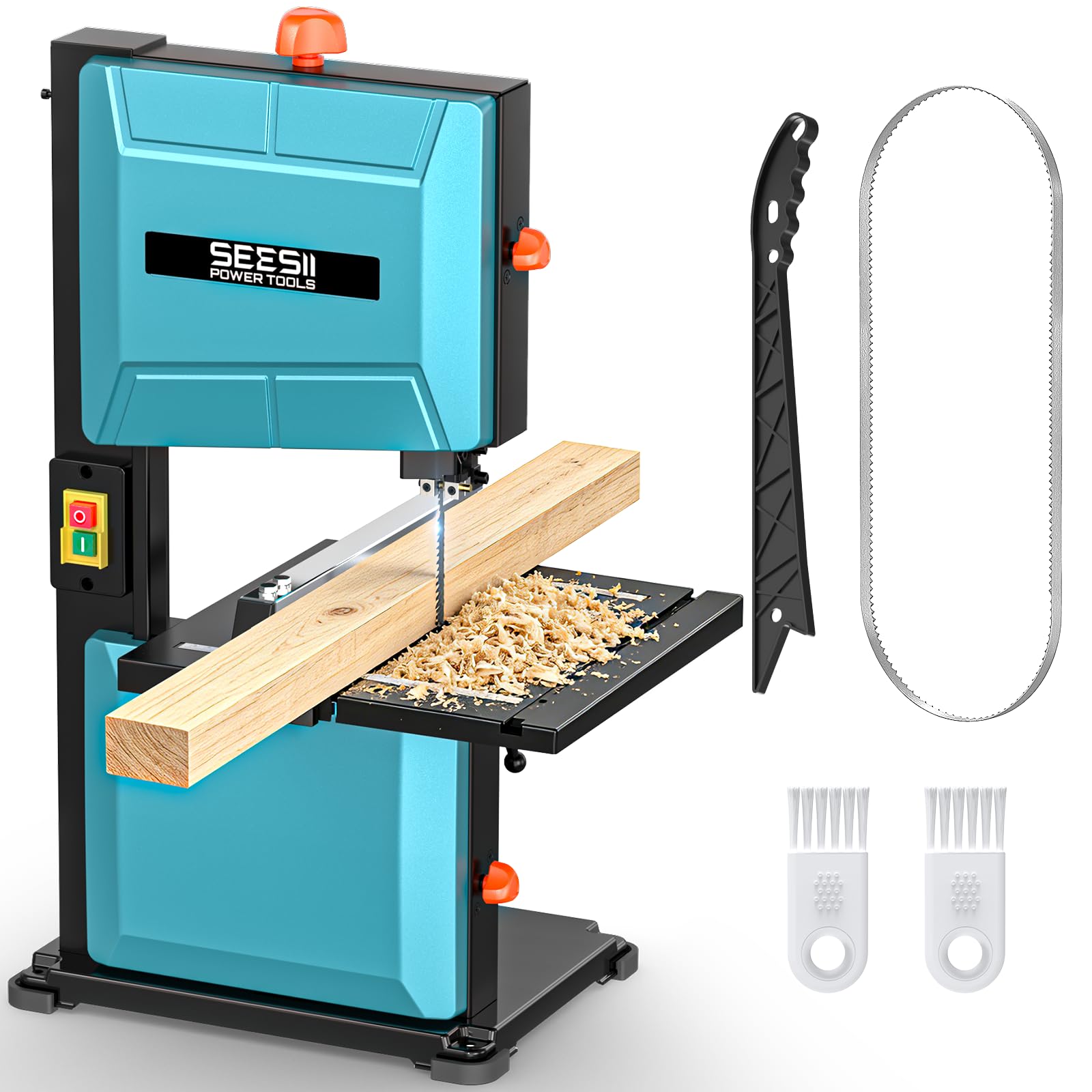
5. SEESII Benchtop Band Saw for Woodworking
A tiny footprint for garages where every inch counts
The SEESII band saw trades a bit of cutting width for compact storage. The throat is 8 inches versus the 9 inches on most competitors, so you are giving up 1 inch of panel capacity. For small shop owners squeezing a saw between a workbench and a shelving unit, that trade often works. The cutting height is adjustable from 1/8-inch veneers up to 3-1/8-inch hardwoods, covering most beginner hobby projects. The motor is a 3-amp corded unit, which matches the Woodskil for power despite the smaller footprint.
Safety is a stronger selling point here than on most other models in this list. The SEESII has dual power buttons that prevent accidental startup, and the start/stop controls are independent — if the power goes out and comes back, the saw will not restart on its own. That is important for home garages where kids might wander in. The 12×12-inch steel work table is laser-etched with measurement grids, but it is steel rather than cast aluminum, so it is heavier and less prone to warping though it may be trickier to get perfectly flat. The table tilts from 0 to 45 degrees using a rack-and-pinion adjustment. It comes with a double-sided fence, a miter gauge, and a magnetic-angle guide for checking 45-degree bevel accuracy.
The main drawback is blade stability. Several owners reported the same issue: “Cuts are not straight because blade has too much give.” With a 55-inch blade (the shortest in this lineup) and a 45-degree cutting angle (compared to the Woodskil’s 120 degrees), the SEESII can feel less rigid when cutting dense hardwoods. It works well for curves and light-duty projects but may frustrate you if you need clean, straight rip cuts on thick oak or maple. For the price and the compact size, it is a decent second saw or a first saw for very small workpieces.
What Shines
- Compact 8-inch throat and 17x12x27-inch footprint fit tight workspaces
- Dual power buttons and anti-restart safety design protect against accidental startups
- Includes miter gauge, fence, and magnetic-angle guide right in the box
- 3-amp motor delivers solid power for the size class
Watch Out For
- Buyers report blade has too much give, causing non-straight cuts in hardwoods
- 55-inch blade is shorter than the 62-inch blades on most competitors
- 45-degree cutting angle is limited versus the 120-degree on Woodskil
Best for: very small workshops or apartment balconies where space is the top priority, and you plan to cut curves and light materials rather than straight rips on dense lumber.
You may outgrow it if: your projects move to thicker hardwoods or you need precise, drift-free straight cuts for furniture joinery.
6. ShopMax 4.2 Amp 10-Inch Benchtop Band Saw
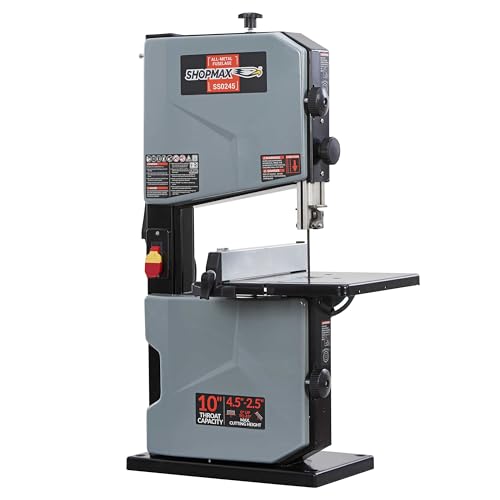
The most powerful motor in the budget tier — at a bargain price
ShopMax swings the biggest motor in this under-200-dollar price bracket. At 4.2 amps, this saw pulls significantly harder than the 2.5 or 3 amp units above, which means it resists bogging down when you push it through thick or dense wood. It cuts up to 4.5 inches deep and 10 inches wide, giving you more resaw capacity than any 9-inch model on this list. The 67.4-inch blade is also the second-longest in the lineup (behind the 72-inch on the VEVOR and WEN), which helps with stability on taller cuts.
The table is heavy-duty steel rather than cast aluminum, which makes it durable though some owners note it is “tough to fine tune” for perfectly square cuts. The table tilts up to 45 degrees for bevel work. It uses ball-bearings for smooth blade guide performance. The fence system is recommended by the manufacturer for stability and precision during curve cutting. The saw comes partially assembled, so you will need to attach the table and adjust the blade guides yourself.
Buyers have mixed feelings about the blade rollers and the bottom wheel shaft adjustment, describing them as “cheesy” and needing DIY fixes to get the saw running smoothly. One owner said “all in all still after fixing the roller guides it was a good buy.” If you are comfortable spending a bit of extra time dialing in the setup, the raw power and 10-inch capacity make this a better value than many smaller saws at similar prices. The 54.7-pound weight also helps absorb vibration, but you will want a sturdy workbench or a wheeled stand to move it.
Power Perks
- 4.2-amp motor provides noticeably more cutting power than 2.5–3 amp competitors
- 10-inch throat and 4.5-inch cutting depth handle larger workpieces
- 67.4-inch blade improves stability for deep cuts
- Heavy 54.7-pound weight keeps vibration low during operation
Assembly Annoyances
- Blade roller guides and wheel shaft adjustment feel low-quality and may need replacement
- Table calibration requires patience to get square with the blade
- Some owners mention blades do not stay on without careful tension adjustment
Go for it if: you want maximum cutting power for the dollar and are willing to invest a little extra setup time to fix the blade guides.
Pass if: you want a ready-to-cut, fuss-free experience straight from the start with premium build quality.
7. VEVOR 10-Inch Band Saw with Stand

A metal-cutting two-speed bench saw with a stand included
The VEVOR stands out because it is the only model in this lineup specifically rated for cutting non-ferrous metals like copper, aluminum, and brass alongside wood and plastic. The 370W (1/2 HP) motor runs at two speeds — 560 RPM and 1100 RPM — which is slower than the wood-focused saws above. That is intentional. Lower RPMs keep the blade from overheating when cutting metal, while you can switch to the higher speed for faster cuts through plastic and softwood. The maximum cutting height is 6 inches, and the throat width is 9.65 inches.
It comes with a freestanding metal stand that raises the saw to a comfortable height — a major advantage over benchtop models that require you to supply your own workbench. The stand also includes a storage shelf for blades and tools. The table is Q235 steel (a structural-grade carbon steel), measuring 13.39 x 13.19 inches, and it tilts from 0 to 45 degrees for bevel cuts. A flexible work light is mounted to the frame so you can see the cut line clearly, which is a feature most beginner saws skip. It also has a dust collection port.
On the downside, buyer reviews are scarce for this particular model, so long-term reliability data is thin. The 60.63-pound weight and stand take up more floor space than a compact benchtop saw — you need about 24 inches by 20 inches of floor room. The two-speed range (560/1100 RPM) is great for metal but may feel slow if wood cutting is your only task. If you plan to cut metal stock and wood, this is the best compromise in one machine. For pure woodworking, a faster saw like the Woodskil or VIGO POWER makes more sense.
Standout Specs
- Two-speed motor (560/1100 RPM) handles both metal and wood cutting
- Includes a full metal stand with storage — no separate workbench needed
- 6-inch cutting depth is the tallest in this lineup
- Built-in adjustable work light illuminates the cut line
Things to Consider
- Slow top speed (1100 RPM) means slower wood ripping than 2500 FPM models
- Limited buyer review data makes reliability hard to assess
- Large footprint plus 60+ pound weight requires dedicated floor space
Invest in this if: you need one saw for both woodworking and occasional metal-cutting projects and want a stand included without paying extra for a floor-model saw.
pass on it if: your main focus is fast, efficient wood ripping — a 2500 FPM benchtop saw is faster and cheaper for that task.
8. WEN 10-Inch Two-Speed Band Saw with Stand

A floor-standing WEN that comes with a fence, light, and 2-year warranty
When your projects outgrow a benchtop, the WEN BA3962 is the logical step up without jumping to a full industrial shop saw. It is a 10-inch floor-standing model with a 3.5-amp motor that cuts up to 6 inches deep and 9.75 inches wide. It uses 72-inch blades (the longest in this round-up) ranging from 1/8 to 1/2 inches in width, which provides excellent stability and reduces blade drift on deep resaw cuts. The saw operates at two speeds: 1520 FPM for detailed curves and 2620 FPM for fast straight ripping — a wider speed range than the VIGO POWER’s 1700/2500 and more useful for a beginner figuring out what speed works for different materials.
The work table is a spacious 14.125 x 12.5-inch cast-aluminum unit that stays flat and resists warping. It bevels up to 45 degrees. WEN includes a fence, a miter gauge, and a 3/8-inch 6 TPI (teeth per inch — lower TPI means faster but rougher cuts) blade right in the box. A built-in work light shines directly on the cut line, which is helpful for following patterns or pencil lines. The dust port is a 3-in-1 design that accepts different vacuum hose sizes. The saw comes with a 2-year warranty.
The main consideration is price. This is the highest-priced model in the list, reflecting the floor stand, larger capacity, and included accessories. If you are a beginner working from a bench, a 9-inch benchtop model may be a smarter first purchase. But if you know you will grow into the machine and do not want to buy a second saw in a year, the WEN gives you the capacity and features of a much more expensive tool. The floor stand takes up about 26.5 x 21 inches of space and weighs more than most benchtop models, so be sure you have the room.
Big Advantages
- 10-inch throat and 6-inch cutting depth handle larger work than any 9-inch benchtop
- Two-speed motor (1520/2620 FPM) gives wide speed range for curves and rips
- Large 14.125 x 12.5-inch cast-aluminum table stays flat and rigid
- Includes stand, fence, miter gauge, work light, and blade from the start — no extra purchases
Downsides
- Highest price in this guide — may be overkill for very small projects
- Floor stand footprint and weight require dedicated workshop space
- Less portable than benchtop models; not easy to store on a shelf
Buy this if: you have the budget and floor space, and you want a saw that will handle both beginner projects and more advanced work for years without needing an upgrade.
Stick with a benchtop if: you are working from a small garage or apartment and do not have room for a 58.5-inch tall floor-standing model.
Understanding the Specs
Throat Depth & Cutting Height
The throat depth tells you the maximum width of wood you can feed through the saw. A 9-inch throat cuts boards up to about 9 inches wide — enough for most small furniture and craft projects. Cutting height (also called resaw capacity) is the maximum vertical thickness the blade can pass through. For a beginner starting with 1x and 2x lumber, a 3-inch cutting height is the minimum. If you want to resaw hardwood into thinner pieces for bookmatched panels or veneers, look for 6 inches or more. The WEN and VEVOR both offer 6-inch cutting heights, while most 9-inch benchtops max out at 3.5 inches.
Blade Speed (FPM) & Motor Power (Amps / HP)
Blade speed is measured in feet per minute (FPM) — how fast the blade travels through the wood. For general woodworking, 2500 FPM is a common balance. Slower speeds (around 1500-1700 FPM) give you more control for tight curves and scrollwork. Faster speeds (2500-2600 FPM) cleanly rip straight lines. Dual-speed saws let you switch. Motor power matters too. A 2.5 to 3.5-amp motor handles most beginner tasks. The ShopMax’s 4.2-amp motor pushes harder through dense wood. Induction motors are quieter and last longer than brushed motors, making them worth the slight price premium.
FAQ
What is the best blade size for a beginner band saw?
Do I need a two-speed band saw as a beginner?
Why does my beginner band saw blade drift to one side?
Can a benchtop band saw cut metal?
How much space does a benchtop band saw need?
What is a miter gauge and do I need one?
Is a cast-aluminum table better than a steel one?
What is the difference between a benchtop and a floor-standing band saw?
Will a 9-inch band saw cut a 2×4?
How do I keep my band saw blade from falling off?
Final Thoughts: The Verdict
Across the board, the band saw for beginners winner is the Woodskil 3-Amp 9-Inch because it delivers a strong 3-amp motor and a cast-aluminum table at a price that leaves room for a new blade and safety gear. If you want the quiet operation of an induction motor with dual-speed flexibility for curves and rips, grab the VIGO POWER 9-Inch. And for the beginner who already knows they want a floor-standing saw that will last through larger projects for years, the WEN 10-Inch with Stand is the long-term investment that pays off in cutting capacity and stability.
How We Picked
We do not accept paid placement. Every pick is matched to a real buyer and a real use-case; we do not hands-on test units.
Sources & Methodology
Specifications: manufacturer listings and product documentation. Review insights: verified customer reviews, as of July 2026. Pricing: not shown on this page (it changes often); check the current price via the retailer link.
As an Amazon Associate, Gadgets Feed earns from qualifying purchases. This does not affect which products we feature.
Related Guides
Product prices and availability are accurate as of the date/time indicated and are subject to change. Any price and availability information displayed on Amazon at the time of purchase will apply to the purchase of this product. As an Amazon Associate I earn from qualifying purchases.
CERTAIN CONTENT THAT APPEARS ON THIS SITE COMES FROM AMAZON. THIS CONTENT IS PROVIDED "AS IS" AND IS SUBJECT TO CHANGE OR REMOVAL AT ANY TIME.
Amazon and the Amazon logo are trademarks of Amazon.com, Inc. or its affiliates.