
Our readers keep the lights on and my morning glass full of iced black tea. As an Amazon Associate, I earn from qualifying purchases.
Specs are compiled from manufacturer listings and verified buyer reviews and can change over time — please confirm the key details on the product page before buying.
An 8‑channel mixing desk is the control center for your sound — the place where you balance microphones, instruments, and backing tracks into one clear mix. The real question isn’t if you need one, but which mixer gives you clean preamps, enough routing flexibility, and the durability to survive gig after gig without introducing hum or hiss into your signal.
I’m Min — the founder and writer behind Gadgets Feed. This guide is built by comparing the manufacturers’ published specifications and the patterns across verified customer reviews, so you get each pick’s real strengths and trade-offs instead of marketing spin.
Whether you run a live sound rig, a home studio, or a podcast setup, finding the right 8 channel mixing desk means matching your input count, effects needs, and connectivity to your actual workflow — and this breakdown helps you do exactly that.
Our Picks at a Glance


How To Choose The Best 8 Channel Mixing Desk
Picking a mixer isn’t just about counting knobs. You need preamps that stay quiet, routing that matches your stage or studio setup, and effects that actually sound good. Here are the three things to nail down before you click buy.
Analog Simplicity vs. Digital Power
Analog mixers give you instant hands‑on control — every fader and EQ knob does exactly one job, no menu diving. Digital mixers, like the Behringer FLOW 8, add app‑based remote control, scene recall, and built‑in effects like compressors and limiters. If you need to save and reload settings between sets, go digital. If you want a board that works the same way every time you power it on, analog is the simpler path.
Preamps and Phantom Power
The preamps are the first thing your microphone signal hits. Cheap preamps add noise; good ones stay clean even at high gain. Look for at least two XLR inputs with +48V phantom power if you plan to use condenser mics. A model like the Mackie 802VLZ4 uses Onyx preamps, which buyers describe as “clean” and “powerful” — that means less hiss and more usable volume from your vocals.
Built‑in Effects and Connectivity
Reverb and delay can save you from carrying a separate effects unit. Some mixers, like the Pyle PMXU88BT, pack 16 DSP effects and a 7‑band EQ. Also check connectivity: Bluetooth streaming lets you pipe in backing tracks from a phone, and USB audio lets you record straight to a computer. A powered mixer, like the Rockville RPM80BT, includes an amplifier so you can drive passive speakers without a separate amp rack.
Quick Comparison
| Model | Best For | Type | Weight | Mic Preamps | Amazon |
|---|---|---|---|---|---|
| Behringer FLOW 8★ Best Overall | Digital control on the go | Digital | 1400 Grams | 2 (Midas) | $199.00Amazon |
| Mackie Onyx8Premium Pick | Studio recording & British EQ | Analog | 9.6 Pounds | 4 (Onyx) | $449.99Amazon |
| Soundcraft EPM8Transparent Classic | Transparent analog sound | Analog | 12.34 Pounds | 4 | $412.02Amazon |
| Mackie 802VLZ4 | Live sound & broadcast | Analog | 4.5 Pounds | 3 (Onyx) | $219.99Amazon |
| Pyle PMXU88BT | Multi‑source DJ & streaming | Analog | 8.4 Pounds | 4 | $194.99Amazon |
| Rockville RPM80BT | All‑in‑one powered PA | Powered Analog | 24 Pounds | 8 | $179.95Amazon |
| Behringer XENYX 802S | USB streaming & podcasting | Analog | 1610 Grams | 2 | $98.90Amazon |
| Depusheng DT8 | Budget multi‑input expansion | Analog | 3.4 Kilograms | 4 | from $120.63Amazon |
In‑Depth Reviews
1. Behringer FLOW 8 — Digital App‑Controlled Powerhouse
Our pick — over 4.5★ from 800+ verified ratings; the strongest balance of quality and price.
The digital mixer that fits in a laptop bag yet runs a whole show from your phone.
You get a full digital mixer that measures just 6.5″D x 9.7″W x 1.1″H — that’s shallow enough to slide into a backpack. The real trick is the FLOW App for Bluetooth remote control from iOS/Android devices, which lets you adjust gain, EQ, and effects while you walk the room. Two Midas microphone preamps with 48 V phantom power handle condenser mics, and the EZ-Gain function automatically sets the gain for optimum headroom so you don’t clip your inputs.
Buyers report that the FLOW 8 is “a must have for mobile DJs” because it packs a mixer, equalizer, compressor, limiter, and crossover into a single device. The 60 mm channel faders give you smooth, precise travel, and the master rotary control has an LED collar so you can see the level in a dark booth. At 1400 Grams, it is heavier than it looks — at 1400 Grams versus the Behringer XENYX 802S at 1610 Grams — but that weight comes from a solid metal chassis that survives transport.
The catch is that the default gain is set to “off” from the start, so you need the app to bring levels up before you hear anything. If you want a simple plug‑and‑play board with no phone required, an analog mixer might be less frustrating. But if you want app‑based control, scene recall, and a compact footprint, this is the most versatile 8‑channel desk for the money.
Digital‑first workflow: The FLOW 8 combines a mixer, EQ, compressor, limiter, and crossover into one device — app‑controlled.
One caveat: The default gain is off, so you must use the app to enable input — not ideal for quick plug‑and‑play.
Reach for this if… you want digital versatility, remote control, and built‑in dynamics processing in a take‑anywhere size.
Look elsewhere if… you dislike relying on a phone app for basic operation or need more than two XLR preamps.
2. Mackie Onyx8 — Studio‑Grade Recording with British EQ
The analog mixer that records multi‑track at studio resolution and shapes tone with a sweepable mid.
The Onyx8 gives you award‑winning Onyx mic preamps with up to 60dB of gain — that means you can drive a quiet ribbon mic or a dynamic vocal mic without adding noise. It records via high‑resolution 96kHz / 24‑bit multi‑track to a Mac/PC over USB, and it can also record stereo directly to an SD card. The Legendary Perkins “British style” EQ with sweepable midrange lets you carve out exactly the frequency you need, unlike fixed‑EQ mixers that only boost or cut preset bands.
On top of that, you get a sturdy digital effects engine with user‑customizable reverbs and delays, plus Bluetooth streaming directly to a channel strip so you can mix in backing tracks from a phone. At 9.6 Pounds, it is heavier than smaller analog desks like the Mackie 802VLZ4 (4.5 lbs), but that heft comes from a durable chassis and the extra circuitry for USB multi‑track. The Onyx8 includes DAW software, a power cord, a USB cord, and a Quick Start Guide right in the box — everything you need to start recording immediately.
The trade‑off is that the Onyx8 is purely analog for the live mix; you cannot control it from a tablet or recall scenes like on a digital mixer. If you need app‑based remote mixing, the Behringer FLOW 8 is a better fit. But for studio recording with pristine preamps and flexible EQ, the Onyx8 leads the category.
What you gain
- Award‑winning Onyx preamps with 60 dB of gain — very clean.
- 96 kHz / 24‑bit multi‑track USB recording plus SD card stereo recording.
- Perkins British‑style EQ with sweepable midrange for precise tone shaping.
What you give up
- No app control or scene recall — it’s a traditional analog workflow.
- Heavier than many 8‑channel analog mixers at 9.6 Pounds.
Studio‑first choice: The Onyx8 rewards anyone who needs high‑resolution multi‑track recording and professional EQ shaping.
Not for you if: you want a lightweight travel mixer or app‑controlled digital features — go digital instead.
3. Soundcraft EPM8 — Analog Purity with Swept Mid EQ
A no‑compromise analog board that lets your source signal pass through untouched.
The EPM8 strips away everything unnecessary — no USB, no Bluetooth, no digital effects — and focuses on a clean, low‑noise signal path. It features 2 configurable auxiliary buses for sending separate monitor mixes, and a 3‑band EQ with a swept mid on mono inputs, meaning you can dial in the exact mid frequency you want to cut or boost. Owners mention the preamps are “amazing at this price point” and call the build quality “excellent,” with one noting they baby it compared to their digital mixer because they want it to last forever.
At 12.34 Pounds, the EPM8 is the heaviest analog mixer here — noticeably more so than the Mackie 802VLZ4 (4.5 lbs) — because of its all‑metal construction and large internal power supply. The XLR‑type and ¼” metal jack connector sockets feel sturdy, and the TRS insert sockets on all mono inputs and the mix output let you patch in outboard compressors or EQs. Noise level is rated at 55 Decibels, which is among the quietest in this roundup.
The absence of a USB interface means you cannot record directly to a computer — you need a separate audio interface. And there is no built‑in effects engine, so you will need external reverb or delay if your mix requires it. But if you want a pure analog desk with a clean signal path and pro‑level routing, the EPM8 is class-leading.
Signal‑purity specialist: No USB, no effects — just clean preamps, swept mid EQ, and dual aux sends for monitor mixing.
The missing pieces: You must buy a separate audio interface for computer recording and external effects for reverb/delay.
Best for: purists who want a transparent, long‑lasting analog desk and already own outboard gear for effects and recording.
skip it if: you need USB recording, Bluetooth, or built‑in effects — the Pyle PMXU88BT or Mackie Onyx8 offer those.
4. Mackie 802VLZ4 — Compact Workhorse with Onyx Preamps
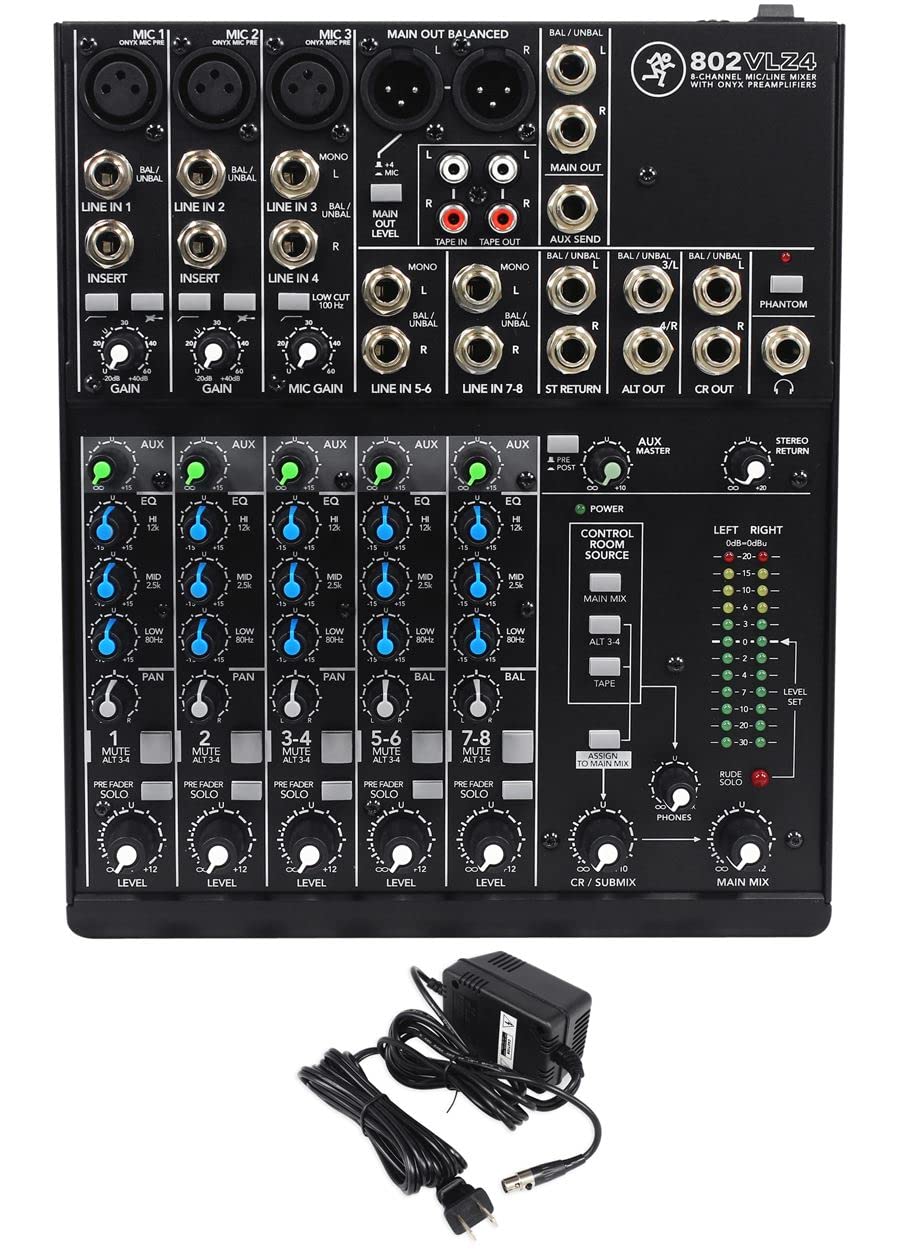
An ultra‑compact 8‑channel mixer that packs three boutique‑quality preamps and survives the road.
The 802VLZ4 is built around Mackie’s signature high‑headroom/low‑noise design and three boutique‑quality Onyx mic preamps. That means you get clean gain on three mic channels — enough for a small band or a podcast setup with multiple hosts. The board measures 15.8″D x 12.1″W x 4.3″H and weighs just 4.5 Pounds, making it one of the lightest analog 8‑channel desks you can buy. Buyers describe it as a “solid work horse” with “clean, powerful mic preamps” and an all‑metal construction that handles regular transport.
It has 8 high‑headroom line inputs in addition to the three XLR mic inputs, and improved RF rejection, which is useful for broadcast applications where wireless signals could cause interference. The noise level is rated at 60 Decibels — very quiet — and the phantom power works for all XLR inputs at once, so condenser mics are covered. One reviewer noted the outboard power supply saves space inside the chassis and keeps the board cooler.
Some buyers wish the knobs had better grip and a center detent, and the headphone volume is not independent of the main mix, which can complicate headphone monitoring during a show. If you need a separate headphone mix, the Behringer XENYX 802S has a more flexible monitoring system. But for a compact, reliable analog mixer with excellent preamps, the 802VLZ4 is a proven choice.
Why it stands out
- Three Onyx preamps with high headroom and low noise — very clean for the size.
- Weighs only 4.5 Pounds, so it is easy to carry to gigs.
- Improved RF rejection helps in venues with wireless interference.
Shortfalls
- No center detent on knobs — can be tricky to find unity quickly.
- Headphone volume is not independent of the main mix.
Road‑ready compact: Perfect for solo acts, duos, or podcasters who need clean preamps in a portable, rugged package.
Pass if: you need separate headphone monitoring or prefer knobs with positive detents — the XENYX 802S offers better monitoring.
5. Pyle PMXU88BT — 16 DSP Effects and Bluetooth Streaming

An effects‑packed analog mixer that lets you dial in 16 different reverb and delay styles on the fly.
The PMXU88BT gives you 16 DSP effects — think hall reverb, plate reverb, delay, and chorus — with separate controls for FX level and decay time. You also get a 7‑band master EQ for shaping the overall mix, plus individual bass, treble, and reverb per channel. It has 4 XLR microphone inputs, 2 pairs of ¼” mono/stereo inputs, RCA inputs, and a USB‑A port for playing MP3 files directly from a flash drive. Customers note it has “many of the features I have come to expect in much more expensive systems” and that it works well for vlog production.
Bluetooth streaming with a range of 15 ft lets you pipe music from a phone into the mix, which is handy for DJ sets or backing tracks. The mixer weighs 8.4 Pounds, so it is heavier than the Mackie 802VLZ4 (4.5 lbs) but lighter than the Rockville or Soundcraft desks. Dimensions are 12.5″D x 16.3″W x 3.66″H — a relatively shallow footprint for a board with this many connection points.
The trade‑off is that phantom power (+48V) is applied to all XLR inputs at once, not per channel. That means you cannot run a condenser mic on one channel and a ribbon mic (which dislikes phantom power) on another without using an external adapter. Also, the USB port reads audio files but does not record to a USB drive — some buyers were confused by that. If you need per‑channel phantom power, look at the Mackie Onyx8 or Soundcraft EPM8.
Effects‑first design: 16 DSP effects with separate FX level and decay controls plus a 7‑band master EQ for tonal shaping.
Worth noting: Phantom power is global — all XLR inputs get +48V at once, and the USB port only plays files, not record.
Best for: DJs, streamers, and performers who want a wide palette of built‑in effects and don’t need per‑channel phantom control.
Not ideal for: studio engineers who need independent phantom switching or USB recording capability.
6. Rockville RPM80BT — 2400W Powered Mixer with 8 Mic Inputs

A mixer and amplifier in one box — enough power to drive passive speakers without a separate amp.
The RPM80BT is a powered mixer, meaning it has a built‑in amplifier rated at 2400W peak and 600W RMS. You can connect passive speakers directly to its ¼” amplified speaker outputs without needing a separate power amp. It has 8 XLR and 8 ¼” TRS inputs, RCA AUX input, RCA REC output, USB, and Bluetooth. The 5‑band master EQ lets you shape the overall sound, and each channel has individual bass, treble, and reverb controls.
Reviewers point out it is “powerful and easy connectivity” and note that it runs “strong a few years later.” The unit weighs 24 Pounds — the heaviest mixer in this roundup — because it contains a Class‑D amplifier and a substantial power supply. Dimensions are 11.8″D x 19.7″W x 7.2″H, so it needs rack space or a sturdy table. One buyer mentioned a “slight learning curve on how to figure out the volume levels for outputs,” which is common on powered mixers where the amp gain interacts with the channel gain.
The catch is that this is a powered mixer, so it cannot be used as a simple line‑level mixer for powered speakers without careful gain staging. If you already own powered speakers, an unpowered mixer like the Mackie 802VLZ4 is a simpler choice. But if you need to drive passive speakers from a single box, the RPM80BT delivers serious power in one package.
Advantages
- 2400W peak / 600W RMS built‑in amplifier — drives passive speakers directly.
- 8 XLR + 8 TRS inputs give you 8 mic channels plus line‑level sources.
- 5‑band master EQ plus per‑channel bass, treble, and reverb.
Limitations
- Weighs 24 Pounds — not portable for frequent travel.
- Powered design requires careful gain staging; not ideal as a line‑level mixer for powered speakers.
Perfect for: venues or bands that need a mixer and amplifier in one unit to drive a passive PA system.
Avoid if: you use powered speakers and want a lightweight line‑level mixer — choose the Mackie 802VLZ4 instead.
7. Behringer XENYX 802S — USB Streaming with Separate Monitor Control

The analog mixer that streams your mix to a computer with separate headphone monitoring.
The XENYX 802S is an ultra‑low noise analog mixer with a stereo USB audio interface that sends your mix directly to a computer for streaming, podcasting, or recording. A standout feature is the monitor system: you can listen to both the USB input (say, a backing track from your computer) and the regular analog inputs at the same time, with separate controls for main and monitor. That means you can hear your voice over a game or podcast while your audience hears the full mix — something the previous version could not do.
It measures 19.69″D x 19.69″W x 11.02″H and weighs 1610 Grams, which makes it noticeably larger than the Behringer FLOW 8 (6.5″D x 9.7″W x 1.1″H). Shoppers say it is “clear, crisp, low noise, solid, dependable” and that it works great with OBS Studio for live streaming sports and events. One long‑time user noted they had the predecessor for several years before a thunderstorm caused a buzz — they upgraded to this model and prefer the improved monitoring.
The 802S only has 2 XLR inputs with phantom power, so if you need to mic up four or more singers, you will need a mixer with more mic preamps, like the Pyle PMXU88BT or Soundcraft EPM8. But for a solo streamer, podcaster, or small‑venue performer who needs clean USB audio and flexible monitoring, this is a focused, affordable solution.
Streamer‑focused: USB audio interface plus simultaneous monitoring of USB and analog inputs with separate controls.
Channel limit: Only two XLR mic inputs — insufficient for multi‑mic band or panel shows.
Ideal for: solo podcasters, streamers, and musicians who need clean USB recording and flexible headphone monitoring.
Not for: bands or events needing more than two XLR microphone inputs.
8. Depusheng DT8 — Affordable Channel Expansion for Home Studios

A budget mixer that turns a 4‑input audio interface into an 8‑channel recording rig.
The DT8 gives you 4 XLR microphone inputs with +48V phantom power, 8 total channels, and Bluetooth wireless audio streaming from a phone or tablet. The chassis is only 1.4 inches thin — sealed rotary controls resist dust — and the mixer has 3‑band EQ on all channels, a 10‑segment stereo output level meter, and 16 DSP effects. One buyer reports they use it to expand their audio interface for recording drums: “With the Depusheng DT8 console, I can now increase the number of inputs going into the audio interface and I can mic up more pieces of the drum kit as a result.”
It weighs 3.4 Kilograms — moderate for an analog mixer — and has dimensions of 17.32″D x 16.14″W x 1.89″H. The connectivity includes USB and MP3 playback from a flash drive, plus Bluetooth for cable‑free music streaming. The on‑board effects include reverb and delay, though one reviewer called the effect section “a waste of dsp” and said the EQ only boosts or cuts preset frequencies rather than a specific frequency. That makes it less precise than the swept‑mid EQ on the Soundcraft EPM8.
The DT8 is best treated as a basic mixer for expanding inputs or for live sound in small venues, not for critical studio recording where EQ precision matters. If you need surgical EQ control, the Mackie Onyx8 or Soundcraft EPM8 are better investments. But for doubling your mic count on a tight budget, the DT8 does the job.
Input expansion specialist: Adds 4 XLR inputs to any audio interface via line outputs — great for recording drums or multiple vocalists.
EQ and effects trade‑off: The EQ works on preset frequencies, and built‑in effects are underwhelming — fine for live use, not for recording.
Reach for this if… you need to add affordable XLR channels to an existing setup and Bluetooth streaming is a bonus.
Look elsewhere if… you need precise, sweepable EQ or professional‑grade effects — the Mackie Onyx8 or Soundcraft EPM8 are better.
Understanding the Specs
Preamps and Gain Staging
Your microphone plugs into a preamp — a circuit that boosts the tiny signal from the mic up to a level the mixer can work with. A good preamp adds very little noise (hiss) even when you turn the gain up. The Mackie Onyx preamps, for example, provide up to 60dB of gain while keeping the noise floor low, which means you can use a quiet dynamic mic and still get a clean signal. If a mixer has weak preamps, you will hear a constant background hiss as you turn up the volume — exactly what you want to avoid in a live or recorded mix.
Phantom Power (+48V)
Condenser microphones (common in studios and for high‑quality vocals) need a small electrical current to work — that is the +48V phantom power. Most mixers have a button that turns phantom power on or off for a group of XLR inputs. On the Pyle PMXU88BT, phantom power applies to all XLR inputs at once, so you cannot run a condenser mic on one channel and a ribbon mic (which can be damaged by phantom power) on another without external adapters. Mixers with per‑channel phantom switching, like higher‑end models, give you more flexibility with different mic types.
Digital vs. Analog Mixing Engines
An analog mixer runs every signal through physical circuits — knobs and faders directly control voltage. It is instant, simple, and reliable. A digital mixer, like the Behringer FLOW 8, converts the audio to digital data inside the board, allowing features like app‑based remote control, scene recall (saving and loading entire mixer setups), and built‑in digital effects like compressors and limiters. Digital gives you more processing power, but it can introduce latency (a tiny delay) if not well‑designed. For most live sound and studio work, digital is now the standard because you can control it from anywhere in the room.
Powered vs. Unpowered Mixers
A powered mixer has a built‑in amplifier — you connect passive speakers directly to it, and it provides the wattage to drive them. The Rockville RPM80BT, for example, delivers 2400W peak and 600W RMS, enough for medium‑sized venues without a separate amp rack. An unpowered mixer (sometimes called a “line‑level” mixer) sends a weak signal that must go to powered speakers or a separate amplifier. Unpowered mixers are lighter, smaller, and give you the freedom to choose your own amplifier and speakers, which is why most studio and touring rigs use them.
FAQ
What makes an 8‑channel mixing desk different from a 4‑channel or 12‑channel model?
Can I use an 8‑channel mixer to record directly to my computer?
What does phantom power do and when do I need it?
How do I connect Bluetooth headphones or speakers to a mixer?
What does “gain staging” mean and why does it matter?
Can I use a powered mixer with active (powered) speakers?
What is the difference between a “stereo channel” and a “mono channel”?
How do I choose between XLR and ¼” inputs for my equipment?
What does “aux send” do on a mixing desk?
How long does an analog mixing desk typically last with regular use?
Final Thoughts: The Verdict
For most buyers, the best 8 Channel Mixing Desk winner is the Behringer FLOW 8 because it combines digital app control, built-in effects, and a compact footprint that works for both live sound and recording. If you want high-resolution multi-track USB recording and a sweepable mid EQ for studio work, grab the Mackie Onyx8. And for a pure analog signal path with class-leading build quality and a clean noise floor, the standout is the Soundcraft EPM8.
How We Picked
We do not accept paid placement. Every pick is matched to a real buyer and a real use-case; we do not hands-on test units.
Sources & Methodology
Specifications: manufacturer listings and product documentation. Review insights: verified customer reviews, as of July 2026. Pricing: not shown on this page (it changes often); check the current price via the retailer link.
As an Amazon Associate, Gadgets Feed earns from qualifying purchases. This does not affect which products we feature.
Related Guides
Product prices and availability are accurate as of the date/time indicated and are subject to change. Any price and availability information displayed on Amazon at the time of purchase will apply to the purchase of this product. As an Amazon Associate I earn from qualifying purchases.
CERTAIN CONTENT THAT APPEARS ON THIS SITE COMES FROM AMAZON. THIS CONTENT IS PROVIDED "AS IS" AND IS SUBJECT TO CHANGE OR REMOVAL AT ANY TIME.
Amazon and the Amazon logo are trademarks of Amazon.com, Inc. or its affiliates.