
Our readers keep the lights on and my morning glass full of iced black tea. As an Amazon Associate, I earn from qualifying purchases.
Specs are compiled from manufacturer listings and verified buyer reviews and can change over time — please confirm the key details on the product page before buying.
A protein skimmer is the single most important piece of gear for a saltwater or reef tank. It churns thousands of tiny bubbles through the water to grab dissolved organic waste, fish waste, and uneaten food. It traps these before they break down into toxic ammonia and nitrates (nitrogen compounds that harm fish and corals). Without one, your water quality slowly drops, corals stop growing, and fish get stressed. The right skimmer pulls out dark, smelly skimmate (the sludge that collects in the cup) so your filtration handles the rest easily.
I’m Min — the founder and writer behind Gadgets Feed. This guide is built by comparing the manufacturers’ published specifications and the patterns across verified customer reviews, so you get each pick’s real strengths and trade-offs instead of marketing spin.
You want a skimmer that fits your sump or tank, handles your bioload (the waste your fish and corals produce), and does not drive you crazy with constant adjustment. The best aquarium protein skimmer pulls dark skimmate reliably without overflowing.
Our Picks at a Glance


How To Choose The Best Aquarium Protein Skimmer
A skimmer seems simple — a pump, a body, a cup — but the difference between one that pulls dark skimmate in 24 hours and one that just makes microbubbles for weeks depends on three key decisions. Here is what to look at before you buy.
Match the rating to your real bioload, not your tank volume
A skimmer rated for “100 gallons” works fine for a 75-gallon tank with a few fish. But if you have a 60-gallon tank packed with messy eaters like triggers or puffers, you want a skimmer rated for 120 to 150 gallons. Oversizing gives you a wider adjustment window and keeps the skimmate dark even after heavy feedings. Most buyers report they wish they had gone one size up.
DC pump or AC pump — speed control versus simplicity
A DC (direct current) pump uses a controller to let you dial the flow from 1 to 8 (or more), which helps fine-tune the foam head without messing with the water level. An AC (alternating current) pump runs at full speed and you adjust only by raising or lowering the skimmer in the water. DC pumps are quieter and more efficient, but they cost more and add an electronic controller that can fail. For a nano tank on a budget, a simple AC pump usually works fine.
In-sump or hang-on-back — space decides it
In-sump skimmers sit inside the sump chamber below the tank. They are more stable because water level stays constant, and they hide out of sight. Hang-on-back (HOB) skimmers clip onto the tank rim — useful if you do not have a sump. The trade-off is HOB units are harder to tune and more prone to microbubbles spilling into the display. Most serious reefers go in-sump when possible.
Quick Comparison
| Model | Best For | Tank Rating | Pump Type | Weight | Amazon |
|---|---|---|---|---|---|
| Reef Octopus Classic 110-INT★ Best Overall | Mid-size reef tanks with moderate bioload | 100 gal | AC needle wheel | — | Amazon |
| MagTool N130 PlusBest Value | Mid-large tanks needing silent DC control | 105-135 gal | DC sine wave | — | Amazon |
| IOAOI REEF-40 Nano | Nano tanks and AIO chambers under 20 gal | 20 gal | DC pinwheel | 1.39 lbs | Amazon |
| Tunze Comline DOC 9001 | Compact in-sump in BIOCUBE and small sumps | — | — | — | Amazon |
| IceCap K1-130 | Heavy bioload in 60-100 gal tanks | 80-140 gal | EVair 400 (AC) | 7.98 lbs | Amazon |
| Simplicity 240DC | Large tanks up to 240 gal with DC adjustability | 240 gal | DC | — | Amazon |
In‑Depth Reviews
1. Reef Octopus Classic 110-INT Needle Wheel Protein Skimmer
Our pick — 4.5★ from 250+ verified ratings; the strongest balance of quality and price.
The workhorse that turns cloudy water into dark, coffee-colored skimmate without fuss.
Experienced reefers recommend this skimmer when you want something that just works. The 4-inch needle wheel impeller (a rotor with tiny plastic needles that shear air into fine bubbles) whips air aggressively into microbubbles. The 100-gallon rating gives you room to run it on a 40-to-90 gallon display with a moderate fish load. Owners mention it is “dead silent” from the start, and one reviewer noted: “I could not believe how much gunk was in the water!! It was pulling out dark tea/coffee colored skimmate.” That is visible proof that organics are leaving your system.
The Classic 110-INT sits in-sump and uses an AC pump (a simple needle wheel design with no controller to fiddle with). You set the water level in your sump between 7 and 8 inches and let it break in. A few buyers mention the skimmer reacts to water level changes in the sump — if your sump evaporation runs wild, the foam head shifts. Pair it with an auto top-off unit (a device that keeps sump water level constant) and you will not have that issue.
Unlike the compact Tunze 9001 below, this skimmer has the body height to produce dry foam consistently, which means less frequent cup emptying. The collection cup detaches easily for cleaning. It is not the cheapest skimmer on this list, but considering its build quality and 293 ratings averaging 4.5 stars, it earns the top spot.
Why it earns the top spot
- Proven performance — pulls dark skimmate even on moderate bioloads
- Dead silent pump operation according to multiple reviewers
- Easy cup removal for quick cleaning
One thing to plan for
- Foam level shifts with sump water level — an auto top-off is recommended
Your best bet if: you have a 40-90 gallon reef or mixed tank and want a skip-the-hassle skimmer that produces consistent dark skimmate.
Think twice if: your sump water level fluctuates more than an inch and you do not want to add an auto top-off.
2. MagTool N130 Plus DC Protein Skimmer
A silent DC skimmer with an overflow alarm that protects your sump floor.
The MagTool N130 Plus packs features usually found on skimmers twice its sticker price. Its DC sine wave pump (a type of direct-current pump known for quiet operation) is rated at 400 GPH (gallons per hour) and comes with a controller that lets you pick from 1 to 8 speed levels. Speeds 3-5 are enough for most mixed-reef tanks up to 105 gallons with a heavy fish load. The small footprint (7.9 x 7.4 inches) fits tight sumps, and the recommended water depth of 6.5-8.0 inches is forgiving.
Reviewers consistently mention two standouts: silence and the overflow kill switch. One long-term buyer wrote that the pump is “silent” and that the overflow protection switch connects to a Neptune Apex (a popular aquarium controller) for automatic shutdown. Another noted the skimmer pulled gunk within two hours of startup — no multi-week break-in. The Cell-Cast diffuser and hybrid cone shape stabilize the foam column so you get darker skimmate, faster.
Where this beats the IceCap K1-130 (next) is adjustability. The IceCap uses an AC pump with no speed control; the MagTool gives you 8 speeds plus a feed mode that pauses the pump for 10 minutes so you can feed without the skimmer overflowing. The trade-off is that the electronic controller adds a failure point — a few buyers found the pump hummed until they lubricated the impeller bearing.
What makes it a value pick
- 8-speed DC pump for fine tuning without adjusting water level
- Overflow sensor with alarm — real confidence
- Solid foam production within hours, not weeks
The catch
- Some units need a dab of pump grease on the impeller to silence a hum
Reach for this if: you want DC speed control and overflow protection without jumping to the tier.
Look elsewhere if: you prefer a simple AC pump with no electronics that can fail.
3. Simplicity 240DC Protein Skimmer

The beast that handles a 240-gallon bioload and still fits under most standard stands.
If you have a large reef tank — 120 to 240 gallons — the Simplicity 240DC is exactly what the name implies: a powerful, quiet DC skimmer that breaks in fast and stays stable. The cone-shaped reaction chamber (8.3 x 7.9 x 19.5 inches, about 8.5 lbs) forces bubbles into a tight column for better contact time with the water. The adjustable DC pump lets you dial the flow to match your bioload, which helps when you switch from a light fish load to heavy feeding periods.
One buyer who has used Simplicity skimmers for over 7 years calls it “the best skimmer brand in 25 years of reefing.” Another reviewer with a 180-gallon reef tank said the unit replaced a failing EuroReef and produced skimmate within 24 hours — no extended break-in. The collection cup is large and has a drain line with a cap, so you can route the waste to a container and empty it less frequently.
At 19.5 inches tall, the 240DC is tall enough that you need to measure your sump clearance before buying. The base footprint is compact for a skimmer rated this high (8.3 x 7.9 inches), so it fits most standard sump chambers. One buyer mentioned persistent microbubbles during the break-in period that took about three weeks to settle — this is common with cone skimmers and usually resolves once the surface tension inside the cone stabilizes.
Why big-tank owners pick it
- Handles up to 240 gallons — the highest rating on this list
- DC pump with micro-adjustments for dry or wet skimming
- Drainable collection cup reduces maintenance frequency
Before you buy
- Tall body requires at least 20 inches of sump clearance
- Microbubbles may persist for 2-3 weeks during break-in
Made for: reefers with 120-240 gallon tanks who want a quiet, adjustable DC skimmer that pulls dark skimmate quickly.
Not for: anyone with less than 20 inches of vertical clearance in their sump area.
4. IceCap K1-130 Protein Skimmer
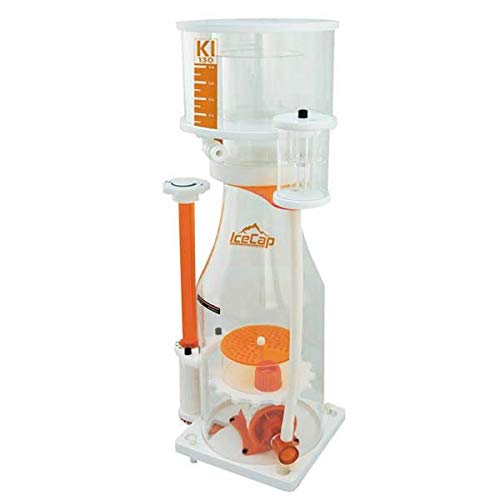
The compact brute that pulls dark skimmate from heavy-bioload tanks the same day you install it.
The K1-130 is rated for 80 gallons heavy bioload, 100 gallons medium, and up to 140 gallons light bioload. That makes it among the most versatile mid-range skimmers here, especially if you have a messy tank like a seahorse or predator setup. One buyer runs it on a 60-gallon seahorse tank with heavy feeding and reports it “works exceptionally well.” The same reviewer noted the unit started producing skimmate the day after installation — no two-week break-in period.
At 7.98 pounds, the K1-130 is noticeably heavier than the IOAOI at 1.39 pounds and feels built from solid PVC (polyvinyl chloride, a durable plastic) and acrylic. The footprint (5.6 x 7.3 inches) is compact, and the recommended sump water depth is 6 to 8 inches. The EVair 400 pump is an AC needle wheel design, so there is no speed controller — you adjust by raising or lowering the skimmer in the sump. It is not as flexible as the DC pumps on the MagTool or Simplicity, but it is dead simple and has fewer electronic parts to fail.
A couple of customers note the unit ships without paper instructions — everything is online, and a YouTube video covers assembly. The collection cup is adequate but not huge; one reviewer wished it was bigger. Still, the bottom-venting outlet design keeps turbulence low in the sump, which means less noise and salt creep compared to the Reef Octopus above.
What stands out
- Starts pulling gunk immediately — no long break-in
- Solid PVC and acrylic construction feels premium
- Quiet operation with bottom venting to reduce sump turbulence
Good to know
- No paper instructions included — check the online video
- Small-ish collection cup for its rating
Best for: fish-heavy tanks up to 80-100 gallons where you need a skimmer that starts working immediately.
skip it if: you want adjustable pump speed — the K1-130 uses a fixed-speed AC pump.
5. Tunze Comline DOC Protein Skimmer 9001

The slender skimmer that slides into a BIOCUBE 32 rear chamber and disappears.
If you have a smaller all-in-one (AIO) tank like the BIOCUBE 32 or a nano with a tight sump, the Tunze 9001 is the skimmer you can actually fit. At just 4.33 x 2.48 x 8.46 inches, it is dwarfed by every other unit on this list — the IOAOI nano is actually larger in two dimensions. The internal mount uses a magnet to hold the skimmer body in place, and the air adjustment dial is built into the external magnet for easy access.
One buyer confirmed it fits “perfect in the rear filter area” of a BIOCUBE 32 and produces “great foam.” The 0.8-kilogram weight (about 1.76 pounds) makes it light enough to hang without stressing the glass. Tunze is a well-known German brand in the aquarium world, and the 9001 uses a stainless steel impeller shaft for longevity. The compact style means the skimmer body is shorter, so it works best in tanks with low bioload — a few fish, light feeding, soft corals.
The honest trade-off is that the 9001 is not powerful enough for a heavy fish load. One reviewer rated it 2/5, calling it “over priced” and frustrating to dial in. Others found it works well once broken in (expect a few days of microbubbles). It is also the most expensive skimmer here per gallon of rating — you are paying for the small footprint and Tunze’s reputation, not raw skim capacity.
Why nano keepers love it
- Tiny footprint fits tight AIO chambers and nano sumps
- Magnetic mount keeps it stable without suction cups
- Stainless steel impeller shaft for durability
Know before you buy
- Only suitable for low-bioload nano tanks — not for heavy feeding
- Higher price per gallon of capacity than most competitors
Perfect for: BIOCUBE 32, Fluval Evo, or similar AIO tanks where space is measured in inches.
Not for: any tank with more than 3-4 fish or frequent heavy feedings — it will not keep up.
6. IOAOI Nano Protein Skimmer REEF-40

The featherweight nano that hides in an AIO chamber and starts skimming in 24 hours.
For anyone running a 20-gallon nano reef or a small all-in-one tank, the IOAOI REEF-40 offers DC pump adjustability at a price that undercuts everything else. At 1.39 pounds, it is light enough to hang on a rimless tank (maximum rim thickness: 0.5 inches, so it is for rimless or thin-rim tanks only). The included controller lets you pick power levels 1-3 — most owners find levels 1-2 are quiet and efficient for a 20-gallon setup.
Reviewers point out it “fits perfectly in the back of my AIO chamber and started skimming excess nutrients within 24 hours.” The collection cup has a drain tube at the bottom so you can empty it without removing the cup or detaching the airline — a nice touch for a skimmer at this end of the price spectrum. One owner reported the build quality felt “solid” and the packaging was professional, which is not always the case with affordable skimmers.
The main limitation is the small collection cup. For a heavy bioload, you may need to empty it every 2-3 days. The air flow is not adjustable — the manufacturer states this ensures stable foam production without fiddling. A few buyers mention the drain valve can leak slightly if not fully closed. Still, for a sub- skimmer with a DC pump, this delivers performance that punches well above its weight class.
Why it wins at this price
- DC pump with speed control — rare at this price point
- Drainable collection cup for easy maintenance
- Compact enough to fit most AIO rear chambers
The compromises
- Small collection cup needs frequent emptying with heavy bioload
- Air flow is non-adjustable — you tune only by pump speed
Reach for this if: you have a 20-gallon rimless nano or AIO tank and want a quiet, adjustable DC skimmer on a budget.
pass on it if: your tank has a thick plastic rim (over 0.5 inches) — it will not hang properly.
Understanding the Specs
Tank rating vs real-world bioload
The gallon rating printed on the box (like “110 gal” or “240 gal”) assumes a light fish load. A skimmer rated for 100 gallons works fine for a 75-gallon tank with 3-4 small fish. But if you keep messy eaters like triggers, puffers, or large angels, you want a skimmer rated for 1.5x to 2x your display volume. Oversizing gives you a wider adjustment range and darker skimmate, which means less frequent water changes.
DC pump vs AC pump
A DC (direct current) pump uses an electronic controller to let you adjust the pump speed from low to high (usually 1 to 8). You can fine-tune the foam head without changing the water level in your sump. An AC (alternating current) pump runs at a fixed speed, and you adjust the skimmer by raising or lowering the unit in the water. DC pumps are quieter, more energy-efficient (20 watts vs 30-40 watts for an equivalent AC pump), and let you run a feed mode. AC pumps are simpler, cheaper, and have fewer parts that can fail.
Needle wheel vs pinwheel impeller
Both impeller designs chop air into fine bubbles, but a needle wheel has hundreds of tiny plastic needles on the rotor that shear air into microbubbles more aggressively. A pinwheel has flat pins or paddles that draw in air through a venturi and spin it into bubbles. Needle wheels generally produce finer, denser foam, which means darker skimmate and better organic removal. Pinwheel impellers are easier to clean and less prone to clogging on nano skimmers.
Break-in period — what to expect
Most new skimmers produce only microbubbles and watery foam for the first 3 to 10 days. This is the “break-in” period when oils from manufacturing and surface tension in new plastic prevent stable foam from forming. Do not make aggressive adjustments during this period — let the skimmer run at a moderate pump speed. Once the interior surfaces develop a biofilm (a thin layer of beneficial bacteria), the foam will thicken and the skimmate will turn from clear to yellow to dark brown. A skimmer that starts producing dark skimmate within 24-48 hours (like the IceCap K1-130 or MagTool N130 Plus) is unusual and indicates very efficient bubble production.
In-sump vs hang-on-back (HOB)
In-sump skimmers sit inside your sump chamber. They are more stable because the water level in a sump is controlled by the return pump and auto top-off, so the foam head stays consistent. HOB (hang-on-back) skimmers clip onto the tank rim and hang outside the display. They are useful if you do not have a sump, but they can be harder to tune, produce more microbubbles in the display, and can overflow if the collection cup fills up. Most serious reefers prefer in-sump for reliability.
Collection cup size and drain line
The collection cup is the container that catches the skimmate. A larger cup means fewer emptyings — important if you run a heavy bioload and produce dark skimmate daily. A cup with a drain line (a hose fitting at the bottom) lets you route the waste to a separate container or a drain, so you can go longer between maintenance checks. Some skimmers (like the Simplicity 240DC and IOAOI REEF-40) include a drain tube with a shut-off cap. Others require you to remove and pour out the cup manually.
FAQ
Can I use a protein skimmer on a freshwater tank?
How long does a protein skimmer take to break in?
What happens if the collection cup overflows?
Should I oversize my skimmer?
What is the difference between wet skim and dry skim?
Can I run a protein skimmer in a tank without a sump?
How often should I clean the skimmer pump and body?
Why is my skimmer producing only microbubbles and no skimmate?
Does a cone-shaped skimmer body perform better than a cylinder?
What size sump water depth do most in-sump skimmers need?
Final Thoughts: The Verdict
For the majority of shoppers, the best aquarium protein skimmer winner is the Reef Octopus Classic 110-INT because it combines proven performance, dead-silent operation, and the ability to pull dark skimmate consistently on mid-size reef tanks without excessive fiddling. If you want DC speed control and overflow protection at a mid-range price, grab the MagTool N130 Plus. And for a large tank up to 240 gallons, the standout is the Simplicity 240DC with its quiet adjustable pump and generous collection cup.
How We Picked
We do not accept paid placement. Every pick is matched to a real buyer and a real use-case; we do not hands-on test units.
Sources & Methodology
Specifications: manufacturer listings and product documentation. Review insights: verified customer reviews, as of July 2026. Pricing: not shown on this page (it changes often); check the current price via the retailer link.
As an Amazon Associate, Gadgets Feed earns from qualifying purchases. This does not affect which products we feature.