
Our readers keep the lights on and my morning glass full of iced black tea. As an Amazon Associate, I earn from qualifying purchases.
Specs are compiled from manufacturer listings and verified buyer reviews and can change over time — please confirm the key details on the product page before buying.
A power outage doesn’t have to mean lost work or a scrambled PC. The real question isn’t if you need a 1000 VA UPS, but which battery technology and features protect your gear without costing you more in replacements.
I’m Min — the founder and writer behind Gadgets Feed. This guide is built by comparing the manufacturers’ published specifications and the patterns across verified customer reviews, so you get each pick’s real strengths and trade-offs instead of marketing spin.
Whether your priority is a decade-long battery life, pure sine wave output for sensitive electronics, or just a reliable surge protector with enough outlets, we have sorted the best 1000 va ups options for home offices, entertainment centers, and workstations.
Our Picks at a Glance


How To Choose The Best 1000 VA UPS
A 1000 VA UPS typically provides 500W to 600W of backup power, which is enough for a desktop PC, a monitor, and your networking gear. But not all UPS units are created equal. Here is what to look for beyond the VA rating.
Battery Chemistry: Lead-Acid vs. LiFePO4
Most traditional UPS units use sealed lead-acid (SLA) batteries. They work fine, but they usually last around 3 years and take 8 hours or more to recharge. Newer units use LiFePO4 (lithium iron phosphate) batteries. These can last over 10 years and often recharge in as little as 6 hours, saving you money over the long run even though the upfront cost is higher.
Output Waveform: Simulated vs. Pure Sine Wave
A simulated (or modified) sine wave is fine for most desktop PCs and monitors. However, if you have sensitive gear like a gaming PC with an Active PFC power supply, a studio amp, or a home server, you need a pure sine wave UPS. It delivers the same clean power you get from the wall outlet, preventing errors or shutdowns.
Automatic Voltage Regulation (AVR)
AVR corrects minor voltage dips and spikes (like brownouts) without draining the battery. This is a must-have if your home or office has unstable power. It keeps your equipment running on clean, regulated power and extends the overall life of your UPS battery by reducing unnecessary switchovers.
Quick Comparison
| Model | Best For | Wattage | Battery Life | Charge Time | Amazon |
|---|---|---|---|---|---|
| Amazon Basics 1000VA★ Best Overall | Budget Desk Protection | 550W | 3 years (lead-acid) | — | Amazon |
| APC BX1000M ProAlso Great | Home Office Reliability | 600W | 3 years (lead-acid) | 8 Hours | Amazon |
| APC SMC1000C Smart-UPSPremium Pick | Remote Monitoring & Sinewave | 600W | 2 years (SLA) | — | Amazon |
| CyberPower CP1000AVRLCD | Value & LCD Info | 600W | 3 years (lead-acid) | — | Amazon |
| CyberPower BRG1000AVRLCD | Extra Outlets & USB | 600W | 3 years (lead-acid) | 8 Hours | Amazon |
| GOLDENMATE LiFePO4 (600W) | Ultra-Long Battery Life | 600W | 10 years (LiFePO4) | 6 Hours | Amazon |
| Tripp Lite SMART1000LCD | Office PC Half-Load Runtime | 500W | 3 years (lead-acid) | 16 Hours | Amazon |
| Tripp Lite OMNIVS1000 | Fast Recharge Option | — | 3 years (lead-acid) | 4 Hours | Amazon |
| GOLDENMATE LiFePO4 Pro (800W) | Higher Wattage + LiFePO4 | 800W | 10+ years (LiFePO4) | 10 Hours | Amazon |
In‑Depth Reviews
1. Amazon Basics 1000VA/550W UPS
Our pick — over 4★ from 14,500+ verified ratings; the strongest balance of quality and price.
The budget-friendly mini-tower that slides under a desk without fuss.
This is the most straightforward option on the list. It offers 550W of backup power (1000VA) across 9 outlets — 5 with battery backup and 4 with surge protection only. The mini tower design with a 6-foot power cord fits easily where space is tight, measuring just 10.2 x 3.9 x 9 inches, which is noticeably more compact than the GOLDENMATE units.
Amazon Basics includes Automatic Voltage Regulation (AVR) and simulated sine wave output, so it handles minor power fluctuations without burning battery. The stated runtime is about 7 minutes at half load (500VA/275W) and about 1 minute at full load. That is enough to save your work and shut down cleanly, but not enough to keep playing through an outage.
It is metal-enclosed, which feels more durable than the plastic of some competitors at this price. Buyers with over 14,800 ratings (4.2 stars) call it a reliable workhorse for a basic PC and router setup.
Solid Points
- Compact 9-inch profile fits in small spaces.
- 9 total outlets give good connectivity.
- Metal enclosure feels sturdy.
Limits
- 550W output — less headroom than the 600W units.
- Simulated sine wave; not suitable for Active PFC power supplies.
- Lead-acid battery (standard 3-year replacement cycle).
Reach for this if: You need a simple, reliable, low-cost UPS for a standard desk PC and router.
Look elsewhere if: You need 600W+ capacity or pure sine wave power.
2. APC BX1000M Pro 1000VA/600W
The all-rounder that keeps your home office running through flickers and full blackouts.
You get a reliable 600W of battery backup here, but what sets the APC apart is the real-world runtime you can plan around. The manufacturer states it provides over 42 minutes of backup at just a 100W load — enough to keep your Wi-Fi router, modem, and a small lamp on for a proper shutdown or to ride out a short outage.
This unit includes 8 outlets total, with 4 providing battery backup and 4 for surge protection only. It also has built-in coaxial and Ethernet surge protection (a feature not every UPS at this level offers), so your cable modem or network line is shielded too. The Automatic Voltage Regulation (AVR) corrects voltages from as low as 88V and surges up to 13% above normal without draining the battery, which is a big plus if you deal with flickering lights.
The battery is user-replaceable (APCRBC158, sold separately), a feature owners mention as a major plus because it means the unit can last longer than a sealed model. One downside to note: it uses a lead-acid battery (average life about 3 years), and it takes a full 8 hours to recharge — not as fast as the lithium units on this list.
What Works Well
- Coaxial and Ethernet surge protection covers incoming network cables.
- 42-minute runtime at a low 100W load gives you comfortable time to shut down or wait out a flicker.
- User-replaceable battery extends the life of the UPS (typical lead-acid replacement cycle).
What to Watch Out For
- Lead-acid battery will need replacement every few years.
- 8-hour recharge time is longer than some competitors.
Who it fits: Home-office users who need solid runtime and network-line protection in a trusted brand.
Caveat: If you want a battery that lasts a decade without swapping, look at the LiFePO4 picks below.
3. APC SMC1000C Smart-UPS 1000VA/600W
The network manager’s choice that lets you monitor power conditions from anywhere.
This is a true sine wave UPS, meaning the power it supplies during an outage is exactly the clean sine wave your devices expect from the wall. That is crucial for sensitive gear like a home server, a NAS, or any Active PFC power supply that might shut off or reboot with a simulated sine wave.
The standout feature here is APC SmartConnect. This gives you remote monitoring through a secure web portal, so you get automatic notifications about battery status and power events. You also get firmware updates remotely — a rare and useful feature. Buyers report that the SmartConnect feature is very handy for checking battery health without walking to the basement or closet. Note that for units purchased after August 1, 2023, SmartConnect comes as a 6-month free trial.
The unit delivers 600W of power across 8 NEMA 5-15R outlets. It is an Energy Star certified model, which keeps efficiency high. The main trade-off: this is a sealed lead-acid battery with a shorter warranty (2 years on the battery) and it is physically bigger than the other 1000VA units here — 17.28 inches deep, so make sure your desk or shelf has the depth.
Strengths
- Pure sine wave output — safe for any sensitive electronics or Active PFC power supplies.
- SmartConnect remote monitoring gives you automatic alerts over the web.
- Energy Star certified, so it runs efficiently.
Weaknesses
- Larger footprint (17.28 inches deep) — requires more space.
- Lead-acid battery; 2-year battery warranty is shorter than some rivals.
The right pick for: A home-lab or server owner who wants remote oversight and pure sine wave security.
Not ideal if: Depth is tight or you want a battery that lasts a full decade.
4. CyberPower CP1000AVRLCD

The high-value veteran with a clear LCD that shows you exactly what the power situation is.
This CyberPower is among the most reviewed units in this class (4573 ratings at a solid 4.5 stars), and for good reason. It gives you 600W capacity across 9 outlets — 5 with battery backup and surge protection, 4 with surge protection only. The right-angle 45-degree plug helps it fit flush against the wall.
The multifunction LCD panel is a genuine help. It displays estimated runtime remaining, battery capacity, and load capacity in real-time. You don’t have to guess if you have a few minutes to save your work. The Automatic Voltage Regulation (AVR) corrects minor fluctuations without draining the battery, so your equipment stays protected during brownouts without wearing down the UPS batteries prematurely.
It also comes with a 3-year warranty and a connected equipment guarantee, which gives confidence. Owners mention that the LCD panel works perfectly for years, and the unit is quiet in normal operation. The catch: it uses a standard lead-acid battery with a 3-year average life, which is typical for this price range.
Key Strengths
- Informative LCD shows runtime, load, and battery status clearly.
- 9 total outlets give you room for a full desktop setup.
- 3-year warranty with a connected equipment guarantee.
Key Limitations
- Lead-acid battery — expect around 3 years before needing replacement.
- Simulated sine wave output, so not ideal for Active PFC power supplies.
Pick this if: You want a proven, feature-rich unit with an informative LCD at a good value.
skip it if: You need pure sine wave output for a gaming PC or sensitive audio gear.
5. GOLDENMATE LiFePO4 1000VA/600W

The decade-long battery that makes conventional UPS batteries look like disposable lighters.
The biggest difference here is the battery chemistry. This GOLDENMATE uses a LiFePO4 (lithium iron phosphate) battery pack that is rated for over 10 years of life and more than 5000 charge cycles. Compare that to a typical lead-acid unit where you are swapping the battery every 3 years — the difference is massive.
It also charges much faster. While the APC and CyberPower units above take 8 hours to recharge, this one is ready in just 6 hours. The pure sine wave output ensures it’s safe for any connected gear, including gaming PCs with Active PFC power supplies. It has 8 outlets, an LCD display showing real-time battery and load info, and a built-in Battery Management System (BMS) with a cooling fan that stays below 50 dB.
The GOLDENMATE unit has a trusted safety certification, and customers note in the reviews that the compact size (12.99 x 4.13 x 9.84 inches) fits easily under a desk. The trade-off: it provides 600W output, which is fine for a desktop, but not as high as the 800W GOLDENMATE Pro version below.
Why It Stands Out
- 10-year battery lifespan and 5000+ charge cycles — far outlasts lead-acid alternatives.
- Pure sine wave output protects sensitive gear.
- 6-hour recharge time is faster than typical 8 hours.
Things to Know
- 600W output is standard for this class, but less than the 800W Pro version.
- Cooling fan can activate audibly under heavy load (below 50 dB).
The ideal choice when: You plan to keep the UPS for the long haul and hate replacing batteries.
Worth noting: If you need higher wattage (800W), the GOLDENMATE Pro variant below is a stronger fit.
6. GOLDENMATE LiFePO4 Pro 1000VA/800W

The upgraded lithium power station that packs 800W into a compact, smart-connected chassis.
This is the updated Pro version from GOLDENMATE, and it brings two key upgrades: higher power and smarter communication. The wattage is 800W instead of 600W, which gives you more headroom for a beefier gaming PC or multiple monitors plus peripherals. It also has a dedicated USB communication port. Reviewers point out that connecting this port to a Windows PC, Mac, or NAS triggers an automatic safe shutdown when the battery runs low — no extra software needed.
Like the other GOLDENMATE, it uses a LiFePO4 battery with a lifespan of over 10 years and more than 5,000 charge cycles, and it produces pure sine wave power. The 8 NEMA 5-15P outlets all include surge protection and battery backup. The LCD panel provides the usual monitoring, and the upgraded cooling fan operates below 50 dB.
The dimensions (13 x 4.1 x 9.8 inches) are nearly identical to the 600W model, making it a vertical upgrade without growing its footprint. At 5.9 kg, it is slightly heavier. The catch is that the battery charge time is 10 hours — longer than the 6-hour charge time of the 600W GOLDENMATE, so plan ahead if you have back-to-back outages.
Pro Upgrades
- 800W capacity supports higher-power desktop setups.
- USB communication port enables automatic system shutdown.
- Pure sine wave + LiFePO4 (10-year lifespan) for long-term value.
Downsides
- 10-hour recharge time is longer than the 6-hour charge of the 600W GOLDENMATE.
- Heavier (5.9 kg) than the standard 600W model.
Best for: Users who need higher wattage without giving up the decade-long LiFePO4 battery.
Consider if: Recharge speed is a concern, the standard 600W model might be a better fit.
7. Tripp Lite SMART1000LCD 1000VA/500W
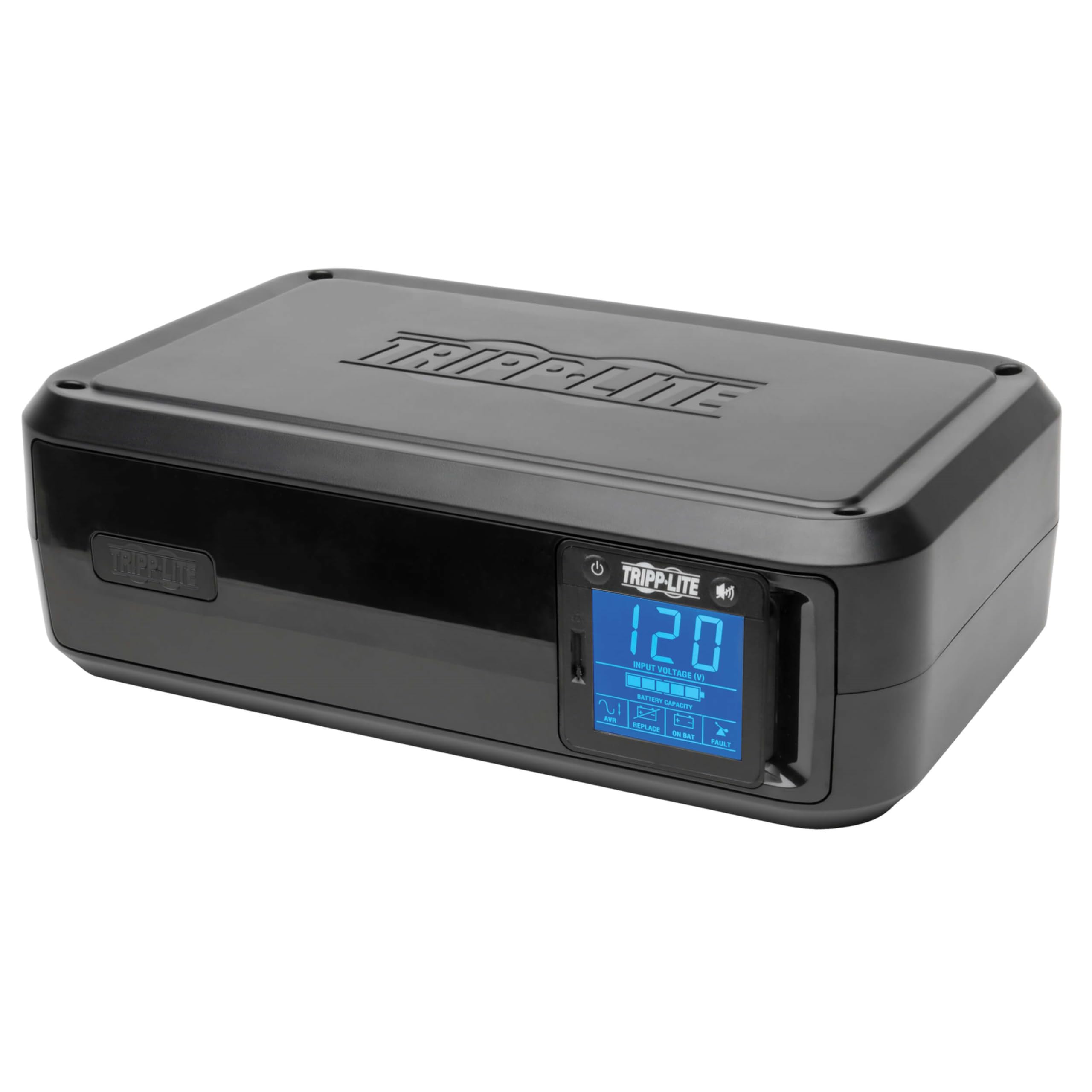
A clever unit with a rotating LCD screen and 10-minute runtime for an office PC.
Tripp Lite takes a slightly different approach here. The wattage is 500W, but the focus is on providing stable half-load runtime. You get 10 minutes of backup for a 250W office PC and 3 minutes for a 500W gaming PC. The LCD screen rotates, so you can place the tower either vertically or horizontally, which is a nice touch for fitting into cramped entertainment centers or shelves.
It has 8 outlets in total, all offering 1038 joules of surge protection and EMI/RFI noise filtering. The Automatic Voltage Regulation corrects undervoltages as low as 89V back to a safe 120V without using battery power. The battery is user-replaceable and hot-swappable, a feature reviewers appreciated for extending the unit’s usable life beyond a single battery cycle.
At 500W, it has less power headroom than the 600W CyberPower or APC units, meaning you cannot plug in as many high-draw devices. The battery charge time is 16 hours, which is the longest of any unit in this comparison — a real problem if you face multiple outages in a single day.
Good Points
- Rotating LCD display offers flexible placement (vertical or horizontal).
- User-replaceable hot-swappable battery extends the unit’s lifespan.
- EMI/RFI noise filtering keeps power clean.
Weak Points
- 500W output is the lowest among the 1000VA units here.
- 16-hour battery recharge time is very long.
Ideal for: An office PC in a space-constrained shelf or cabinet where a rotating LCD helps.
Not for: High-draw workstations or areas with frequent back-to-back outages.
8. Tripp Lite OMNIVS1000
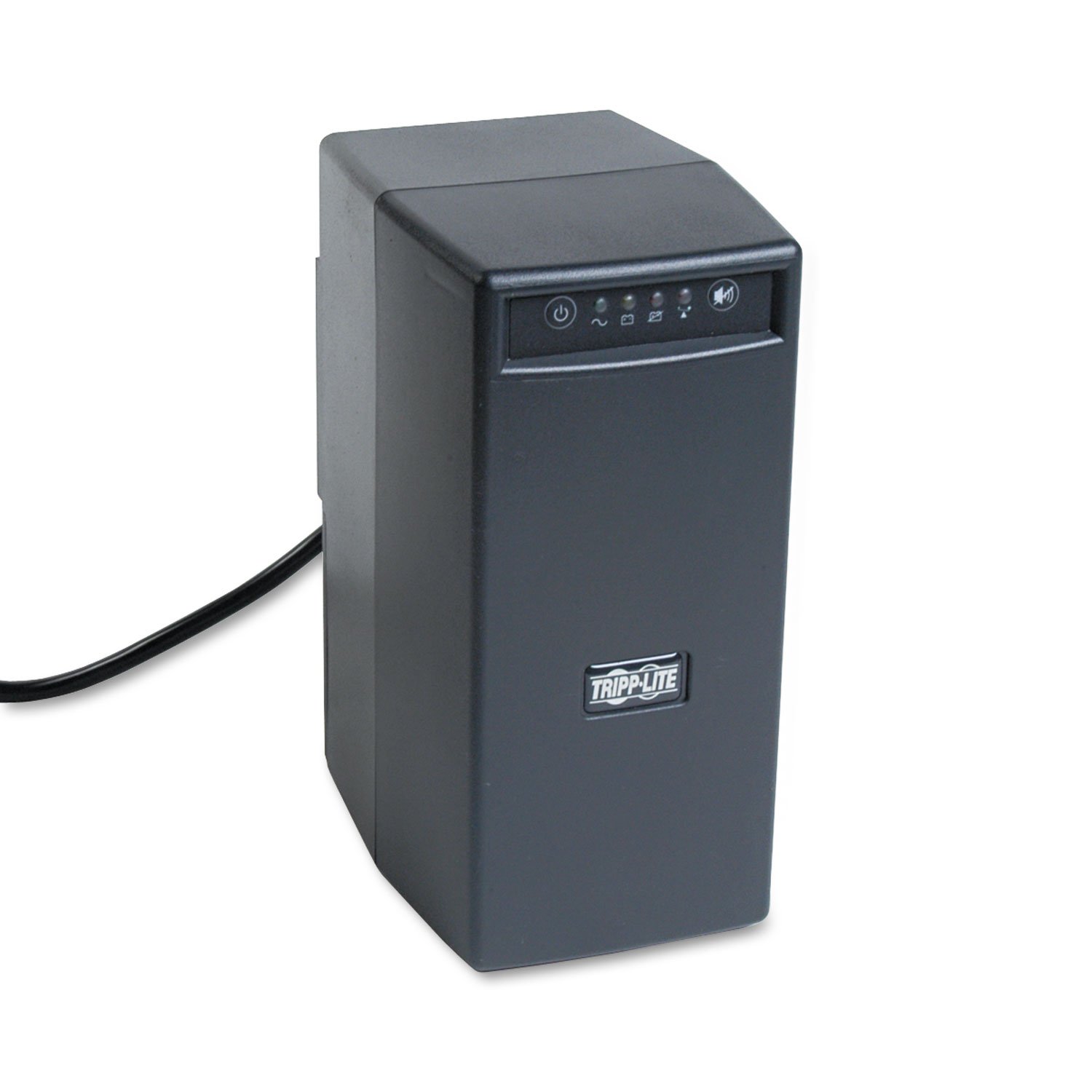
The fast-charging tower that cuts recharge time from 8 hours down to 4.
Most lead-acid UPS units take 8 hours to fully recharge. The Tripp Lite OMNIVS1000 is different — it recharges in just 4 hours. That makes it a great option if you live in an area with multiple short power cuts in the same day, as the battery will be ready for the next outage much sooner.
It is a line-interactive tower with AVR, which means it can handle voltage fluctuations without wearing out the battery. The form factor measures 5.24 x 7.48 x 10.75 inches, so it is relatively compact for a tower-style unit. It includes a USB cable and telephone cable for dataline surge protection. The brand is Tripp Lite (now Eaton), which has a long reputation in the power protection industry.
The trade-off: it uses a standard lead-acid battery, so even with the fast 4-hour charge, you are still looking at a replacement cycle every few years. The feature set is basic — no LCD screen, no pure sine wave — so it is more of a functional workhorse than a feature-packed unit. A 3-year warranty is included for confidence.
What We Like
- 4-hour recharge time is the fastest in the lead-acid segment here.
- Compact tower footprint saves desk space.
- Trusted Tripp Lite (Eaton) reputation for power equipment.
What Holds It Back
- No LCD screen for monitoring battery/load status.
- Standard lead-acid battery will need replacement in a few years.
The right pick when: You face multiple daily outages and need the battery ready as fast as possible.
Consider alternatives if: You want an LCD panel or a long-life LiFePO4 battery.
9. CyberPower BRG1000AVRLCD
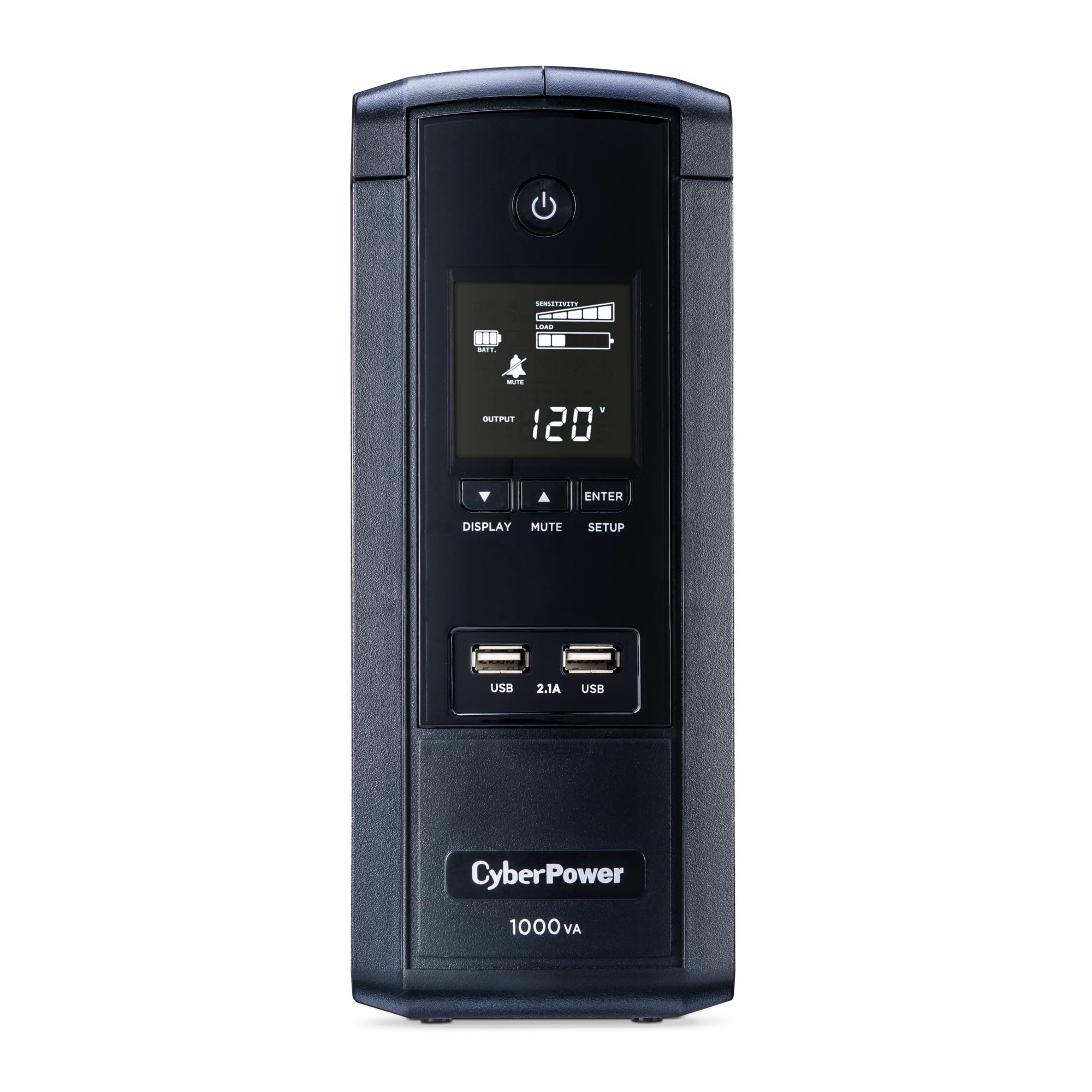
The outlet king with 10 ports and a dedicated USB charger for your phone or tablet.
With 10 NEMA 5-15R outlets, the CyberPower BRG1000AVRLCD beats every other pick here in sheer outlet count. Five outlets offer battery backup plus surge protection, and five provide surge-only protection. It also has two USB charge ports (2.1 Amps shared) so you can charge a phone or tablet directly from the unit — a nice convenience that saves a wall plug.
The intelligent LCD panel shows you detailed information including estimated runtime remaining and load capacity, which makes it easy to check your power status at a glance. AVR corrects minor fluctuations without switching to batteries. It comes with a 5-year warranty (including the battery) and a connected equipment guarantee, which is among the best coverage lengths here.
The catch is that at 10.2 x 3.9 x 9.7 inches, it is slightly deeper (by 0.7 inches) than the standard CyberPower CP1000AVRLCD. It uses a simulated sine wave, so it is not recommended for gear with Active PFC power supplies. The lead-acid battery has an average life of 3 years and takes 8 hours to recharge.
Outlet Advantage
- 10 total outlets — most in this comparison.
- Two USB charge ports (2.1A shared) for devices.
- 5-year warranty (including battery) with equipment guarantee.
Outlet Compensation
- Simulated sine wave is not ideal for sensitive electronics.
- Standard lead-acid 3-year battery life with 8-hour charge.
Best for: A setup with many peripherals that needs lots of outlets and USB charging.
Not for: Pure sine wave requirements or buyers wanting a lithium battery.
Understanding the Specs
VA vs. Watts
A 1000 VA UPS can theoretically deliver up to 1000 volt-amps, but the actual wattage it can supply is usually lower — typically 500W to 600W. The gap exists because of the power factor of the devices you plug in. Always check the real wattage (Watts) rating, not just the VA number, to know what your equipment can actually draw during a blackout.
Lead-Acid vs. LiFePO4
Standard sealed lead-acid batteries are cheap upfront but wear out in about 3 years. LiFePO4 (lithium iron phosphate) batteries cost more initially but have a huge lifespan advantage: they can handle over 5000 charge cycles and typically last a decade. They also charge faster. If you plan to keep your UPS for many years, the TCO (total cost of ownership) often favors LiFePO4.
FAQ
Can a 1000 VA UPS power a gaming PC and monitor?
What is the difference between pure sine wave and simulated sine wave?
How long does a 1000 VA UPS battery last before I need to replace it?
How long does a 1000 VA UPS provide power during an outage?
What is the advantage of an LCD screen on a UPS?
How do I know if my computer is compatible with a simulated sine wave UPS?
What is the warranty on a typical 1000 VA UPS?
Can I replace the battery in my 1000 VA UPS myself?
What does “Automatic Voltage Regulation” (AVR) do?
How many outlets do I need on a 1000 VA UPS?
Final Thoughts: The Verdict
For the majority of shoppers, the 1000 va ups winner is the APC BX1000M Pro because it delivers a great balance of runtime, protection features, and brand reliability at a fair price. If you want a long-term solution without ever worrying about battery swaps, grab the GOLDENMATE LiFePO4 600W for its decade-long battery. And for a pure sine wave model with remote monitoring that keeps an eye on your network gear, the APC SMC1000C Smart-UPS is the top pick.
How We Picked
We do not accept paid placement. Every pick is matched to a real buyer and a real use-case; we do not hands-on test units.
Sources & Methodology
Specifications: manufacturer listings and product documentation. Review insights: verified customer reviews, as of July 2026. Pricing: not shown on this page (it changes often); check the current price via the retailer link.
As an Amazon Associate, Gadgets Feed earns from qualifying purchases. This does not affect which products we feature.