
Our readers keep the lights on and my morning glass full of iced black tea. As an Amazon Associate, I earn from qualifying purchases.
Specs are compiled from manufacturer listings and verified buyer reviews and can change over time — please confirm the key details on the product page before buying.
Pick the wrong grit or bond, and you spend double the time fighting a wheel that glazes over or wears down before you finish a single weld seam. This guide breaks down what actually matters: the abrasive type (aluminum oxide for metal, diamond for concrete), the grit number (how coarse the particles are), and the real-world trade-off between fast stock removal and a smooth finish.
I’m Min — the founder and writer behind Gadgets Feed. This guide is built by comparing the manufacturers’ published specifications and the patterns across verified customer reviews, so you get each pick’s real strengths and trade-offs instead of marketing spin.
You will find three different approaches to the same job here with the 4 1/2 grinding wheel, from a fast-cutting diamond cup designed for concrete to a value-packed aluminum-oxide pack meant for metal fabrication.
Our Picks at a Glance

How To Choose The Best 4 1/2 Grinding Wheel
A grinding wheel that matches your material and tool saves you time and frustration. The three specs that make or break your pick are the abrasive type, the grit number, and the arbor size.
Match the Abrasive to Your Material
Aluminum-oxide wheels are the standard for metal — they cut steel, stainless, and alloy well and are economical in multi-packs. Diamond cup wheels use industrial diamond particles bonded to a steel body and are meant for concrete, stone, and masonry; they remove material fast on hard, brittle surfaces but are overkill (and ineffective) on soft metal.
Pick the Right Grit for the Task
Grit number tells you how coarse the abrasive is. A lower number like 40 or 50 means bigger, more aggressive particles that chew through material quickly but leave a rougher finish. A higher number like 60 grinds slower but leaves a smoother surface. For heavy stock removal on concrete or thick welds, go with grit 40-50. For cleaning up edges or blending a surface, grit 60 is a better balance.
Check Arbor Size and Wheel Thickness
The 7/8-inch arbor (center hole) is the universal standard for 4-1/2-inch wheels on most angle grinders. The wheel thickness affects both cut speed and durability: a 1/4-inch wheel is the most common for metal grinding and holds up well under pressure, while a thinner wheel cuts faster but wears quicker. A 20mm-thick diamond cup wheel is designed for surface grinding on flat concrete.
Quick Comparison
| Model | Best For | Abrasive Type | Grit | Wheel Thickness | Amazon |
|---|---|---|---|---|---|
| DEWALT DW4514B5★ Best Overall | Metal surface grinding and cleaning | Aluminum Oxide | 60 | 0.25 in | Amazon |
| WORKPRO Diamond Cup Wheel | Concrete and masonry leveling | Diamond (Double Row) | 40 | 20 mm | Amazon |
| KSEIBI 651006 (25-Pack) | High-volume metal grinding and deburring | Aluminum Oxide | 50 | 0.25 in | Amazon |
In-Depth Reviews
1. DEWALT DW4514B5 4-1/2-Inch by 1/4-Inch by 7/8-Inch Metal Grinding Wheel – 10 Pack
Our pick — over 4.5★ from 800+ verified ratings; the strongest balance of quality and price.
The 10-pack that balances smooth finish with enough aggression for daily metal work.
The DEWALT DW4514B5 delivers a clean metal finish that reduces follow-up sanding, and it does that with a grit rating of 60 — a medium-coarse that removes rust and scale efficiently while leaving a surface you can paint or weld over without much extra work. Each wheel is 4-1/2 inches in diameter, is 1/4-inch thick, and has the 7/8-inch arbor (center hole) that fits almost every angle grinder on the market. The pack contains ten wheels, which works out to a price per wheel that beats buying singles at the hardware store.
The key difference between this wheel and the KSEIBI below is the grit: 60 versus 50. A 60-grit wheel cuts slower than a 50-grit but produces a noticeably smoother finish — so it suits cleaning up a weld bead or removing a light layer of rust where you do not want deep gouges. The 13.12-ounce weight feels substantial on the grinder, which helps damp vibration during extended use.
Buyers report these wheels hold up well under heavy pressure without delaminating (layers separating), and they run true from the start with no annoying wobble at startup. One experienced owner noted that for heavy stock removal on thick steel, they prefer a coarser wheel, but for general shop clean-up and surface prep this pack hits a near-perfect balance.
Why it earns the top spot
- Grit 60 provides a clean finish that reduces follow-up sanding on metal
- 10-pack delivers strong per-wheel value for regular metalwork
- 0.25-inch thickness resists chipping under heavy side pressure
The trade-off to know
- Grit 60 is slower on heavy stock removal than coarser wheels
- Only for metal — not designed for concrete, stone, or masonry
Reach for this if: your daily work involves cleaning metal surfaces, deburring edges, or removing rust where a medium finish is acceptable and you want ten wheels that stay consistent.
Look elsewhere if: you are grinding concrete or need to cut through thick welds fast — a coarser grit or a diamond cup will finish the job in fewer passes.
2. WORKPRO 4.5 Inch Diamond Cup Wheel Double Row, 115mm Concrete Grinding Disc
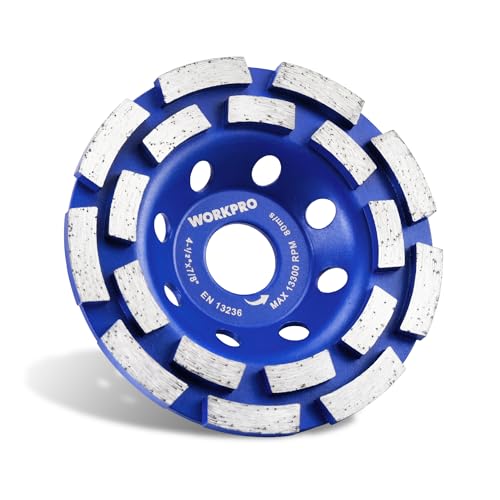
A diamond-tipped cup wheel that devours concrete coatings and levels floors fast.
This WORKPRO wheel takes a completely different approach to grinding. Instead of aluminum-oxide grains bonded into a flat disc, it uses a double-row ring of industrial diamond segments — 18 segments total — fused to a reinforced steel body. The grit rating sits at 40.0, which is significantly coarser than the DEWALT’s 60, and that makes sense for a wheel whose job is aggressive material removal on hard, brittle surfaces like concrete, brick, and stone. The 20mm thickness of the diamond segment gives it enough depth to flatten high spots and level uneven concrete.
The 22.23mm arbor (equivalent to 7/8-inch) means it mounts on any standard angle grinder without an adapter. Where this wheel really parts ways from the DEWALT and KSEIBI picks is the built-in ventilation — the manufacturer designed what it calls ‘tune ventilation holes’ that pull air through the wheel during use to reduce heat buildup and keep dust from packing between the segments. That translates to less glazing (when abrasive particles clog and stop cutting) and a longer effective cutting life on jobs like removing tile mortar or old epoxy coatings from a garage floor.
Owners mention this wheel is noticeably heavier than a standard grinding disc due to the steel core and diamond segments, which adds momentum that helps it bite into concrete. One reviewer noted it chewed through a stubborn coating on a concrete driveway far faster than the flap disc they tried first.
Where this wheel dominates: concrete surface leveling, coating removal, and masonry prep where a standard aluminum-oxide wheel would glaze over in seconds. The double-row diamond segments outlast a conventional wheel by a wide margin on abrasive materials.
Where it falls short: it is useless on soft steel or aluminum — the diamond segments skip and wear unevenly, so stick to metal-only jobs with the DEWALT or KSEIBI packs.
Get this for: construction renovation, concrete floor prep, or removing thick coatings where speed and wheel life matter more than a polished finish.
Avoid if: you only work with steel — you will waste the diamond segments and get better results with an aluminum-oxide wheel at a fraction of the cost.
3. KSEIBI 651006 Grinding Wheels 25-Pack, Aluminum Oxide Discs for Metal & Stainless Steel, 4-1/2″ x 1/4″ x 7/8″

Twenty-five wheels for the cost of a single pizza — and they actually cut well.
The KSEIBI 651006 is the high-volume workhorse of this list. Each wheel is 4-1/2 inches in diameter and 1/4-inch thick with the standard 7/8-inch arbor, made from aluminum-oxide abrasive at a grit rating of 50. That grit 50 sits between the DEWALT’s 60 and the WORKPRO’s 40, giving you an aggressive cut that still leaves a moderately smooth surface — decent for cleaning up flame-cut edges or blending out machine marks on mild steel. The 25-pack means you can burn through wheels on production work without reordering every week.
The key advantage over the 10-pack DEWALT above is the sheer quantity at a similar total cost, but there is a trade-off: the DEWALT’s grit 60 provides a noticeably finer finish, while the KSEIBI’s grit 50 removes material faster but leaves deeper scratches that may need a separate pass with a flap disc. The depressed center design (a raised hub that lets the wheel reach into corners) helps the wheel reach into tight corners and weld joints without the body of the grinder getting in the way.
Buyers — with 951 ratings averaging 4.6 stars — report these wheels work reliably on stainless steel, aluminum, and alloy steel without excessive glazing. Several reviewers specifically mention the low-vibration design: the wheels run smooth on the grinder spindle, which reduces hand fatigue during a long session of rust removal or deburring.
The big draw
- 25 wheels in one box — ideal for shops that go through discs fast
- Grit 50 strikes a solid middle ground between cut speed and finish
- Low-vibration run reduces arm fatigue on long grinding jobs
The honest caveat
- Finish is rougher than the DEWALT’s grit-60 wheel — extra sanding may be needed
- Not for concrete or masonry — strictly metal and alloy
Best suited for: auto body shops, metal fabrication, and maintenance crews who use grinding discs in volume and want the lowest cost per wheel.
skip it if: you are a DIYer who goes through one wheel every few months — the 25-pack sits around longer than you need, and the DEWALT 10-pack gives a nicer finish for less total money.
Understanding the Specs
Grit Number and Abrasive Type
The grit number tells you how coarse the abrasive particles are. A lower number like 40 means bigger, more aggressive grains that remove material quickly but leave a rough surface. A higher number like 60 cuts slower and gives a smoother finish. The abrasive type matters too — aluminum-oxide is for metal, diamond is for concrete and masonry. Using the wrong type wastes time and damages the wheel.
Wheel Thickness and Arbor Size
Wheel thickness determines how much material the wheel can grind before wearing out and how much side load it can take. A 1/4-inch (6.35mm) wheel is the standard for metal grinding and offers good durability. The arbor (center hole) size must match your grinder’s spindle — 7/8-inch (22.23mm) fits nearly all 4-1/2-inch angle grinders. Check your grinder’s spindle thread size and arbor diameter before buying any wheel.
FAQ
Will a 4-1/2 inch grinding wheel fit my angle grinder?
Can I use an aluminum-oxide wheel on concrete?
What does the grit number mean on a grinding wheel?
How long does a 4-1/2 inch grinding wheel last?
What is the difference between a depressed center wheel and a flat wheel?
Can I cut metal with a grinding wheel?
What RPM should I run a 4-1/2 inch grinding wheel at?
Are diamond cup wheels worth the higher cost for concrete work?
Final Thoughts: The Verdict
Across the board, the 4 1/2 grinding wheel winner is the DEWALT DW4514B5 10-Pack because grit 60 provides a cleaner finish on metal than coarser alternatives while the 10-pack keeps cost per wheel low enough for regular shop use. If you work mainly on concrete and masonry, grab the WORKPRO Diamond Cup Wheel for fast surface leveling and coating removal. And for high-volume metal fabrication where you burn through wheels in a single shift, the KSEIBI 25-Pack gives you the most discs per dollar without sacrificing cut quality.
How We Picked
We do not accept paid placement. Every pick is matched to a real buyer and a real use-case; we do not hands-on test units.
Sources & Methodology
Specifications: manufacturer listings and product documentation. Review insights: verified customer reviews, as of July 2026. Pricing: not shown on this page (it changes often); check the current price via the retailer link.
As an Amazon Associate, Gadgets Feed earns from qualifying purchases. This does not affect which products we feature.