
Our readers keep the lights on and my morning glass full of iced black tea. As an Amazon Associate, I earn from qualifying purchases.
Specs are compiled from manufacturer listings and verified buyer reviews and can change over time — please confirm the key details on the product page before buying.
You want a stove that lights fast, holds its flame in a breeze, and can go from a rolling boil to a low simmer without drama. The fuel type, the BTU output, the number of burners, and the build stability all decide if cooking at a campsite is a pleasure or a chore. This guide breaks down seven real options using the manufacturers’ published specs and patterns from verified customer reviews.
I’m Min — the founder and writer behind Gadgets Feed. This guide is built by comparing the manufacturers’ published specifications and the patterns across verified customer reviews, so you get each pick’s real strengths and trade-offs instead of marketing spin.
If you are packing the car for a long weekend and want a stove that handles real meals without the headache, this breakdown of the best car camping stove options gives you a focused look at the top contenders.
Our Picks at a Glance


How To Choose The Best Car Camping Stove
A car camping stove lives somewhere between a backpacking burner and a home range. You don’t need ultralight gear, but you do want something that packs down and sets up fast. Focus on the fuel type, the burner layout, and the wind resistance — those three things decide whether cooking is a joy or a fight.
BTU Output and Burner Control
A higher BTU (British Thermal Unit) number means the stove can put out more raw heat. More heat means faster boiling, especially in cold weather or windy conditions. But raw power matters less than the ability to turn it down. A stove with a low simmer range lets you cook eggs without burning them or keep a pot of chili at a gentle bubble. The best burners do both — roar when you need speed and whisper when you need control.
Wind Protection
A gust of wind can knock the flame out on a bare burner, leaving you with cold food and a wasted canister of fuel. Some stoves include built-in wind-blocking panels that fold out from the sides. Others rely on the lid to act as a shield. If you camp in open areas or on breezy ridgelines, built-in wind protection is a must-have feature, not a luxury.
Size, Weight, and Setup
You are driving to the site, so a few extra pounds are not a dealbreaker. But the stove still has to fit in the trunk alongside coolers, tents, and chairs. Look at the folded dimensions and whether the legs are detachable. A stove that packs into its own carry case or nests inside a pot saves you the headache of cramming in awkward shapes.
Fuel Compatibility
Propane is the standard for car camping stoves — the small green 16.4-ounce cylinders are everywhere. But some stoves also accept butane canisters, which gives you more flexibility if a store is sold out of one or the other. A dual-fuel stove that includes a propane adapter saves you from being locked into a single cartridge type.
Quick Comparison
| Model | Best For | Total BTUs | Burners | Weight | Amazon |
|---|---|---|---|---|---|
| Coleman Classic 3-Burner★ Best Overall | Group meals | 28,000 BTUs | 3 | 8.5 kg (18.7 lbs) | Amazon |
| Camp Chef Everest 2XTop Performer | High-output cooking | 40,000 BTUs | 2 | 15 lbs | Amazon |
| Gas One Double Burner | Heavy cast iron cooking | — | 2 | 27 lbs | Amazon |
| Hike Crew Camping Oven | Baking and roasting | 19,800 BTUs (16K + 3.8K) | 2 + oven | 30 lbs | Amazon |
| GasOne Dual Fuel | Compact dual-fuel use | 15,000 BTUs | 1 | 6 lbs | Amazon |
| Vivicreate 2 Burner | Budget-friendly two-burner | 20,000 BTUs | 2 | 10 lbs | Amazon |
| Jetboil Genesis Basecamp | Compact all-in-one system | 20,000 BTUs (10K per burner) | 2 | 9.1 lbs | Amazon |
In‑Depth Reviews
1. Coleman Classic 3-Burner Propane Camping Stove
Our pick — over 4.5★ from 950+ verified ratings; the strongest balance of quality and price.
Three burners and a rock-solid warranty make this the group-cooking workhorse.
You can run a pot of pasta, a pan of veggies, and a kettle for coffee all at once because this stove has three adjustable burners pushing out a total of 28,000 BTUs. The cooking area fits two 12-inch pans or three 8-inch pans, so nobody waits for their turn at the stove. The wind-blocking panels fold down and double as side tables — a clever space-saver that gives you shelf room next to the burners, something the Camp Chef Everest 2X does not offer.
Buyers consistently praise the reliability, noting “excellent warranty: leaky regulator replaced with a whole new stove after quick claim process.” That 3-year limited warranty backs up the purchase if anything goes wrong. The main complaint is the regulator forces the propane cylinder behind the stove, which can be awkward in tight spaces — one owner solved it with an extension hose. For a family that cooks full meals at a single site, this is the practical balance.
Group Ready
- Three burners handle multiple dishes at once
- Wind panels fold into side tables
- 3-year limited warranty with real support
Awkward Propane Position
- Regulator puts the propane cylinder behind the stove
- Runs only 0.75 hours on high with one cylinder
- Controls lack fine precision on low flame
Ideal for: families or small groups cooking full meals at a single campsite.
Not as ideal for: campers who need ultra-precise low-flame simmering for delicate dishes.
2. Camp Chef Everest 2X 2-Burner Portable Camping Stove
The high-output beast that boils water faster than your kettle at home.
You get 40,000 total BTUs (British Thermal Units, a measure of heat output) on this two-burner stove, so it boils water very fast — faster than the Coleman Classic’s 28,000 BTUs. Buyers report it is “the standard by which all other camping stoves are measured.” The folding lid doubles as a windscreen, so breezy conditions don’t knock the flame around, and the 215 square inch cooking surface fits two pans without crowding.
The trade-off is space. At 27 inches long and 15 pounds, it takes up a significant chunk of your trunk. One reviewer called it “the BOSS of camp stoves” but also mentioned the large size takes up significant car space. The knob springs back slightly when you reduce the flame, which some find a minor annoyance during precise simmering. This is the burner for you if speed and power matter more than a small pack size.
Heats Like a Beast
- 40,000 total BTUs boils water fast
- Built-in windscreen lid for windy campsites
- Instant-start ignition works every time
Takes Up Trunk Space
- 15 pounds and 27 inches long packs large
- Knob springs back when reducing flame
- Refurbished units may miss parts (buyer note)
Grab it for: campers who want the fastest boil and the highest BTU output in a two-burner package.
Look elsewhere if: trunk space is tight or you need a stove that fits in a small carry case.
3. Gas One Propane Double Burner with Windscreen

A rugged two-burner that handles cast iron cookware every single night.
This stove’s alloy steel and cast iron construction makes it rock-solid — it weighs 27 pounds, so it handles big pots and heavy pans without wobbling, unlike the lighter Camp Chef Everest 2X. One buyer reports cooking on cast iron nearly every night, and another uses it to support two 32-quart steamer pots full of tamales for a small business.
The adjustable 0-5 PSI (pounds per square inch, a measure of gas pressure) regulator with a steel braided hose is a serious upgrade over the basic regulators on most camping stoves. It lets you tune the gas flow precisely for each burner using the individual heat dials. Reviewers describe the heat as “very powerful” and “evenly distributed.” The detachable legs make portability easier, but you are still hauling a 27-pound unit, so this is a dedicated camp-kitchen piece. skip it if you need a lightweight stove you can toss in the trunk without grunting.
Built Tough for Real Cooking
- 27-pound steel/cast iron construction is rock-solid
- Adjustable 0-5 PSI regulator for fine gas control
- Two individual heat dials per burner
Heavy to Haul
- At 27 pounds versus the GasOne Dual Fuel at 6 pounds
- Large footprint at 30.75 inches long
- Requires a dedicated table or stand
Choose this when: you plan to cook with cast iron, large pots, or high-volume meals and want a stove that won’t budge.
Skip when: you need a lightweight stove you can toss in the trunk without grunting.
4. Hike Crew Outdoor Gas Camping Oven
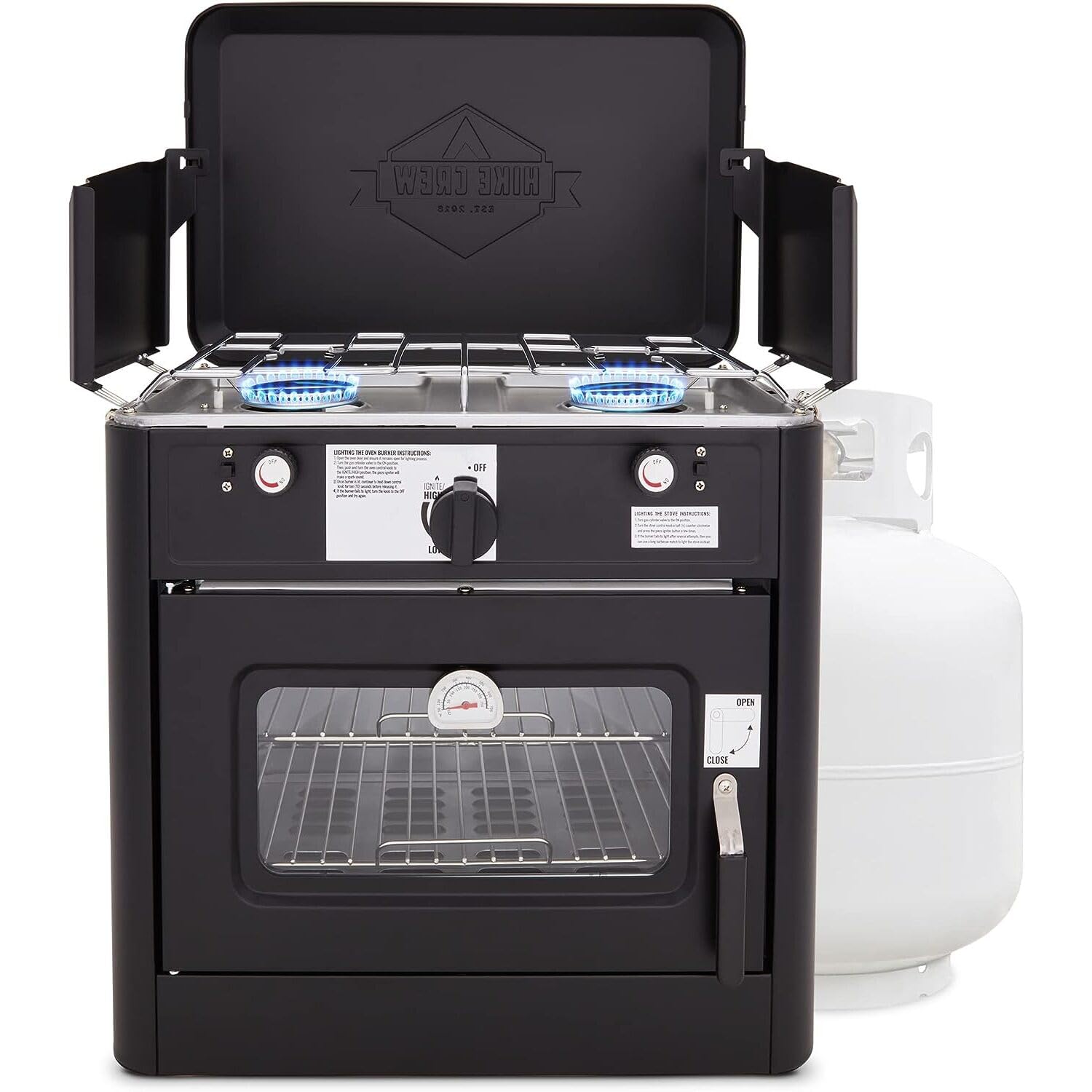
Two burners on top and an oven below — bake a pizza in the woods.
This is the only unit in the lineup that packs an actual oven, so you can roast chicken or bake frozen pizza at a base camp or RV site. The two-burner cooktop fires out 16,000 BTUs, while the separate oven delivers 3,800 BTUs and reaches up to 425 degrees Fahrenheit. A built-in thermometer and thermocouple automatic safety shutoff mean you can warm leftovers without hovering over it constantly. Buyers love it for the nomad lifestyle and report it even works for frozen pizza and garlic bread.
Reality check: this is a lightweight unit at 30 pounds with a price tag that reflects the oven function. The oven door latch is a known weak point — a few buyers mention it feels flimsy and one fabricated their own replacement. The oven temperature gauge also takes getting used to, as owners mention it isn’t perfectly accurate. For car camping with a small RV or a long-term base camp, the versatility is class-leading, but it’s not a grab-and-go stove. If you just need a simple burner to boil water and sear steaks on a quick trip, pass on this one.
Oven Flexibility
- Bakes, roasts, and warms up to 425°F
- Includes carry bag and regulator
- Built-in thermometer and safety shutoff
Light Build, Fussy Latch
- Door latch is flimsy and may need modification
- 30 pounds is heavy for a single camper
- Oven gauge requires practice to use accurately
Pick this if: you want to bake, roast, or cook full meals at a base camp or RV site rather than just boil and fry.
Pass on it if: you just need a simple burner to boil water and sear steaks on a quick trip.
5. GasOne 15,000 BTU Propane or Butane Stove

A compact single-burner that runs on either propane or butane and lights right up in wind.
When you need a stove that fits anywhere and works with whatever fuel you can find, this one delivers. It runs on both 8-ounce butane camping cartridges and 16.4-ounce propane cylinders (the propane adapter is included), so you aren’t locked into a single fuel type. The 15,000 BTUs of output is plenty for a large pot of water — one reviewer confirms it “brought a good sized pot of water to a hard boil shockingly fast on Kovea butane/propane mix” on a windy afternoon. The four-corner windblocker keeps the flame alive in breezy conditions. Compared to the Camp Chef Everest 2X, this is a fraction of the weight at just 6 pounds.
The trade-off is that it’s a single burner. If you are cooking for more than yourself, you will be waiting between dishes. At 6 pounds and measuring 12.9 inches by 10.9 inches, it packs down tiny compared to the 27-pound Gas One Double Burner above. Buyers love the “full gas adjustment” and the “mechanical lock system” that feels superior to magnetic connections. The plastic carrying case works fine if you handle it carefully. Reach for this if you cook solo or for two and value fuel flexibility above all else.
Fuel Flexibility
- Accepts both butane and propane (adapter included)
- 15,000 BTUs boil water fast even in wind
- Lightweight at just 6 pounds
Single Burner Limits You
- One burner means sequential cooking only
- Propane bottle positioning feels awkward
- Plastic carry case is not rugged
Reach for this if: you cook solo or for two, and you value fuel flexibility and a compact pack size above all else.
Look elsewhere if: you need to cook multiple dishes at once or feed a group.
6. Vivicreate 2 Burner Propane Stove

A budget-friendly two-burner that gets the job done for casual car camping trips.
If you just need a simple, dual-burner propane stove for the occasional weekend, this is an affordable way to get one. The stainless steel body resists corrosion, and the two burners deliver 20,000 total BTUs for a consistent flame. Customers note it is “easy to use from the start” and “small and compact for camping.” The anti-slip pot stands keep pans in place, which matters when you are cooking on an uneven picnic table. The included hose and regulator make setup about as easy as it gets. At 10 pounds, it is lighter than the Coleman Classic 3-Burner at 18.7 pounds.
The honest catch comes from a reviewer who pointed out quality control issues: when adjusting the heat, the knob sometimes gets stuck or the gas turns off, and the low-flame range is hard to dial in. They also mentioned that as the propane tank runs low, a strong gas smell can leak. These are real concerns for a budget-tier stove, so check connections carefully on each use. For occasional use with proper setup, it works, but it lacks the polish of the more expensive options. If you need reliable simmer control or plan to cook daily on it for extended periods, avoid this one.
Simple and Clean
- Two-burner layout for multi-dish cooking
- Stainless steel body is easy to clean
- Lightweight at 10 pounds
Hit or Miss Quality
- Knob can get stuck or turn off gas during adjustment
- Low-flame control is inconsistent
- Gas leak smell reported as tank empties
Good for: budget-conscious campers who want a simple two-burner for occasional trips and will double-check connections.
Avoid if: you need reliable simmer control or plan to cook daily on it for extended periods.
7. Jetboil Genesis Basecamp Backpacking and Camping Stove

A premium system where the burners and cookware nest together into a single compact package.
This stove is designed to be the centerpiece of a well-organized camp kitchen. The two burners each push out 10,000 BTUs and are paired with a 5-liter FluxRing pot with strainer lid and a 10-inch ceramic-coated nonstick fry pan. When you are done, the burners fold and nest inside the pot, and everything fits into the included carry bag. At 9.1 pounds, it is lighter than the Camp Chef Everest 2X (15 pounds) and far more space-efficient. One reviewer calls it “the best camp kitchen money can buy.”
The fine flame control is the standout feature here — it handles everything from a low simmer to a fast boil. Reviewers point out it boils 1 liter of water in just over three minutes and performs reliably down to 20 degrees Fahrenheit. The main criticisms are that the included windscreen feels flimsy and the stove can scratch the pots if you are not careful. This is a car-camping-only stove; it is too heavy for backpacking but perfect for site-based cooking. Choose this if packability and integrated cookware matter more to you than maximum BTUs.
Nests Together Perfectly
- Burners fold and fit inside the 5L pot
- Includes pot, fry pan, and carry bag
- Outstanding flame control from simmer to boil
Premium Price Premium Care
- Stove can scratch pot bottoms (use a cloth liner)
- Stock windscreen is flimsy
- Not suitable for large griddle use
Best for: car campers who prioritize packability, integrated cookware, and a premium cooking experience over maximum BTUs.
Not great for: anyone who needs a massive griddle surface or wants to feed a big group with large pots.
Understanding the Specs
BTU (British Thermal Unit)
BTU is the standard measure of heat output for a gas stove. A higher BTU number means the burner can produce more heat, which translates to faster boiling times and better performance in cold or windy conditions. For a car camping stove, anything in the 10,000 to 15,000 BTU range per burner is solid for general cooking. A single burner at 20,000 BTUs or higher is considered high-output and will boil water in a flash. Remember that raw power is only half the story — the stove also needs to throttle down to a low simmer without flaming out.
Windblocking and Stability
A camping stove without wind protection is a recipe for cold meals. Look for built-in wind-blocking panels that encircle the burners, or a folding lid that shields the flame from gusts. The more corners covered, the better the stove holds its flame in a breeze. Stability is equally important — a stove that slides or tips when you are stirring a heavy pot is dangerous. Check the weight of the unit and whether the feet have rubber grips. Heavier stoves with low centers of gravity tend to stay planted on a picnic table or in the dirt.
Fuel Type and Dual-Fuel Capability
Propane is the dominant fuel for car camping stoves because the small 16.4-ounce green cylinders are easy to find and simple to connect. Butane is an alternative that burns a little cleaner, though it struggles below freezing. A dual-fuel stove accepts both butane cans and propane cylinders (usually via an included adapter), giving you fuel flexibility when one type is sold out. Always check whether the stove includes the propane adapter or if it is sold separately. If you plan to cook in cold weather, stick to propane — butane loses vapor pressure and stops flowing reliably below about 32°F.
Burner Count and Cooking Area
Two burners is the standard balance for a car camping stove. It lets you run a main dish and a side simultaneously without running out of space. Three-burner stoves like the Coleman Classic offer even more flexibility for group cooking but come with a larger footprint. Single-burner stoves are the most compact but force you to cook dishes one after the other. Consider the surface area too: a stove that fits two 10-inch pans is more versatile than one where the burners are crammed together. If you often use a large griddle, check the dimensions to make sure it sits flat across the burners.
FAQ
What size propane tank do I need for a car camping stove?
Can I use a car camping stove in cold weather?
How do I clean a camping stove after a trip?
Is a 20,000 BTU stove too powerful for car camping?
How much wind protection do I really need on a camping stove?
Can I use a car camping stove on a wooden picnic table?
What is the difference between a car camping stove and a backpacking stove?
How long does a propane cylinder last on a typical two-burner stove?
Is it safe to cook inside a tent with a propane stove?
What does a dual-fuel stove mean and why does it matter?
Final Thoughts: The Verdict
For most people, the best car camping stove winner is the Coleman Classic 3-Burner because it combines three burners, reliable wind protection, and a trusted warranty into one affordable package that handles any camp meal. If you want the fastest boil and the highest raw power, grab the Camp Chef Everest 2X. And for a compact all-in-one system that packs its own cookware and saves trunk space, the standout is the Jetboil Genesis Basecamp.
How We Picked
We do not accept paid placement. Every pick is matched to a real buyer and a real use-case; we do not hands-on test units.
Sources & Methodology
Specifications: manufacturer listings and product documentation. Review insights: verified customer reviews, as of July 2026. Pricing: not shown on this page (it changes often); check the current price via the retailer link.
As an Amazon Associate, Gadgets Feed earns from qualifying purchases. This does not affect which products we feature.