
Our readers keep the lights on and my morning glass full of iced black tea. As an Amazon Associate, I earn from qualifying purchases.
Specs are compiled from manufacturer listings and verified buyer reviews and can change over time — please confirm the key details on the product page before buying.
If you have ever run an extension cord across a room just to smooth one edge of a table, you already know the pain this category solves. A battery operated sander cuts the tether entirely, letting you move around a workshop, a deck, or a tight cabinet without hunting for an outlet. The trick is finding one that keeps spinning long enough to finish the job and actually removes material instead of just vibrating in place.
I’m Min — the founder and writer behind Gadgets Feed. This guide is built by comparing the manufacturers’ published specifications and the patterns across verified customer reviews, so you get each pick’s real strengths and trade-offs instead of marketing spin.
You need a battery operated sander that matches your project’s speed range, dust collection, and ergonomics — whether you are touching up furniture or stripping paint all day.
Our Picks at a Glance

How To Choose The Best Battery Operated Sander
The right cordless sander is not just about the battery voltage. You need to match the pad size, speed range, and dust management to your specific projects. Here are the three things to focus on before you buy.
Pad Size & Motion Type
The pad shape and motion directly control how fast you remove material and how smooth the final surface is. A 5-inch random orbit sander spins in a circle while vibrating (the “orbit”) to prevent swirl marks, making it the best all-around choice. A 1/4-sheet sander moves back and forth in a straight line, which is faster at removing material but can leave scratches if you are not careful. A detail “mouse” sander has a pointed tip for getting into corners and tight spots.
Speed Control & OPM Range
Different materials need different speeds. A higher OPM (orbits per minute) removes material faster but can burn or melt softer materials like plastic or soft wood. A variable-speed trigger or dial lets you slow down for finishing and speed up for stripping. Look for a range of at least 8,000 to 12,000 OPM for enough flexibility across wood, metal, and paint.
Dust Collection System
Sandpaper creates fine dust that gets everywhere and is bad to breathe. A sander with a solid on-board dust bag or a port that connects to a shop vacuum (usually 1-1/4 inch or 1-1/2 inch) keeps your workspace much cleaner. A dust-sealed switch on the tool itself also prevents the gritty debris from killing the trigger or speed dial over time.
Quick Comparison
| Model | Best For | Pad Size | Max Speed (OPM/RPM) | Weight | Amazon |
|---|---|---|---|---|---|
| BOSCH GEX18V-5N★ Best Overall | Best Value Pro | 5 in | 10,000 RPM | 2.4 lbs | Amazon |
| DEWALT DCW210P1Also Great | Best Overall | 5 in | 12,000 OPM | 5.6 lbs | Amazon |
| Metabo HPT SV1813DAQ4 | Premium Pro | 5 in | 6 speeds | 2.6 lbs | Amazon |
| RYOBI PCL401B | Speed Demons | 1/4 Sheet | 14,000 OPM | 3.2 lbs | Amazon |
| CRAFTSMAN CMCW222B | DIY Builders | 1/4 Sheet | 9,000-12,000 OPM | 3.2 lbs | Amazon |
| BLACK+DECKER BDCMS20B | Corner Detail | Mouse | — | 2.1 lbs | Amazon |
In‑Depth Reviews
1. BOSCH GEX18V-5N 18V Brushless 5 Inch Cordless Random Orbit Sander
Our pick — over 4.5★ from 600+ verified ratings; the strongest balance of quality and price.
The lightest 5-inch random orbit sander here at 2.4 pounds, with pro-grade Bosch engineering.
BOSCH brings its reputation for smooth operation and reliability into this cordless model. It spins at a maximum of 10,000 RPM and features soft-start technology (meaning the motor does not jerk or kick when you pull the trigger), which helps you ease into the workpiece without gouging it. The vibration dampening element cuts down on hand fatigue, and the compact shape means you can sand into tight spaces that a bulkier sander cannot reach.
Mobile dust collection is handled by your choice of a dust bag or a vacuum hose attachment, and the hook-and-loop backing pad conforms to contours for a more consistent finish. Compared to the Metabo HPT above, the BOSCH is slightly lighter (2.4 lbs vs 2.6 lbs) and has a single fixed max speed rather than six speed settings, so it is simpler to operate but offers less control over aggressiveness. At 10,000 RPM (rotations per minute), it runs a bit slower than the RYOBI’s 14,000 OPM (orbits per minute), but the random orbit action produces a finer finish with less risk of swirl marks.
Owners mention that the five-year limited warranty (for Bosch 18V tools) is a big confidence booster for long-term ownership. The biggest catch is that it is a bare tool, so you must own a Bosch 18V battery and charger already.
Top Qualities
- Featherlight at 2.4 lbs — easy to use for long periods
- Soft-start prevents sudden jerks and marring the surface
- Vibration dampening reduces hand fatigue
- Five-year limited warranty from Bosch
Know Before You Buy
- Bare tool only — requires a Bosch 18V battery
- Single max speed (10,000 RPM) rather than variable-speed settings
Rated for: Bosch ecosystem users who need a lightweight, smooth-operation sander for detailed finishing work.
Not ideal if: you want a variable-speed trigger or need a kit with a battery included.
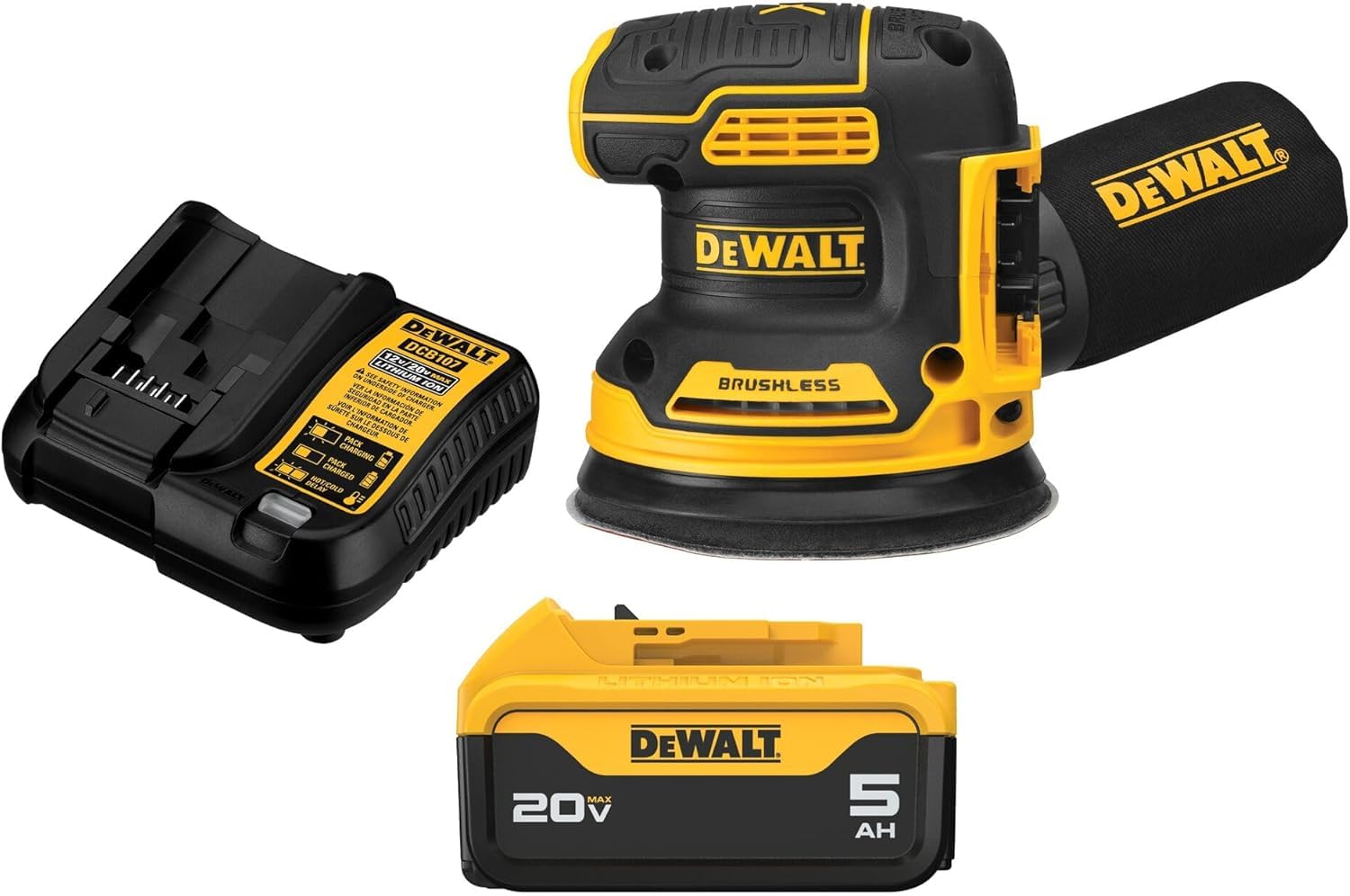
2. DEWALT 20V MAX Random Orbital Sander Kit (DCW210P1)
The cordless sander that brings corded power to the job site with a 5.0Ah battery included.
This kit from DEWALT is the real workhorse of the lineup. It is a 5-inch random orbit sander with a brushless motor (which means more runtime and less maintenance) and variable-speed control from 8,000 to 12,000 OPM. You get a 20V MAX 5.0Ah battery and charger in the box, so you can start sanding immediately without buying anything else. The low-profile height lets you get the tool right up to the workpiece for precise control, and the texturized rubber overmold grip helps you hold on even after a long session.
Buyers report that the dust-sealed switch and the one-handed locking dust bag are major pluses on job sites where debris is everywhere. The 8-hole hook-and-loop pad (a pad with tiny loops that grip sandpaper) makes swapping sandpaper fast, and the dust port fits the DWV010 or DWV012 dust collectors directly. At 5.6 pounds, it is the heaviest pick here, but that weight comes from the included battery and the sturdy build that pro users need.
Compared to the BOSCH GEX18V-5N (2.4 lbs), the DEWALT is noticeably heavier, so if you are holding it above your shoulders for hours, the weight may tire you out. But for sanding a deck, stripping a door, or prepping walls, the combination of included battery, brushless power, and DEWALT’s reliability makes this the one to beat.
Reasons to Buy
- Includes 5.0Ah battery and charger — no extra purchase needed
- Brushless motor for longer runtime and efficiency
- Variable-speed 8,000-12,000 OPM matches any project
- Dust-sealed switch protects the tool from grit
Consider This
- At 5.6 lbs, it is the heaviest option in this guide
- The dust port needs an adapter for standard 1-1/4 inch shop vac hoses
Reach for it if: you want a complete kit that is ready to sand from the start, and you can handle a little extra weight for the power and runtime it brings.
Look elsewhere if: you need a featherweight sander for overhead work or fine finishing on delicate furniture.
3. Metabo HPT 18V Cordless 5-Inch Random Orbital Sander (SV1813DAQ4)

A lightweight sander with pro-level control and the industry’s best dust collection in its class.
Metabo HPT claims this is their top-tier sander for dust collection and sanding performance, and the 4.8-star average from 136 reviews backs that up. The six speed settings let you dial in exactly the right aggressiveness for wood or metal, and the electric brake stops the pad instantly when you release the trigger.
The ergonomic one-handed dust bag is a smart touch — you can operate it with one hand and still have the other free to hold the workpiece. It comes with a 1-3/8 inch dust port, a 1-1/2 inch collection adaptor, and a 1-3/4 inch adapter, so it fits almost any shop vacuum without buying extra parts. Reviewers mention that the smooth finish it leaves is comparable to high-end corded models, and the variable speed helps avoid burning softer woods.
One trade-off is that it is a bare tool (no battery or charger included), so you need to already be in the Metabo HPT MultiVolt system. If you are starting fresh, the upfront cost plus a battery and charger can add up. But if you already own Metabo HPT gear, this sander is a fantastic addition to your kit.
Standout Benefits
- Lightweight at 2.6 lbs reduces hand fatigue
- Six speed settings give precise control over different materials
- Electric brake stops quickly for safer, faster work
- Multiple dust port adapters included for universal vacuum fit
A Limitation
- Bare tool only — requires a separate Metabo HPT battery and charger
Best suited for: the finishing carpenter or woodworker who already uses Metabo HPT batteries and wants precision and comfort without the cord.
skip it if: you are not invested in the Metabo HPT battery system or need a sanding kit with a battery included.
4. RYOBI ONE+ 18V Cordless 1/4 Sheet Sander, Tool Only (PCL401B)

The fastest spinning sander in this guide, at a budget-friendly price that fits any tool collection.
This makes it the best pick if you need to strip paint or smooth rough lumber quickly. The upgraded paper clamp system makes swapping sandpaper easier than on older RYOBI models, so you spend less time fiddling and more time working.
On-board dust collection and vacuum compatibility help keep your workspace clean, though the 1/4-sheet format does not collect dust as efficiently as a 5-inch random orbit sander on large flat surfaces. At 3.2 pounds, it is heavier than the 2.4-pound BOSCH, but it is still manageable for most projects. Reviewers point out that it runs on the massive RYOBI ONE+ battery system, so if you already have a dozen RYOBI tools, this sander is a no-brainer addition.
The main trade-off is that a 1/4-sheet sander moves in a straight-line (orbital) motion, so it can leave visible scratches if you are not careful, especially compared to the random orbit action of the DEWALT or Metabo HPT models. It is ideal for rough work and speed, less so for a fine furniture finish.
What Stands Out
- Fastest max speed at 14,000 OPM for rapid material removal
- Works with the vast RYOBI ONE+ battery platform
- Improved paper clamp system for quick changes
- Budget-friendly price point
One Thing to Watch
- Straight-line orbital motion can leave swirl marks — less ideal for fine finishing
- Heavier than the BOSCH at 3.2 lbs
Your best bet if: you are on a tight budget, already own RYOBI batteries, and need to strip paint or smooth wood quickly without worrying about a showroom finish.
Pass on it if: you need a swirl-free finish for furniture or cabinet work that demands a random orbit sander.
5. CRAFTSMAN V20 Sander, Cordless, 1/4 Sheet Sander, Bare Tool Only (CMCW222B)

A variable-speed 1/4 sheet sander from a trusted American brand, built for durability and control.
CRAFTSMAN’s CMCW222B offers a variable speed dial that adjusts from 9,000 to 12,000 OPM, giving you the flexibility to slow down for finishing or speed up for aggressive sanding. That range is not as wide as the DEWALT’s 8,000-12,000 OPM, but it covers the most common DIY sanding tasks. The dust-sealed switch is designed to keep grit out of the trigger mechanism, which is a common failure point on budget sanders.
Rapid dust collection comes through a dust bag or a 1-1/4 inch vacuum connection, so you can keep the workspace cleaner. The low-profile, lightweight build (the data says 1.43 kilograms, which is about 3.15 pounds) makes it easy to handle for a hobbyist working on weekend projects. It uses the CRAFTSMAN V20 battery platform, which is shared with many drills, saws, and other tools, so if you already own CRAFTSMAN gear, this sander is a natural fit.
Customers note that the paper clamp system works well for standard 1/4-sheet sandpaper, but a few note that the dust bag is small and fills up quickly. It is a solid entry-level option that outperforms pricier rivals.
Strong Points
- Variable speed from 9,000 to 12,000 OPM for different tasks
- Dust-sealed switch protects against grit ingestion
- Runs on the CRAFTSMAN V20 battery system
Minor Hiccups
- Dust bag is on the small side and needs frequent emptying
- Bare tool only — no battery or charger included
Perfect for: the weekend DIYer who already uses CRAFTSMAN V20 tools and wants a versatile, durable sander for home projects.
Not the best fit: if you expect to sand all day — the smaller dust bag and 1/4-sheet format are better suited to occasional use.
6. BLACK+DECKER 20V MAX* Mouse Sander, Tool Only (BDCMS20B)

The lightest and smallest sander here, built specifically for corners, edges, and tight spots.
At 2.1 pounds, the BLACK+DECKER BDCMS20B is the featherweight of this lineup — a full 2.7x lighter than the 5.6-pound DEWALT. Its “mouse” shape has a pointed tip that fits into corners, along baseboards, and inside cabinet frames where no 5-inch random orbit sander can reach. The compact and ergonomic design helps you get great control in small, awkward spaces.
The hook-and-loop system makes changing sandpaper quick, and the dust collection helps keep the surface clean while you work. It uses the BLACK+DECKER 20V MAX battery platform (batteries and charger sold separately) and comes with a 2-year limited warranty. Reviewers love how easy it is to maneuver, and several mention it is the go-to tool for touching up furniture without dragging out a larger sander.
The obvious trade-off is that it is a detail sander, not a production tool. It is slow on large flat surfaces and cannot match the material removal rate of the 1/4-sheet or 5-inch sanders. But if your projects involve a lot of trim, corners, or small repair work, this is the right tool for the job.
What We Love
- Ultra-light at 2.1 pounds — easy to control with one hand
- The pointed mouse tip reaches into corners and tight spaces
- Hook-and-loop paper changes are fast and simple
Real-World Limit
- Not designed for large flat surfaces — slow on broad stock
- Bare tool only, requires a separate BLACK+DECKER battery
Grab this if: you often find yourself sanding inside corners, around trim, or fixing small pieces of furniture where a big sander does not fit.
Pass if: you are sanding a deck, a door, or any large flat surface — you will get frustrated with how long it takes.
Understanding the Specs
OPM vs RPM vs Orbit Type
Orbits Per Minute (OPM) tells you how fast the pad moves. A number like 12,000 OPM means the pad completes 12,000 small circles every minute. A random orbit sander combines that fast spinning with a random wobble, which prevents the pad from leaving visible swirl marks on the wood. A 1/4-sheet sander typically uses a straight-line orbital motion, which removes material faster but can leave scratches if you are not careful. For a furniture-grade finish, stick with random orbit. For stripping paint fast, a 1/4-sheet can be the better choice.
Pad Size and Its Real Effect
Pad size controls how much surface you cover per pass and which sandpaper you can buy. A 5-inch pad is the standard for random orbit sanders — you can find 5-inch sticky-back discs at any hardware store. A 1/4-sheet pad uses standard quarter-sheet sandpaper (about 4.5 x 5.5 inches), which is cheaper but clips on instead of sticking. A mouse sander uses a custom triangular shape for corners. If you own one sander, make it a 5-inch. If you own two, add a mouse sander for detail work.
FAQ
Can I use a battery operated sander on metal?
How long does a battery last on one charge?
Can I connect any battery sander to a shop vacuum?
What is the difference between a random orbit sander and a 1/4 sheet sander?
Do I need a variable-speed sander?
What does “dust-sealed switch” mean?
Can I use a battery sander for wet sanding?
How do I choose sandpaper grit for my sander?
Final Thoughts: The Verdict
For most buyers, the battery operated sander winner is the DEWALT DCW210P1 because it combines a brushless motor (a motor that runs without brushes for longer life), variable speed, and a complete kit (battery and charger included) so you can start sanding immediately. If you want a lightweight precision tool that fits perfectly in the Metabo HPT system, grab the Metabo HPT SV1813DAQ4. And for the tightest corners and smallest projects, the BLACK+DECKER BDCMS20B is the most compact option.
How We Picked
We do not accept paid placement. Every pick is matched to a real buyer and a real use-case; we do not hands-on test units.
Sources & Methodology
Specifications: manufacturer listings and product documentation. Review insights: verified customer reviews, as of July 2026. Pricing: not shown on this page (it changes often); check the current price via the retailer link.
As an Amazon Associate, Gadgets Feed earns from qualifying purchases. This does not affect which products we feature.