
Our readers keep the lights on and my morning glass full of iced black tea. As an Amazon Associate, I earn from qualifying purchases.
Specs are compiled from manufacturer listings and verified buyer reviews and can change over time — please confirm the key details on the product page before buying.
If your pipes rattle when you turn on a faucet or your shower pressure jumps between hot and cold, a pressure reducing valve is the fix — it takes the raw street water pressure and drops it to a safe, steady level so your home’s plumbing and appliances don’t take a beating. The key spec you need to check first is the maximum inlet pressure the valve can handle (measured in PSI or pounds per square inch), because some home lines hit 150 PSI while others can push 400 PSI, and picking the wrong rating means the valve fails on day one. This guide walks you through the four best options in the 1-inch size for residential and light commercial use, with everything you need to match the right valve to your actual water supply.
I’m Min — the founder and writer behind Gadgets Feed. This guide is built by comparing the manufacturers’ published specifications and the patterns across verified customer reviews, so you get each pick’s real strengths and trade-offs instead of marketing spin.
Whether you are replacing an old unit or installing a new line from the meter, choosing the right 1 pressure reducing valve means matching the inlet pressure, connection type, and body material to your specific plumbing setup so you avoid leaks, bursts, and wasted water.
Our Picks at a Glance
How To Choose The Best 1 Pressure Reducing Valve
A pressure reducing valve (PRV) screws into your main water line and steps the incoming pressure down to a safe range, usually between 25 and 75 PSI. If you skip this valve, your water heater, washing machine, and even your faucet seals can wear out fast due to constant high pressure. Here are the three specs that decide whether the valve actually works for your setup.
Maximum Inlet Pressure (the valve’s survival limit)
Every PRV has a maximum pressure it can take from the street side before it breaks or leaks. Some handle 75 PSI, others go up to 400 PSI. You need to know your incoming water pressure — if it can hit 150 PSI during a low-use period, a valve rated for 75 PSI will fail quickly. Buy a valve whose max rating is higher than your worst-case incoming pressure.
Connection Type and Size
All five picks here use NPT threads (National Pipe Tapered), which is the standard threading on most copper and galvanized steel pipes in the US. A 1-inch NPT male or female connection matches the same size pipe on your water line. The “union” design lets you unscrew the valve body for repairs without cutting the pipe — a big convenience if you ever need to replace the cartridge or clean the strainer.
Built-in Strainer (keeps debris out of the valve)
Water supply lines often carry sediment, sand, or rust flakes from the main. A valve with a removable stainless steel strainer screen catches that debris before it gets inside the valve mechanism, preventing clogs and extending the valve’s service life. Models without a strainer force you to add a separate Y-strainer upstream, which takes up more space and adds another point of maintenance.
Quick Comparison
| Model | Best For | Max Inlet PSI | Connection Size | Body Material | Amazon |
|---|---|---|---|---|---|
| Zurn Wilkins 1-600XL★ Best Overall | High-pressure residential mains | 300 PSI | 1 in. NPT | Bronze | Amazon |
| Watts LFN45B 1″Also Great | Versatile home & light commercial | 400 PSI | 1 in. NPT | Lead-free copper silicon alloy | Amazon |
| Snooweerin NR3XLDU | Budget-friendly home installs | 100 PSI | 1 in. NPT | Bronze | Amazon |
| Watts 3/4″ (Backflow Preventer) | Pit & outdoor meter installs | 400 PSI | 0.75 in. NPT | Lead-free copper silicon alloy | Amazon |
| Zurn Wilkins 1-NR3XL | Tight spaces & fast cartridge swaps | 75 PSI | 1 in. NPT | Stainless steel | Amazon |
In‑Depth Reviews
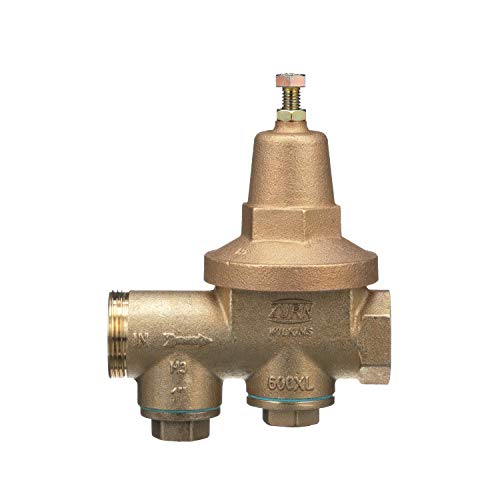
1. Zurn Wilkins 1-600XL 1″ 600XL Pressure Reducing Valve
Our pick — over 4.5★ from 700+ verified ratings; the strongest balance of quality and price.
The heavy lifter for mains that push 300 PSI without giving up
This Zurn gets the nod for homes or small commercial lines where incoming pressure is well above normal. It handles up to 300 PSI on the inlet side, compared to the Zurn NR3XL’s 75 PSI, meaning it survives street pressures that would blow a lower-rated valve apart. The balanced design is what makes this work — it reacts to inlet pressure changes without letting the outlet pressure spike, so appliances downstream see a steady flow. Buyers report that the stainless steel strainer screen unscrews in one piece for cleaning, which saves a trip under the house with tools.
The bronze exterior finish resists corrosion even in damp basements or outdoor meter pits. A fiber union gasket is included, and multiple owners mention it seats perfectly the first time with standard pipe dope on the NPT threads. It is a heavy part at 2.24 pounds, so the valve feels solid in hand. If your incoming pressure is anywhere near 300 PSI, this is the valve that actually fits the job — the others simply cannot take that load.
The catch: the 300 PSI rating is overkill for most residential homes, where typical street pressure sits between 45 and 80 PSI. If your water pressure is normal, you can save money with a lower-rated valve.
Where It Excels
- Supports 300 PSI max — handles high-pressure mains without failure
- Bronze body resists corrosion in damp locations
- Balanced design keeps outlet pressure stable despite inlet fluctuations
- Single-cap strainer removal for fast cleaning
The Trade-Offs
- Overbuilt for normal residential pressures that stay below 100 PSI
- Higher price compared to 75-100 PSI valves
Reach for this if: your incoming water pressure regularly hits 150 PSI or higher and you need a valve that survives the surge.
Look elsewhere if: your home supply is a typical 50-80 PSI — you are paying for capacity you will never use.
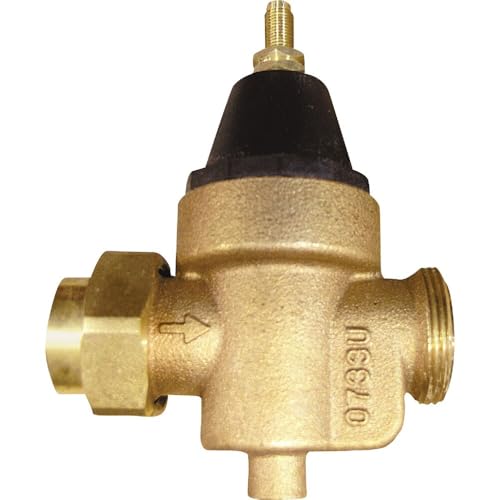
2. Watts LFN45B Series 1″ Lead-Free Cast Copper Silicon Alloy Water Pressure Reducing Valve
The do-everything valve that tames up to 400 PSI and adjusts 25-75 PSI
Watts is the name you see on most residential PRVs, and the LFN45B is the reason. It handles a massive 400 PSI max inlet pressure, the highest in this roundup, while letting you dial the outlet anywhere between 25 and 75 PSI with an adjustment screw. The standard factory setting is 50 PSI, which is exactly where most home systems need to be. It also includes a thermal expansion bypass — a small passage that lets water flow back into the main line when your water heater heats up and expands the water, preventing pressure spikes that damage pipes.
The body is made from lead-free cast copper silicon alloy, which meets the lead-free requirements for drinking water systems in commercial buildings and schools. An integrated stainless steel strainer catches sediment before it reaches the seat, and the sealed spring cage is designed for waterwork pit installations where the valve sits partly submerged. Owners mention the NPT threaded union inlet makes swapping out an old valve straightforward, especially if the old one was also a Watts — the dimensions line up without needing extra adapters.
It weighs 2.24 pounds and measures 7.38 x 5.62 x 2.44 inches, so it fits in the same footprint as most standard 1-inch PRVs. The only downside some installers mention is the thermoplastic seat module — it works fine, but a metal seat would be more durable if you ever need to rebuild the valve after years of use. That said, at this price, it is the best balance of pressure capacity, adjustability, and lead-free compliance for both home and light commercial work.
Strengths
- 400 PSI max handles the highest residential and light commercial incoming pressures
- Adjustable 25-75 PSI range covers any downstream need
- Thermal expansion bypass protects water heaters from pressure spikes
- Lead-free construction meets modern drinking water codes
Limitations
- Thermoplastic seat is less durable than a metal seat for long-term rebuilds
- Slightly more expensive than basic brass valves with no expansion bypass
Go-to pick for: most home and light commercial installs where you need the highest safety margin (400 PSI) and a built-in expansion relief.
Skip it for: a tight budget — the Snooweerin covers normal residential pressure for less money, but without the expansion bypass.
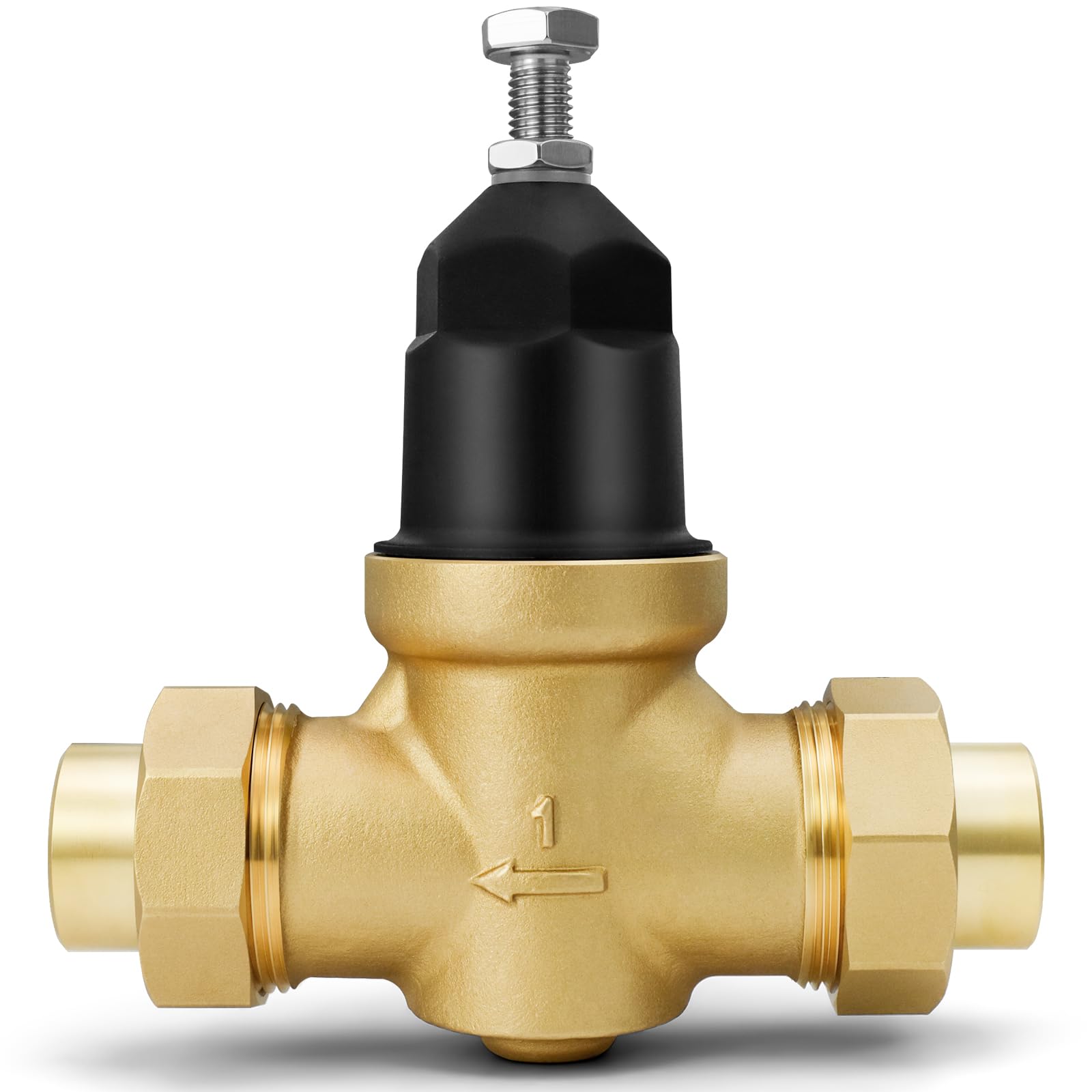
3. NR3XLDU 1″ Brass Pressure Reducing Valve With Double Union FNPT Connection, Built-In Stainless Steel Filter
A solid no-frills valve for normal home lines at a fraction of the premium cost
If your incoming water pressure stays at or below 100 PSI — which covers most city-supplied homes — this Snooweerin valve does everything the expensive ones do without the premium price. It is built from corrosion-resistant bronze, includes a built-in stainless steel filter to catch debris, and drops the outlet pressure to a standard 50 PSI. The double union FNPT connections let you disconnect the valve body without cutting the pipe, which is handy if you ever need to clean the strainer or replace the cartridge. At 6.25 x 2.5 x 5 inches, it is the most compact option in the lineup, fitting easily under a sink or inside a utility closet where space is tight.
Customers note that the valve handles typical street pressures without issue and that the built-in strainer catches enough sediment to justify the design — no separate Y-strainer is needed upstream. If your water supply occasionally spikes above 100 PSI, this valve will leak or fail. But for a standard home where pressure never goes over 80 PSI, it is a perfectly capable pick that leaves money in your pocket.
What Works
- Bronze body resists corrosion in normal home environments
- Double union connections simplify removal without cutting pipe
- Compact size fits in tight spots like inside a vanity cabinet
- Significantly lower price than Watts and Zurn premium models
The Catch
- 100 PSI max is too low for high-pressure mains or homes with pressure spikes
- No thermal expansion bypass, so you may need a separate expansion tank
Perfect for: homeowners on a budget whose street pressure never exceeds 100 PSI and who want a valve with a filter included.
Not suitable for: any property where the incoming pressure can hit 120 PSI or higher — it will not handle the load.
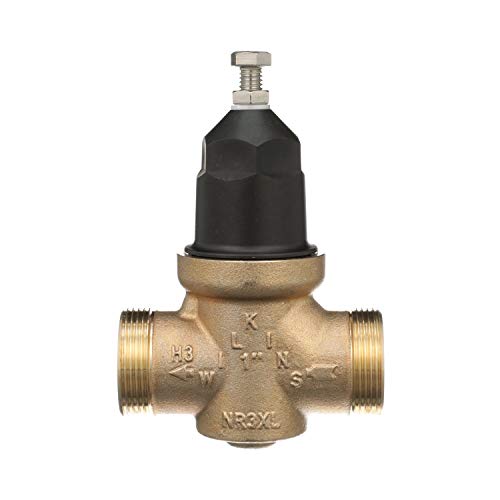
4. Zurn Wilkins 1-NR3XL 1″ NR3XL Pressure Reducing Valve Single Union Female x Female NPT Connection
The shortest 1-inch PRV on the list, built for cramped closets and tight basements
At 4.94 inches long and 2.5 inches wide, the NR3XL is noticeably more compact than the Watts LFN45B (which measures 7.38 inches long). That short lay length makes it the valve to grab when the water line is packed into a tight corner, like inside a crawl space or behind a washer box. The single union design lets you unscrew the downstream side to remove the cartridge without disturbing the upstream pipe. Reviewers point out that the cartridge-loaded design simplifies repairs — you pull the cartridge and swap it in minutes instead of disassembling the whole valve body.
The valve is made with a highly durable threaded bell that resists corrosion, and it includes a quality integral stainless steel strainer screen. It meets ASSE 1003 and NSF/ANSI 61 standards for drinking water safety. However, the maximum inlet pressure is only 75 PSI — the lowest of any valve in this lineup. That is roughly 25 PSI higher than typical home pressure, but it leaves no margin for pressure spikes. If your street pressure hits 80 PSI or above, this valve will not hold. The Zurn 600XL above handles 300 PSI; at 75 PSI versus 300 PSI, the NR3XL is strictly for homes with consistently low incoming pressure.
Advantages
- Short 4.94-inch length fits in the tightest spaces
- Cartridge-loaded design means fast in-place repairs without removing the valve
- Integral stainless steel strainer catches debris without needing an extra filter
- Meets ASSE, IAPMO, CSA, and NSF/ANSI 61 standards
The Limitation
- 75 PSI max is too low for any home with incoming pressure above typical 50-60 PSI
First choice for: installation in extremely tight spots where a longer valve will not fit, as long as the incoming water pressure stays under 75 PSI.
Do not pick if: your water pressure ever exceeds 75 PSI — the valve will leak or fail. Choose the Zurn 600XL or Watts LFN45B instead.
Understanding the Specs
PSI (Pounds per Square Inch)
PSI is the unit for water pressure — how much force the water is pushing against the inside of your pipes. A pressure reducing valve has two PSI numbers: the maximum inlet PSI (what it can survive from the street side) and the adjustable outlet PSI (what it delivers to your home). Standard home pressure is 40-60 PSI. Picking a valve with a max inlet rating far above your actual pressure gives you a safety buffer, but also costs more. If the valve’s max is lower than your incoming pressure, it will leak or burst.
NPT (National Pipe Tapered) Threads
NPT is the standard threading pattern for residential water pipes in the US. The threads taper slightly, which means they tighten and seal as you screw them together (with pipe thread tape or pipe dope). A 1-inch NPT connection matches a 1-inch copper or galvanized steel pipe. A “union” connection adds a removable coupling, so you can disconnect the valve body from the pipe without unscrewing the entire pipe run — this saves time during repairs or replacement.
FAQ
What PSI should I set my pressure reducing valve to?
Will a 1-inch valve fit my existing 3/4-inch pipe?
How do I know my incoming water pressure?
Can a pressure reducing valve also act as a backflow preventer?
How often should I clean the strainer screen inside the valve?
What causes a pressure reducing valve to make a buzzing or chattering noise?
Can I install a pressure reducing valve outside in a meter pit?
Does a pressure reducing valve save water?
What is the difference between a single union and double union PRV?
How long does a pressure reducing valve last?
Final Thoughts: The Verdict
For most people, the best 1 pressure reducing valve is the Watts LFN45B because it handles up to 400 PSI, adjusts from 25 to 75 PSI, and includes a thermal expansion bypass — all in a lead-free body that meets modern codes while staying affordable. If your incoming pressure is consistently low and you need the most compact option for a tight space, grab the Zurn Wilkins 1-NR3XL. And for a budget-friendly pick on normal home pressure lines, the Snooweerin NR3XLDU covers the basics with a double union and built-in filter at a significantly lower cost.
How We Picked
We do not accept paid placement. Every pick is matched to a real buyer and a real use-case; we do not hands-on test units.
Sources & Methodology
Specifications: manufacturer listings and product documentation. Review insights: verified customer reviews, as of July 2026. Pricing: not shown on this page (it changes often); check the current price via the retailer link.
As an Amazon Associate, Gadgets Feed earns from qualifying purchases. This does not affect which products we feature.