
Our readers keep the lights on and my morning glass full of iced black tea. As an Amazon Associate, I earn from qualifying purchases.
Specs are compiled from manufacturer listings and verified buyer reviews and can change over time — please confirm the key details on the product page before buying.
If you have ever tried to sleep in a tent on a hot, sticky night, you know the frustration. You lie on top of your sleeping bag, the air is thick, and every tiny movement makes you sweat more. A true portable air conditioner is the only cure, and picking the right one means understanding real specs like BTU (British Thermal Units, which measure raw cooling power) and wattage, not marketing fluff. This guide cuts through the noise to show you the units that actually deliver cold air where it matters most — in the woods, in your van, or at a sweltering campsite.
I’m Min — the founder and writer behind Gadgets Feed. This guide is built by comparing the manufacturers’ published specifications and the patterns across verified customer reviews, so you get each pick’s real strengths and trade-offs instead of marketing spin.
The true test of an air con for camping is whether it can cool a small space on limited power without waking you up with noise or dying before dawn, and we have found six that pass that test with clear winners for different priorities.
Our Picks at a Glance
How To Choose The Best Air Con For Camping
Picking the right camping air conditioner is not about the most expensive model or the biggest brand. It is about matching the unit’s cooling power and energy appetite to your tent size and your available power source. Get these two things wrong, and you will be left sweating or sitting in the dark with a dead battery.
BTU vs. Tent Size: Why Bigger Is Not Always Better
BTU (British Thermal Unit) tells you how much heat the unit can remove per hour. A 5,200 BTU unit can cool roughly 130 square feet, which is perfect for a large tent or small RV. A 3,500 BTU unit is better for a small two-person tent (up to 64.58 square feet, like the BougeRV PC35). Oversizing a unit for a tiny space can cause it to cycle on and off too quickly, wasting power and failing to dehumidify the air properly.
Power Source: The Battery and Wattage Reality
Most portable camping ACs run on standard 110V wall power, which means you need a beefy portable power station (like a Jackery or EcoFlow) or a generator. Look at the “Annual Energy Consumption” in watts — a unit that pulls 400 watts is very different from one that pulls 960 watts. You also need to check the startup surge, called “compressor startup power.” Some units, like the BougeRV PC35, can briefly spike to 2,000 watts (2 kW) when the compressor kicks on, which will shut down a smaller power station instantly.
Noise and Drainage: The Two Hidden Comfort Killers
Noise is measured in decibels (dB). A unit running at 45 dB is like a quiet library and is fine for sleeping. A unit at 50 dB is like light traffic noise — noticeable but tolerable. Drainage is the other big one. Many units claim “drainage free” when humidity is below 70%, but in humid summer campgrounds, you will still need to empty the water tank or hook up a drain pipe. Units with a dehumidification function can handle damp air much better than those without.
Quick Comparison
| Model | Best For | BTU Cooling | Power Consumption | Weight | Amazon |
|---|---|---|---|---|---|
| RV Rooftop Unit★ Best Overall | Permanent Van / RV Installation | 10,000 BTU | 960 Watts | — | Amazon |
| Cybertake S2 ProAlso Great | 8-Hour Battery Life & Dual Heat/Cool | 5,100 BTU | 1 kWh per 8h (Eco+) | 21 lbs | Amazon |
| 5200 BTU FO-KOKO | Large Space & Low 400W Power | 5,200 BTU | 400 Watts | 33 lbs | Amazon |
| OUTOHOME 5200BTU | Balanced 5,200 BTU for Rental Vans | 5,200 BTU | <400W/hour | 31.9 lbs | Amazon |
| BAYKUL 5000 BTU | Lightest Premium Unit for Portability | 5,000 BTU | 400 Watts | 27.5 lbs | Amazon |
| BougeRV PC35 | App-Controlled Small Tent Cooling | 3,500 BTU | 2 kW startup surge | 34.17 lbs | Amazon |
In‑Depth Reviews
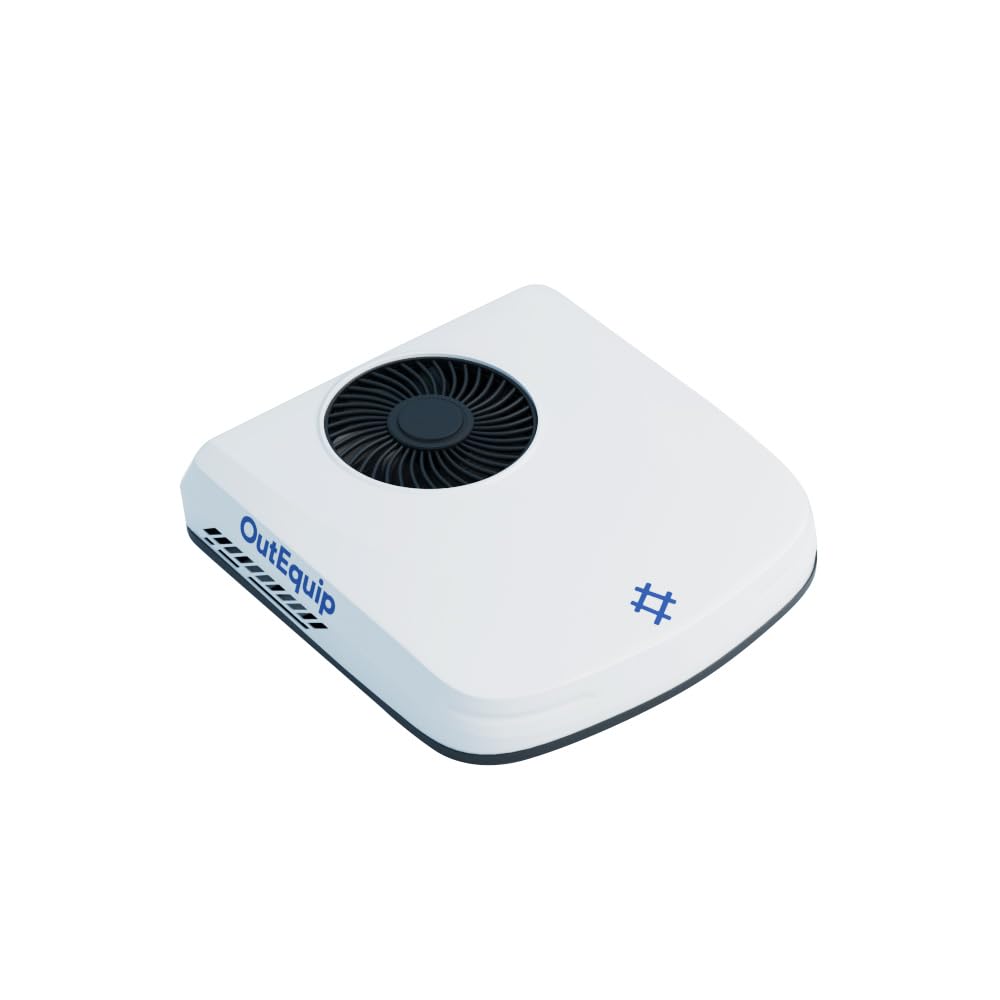
1. RV Rooftop Air Conditioner 12V 10000 BTU (OutEquip)
Our pick — 4.5★ from 100+ verified ratings; the strongest balance of quality and price.
The heavy-duty roof unit for vans that need quick, full-space cooling on 12V.
The OutEquip 12V rooftop AC is a completely different beast from the portable units above. It is a permanent installation for RVs, trucks, vans, and campers, delivering 10,000 BTU of raw cooling power — at 10,000 BTU versus the BougeRV PC35’s 3,500 BTU and the 5,200 BTU units. It cools an RV in just 15 minutes, making it the fastest option here for medium-to-large vehicles.
It runs on 12V DC directly from your vehicle’s electrical system, so you do not need a separate power station — but the annual energy consumption is 960 Watts at 960 Watts versus the 400W of the FO-KOKO and BAYKUL, which will drain a standard RV battery bank quickly. The unit includes a 4,500 BTU PTC heater for mild warmth, but the maker clearly states it is not a primary heat source for extreme cold.
The construction is built for the road: UV-stabilized ABS materials, EPDM foam gasket, and a zinc-coated condenser to resist weather and corrosion. It comes with both a remote control and multiple modes (eco, sleep, turbo). The spring-mounted mounts and brushless copper motor fans keep noise low for a unit of this size. Reviewers with vans and work trucks consistently praise the fast cooldown and the 4.5-star rating across 138 ratings is the highest in this list.
Raw power for big rigs: 10,000 BTU cools a large RV space in 15 minutes — far faster than any portable unit here, but the 960W power draw means you need a serious battery bank or generator.
Installed only: This is not a portable unit you can throw in a tent. It requires cutting a roof hole and wiring into the vehicle’s 12V system,.
Reach for this if: You own an RV, van, or truck camper and want permanent, powerful cooling that does not take up floor space — the 12V operation integrates with your existing electrical system.
it’s not for you if: You are a tent camper or need a portable unit — this is a permanent installation only.
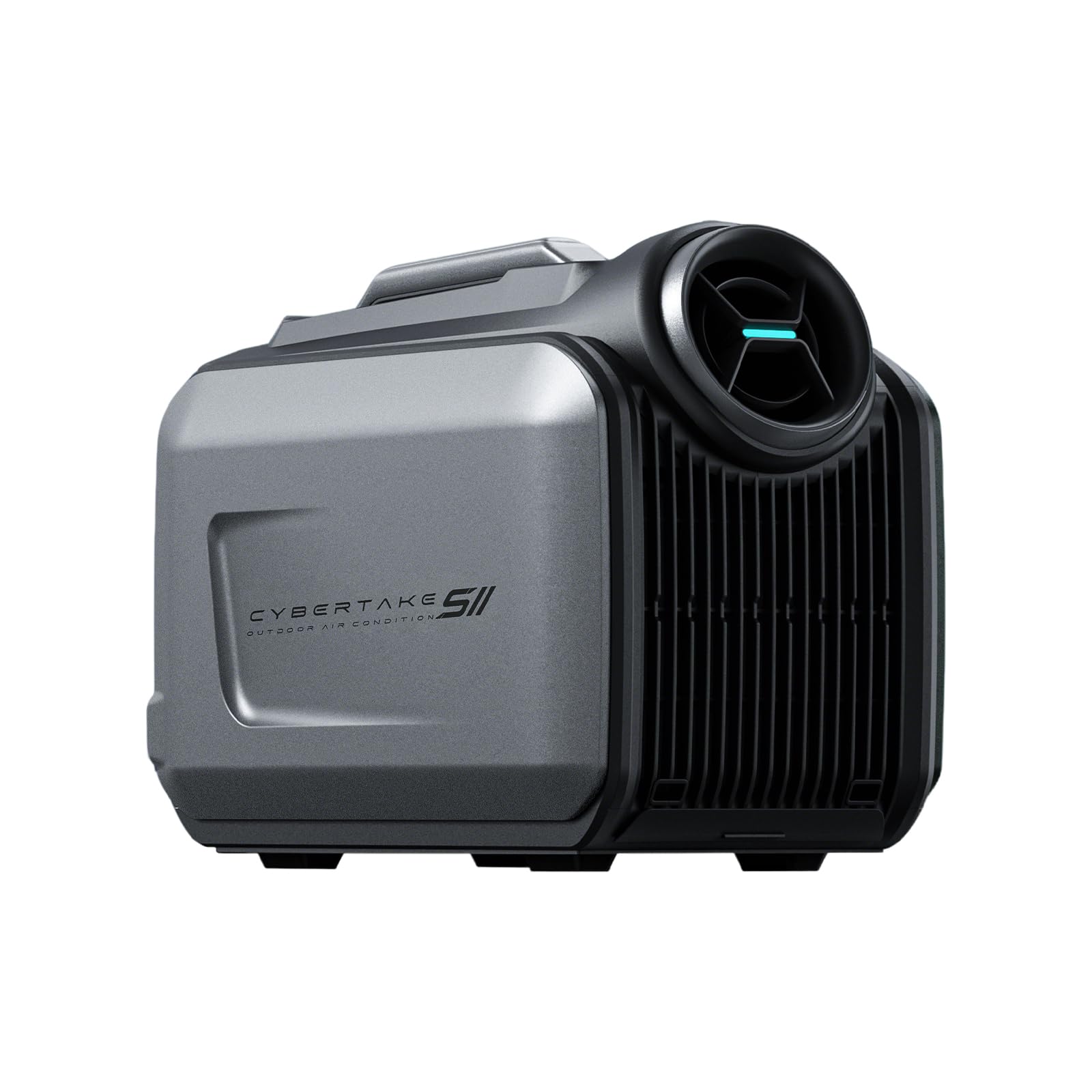
2. Cybertake S2 Pro Portable Camping Air Conditioner
The AC that chills your tent all night on a single power station charge.
The Cybertake S2 Pro is the rare camping AC that solves the two biggest problems at once: battery life and temperature range. It delivers 5,100 BTU of cooling and an impressive 6,100 BTU of heating, covering spaces up to 130 square feet (same as the 5,200 BTU FO-KOKO unit). But the real win is the efficiency — in Eco+ mode, it uses just 1 kWh per 8 hours. That means you can run it overnight on a mid-sized portable power station without waking up to a dead battery.
Versatility is built in with three power inputs: standard 100V-240V wall plug, a 12V/24V vehicle system, and a DC 48V port for direct solar or battery hookup. Buyers report the instant 30-second setup really works, and the 40 dB noise level (quieter than a dishwasher) keeps the peace inside a small tent. The IPX4 water-resistant shell (protected against splashes) means you do not panic if rain hits the side of the unit.
It cools to a low of 60°F and heats to 90°F, which beats the single-mode cooling units below.
Why it wins: You get both cooling and heating from one 21-pound box with an IPX4 shell, and the 1 kWh per 8-hour Eco+ mode means you can actually sleep through the night on a power station that would drain a 400W unit in a few hours.
The trade-off: At 5,100 BTU versus 5,200 BTU on the FO-KOKO, the raw cooling is comparable, but the Cybertake costs more upfront — you pay for the heating and the triple-power flexibility.
Reach for this if: You camp off-grid for multiple nights and want a unit that cools, heats, and sips power slowly enough to run all night on a single battery pack.
Look elsewhere if: You only need straight cooling for a small tent and your budget is under the mid-range mark.
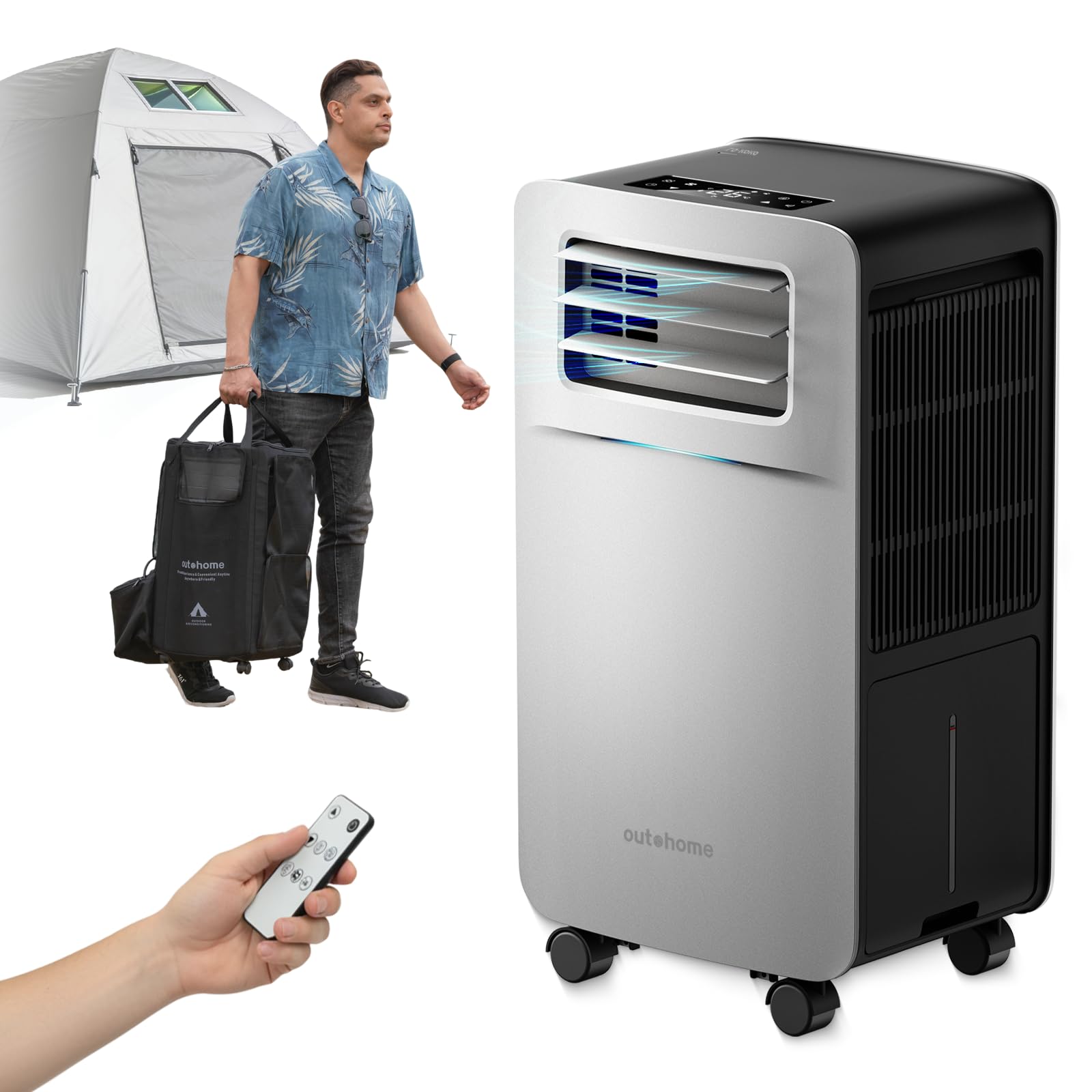
3. FO-KOKO 5200 BTU Portable Camping Air Conditioner
The budget-friendly workhorse that cools a big tent on only 400 watts.
The FO-KOKO 5200 BTU is the volume king of this list, cooling a full 130 square feet — at 130 square feet versus the BougeRV PC35’s 64.58 square feet. It hits that 130 sq. ft. mark with a 5,200 BTU output, a spec that matches the Cybertake S2 Pro’s coverage but at a significantly lower price point. Running on just 400 watts, it is easy to pair with a mid-range power station.
The “dual-loop water cooling” technology (spraying water over the condenser to speed heat dissipation) is a clever trick that owners mention makes the cold air feel noticeably cooler than standard portable units. It can drop the temperature by 18°F in five minutes. The sleep mode hums at 45 dB (quiet enough for most campers to sleep through).
At 33 pounds, it is heavier than the Cybertake (21 lbs) and the BAYKUL (27.5 lbs), so you will not be carrying it far on a backpacking trip. Reviewers also mention the “drainage free” claim only holds under 70% humidity — in a damp campsite, you will need to drain it manually or use the pipe. The included carry bag is a nice touch: you can run it right inside the bag without unpacking.
Pure cooling for less: 5,200 BTU at 400W is the best raw cooling-per-watt ratio here, giving you the big tent coverage of the Cybertake without the premium price tag.
The weight to know: At 33 pounds, compared to the Cybertake at 21 pounds, which makes it a car-camper or glamping unit rather than something you haul up a trail.
Reach for this if: You drive to camp and want the most square footage cooled for the lowest power draw. It also works well in a garage or small apartment between trips.
skip it if: You need to hike with your AC or you camp in very humid conditions where manual drainage becomes a chore.
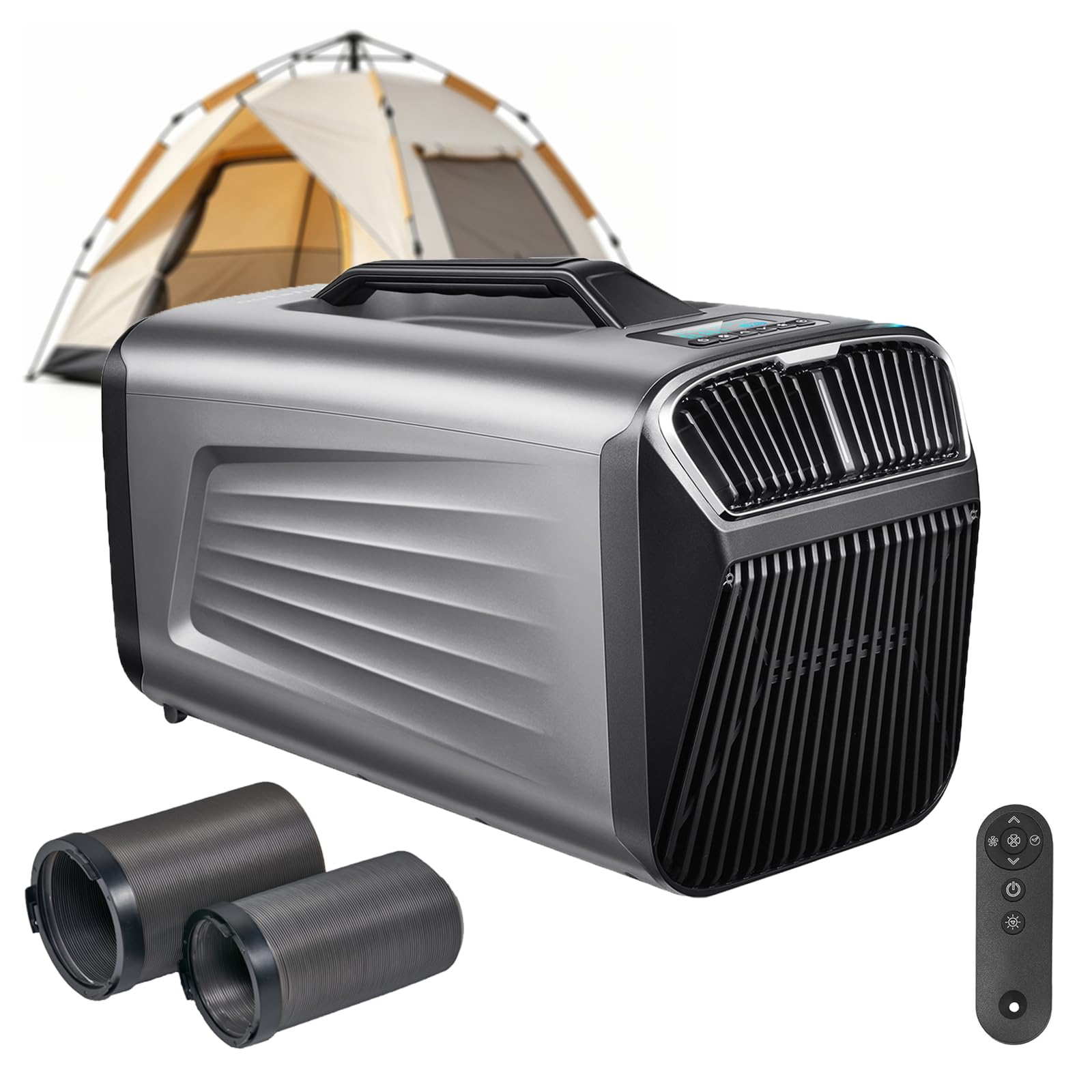
4. OUTOHOME 5200BTU Portable Tent Air Conditioner
The 5,200 BTU unit built with the quietest GMCC compressor for van life.
The OUTOHOME 5200BTU uses the same GMCC high-end compressor found in many premium home mini-splits, which customers note delivers that 18°F temperature drop in five minutes with a notably smooth hum. It runs on under 400W per hour, putting it in the same ultra-low power range as the FO-KOKO (400 watts) but lighter at 31.9 pounds versus 33 pounds.
Sleep mode is genuinely quiet at 46-50 dB, and reviewers specifically mention that the compressor noise itself is barely audible — you just hear the fan. The compact size (22.4 x 11.2 x 14.6 inches) is about the shape of a medium cooler, and the metallic dark silver finish actually resists scratches better than the glossy plastics on some competitors.
The drainage-free promise in cooling mode (below 70% humidity) is the same as the FO-KOKO, but the OUTOHOME adds a strong dehumidification function that the maker says works well even in muggy weather — outperforming semiconductor dehumidifiers. On the flip side, the control options are more basic (push button and remote) compared to the app-controlled BougeRV PC35.
Build quality edge: The GMCC compressor and metallic paint finish give this unit a more rugged, permanent-feeling build that van-lifers appreciate compared to the plastic shells of the FO-KOKO or BAYKUL.
Limited smart features: No app control or Bluetooth, which means you have to get up to change settings — a minor annoyance if you are already cozy in your sleeping bag.
Reach for this if: You are kitting out a van or RV and want a compressor you can trust, plus a unit that doubles as a dehumidifier in damp climates.
Look elsewhere if: You want to control your AC from your phone without leaving your chair.
5. BAYKUL 5000 BTU Portable Air Conditioner
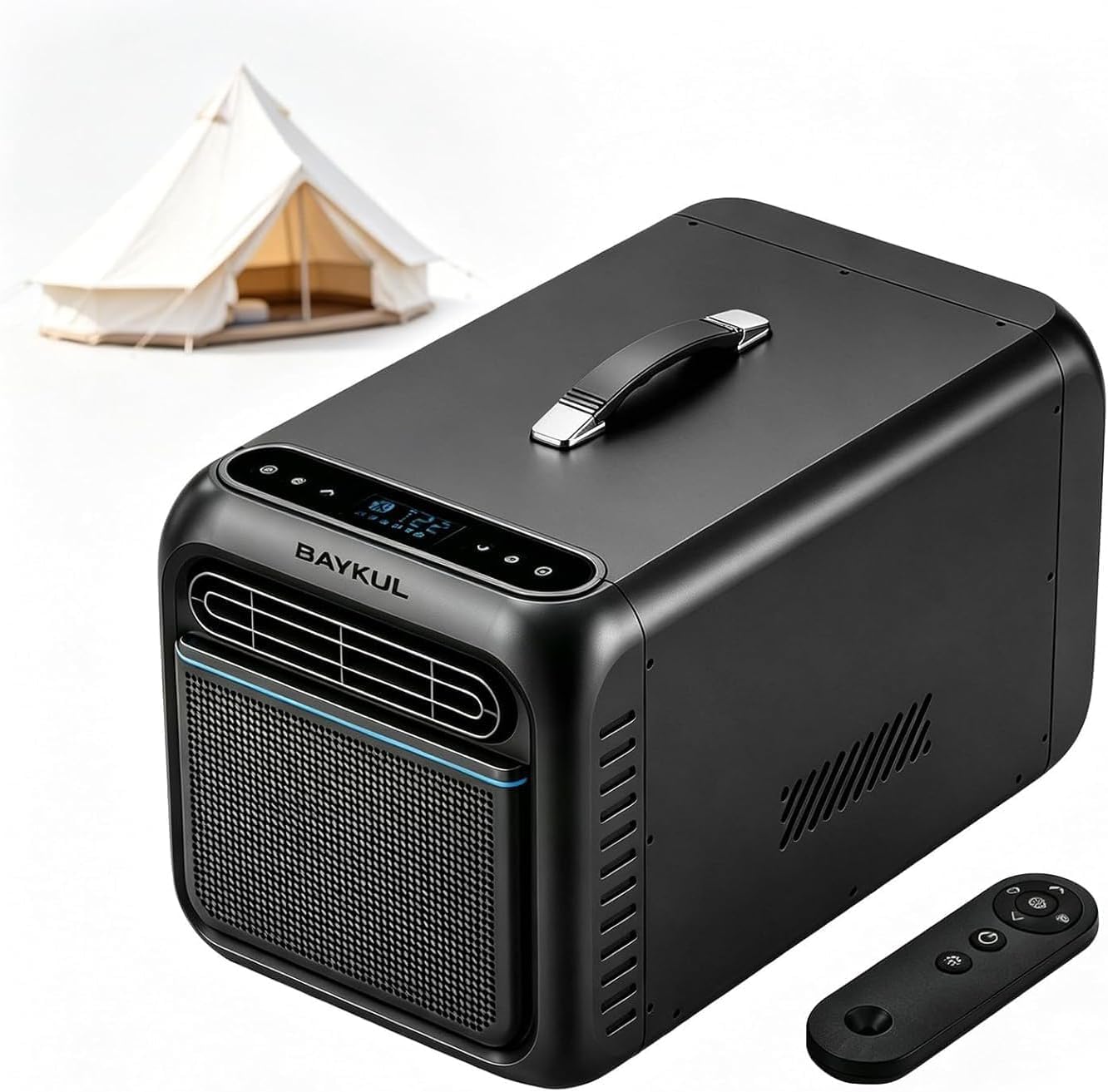
The lightest premium AC here — 27.5 pounds of portable, powerful cooling.
The BAYKUL 5000 BTU is the lightest premium unit in the lineup at 27.5 pounds — at 27.5 pounds versus the OUTOHOME’s 31.9 pounds and the BougeRV PC35’s 34.17 pounds. That weight difference matters when you are hauling gear from car to campsite. It still packs 5,000 BTU of cooling power with the same GMCC-style compressor that drops the temperature by 18°F in five minutes.
The dimensions are slim at 21.1 x 11.2 x 11.8 inches, and reviewers point out the handle makes one-handed carrying genuinely possible. It draws 400 watts (400 Watts annual energy consumption), matching the FO-KOKO for power efficiency, and sleep mode runs at 46-50 dB with barely audible compressor sound — just gentle fan airflow.
The trade-off is that at 5,000 BTU versus the FO-KOKO’s 5,200 BTU, you lose a small margin of raw cooling capacity. The manufacturer BAYKUL is less established than some brands here, so long-term durability is less proven than the OUTOHOME’s GMCC compressor or the Cybertake’s IPX4 construction. The dark grey finish looks nice but shows dust quickly.
Portability focus: At 27.5 pounds with a good handle, this is the easiest premium unit to move between your truck, tent, and storage shed — ideal if you camp at multiple spots.
Newer brand, less data: With only 15 ratings versus the FO-KOKO’s 20 or the OUTOHOME’s 25, there is less long-term reliability data to go on.
Reach for this if: You prioritize weight above all else and want a premium compressor in the lightest possible package.
pass on it if: You want maximum BTU for the dollar and do not mind carrying a few extra pounds.
6. BougeRV PC35 Portable Air Conditioner 3500BTU
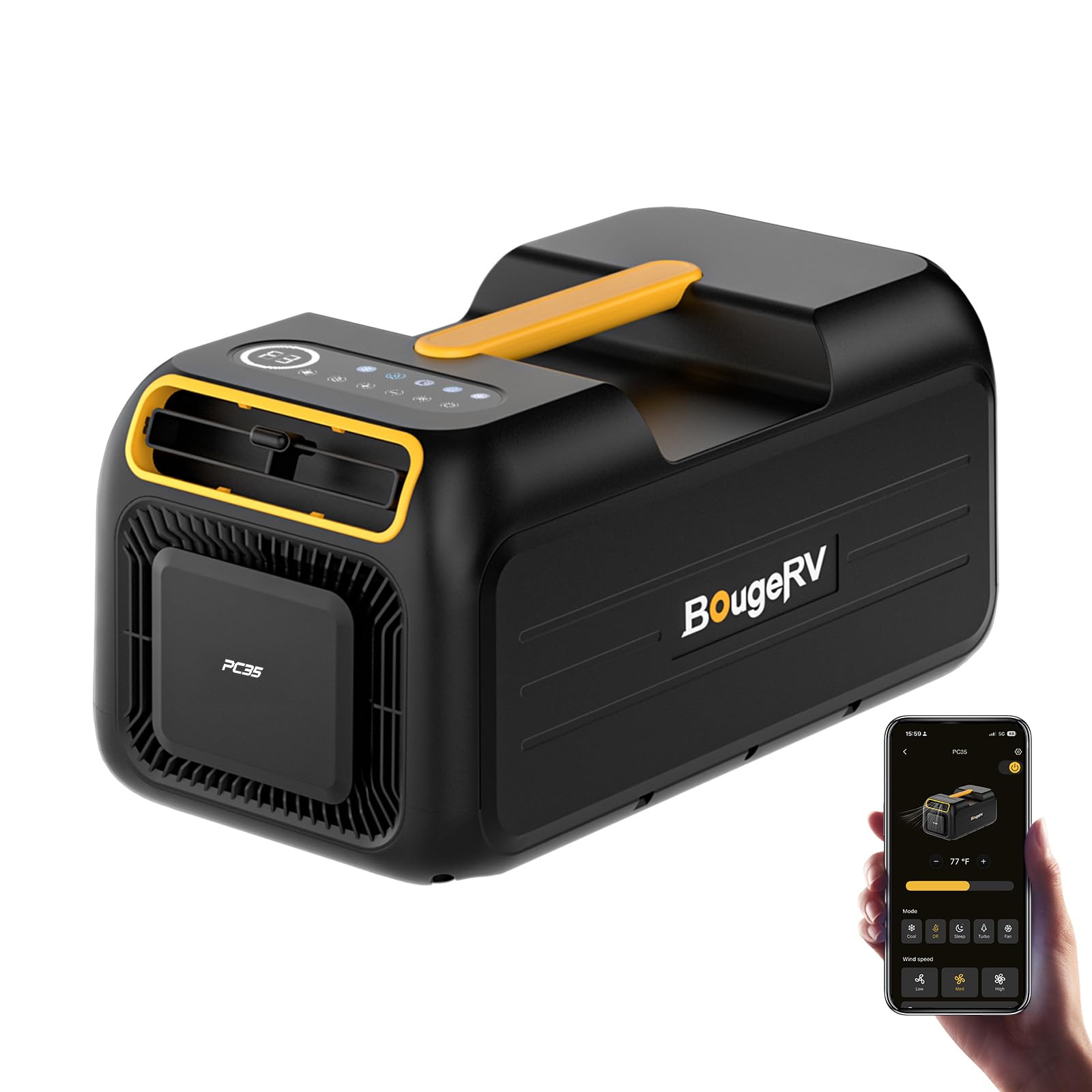
Small-tent specialist with smart app control and a 2 kW startup surge to know.
The BougeRV PC35 is built for truly small spaces — it cools just 64.58 square feet, compared to the 130 square feet of the FO-KOKO and Cybertake. That makes it perfect for a two-person tent or a tiny van bunk, not a full RV. The 3,500 BTU output drops the temperature by 18°F in 15 minutes (versus 5 minutes for the 5,200 BTU units).
The standout feature here is the BougeRV App control, allowing you to adjust temperature, modes, and timer from up to 33 feet away — so you can cool down your tent before you even crawl inside. It is the only unit in the mid-range with app control, beating the basic remotes on the FO-KOKO and OUTOHOME. It packs five functions into one: cooling, dehumidifying, fan, high-power mode, and sleep mode, plus a 24-hour timer.
The clear catch is the compressor startup power, which can reach 2 kW (110V, 18A max). The maker explicitly states you need a battery power station with a continuous output of no less than 2 kW. That is a huge ask compared to the 400W units that can run on smaller power stations. At 34.17 pounds, it is also the heaviest portable unit here — at 34.17 pounds versus the BAYKUL at 27.5 pounds and the Cybertake at 21 pounds.
What stands out
- App control (up to 33 ft) is genuinely convenient for pre-cooling a tent
- Works as a dehumidifier and fan too — versatile for its size
- 5-in-1 modes including a dedicated high-power mode for fast drops
The power reality
- Requires a 2 kW continuous inverter — many power stations cannot deliver this
- At 34.17 lbs, it is the heaviest portable unit here, limiting portability
- Only 3.0 out of 5 stars from 45 ratings — reliability questions
Reach for this if: You have a very small tent (up to 64.58 square feet) and already own a beefy 2 kW+ power station, plus you want to control your AC from your phone.
Look elsewhere if: You have a mid-range power station or need to cool a larger space — the startup surge will kill your battery, and the 35 sq ft limit is hard.
Understanding the Specs
BTU: The Real Cooling Muscle
BTU (British Thermal Unit) measures how much heat the air conditioner removes per hour. For camping, 3,500 BTU is fine for a small two-person tent (about 35 sq ft). 5,000 to 5,200 BTU covers a large family tent or small RV (130 sq ft). The 10,000 BTU rooftop unit is for full-size RVs. A bigger number does mean better cooling, but it also means more power draw and a larger unit to carry.
Wattage: What Your Power Station Can Handle
This is the number that determines if your battery can actually run the unit. Most portable camping ACs draw 400 watts continuously, which is safe for mid-range power stations (like a 500Wh+ unit). The startup surge is the real trap — some compressors briefly need 2,000 watts to start, which will trip smaller inverters. The Cybertake S2 Pro is designed to sip just 1 kWh over 8 hours in Eco+ mode, making it the most power-friendly option for off-grid use.
FAQ
Can I run a camping air conditioner on a Jackery or EcoFlow power station?
How many BTU do I need for a tent?
What does “drainage free” mean on a camping AC?
Is a 12V rooftop AC better than a portable unit for a van?
How loud are camping air conditioners in decibels?
Can I use a camping AC in my house or apartment?
What does compressor startup power mean and why does it matter?
How long does a camping AC last on a battery?
What is the difference between a camping AC and a swamp cooler?
Which camping AC is best for a truck or work van?
Final Thoughts: The Verdict
For most campers, the air con for camping winner is the Cybertake S2 Pro because it balances cooling, heating, and ultra-efficient 1 kWh per 8-hour runtime in a compact 21-pound package with IPX4 weather resistance. If you want the best raw cooling for the price and have a good power station, grab the FO-KOKO 5200 BTU. And for a permanent van or RV setup with massive 10,000 BTU output, the standout is the OutEquip 12V Rooftop Unit.
How We Picked
We do not accept paid placement. Every pick is matched to a real buyer and a real use-case; we do not hands-on test units.
Sources & Methodology
Specifications: manufacturer listings and product documentation. Review insights: verified customer reviews, as of July 2026. Pricing: not shown on this page (it changes often); check the current price via the retailer link.
As an Amazon Associate, Gadgets Feed earns from qualifying purchases. This does not affect which products we feature.