
Our readers keep the lights on and my morning glass full of iced black tea. As an Amazon Associate, I earn from qualifying purchases.
Specs are compiled from manufacturer listings and verified buyer reviews and can change over time — please confirm the key details on the product page before buying.
That ache in your lower back after a day on the water is not from the fish — it is from your gear swinging loose. A good belt for fishing locks your tools in place, spreads the weight evenly, and keeps pliers and tackle within reach so you stop twisting and bending. The right belt locks your tools in place and spreads weight evenly, so you stop twisting and bending.
I am Min, founder of Gadgets Feed. This guide compares published specs from manufacturers and patterns across verified customer reviews, so you see each pick’s real strengths and trade-offs.
The best belt for fishing keeps your kit secure without digging into your sides, if you need a lightweight waist pack or a serious fighting belt.
Our Picks at a Glance


How To Choose The Best Belt For Fishing
Pick the right belt based on how you fish — wading a river, casting from a kayak, or fighting a big game fish from a boat. A mismatch between belt type and fishing style turns a good day into a sore one.
Belt Type: Webbing vs. Waist Pack vs. Fighting Belt
The simplest option is a basic nylon webbing belt. It holds your waders up and keeps a clip or two handy. A waist pack adds zippered compartments for tackle, pliers, and even a drink. For big-game anglers, a fighting belt includes a gimbal (a socket that holds the rod butt) or a rod holder built into a padded pad to transfer the strain of a heavy fish from your arms to your hips — so you fight with your whole body, not just your arms. Pick the type that matches your most common fishing style.
Adjustability and Fit
A belt that cannot tighten enough will sag under your gear. Look for an adjustable range that covers your waist size with room for layers. Many belts go from around 28 inches up to 44 or even 50 inches, but check the specific max and min lengths. A buckle that releases with one hand is important if you wade in moving water — a quick-release can be a safety device in an emergency.
Material and Durability
Nylon webbing resists water and abrasion better than cotton or polyester blends. A PVC coating (a plastic layer that sheds water) or a waterproof liner adds another layer of protection for your tackle. If you fish in saltwater, look for corrosion-resistant hardware like ABS plastic (a tough, impact-resistant plastic) or stainless-steel clips. A belt that rusts or rots after a few trips is no bargain.
Quick Comparison
| Model | Best For | Max Waist | Weight | Type | Amazon |
|---|---|---|---|---|---|
| Huk Nylon Webbing Belt★ Best Overall | Casual / Everyday | 44″ | — | Webbing Belt | Amazon |
| fishpond Switchback 2.0Top Performer | Modular Fly System | 64″ | 0.82 kg | Waist Pack System | Amazon |
| KastKing BaitSpace Waist Bag | All-Day Storage | — | 0.92 kg | Waist Bag | Amazon |
| Allen Eagle River Lumbar Pack | Fly Box Organization | — | — | Lumbar Pack | Amazon |
| ASOCEA Fishing Fighting Waist Belt | Big-Game Fighting | 41″ | 9.8 oz | Fighting Belt | Amazon |
| Booms Fishing FB2 Wade Belt | Wading Safety | 45″ | — | Webbing Belt | Amazon |
| Fishing Fanny Pack (Generic) | Budget Versatility | 50″ | 0.77 lb | Waist Pack | Amazon |
In‑Depth Reviews
1. Huk Fishing Nylon Webbing Belt
Our pick — over 4★ from 950+ verified ratings; the strongest balance of quality and price.
The simple nylon webbing belt that works on the boat and at the bar without looking out of place.
Sometimes you just want a belt that keeps your shorts up, dries quickly after a splash, and looks clean enough to wear to dinner. The Huk Nylon Webbing Belt is exactly that. It is made from nylon webbing that resists water and holds up to repeated soakings, with a trim-to-fit design that adjusts up to a 44-inch (112 cm) waist. It is the lightest and most minimal option in this list, and it comes in multiple colors and patterns.
Unlike the dedicated fishing belts above, this one has no clips, no pouches, no foam padding. It is a straightforward accessory that handles wet conditions much better than leather or cotton. A rating of 4.3 out of 5 stars across 968 reviews indicates that most buyers are happy with the simple, reliable design. It is also the most affordable pick in the premium tier.
The catch is that its simplicity is also its limit. It cannot hold tools directly (no D-rings or swivel hooks like the Booms Fishing FB2), and it is not a full waist storage system. For a day of heavy fishing, you will still need separate gear storage. It is best seen as a lifestyle belt that happens to be great for fishing, not a dedicated fishing tool.
What it does best: It resists water and dries quickly, so you are not sitting in a wet lap on the boat ride home.
What it does not do: It lacks any tool attachment points — if you need to carry pliers or a net, you will need a different setup.
Grab this if you: Want a single belt that works for daily wear and occasional fishing without ever needing a swap.
Pass if you: Need to carry tools or tackle on your belt — the Booms Fishing FB2 with clips or a full waist pack like the KastKing is a better fit.
2. fishpond Switchback Belt System 2.0
The modular system that lets you slide your pack out of the way while keeping your net and belt in place.
This is the most thoughtfully engineered waist system for fly anglers who wade. The fishpond Switchback 2.0 uses a thermoformed foam belt (a molded, padded band) with a built-in net slot that fits a wide range of net sizes, so you stop fumbling for a stow spot. The 2-liter (0.53 gallon) pack slides forward and backward on a wader belt “rail” — you leave the belt and net in position and move only your pack into your workspace. At 0.82 kilograms (1.8 pounds), it is 12% lighter than the KastKing BaitSpace bag, which matters when you wear it all day without shoulder fatigue.
The pack is ambidextrous, so left- or right-handed casters can set it up their way. The shoulder strap includes Hypalon (a tough, rubber-like material) tool attachment points plus a Velcro pad for flies. The belt fits waist sizes from 33 to 64 inches (84 to 163 cm), covering everything from slim waders to heavy layers. Buyers report that the quick-release buckle gives confidence when wading in current.
The catch is that the modular design works best once you invest in the full system — the pack alone is expensive, and the included 2-liter capacity is limited compared to larger waist bags. It is a premium tool for the dedicated fly angler, not a casual shore pick.
Who it fits perfectly: The wading fly angler who wants a clean, hands-free setup where the net, tools, and pack all stay on the body and never hit the water.
One real trade-off: The 2-liter pack is compact — you will not fit bulkier tackle boxes or a full lunch inside, so plan for a minimalist approach.
Best for Serious Wade Fishermen: If you are on the water three or more days a week and want a system that moves with you rather than against you, this is the clear winner.
Not ideal for: The casual bank angler who just needs a simple belt to hold pliers — the cost and complexity are wasted for that use case.
3. KastKing BaitSpace Waist Bag

The waist bag that feels like a full tackle station wrapped around your hips without shoulder soreness.
The KastKing BaitSpace packs more storage than any other waist bag here — 12 separate compartments. That includes an internal mesh pocket, a rod pocket, a beverage holder, a plier pocket, and two gear sleeves. It also comes with six soft bait storage bags and a 3600-size utility box (about 7 by 4 inches), so you are ready the moment you open the box. The premium nylon oxford fabric has a PVC coating (a plastic layer that resists water) and an EPE foam layer (expanded polyethylene — a cushioning sheet) to protect your gear from bumps.
At 0.92 kilograms (2.0 pounds), it is slightly heavier than the fishpond system, but that weight buys a huge jump in capacity. The extra-wide belt and adjustable strap can be tucked into the rear pocket to convert into a shoulder or chest bag. Reviewers mention that the non-slip pad on the shoulder strap keeps it planted when you lean over to land a fish. Unlike the Huk belt (max 44 inches), this one fits a much broader range of body types.
The one downside is that the bag is deep — when fully packed, it feels bulky against your lower back if you sit in a kayak. For shore or bank fishing, it is the most versatile single-strap system here.
Why it earns the top spot: The sheer storage (12 compartments + utility box + six bait bags) means you carry everything for a full session without an extra backpack.
A small caveat: The depth of the main pocket makes rummaging for small lures harder — use the included utility box for your most-used baits.
Reach for this if you: Want one waist bag that covers everything from soft plastics and pliers to a drink and a rod, all in a water-resistant shell.
skip it if you: Prefer an ultra-low-profile belt — this is a full waist pack, not a webbing strap.
4. Allen Company Eagle River Lumbar Fly Fishing Pack

The lumbar pack that turns your waist into a tidy fly-tying station with room for six boxes.
The Allen Company Eagle River is built for the fly angler who carries a lot of patterns. It holds up to six fly boxes (small plastic cases for hooks) or two 9-inch tackle boxes. The wide-mouth opening gives you a full view of the main compartment without digging. The zip-down workstation includes a tippet tender (a gadget that holds your leader material) and a fly patch (a foam pad for drying or storing flies). The high-visibility lining inside means you will not lose a small fly like a size 18 Adams in the shadows.
Comfort comes from a padded cool mesh waist belt. Two water bottle pockets on the sides are rare on lumbar packs — a big help on hot summer wades. Multiple exterior D-rings let you clip on a net, nippers, or forceps. The padded sling strap includes a net D-ring as well, so you can carry a net without it banging your leg. Owners mention that the pack stays stable even when loaded with a full complement of boxes.
The main trade-off is that the lumbar shape works best standing or wading — sitting in a boat or kayak can push the pack into your lower back uncomfortably. It is also a dedicated fly pack; the workstation and fly patch are less useful for a spin or bait angler.
Its standout feature: The zip-down workstation with tippet tender and fly patch is effectively a mobile tying desk — you can change rigs without ever putting the pack down.
A realistic limit: The padded mesh belt, while comfortable, is not quick-release like the Booms Fishing FB2 wading belt, so it is less suited for safety-focused wading.
Best for the fly enthusiast: If you carry multiple fly boxes and want a dedicated workstation on your waist, this pack is the most organized choice.
Look elsewhere if you: Mostly spin fish or bank fish — the fly-specific features will go unused, and a simpler waist bag would serve you better.
5. ASOCEA Fishing Fighting Waist Belt

The fighting belt that transfers the burn of a big fish from your arms to your hips with a solid rod holder.
Landing a big tuna or striper tests endurance as much as skill. A fighting belt is the one piece of gear that saves your lower back and forearm. The ASOCEA belt features a rod holder with a 2.55-inch (6.5 cm) inner diameter, which fits most conventional and spinning rod butts (the thick end of the rod) securely. The holder is made from ABS engineering plastic (a tough, impact-resistant plastic) that resists saltwater corrosion, making it a solid choice for offshore or surf fishing. The belt adjusts from 27.5 to 41 inches (70 to 104 cm), with a safety buckle that releases quickly if you need to ditch the setup.
A soft EVA sponge pad (ethylene-vinyl acetate — a lightweight, flexible foam) on the back evenly distributes the pressure from the rod butt during a fight, so the force spreads across your hip rather than concentrating in one point. At 9.8 ounces (278 grams), it is lightweight enough to wear for hours unnoticed. Buyers give it 4.5 out of 5 stars across 605 ratings, noting that the rod holder spins vertically for flexible control.
The catch is that this is a fighting belt only — no storage compartments, no tool clips, no tackle room. If you need to carry gear, you will need a separate pack or a setup like the KastKing BaitSpace combo. It is a specialized tool that shines in one specific role.
Where it dominates: In a 45-minute fight with a 40-pound fish, the EVA pad and ABS holder keep the rod butt planted and your hands free for pumping.
A missing feature: No D-rings or tool clips — you will need to rig gaffs and pliers into a separate belt or pack.
Grab this for: Offshore, surf, or pier fishing where you regularly hook into big fish and need a dedicated rod support system.
Pass if you: Mostly fish for panfish, trout, or bass where the fight is short — a waist pack with a rod holder (like the KastKing BaitSpace) will serve better.
6. Booms Fishing FB2 Fishing Wade Belt
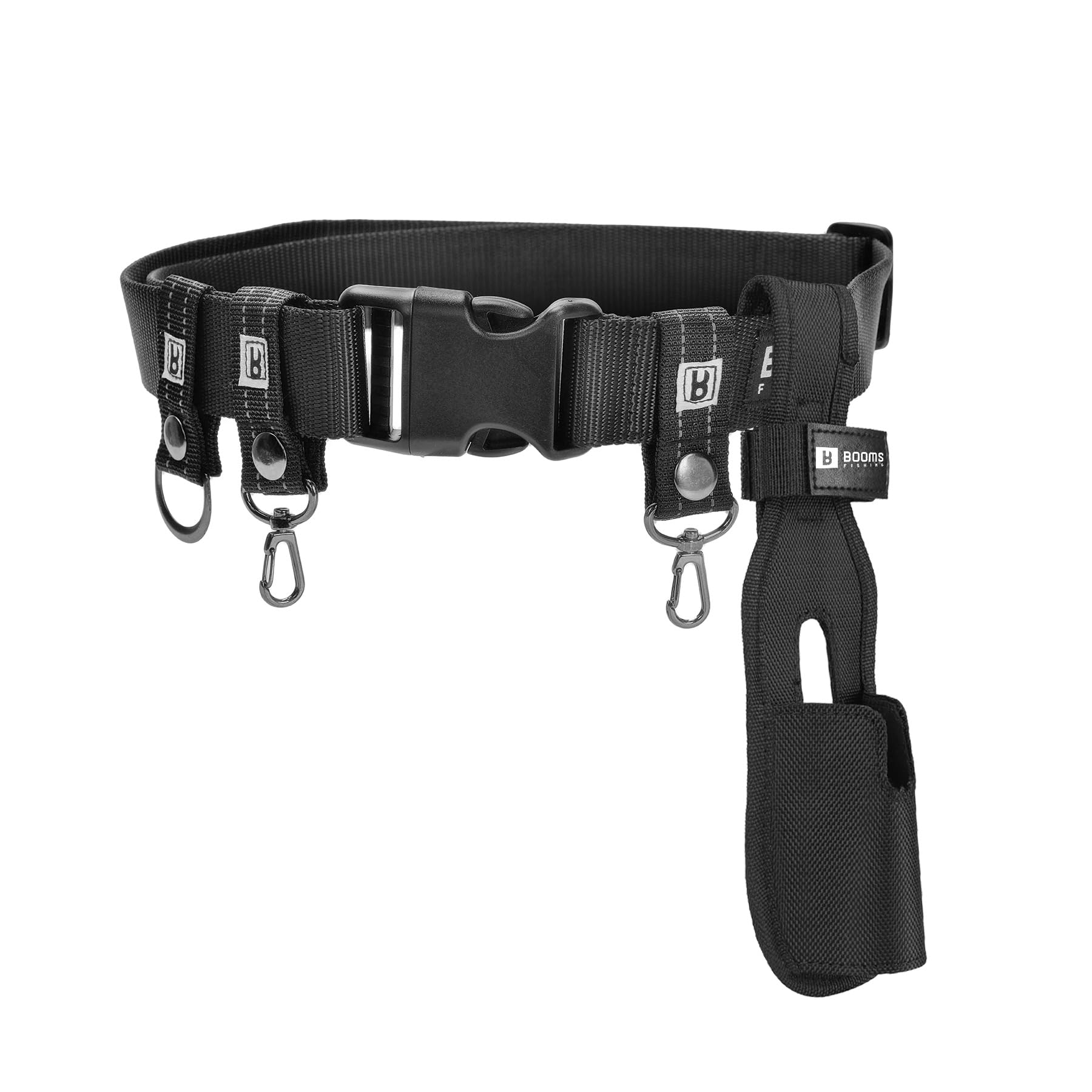
The wading belt that locks your waders tight and includes four removable clips for your most-used tools.
When you wade a fast-moving river, the last thing you want is a belt that loosens or a buckle that pops open. The Booms Fishing FB2 uses a heavy-load ABS plastic buckle with a one-button release that customers note is much less likely to open accidentally than cheaper plastic buckles. The webbing is 1.5 inches (3.8 cm) wide and holds its shape when tight, stopping your waders from slipping down and preventing water from funneling in.
What sets the FB2 apart from a basic belt like the Huk is the four removable clips: two detachable D-rings and two swivel hooks. You can clip a net, a stringer (a chain for holding caught fish), or pliers directly to the belt without threading. The nylon fabric is abrasion and corrosion resistant, and the adjustable buckle has reflective elements that make you easier to see at night — a real safety plus if you wade at dusk or dawn.
The limitation is that this is a simple webbing belt — no storage pouch, no pack, no padding. If you need to carry tackle, you will need a separate pack or a large pocket on your waders. For pure wader security and tool access, it is the best simple belt in the lineup.
Safety first: The heavy-duty one-button buckle and reflective accents give you confidence in moving water and low-light conditions.
The space it saves: At just 1.5 inches of webbing plus clips, it takes up almost no room and adds negligible weight to your waders.
Perfect for waders: If you are a river fisherman who needs a secure belt that holds its shape and keeps your tools handy, this is the pick.
Not for the gear-heavy: You will need a separate storage solution for tackle and bait — this belt is purely for tool attachment and wader security.
7. Fishing Fanny Pack for Men (Generic)
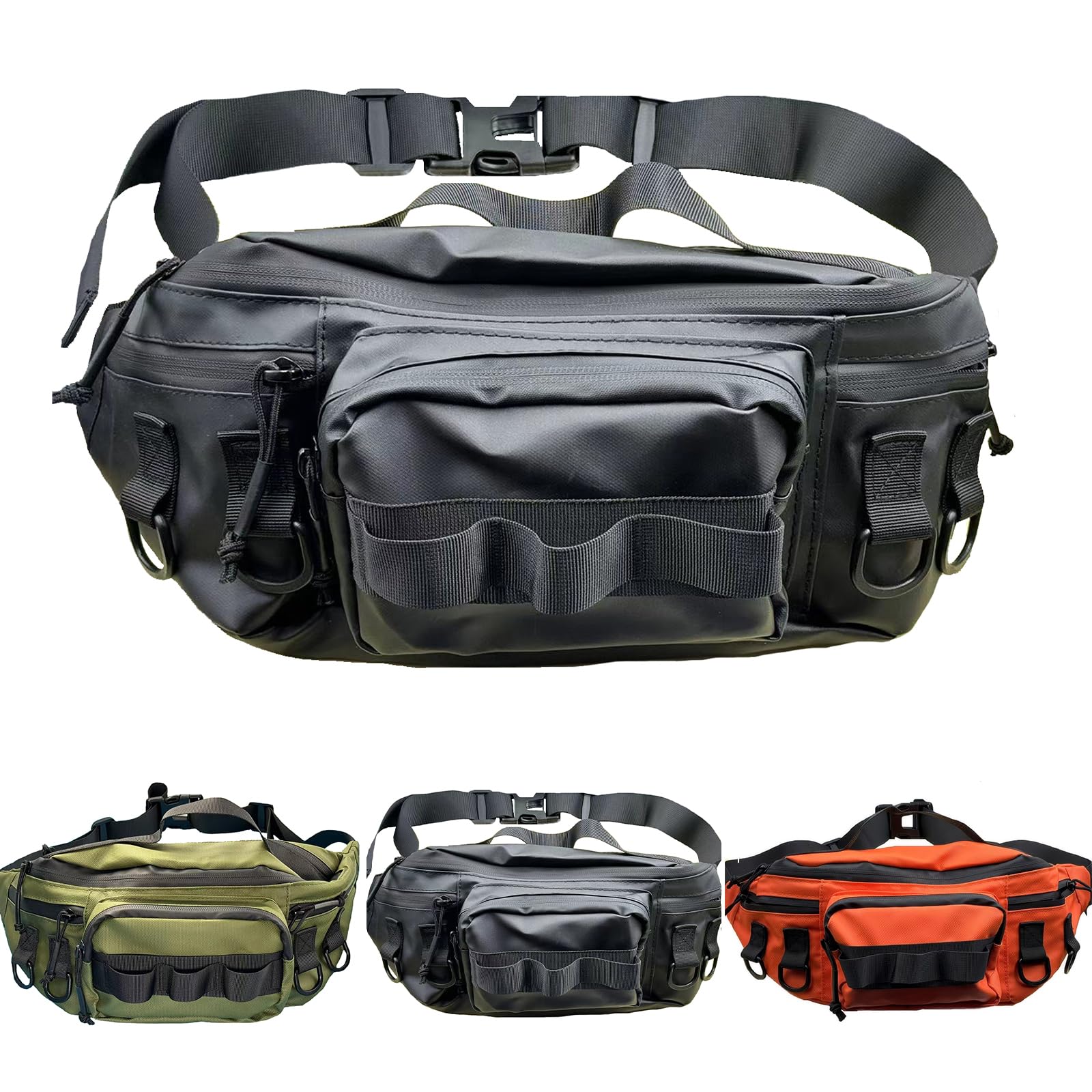
The budget waist pack that goes from a 24-inch waist to 50 inches and fits both men and women.
Not every fishing trip needs a premium system. For quick bank sessions, pier runs, or kayak trips where you just need a few lures and a pair of pliers, this fanny pack does the job without breaking the budget. It is an entry-level waist pack made from waterproof branded material (the listing mentions “leather film” and nylon) sized at 17 by 5.5 by 5.11 inches (43 by 14 by 13 cm), with an adjustable range of 24 to 50 inches (61 to 127 cm) — the widest fit of any product here. The main pocket is large enough for standard plastic lure cases.
The pack includes multiple compartments for easy access, and the abrasion-resistant curved zipper pull adds ruggedness for the price. At 0.77 pounds (0.35 kg), it is noticeably lighter than the KastKing bag (0.92 kg, about 2 pounds), which is a plus for a minimal load. Reviewer feedback notes that the buckles feel nice and the zippers seem tough for the category. It is a functional, no-frills waist pack that gets you on the water fast.
The trade-off is in durability and organization. The material is not as rugged as the KastKing’s oxford with PVC coating, and the compartment layout is less refined — you get basic storage, not a 12-compartment system with a utility box. For regular heavy use, the Allen or KastKing packs will outlast this one. For the price-conscious angler or someone starting out, it is a solid entry point.
Its biggest advantage: The 24- to 50-inch adjustable range means it truly fits any body type, from a slim build to a larger frame.
Where it cuts corners: The materials and zippers are decent for the cost but will not survive years of saltwater abuse — treat it as a seasonal pack.
Best for the casual angler: If you fish once a month, want something cheap, and only need basic tackle storage, this is a safe bet.
Not for the dedicated fisherman: The lack of tool-specific slots and lower build quality mean it will struggle with daily or heavy use — step up to the KastKing or Allen pack if you fish weekly.
Understanding the Specs
Max Waist Size and Adjustment Range
The max waist size is the largest belly or wader circumference the belt can comfortably fit. A range like 24 to 50 inches (61 to 127 cm) gives you room for heavy winter layers or a slim summer build. If you wade, look for a belt that tightens evenly and holds its shape when snug — the Booms Fishing FB2, for example, uses 1.5-inch (3.8 cm) webbing and a heavy-duty buckle designed to stay locked. A belt that cannot cinch down will let your waders sag and defeat the purpose entirely.
Material and Water Resistance
Nylon webbing is the standard because it dries quickly and resists rot. A PVC coating (a plastic layer that sheds water), as used on the KastKing BaitSpace, adds a waterproof layer that protects your tackle from splashes and rain. For fighting belts, corrosion resistance matters more — the ASOCEA uses ABS engineering plastic for its rod holder so saltwater does not eat the hardware. A simple webbing belt like the Huk is water-resistant by nature of the nylon itself but offers no sealed storage for sensitive items.
FAQ
Can a fishing belt help with lower back pain during long trips?
How do I know if a belt will fit my waders?
What is the difference between a wading belt and a regular belt?
Can I use a fighting belt for fly fishing?
How many fly boxes can the Allen Company lumbar pack hold?
Is the KastKing BaitSpace bag waterproof or just water-resistant?
How should a fishing belt fit to be safe for wading?
What size waist does the fishpond Switchback 2.0 fit?
How do I attach tools to a belt without D-rings?
Can a fishing waist pack double as a shoulder bag?
Final Thoughts: The Verdict
If you want one dependable pick, the best belt for fishing winner is the KastKing BaitSpace Waist Bag because it packs 12 compartments, a drink holder, rod pocket, and utility box into a water-resistant shell at a mid-range price. If you want a dedicated fighting belt for big-game battles, grab the ASOCEA Fishing Fighting Waist Belt. For the serious wading fly angler who values modularity and a clean setup, the fishpond Switchback Belt System 2.0 is the top pick for its built-in net slot and pack-rail design.
How We Picked
We do not accept paid placement. Every pick is matched to a real buyer and a real use-case; we do not hands-on test units.
Sources & Methodology
Specifications: manufacturer listings and product documentation. Review insights: verified customer reviews, as of July 2026. Pricing: not shown on this page (it changes often); check the current price via the retailer link.
As an Amazon Associate, Gadgets Feed earns from qualifying purchases. This does not affect which products we feature.