
Our readers keep the lights on and my morning glass full of iced black tea. As an Amazon Associate, I earn from qualifying purchases.
Specs are compiled from manufacturer listings and verified buyer reviews and can change over time — please confirm the key details on the product page before buying.
Your room feels drafty or stuffy because the vent cover does not fit the duct opening. The fix is measuring the hole itself, not the old grille you are pulling off — that is where most sizing mistakes happen. This guide walks you through the exact specs that matter so you buy the right cover the first time.
I’m Min — the founder and writer behind Gadgets Feed. This guide is built by comparing the manufacturers’ published specifications and the patterns across verified customer reviews, so you get each pick’s real strengths and trade-offs instead of marketing spin.
A simple white grille to cover an old hole or a modern diffuser (a vent with adjustable blades) to control airflow in a specific room — finding the best ceiling air vent covers depends on matching the exact duct size, choosing between steel or aluminum, and deciding how much you want to steer the air.
Our Picks at a Glance

How To Choose The Best Ceiling Air Vent Covers
Picking the right cover is simple once you know two rules: measure the opening in the ceiling or wall, and decide if you need to direct the air or let it flow straight through. Here are the features that separate a good fit from a frustrating one.
Measure the Duct Opening, Not Your Current Cover
The most common mistake is measuring the old vent cover you are removing. The outer edge is always wider than the hole. Write down the width and height of the actual rectangular opening in your ceiling or wall, and then match that number to the “duct opening size” listed by the manufacturer. A cover listed as 8″ x 4″ is meant for a hole that is 8 inches wide and 4 inches tall.
One-Way vs. Two-Way Airflow
A one-way vent has parallel blades that send air in a single direction. Two-way louvers (angled fins) split the air in two directions, spreading the airflow across a wider area or avoiding a direct blast on a seating spot. If you are covering a return air grille (an intake that pulls air out of the room), a fixed louver without adjustable dampers is the standard choice.
Steel vs. Aluminum Construction
Steel vent covers feel solid and hold their shape well, but they are heavier and can rust if the powder coating chips. Aluminum covers are lighter and naturally rust-proof, and they tend to produce less noise as the metal expands and contracts with temperature changes. Both materials take paint well if you need to match a specific ceiling color.
Quick Comparison
| Model | Best For | Duct Opening | Material | Item Weight | Amazon |
|---|---|---|---|---|---|
| Handua 8″x4″ 2-Way Register★ Best Overall | Small Sidewalls & Ceilings | 8″W x 4″H | Steel | 13.1 oz | Amazon |
| Howeall 12″x8″ Return Air GrilleAlso Great | Large Return Intakes | 12″W x 8″H | Steel | 1.19 lb | Amazon |
| HBW 10″x6″ 2-Way Register | High Airflow Control | 10″W x 6″H | Steel | 1.43 lb | Amazon |
| Howeall 10″x6″ 2-Way Register | Mid-Size Supply Covers | 10″W x 6″H | Steel | 1.23 lb | Amazon |
| LAMINAIRE 8″x12″ 1-Way Register | Quiet, Rust-Free Install | 8″W x 12″H | Aluminum | 1.08 lb | Amazon |
In‑Depth Reviews
1. Handua 8″x4″ 2-Way Steel Register
Our pick — over 4.5★ from 800+ verified ratings; the strongest balance of quality and price.
The compact steel diffuser that fits small sidewall holes without sharp edges.
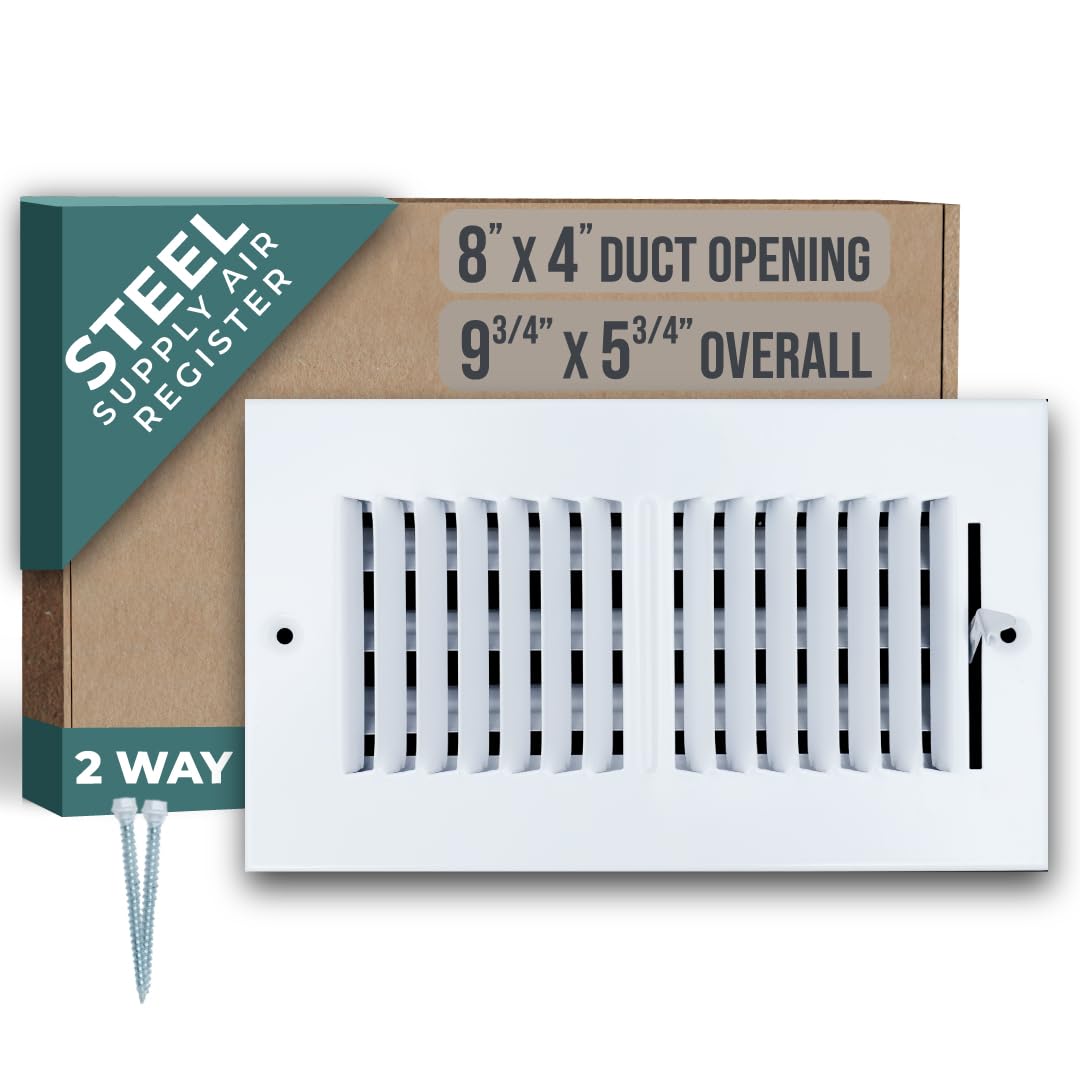
For the smaller openings — an 8-inch by 4-inch duct — this Handua register has an outer dimension of 9.75 inches by 5.75 inches (it extends 1.75 inches wider all around to cover the hole cleanly). It is a two-way air supply diffuser (a vent that spreads air), meaning the louvered fins split the airflow in two directions so you avoid a concentrated blast. The steel is stamped with a powder paint coating, and the manufacturer says the edges are deburred so there are no sharp spots during installation.
It weighs 13.1 ounces (0.82 pounds), which is noticeably lighter than the full-size steel covers above, and it includes color-matched screws in the package. Owners mention that the 2-way louvers are effective at redirecting air in tight rooms. If you are comparing this to the LAMINAIRE cover, note that the Handua weighs 13.1 ounces (0.82 pounds) while the LAMINAIRE weighs 1.08 pounds, making the Handua the lighter option despite its smaller duct opening.
Perks
- Stamped steel with deburred edges — no sharp metal during install
- Two-way louvers spread air effectively in small spaces
- Comes with matching screws for a clean finish
One Thing to Know
- At 8″ x 4″, it is the smallest duct opening here — verify your hole size a second time before ordering
Ideal for: small ceilings, hallway sidewalls, or bathrooms where a compact 8×4 register fits and you want to steer the air away from direct contact.
Not for: anyone needing a larger opening — triple-check that your duct is actually 8 by 4 inches before purchasing.
2. Howeall 12″W x 8″H Return Air Grille
The metal slab that handles the largest intakes without rattling.
This return air grille is built for the big holes — a 12-inch by 8-inch duct opening — that you usually find on intake vents in hallways or main living areas. It uses fixed louvers and slotted vanes (long, narrow slots that let air pass through without moving parts) so there is nothing to rattle or adjust. The outer dimensions of the cover are 13.75 inches wide by 9.75 inches high, giving a clean overlap around the hole. The steel body has a matte white powder-coated finish to resist yellowing and stay flat even when hot or cold air passes through. Unlike the LAMINAIRE aluminum cover below, which is a supply register, this steel grille is specifically meant for return air, not supply airflow, so you get quiet, steady pull without adjustable blades.
Buyers report that the protective packaging — reinforced cardboard on both sides with corner guards — means the grille usually arrives without scratches or dents. At 1.19 pounds it feels hefty but not overly heavy.
What Shoppers Like
- Fixed slotted vanes are completely rattle-free
- Impact-resistant packaging prevents damage during shipping
- Steel construction withstands temperature changes without warping
One Limitation
- No adjustable damper — this is a pure return grille for intake, not for directing supply air
Reach for this if: you need to cover a standard 12 x 8 inch return air opening and want a tough, silent grille that blends into the ceiling.
Look elsewhere if: you need to steer the airflow in a specific direction — this is a fixed louver, not an adjustable register.
3. HBW 10″x6″ 2-Way Stamped Face Register

The stamped steel veteran with 1/2-inch fin spacing for wide-open airflow.
If your duct opening is 10 inches by 6 inches, this HBW register fits it squarely with an outer dimension of 11.75 inches by 7.75 inches. Why that matters: the fins (the blades that direct air) are spaced at half an inch apart, which lets a lot of air through while still sending it in two different directions — useful when you want to push warm air to both sides of a room instead of straight down. It weighs 1.43 pounds, making it the heaviest cover here, and that weight comes from thick stamped steel with a smooth white finish.
A multi-shutter damper (a small lever and linked blades behind the face) lets you turn the airflow down or off completely. Reviewers point out that the individually shrink-wrapped packaging with a cardboard pad in the back keeps the edges from getting bent in transit. Compared to the Howeall 10×6, which is 1.23 pounds, this HBW register feels notably more solid in hand, though both share the same duct opening size.
Why It Stands Out
- 1/2-inch fin spacing gives higher airflow than tighter designs
- Two-way deflection spreads air across a wider area
- Heavy stamped steel resists flexing when installed flush
The Trade-Off
- At 1.43 lb it is the heaviest pick — fine for ceilings but may need extra screw support on a sidewall
Grab this for: a 10×6 duct where you want maximum air movement plus the ability to shut the vent completely when the room is empty.
Pass if: you prefer a rust-free aluminum body or need a lighter cover for a thin ceiling surface.
4. Howeall 10×6 Inch 2-Way Steel Air Vent Cover

The entry-level steel cover that includes a smart multi-shutter damper without the premium price.
This Howeall cover matches the 10-inch by 6-inch duct opening and has an outer dimension of 11.75 inches by 7.75 inches — identical to the HBW register above. The difference here is a multi-shutter damper (a series of linked blades you control with a small dial) that lets you adjust airflow vertically or shut it off completely. The steel body is coated with a white powder finish that resists rust and handles heat and cold without warping, according to the manufacturer.
At 1.23 pounds, it is 0.2 pounds lighter than the HBW option, which may not matter on a sturdy ceiling but is note if you are mounting on drywall. Buyers mention that the included magnets in the damper design keep the blades from rattling when the HVAC system (heating, ventilation, and air conditioning) kicks on. If you have a 10×6 opening and want adjustable control, this is the mid-range option that delivers the same feature set as more expensive covers at a gentler cost.
Strengths
- Multi-shutter damper with fine adjustment for vertical airflow
- Powder-coated steel resists rust and temperature warping
- Sleek white finish blends with most ceiling colors
Weaknesses
- Not as hefty as the HBW stamped version — slightly lighter construction
Buy this if: you need a 10×6 supply register with full on/off control and you prefer a lighter, modern-feeling cover over an industrial-weight one.
skip it if: you need the higher airflow that half-inch spacing provides — the HBW is a better choice for that specific need.
5. LAMINAIRE 8″x12″ 1-Way Aluminum Vent Cover
The aluminum alternative that stays quiet, rust-free, and seals tightly against the ceiling.
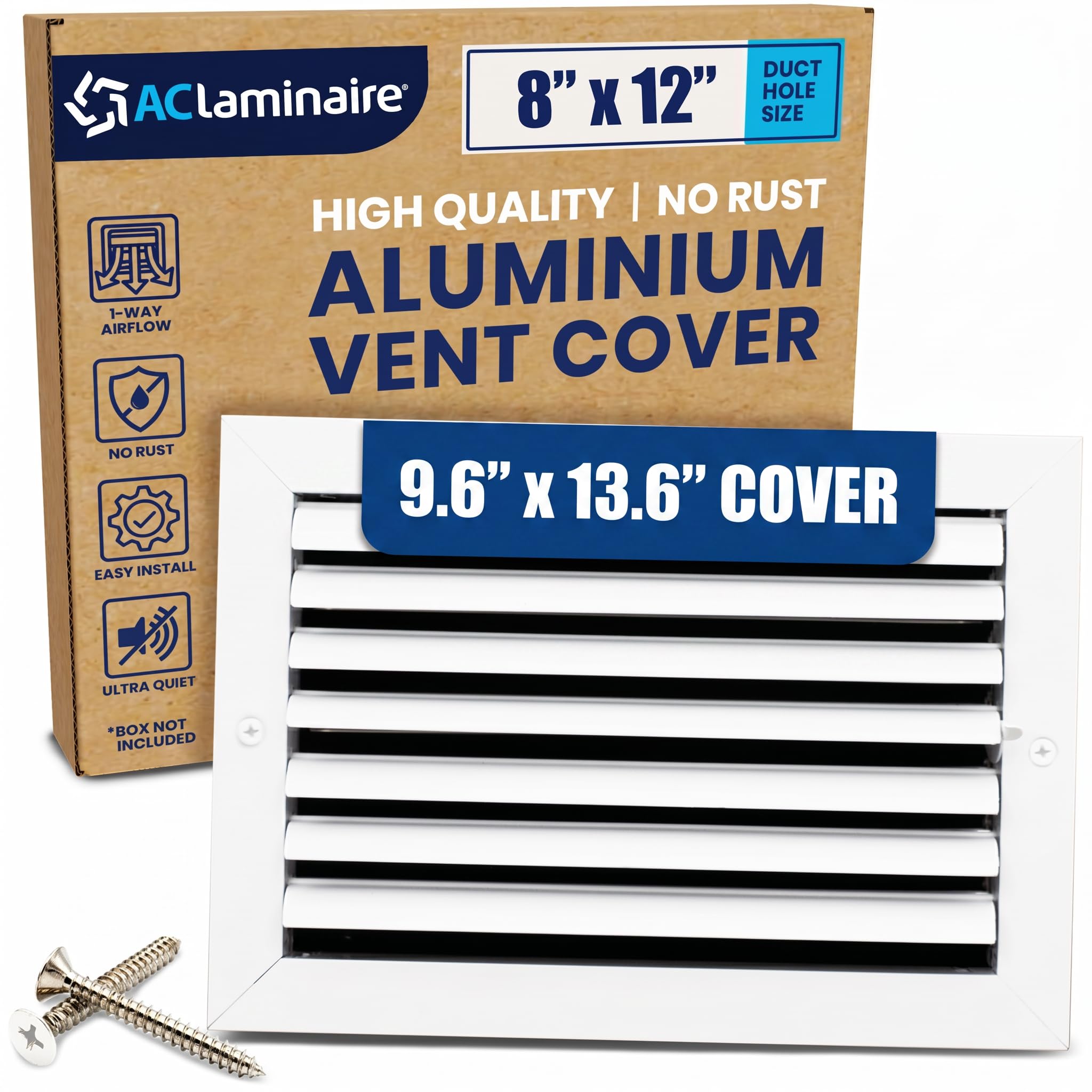
This LAMINAIRE register is made from extruded aluminum (aluminum that is forced through a die to create a precise, uniform shape), which makes it naturally rust-proof and lightweight. The duct opening is 8 inches by 12 inches, and the visible face measures 9.6 inches by 13.6 inches after installation. It uses a multi-shutter damper with adjustable curved blades that direct airflow in one direction — a good choice if you want to push air along a wall rather than straight down into a seating area.
At just 1.08 pounds, it is the lightest cover in this lineup — 0.35 pounds lighter than the HBW steel option. The integrated plastic seal around the rim eliminates gaps between the cover and the ceiling surface, helping prevent air leaks and giving a more finished look. Buyers appreciate that the aluminum construction does not amplify the sound of moving air the way some steel covers can. This is a premium pick for anyone prioritizing rust resistance, low noise, and a snug seal over the raw heft of a steel cover.
Why It Stands Out
- Aluminum body is completely rust-proof and lightweight
- Plastic seal on the rim eliminates air gaps for a tight fit
- Noise and vibration are minimized compared to steel alternatives
Trade-Off
- One-way airflow only — you cannot split the air in two directions like the 2-way registers
Choose this for: an 8×12 duct where you want a durable, rust-free cover that stays silent and seals flush against the ceiling.
Avoid if: you need two-way airflow direction or prefer the heavier feel of a stamped steel register.
Understanding the Specs
Duct Opening Size vs. Outer Dimensions
The duct opening size is the measurement of the actual hole in your ceiling or wall. The outer dimensions of the cover are always larger — typically about 1.75 inches wider and taller — so the cover overlaps the edges of the hole. Always measure the opening, not the old cover you are replacing, because old covers can be bent or sized differently. If the hole is 8 inches wide and 4 inches tall, order a vent cover with an 8″ x 4″ duct opening.
2-Way vs. 1-Way Airflow
A two-way vent uses angled louvered fins to split the incoming air into two separate directions, which helps distribute air across a wider area instead of blasting straight down. One-way vents have blades that all face the same direction, pushing air along a single path. For supply registers (where heated or cooled air enters the room), a 2-way design is often more comfortable. For return grilles (where air is pulled out of the room), fixed louvers without directional control are standard and perfectly fine.
Multi-Shutter Damper
A multi-shutter damper is a set of linked blades behind the face of the vent that you adjust using a small lever or dial. It lets you control how much air passes through — from fully open to completely closed. This is useful for balancing airflow between rooms. A cover without a damper is always open and cannot be throttled down.
Steel vs. Aluminum
Steel vent covers are heavier and feel very solid, but they can rust if the paint coating chips. Aluminum covers are lighter, completely rust-proof, and tend to make less noise when the air flows through them because aluminum does not vibrate the same way steel does. Aluminum can be slightly more expensive, but it usually lasts longer in humid spaces like bathrooms or basements.
FAQ
How do I measure for a ceiling air vent cover?
What is the difference between a supply register and a return grille?
Can I paint a steel or aluminum vent cover?
Will a 2-way vent cover work for a sidewall opening?
How do I know if I need a steel or an aluminum vent cover?
Will a steel vent cover rust in a bathroom?
What does “multi-shutter damper” mean?
How do I install a ceiling vent cover?
What size vent cover do I need if my old cover is 12 inches wide?
Final Thoughts: The Verdict
Across the board, the best ceiling air vent covers winner is the Handua 8″x4″ 2-Way Steel Register because it combines a precise fit for small openings with deburred edges, two-way airflow control, and a solid build at a great price. If you need adjustable airflow control on a 10×6 supply duct, grab the Howeall 10×6 Inch 2-Way Steel Vent Cover. And for a rust-proof, whisper-quiet option with a tight plastic seal, the standout is the LAMINAIRE 8″x12″ Aluminum Vent Cover.
How We Picked
We do not accept paid placement. Every pick is matched to a real buyer and a real use-case; we do not hands-on test units.
Sources & Methodology
Specifications: manufacturer listings and product documentation. Review insights: verified customer reviews, as of July 2026. Pricing: not shown on this page (it changes often); check the current price via the retailer link.
As an Amazon Associate, Gadgets Feed earns from qualifying purchases. This does not affect which products we feature.