
Our readers keep the lights on and my morning glass full of iced black tea. As an Amazon Associate, I earn from qualifying purchases.
Specs are compiled from manufacturer listings and verified buyer reviews and can change over time — please confirm the key details on the product page before buying.
Living in a rural area means you already know the drill: you walk to one corner of the room to send a text, or you drive a mile down the road to take a call. A signal booster solves that by catching the weak signal outside your house and amplifying it indoors so your phone actually works like it is supposed to. You do not need a new carrier or a monthly subscription — you need a box that grabs the far-away tower and brings its signal to your living room.
I’m Min — the founder and writer behind Gadgets Feed. This guide is built by comparing the manufacturers’ published specifications and the patterns across verified customer reviews, so you get each pick’s real strengths and trade-offs instead of marketing spin.
Every model here supports at least one 5G frequency band and carries the high gain needed for truly remote locations. This is your practical, no-nonsense look at the 5g cell phone booster for rural areas that actually stands a chance against the countryside’s dead zones.
Our Picks at a Glance

How To Choose The Best 5G Cell Phone Booster For Rural Areas
Choosing a booster for the countryside is different than buying one for a city apartment. The key is that your nearest cell tower is often miles away, so the booster needs to reach far and then spread the signal wide indoors. Here are the three specs that separate a useful rural booster from a disappointing one.
Gain (Measured in Decibels) — The Reach of Your Booster
Gain tells you how much the booster can amplify a weak signal. For rural use, look for a model with at least 70 dB of gain. The highest models hit 100 dB, which is transformative for truly remote locations because the stronger the gain, the farther the booster can pull a signal from a distant tower.
Coverage Area — The Indoor Spread
This number, measured in square feet, tells you how much of your home the boosted signal can fill. A booster rated for 5,500 square feet covers a typical ranch home. An 8,000 square foot unit can handle a larger house or a basement plus the main floor. Just remember that your actual coverage will vary depending on the construction of your home and the strength of the outside signal you receive.
Carrier Band Compatibility
Not all 5G is the same. Many rural carriers use 5G DSS (Dynamic Spectrum Sharing), which shares the same frequencies as 4G LTE. That means a booster that supports bands 12/13, 5, 2/25, and 4 usually covers the 5G signals in rural areas. Always check your carrier’s specific bands before buying.
Quick Comparison
| Model | Best For | Gain (dB) | Coverage (sq ft) | Weight | Amazon |
|---|---|---|---|---|---|
| CEL-FI GO G41★ Best Overall | Massive whole-home coverage | 100 dB | 15,000 | 24 lb | Amazon |
| weBoost Home CompleteTop Performer | Balanced power & weight | — | 7,500 | 1.53 lb | Amazon |
| SureCall Fusion Pro | Heavy-duty commercial grade | 72 dB | 8,000 | 11 lb | Amazon |
| HiBoost 10K SL | App-monitored & easy install | — | 5,500 | 4.85 lb | Amazon |
| SureCall Fusion4Home Max | Budget-friendly premium | — | 6,500 | — | Amazon |
In‑Depth Reviews
1. CEL-FI GO G41
Our pick — 4.5★ from 650+ verified ratings; the strongest balance of quality and price.
The heavyweight champion that pulls signal from impossible distances and floods your entire home.
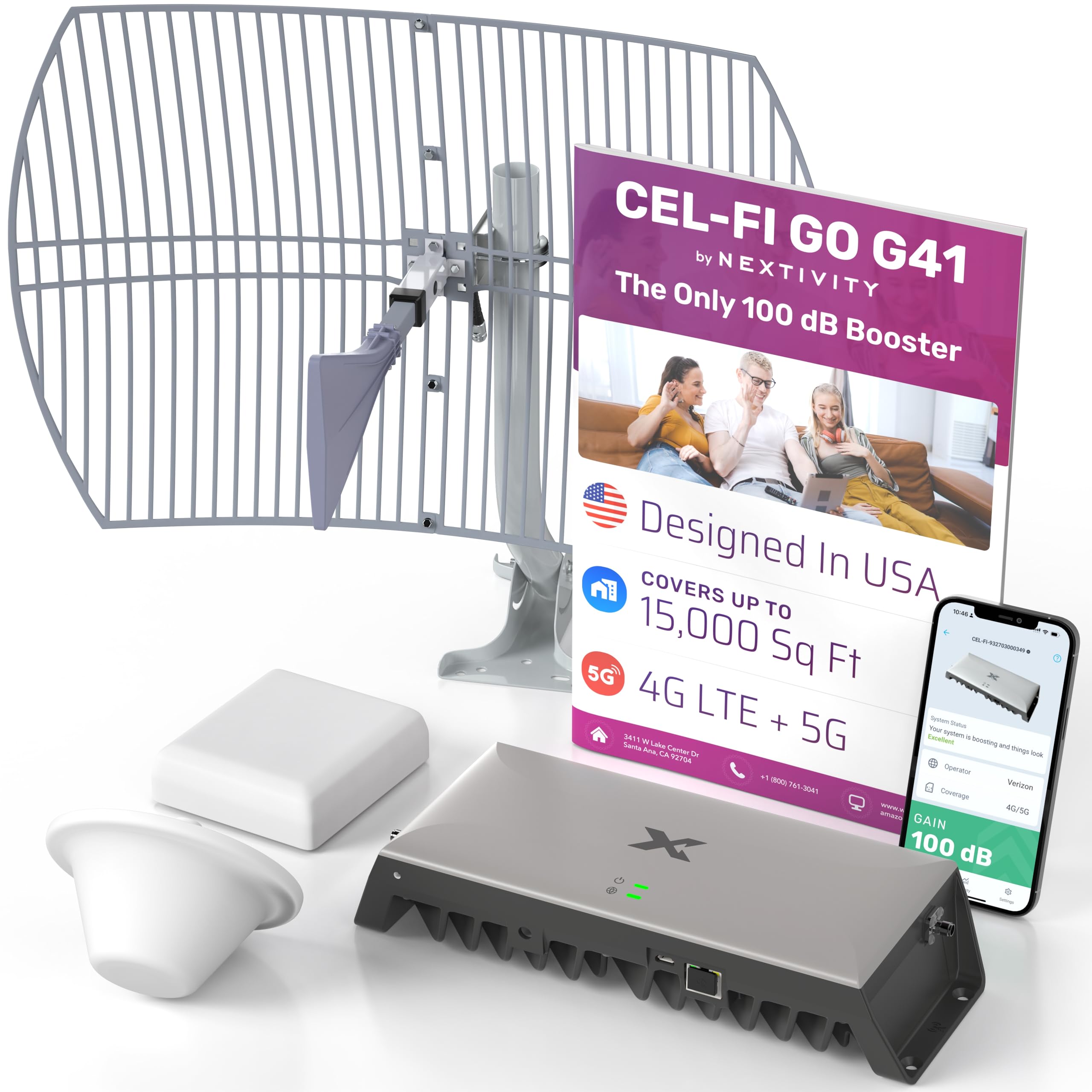
If you live in a true dead zone — where you drive a mile just to get one bar — this is the booster you actually want. The CEL-FI GO G41 delivers 100 dB of gain. In practical terms, that means it covers 15,000 square feet, so it fills a large house, a basement, a garage, and maybe even a shop without any second unit. It uses the 4th generation IntelliBoost chipset and supports 4G LTE, 5G-DSS, and 5G NR. That makes it future-proof for the latest 5G networks.
The catch is the size. At 24 pounds, this is not a small box you hang on a shelf. It is a 24-pound piece of commercial-grade hardware, so you need a dedicated spot for it. Compared to the weBoost Home Complete at 1.53 pounds, the CEL-FI is a massive trade-off in weight for a massive gain in power. Buyers report that if you are willing to handle the installation weight and mount the outdoor grid antenna, the coverage is unlike anything else on this list.
It supports 700 MHz, 850 MHz, 1900 MHz, and 2100 MHz bands, covering Verizon, AT&T, and T-Mobile. It is fully FCC certified with ID YETG41-BE. This is the one to pick when you need to cover a large space in a tough location and you want a single box to do it all.
The coverage king: For huge homes or properties where no other booster reaches the tower, this is the definitive answer.
The weight barrier: At 24 pounds, plan your mounting location before you buy or budget for professional installation.
Grab it if: you have a 2,000+ square foot home in a deep rural area and you want one solution that covers it all.
skip it if: you live in a smaller space or want a lightweight unit you can install on your own in 20 minutes.
2. weBoost Home Complete
The sleek all-in-one that balances real power with a weight you can actually handle yourself.
The weBoost Home Complete is probably the most practical choice for a typical rural home. It covers up to 7,500 square feet, which handles a two-story house plus a basement without breaking a sweat. It boosts signal , which the brand states is the maximum allowed by the FCC. At just 1.53 pounds, it is at 1.53 pounds versus the CEL-FI GO G41 at 24 pounds, making installation a true DIY job.
It supports all major U.S. carriers — Verizon, AT&T, T-Mobile, and Sprint — and the included weBoost app helps you find the nearest cell tower and see your signal strength before and after installation. The kit comes with an inside panel antenna with a drill-free wall mount bracket and an outside directional antenna with a pole mount bracket. Reviewers mention that the real-world coverage in a ranch-style home is excellent, though in a very deep dead zone you may want the CEL-FI’s extra gain.
Owners mention that the component quality is solid and that the ability to mount the indoor antenna without drilling holes is a big plus for renters. The unit is FCC approved with ID PWO460060. This is the right pick when you want a mid-range balance of power and ease.
The balanced choice: Strong enough for a large rural home, light enough for one-person installation.
The limitation: In extreme rural zones with zero outside signal, you may need the higher gain of the CEL-FI.
Reach for this if: you have a house up to 7,500 square feet and want a DIY-friendly kit that covers every carrier.
Look elsewhere if: you are in a location so remote that even a weak outside signal is absent — you need the 100 dB gain.
3. SureCall Fusion Professional

Pro-grade hardware designed for large or commercial spaces that need consistent multi-user signal.
If you need to cover a big building — a rural workshop, a large farmhouse, or a small office — the SureCall Fusion Professional is built for that. It delivers up to 8,000 square feet of coverage with a max gain of 72 dB. While that gain is lower than the CEL-FI’s 100 dB, the Fusion Professional uses SureCall’s patented 2XP technology, which the brand says doubles uplink power. That helps your phone talk back to the tower in challenging environments.
At 11 pounds, it sits between the lightweight weBoost and the heavy CEL-FI. It is compatible with all North American carriers, including Verizon, AT&T, Sprint, and T-Mobile, and it supports 4G and 5G devices, including MiFi hotspots and cellular data hubs. The frequency bands covered span 698 to 2155 MHz, so it handles a wide range of network types. Customers note that the Yagi panel antennas included in the kit provide excellent directional focus for pulling in a distant tower.
One thing to keep in mind: at a 3.9 out of 5 rating from only 28 reviews, it has less user feedback than the other picks. But for a commercial-grade booster that comes with a 3-year warranty and U.S.-based support, it is a solid mid-range bet. It covers 8,000 square feet versus the HiBoost 10K SL’s 5,500 square feet.
Commercial strength: Built for large spaces where multiple devices need stable signal simultaneously.
The caution: With fewer customer reviews than other picks, it carries slightly more uncertainty for first-time buyers.
Best for: large homes or commercial buildings around 8,000 square feet where you need pro-grade components and a 3-year warranty.
Not for: small homes or users who want a lightweight, ultra-simple install.
4. HiBoost 10K SL

The connected booster that lets you monitor and fine-tune your signal from your phone.
The HiBoost 10K SL stands out because of its Signal Supervisor app, which lets you monitor the booster’s real-time status remotely from your phone. It also has an LCD screen on the booster unit itself that simplifies the installation process. This is a big help for anyone who finds mounting an outdoor antenna and running cables a little intimidating — the app includes installation videos and live chat support.
It covers up to 5,500 square feet, which is enough for a typical three-bedroom rural home. It works with all U.S. carriers including Verizon, AT&T, T-Mobile, Sprint, U.S. Cellular, and Straight Talk, supporting bands 12, 13, 17, 5, 2, 25, and 4. It uses a high-gain directional outdoor antenna that reaches far-away towers better than an omni antenna. The booster automatically adjusts its output with AGC (automatic gain control) to maintain stable performance without interfering with the carrier’s network.
Reviewers appreciate the no-drill installation: the kit includes a through-window cable so you do not have to cut holes in your walls. It comes with a 3-year warranty and lifetime technical support. At 2.2 kilograms (about 4.85 pounds), it is heavier than the weBoost but still manageable for a single person to install. One reviewer noted that the app is genuinely useful for troubleshooting weak spots in their coverage.
The tech-forward pick: The app + LCD screen combo makes it the easiest to install and monitor among all the options.
The size factor: At 2.2 kg, it is not as light as the weBoost, and the 5,500 square foot limit means very large homes may need the bigger models.
Reach for this if: you want a modern, app-connected booster that guides you through installation and lets you monitor performance.
Look elsewhere if: you have more than 5,500 square feet to cover or prefer a dead-simple setup without an app.
5. SureCall Fusion4Home Max
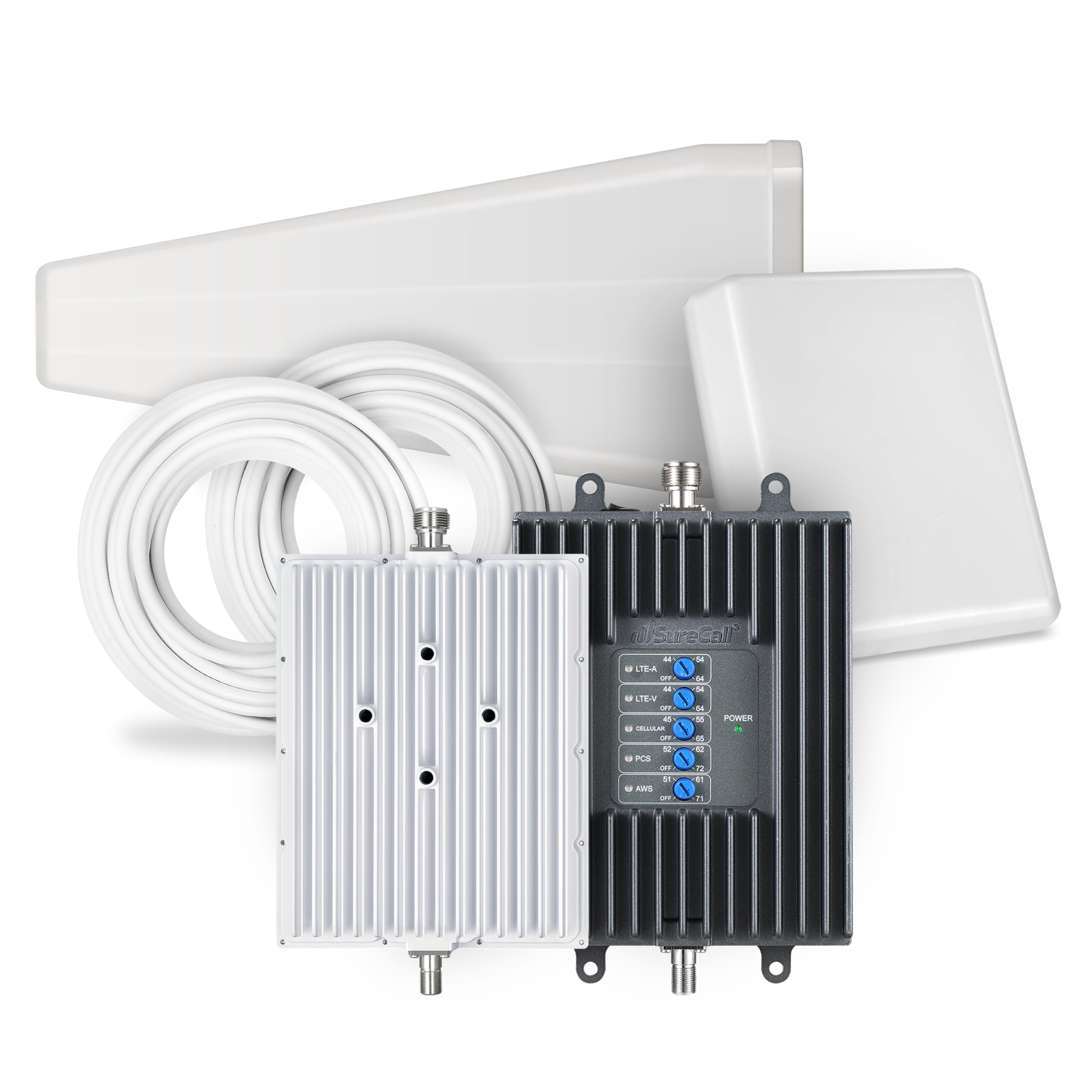
An affordable US-made unit that uses patented outdoor amplification to fill your space with signal.
The SureCall Fusion4Home Max is the entry point into the premium booster world without jumping to the high cost of the CEL-FI. It covers up to 6,500 square feet, which is more than enough for most rural homes. The key difference here is SureCall’s patented ERT (Extended Range Technology), which the brand says amplifies the signal at its strongest point outside the building. That means the outdoor antenna does the heavy lifting, giving you a larger indoor coverage area and better call quality.
It works with all U.S. carriers — AT&T, T-Mobile, Verizon, US Cellular, and Mint Mobile — and supports simultaneous connections for multiple phones, tablets, and hotspots. It supports 5G and 4G LTE. The unit is designed, assembled, and tested in the USA, which is a strong selling point for buyers who prefer domestic manufacturing. It comes with a 3-year warranty and lifetime U.S.-based support.
One thing to note: it has a 4.2 out of 5 rating from 76 reviews, which is decent but lower than the HiBoost’s 4.5 from 682 reviews. Some buyers mention that the installation is straightforward, but you need a clear line of sight to the tower for the outdoor antenna to work best. It is also an authorized Verizon 5G Signal Booster Vendor product.
The value pick: Gets you a USA-made, 5G-ready booster with 6,500 square feet of coverage at the most accessible price point.
The trade-off: The ERT system works best when the outdoor antenna has a clear view — obstructed views may reduce performance.
Best for: budget-conscious buyers who still want a quality, US-made booster with a 3-year warranty for a 2,000-6,000 square foot home.
Not for: extremely deep dead zones where you need the 100 dB gain of the CEL-FI.
Understanding the Specs
Gain in Decibels (dB)
This is the measure of how much the booster can amplify a weak incoming signal. The higher the dB, the farther the booster can reach to grab a signal from a distant tower. For rural use, 70 dB is a solid baseline, while 100 dB is the maximum available for consumers. In very remote locations, that extra 30 dB can mean the difference between a usable connection and none at all.
Coverage Area
The coverage area (in square feet) tells you how much indoor space the booster can fill with boosted signal. A 5,500 sq ft unit handles a typical ranch home, while a 15,000 sq ft unit can cover a large house plus a basement, a garage, and a workshop. Your actual coverage depends on your home’s construction materials and the outdoor signal strength you start with.
FAQ
Will a 5G booster work with my carrier?
Do I need a professional to install a cell signal booster?
How far from the tower will a booster work?
Can I use a booster with a metal roof or metal siding?
Does a booster need a monthly subscription?
Can a booster work with multiple phones at once?
Will a booster help with data speeds or just calls?
Is it legal to use a signal booster?
Final Thoughts: The Verdict
If you live far from a cell tower, you need a booster that can pull in a weak signal and spread it through your home. The 5g cell phone booster for rural areas that does this best is the CEL-FI GO G41 — it gives you 100 dB of gain (how much it amplifies the signal) and covers 15,000 square feet, so even deep rural spots get usable service. If you prefer a lighter, DIY-friendly kit that still covers 7,500 square feet, choose the weBoost Home Complete. And for app-guided setup with a modern monitoring screen, the HiBoost 10K SL is a smart, connected option.
How We Picked
We do not accept paid placement. Every pick is matched to a real buyer and a real use-case; we do not hands-on test units.
Sources & Methodology
Specifications: manufacturer listings and product documentation. Review insights: verified customer reviews, as of July 2026. Pricing: not shown on this page (it changes often); check the current price via the retailer link.
As an Amazon Associate, Gadgets Feed earns from qualifying purchases. This does not affect which products we feature.