
Our readers keep the lights on and my morning glass full of iced black tea. As an Amazon Associate, I earn from qualifying purchases.
Specs are compiled from manufacturer listings and verified buyer reviews and can change over time — please confirm the key details on the product page before buying.
Your marine battery sliding or tipping on a wet deck can damage cables and spill acid. You need a box that locks the battery in place, vents dangerous fumes, and stands up to salt spray. The best battery box for marine battery for most buyers is the SeaSense Deluxe Power Station — it adds a built-in voltmeter (a gauge that reads battery voltage, so you check charge without lifting the lid) and a 12V socket, and it fits two sizes of battery. For a simpler, tougher strap, the Attwood 9069-1 has a hold-down strap rated for 350 pounds of force so the battery stays put in rough water. For an enclosed compartment, the Camco 55371 includes a vent hose and grille that routes hydrogen gas outside, meeting USCG CFR 183.420 and ABYC E-10.7 compliance for safe installation under a seat or in a locker.
I’m Min — the founder and writer behind Gadgets Feed. This guide is built by comparing the manufacturers’ published specifications and the patterns across verified customer reviews, so you get each pick’s real strengths and trade-offs instead of marketing spin.
Your three must-decide factors are: exact battery group size (the box must match your battery’s length, width, and height), material (polypropylene, steel, or stainless steel), and if you need a vented lid (a lid with a hose port for hydrogen gas) for a sealed compartment.
Our Picks at a Glance

How To Choose The Best Battery Box For Marine Battery
Marine battery boxes are not all the same. A box that fits a car battery will not necessarily fit a deep-cycle marine battery, and the wrong lid type could create a dangerous gas buildup inside your boat. Focus on these three things and you will land on the right pick.
Battery Group Size Is Non-Negotiable
Your battery has a group size (24, 27, 30, 31) stamped on its label. The box must match that size exactly. A Group 24 box will not hold a Group 27 battery, and a Group 27 box will leave a Group 24 battery rattling around. Measure your battery’s length, width, and height before you buy — some boxes list interior dimensions like “10.6 x 7 x 10.125 inches” (the Attwood 9069-1) so you can verify the fit.
Vented vs Non-Vented: One Is Safer in Enclosed Spaces
Lead-acid batteries release hydrogen gas while charging. If you store the battery inside a compartment (under a seat, in a storage locker), you need a vented box with a hose port that routes gas outside. A non-vented lid like the Attwood 9069-1 is fine for batteries in open, well-ventilated areas or specific OEM-approved enclosures. Many budget boxes are non-vented, so check before you install.
Hold-Down Strap Strength Matters for Rough Water
A box that is not strapped down is a hazard. The U.S. Coast Guard requires a minimum hold-down force. Some boxes exceed that by a wide margin: the Attwood 9069-1 uses a 40-inch strap rated for 350 lbs of force. If you run in rough water or take sharp turns with a trolling motor, a stronger strap keeps the battery from becoming a projectile inside your boat.
Quick Comparison
| Model | Best For | Battery Group | Weight | Material | Amazon |
|---|---|---|---|---|---|
| SeaSense Deluxe Power Station★ Best Overall | All-in-one with voltmeter & socket | Group 24 or 27 | — | Plastic | $65.29Amazon |
| Attwood 9069-1Tough Strap | Strap strength & tight fit | Group 24 | 2 pounds | Polypropylene | $20.59Amazon |
| Seachoice 50-22080 | Lightweight USCG-compliant box | Group 27 | 1.6 pounds | Polyethylene | $25.00$35.41Amazon |
| Moeller 42214 | Flexible fit for 27/30/31 series | Group 27, 30 or 31 | 2 pounds | Plastic | $26.30Amazon |
| Camco 55371 | Vented box for compartments | Group 24 | 1 pounds | Plastic | $45.91Amazon |
| Peastorm Steel Relocation Kit | Heavy-duty steel protection | Group 27 | 10 pounds | Steel | $48.99Amazon |
| Peastorm Stainless Steel Box | Rust-proof stainless steel | Group 27 | — | Stainless steel | $63.99Amazon |
In‑Depth Reviews
1. SeaSense Deluxe Power Station Battery Box
Our pick — over 4★ from 450+ verified ratings; the strongest balance of quality and price.
The one box that doubles as a power station with an onboard voltmeter and 12V socket
Most battery boxes are just plastic shells — this SeaSense box actually does something useful while the lid is closed. It has a built-in voltmeter that lets you check your battery condition with a single button push. You connect it to the external terminals, turn the device off, wait a minute, and push the button. No need to open the box until you change the battery. That alone saves you a lot of fiddling with a multimeter in a cramped boat compartment.
It also includes a 12-volt accessory socket (a standard cigarette-lighter-style outlet) so you can power a fish finder, phone charger, or small pump directly from the box. A 10 amp circuit breaker provides short protection (it trips if something shorts out, then resets). The vinyl-coated steel wing nuts resist corrosion better than bare metal. It fits both Group 24 and Group 27 batteries, which is convenient if you upgrade later.
The trade-off is that this box is non-vented, so it is not suited for an enclosed compartment where hydrogen gas could accumulate. It is designed for open cockpit use, small boats, kayaks, and pontoons where the battery is in a ventilated space. The lack of a hold-down strap is also note — unlike the Attwood below, you will need to secure it separately.
Built-in smarts: The voltmeter is genuinely handy for a quick check — push one button and know your battery state without lifting the lid. No other box in this lineup offers that.
The catch: No strap included and no venting, so it is not the safest pick for a fully enclosed battery compartment.
Best for: Anglers and small-boat owners who want voltage checking and a 12V outlet without extra gear.
skip it if: You need a vented box or a factory-rated hold-down strap for rough water.
2. Attwood 9069-1 Standard Non-Vented Battery Box
The plastic box with a strap rated for 350 lbs of force
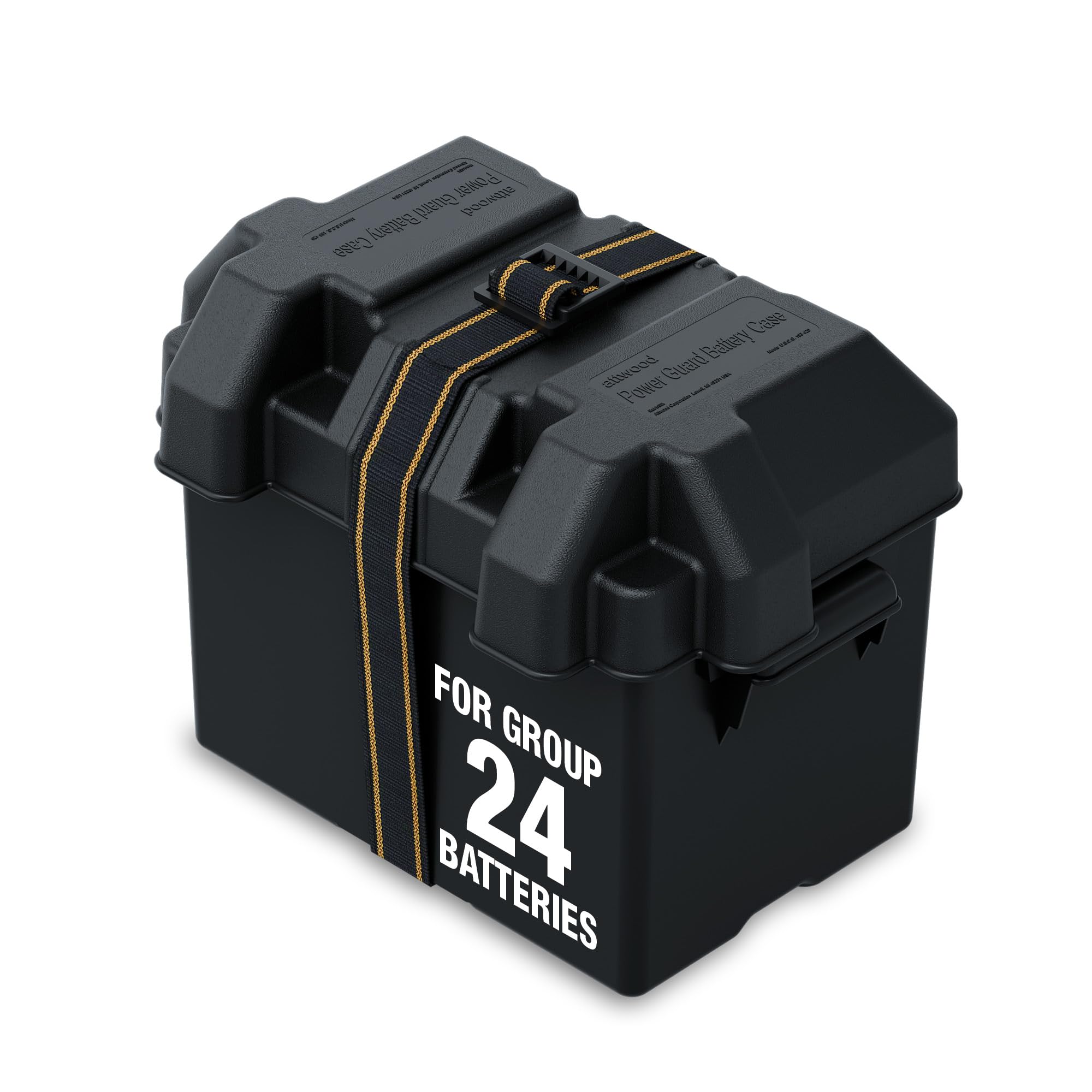
If your boat bounces through chop, a battery that comes loose is dangerous. That is the strongest argument for the Attwood 9069-1. It includes a 40-inch hold-down strap rated for 350 pounds of force. That means your Group 24 battery stays locked in place even when you take a wave sideways. It weighs just 2 pounds itself, so it adds almost no weight to your setup.
The box is made from polypropylene that is impact-tested from -20°F to +120°F. That wide temperature range matters if you store your boat in freezing winters or blazing summers. The interior measures 10.6 x 7 x 10.125 inches, so it fits batteries up to 10.125 inches tall. The non-vented lid design shields terminals from moisture and debris, making it a good choice for installations approved by the original equipment manufacturer for enclosed compartments.
Unlike the SeaSense above, you get zero extras — no voltmeter, no socket. It is a pure, tough box with an outstanding strap. Buyers report the polypropylene feels thick and the strap is genuinely heavy-duty compared to other boxes they have used. It is also lighter than the steel options below, at 2 pounds versus 10 pounds for the Peastorm steel box.
Strap that inspires confidence: At 350 lbs of force, this strap is not coming loose unless you really work at it. For rough-water boats, that is the single most important spec.
No frills trade-off: You give up the convenience features of the SeaSense, but you get USCG-compliant security for about a third of the price.
Reach for this if: You want the most secure strap in the budget segment and a box that will not crack in extreme temperatures.
Look elsewhere if: You need a vented lid or want built-in power outlets.
3. Seachoice USCG-Approved Marine Group 27 Standard Battery Box

A featherlight polyethylene box that still meets both ABYC and USCG standards
At just 1.6 pounds, the Seachoice box is one of the lightest options here. It is noticeably lighter than the Attwood (2 pounds) and far lighter than the steel Peastorm boxes. The acid-resistant polyethylene construction is tough enough to meet both ABYC standard E-10 and USCG spec 183,420, so you are not sacrificing compliance for weight savings. It fits a single Group 27 battery in a 14 x 7-1/4 x 10 inch space.
The lid is designed to allow easy access around battery cables and wires, which is a small detail that saves frustration during installation. It comes with a hold-down strap and mounting hardware, so nothing else to buy. Owners mention the lid snaps shut securely and the strap is adequate for typical use, though it does not have the 350-lb rating of the Attwood strap.
The main difference from the Moeller below: the Seachoice is Group 27 only, whereas the Moeller also fits 30 and 31-series batteries. If you have a larger battery, you need the Moeller. Also, the polyethylene is less rigid than polypropylene, so it may flex more under heavy load — fine for trolling motors, less ideal for heavy house batteries in rough seas.
Weight weenie pick: If every pound matters on a small kayak or canoe, this is the lightest USCG-compliant option at 1.6 pounds.
Size limitation: Group 27 only — no room to grow if you upgrade to a 30 or 31 series battery later.
Best for: Kayakers and canoe anglers who need the lightest compliant box that still passes USCG inspection.
pass on it if: You need 30/31-series capacity or want a thicker polypropylene wall.
4. Moeller Marine Injection-Molded Marine Battery Box (27, 30 or 31-Series)

The box that fits 27, 30, and 31-series batteries — future-proofing your battery upgrade
Most boxes lock you into one battery group size. The Moeller 42214 accepts Group 27, 30, or 31 batteries in its 13.44 x 7.75 x 10.5 inch interior. That makes it the most flexible option in this list. If you might swap in a larger deep-cycle battery next season, this box saves you from buying a new box. Injection-molded plastic construction resists corrosion and stands up to marine environments without rusting.
It weighs 2 pounds and comes with a hold-down strap and mounting hardware included. It complies with industry standards, though the specific USCG and ABYC compliance certifications are not listed the way they are for the Seachoice and Attwood boxes. The non-corrosive high-strength plastic is a step up from basic polyethylene in rigidity, according to buyer reports, who note the box feels solid and the lid fits snug.
Unlike the vented Camco below, this Moeller box is non-vented. If you install it inside an enclosed compartment, you need to be sure that compartment is ventilated or pick the Camco instead. Buyers also note the included strap is adequate but not as heavy-duty as the Attwood’s 350-lb rated strap.
Future-friendly fit: One box covers three group sizes — if you are not sure which battery you will end up with, this takes the guesswork out.
No venting: Non-vented lid means it is not safe for a sealed compartment unless you add separate ventilation.
Reach for this if: You plan to upgrade your battery size later and want a single box that grows with you.
Look elsewhere if: You need a vented box or an explicit USCG certification stamp.
5. Camco 55371 Vented RV/Marine Battery Box

The box with a vent hose and grille — the safe choice for enclosed battery compartments
If your marine battery lives under a seat, in a storage locker, or inside a cabin, you need a vented box. The Camco 55371 is designed for exactly that scenario. It includes a hose, a hose mount plate, a louvered vent grille, and foam tape to route explosive hydrogen gas outside your compartment. It meets both USCG CFR 183.420 and ABYC E-10.7 specifications, so it passes the compliance check boat inspectors look for.
At just 1 pound, it is the lightest box in this lineup — even lighter than the Seachoice. It holds a single Group 24 battery. The external dimensions are 14 7/8 x 9 5/8 x 11 3/4 inches including the vent ports (10 1/4 inches tall without them). That extra height from the vent ports is important to measure before you install in a tight compartment. Customers note the venting system works well and the hose routing is straightforward.
The trade-off: it is Group 24 only, so it will not fit a Group 27 or larger battery. And at 1 pound, the plastic feels lighter-duty than the Attwood’s polypropylene. It protects the battery from collisions and contaminants, but the thinner walls mean it is better suited for calm-water boats and RVs than high-impact environments. Unlike the SeaSense, there is no built-in voltmeter or power socket.
Compartment-ready: The vent hose kit is complete from the start — you do not have to piece together parts to get gas safely outside.
Group 24 only: No room to grow if you switch to a larger deep-cycle battery.
Best for: Boat owners who must install the battery inside an enclosed compartment and want a complete vent kit that passes USCG inspection.
it’s not for you if: Your battery is Group 27 or larger, or you want a heavier-duty box for rough water.
6. 12V Car/RV/Marine Battery Box, Assemble Steel Battery Relocation Kit (Peastorm)
The heavy steel box that weighs 10 pounds — eight pounds more than the plastic alternatives
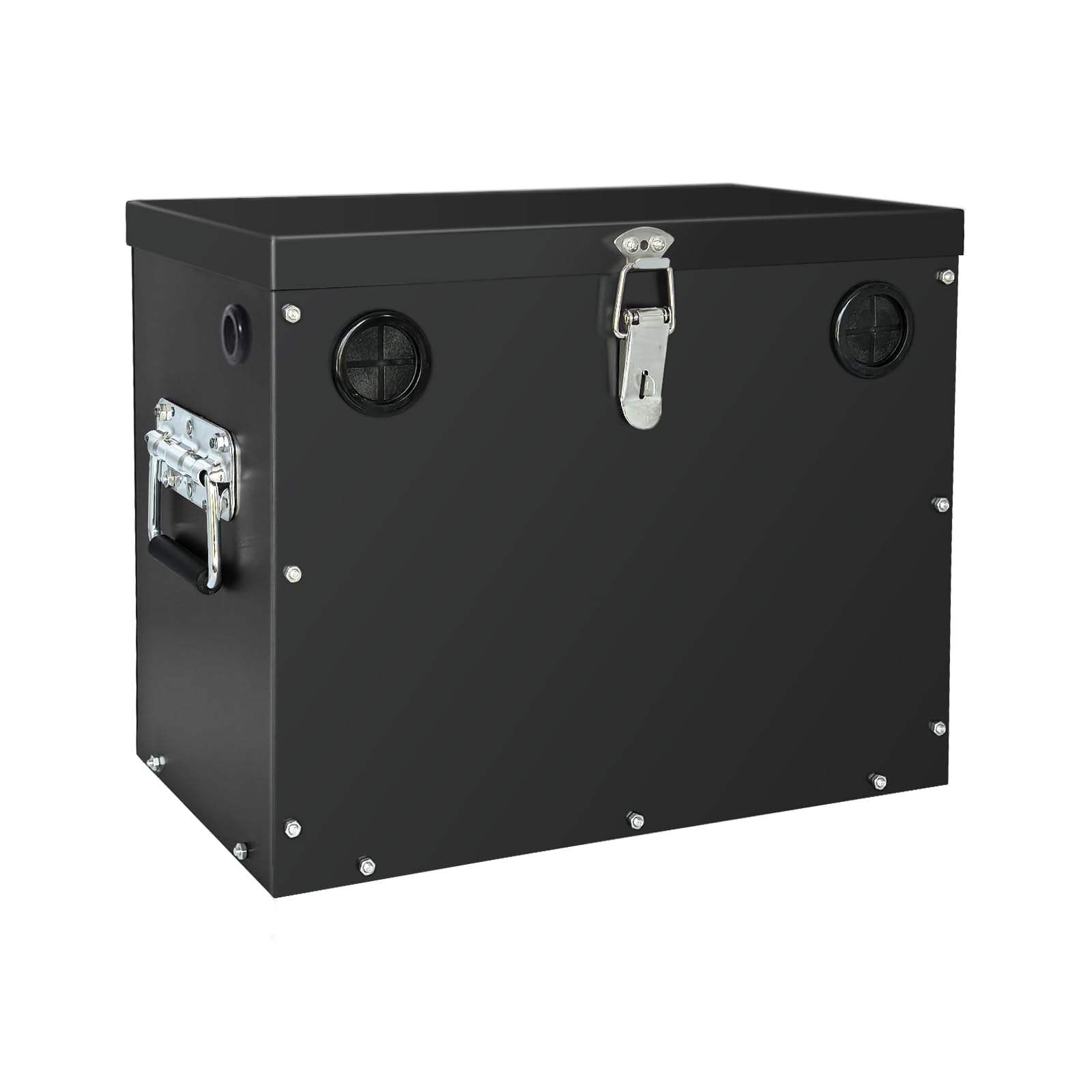
When plastic will not cut it, this steel box from Peastorm steps in. Made from quality steel with a spray black coating for rust resistance, it weighs 10 pounds — that is a full 8 pounds heavier than the Camco plastic box and 8 pounds heavier than the Attwood. The extra mass means it does not flex, crack, or deform under impact. It is sunscreen and fireproof, so it can sit in direct sunlight without degrading.
The box fits a Group 27 battery with a maximum capacity size of 13.78 x 7.8 x 11 inches. It has handles on both sides for carrying, a lockable upper cover (the lid can be locked), and multiple reserved holes protected by rubber rings for cable routing. Four fixing holes at the bottom with included screws let you bolt it down permanently. One important note: this product requires assembly, which the manufacturer says takes about 10 minutes.
At 10 pounds, this steel box is heavier than the 2-pound Attwood plastic box. That weight is a genuine con if you are carrying it into a kayak or small boat. Also, steel will eventually rust if the coating gets scratched, unlike the stainless steel version below. Reviewers point out the assembly is straightforward but you need basic tools. The external box size is 14 x 8 x 11.25 inches — measure your compartment before committing.
Armor-level protection: Steel construction with a lockable lid and fireproofing makes this the most rugged box here for heavy-duty use.
Weight penalty: At 10 pounds, it is the heaviest box by a wide margin — not ideal for portable setups.
Reach for this if: You need maximum physical protection in a rough environment like a utility trailer or off-road RV.
Look elsewhere if: You want a lightweight carry box or are installing in a location where steel could rust from salt spray.
7. Peastorm Trailer RV Marine Battery Box – 12V Waterproof Stainless Steel

Stainless steel that laughs at saltwater — waterproof, sunscreen, and fireproof
The step up from the steel box above: this version uses stainless steel instead of painted steel, which means it will not rust even when exposed to salt spray and constant marine humidity. It is the same design as the steel box — same battery capacity (13.78 x 7.8 x 11 inches for the battery, 14 x 8 x 11.25 inches external), same lockable cover (a lock is included), same handles on both sides, and the same rubber-ring-protected cable holes. The difference is the material and the price premium.
The box ships with a lock, four rubber rings, four screws, and the box itself. It is designed for Group 27 batteries and is compatible with cars, marine vessels, RVs, trailers, and camping setups. The item dimensions are 9.45″D x 14.9″W x 11.2″H, which is slightly deeper and wider but about the same height as the steel version. The stainless steel construction makes it waterproof, which is a real advantage for boats where water splashes into the battery compartment.
Like the steel box, this requires assembly, and the stainless steel material is harder to modify if you need to drill extra holes. It is heavier than plastic boxes but the weight is not listed separately. Buyers praise the build quality and the lockable lid, noting it feels premium compared to plastic boxes. The main downside versus the Camco or Attwood: no venting, so it is not safe for enclosed compartments without separate ventilation.
Marine-grade material: Stainless steel is the right choice for saltwater boats — it will not rust where the painted steel box eventually would.
No venting included: Same as the steel version — this is an open-air or well-ventilated-spot box, not for a sealed compartment.
Best for: Saltwater boaters and trailer owners who want a lockable, rust-proof box that can sit in the weather for years.
look elsewhere if: You need a vented box or a lightweight carry option for a small kayak.
Understanding the Specs
Vented vs Non-Vented Lid
A vented battery box has a hose port and a grille that routes hydrogen gas outside the compartment. This is required when the battery is installed inside a sealed or semi-enclosed space (under a seat, inside a cabin) because hydrogen gas is explosive if it accumulates. A non-vented box is fine for open, well-ventilated areas such as a boat deck or a trailer tongue. The Camco 55371 is vented; the Attwood 9069-1 is non-vented. Choose based on where your battery sits, not on which is “better.”
Hold-Down Strap Rating
The strap that holds the battery down is rated in pounds of force. The U.S. Coast Guard requires a minimum hold-down force (USCG 183.420). Some boxes exceed that by a lot — the Attwood 9069-1 uses a strap rated for 350 pounds of force. A higher rating means the battery is less likely to shift or fly loose when the boat hits a wave or you take a sharp turn. If you run in rough water, a higher-rated strap is worth prioritizing over other features.
FAQ
Can I use a car battery box for a marine battery?
What size battery box do I need for a Group 27 marine battery?
Do I need a vented battery box on a boat?
How much does a marine battery box weigh?
What is the difference between USCG 183.420 and ABYC E-10?
Can a steel battery box rust in a marine environment?
How do I secure a battery box inside my boat?
Will a Group 24 box fit a Group 27 battery?
Final Thoughts: The Verdict
For the majority of shoppers, the battery box for marine battery winner is the SeaSense Deluxe Power Station because it adds real utility (a voltmeter and 12V socket) while fitting both Group 24 and Group 27 batteries. If you want maximum strap strength and USGC compliance at a budget price, grab the Attwood 9069-1. And for a safe vented installation inside a sealed compartment, the standout is the Camco 55371.
How We Picked
We do not accept paid placement. Every pick is matched to a real buyer and a real use-case; we do not hands-on test units.
Sources & Methodology
Specifications: manufacturer listings and product documentation. Review insights: verified customer reviews, as of July 2026. Pricing: not shown on this page (it changes often); check the current price via the retailer link.
As an Amazon Associate, Gadgets Feed earns from qualifying purchases. This does not affect which products we feature.
Related Guides
Product prices and availability are accurate as of the date/time indicated and are subject to change. Any price and availability information displayed on Amazon at the time of purchase will apply to the purchase of this product. As an Amazon Associate I earn from qualifying purchases.
CERTAIN CONTENT THAT APPEARS ON THIS SITE COMES FROM AMAZON. THIS CONTENT IS PROVIDED "AS IS" AND IS SUBJECT TO CHANGE OR REMOVAL AT ANY TIME.
Amazon and the Amazon logo are trademarks of Amazon.com, Inc. or its affiliates.