
Our readers keep the lights on and my morning glass full of iced black tea. As an Amazon Associate, I earn from qualifying purchases.
Specs are compiled from manufacturer listings and verified buyer reviews and can change over time — please confirm the key details on the product page before buying.
I’m Min — the founder and writer behind Gadgets Feed. This guide is built by comparing the manufacturers’ published specifications and the patterns across verified customer reviews, so you get each pick’s real strengths and trade-offs instead of marketing spin.
The right bathroom fan in ceiling balances powerful airflow with whisper-quiet operation. The six picks below match real bathroom sizes and installation needs.
Our Picks at a Glance

How To Choose The Best Bathroom Fan In Ceiling
Picking the right ceiling fan for your bathroom depends on three key numbers: how much air it moves (CFM), how loud it is (Sones), and how it fits in your ceiling.
CFM — The Real Air-Pulling Muscle
CFM stands for Cubic Feet per Minute. It measures how much air the fan pulls out of the room every sixty seconds. A good rule of thumb is one CFM per square foot of bathroom space. For a smaller bathroom around 50 square feet, a 50 CFM fan is plenty. For a medium bathroom of 100 square feet, you want at least 100 CFM. A larger master bath needs 110 CFM or more. Picking too-low CFM leaves steam on the mirror and moisture in the drywall.
Sones — How Loud Is “Quiet”?
A Sone is the unit of loudness as humans perceive it. One Sone is roughly the sound of a quiet refrigerator hum. For a bathroom fan, aim for 1.0 Sone or lower if you want it to fade into the background. At 0.8 Sone, the fan is genuinely easy to forget. At 0.7 Sone, it is barely there. Any fan rated above 1.5 Sones will be distracting during a shower or conversation.
Installation Type — Attic Access Or Room-Side
Many older homes require you to go into the attic to mount a ceiling fan. You do not always want to do that. Several modern fans (often called “room side” or “no attic access needed” models) install entirely from inside the bathroom. You cut the hole, wire it, and push the housing up into the ceiling. If your attic is full of insulation or you simply do not have one, prioritize fans that advertise room-side installation.
Quick Comparison
| Model | Best For | Airflow (CFM) | Noise (Sones) | Duct Size | Amazon |
|---|---|---|---|---|---|
| Panasonic WhisperFit FV-0511VFL1★ Best Overall | Best Overall | 50-80-110 CFM | Not listed | 4″ or 6″ | Amazon |
| Broan-NuTone B00MYV45DGBest Retrofit | Retrofit With Light | 110 CFM | 1.0 Sones | Not listed | Amazon |
| Homewerks 7141-50 | Smallest & Quietest | 50 CFM | 0.7 Sones | 4″ | Amazon |
| KAZE APPLIANCE SNP100 | Consumer Reports Pick | 100 CFM | 0.8 Sones | 4″ | Amazon |
| JOEAONZ 13B-110 | Budget Large Room | 110 CFM | 1.0 Sones | 4″ | Amazon |
| Tech Drive 50 CFM | Budget Small Room | 50 CFM | 1.0 Sones | 3″ | Amazon |
In‑Depth Reviews
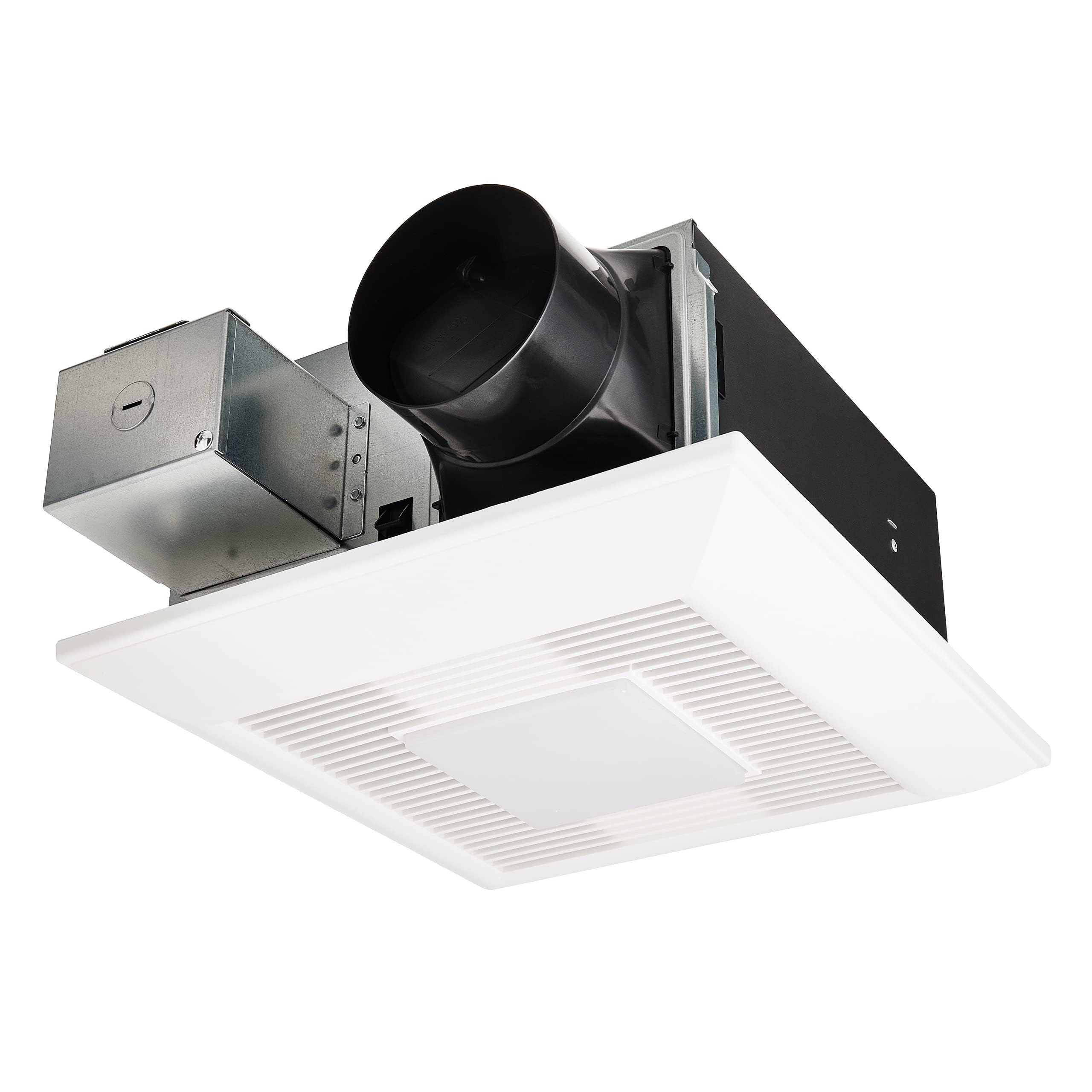
1. Panasonic WhisperFit Ceiling Mount Bathroom Exhaust Fan with Dimmable LED Light, FV-0511VFL1
Our pick — over 4.5★ from 900+ verified ratings; the strongest balance of quality and price.
Three airflow settings in one unit, so you match the fan to your room without buying a different model.
This is the most flexible fan on the list by a wide margin. The Panasonic WhisperFit uses a DC/ECM motor (a brushless magnetic motor that runs quieter and more efficiently than older AC designs) and the Pick-A-Flow switch lets you choose 50, 80, or 110 Cubic Feet Per Minute. That range covers small half-baths up to larger 110-square-foot bathrooms. You get a dimmable 10W LED light and a low-power night light that draws less than 1W — warm illumination without a separate fixture.
The Flex-Z Fast Bracket hangs on a single hinge. That means you can position the housing first, then connect the ducting, all without needing attic space. The fan accepts both 4-inch or 6-inch ducts, which is useful if your home has an older, larger duct run. Buyers report that the built-in night light is surprisingly practical for middle-of-the-night trips without blinding yourself with the main LED. The trade-off is that Panasonic does not publish the Sone rating on this model, so you are relying on the “WhisperFit” branding and the DC motor reputation for quietness rather than a hard number.
Unlike the JOEAONZ or Tech Drive below, this Panasonic runs on a DC motor rather than AC, which typically means less current draw, less heat, and longer motor life. It is Energy Star certified, which confirms it meets strict efficiency standards.
What Makes It Stand Out
- Three selectable CFM settings (50, 80, 110) — one fan fits any bathroom up to 110 sq. ft.
- SmartFlow DC motor maintains airflow even against external duct pressure.
- Dimmable 10W LED light with separate low-power night light included.
- Flex-Z bracket installs entirely from the room side — no attic access required.
The One Catch
- Sone rating is not listed, so you cannot compare noise with a precise number.
Your best bet if: you want one fan that adapts to any bathroom size and includes integrated lighting, backed by Panasonic’s DC motor efficiency.
Look elsewhere if: you need a guaranteed Sone number to compare loudness — this model does not publish one.
2. Broan-NuTone Bathroom Exhaust Fan – Retrofit Design, 1.0 Sones, 110 CFM
A fan-and-light combo that swaps into your old housing without touching the attic.
The Broan-NuTone is built for the retrofit buyer who already has a ceiling hole and just wants a better, quieter unit with a modern LED light. It moves 110 Cubic Feet Per Minute — exactly the same peak airflow as the Panasonic above but with a published noise rating of 1.0 Sones (quiet enough to blend into background noise). The light panel lets you pick between four color temperatures: 3000K (warm white) up to 5000K (daylight) by flipping a switch, and it remembers your last choice.
Installation is strictly room-side. The housing measures 9-1/4″ x 10″ x 5-3/4″ and fits into a 2″ x 6″ joist space. The CleanCover grille pulls air from the full perimeter rather than the center, which the maker claims reduces dust build-up on the grille surface. At 110 CFM, the manufacturer recommends it for spaces up to 105 square feet. That is a solid match for most standard master bathrooms.
Owners mention that the selectable light temperature is genuinely useful if your bathroom lacks a separate light fixture — you can dial in warm for relaxing baths or cool for morning grooming. The one caution: this is a 1.0 Sone fan, so it is quiet, but the Homewerks below (0.7 Sones) is measurably quieter on paper.
Why It Works
- 110 CFM airflow clears bathrooms up to 105 sq. ft. — strong and effective.
- Four LED color temperatures (3000K to 5000K) let you tune the light to your mood.
- Room-side installation means you replace the old unit without ever entering the attic.
- CleanCover perimeter grille design is designed to stay cleaner longer.
Watch For
- At 1.0 Sones, it is not the quietest on the list — the Homewerks (0.7 Sones) is quieter.
Ideal for: anyone replacing an old fan who wants an all-in-one light upgrade without attic work.
skip it if: absolute silence is your priority — the Homewerks drops lower in Sones.
3. Homewerks 7141-50 Bathroom Fan Integrated LED Light, 0.7 Sones 50 CFM

The quietest fan here at 0.7 Sones — quieter than a library whisper.
At 0.7 Sones, the Homewerks 7141-50 is the lowest-noise fan in this lineup. That is below the 1.0 Sone “very quiet” benchmark. It moves 50 Cubic Feet Per Minute, making it a perfect fit for a small bathroom up to 50 square feet. The fan includes a built-in 4000K Cool White LED light (roughly noon-daylight color), so you do not need a separate fixture above the shower area.
The housing uses a galvanized steel body (standard for corrosion resistance in damp spaces) with a round 13-inch grille. The duct connector is 4 inches round, which is the most common size in US homes. Installation is ceiling-mount with a no-cut design — you cut the opening to 7-1/2 by 7-1/4 inches and fit the housing through. The fan runs on an AC motor rather than the DC motor found in the Panasonic above. AC motors are generally simpler and cheaper to replace, but they are slightly less efficient than DC motors.
Buyers consistently comment that they genuinely cannot hear this fan running unless the room is completely silent. The trade-off is the 50 CFM limit: this fan is not for a large master bath. If your room exceeds 50 square feet, you need at least the 100 CFM Kaze or the 110 CFM Broan.
The Big Win
- 0.7 Sones — quieter than any other fan in this article.
- Built-in 4000K LED light saves installing a separate fixture.
- No-cut design and 4-inch duct connector fit standard ceiling openings.
- Galvanized steel housing resists bathroom moisture.
The Limitation
- 50 CFM only suits rooms up to 50 sq. ft. — too weak for larger bathrooms.
Grab this if: noise is your only concern and you want the quietest fan available for your small bathroom.
Choose another if: your bathroom is larger than 50 square feet — you need at least 100 CFM for effective ventilation.
4. KAZE APPLIANCE SNP100 100 CFM, 0.8 Sone, Energy Star Certified

A Consumer Reports “CR Smart Buy” pick that pairs 100 CFM power with 0.8 Sone quietness.
The Kaze Appliance SNP100 earned a spot on Consumer Reports’ “Best Bathroom Exhaust Fans of 2024” list with a perfect 5/5 rating for airflow. It moves 100 Cubic Feet Per Minute, which covers bathrooms up to 100 square feet. The noise rating is 0.8 Sones — quieter than the 1.0 Sone benchmark and noticeably more discreet than the Broan or JOEAONZ at the same airflow level. It is also Energy Star certified, meaning lower electricity consumption than a non-certified model of the same power.
Installation does not require attic access. The housing fits most standard 9 x 9 inch ceiling openings, though if you are replacing a differently-sized fan, you may need minor adjustments to the opening. The duct connector is a detachable 4-inch polymeric pipe with a back-draft prevention damper (a flap that closes when the fan is off to stop cold air from blowing back through the vent). Unlike the Panasonic which offers multiple CFM settings, the Kaze runs at a fixed 100 CFM — you cannot dial it down for smaller rooms.
Buyers appreciate that it is genuinely “forget it’s running” quiet, and several mentioned they were surprised at the build quality for a fan in this middle price tier. The one shortcoming against the higher-price competition is that it does not include any integrated light — you need a separate bathroom light fixture.
What Stands Out
- 100 CFM paired with 0.8 Sones — strong airflow at very low noise.
- Energy Star certified for lower power draw.
- Back-draft prevention damper built into the 4-inch duct connector.
- Consumer Reports’ CR Smart Buy designation with a perfect 5/5 airflow score.
What It Lacks
- No integrated LED light — you will need a separate ceiling light.
- Fixed 100 CFM — not adjustable for smaller rooms like the Panasonic.
Reach for this if: you want strong airflow with very low noise in a medium bathroom, and you already have a separate light fixture.
Spend more if: you need an integrated light or want adjustable CFM settings for a multi-size room.
5. JOEAONZ Bathroom Exhaust Fan 110 CFM, 1.0 Sones, Ceiling Mount

110 CFM at a budget-friendly price — the cheapest way to ventilate a larger bathroom.
The JOEAONZ delivers the same peak airflow as the Panasonic and Broan (110 Cubic Feet Per Minute) for a dramatically lower cost, making it the most affordable option for bathrooms up to around 107 square feet. The noise level is rated at 1.0 Sones — as loud as a quiet refrigerator hum — which is standard for this price tier and perfectly acceptable for most households.
The duct connector is a detachable 4-inch polymeric (plastic) piece, which means you can reuse your existing 4-inch exhaust pipe when replacing an old fan. The suggested ceiling opening is 7.75 by 7.5 inches with a housing depth of 5.7 inches — a common size that matches many old fan openings. Installation is straightforward: the maker says you can complete it by following the manual’s steps and pictures, and if you are swapping an old fan with existing ductwork, you likely need no extra materials.
Buyers mention that the fan moves air effectively for the price, and several note that installation took under an hour. The catch is the AC motor is not as energy-efficient as the DC motor in the Panasonic, and at 1.0 Sones it is louder than the Kaze (0.8 Sones) and Homewerks (0.7 Sones). A reviewer also pointed out that the plastic housing feels less premium than metal-bodied competitors, but at this price that is expected.
Why It Earns Its Spot
- 110 CFM — the highest airflow you can get at this price level.
- Detachable 4-inch duct connector lets you reuse existing exhaust pipes.
- Common opening size (7.75″ x 7.5″) fits most standard ceiling holes.
- Good for bathrooms up to 107 sq. ft.
Where It Falls Short
- 1.0 Sones is louder than premium picks at 0.8 or 0.7 Sones.
- Plastic housing feels less solid than the Panasonic or Kaze.
Best for: anyone with a medium-to-large bathroom on a tight budget who needs 110 CFM airflow.
Not for: buyers who want the quietest possible operation — spend more for the Kaze or Homewerks with lower Sone ratings.
6. Tech Drive Very Quiet Bathroom Fan 50 CFM, 1.0 Sones, DC Motor, 3 Inch Duct

A DC motor fan at a near-entry-level price, but with a 3-inch duct that limits replacement options.
The Tech Drive fan is the only model in this list with a DC (brushless) motor at the budget tier — most fans at this price use an AC motor. The DC motor draws only 7 watts of power, which is remarkably low. It moves 50 Cubic Feet Per Minute, enough for a small bathroom up to 50 square feet, and runs at 1.0 Sones, the same noise level as the JOEAONZ and Broan.
Installation is a “no cut” design — the housing measures 7.5 by 7.25 by 4 inches with a 3-inch duct connector. The ceiling opening needs to be 7.6 by 7.3 inches. The most important detail here is the 3-inch ducting. Most US homes use 4-inch or 6-inch ductwork. If your existing exhaust pipe is 4 inches, you will need a reducer adapter or a new duct run. This makes the Tech Drive a better fit for a new installation where you can choose the duct size, rather than a direct replacement of an old fan with 4-inch ducting.
The motor has a 7-second delay protection function — it waits seven seconds after starting before reaching full speed, which may reduce the initial current surge. The fan is Energy Star qualified and UL and HVI certified (independent safety and performance standards). Buyers like how small and unobtrusive the low-profile white grille looks in tight ceilings. The common complaint: the 3-inch duct size caused installation problems for anyone replacing a standard 4-inch vent system.
The Surprising Benefit
- DC motor at a budget price — only 7W power draw and longer motor life.
- Energy Star, UL, and HVI certified for performance assurance.
- 1.0 Sones is decently quiet for a small room.
- No attic access needed — installs entirely from the room side.
The Deal Breaker For Some
- 3-inch duct — incompatible with standard 4-inch ductwork without an adapter.
- At 50 CFM, only suitable for bathrooms up to 50 sq. ft.
Pick this for: a brand-new bathroom build where you can install fresh 3-inch ducting and want the efficiency of a DC motor cheaply.
Avoid if: you are replacing an old fan with a 4-inch duct — the duct mismatch creates extra work.
Understanding the Specs
CFM — How Much Air Moves
CFM stands for Cubic Feet per Minute. It tells you the volume of air the fan can pull out of the room every sixty seconds. The general rule: you need at least 1 CFM for every square foot of floor area. A 50 CFM fan handles a 5×10 foot room. A 110 CFM fan handles a 10×11 foot bathroom. Going too low leaves steam on the mirror and moisture trapped in the ceiling drywall, which can eventually lead to peeling paint or mildew.
Sones — How Loud It Actually Is
A Sone is a human-perceived loudness measurement. One Sone is roughly the hum of a quiet refrigerator running in the next room. A fan rated at 1.0 Sones is noticeable but fades into the background. A fan at 0.8 Sones becomes easy to ignore. At 0.7 Sones you will often forget it is on. Anything above 1.5 Sones will be a distracting whir that competes with conversation or shower noise.
DC vs AC Motor — What Changes
A DC (Direct Current) motor, like the one in the Panasonic and Tech Drive, uses a brushless magnetic design. It draws significantly less electricity (the Tech Drive uses just 7 watts) and typically produces less vibration noise than an AC (Alternating Current) motor. AC motors, found in the Homewerks and JOEAONZ, are cheaper to manufacture and easier to find replacement parts for, but they use more power and tend to be slightly louder at the same CFM rating. For a fan that runs frequently, the DC motor usually pays back its extra cost in electricity savings over a few years.
Room-Side vs Attic Installation
Room-side installation means you mount the fan housing through the ceiling opening from inside the bathroom. You do not need to crawl into the attic at any point. This matters most for single-story homes with a shallow attic, for rooms above a garage, or for apartments where you have no attic access. Fans that advertise “no attic access needed” or “room side series” (like the Broan-NuTone) usually have a housing designed to be inserted from below and secured with built-in brackets. Standard fans often require you to go above the ceiling to screw the housing to the joists.
FAQ
How do I know what CFM my bathroom needs?
Is a 0.8 Sone fan noticeably quieter than a 1.0 Sone fan?
Can I install a bathroom fan without attic access?
What duct size do most bathroom fans use?
Do I need a bathroom fan with an integrated light?
What does “back-draft prevention damper” mean?
How long does a bathroom ceiling fan typically last?
Can I use a 50 CFM fan in a large master bathroom?
What is the difference between “room side” installation and “attic installation”?
Does an Energy Star certified fan save real money?
Final Thoughts: The Verdict
Across the board, the bathroom fan in ceiling winner is the Panasonic WhisperFit FV-0511VFL1 because it gives you three airflow settings (50, 80, or 110 CFM) in one unit with a dimmable LED light and a flexible DC motor — all installable from the room side. If you want strong airflow with a proven quiet rating from Consumer Reports, grab the Kaze Appliances SNP100 with 0.8 Sones at 100 CFM. And for the absolute quietest fan you can buy for a small bathroom, the standout is the Homewerks 7141-50 at only 0.7 Sones.
How We Picked
We do not accept paid placement. Every pick is matched to a real buyer and a real use-case; we do not hands-on test units.
Sources & Methodology
Specifications: manufacturer listings and product documentation. Review insights: verified customer reviews, as of July 2026. Pricing: not shown on this page (it changes often); check the current price via the retailer link.
As an Amazon Associate, Gadgets Feed earns from qualifying purchases. This does not affect which products we feature.