
Our readers keep the lights on and my morning glass full of iced black tea. As an Amazon Associate, I earn from qualifying purchases.
Specs are compiled from manufacturer listings and verified buyer reviews and can change over time — please confirm the key details on the product page before buying.
The difference between spotting a leopard in a tree and missing it entirely often depends on one thing: how steady and clear your view is when the vehicle shakes. You need a pair of binoculars that can handle dust, quick movements, and changing light without making you dizzy. That means paying close attention to the magnification, the lens size, and how waterproof the build is — not the brand name or the price tag.
I’m Min — the founder and writer behind Gadgets Feed. This guide is built by comparing the manufacturers’ published specifications and the patterns across verified customer reviews, so you get each pick’s real strengths and trade-offs instead of marketing spin.
After sifting through the details, these seven models stand out as the top contenders for the budget binoculars for safari — each with a specific strength that makes it worth your time to consider.
Our Picks at a Glance


How To Choose The Best Budget Binoculars For Safari
Safari viewing is different from birding in your backyard or watching a football game. You are often in a moving vehicle, the light changes fast, and the animals can be far away. The right pair of binoculars for a safari balances three things: how much you can zoom in, how much light they gather, and whether they survive a surprise rainstorm. Here is what you need to know before you click “buy.”
Magnification and Lens Size
You will almost always see two numbers on binoculars, like “8×42” or “10×50.” The first number is how many times closer the object appears. For a safari, an 8x or 10x magnification is the balance. 8x gives you a wider, steadier view — important when the vehicle is bouncing. 10x gets you a closer look at a lion resting far off, but it makes every little hand shake much more noticeable. The second number is the objective lens diameter in millimeters. A bigger lens (42mm or 50mm) lets in more light, which is crucial for seeing wildlife clearly during the early morning or late afternoon game drives.
Waterproofing and Fog Proofing
Safaris often involve unexpected weather — a sudden downpour or the humidity from a river crossing. You need binoculars that are sealed with O-rings and purged with a gas (like nitrogen or argon) to stop water and moisture from getting inside. This feature, often called “waterproof and fogproof,” means the internal lenses won’t cloud up when you move from an air-conditioned lodge into the hot, humid air outside. Without it, your view can go blurry just when a cheetah walks into sight.
Lens Coatings and Prism Quality
The glass quality inside the binoculars determines how bright and sharp the image is. Look for “fully multi-coated” lenses. This means every glass surface has multiple layers of coating to reduce glare and bounce more light to your eye. The result is a clearer, brighter picture — especially valuable in low light. For the prisms (the part that turns the image the right way up), BaK-4 glass is a step above BK-7. BaK-4 prisms deliver a rounder, brighter exit pupil, which means you see more of the image without dark edges.
Quick Comparison
| Model | Best For | Magnification | Objective Lens | Waterproof | Amazon |
|---|---|---|---|---|---|
| Gosky 8×42 Roof Prism★ Best Overall | Budget-friendly starter | 8x | 42mm | Yes, IPX7 | Amazon |
| Celestron Outland X 10×50Also Great | Long-distance detail | 10x | 50mm | Yes, Nitrogen purged | Amazon |
| Vortex Triumph HD 10×42 | All-around performance | 10x | 42mm | Yes, Nitrogen purged | Amazon |
| Bushnell R3 8×42 | Wide scanning view | 8x | 42mm | Yes, IPX7 | Amazon |
| Athlon Optics 8×42 Neos G2 | Eyeglass wearers | 8x | 42mm | Yes | Amazon |
| Timorn HD 8×42 | Value bundle | 8x | 42mm | Yes, up to 1m | Amazon |
| Bushnell Prime 10×42 | Rugged build | 10x | 42mm | Yes | Amazon |
In‑Depth Reviews
1. Gosky 8×42 Roof Prism Binoculars
An entry-level workhorse that packs a phone adapter and real waterproofing into a low price.
The Gosky 8×42 is among the most popular budget binoculars on Amazon with over 6,400 ratings, and for good reason. It provides a solid 8x magnification and a 42mm objective lens — a reliable starting point for a safari newbie. The fully multi-coated optics paired with BaK-4 prisms deliver high resolution and contrast, making it suitable for both daytime game drives and low-light viewing around sunset. The 15mm eye relief is adequate for quick looks, and the rising eyecups help non-glasses wearers get a full view without black ring distortion.
This model is IPX7 waterproof and fogproof, meaning it can take a rain shower or even a short drop in the water without damage. It uses argon purging (a heavy gas that resists fogging better than nitrogen at altitude) and O-ring seals for moisture protection. The rubber armor also gives you a secure, non-slip grip in humid or wet conditions. The bundle includes a phone adapter and a 2.2-inch extendable tripod, which makes it a versatile kit for a first-time safari traveler who wants to try digiscoping (taking photos through the binoculars).
An honest limitation: at only 1.25 pounds, it is the lightest binocular in this review, which is great for comfort but sometimes indicates a more plastic feel in the focus wheel. Some users note that the included tripod is short, and the phone adapter can take a few tries to align perfectly. Also, the 8x magnification and 15mm eye relief means it demands a bit more effort for glasses wearers than the Athlon. For the price, however, it is a very strong starter kit that is ready for the rugged safari environment.
What You Get
- IPX7 waterproof and fogproof with argon purging for harsh conditions
- Fully multi-coated optics and BaK-4 prisms for clear, bright images
- Bundle includes a phone adapter and small tripod
Where It Compromises
- Build quality feels less premium, with plastic elements throughout
- 15mm eye relief is shorter than others, less ideal for glasses wearers
Perfect for: A first-time safari buyer on a tight budget who wants a waterproof binocular with a phone adapter.
Not if you need: Higher magnification (10x) for long-distance spotting or premium build quality for heavy daily use.
2. Celestron Outland X 10×50 Binoculars
The big-lens binoculars that turn distant safari silhouettes into recognizable animals.
Out on the savanna, with animals often hundreds of yards away, the magnification you choose makes a real difference. The Celestron Outland X offers 10x magnification and a 50mm objective lens — a combination that brings distant lions or eagles into clear view while gathering plenty of light. Its multi-coated lenses and BaK-4 prisms work together to produce sharp, color-accurate images even during the golden hours of dawn and dusk, which is when a lot of predators are most active. You get a field of view of 289 feet at 1000 yards, which is tight enough for detail but wide enough to track an animal moving through the brush.
A rugged build is just as important as the optics when you are in the field. The polycarbonate housing is rubber-armored to take bumps on a rocky game drive road, and the unit is waterproof and nitrogen-purged to prevent internal fogging — meaning you can keep watching through a rain shower without worrying about moisture. It also has built-in threads for a tripod adapter (bought separately), which is a bonus if you want a shake-free view during a long observation session. Buyers report that the image clarity at long range consistently exceeds their expectations given the price point.
The honest trade-off with 10×50 binoculars is weight. At a touch over a typical 8×42 model, you may notice the extra heft after holding them up for a while. The Celestron is also optically sharp, though the 5.6° angular field of view is noticeably narrower than an 8x model — the Bushnell R3 below gives you a 6.8° width. That means you have to pan your head more to follow fast-moving animals. Still, for raw reach and light-gathering on a dusty savanna, this combination is hard to top at this level.
What Stands Out
- 10x magnification with large 50mm objective lens for bright, close-up views
- BaK-4 prisms and multi-coated lenses deliver sharp, true-to-life colors
- Waterproof and nitrogen-purged construction handles sudden rain without fogging
- Limited lifetime US warranty from a well-known optics brand
Points to Keep in Mind
- Heavier than the 8×42 models, so you may want a neck strap or harness
- Narrower field of view (5.6°) than the 8×42 models (6.8°)
- Tripod adapter is sold separately
Reach for them if: You want maximum reach for spotting distant animals and don’t mind the extra weight of a 50mm lens.
Look elsewhere if: You need a lighter, wider-angle binocular for scanning treelines quickly from a moving vehicle.
3. Vortex Triumph HD 10×42 Binoculars

A well-balanced 10×42 that delivers premium clarity without the premium cost.
The Vortex Triumph HD hits a very specific balance for the safari buyer who wants higher magnification but also wants to keep a manageable size. Its 10×42 configuration is lighter than a 10×50 like the Celestron, making it easier to hold steady during a long game drive. The HD optical system uses specialized glass elements that cut chromatic aberration — that annoying purple fringe you sometimes see around branches or animal silhouettes against the sky. The fully multi-coated lenses also boost light transmission, so you get good brightness even with the slightly smaller 42mm objective lens. The exit pupil diameter here is 4.2mm vs the Athlon’s 5.25mm, but the HD glass does a good job keeping the image sharp.
Vortex is known for its warranty, and the Triumph HD is backed by their unlimited, unconditional, lifetime VIP Warranty. If it breaks, they repair or replace it — no questions asked, and it’s fully transferable. The binocular itself is nitrogen-purged, making it waterproof and fogproof. It also comes with a GlassPak harness for quick access and hands-free carrying, which is a practical touch you will appreciate when you need both hands to climb back into the safari vehicle. Owners mention that the edge-to-edge sharpness is noticeably better than cheaper 10×42 models they have tried.
One limitation to weigh: at 10x magnification on a 42mm lens, the image gets dimmer faster when the sun drops than an 8×42 would. If your safari includes a lot of pre-dawn or post-sunset drives, the Athlon or Bushnell R3 (both 8×42) will give you a brighter view. And while the build feels solid, it lacks the dedicated IPX waterproof rating of the Gosky or Bushnell R3 — though Vortex’s warranty provides confidence.
Key Strengths
- HD optical system with fully multi-coated lenses for sharp, clear images
- Unlimited, unconditional, lifetime VIP warranty that covers any damage
- Comes with a GlassPak harness for comfortable, quick-access carry
Where It Falls Short
- 10x magnification on a 42mm lens gets dimmer in very low light than an 8×42
- Exit pupil diameter (4.2mm) is smaller than the 8×42 binoculars in this list
The best pick for: The buyer who wants 10x magnification without the bulk of a 50mm lens and values a legendary warranty.
A cautious note: If your safari is heavy on dawn or dusk game drives, an 8×42 will give you a brighter view in low light.
4. Bushnell R3 8×42 Binoculars
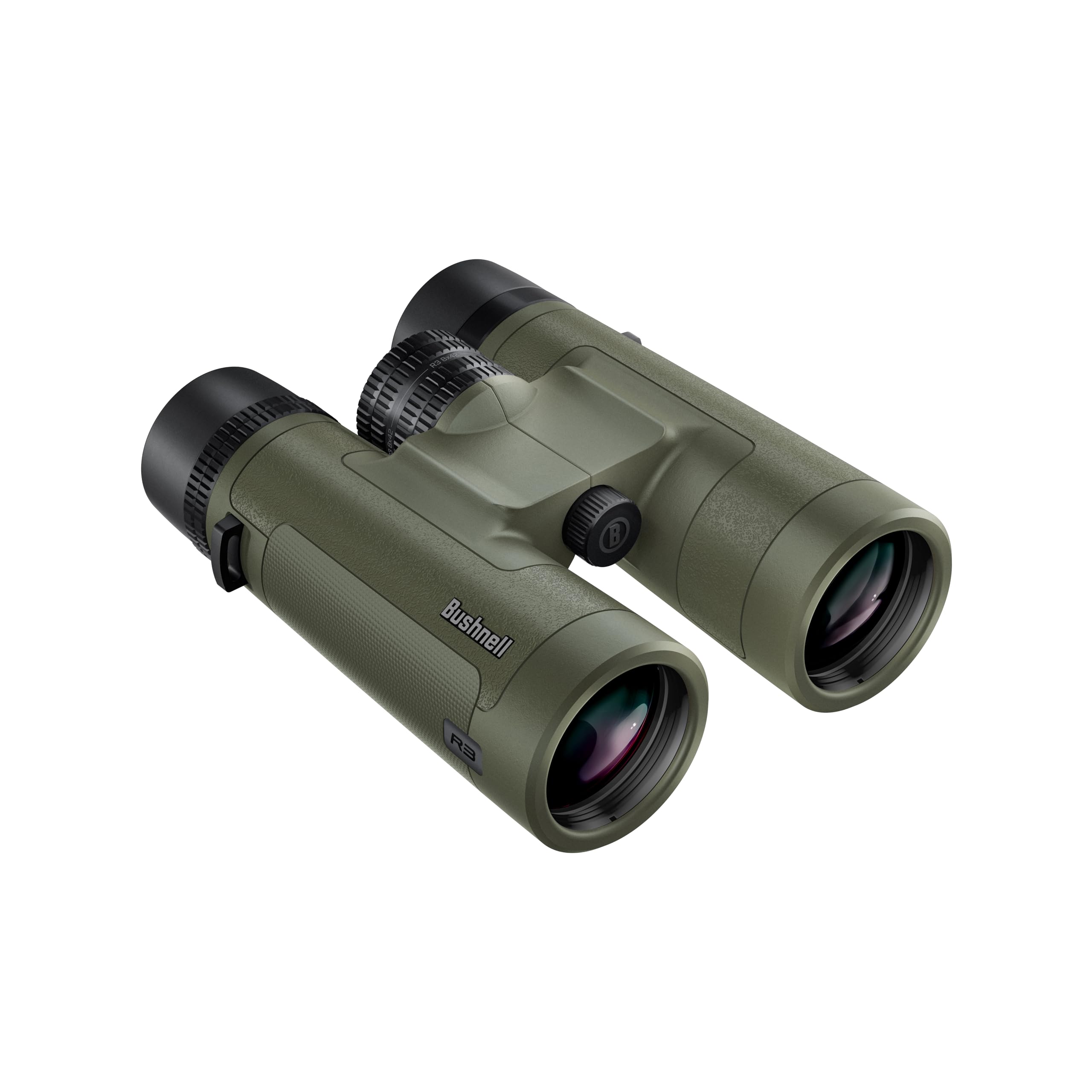
The binocular that prioritizes a wide, steady view for scanning treelines and plains.
When you are in a safari vehicle, your guide might say “elephants at two o’clock,” and you have to find them fast. That is where the Bushnell R3 8×42 really shines. The 8x magnification gives you a much more forgiving field of view than a 10x model. It comes with an HD Optical System that provides strong light transmission and contrast, and its fully multi-coated lenses help keep the image bright even when the sun is low. This binocular is all about making your scanning experience comfortable and effective, reducing the urge to lower your arms and search with your eyes instead.
Bushnell also outfits the R3 with its exclusive EXO Barrier, a permanent coating on the outer lenses that repels water, oil, fog, dust, and debris. On a dusty safari road, this is a real practical advantage — you spend less time cleaning the lenses and more time watching animals. The binocular is also IPX7 waterproof, which means it can survive accidental submersion in up to 1 meter of water for 30 minutes. The field of view is 6.8 degrees, compared to the Celestron 10×50’s 5.6-degree view. The R3 includes a Vault Lite Bino Chest Harness for safe, quick-access carry.
This doesn’t mean it’s a bad binocular — it’s a newer model — but there is less crowd-sourced feedback to confirm long-term durability. Also, the diopter adjustment may feel less precise than the Athlon’s +/-5 diopter range. For a clear, wide-viewing safari tool with excellent weather sealing, though, the R3 is a smart buy.
What We Like
- Wide 6.8° field of view makes it easy to scan large landscapes
- EXO Barrier coating repels water, oil, and dust on the outer lenses
- IPX7 waterproof rating means it can survive a dunk in the river
A Fair Warning
- Newer model with fewer customer reviews than the competition
- 8x magnification means less reach than the 10x models for distant spotting
The right choice for: Anyone who prioritizes a stable, wide field of view and hates fiddling with dusty lenses.
Not the best option if: You need maximum reach — a 10x model brings far-away details closer.
5. Athlon Optics 8×42 Neos G2 HD Binoculars

The 8×42 built specifically for people who wear glasses — a rare combination of specs.
If you wear eyeglasses, you have likely experienced the annoyance of not being able to see the whole image through a pair of binoculars. The field of view seems cut off, and you have to press the eyepiece into the glass. The Athlon Optics 8×42 Neos G2 directly addresses this with a generous 17mm of eye relief, which is at the high end for this price range. Long eye relief means you can hold the binoculars at a comfortable distance and still see the full field of view, even with glasses on. Its twist-up eyecups have intermediate stops, allowing you to fine-tune the height to match exactly how far from the lens you need to be.
Beyond the comfort, the Neos G2 uses BaK-4 glass prisms and multi-coated optics, which together reflect more light to your eyes for a brighter, sharper image. The exit pupil diameter is a wide 5.25mm , compared to the Vortex Triumph’s 4.2mm, which means you get a much brighter image in low light. The binocular is also waterproof and fog-proof, and it has a center focus wheel that feels smooth and precise. Buyers like the included padded neck strap and soft case, which make it easy to pack for a trip.
A fair note: the coating is “multi-coated” rather than “fully multi-coated,” which is one step lower than the Vortex or Bushnell R3. In practice, this means slightly less light gets through the entire optical path, so the brightness may not be quite as high on a heavily overcast day. And while the composite enclosure feels solid, it does not have the full rubber armor of the Gosky. But for the eyeglass-wearing safari-goer, the combination of 17mm eye relief and 5.25mm exit pupil makes this a standout choice.
Why Choose This
- 17mm eye relief and twist-up eyecups make it ideal for eyeglass wearers
- 5.25mm exit pupil provides a bright, easy-to-see image in low light
- BaK-4 prisms deliver sharp, bright images for the price
Consider This
- Optics are multi-coated, not fully multi-coated, which slightly reduces light transmission
- Composite enclosure lacks the shockproof rubber armor of some competitors
A solid fit for: Anyone who wears glasses and wants a comfortable, bright 8×42 binocular for safari.
Worth noting: The optical coatings are a step below the fully multi-coated options on this list.
6. Timorn HD 8×42 Binoculars

A full kit for the safari-goer who wants to share the view on social media.
The Timorn HD 8×42 comes as a bundle that includes a phone adapter and a tripod, so you can capture and share exactly what you are seeing through the lenses. The binocular itself has an impressive 8.2-degree field of view (an 8.2-degree view compared to the Celestron 10×50), which helps you spot animals moving across the horizon without constantly shifting your aim. The 8x magnification is steady enough for handheld use in a moving vehicle, and the 5.2mm exit pupil delivers a bright image in lower light. The fully multi-coated green film coating on the lenses helps improve light transmission for a clear view.
The nitrogen-purged construction makes it waterproof up to 1 meter for 30 minutes and prevents internal fogging, so you can use it comfortably in humid or rainy conditions. The twist-up eyecups adjust quickly for eyeglass wearers, and the rubber armor provides a secure grip even if your hands are sweaty from the heat. The included 360° swivel tripod and phone adapter come in handy for recording videos or taking steady photos of wildlife, and it fits most smartphones including iPhones and Galaxy models. One owner mentioned that the image quality surprised them for the price, particularly the clarity at dawn.
A trade-off to note: the field of view is listed as 430 feet at 1000 yards, but the apparent angle of view is 8.2 degrees, which is wide but can sometimes show slight distortion at the edges. The eye relief is 15mm, which is shorter than the Athlon’s 17mm, so glasses wearers might need to press the eyecups a bit closer to their lenses. Also, while the tripod is a nice bonus, it is compact and may be too short for comfortable standing use. Still, for the price, you get a very capable binocular and a whole photography setup.
Bundle Highlights
- Includes a phone adapter and tripod for capturing photos and videos
- Wide 8.2° field of view is excellent for scanning broad safari landscapes
- Waterproof (1m for 30 min) and nitrogen-purged to prevent fogging
What’s Not Perfect
- 15mm eye relief is shorter than some competitors — glasses wearers take note
- Included tripod is compact, not ideal for full-height viewing
Best suited for: The budget-minded safari traveler who wants a wide view and a phone adapter bundled in.
A possible drawback: Eye relief is on the shorter side, so check your glasses setup before you buy.
7. Bushnell Prime 10×42 Binoculars

A build-first binocular designed to shrug off the worst a safari can throw at it.
The Bushnell Prime 10×42 focuses on durability. It is designed with a waterproof and fog-proof construction using O-ring seals to keep out moisture and debris. The rubber-armored housing provides a secure non-slip grip, which is useful when you are quickly raising the binoculars to your eyes while bouncing along a dirt track. The 10x magnification and 42mm objective lens give it solid reach for spotting animals that are off in the distance, and the 341-foot field of view at 1,000 yards is decent for a 10x model — wider than the 289 feet of the Celestron Outland X.
Bushnell includes its EXO Barrier Protection on the Prime, which is a molecular lens coating that repels water, oil, dust, and debris. In the dusty environment of a safari vehicle, this coating means you can often wipe the lenses clean with a breath and a shirt sleeve instead of constantly pulling out a lens cloth. The diopter adjustment is easy to use for fine-tuning focus per eye, and the 18mm eye relief is the longest in this review, making it the most comfortable option for glasses wearers. It is also tripod-adaptable for stable viewing sessions.
A point of honesty: at a 10x magnification on a 42mm lens, the exit pupil diameter is only 4mm. That is smaller than the 5.25mm exit pupil of the 8×42 models, which means the image gets dimmer much faster as the sun goes down. If your safari is focused on early morning or late afternoon drives, you will get a brighter, easier-to-see image from the 8×42 Athlon or Bushnell R3. The Prime is best for the buyer who values toughness and a clear warranty over low-light performance.
Built Tough
- EXO Barrier coating repels water, oil, and dust for easy cleaning
- Longest eye relief on this list at 18mm — great for glasses wearers
- Waterproof and fogproof with rugged rubber-armored housing
Not Ideal For
- Small 4mm exit pupil means image brightness drops quickly in low light
- 10x magnification on a 42mm lens makes it dimmer than 8×42 options at dusk
Choose this if: You are rough on gear and want a tough 10×42 with the best lens coatings and longest eye relief.
Think twice if: Low-light performance is your priority — an 8×42 model will keep the image brighter at dusk.
Understanding the Specs
Magnification and Objective Lens
The first number (8x or 10x) tells you how many times closer an object will appear. 8x is more stable and offers a wider field, making it easier to spot moving animals from a moving vehicle. 10x gets you closer but amplifies hand shakes. The second number (42mm or 50mm) is the objective lens diameter. A larger lens collects more light, which helps you see details in dim conditions like early morning or late afternoon. For a general safari, 8×42 is a versatile balance of reach and brightness. If you have a steady hand and want maximum detail, 10×42 is a good choice.
Field of View
This is measured in degrees or in feet at 1,000 yards. A wider field of view (like 6.8° or 8.2°) means you see more of the landscape at once, which is critical for spotting animals in the bush. A narrower field of view (like 5.6°) is like looking through a soda straw — you see great detail but have to move your head more to find things. For a safari, a wider field of view is generally more helpful, as it allows you to scan the treeline without losing your target.
Eye Relief and Exit Pupil
Eye relief is the distance your eye can be from the eyepiece while still seeing the whole image. A longer eye relief (15mm or more) is a must if you wear eyeglasses, because the eyepiece needs to be further from your eye to accommodate the glasses. The exit pupil is the little circle of light you see when you hold the binoculars at arm’s length. A larger exit pupil (around 5mm) means the binoculars work better in low light because more light reaches your eye. This is what makes 8×42 binoculars (exit pupil = 42/8 = 5.25mm) brighter than 10×42 binoculars (exit pupil = 42/10 = 4.2mm) in the same conditions.
Waterproofing and Lens Coatings
Waterproofing is essential for a safari, where rain and humidity are common. Look for models that are “nitrogen-purged” or “argon-purged” — a gas that displaces moisture inside the binoculars, preventing fogging. Some models carry an IPX7 rating, which means they can be submerged in 1 meter of water for 30 minutes. Lens coatings matter too: “fully multi-coated” means every lens surface has multiple anti-reflective layers, which increases light transmission and contrast. “Bak-4 prisms” are superior to BK-7 prisms, providing a rounder, brighter exit pupil without dark edges.
FAQ
What is the best magnification for a safari?
Is 8×42 or 10×42 better for safari?
Do I need a phone adapter for safari binoculars?
How important is the IPX7 waterproof rating for a safari?
What does “fully multi-coated” mean for binoculars?
Can I use 10×50 binoculars on a safari?
What is the difference between BaK-4 and BK-7 prisms?
How do I clean the lenses on my safari binoculars?
What is the best eye relief for glasses wearers?
How much should I spend on budget safari binoculars?
Final Thoughts: The Verdict
For most people, the budget binoculars for safari winner is the Celestron Outland X 10×50 because it combines the highest reach with excellent light-gathering at a price that leaves room for other travel gear. If you want a lighter, wide-viewing binocular that stays comfortable all day, grab the Bushnell R3 8×42. And for the first-time safari-goer on a tight budget, the standout is the bundled value of the Gosky 8×42.
How We Picked
We do not accept paid placement. Every pick is matched to a real buyer and a real use-case; we do not hands-on test units.
Sources & Methodology
Specifications: manufacturer listings and product documentation. Review insights: verified customer reviews, as of July 2026. Pricing: not shown on this page (it changes often); check the current price via the retailer link.
As an Amazon Associate, Gadgets Feed earns from qualifying purchases. This does not affect which products we feature.