
Our readers keep the lights on and my morning glass full of iced black tea. As an Amazon Associate, I earn from qualifying purchases.
Specs are compiled from manufacturer listings and verified buyer reviews and can change over time — please confirm the key details on the product page before buying.
When you build a CNC machine, a 3D printer, or any automated motion rig, the biggest choice is between a belt-driven system and a leadscrew. A belt-driven linear actuator moves a carriage along a rail using a toothed belt and pulleys — this gives you high speed, quiet movement, and smooth operation. That matters when every second of travel time counts. The trade-off is that you have to pick the right stroke length (how far the carriage travels), load capacity, and motor compatibility for your specific build. Pick wrong, and the module either stalls under load or runs out of travel mid-job.
I’m Min — the founder and writer behind Gadgets Feed. This guide is built by comparing the manufacturers’ published specifications and the patterns across verified customer reviews, so you get each pick’s real strengths and trade-offs instead of marketing spin.
Every option below was chosen on concrete specs like maximum speed, load rating, repeatability (how accurately the carriage returns to the same spot), and stroke length. You can confidently pick the right belt driven linear actuator for your next project without guessing.
Our Picks at a Glance
How To Choose The Best Belt Driven Linear Actuator
Picking a belt-driven linear actuator is about balancing three things: how far the carriage travels, how fast it moves, and how much weight it can shift. Get these right, and your motion system runs without hitches. Get one wrong, and you are either rebuilding the whole axis or spending more on a replacement.
Stroke Length: The Most Common Mistake
The stroke length is the total distance the carriage can travel from end to end. Buyers often pick a module that is too short. With belt-driven units, the rail itself limits your range. Measure your work area and add at least 20% to account for the carriage body and motor clearance. The FUYU modules, for example, offer strokes from 100mm up to 2000mm in the same FPB30 family. You can scale up without changing the rail width.
Load Capacity and Mounting Orientation
Load capacity is not a single static number — it changes based on how you mount the actuator. A unit that carries 8kg horizontally might handle only 2kg when mounted vertically because gravity works against the carriage. Always check the horizontal, vertical, side-mount, and flip-mount ratings from the manufacturer. If you plan to use the actuator upright in a gantry, the vertical load rating is the one that matters.
Speed and Repeatability
Maximum speed is measured in millimeters per second (mm/s). For CNC routing and 3D printing, speeds of 800mm/s to 1500mm/s are common. Faster is not always better if your controller or stepper motor cannot keep up. Repeatability, stated as ±0.1mm or ±0.05mm, tells you how accurately the carriage returns to the same position. Tighter numbers matter for engraving and pick-and-place, less for simple transfer slides.
Quick Comparison
In‑Depth Reviews
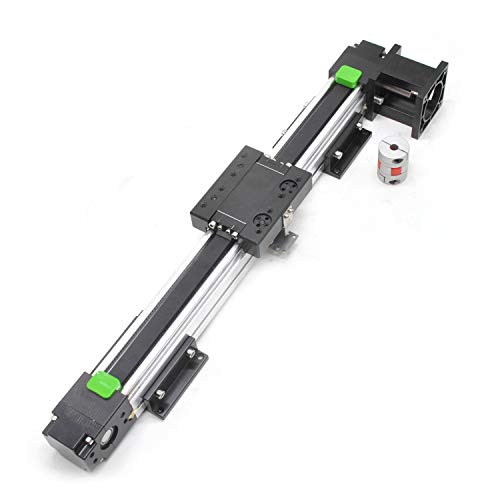
1. High Speed 400 MM 16 INCH Stroke Belt Drive Linear Guide Rail Motion Slide Actuator Module
The fastest runner in the lineup, built for builders who need speed over brute strength.
This is the module you reach for when every millisecond of travel time cuts into your cycle time. It hits a maximum speed of 1500mm/s — at 1500mm/s versus the FUYU units at 800mm/s — so it suits CNC routing, high-speed pick-and-place, and fast gantry traversal where throughput is the priority. The positioning repeatability is ±0.1mm, meaning the carriage returns to the same spot within a tenth of a millimeter each time, which is tight enough for most wood routing and light engraving tasks.
The unit comes with a NEMA 23 motor base (the motor itself is not included, so you supply your own stepper) and a foot mounting bracket. The aluminum alloy profile is sandblasted for corrosion resistance, and the precision hole positions let you combine multiple units into cross slides or 3-axis and 4-axis gantries without drilling. At 5.5 pounds, it is 10.34 pounds lighter than the 2000mm FUYU, making it easier to handle during assembly.
Buyers report that the 16-inch stroke is a balance for desktop CNC machines and mid-size 3D printers. If your project needs more than 400mm of travel, you will need a longer module or a multi-axis combination. The smooth belt drive keeps noise low, so you can run it in a workshop without earplugs.
Where It Excels
- Fastest max speed at 1500mm/s — cuts cycle times noticeably
- Light at 5.5 lbs for easy mounting and gantry builds
- NEMA 23 base gives you a common motor platform for upgrades
- ±0.1mm repeatability suits most CNC routing tasks
What To Consider
- Motor not included — you need to buy a NEMA 23 stepper separately
- 16-inch stroke is fixed; no longer version in this product line
Reach for this if: you are building a fast-moving CNC or gantry and 400mm of travel is enough for your work envelope.
Look elsewhere if: your project needs a stroke longer than 16 inches or you need the motor included in one package.
2. FUYU FPB30 Linear Guide Belt Drive Linear Module — 100mm Stroke

A tiny, motor-ready linear slide that fits into tight spaces without sacrificing belt-drive speed.
When your build box is small — say a compact pick-and-place arm or a micro laser engraver — this 100mm-stroke FUYU module is exactly the size you need. The rail body width is just 30mm, and at 4.19 pounds it is the lightest option here, so you can mount it on a small gantry without adding inertia. It ships with a NEMA 17 (4247) stepper motor already installed, unlike the High Speed unit above, so you have a complete moving assembly from the start.
The belt drive hits a maximum speed of 800mm/s with noise rated at 65dB or less — quiet enough for a desktop setup. Load capacity varies by orientation: 8kg horizontal, 2kg vertical, 4kg side-mounted, and 4kg in a flip orientation. That vertical rating is a key number if you plan to use this on a Z-axis. The manufacturer claims a service life of up to 6000km at full speed and full stroke, which translates to more than 860,000 round trips for this 100mm version.
Reviewers appreciate that FUYU accepts custom orders for longer strokes (up to 3500mm on this rail platform) and different motors. If your project grows later, you can order a matching module rather than switching brands. The included NEMA 17 motor is fine for light loads. If you need higher torque, you will want to contact them for an upgrade option.
Why It Works
- NEMA 17 stepper motor included — no extra parts to source
- 30mm rail width fits into tight build envelopes
- Customizable stroke up to 3500mm from the same rail family
- Rated for 6000km service life before belt or bearing wear
The Limitation
- 100mm stroke is very short — only for micro builds and small parts
- Vertical load limit of 2kg restricts heavy Z-axis use
Best fit for: compact desktop automation where the work piece is small and the motor needs to come in the same box.
skip it if: your project requires a stroke beyond 150mm or you need to lift more than 2kg vertically.
3. FUYU FPB30 Linear Guide Belt Drive Linear Module — 1000mm Stroke
Maximum Speed (mm/s)
Measured in millimeters per second, this is the fastest the carriage can travel along the rail under no-load conditions. A module rated at 1500mm/s covers 1.5 meters every second, which is fast enough for production cycle times. At 800mm/s, the carriage is still moving, which feels brisk in a desktop machine. Higher speed means more aggressive acceleration and deceleration curves, so your controller and stepper driver must support the ramp-up profile to avoid missed steps.
FAQ
Can I use a belt driven linear actuator vertically on a Z-axis?
What does the ±0.1mm repeatability spec actually mean for my CNC?
Do I need a separate stepper motor controller for these actuators?
How do I mount multiple actuators for a 3-axis gantry?
What is the difference between a belt drive and a leadscrew linear actuator?
How do I set belt tension on these modules?
Can I replace the NEMA 17 motor on the FUYU with a NEMA 23 for more torque?
What is the recommended power supply voltage for the stepper motor?
How do I lubricate the linear guide rails and bearings?
Can I use a belt driven actuator for pushing and pulling heavy objects like doors or hatches?
Final Thoughts: The Verdict
For the majority of shoppers, the belt driven linear actuator winner is the High Speed 400mm because of its 1500mm/s top speed, light 5.5-lb weight, and compatibility with common NEMA 23 motors. If you want a complete motor-included package for a mid-size build, grab the FUYU FPB30 1000mm. And for a two-meter continuous rail that handles long-reach automation without coupling modules, the FUYU FPB30 2000mm is the clear choice.
How We Picked
We do not accept paid placement. Every pick is matched to a real buyer and a real use-case; we do not hands-on test units.
Sources & Methodology
Specifications: manufacturer listings and product documentation. Review insights: verified customer reviews, as of July 2026. Pricing: not shown on this page (it changes often); check the current price via the retailer link.
As an Amazon Associate, Gadgets Feed earns from qualifying purchases. This does not affect which products we feature.