
Our readers keep the lights on and my morning glass full of iced black tea. As an Amazon Associate, I earn from qualifying purchases.
Specs are compiled from manufacturer listings and verified buyer reviews and can change over time — please confirm the key details on the product page before buying.
Sleeping in a sweltering van or camper stops being an adventure and starts being a problem. A 12V air conditioner that runs off your battery bank is the fix, but picking the right one means balancing raw cooling power, power draw, and noise — because a unit that drains your battery by dawn or roars like a generator defeats the whole point. This guide breaks down the three most capable options to help you match the right one to your rig and your budget.
I’m Min — the founder and writer behind Gadgets Feed. This guide is built by comparing the manufacturers’ published specifications and the patterns across verified customer reviews, so you get each pick’s real strengths and trade-offs instead of marketing spin.
If you need consistent, battery-friendly cooling without a complex installation, the 12v portable auto air conditioner that delivers the best balance of low power draw and all-night comfort is the Gidrox rooftop unit.
Our Picks at a Glance
How To Choose The Best 12V Portable Auto Air Conditioner
Every unit in this category runs on your vehicle’s 12V DC system, but the specs that matter most are cooling power in BTU, power consumption in watts (or watt-hours), and installation type. Here is what to look for.
Crucial Rule #1: Match BTU to Your Camper’s Size
The BTU rating — British Thermal Units — tells you how much heat the unit can remove per hour. A higher number means it can cool a larger space. For a small tent or roof-top tent, 5,000 BTU is typically enough. For a full-size RV or camper van, you will want 10,000 BTU to keep the interior comfortable during peak sun.
Crucial Rule #2: Know the Power Draw to Protect Your Battery
All 12V units pull power from your battery bank. The spec you care about is the annual energy consumption measured in watts. Lower watts means less strain on your battery, letting you run the air conditioner longer overnight without needing a generator or shore power. A unit that draws around 2,900 watts annually is much friendlier to a mid-sized battery bank than one drawing 3,600 watts or more. Pairing a low-draw unit with a 400Ah battery lets you sleep through the night.
Crucial Rule #3: Choose Rooftop for Permanence or Portable for Flexibility
A rooftop unit bolts into a standard 14″ x 14″ roof vent and becomes a permanent part of your camper. It frees up floor space and is less prone to bumps. A portable unit sits inside your tent, RV, or cabin and can be moved between vehicles or rooms. It needs no major installation — just plug it in and run the hose out a window or vent. Your choice depends on if you want the lowest profile (rooftop) or the most versatility (portable).
Quick Comparison
| Model | Best For | Cooling Power | Energy Consumption | Form Factor | Amazon |
|---|---|---|---|---|---|
| Countrymod 10,000 BTU★ Best Overall | Premium — inverter-driven rooftop | 10,000 BTU | 3,650 Watts | Rooftop | $939.00Amazon |
| Gidrox 10,000 BTU | Best overall — battery-friendly rooftop | 10,000 BTU | 2,930 Watts | Rooftop | $849.99$949.99Amazon |
| Cybertake S2 Pro | Best value — portable with heat | 5,100 BTU | 1,095 kWh | Portable | $739.00$1,079.00Limited time dealAmazon |
In‑Depth Reviews
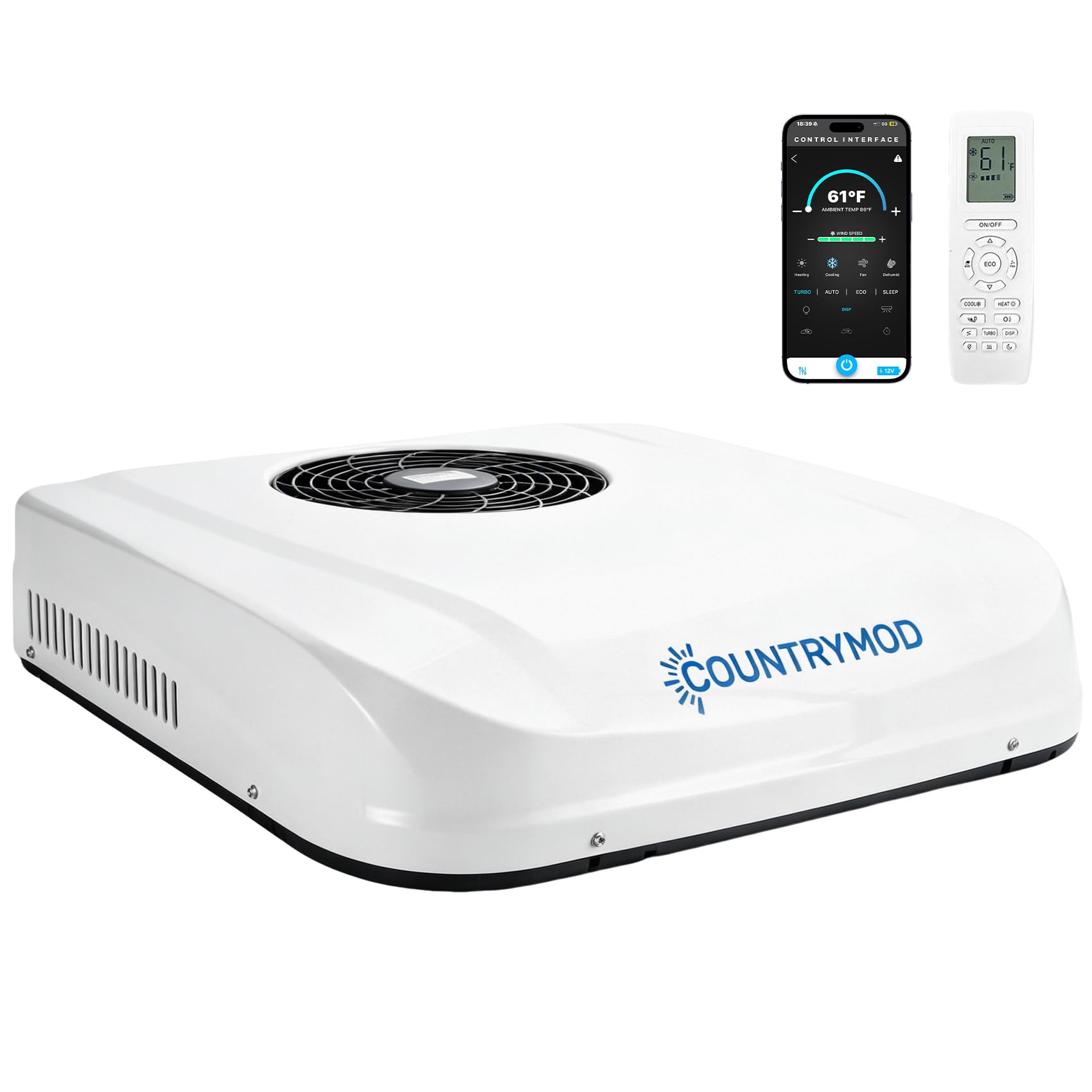
1. Countrymod 12V DC RV Air Conditioner 10,000 BTU
Our pick — 4.5★ from 80+ verified ratings; the strongest balance of quality and price.
The Countrymod uses an inverter compressor to adjust cooling output on demand, matching power use to the actual temperature.
This is the most premium roof-mounted unit of the three. It also delivers 10,000 BTU of cooling power, so it can handle the same size RV or camper as the Gidrox above. The big difference is the inverter technology — a variable-frequency compressor that smartly adjusts its speed so the unit only uses as much energy as needed to maintain the temperature you set. Instead of cycling on and off in bursts, it runs continuously at a lower level, which should mean more stable comfort and less wear on the compressor.
The evidence shows it uses more electricity overall: its annual energy consumption is 3,650 Watts compared to the Gidrox’s 2,930 Watts. The Countrymod therefore pulls more power from your battery over a full night. However, if you have a large battery bank — say 400Ah or bigger — and you value the smoothest possible temperature regulation, the inverter design is a genuine advantage. It comes with both a remote control and touch controls on the unit, plus an app for smartphone adjustment. Owners mention that the horizontal compressor design reduces vibration and keeps the center of gravity lower, which they say adds stability when driving on rough roads.
Installation is the same standard 14″ x 14″ roof vent cutout and requires no ductwork, so it fits a wide range of RV and camper models. The unit has a 4.5 out of 5 star rating from 88 reviews — the highest rating and count in this comparison — and that volume of buyer feedback gives more confidence in its real-world performance. The trade-off is clear: if maximum battery efficiency is your goal, the Gidrox is a smarter choice. If you want inverter-driven variable cooling and the confidence that comes with hundreds of positive reviews, the Countrymod is worth the extra power draw.
What Stands Out
- Inverter compressor adjusts cooling output automatically, keeping cabin temperature stable
- Highest rating of the three at 4.5 stars from 88 reviews — broad buyer confidence
- Horizontal compressor design reduces vibration and lowers the center of gravity for stability
- Operates at a low 45-55 dB, which buyers compare to a soft breeze
Battery Caveat
- Annual energy consumption of 3,650 Watts versus the Gidrox’s 2,930 Watts — more drain on your battery
- Not suitable for RVs with ducted systems — only works with standard direct vent openings
- Rooftop installation is not reversible without patching the roof hole
Best suited for: RV owners with a large battery bank who want the smoothest, most consistent cooling temperature and trust the highest-rated unit in the group.
May disappoint: vanlifers running a small battery who need every watt to stretch through the night — the Gidrox’s lower draw is a better match.
2. Gidrox 10,000 BTU 12V DC RV Air Conditioner with Heater
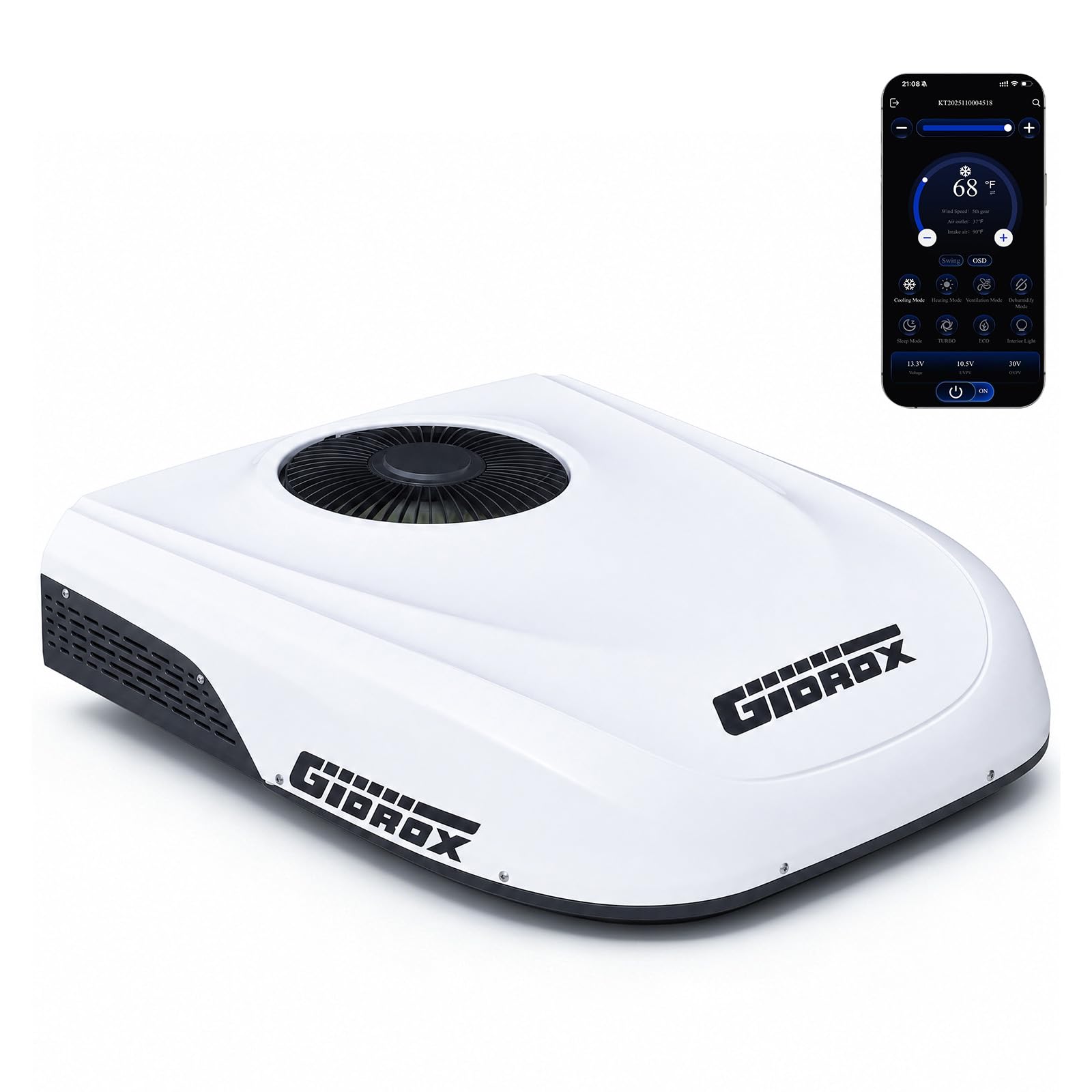
The Gidrox delivers full 10,000 BTU cooling at the lowest annual energy consumption in this comparison.
This roof-mounted unit is built for people who want all-night air conditioning without worrying about their battery giving out by morning. The maker claims the average power consumption is only about 350W during nighttime operation in 30°C ambient conditions, and pairing it with a 400Ah battery can support all-night use. Looking at the numbers, its annual energy consumption of 2,930 Watts versus the Countrymod unit’s 3,650 Watts — a meaningful gap when you are running off stored DC power in a van or camper.
It is also a heat pump, meaning it does not just cool — it warms you up too. Advanced PTC (Positive Temperature Coefficient) technology delivers instant heat even when it is below freezing outside, and you can switch to cooling in seconds. The unit has three operating modes: Turbo for rapid cooling or warming, ECO for energy-efficient operation, and Sleep mode where it drops to a library-quiet 40dB. Buyers report that the brushless fan and sound-insulation design make a real difference in how restful the cabin feels overnight.
Installation is straightforward. The unit fits a standard 14″ x 14″ roof cutout, weighs 52 lbs, and comes with a 19.7 ft power cable. You can control it via a smartphone app through Bluetooth, an infrared remote, or the physical buttons on the unit itself — so you can adjust the temperature without climbing out of bed. The form factor is rooftop, meaning it is a permanent install that frees up interior floor space, unlike a portable unit you have to stash somewhere. One potential trade-off: with a rating of 3.9 out of 5 stars from 16 reviews, early adopters suggest it is a solid unit, though the sample size is still small.
Why It Leads
- Lowest annual energy consumption at 2,930 Watts — significantly easier on battery banks
- Provides both cooling and heating; PTC heat works immediately in freezing weather
- Sleep mode runs at a very quiet 40dB for undisturbed rest
- Lightweight 52 lb rooftop unit with app, remote, and button control
What To Watch For
- Only 16 reviews on Amazon — long-term reliability is not yet proven at scale
- Requires a standard 14″ x 14″ roof opening and supports roof thicknesses between 1.5″ and 3.5″ (check your roof before buying)
- Rooftop installation is permanent — not for renters or drivers who swap vehicles
Reach for this if: you want the most battery-friendly 10,000 BTU rooftop unit that cools and heats, and you plan to stay put in one camper long-term.
Look elsewhere if: you need a portable unit you can move between a tent, car, and cabin — the Cybertake S2 Pro below is a better fit for that.
3. Cybertake S2 Pro Portable Camping Air Conditioner
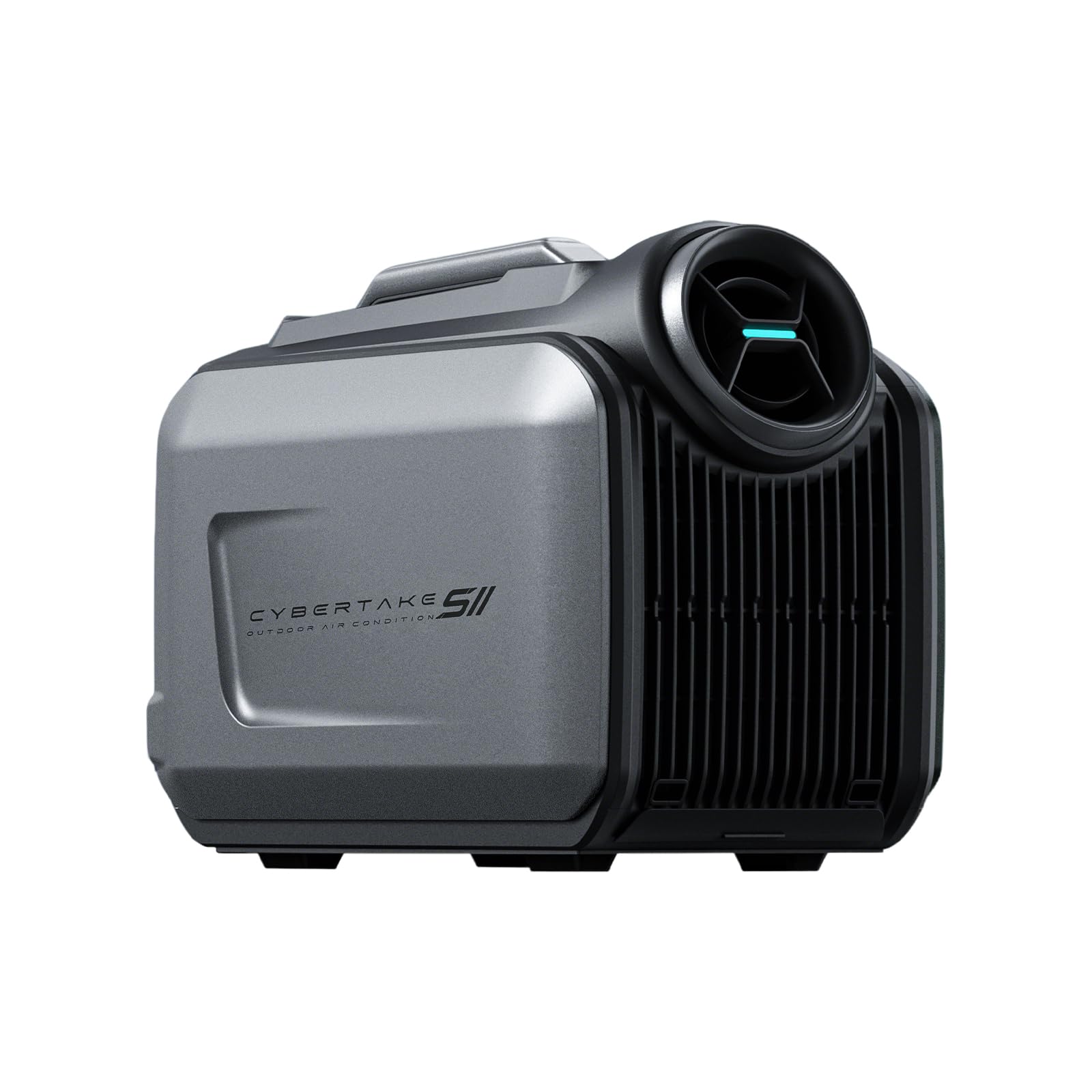
This portable unit covers spaces up to 130 square feet and adds 6,100 BTU of heating power for three-season use.
The Cybertake S2 Pro is the most versatile of the three because it is not bolted to your roof. It sits on the floor of your tent, RV, or cabin and vents out a window or opening. It has a cooling capacity of 5,100 BTU — compared to the 10,000 BTU of the two rooftop units above — and a heating capacity of 6,100 BTU. For a typical tent or small RV room up to 130 square feet, that is more than enough to keep you comfortable. The ambient operating range is 41°F to 113°F, so it works through summer heat and chilly nights alike.
Where it really shines is power flexibility. It runs on three different inputs: a standard 100-240V AC wall outlet, a 12V or 24V vehicle socket, and a 48V DC portable power station. That means you can use it at home, in your car, or off your solar battery bank — no inverter needed for the DC modes. The unit also has four operating modes: Cool, Heat, Dehumidify, and Eco+. In Eco+ mode, the maker says it uses as little as 1 kWh per 8 hours, which is very efficient for a portable AC. It runs at a whisper-quiet 40dB in its quietest mode, quieter than a dishwasher, so it will not disturb conversation or sleep. The shell has an IPX4 water-resistance rating, meaning it holds up against splashes and rain, and the silicone buttons are fully sealed.
Setup takes about 30 seconds — connect the included hoses and adapters and plug it in. Customers note that the Bluetooth app control and remote give you full access to the timer (0-12 hours), three fan speeds, and precise temperature settings. The one honest limitation: at 5,100 BTU, it cannot cool a full-size RV as effectively as the 10,000 BTU rooftop units — it is best for tents, small campers, and cabin bedrooms.
Why It Is The Value Pick
- Triple power input (AC 100-240V, DC 12V/24V, DC 48V) — works with almost any power source
- Both cooling and heating in one portable unit, covering 130 sq. ft.
- Eco+ mode uses roughly 1 kWh per 8 hours — efficient for overnight runs
- IPX4 water-resistant shell and sealed silicone buttons for outdoor durability
- Whisper-quiet 40dB operation and 30-second setup
Worth Knowing
- 5,100 BTU versus the 10,000 BTU rooftop units — insufficient for a large RV
- Portable form factor takes up floor space and needs window/vent access for the hose
- 48V DC operation requires a separate boost converter (not included), according to the maker
Grab this if: you need one air conditioner you can take from your tent to your car to your cabin, and you do not need to cool a large RV.
skip it if: you have a full-size RV that needs the full brute force of 10,000 BTU — stick with a rooftop unit like the Gidrox or Countrymod.
Understanding the Specs
BTU — Cooling Power Explained
BTU stands for British Thermal Unit — it measures how much heat an air conditioner can remove from a space in one hour. A higher BTU number means faster cooling in a larger area. For a small tent or roof-top camper, 5,100 BTU (like the Cybertake) is enough. For a full-size RV or camper van, you need 10,000 BTU (Gidrox and Countrymod) to keep the interior comfortable on a hot day.
Annual Energy Consumption — Battery Impact
This spec, listed in watts or kilowatt-hours, tells you how much electricity the unit uses over a year at typical usage. A lower number means less drain on your 12V battery bank. For overnight camping, a unit drawing 2,930 watts annually (Gidrox) will leave more reserve power in your battery than one drawing 3,650 watts (Countrymod). If you run a small battery, the low-draw unit can be the difference between sleeping cool all night or waking up to a dead battery.
FAQ
Can I run a 12V auto air conditioner off my car battery while driving?
Do I need an inverter to use a 12V rooftop AC?
How many BTU do I need for my camper van?
Will a 10,000 BTU rooftop air conditioner fit my RV?
How long will a 12V auto AC run on a 100Ah battery?
Can I use a portable auto AC in a tent?
What is an inverter compressor and why does it matter?
What is the difference between annual energy consumption in watts and kilowatt-hours?
Do I need a separate dehumidifier with a 12V auto AC?
Does a 12V auto air conditioner work in cold weather?
Final Thoughts: The Verdict
For the majority of shoppers, the 12v portable auto air conditioner winner is the Gidrox 10,000 BTU Rooftop Unit because it pairs full-size 10,000 BTU cooling with the lowest annual energy consumption in the group, making it the best choice for battery-powered overnight use. If you want an inverter-driven unit with variable-speed cooling and the highest buyer rating, grab the Countrymod 10,000 BTU. And for a flexible portable option you can move between a tent, car, and cabin — complete with both cooling and heating — the standout is the Cybertake S2 Pro.
How We Picked
We do not accept paid placement. Every pick is matched to a real buyer and a real use-case; we do not hands-on test units.
Sources & Methodology
Specifications: manufacturer listings and product documentation. Review insights: verified customer reviews, as of July 2026. Pricing: not shown on this page (it changes often); check the current price via the retailer link.
As an Amazon Associate, Gadgets Feed earns from qualifying purchases. This does not affect which products we feature.
Related Guides
Product prices and availability are accurate as of the date/time indicated and are subject to change. Any price and availability information displayed on Amazon at the time of purchase will apply to the purchase of this product. As an Amazon Associate I earn from qualifying purchases.
CERTAIN CONTENT THAT APPEARS ON THIS SITE COMES FROM AMAZON. THIS CONTENT IS PROVIDED "AS IS" AND IS SUBJECT TO CHANGE OR REMOVAL AT ANY TIME.
Amazon and the Amazon logo are trademarks of Amazon.com, Inc. or its affiliates.