
Our readers keep the lights on and my morning glass full of iced black tea. As an Amazon Associate, I earn from qualifying purchases.
Specs are compiled from manufacturer listings and verified buyer reviews and can change over time — please confirm the key details on the product page before buying.
You want to know how fast you are going, how far you have ridden, and whether you beat your last lap. A bike speedometer should answer those questions clearly on every ride without forcing you to fumble with your phone. The challenge is picking one that actually fits how you ride — not getting lost in specs that sound impressive but do nothing for you on the road.
I’m Min — the founder and writer behind Gadgets Feed. This guide is built by comparing the manufacturers’ published specifications and the patterns across verified customer reviews, so you get each pick’s real strengths and trade-offs instead of marketing spin.
We look at battery life, screen size, satellite accuracy, and sensor compatibility across seven models to help you find the right bike speedometer for your daily commute, weekend long ride, or serious training.
Our Picks at a Glance

How To Choose The Best Bike Speedometer
Picking the right bike speedometer depends on a few clear decisions. You need to know how long the battery lasts, whether the screen is easy to read in full sun, and if it connects to the sensors or apps you already use.
Battery Life Sets Your Range
A speedometer with a 16-hour battery might get you through a week of commutes, but it will die on a single century ride. Models with 25 to 40 hours let you ride all weekend without worrying about a charge. For daily use, even 16 hours works — just plug it in after a few rides.
Screen Size and Readability Matter in Motion
Larger displays (2.4 to 2.6 inches) show more data at a glance without squinting. A smaller 1.8-inch screen is fine for a few stats but gets crowded if you want speed, distance, cadence, and heart rate all visible at once. Look for auto backlight so you can see it in tunnels or night rides.
GPS Accuracy Depends on Satellite Support
Basic GPS-only units track your route, but models that also use multiple satellite systems (Beidou, GLONASS, GALILEO, QZSS) lock on faster and stay accurate in tree cover or city canyons. If you ride in dense urban areas or wooded trails, more satellites mean fewer dropouts.
Quick Comparison
| Model | Best For | Battery Life | Display Size | Weight | Amazon |
|---|---|---|---|---|---|
| COOSPO BC107★ Best Overall | Premium Value | — | 2.4 Inches | 0.14 Kilograms | $49.99Amazon |
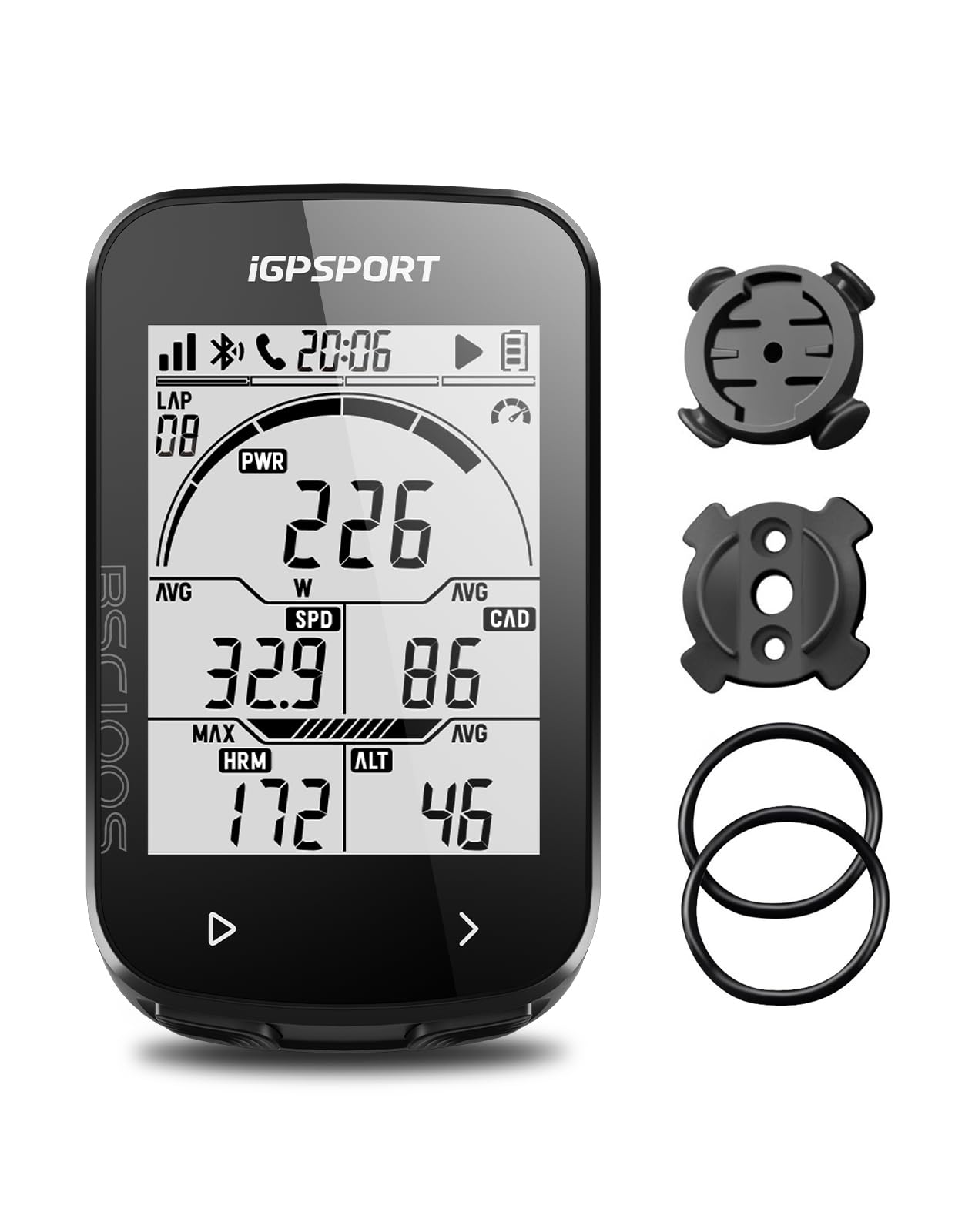
| iGPSPORT BSC100SAlso Great | Best Overall | 40 Hours | 2.6 Inches | 67 Grams | $37.95$39.99PrimeAmazon |
| Garmin Edge 540 | Serious Training | 26 Hours | 2.6 Inches (Color) | — | $324.49$349.99Amazon |
| Garmin Edge Explore 2 | Navigation Focus | 16 Hours | 3 Inches (Touch) | 0.17 Kilograms | $284.99$299.99Amazon |
| Bikevee GPS Computer | Budget Champion | 28 Hours | 2.4 Inches | 50 Grams | $35.99Amazon |
| COOSPO BC26 | Entry Level | 25 Hours | 2.3 Inches | 54 Grams | $25.89$36.99PrimeAmazon |
| XOSS G+ | Budget Pick | 25 Hours | 1.8 Inches | 101 Grams | $29.90Amazon |
In‑Depth Reviews
1. COOSPO BC107 Wireless GPS Cycling Computer
Our pick — over 4★ from 950+ verified ratings; the strongest balance of quality and price.
The COOSPO BC107 delivers a 2.4-inch display and ANT+ sensor support at a price that undercuts most rivals.
That 2.4-inch LCD has no wasted bezel space, and the glass-filled ABS and TPU chassis makes it both sturdy and light at 0.14 kilograms. GPS and Beidou dual positioning give you solid accuracy worldwide without the expensive multi-band hardware. The BC107 supports ANT+ sensors — heart rate monitors, speed and cadence sensors, and power meters — so you can build a full sensor suite over time. Bluetooth is used only for syncing with the CoospoRide app, not for sensors, which is a key difference from dual-protocol units like the iGPSPORT BSC100S.
The CoospoRide app handles device setup, GPS route tracking, activity recording, firmware updates, and syncing to Strava via.fit files. Reviewers highlight the straightforward mount and the IP67 waterproof rating that protects against dust and immersion. The main catch is you need to buy the extension long front mount separately if you prefer that setup.
If you want ANT+ sensor connectivity in a budget-friendly package, the BC107 is a smart pick. But note that Bluetooth sensor pairing is not supported here — so your sensors must be ANT+.
What It Does Well
- 2.4-inch display with compact, durable build
- ANT+ compatibility for heart rate, cadence, and power meters
- GPS and Beidou dual positioning for accurate tracking
Limitations
- No Bluetooth sensor pairing — ANT+ only for sensors
- Extension mount sold separately
Best suited for: riders who want ANT+ sensor connectivity and a clear display without a premium price tag.
Consider another if: you need Bluetooth sensor pairing or a larger battery than what is offered here.
2. iGPSPORT BSC100S GPS Bike Computer
The iGPSPORT BSC100S packs a massive 40-hour battery into a slim 67-gram body.
That 40-hour battery life gives you a 2.5x range over the Garmin Edge Explore 2, which tops out at 16 hours. So you can ride multiple long days in a row without hunting for a charger. The 2.6-inch anti-glare LCD screen is the same size as the premium Garmin Edge 540, but the iGPSPORT costs a fraction of the price. It supports five satellite positioning systems (GPS, Beidou, GLONASS, GALILEO, and QZSS), so the device locks on fast and stays accurate even under heavy tree cover. Buyers report the type-C charging port (though you need to supply the cable) cuts charge time noticeably compared to older micro-USB units.
For data lovers, the unit tracks over 40 metrics including speed, distance, grade, cadence, and calories. You pair it with ANT+ sensors like a heart rate monitor or cadence sensor through the iGPSPORT app, then sync rides to Strava or Komoot. The IPX7 rating means rain will not bother it. If you want the best battery-to-price ratio in this list, this is the one.
The catch is that the type-C cable is not in the box, and the rubber-band mount feels less secure than a twist-lock design.
Why It Leads
- 40-hour battery outlasts every other mid-range option
- 2.6-inch anti-glare screen is big and crisp
- Five satellite systems for fast, accurate GPS lock
Trade-Offs
- No type-C charging cable included
- Rubber band mount can feel wobbly on rough terrain
Reach for this if: you want a long-lasting, big-screen GPS computer that handles long rides and connects to ANT+ sensors without spending Garmin money.
Look elsewhere if: you need a color touchscreen with turn-by-turn maps for navigation.
3. Garmin Edge 540

The Garmin Edge 540 brings pro-grade training tools in a rugged button-controlled body.
If you train with power meters and heart rate monitors, the Edge 540 gives you features you cannot get elsewhere. The power guide recommends wattage targets through a specific course. The stamina tracker shows how much energy you have left during a ride. ClimbPro shows remaining ascent and grade on every climb, even without a pre-loaded route. Multi-band GNSS improves positioning accuracy in challenging environments like deep forests or beside tall buildings. The 2.6-inch color LCD runs for up to 26 hours in demanding use and up to 42 hours in battery saver mode, which puts it close to the iGPSPORT BSC100S on endurance.
Button controls mean you can operate it with gloves or in rain without the touchscreen fuss of the Edge Explore 2. The Edge 540 also gets daily suggested workouts that adapt based on your training load and recovery, making it feel like a personal coach on your handlebars. Reviewers consistently praise the map navigation and the ease of syncing routes from the Garmin Connect app. At 2.3 by 0.8 by 3.4 inches, it is compact enough for aero bars but readable at a glance.
The main trade-off is the premium price. You pay for the coaching and navigation smarts that casual riders might never use.
The Training Edge
- Power guide and stamina insights for serious riders
- Multi-band GNSS for accurate tracking in tough terrain
- Up to 42 hours in battery saver mode
The Cost
- Premium price for features many riders never need
- No touchscreen — buttons only
Get this when: you train with power meters, follow structured workouts, and want adaptive coaching without a phone.
skip it if: you just want speed and distance on a budget — you are paying for coaching you will not use.
4. Garmin Edge Explore 2

The Garmin Edge Explore 2 is the dedicated navigator with a glove-friendly 3-inch touchscreen.
Turn-by-turn directions on a large, sunlight-visible display make this the go-to for riders who explore unfamiliar roads. The touchscreen works with gloves and in rain, so you do not have to stop to poke at buttons. Preloaded road, off-road, and indoor activity profiles mean you can start a ride right from the start. The maps highlight popular roads and trails and let you search points of interest — useful when you need to find a coffee shop mid-ride. It is also compatible with eBikes, receiving navigation alerts based on your battery status and assist level.
When paired with your smartphone, LiveTrack lets friends follow your ride in real time, and the built-in incident detection sends your location to emergency contacts. At 0.17 kilograms, it is noticeably heavier than the COOSPO BC107 (0.14 kilograms), by 21%. Battery life of 16 hours is the lowest here — it will cover a long day but not a multi-day trip without a charge. Reviewers love the simple setup and map clarity, though some note the smaller battery is the price you pay for the larger color display.
The 16-hour battery is the main limitation if you want to use navigation on long rides day after day.
Why It Wins for Navigation
- Glove-friendly 3-inch color touchscreen with turn-by-turn maps
- eBike compatibility with battery-aware routing
- LiveTrack and incident detection for safety
The Battery Reality
- 16-hour battery is the shortest on this list
- Heavier than many competitors at 0.17 kg
Choose this for: exploring new routes with easy touchscreen navigation and safety tracking.
Not for: ultradistance riders who need more than 16 hours of battery per charge.
5. Bikevee GPS Speedometer Odometer
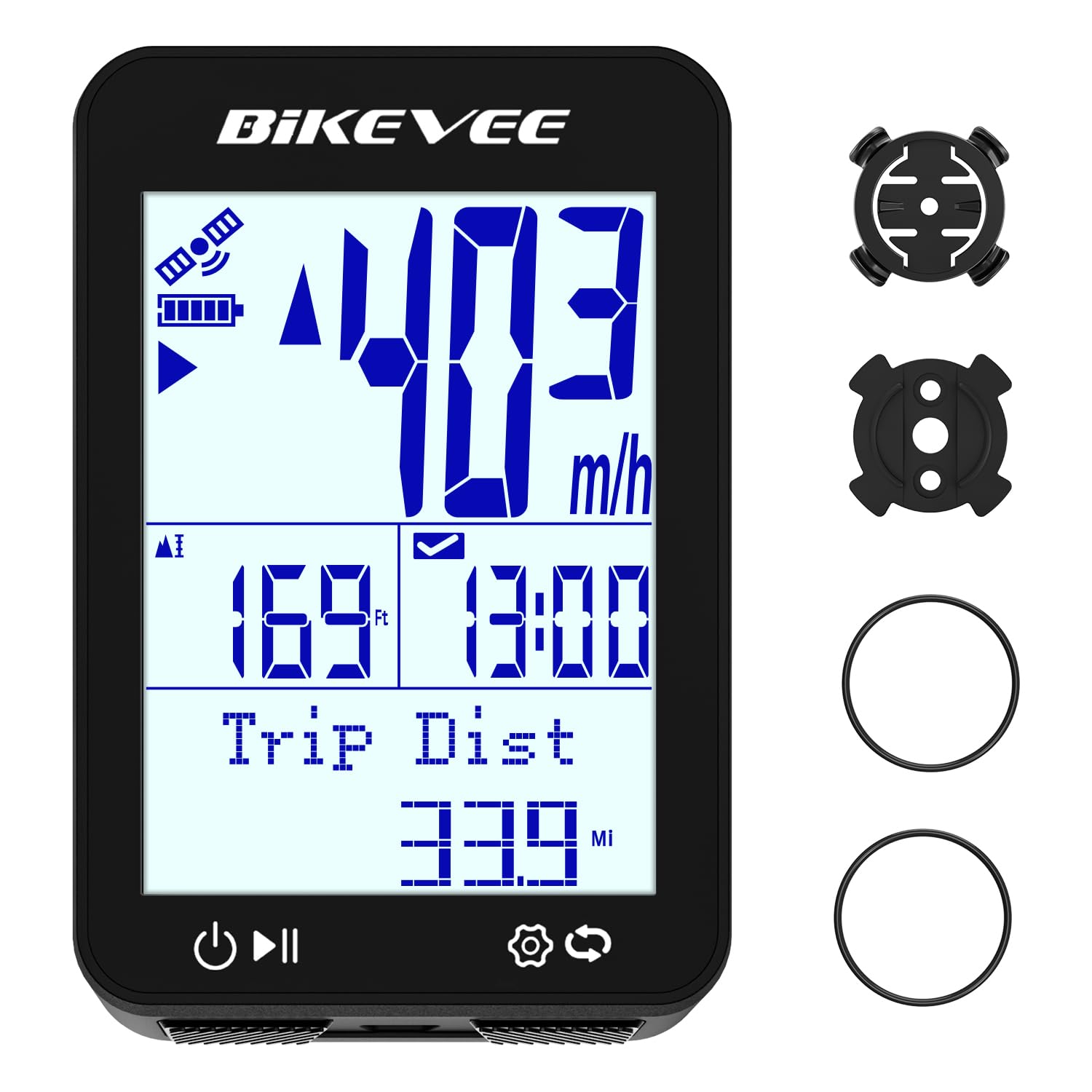
The Bikevee GPS speedometer packs a 28-hour battery and a USB-C port into a tiny 50-gram body.
At 50 grams, it is roughly half the weight of the XOSS G+ (101 grams), making it one of the lightest options here. The 2.4-inch LCD screen includes auto backlight, so you do not have to squint at dusk or in tunnels. Setup is truly wireless — no wheel magnets or complicated wiring. Just mount it, turn it on, and the GPS locks. The 650mAh rechargeable battery delivers up to 28 hours of continuous use, enough for a full week of commutes or a weekend adventure without recharging.
The unit tracks all the usual data: speed, distance, ride time, average and max speed, temperature, altitude, gradient, and ascent. It supports 9 languages including English, Deutsch, Français, and Italiano. The included USB-C charging cable is a welcome modern touch that most budget competitors skip. Reviewers mention the mount feels secure and the screen stays readable in direct sunlight. IPX7 waterproofing means rain will not shut it down.
The downside is that it does not connect to external sensors or apps. You get GPS data only, with no heart rate, cadence, or Strava sync. For basic speed and distance tracking, it is excellent.
Why It Stands Out
- Very light at 50 grams
- 28-hour battery with USB-C charging
- Simple wireless setup with no sensors or apps required
Missing Features
- No app connectivity or Strava sync
- No sensor pairing for heart rate or cadence
Ideal for: casual riders who want a featherweight GPS speedometer with long battery life and zero setup hassle.
Not for: anyone who wants to track heart rate, cadence, or sync rides to a training app.
6. COOSPO BC26 Cycling Computer

The COOSPO BC26 is a no-fuss GPS computer built for entry-level riders who want speed and distance without extras.
Designed specifically for entry-level users, the BC26 does not support pairing with external sensors. That keeps the price low and the setup simple — just charge it, mount it, and ride. The 2.3-inch segment code FSTN glass screen is sunlight-readable and includes auto backlight that turns on automatically in low light. Dual GPS positioning tracks your route accurately and syncs to the CoospoRide app over Bluetooth, where you can upload the.fit file to Strava.
Battery life is 25 hours in GPS mode, which is strong for the price point. It displays current, max, and average speed, total distance, trip distance, cycling time, and altitude. A max speed alarm warns you when you go over a threshold you set. Reviewers appreciate the straightforward app and the clear screen, though some note the lack of sensor support means you cannot track cadence or heart rate. The extension mount is not included and must be bought separately.
The BC26 is a clean, affordable GPS speedometer that does exactly what a new cyclist needs and nothing more.
Why New Riders Like It
- Simple setup — no sensors, no complex pairing
- 25-hour battery handles multiple long rides
- Sunlight-readable 2.3-inch display
What You Give Up
- No sensor support for cadence or heart rate
- No indoor riding mode
Perfect for: new cyclists who want GPS tracking and basic ride stats without spending extra on sensors or a complicated device.
Move on if: you already own ANT+ sensors or plan to add them later.
7. XOSS G+ GPS Bike Computer

The XOSS G+ brings heart rate and cadence sensor support to the budget tier with a 25-hour battery.
Unlike the COOSPO BC26 and the Bikevee unit, the XOSS G+ supports external sensors — you can pair a heart rate monitor and a cadence sensor (sold separately) via ANT+ or Bluetooth. That makes it a better fit for riders who want to ease into data tracking without a big investment. The 1.8-inch HD LCD screen is smaller than the 2.4-inch displays on the iGPSPORT BSC100S or the Bikevee unit, but it includes auto backlight for readability in low light. Battery life is 25 hours from the 500mAh rechargeable Li-ion battery, which is competitive for the price.
The XOSS app handles pairing, ride recording, and syncing to Strava. The unit is IPX7 waterproof, so a rain shower will not force you to cut your ride short. At 101 grams, the G+ is notably heavier than the Bikevee at 50 grams — essentially double the weight. Reviewers mention that the included mount and rubber bands hold the device securely even on gravel roads. The main caveat is the 1.8-inch screen feels small if you want to display many data fields at once.
The XOSS G+ is a capable budget speedometer that adds sensor support missing from other entry-level options.
Smart Value
- Supports heart rate and cadence sensors via ANT+/Bluetooth
- 25-hour battery for long weekend rides
- IPX7 waterproof for rainy rides
Compromises
- 1.8-inch screen is small for multiple data fields
- Heavier than many competitors at 101 grams
Go for this if: you are on a tight budget but want the option to add a heart rate or cadence sensor later.
Pass on it if: you want a larger screen or a lighter unit for racing or minimal weight.
Understanding the Specs
Battery Life
Battery life tells you how many hours you can ride before you need to recharge. A unit rated at 16 hours covers one long day, while 40 hours means multiple days of riding without hunting for an outlet. Battery capacity is measured in mAh (milliamp-hours) — higher numbers like 650mAh or 600mAh generally give longer runtimes, though display size and GPS frequency also affect actual endurance.
GPS and Multi-Satellite Positioning
GPS alone can be slow to lock and prone to drift under trees or near tall buildings. Units that also support Beidou, GLONASS, GALILEO, or QZSS lock onto more satellites at once, giving you faster acquisition and more accurate positioning. If you ride in cities, forests, or mountainous areas, look for a model that supports at least two satellite systems.
Display Size and Readability
Display size is measured diagonally in inches. A 2.6-inch screen lets you see several data fields — speed, distance, cadence, heart rate — without squinting. Smaller screens around 1.8 inches force you to scroll between screens to see the same information. Auto backlight is important for night or tunnel visibility, and anti-glare or sunlight-readable screens matter if you ride in direct sun.
Sensor Connectivity (ANT+ vs Bluetooth)
ANT+ and Bluetooth are two wireless protocols for connecting external sensors like heart rate straps, cadence sensors, or power meters. Some units support only ANT+ sensors, some only Bluetooth, and some support both. If you want to track your pedaling cadence or heart rate, make sure your speedometer is compatible with your sensor gear before buying.
FAQ
Do I need a bike speedometer if I already have a phone?
How long does a bike speedometer battery last?
Can I use a bike speedometer on an eBike?
What is the difference between ANT+ and Bluetooth on a speedometer?
Will a bike speedometer work indoors on a trainer?
How accurate is GPS on a bike speedometer?
Is IPX7 waterproof enough for heavy rain?
Can I sync my ride data to Strava?
What size screen do I need for a bike speedometer?
How do I mount a bike speedometer on my handlebars?
Final Thoughts: The Verdict
For most riders, the best bike speedometer is the iGPSPORT BSC100S because it combines a massive 40-hour battery, a large 2.6-inch display, and ANT+/Bluetooth sensor compatibility at a mid-range price. If you want serious training features like power guidance and adaptive workouts, grab the Garmin Edge 540. And for a featherlight budget option with a 28-hour battery and USB-C charging, the Bikevee GPS speedometer is tough to top.
How We Picked
We do not accept paid placement. Every pick is matched to a real buyer and a real use-case; we do not hands-on test units.
Sources & Methodology
Specifications: manufacturer listings and product documentation. Review insights: verified customer reviews, as of July 2026. Pricing: not shown on this page (it changes often); check the current price via the retailer link.
As an Amazon Associate, Gadgets Feed earns from qualifying purchases. This does not affect which products we feature.
Related Guides
Product prices and availability are accurate as of the date/time indicated and are subject to change. Any price and availability information displayed on Amazon at the time of purchase will apply to the purchase of this product. As an Amazon Associate I earn from qualifying purchases.
CERTAIN CONTENT THAT APPEARS ON THIS SITE COMES FROM AMAZON. THIS CONTENT IS PROVIDED "AS IS" AND IS SUBJECT TO CHANGE OR REMOVAL AT ANY TIME.
Amazon and the Amazon logo are trademarks of Amazon.com, Inc. or its affiliates.